
Showing posts sorted by relevance for query carol Drinkwater Irish childhood. Sort by date Show all posts

Thursday, 26 June 2025

Born Out of Wedlock, by Carol Drinkwater


I am a week away from publication of my latest novel, ONE SUMMER IN PROVENCE. 3rd July 2025. It is always an exciting as well as a nerve-racking time. 

A broad synopsis of what the novel is about: a British couple, Celia and Dominic, are living on a vineyard in the south of France. A vineyard that was inherited by Celia when her father died a decade earlier. Celia has decided to throw a huge summer party to celebrate the growing success she and her husband are making of their wine production. A few days before the big August bank holiday weekend when the party will be in full swing, Celia receives a forwarded letter from a man, David Hawksmith, who claims to be her son; the son she gave up at birth in 1977. David's existence is the outcome of a traumatic incident from Celia's past that she has never spoken about, not even to Dominic. Celia invites David to the party. Dominic graciously welcomes him (and David's unexpected and rather curious travelling companion) even though he has his doubts about the veracity of David's claims.

The book has elements of mystery but, ultimately, it is a story of  Betrayal and Belonging set against a backdrop of all the glorious ingredients - food, sunshine, scents etc - of living along the Mediterranean coast in the south of France. 

The Irish Times, in a recent Q and A, asked me whether the fact that I don't have children of my own had been the seed, the inspiration, for the novel. Giving up a child born out of wedlock is a very big issue in Ireland. Only two weeks ago, a dig began in search of the bodies of babies whose mothers were obliged to give up their "illegitimate" offspring during the last century.

https://news.sky.com/story/opening-the-pit-dig-for-remains-of-800-infants-at-former-mother-and-baby-home-in-ireland-begins-13384111?fbclid=IwY2xjawK8yglleHRuA2FlbQIxMQBicmlkETB5RzI4SXF3eFBab042VmNyAR7960m6fL8n0J55ru2FjHnpkPSRQPp9TKphdWrgRFnD2zV0qQ8HeqYtXUjj6A_aem__xN9uAsQA5bsM7CkprKizA

I have written a little about this subject before in one of my earlier History Girls blogs. Via the link below you will read that Ireland's right to abortion was not made legal until 2018.

http://the-history-girls.blogspot.com/search?q=carol+Drinkwater+Irish+childhood

Abortion was made legal in Britain on 27th October 1967, and came into effect on 27th April 1968. In theory, this means that Celia, the leading character in ONE SUMMER IN PROVENCE, could have legitimately terminated her pregnancy, but, for reasons  revealed in the novel, she did not.

The choices for young pregnant women before the late sixties in Britain were: a termination of the pregnancy (frequently a risky abortion, a backstreet illegal business), a hasty marriage, for some a shotgun wedding, or give up the child at birth for adoption.

In my novel, the young Celia gives birth to her son and, four days later, the child is taken from her for adoption. All she knows about the boy is the Christian name she has chosen for him, David.

Ghosts from the past. 

I am fascinated by secrets that step out of the shadows of our own lives and others' lives. The lives of those close to us. My mother was expecting me when she married my father in October 1947. I often joke about the fact that I was with them on their honeymoon in Devon. However, this was a fact I only discovered, by accident, when I was about ten or eleven. I found a stash of their honeymoon pics and calculated the dates! The subject had never been spoken about and when I confronted my parents with the question, they (both Catholics) were a little sheepish, but did not deny the fact. Why should they? I have, since that discovery, perceived my conception as one fired by love and passion. Would they have married if Mummy had not been pregnant with me? I believe they would, but who can say? The choice they made was to keep the baby, marry and start a family.

I love to be by the sea - I live overlooking the Mediterranean. I crave its rhythms and I have asked myself whether this has anything to do with the fact that my parents were happy on their honeymoon. A happiness that was tested in a relationship that was tumultuous even though they stayed together all their lives and my mother was deeply committed to her marriage. She loved my father loyally till the day he died, forty-six years later. Her face and her demeanour at his deathbed I will never forget. 

Now that both my parents are gone, I deeply regret all the questions I never asked. How did Mummy feel the moment she discovered she was pregnant; was she frightened, elated, guilty? What were the circumstances when she discussed her situation with Daddy? What was his response: "Let's get married, Phil" ... Was his willingness to tie the knot instantaneous? I know that they had been expecting a boy and had decided to Christian me Charles!

The morning the newly-weds, my parents, were boarding the luxurious Devon Belle train at Waterloo station heading to Ilfracombe in north Devon for their honeymoon, my father discovered that he had won the Football Pools. His win was the staggering sum of almost one hundred pounds. It was a fair fortune in those years of austerity after WWII. Mummy told me some years later that it felt as though their marriage had been blessed. It was all their wedding presents rolled into one. As an Irish country girl who had relocated to London during WWII to train as a nurse, she was far from home and her family. The wedding was a very quiet affair with only my father's brother and my mother's younger sister in attendance, as far as I am aware. 



The Devon Belle was a luxury passenger train which only began service in June 1947 so my parents would have been early travellers. I wonder, before his pools win, how my father, so soon home from life in the RAF entertaining the wartime troops in Africa, could have afforded to splash out on such a treat. But it does seem to suggest that he was celebrating their union, that he wanted to give my mother, pregnant with their first child, the best that was on offer. A luxurious and memorable debut to the life ahead of them together in post-war London.

Last week I was in London recording ONE SUMMER IN PROVENCE for audio. Reading the novel as an actress is quite another eye to when I am working on the text as a writer. This time, as I read, a period from my own teenage years came flooding back to me. Bromley in Kent, in England in the early 60s, a little earlier than my principal character, Celia's teenage years in a small provincial town outside Bristol. Without realising it, subconsciously, I must have taken from my own experiences of this era and interwoven it into Celia's story in the novel. 

When I was a late teenage girl, the battle to legalise abortion was underway. David Steel, Liberal MP, later leader of the Liberal Party, was responsible for introducing as a Private member's bill, the Abortion Act 1967. Fortunately, I had no need of the liberating results of this act once passed. Even so, as a teenage girl growing up, educated at a rather strict Irish convent, the waves of such a progressive bill would have been in the news and in debates all around me. As well, I must have had some awareness of the trials and terrors for young unmarried women who found themselves "in trouble" in the days before abortion was an available choice for them.

The episode that came flooding back to me as I was recording my novel last week was of a completely forgotten incident. It was the case of R., a girl in my class at the convent. We both would have been about fifteen at the time. R. discovered that she was pregnant. In our middle-class, Catholic-educated circles, this was completely unheard of and very shocking. How did R. deal with her situation? She said nothing, packed a bag and just disappeared. It was a scandal. Her parents, of course, were fraught with worry. I have a clear image of her mother and father paying a visit to our house one evening after school. We were all gathered in the sitting room, which in itself was rare. The white and gold-flecked three-piece suite was usually covered in dust sheets to keep it clean and protected from the light. The room was rarely used. Mummy kept it immaculate for "special occasions". Well, this must have been deemed a special occasion. I sat in a corner. Our guests remained standing. R.'s exceedingly tall mother was chain-smoking. (Smoking in Mummy's pristine sitting room!) She was clutching a small ashtray shaped like a shell in the palm of one hand. The reason for the gathering was information. "We need to hear what Carol knows about R. Her movements, her companions, before she fled." 

Or had she been kidnapped, abducted, murdered? Were any of these scenarios ever considered? I don't remember. Certainly the police had been called in and a search for R. had been set in motion. It wasn't known at this stage that R. had gone of her own volition nor that she was pregnant. I had no information to share with the grieving adults towering over me. R. had not confided in me - we weren't that close - and I had not overheard any chatter in the classrooms. I could shed no light on the crisis. R's mother was in tears as they exited our house. I felt so bad about their situation that I was almost inclined to run after them, invent a tale, but I knew better than to create false leads. 

It was at least another three weeks before R. was eventually tracked down, It was then her parents discovered that their daughter was pregnant. This was two or three years before David Steel's Abortion bill. R. was sent away somewhere unknown to me to give birth to the child who was then immediately handed over for adoption. My classmate never returned to the convent. She became a girl from our childhood whose story was not spoken aloud. Her parents split up, as I remember. Tragedy had befallen the family.

R. was a young woman shamed. From there on she and the "unsavoury business" was only spoken of in whispers.

What happened to R.'s child, her son? Did she and he ever make contact, did they find one another at some point later in their lives? I have no idea. I sincerely hope that there was some kind of happy ending to the tale.

In ONE SUMMER IN PROVENCE, Celia's son, David, contacts her out of the blue. A forty-seven-year-old man claiming to be the son she gave up at birth comes knocking, or rather, sends a letter requesting a meeting ... How does a mother respond? Invite the stranger into your life, welcome him as long lost kin ... Or deny his existence? Refuse to see him?

Earlier this year, I was honoured to be one of the two judges for the very prestigious Listowel Literary Festival's 'Kerry Group Irish Novel of the Year Award.'  Settling on our overall winner was very tough; the standard of fiction being published by Irish writers right now is mesmerisingly good. The prize went to Niall William's, Time of the Child. Williams' story is set during the season of Advent in the year of 1962 in a small (fictional) village over on the west coast of Ireland. An abandoned baby is found in the churchyard and taken in by the local doctor and his unmarried youngest daughter ... The prose is luminous and the story, compassionate and heart-wrenching.
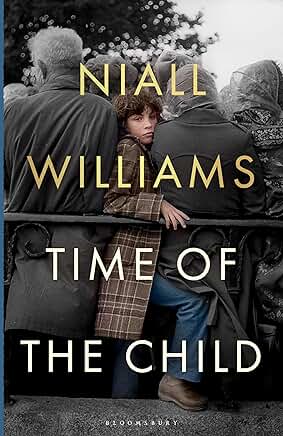


Coincidentally, having read fifty novels for the Kerry Prize, I am now reading another Irish novel, also delicately crafted. The Boy From the Sea from debut novelist, Garrett Carr. It is 1973. A baby is found in a barrel off the shore of a small coastal Atlantic town in Ireland. A local family adopts the boy ... Beautifully written, full of wry humour.


Every conception offers up the possibility of an untold story; a world of choices, of future bondings or terminations. Of aspirations and dreams dashed or built, of love washed up on unexpected shores. 

I beg to be forgiven for placing my novel on the same page as the very fine works of Williams and Carr. These are three very different stories. What they have in common is that each centres on the ripples and (tidal) waves caused by the arrival of a boy born out of wedlock. Interestingly, the other two are both written by male authors.

I hope you will enjoy ONE SUMMER IN PROVENCE. It is receiving some splendid feed back. It is a LoveReading Book of the Month for July. Available at all good bookstores and on Amazon etc. If you are outside the UK, Blackwells will have it in stock and they ship worldwide for free. Here is the link:

https://blackwells.co.uk/bookshop/product/One-Summer-in-Provence-by-Carol-Drinkwater/9781805462767


Have a wonderful summer. If you happen to be in Britain, Ireland or France during July, here, above, are a few of the events I will be talking at. It would be lovely to see you at one or other of them.

Enjoy your summer reading.

www.caroldrinkwater.com


Thursday, 29 December 2022

The Ireland of my Childhood, by Carol Drinkwater


Small Things Like These by the Irish novelist Claire Keegan is my Book of the Year. There have been several books especially by women authors that have 'spoken' to me but this one hit a deep chord. I am late to the party in the sense that this novel, published in 2021, has already been short-listed for the Booker Prize and won the Kerry Group Irish Novel of the Year Award  back in May. There have also been several other gongs for this haunting work including the Orwell prize. It is less than 100 pages in length, so little longer than a novella but it throws such a powerful punch, and its graceful writing has stayed with me, resonating, taking me back to my own Irish childhood, looking at many of my memories anew. 

The story is set late in the twentieth century in a small Irish town during a bitter December. Its principal character is Bill Furlong, a caring family man with five daughters who owns his own modest coal and timber business. A merchant of coal, anthracite, logs. These he delivers to his customers himself in his rather antiquated lorry. His yard is manned by a small crew of men who work for him. He is a kind boss and there are good vibes between them all.

Bill 'came from nothing'. He was born to a young woman, little more than a girl, who at the age of sixteen fell pregnant. She was a domestic servant in a big house on the outskirts of the town where Bill Furlong lives. The house was owned by a well-heeled Protestant woman, Mrs Wilson. Mrs Wilson took pity on the serving girl and did not dismiss her when she got pregnant. She kept her on and allowed her son to remain with her. Bill Furlong grew up on the estate, a happy child. He was never told the identity of his father who he assumed was possibly a gentlemen of some standing related in some way to the kind, widowed Mrs Wilson.

The novel takes place in the days leading up to Christmas in 1985. Bill is exceptionally busy with the orders,  his deliveries. These include a load of logs to the local convent. I don't want to give too much away of this marvellous story, but at the convent he discovers a girl locked in an outdoor coal shed. She is freezing, barely-clad, barefoot and traumatised. He is shocked by her presence there and by the condition of her. He releases her, leads her across to the main convent building and asks the nuns to take care of her. Little does he yet realise that it was the holy sisters who have locked the girl in the unheated shed. 

From the eighteenth century onwards, religious institutions in Ireland took in 'girls of ill-repute', 'prostitutes' and girls who had fallen pregnant outside the 'holy order of marriage'. The first home was founded by Protestants but soon they became predominantly Roman Catholic asylums run by religious sisters, nuns.  These institutions were known as laundries because that was how the convents paid their way, by taking in laundry. It was the girls, the single mothers, who did the work, the drudgery.

Many of their babies were sold to families who wanted children, both in Ireland and abroad. Over 9,000 babies died while in the convents' care.

The last of these laundries closed in 1996.

Inside a Magdalene Laundry, 
(photo courtesy of Wikimedia Commons (found on the internet)

The revelations that started to come out in 1993 about the treatment the girls and their babies suffered, kept under lock and key like prisoners, working till they could barely stand, is one of Ireland's most heart-rending modern scandals. It is believed that over 30,000 girls passed through these 'asylum' doors over the two centuries the houses were operating.

It was in 1993 when the Dublin-based Sisters of Our Lady of Charity sold off a portion of their land to a property developer that the scandal first came to light. When the land was dug up to begin construction work, more than one hundred bodies in unmarked graves were discovered. There were no death certificates, the deaths had never been registered, which was illegal. 

The bodies were exhumed and reburied in a mass grave.

This discovery led to the opening of an enquiry. It was all a great deal more horrific than anyone might have imagined, though both Church and State were aware of the existence of these homes. The tragedy continues today; many women are still looking for the bodies of their mothers, sisters, aunts etc.

Claire Keegan deals with the subject with great delicacy. Her touch is light, her words are powerful. She concentrates on one man, Bill, who was an illegitimate child himself but whose mother was shown kindness and was offered a home and shelter for herself and her baby. As a grown man with five daughters of his own in these days before Christmas, Bill looks back on his more fortunate past and considers the present and the young starving girl he has discovered in the coal shed.

The novel is not hard to read. Although it has been inspired by a harrowing chapter in Ireland's modern history, it does not bludgeon the reader with unpalatable details. It is rich in humanity and the power of ordinary love and courage. I highly recommend it.

Reading the novel set me thinking back to my own youth and my childhood in Ireland, in the fifties and sixties, and how little I knew or understood of what was going on.

I was born in London to an Irish Catholic mother and partially Irish Catholic father. I have always considered myself Irish rather than English. I am an Irish citizen and carry an Irish passport. Those early Irish days were, for the most part, the happiest ones of my childhood. However, it is perhaps fair to say that in some ways I romanticised my childhood in Ireland. I look back on those times as joyful, colourful, full of love with occasional recollections of harshness, which puzzled me at the time because I did not understand the roots of this behaviour.


My childhood was lived between school-term times in Kent in England where I attended a Catholic convent run by an order of nuns that had been founded near Lyon in France in 1675,  the Trinitarian Sisters of Valence. At our convent, they were ruled over by a fierce Irish Reverend Mother with a poker expression and mean thin lips. I was exceedingly unhappy there. We were educated to fear God, to recognise that we were born with the stain of original sin on our souls (hence our lifelong burden of guilt) and to be pure young girls in both mind and body. Compare this to the long leisurely holiday months which I spent in perfect harmony at my grandparents' and uncle's farm in rural Ireland. The excitement, for example, when a litter of pups was born. I watched on with wonder as the pups sucked milk from their mother's nipples. I was taught to milk cows, sitting on a tiny stool, squeezing and gently tugging with thumb and forefinger at the huge warm beast's udders. The smell of damp hay, the heat of the white liquid milk. Its odour. Nature and the seasons ruled. Life was about the earth, the rotation of crops, of harvests and planting, of birth and death. This was my mother's family home. She was born one village away where Protestants and Catholics lived and worked alongside one another in harmony.

I cannot remember the Irish Reverend Mother's name. I have erased it from my mind. No doubt because she so terrified and traumatised me, warning me that my father would rot in hell for his sins. The sleepless nights that caution caused me. I have never entirely recovered from it. For a short while at our convent in Kent, we had a French Reverend Mother, Genevieve, who I adored because she broke all the rules - 'serious' rules such as lifting up the skirts of her habit, revealing her black lace-up shoes and stockings and her trim ankles in order that she could more easily hare up and down the wooden staircases or hotfoot it along the corridors! I never saw her walk. Even though it was drummed into us girls on a daily basis that young ladies never run, they walk sedately with their heads held high as though carrying books on their head.

It was very sudden the replacement of Mother Genevieve. One day she was there, the next we were in the iron grip of the Irish ogre. It was whispered between us girls that Reverend Mother Genevieve had engaged in an illicit affair with the gardener, fell pregnant and was sent to Africa. I doubt there was a word of truth in this, but it brought simple amusement and a soupçon of naughtiness to our regimented  'holy-clean' days. 

A nun as a 'fallen woman' was a delight to us. She'd bucked the system, broken the rules.  We, innocent girls, who knew nothing of the existence of the Magdalene Laundries and the shame of unlawful pregnancies. (By the way, I was conceived out of wedlock, but it was a long time before I discovered this and what it implied. Did my grandparents ever learn this? I have no idea. I was certainly never judged or blamed for it, if they knew. You might think this odd, that the child of an "illegitimate" pregnancy might be punished, but they certainly were. Back to the Magdalene Laundries where the offspring were taken from their mothers and either sold or ... many child corpses were later found when the truth of what had been going on at these asylums was, literally, unearthed.

I was so unhappy at that convent in Kent. I loved learning but the convent was a prison in my mind. 

When I wasn't in Kent during the term times, I was in Ireland with my mother staying with family. She had an older sister in Dublin who was rather strict with me, insisting I kneel on the kitchen floor to say my prayers. 'You must say your penance,' she bid. She was very religious - or so I looked upon her back then. I knew nothing of her past. Only later did secrets come to light.

As well as Dublin, there was the modest family farm in County Laois, in the Midlands of Ireland. I loved it there. It was my bucolic heaven: the fields growing with acres of tall ripening wheat, the river with its salmon, the farm dogs and chickens and geese all foraging in the yard beneath endless lines of washing billowing in the wind. My plump grandmother adored me. She'd cackle and pull me up onto her lap. She smelt of potatoes, peat, grass and carbolic soap. She had a few wisps of hair on her face which I found a bit scary, witch-like, but she was kind as kind to me. My gentle-natured grandfather was as thin as his wife was rotund. They adored each other. I never heard a cross word in that small farmhouse, unlike our family home in Kent, which was forever ringing with the sound of angry voices. 

I knew nothing of my grandparents' love story back then: how they had run away together when she was twenty and he eighteen. She, the daughter of not quite landed gentry but comfortably-off land-owning parents. He, hardly yet a man, the labourer employed by my granny's parents.  My grandparents, the young lovers, (still unmarried at the time?) crossed counties from Kilkenny to be free of the family wrath. The pair ended up in Laois where they spent their entire lives, dying within eleven months of one another. Granny was cut off by her family. Any financial assistance marriage might have brought her was denied to her and her beloved. 

I believe her parents did at some point forgive her. I don't know when.  I never met them and know very little about granny's side of the family. What I know is that my grandparents tale was a happy one, bolstered by love, courage and the choices they had freely made for one another, even though they had a hard life financially and must have been judged when young as an 'immoral' couple.

The Ireland of my childhood (fifties, early sixties) was a very different island to the foreword-looking republic it is today. It lived in the long dark shadow of the Catholic church and, though politically unshackled from British rule, the British Monarchy still had a say in the running of the state, until as late as 1949. The Republic of Ireland only became a fully independent state in 1949 with the passing of the Republic of Ireland Act.


In 1960, Penguin Books published an unexpurgated edition of D. H. Lawrence's Lady Chatterley's Lover. It was immediately banned for obscenity. Penguin fought the case. The obscenity trial lasted six days at the Old Bailey. The jury found the novel to be Not Obscene. Penguin won. The book was not only a sensation but it became an overnight bestseller.  More importantly, it was a watershed decision for both literature and society. 

I was eleven or twelve at this time, an adolescent but still very much a naive girl. 

As the British poet Philip Larkin wrote in the opening lines of his poem Annus Mirabilis

"Sexual intercourse began

In nineteen sixty-three

(which was rather late for me) -

Between the end of the "Chatterley" ban

And the Beatles' first LP"

After the Lady Chatterly trial and as the Beatles were emerging, according to Larkin, Britain was waking up to sex and the liberation of the written descriptions of it. The birth pill came on the market at the beginning of 1964 and that brought a new freedom for young women. Sex and babies, as the late bestselling author Fay Weldon pointed out, were no longer intrinsically linked.

The Brits were dancing and singing, reading about and having sex ("doing it", as the Irish might have said). In the US, the Hippie generation was rolling out the sexual revolution. Free Love. Make Love Not War (the Vietnam War). While in Ireland, the Catholic church continued to keep its vice-like grip on the nation's morals. Birth control, the sale and import of contraceptives, was illegal in the Republic until February 1979 when, with a highly-controversial vote, the Irish government defied the Catholic Church and approved the sale of contraceptives. Even so, access was very limited. One needed a prescription from a practicing doctor.

I have a cousin who, to all intents and purposes, did not exist back in the 60s, in spite of the fact that he is ten years my senior.  No one knew about him or if they did they were keeping silent. The acknowledgement of his existence might have broken up at least one branch of our family. How many in our clan ever found out about him or acknowledged him, I don't know. He was born in a convent in Dublin and later adopted. The circumstances are not discussed. Most of those involved have died now. I am in touch with him. He is a senior citizen today, partially broken by all that he lived through.

It was not until 25th May 2018, that abortion was made legal in the Republic. I remember the powerful emotions so many of us felt when, from all over the world, thousands of women flew home to vote. I even read that some loaned others the money to pay for their air ticket. The hashtag  #hometovote became famous. The Irish diaspora mobilised itself with such a force that it felt to me, as I witnessed what was happening, that two centuries of pain and subjection was being rightfully overturned.

The law - the repeal of the 8th amendment, which had kept abortion illegal for so long - was overwhelmingly overturned. It was a watershed moment for men and women, for everyone in Ireland.

When the results were announced, I broke down. I wept for my mother who had so recently died, for her generation, those before her and those who came after (my own generation). I wept for my aunts and their offspring both known and unknown, my cousins and other loved ones, for all these innocent women's young lives lived, for some of them, shrouded in secrecy. In fact, I wept for all women, living or dead, who had been held in shame, some imprisoned in these convents, punished for acts that were born of love, passion, ignorance, or rape ... For every woman who was obliged to travel beyond the frontiers of the Republic to obtain the healthcare, the assistance, she needed, which should have been available to her in her homeland.

I am delighted that Claire Keegan's novel has sparked so many emotions, exchanges, both outside Ireland and within the Republic. A short beautiful novel that has unpeeled layers of hidden pain and misjustices and shown us the power of love and courage.

Let us celebrate the power of the written word.

In the meantime, I hope you receive many books for Christmas. I wish you a wonderful 2023.

www.caroldrinkwater.com


Tuesday, 26 July 2016

Favourite hideaways of mine in Ireland, by Carol Drinkwater

 I have just returned from a memorable trip to Ireland - my semi-adopted homeland because I was actually born in London. My recently-departed mother and all her family were born and bred in County Laios, set in the Midlands of Ireland. The farm her parents spent their hardworking lives running is still in the family and belongs now to two of my cousins. They were a struggling, hardworking Catholic family.
Until 1922, when the Irish Free State came into existence and British rule over Ireland was drawing to its bitter close, Laois was known as Queen's County (a nod to British monarchy).
My mother used to recount to me many stories of local Protestants helping the Catholics and vice-versa (lending one another tractors, or a gallon or two of petrol when rationing during the WWII badly hit their agricultural way of life even though Ireland had chosen a neutral position). She told me that the families of the two faiths lived alongside one another in peace. Of course, this wasn't always the case.

Like most counties in Ireland, Laois has its fair share of grand Georgian or Regency properties built by the Protestant British when they were the landlords of the island while the tenants or farm workers were the less privileged Catholics. 
Ballyfin, considered the most lavish Regency house in Ireland, is an example. It was built in the 1820s on the site of previous luxury manor houses, by Sir Charles Coote and his wife Carolyn. It stayed in the Coote family until the 1920s when it was bought by the Patrician Brothers, a Roman Catholic teaching order. At this stage, Ireland was taking back its independence from the British and the brothers ran Ballyfin as a school right through to the twentieth-first century. In 2002, a decline in vocations, less brothers to run the school, forced them to sell the estate on.
Today, after nine years of restoration by its present owners, a couple from Chicago with Irish connections, it has been transformed into a sumptuous five-star hotel, Ballyfin Demesne, set in some 600 acres of manicured gardens. 
If your budget can run to even a cup of tea there - room rates start from around 850 euros a night - it is worth visiting just to get a sense of its splendour and to imbibe the stories and ghosts from its past. If I were to covet any of it with Big House envy, it would be its magnificent conservatory.

                                                           Ballyfin Regency Manor House

The history of Laois reaches back at least 8,000 years, to pre-Neolithic times when tribes of hunters roamed the forests in search of nuts and berries to supplement their diets. There are several sites and monuments that bear witness to the history of this region from Neolithic times to modern days, and it is claimed that Christianity came to Laois even before Saint Patrick arrived there.
I spent two or three days in the neighbourhood paying tribute to my mother, leaving a lock of her hair at my  grandparents' grave to reunite her with her family and the place of her birth.

We stayed in Offaly at Gloster House, a Georgian mansion built for the Lloyd family in the 1720s.
This house, with a 1960s convent stuck onto its rear, was sold to its present owners, Tom and Mary Alexander in 2001. It was a purchase of love, no doubt about it. The nuns who had run the place as a rest home for rich elderly women and a school in the convent addition at the back had, through lack of funds, allowed the property to fall into a very sorry state of disrepair. I know this first hand because my mother and I took the gate lodge in 2005 as a rental and over the years we became friends with the present owners. We have witnessed the painstaking renovations undertaken. Today, Gloster is both a stunning private residence and can be booked for wedding and birthday events. If you are looking for a location for a very special occasion, I cannot recommend Gloster highly enough. 


                                           Gloster House - Photo taken last week by my husband, Michel Noll

Here is a piece I wrote for my website earlier this year. 


           A view of the Slieve Bloom Mountains in Laois where I spent many blissful childhood days 

From Laois and Offaly, we turned southwest to the coast, to Bantry Bay, a picturesque stop along the Wild Atlantic Way.

As I write, this year's West Cork Literary Festival is drawing to its close. I was the first event of the 2016 festival. It was held in the library of magnificent Bantry House overlooking Bantry Bay in West Cork, and I am thrilled to say it was a sold-out event. On Tuesday morning I did a smaller event in the tea rooms at Bantry House. Bantry is also a country house I know quite well. My first stay there was, again with my mother, for my first visit to the West Cork Lit Fest. It rained - 'lashed', as we say in Ireland - from the moment we drove into the fishing town till our departure. Again, my event was at the great house. On that occasion we were also staying in the elegant annexe area the Shelswell-White family use for bed and breakfasts. Mrs Brigitte Shelswell-White was so welcoming, lending us two of her Burberry raincoats (bought in charity shops, she assured us) and wellies, showing us into the private areas of the house, that I have been marked by this place, that visit ever since.
Here is a 'snapshot' history of this property: http://www.bantryhouse.com/bantryhouse/visit-2/history/
Egerton-Shelswell-White, Brigitte's late husband, a much-loved patron of the arts in West Cork, was the eight generation of his family to reside at Bantry. Since his death in 2013, one of his children, of which there are six, Sophie, has taken over the responsibility of management of the estate. No mean feat.
The family continues to host events for both the West Cork Chamber Music Festival and the West Cork Literary festival.


Eimear O'Herlihy, Festival Director, (standing) introducing me. To my left (right as you look at the pic) is Elizabeth Rose Murray who hosted my first event. Elizabeth is also a writer and was appearing at the festival later in the week for her own events.

Here is the jacket of THE HUNGER, a historical novel I wrote for adolescents. It is set in Ireland during the 1845-1849 Irish Potato Famine, published by Scholastic Books

My latest, THE FORGOTTEN SUMMER (the novel I was in Bantry to read from and talk about), is a Summer Special on Kindle e-books. A GREAT deal at £1.99

Or if you prefer to wait, THE FORGOTTEN SUMMER will be published in paperback on 8th September in UK. In Ireland it was published last week


Thursday, 28 December 2023

One Day in Dublin, by Carol Drinkwater


Due to Covid and work restraints, I hadn't been back home to Ireland since the beginning of the pandemic. It meant that my trip planned for late November of this year (2023) was intended to be a special one. I was excited about it. I was planning to spend a few days alone in the capital to walk the city, visit outlying suburbs, to take a look, from the exterior at least, of the house where my late aunt had lived, as well as various other places from my childhood where I had spent time with my mother and other members of the family. This was before hiring a car to drive south to the Midland region, which includes the counties of Laois and Offaly, where several members of my family still live on the 'McCormack farm', close to where my mother was born and where so many wonderful memories from my childhood had unfolded.


Added to the list of these plans, there was something else I wanted to investigate. A quest which I have left almost too long. The identity, destiny, of a family member who had taken part in the Easter Uprising of 1916. 

I booked a room at the Gresham Hotel in O'Connell Street, on the north side of the city. As a rule I stay south but decided on the Gresham because, as a child, my mother had occasionally taken me there for tea, and more importantly, it was only a few steps from the General Post Office, one of the main locations for the 1916 Easter Uprising. Staying in O'Connell Street fitted with my plan. The Gresham itself is also a building of historic interest, situated in one of the city's most important thoroughfares. Two Georgian houses at 21-22 Sackville Street (now O'Connell Street) were bought by an Englishman, Thomas Gresham, who opened them in 1817 as an elegant lodging house, mostly for aristocrats and their families. 
Today, the Gresham is a Dublin city landmark and still retains the name of its founder. Thomas Gresham was an abandoned baby found on the steps of London's Royal Exchange. He was named after Sir Thomas Gresham, a merchant, politician and the founder of the Royal Exchange. 

The Gresham was burnt down during the Irish Civil War (June 1922 -  May 1923), but was rebuilt in 1926 and reopened in 1927. 


I found this postcard for sale on Amazon. A photo of the rebuilt Gresham Hotel posted in 1931 to an address in. Detroit.

My date of arrival was Thursday 23rd November. I was scheduled to land in Dublin on a late afternoon flight from Paris at around 5 pm. The horrors that I was to encounter later that day were triggered by a series of rather ghastly stabbings that took place at around 1.30 pm Irish time in Parnell Square East, north Dublin outside a primary school. The perpetrator, it was later announced, was Algerian. 
At that time, I was en route to Charles de Gaulle airport, blithely unaware of any stabbings or what was to follow once the news of the attacks had been made public.

The city riots began with an anti-immigrant protest. Unfortunately, the protests soon got out of control and grew violent.  I was in the plane and ignorant of what was unfolding. No announcement warned us passengers of the destruction, the looting and vandalism. It was not until I landed that I realised something was amiss. Outside the airport, there were several hundred people waiting for taxis to transport them to the city centre or other destinations. I had never seen such disorder there before. Even queuing at the airport, during my eighty-minute wait for a taxi, no one seemed to know what was causing the chaos and the lack of transport. It was my taxi driver when I finally managed to nab one, who at first refused to drive me to the Gresham Hotel declaring it to be dangerous, began to recount to me as he moved slowly towards the city, what was going on. He warned me that O'Connell Street, which is where the Gresham is situated, was barricaded off as was its neighbour, Parnell Street. 
'Why?' I asked bemused.
Three children had been stabbed and were seriously injured. An adult woman too, who was a carer and had tried to protect the children, had also been assaulted. They were being treated in hospital. At least one of them, a five-year old, was in intensive care, he explained. The assailant was not Irish; he was a foreigner residing in Dublin. An immigrant. It was this, the fact that he was a foreigner, that had unleashed the anger and the ensuing riots. Anti-immigrant agitators had taken to the city centre streets and to social media calling on others to join them, to swell the raging crowds shouting 'Ireland for the Irish'. Their messages vastly inflated the details, stating that the children were dead, (none have died), that the attacker was an illegal immigrant. He has lived in Ireland for twenty years and became an Irish citizen in 2014.  Demonstrators and hooligans carrying metal bars, some wearing balaclavas and hoods, letting off flares and fireworks, began to set light to cars, damage public transport, loot shops and to attack the police. Egging one another on, some were shouting, 'kill all foreigners', 'kill anyone you come across'. 
By this time Gardai were being bussed in from across the counties.
Public transport was suspended, which left many people stranded, caught up in the insanity with no means of reaching their homes. This, of course, added to the mayhem. It also explained why it had been almost impossible to get a taxi at the airport.

My driver dropped me a block away from the Gresham, by which time it was almost nine pm. I had been expecting to be in town around 6 pm. My driver, an Englishman who had relocated to Dublin a decade earlier because 'life is so much kinder here', apologised profusely for the fact that I would have to walk the rest of the way. 'A matter of a few hundred yards, not far.' A burly red-haired garda came to interrogate me. Only when he was satisfied that I was intending no trouble and there was nothing dangerous in my hand luggage, did he let me pass the barricade, warning me to 'mind yerself now'. As I turned onto O'Connell Street, my heart beating fast, the hot bright light hit me. It was a freezing evening, especially after my long queue, but I was taken aback by the light, the remaining flames. Further south towards the bridge, a bus had been set alight. Elsewhere a Luas train was also on fire. The street about me was littered with upturned chairs, broken bottles, sheets of glass from smashed shops and hotel windows. The air hung with an acrid smell. Petrol? Burning rubber? A few people, not many because they had been forced out of the danger area or arrested, were running to and fro. It was like a war zone. Gardai everywhere. I hurried to the Gresham and after brief questioning I was welcomed inside but warned that it was best if I didn't venture out again. I checked into my room and then descended to the bar, which was packed with local people taking refuge or hotel guests who, like me, had found themselves caught up in the fray. Everyone was in a state of shock, talking loudly. Someone was crying. I drank a glass of red wine, sat for a while watching people, taking on board what I had witnessed, the impact of it all, and then reluctantly took the lift to my room. The writer in me was urging me to go out onto the streets and investigate the situation further, get the fuller story, but the other Carol warned me off such a precarious adventure. By now, it was close to eleven pm. I switched on the hotel television and caught up on the news.

People watching the burning bus in O'Connell Street, Thursday 23rd November 2023


I have taken these images from the internet. No copyright is attached to them so my apologies for not acknowledging the owners of the images. Thank you for their use.

On the morning of 24th, I set out to investigate the city. In spite of a restless night, I was up and out reasonably early so the streets were relatively deserted. Little had been cleaned up. First I walked to Parnell Street where a Luas train was parked, obviously abandoned the previous evening, many of its windows had been smashed, seat upholstery ripped, but as far as I could see, it had not been scorched. Quite a few of the shops had been looted. I walked for possibly three or four hours roaming side streets and the main northern centre which mostly seemed down at heel, shabby. I went into Chapters Bookshop in Parnell, always a welcoming address, signed a couple of books and talked to one of the members of staff who told me that they would be closing early, at 3pm, to get the staff home safely before any possible further attacks took place. A demonstration had been announced for 4 pm. 
The bookseller thought it was to be an Anti Anti-Immigration Demo.
I crossed the Liffey River and made my way to the lovely Regency building that is The Clarence Hotel,  (once partly owned by Bono and Edge of the rock band U2), situated on the waterfront in Temple Bar. 
I have stayed many times at the Clarence, many times with my late mother too. She loved this hotel. Since my last visit there, the U2 musicians had sold their shares and the place has been refurbished. It is still elegant and trendy. The restaurant, where I have dined with my mum so many times in the past, was closed - it was still early, around noon - so I went to the lounge/bar. I ordered a cup of coffee and began to scribble notes on all that I had witnessed over the course of the morning. The manager of the hotel came over to say hello and welcome me back. I apologised that I wasn't staying there this time. It made no difference to the warmth of his greeting. When I told him I was at the Gresham, he shook his head. 'Good hotel but wrong location right now.' 
He himself had been working till five in the morning, he said, and 'back in again first thing'. He had been ferrying his staff home. No public transport meant the members of his team had no means of getting to anywhere in the city or the suburbs. But for his generosity, they would have been stranded. 
 'Almost all the staff here are immigrants,' he explained. 'These riots are not in my name, not in any of our names here. Ireland is an inclusive country.'
I was heartened by his kindness and his loyalty to so many who were from abroad working in Ireland and, as he described it, 'holding up the hospitality business'. As I shook his hand, promising to see him next time I was in the city, he warned me to get back to my hotel before dark. 'It could get nasty again.'
I spent that afternoon at the Irish Film Institute in Eustace Street in Temple Bar, and in various bookshops, not wishing to venture too far. I never reached Grafton Street that day, nor any of the other haunts I had written down on my memory trip list.  I decided to cut short my stay and go home to France. I will return to Ireland in the spring when it will be warmer and, hopefully, calm.

Before settling back at the Gresham, as the daylight was fading, I lingered outside the General Post Office, another historic landmark on O'Connell Street. Opened on this site in 1818, when O'Connell was still Sackville Street, this extraordinarily impressive building had served as the headquarters for the leaders of the 1916 Uprising. It was also burned down in the early twentieth century following the failed Uprising. It was rebuilt and then re-opened in 1929. 
I smiled. I speak barely a word of Irish except for a few prayers and the fact that my mother always insisted for some reason unknown to me that I should be able to say 'post office' in Irish:  Oifig an Phoist
I muttered it again then.

Alongside visits to my family over the upcoming days,  my quest had been to try to find out about the role of a relative - my great uncle? - in the 1916 Easter Uprising. Since a child, I had heard talk/whispers within the family of this relative, someone connected to my mother's father, my maternal grandfather - a brother? -  who I vaguely recalled had died in the Uprising. I had never gleaned the facts. This trip had been to learn something about this long disappeared relative. To me, a mythical family hero. Or perhaps not.
General Post Office, O'Connell Street

What part had he played, if at all, in the Easter Uprising, the Rebellion? I don't know. Aside from the family name of McCormack, I am not even sure of his identity. The Uprising was an insurrection that took place during Easter Week in Dublin in 1916. Republicans were fighting against British Rule. Their aim was to establish Irish Independence, an Irish Republic, and to force the British out, once and for all out of Ireland. Alas, the Easter Uprising did not succeed. After a week of fighting and too many deaths on both sides the insurrectionists surrendered.  Fourteen of their leaders were executed in Kilmainham Gaol. The executions were carried out over several days by firing squads at dawn. The bodies were then transported to Arbour Hill Cemetery for burial. (None carried the surname McCormack).


The green flag was flown over the General Post Office during the Uprising. Alas, it didn't get to stay there long. 


Few of my family who might be able to enlighten me about this unknown relative are still living. When I was younger, it had not seemed to be so important to discover the veracity of this tale. Now it does. 

I turned my head and glanced up and down O'Connell Street. Clusters of police had been gathering while I had been standing outside the Post Office, reflecting. They were present in significant numbers now. Expecting further trouble? What about the demonstration? I saw no signs of it here. A few pedestrians were walking the length of the thoroughfare, staring at the remains of the detritus still lying about from the previous day's rioting. I began to step slowly northwards to my hotel, passing by a circle of half a dozen Gardai on my way. A bullet-headed man in a crumpled jacket appeared from out of nowhere, from a shop doorway or side street to my right and skidded to a halt almost in front of me. He directed himself to the police standing in the centre of the street, shouting something, and then he spat. I was taken back, and shuffled to my right. One of the gardai swung to face him and yelled at him to go home, to cause no trouble. This incited the fellow who was dead set on a fight, it seemed. He began to cuss foully. Both men were well built, like a pair of rocks head on to one another, and they were but an arm's length from me. The garda was now at the shoulder of the shouting fellow. His arm was raised. The man turned south, the garda followed hard on his heels, both were shouting, arguing. I steered by them and speeded up my step. 
I felt profoundly sad. 

Because I don't live permanently in Ireland, because Ireland is for me an island mostly of memories both recent and distant, of family members dearly loved, many of whom have since passed on or I have lost contact with, I recognise that I have, or had, carried a romanticised perception of the country which is why these two days shocked me to my core. It is a fact that there is now a small but vocal extreme-right faction who have tainted the image of this peace-loving, welcoming nation. President Michael D Higgins, who for me epitomises much that is warm and intelligent about the Irish people, said in his speech after the stabbings: "This appalling incident is a matter for the Gardai and that it would be used or abused by groups with an agenda that attacks the principle of social inclusion is reprehensible and deserves condemnation by all those who believe in the rule of law and democracy."

Yes, indeed.

I was back in the Gresham by seven pm. There were no further incidents of violence reported. I left the following morning for France where I have made my home for thirty-seven years. I am also a foreigner living abroad!  All being well, I'll be back to Ireland in the spring of 2024, my quest not forgotten. 

Here in France we have Marine Le Pen and her supporterss to contend with, a worryingly larger faction than Ireland's extreme right. Europe has known refugees, immigrants, for centuries. Making room for the others is not easy. The principle of social inclusion can be challenging especially for those who have little to share although in my experience it is frequently those with little who share the more readily. 
Imagine though, for example, if the young nations of America and Canada had rejected the boatloads of Irish immigrants who were seeking refuge from famine and oppression ...

My most recently published novel, An Act of Love, is the story of a Polish Jewish girl, a young woman on the brink of adulthood, taking refuge with her parents in a mountain village behind Nice during WWII. The novel was inspired by the fact that, in 1942, the inhabitants of that mountain village voted almost unanimously to take in war refugees. It is a love story on many levels.

Peace on Earth.


©caroldrinkwater December 2023