Showing posts with label Bloomsbury. Show all posts

Friday, 5 June 2026

The Bloomsbury Set at Charleston by Judith Allnatt


I recently had the opportunity to visit Charleston Farmhouse in East Sussex,  which was home to some members of the Bloomsbury group including Vanessa Bell who was a painter and the sister of Virginia Woolf. 

Both sisters were fragile. In 1911 Vanessa had a mental breakdown following a miscarriage and was nursed by Virginia. Virginia, of course, suffered from depression and was tragically to take  her own life in 1941
In this photo of Vanessa, which sits on the mantelpiece in her studio, one can clearly see the family likeness, not only physically but in the pensive expression, both sisters having rather soulful eyes. Virginia and Leonard Woolf had a home nearby, Monks House at Firle. They were playfully referred to as 'the Woolves' by the Charleston household. 
Vanessa settled at Charleston in 1916 with her two sons, her art critic husband Clive Bell, the painter Duncan Grant and the writer David Garnett. (Grant and Garnett were lovers). Vanessa and Clive Bell had an open marriage, reflecting the freedoms espoused by the Bloomsbury group who were searching for new ways of living and loving. Vanessa had previously had an affair in France with Roger Fry (whom Virginia was also in love with) and later had a  relationship at Charleston with Duncan Grant. 

I was interested in the complex relationships playing out within the group and wanted to find out what drew them to Charleston.  They were a fairly affluent set, at home in London or Paris, whereas Charleston was an isolated rundown farmhouse with no hot water, electricity or telephone. After reading around this, two main factors seem to be involved. The group perhaps wanted a secluded place where they could feel free to pursue their unconventional art and lifestyle but also, at the height of the First World War, men were either conscripted or had to find 'Work of National Importance'  such as farming; Grant and Garnett were able to do the latter living at Charleston.
Visiting the house one feels as if its twentieth century inhabitants have just popped outside for a moment. Everywhere there is evidence of their artistic life. Many paintings, mainly portraits, hang in every room,  but also doors, tables, mantlepieces and cupboards are painted with figures or decoration. The studio, where Duncan and Vanessa painted side by side, is still scattered with paintbrushes and oils and, in a parlour, fire bricks have been  built out onto the hearth in a DIY effort to draw heat into what must have been a freezing room in winter. 


Charleston also houses a collection of dinner plates commissioned by Kenneth Clark the art historian. Vanessa Bell and Duncan Grant were commissioned to decorate them with paintings of famous women. There are four sets of twelve comprising famous Queens, famous beauties, famous writers and famous performers, plus two portraits of the artists themselves. The slant towards the arts is noticeable here -  no mathematicians such as Émilie Du Châtelet or scientists such as Marie Curie. Although the artists were avante garde, perhaps their view of gender was still  influenced to some extent by the assumptions and prejudices of the time.

One also cannot help but question whether the complicated sexual relationships brought freedom equally to both genders. Duncan Grant was the father of Vanessa's third child, Angelica. However, Angelica was not told of this until she was seventeen and had grown up believing that Clive Bell was her father. In her 
memoir 'Deceived by Kindness', she describes the unease she felt as a child, created by an awareness  that the adults were keeping something from her. It also appears that neither man really took on the responsibilities of fathering and that this lack affected her  profoundly. 

On top of this complicated emotional situation, in her twenties Angelica was pursued by David Garnett, (her father Duncan Grant's one time lover).  Angelica, inexperienced and full of doubts was nonetheless persuaded by the older man to marry him, much against the wishes of both Vanessa and Clive Bell.  David Garnett's comment years before on seeing the newborn Angelica was : "I think of marrying it. When she is 20, I shall be 46 - will it be scandalous?" Presumably at the time it was seen as a flippant joke but one wonders whether the whole idea had its roots in jealousy, perhaps over Duncan's relationship with Vanessa or even because of a rejection by Vanessa of Grant's own advances. (Angelica writes that " . .  he had proposed bed to Vanessa and been rejected" and that his purpose in marrying her daughter, "at least in part, was to inflict pain on Vanessa".)

As well as giving a beautifully rendered account of life at Charleston, the memoir shines a strong light on some of the members of the iconic Bloomsbury Set: their personalities, relationships and all-too-human failings. 


For those interested in finding out more, "Deceived by Kindness"  by Angelica Garnett is published by Pimlico, Penguin Random House


Friday, 30 October 2020

Mr KEYNES REVOLUTION, a novel by E.J.Barnes. Interview by Penny Dolan

 
Mr Keynes’ Revolution

I am delighted to welcome Emma Barnes, aka E.J. Barnes, the author of MR KEYNES REVOLUTION, to the History Girls blog today. 


Emma's newly published historical novel, which I very much enjoyed, is about the intriguing relationship between the economist John Maynard Keynes and Lydia Lopokova, the talented ballerina who had danced with Diaghilev. Keynes met Lydia in London, in 1921, while she was appearing as the Lilac Fairy in Sleeping Beauty.

As someone who is lightly fascinated by the Bloomsbury Group, I admit I experienced a slightly wicked pleasure in observing, through Emma's writing, how much this romance ruffled the feathers of Keynes family of friends.  The two sisters at the heart of the Bloomsbury circle - the artist Vanessa Bell and the author Virginia Woolf -  were irritated by Lydia's forthright style and direct manners, and considered her a vulgar foreigner who danced professionally for money.

Keynes' love affairs had previously been with young men, so most of the Bloomsbury set, both male and female, hoped his new passion would fade, leaving their elite aesthetic circle unchanged, as well as still supported by Keynes quiet financial generosity.  In the novel, Lydia, who knows about hardship and poverty, wisely comments: "You mean your friends, the ones they call Bloomsbury, if they don't care for money, that's because they have plenty of it."

A particular strength of this novel is that, alongside the warm but unusual romance, a more political drama is unfolding. Emma Barnes shows Keynes - writer, academic, art lover and investor - struggling to make goverment ministers and bankers appreciate the consequences of their financial decisions. Although not a knight on a white charger,  Keynes' continuing battle against poor postwar economic choices does read quite heroically, and feels more than relevant to the situation in which we now find ourselves.

Emma, thank you for agreeing to be interviewed about your first historical novel: I'd like to ask you a few questions.

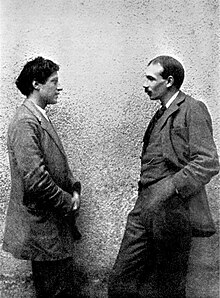
https://upload.wikimedia.org/wikipedia/commons/thumb/d/d6/Duncan_Grant_with_John_Maynard_Keynes.jpg/220px-Duncan_Grant_with_John_Maynard_Keynes.jpg 

 (Image of the artist Duncan Grant on the left, and the economist Maynard Keynes on right. Wikipedia) 

 Q. Why did you choose Keynes? What is it about his character that interested you and inspired you?

A. I'd known about Keynes' work since studying economics, first at school, and then at Cambridge University. where he still loomed very large in the landscape. But I didn't know anything about his life until I read a book called Mrs Woolf and the Servants, which rather circuitously led me to Keynes via the Bloomsbury Group. I was amazed to learn of Keynes' many gay love affairs, and sudden passion for a ballerina. I was also fascinated by his involvement in so many worlds: high finance, government, journalism, academia, the arts and Bohemia.

Above all, I felt his struggles spoke to ours. He lived in a time in which complacency about politics and economics was overtaken by crisis and extremism. Civilisation itself was under threat. His mission was a heroic one: to find a humane capitalism that could serve as an underpinning for a democratic, civilised, peaceful society. Maybe there are some pointers for us now.

 Q. Why did you choose the 1918 Paris Peace conference as the opening point of your novel? 

A: Originally I wrote a quieter start, but I loved the drama of the Paris Peace Conference: Maynard Keynes, who has been so successfully negotiating the corridors of power, suddenly has had enough. He see the politicians are failing everyone and walks out. It sets up the themes of the book: a complacent and callous establishment, and the dilemma of someone who both belongs and does not belong, but can never just walk away. 

Q. Two of the central locations of the novel - Kings College, Cambridge and  Charleston, the Bloomsbury's Sussex retreat - are beautifully described. Were you able to visit these settings specifically for your novel Mr Keynes Revolution?

A. Yes, I've stayed at Kings, and I was lucky enough to see the paintings that Duncan Grant and Vaness Bell produced for Maynard Keynes rooms. At Charleston, I fondly remember the scones in the heavenly gardens. Charleston is a work of art in itself: you can see why it was sucha haven for the metropolitan and vastly overworked Maynard Keynes.

 Cambridge - Wikipedia

Q. Much has been written in admiration of the Bloomsbury movement but I felt that your novel offers a gently humorous sideways view of the group. Vanessa, on occasions, is shown as intellectually snobbish, waspish and possessive, despite Bloomsbury's belief in liberty and sexual freedom. She is a complete contrast to Lydia, the practical "little pony" of a ballerina, comfortable in her all-too-visible skin, and at ease with both the servants and the need to make money. How did you develop your ideas about Lydia?

A. Bloomsbury were never at their best in their dealings with Lydia. In fairness, Maynard did rather hurl her into the group with little regard for how they might respond. But their response was not generous. Bloomsbury did give Maynard a  great deal though - not least, a lasting ideal of art and friendship that inspired him throughout his life.

Lydia Lopokova - Wikipedia

Lydia herself is an astonishing character. She had an amazingly colourful life, from a childhood in Tsarist Russia to stardom on Broadway and with the Ballets Russes, to love affairs, to acting Shakespeare and Ibse, to a long and eccentric old age. More than this, her spirit and originality were noted by everyone and emerge strongly in her letters.

 For those who want to read about her life I would recommend Judith Mackrell's biography, Bloomsbury Ballerina, and the published letters, Lydia and Maynard. Writing the novel, it was a challenge not to portray Lydia in a way that felt over the top. In many ways, she was larger than life, although I think the extrovert persona also disguised a degree of personal tragedy, and so I was concerned that the fictional version might appear to be a caricature. I've tried to convey her vulnerability and her courage.


Q. In your novel, Keynes romance and some of its complications are very much rounded out by the chapters written from the servants point of view. Where did this strand come from?

A. I've long  been interested in servants - my own great-grandmother was a maid. Domestic service was the biggest employer in the early twentieth century but it's a very hidden world. I've always been interested in the memoirs of servants, and also enjoyed Lucy Lethbridge's Servants. The most direct source was Alison Light's Mrs Woolf and the Servants which explores the lives of several Bloomsbury servants in detail. The character of Lottie is particularly influenced by that book. Gates alone is entirely my invention although his storyline is still inspired by historical events. 

 The relationship of servants and their employers is fascinating: intimate, sometimes affectionate but also often exploitative and filled with unexpressed resentments. For employers like Bloomsbury - trying to overturn social conventions, attempting to be progressive, yet undeniably part of a privileged elite - the relationship creates particular tensions.

Mrs Woolf and the Servants - Alison Light

Q, You mentioned writing this as a screenplay. Did that format help you when it came to writing and pacing this as a historical novel?

A. Yes and no. It meant I was familiar with the material but a novel is a very different form and written straight from a screen play would be "choppy." There's more space for introsepction, and I also had to think of historical accuracy all over again - with a screenplay, it's impossible to be completely accurate within the constraints of a two-hour script. With a novel, there's more flexibility so you need to think exactly what you are trying to achieve. A novel is usually more intimate which actually means it has covered a shorter span of time, but in more detail, than a screenplay.

Q. Which was the hardest scene to write? And your favourite scene to write?

A. The opening chapter, at the Paris Peace Conference, was a hard one in terms of it being a big historical event with a lot of detail to get right. Some of the economic discussions are also tricky because you are trying to convey quite difficult subject matter, without overwhelming the reader or losing dramatic tension. At the end of the day, economics is at the heart of what Keynes was about but economic theory rarely crops up in novels so that was a challenge!

My favourite scene is Lydia and Maynard on the Sussex Downs after the ill-fated Charleston party.(Seconded here, by the way!)


File:Charleston farmhouse - geograph.org.uk - 291473.jpg ...

Q Emma, I became very involved with your main characters and their worlds as I read on through Mr Keynes Revolution. Do you have any future plans for these characters? 

A. Yes. This novel finishes in 1925. I am working on a sequel which contains many momentous challenges for Maynard and Lydia, including a trip to Bolshevik Russia and the Great Depression. I'm enjoying it!

Emma - E.J. Barnes! - thank you for answering all my questions here on History Girls. Good wishes on this novel - and on the next.


E.J.Barnes


Interview by Penny Dolan

MR KEYNES REVOLUTION by E.J.BARNES. Longlisted for The Peggy Chapman-Andrews First Novel Award . Greyfire Publishing ISBN 9780993515835 . www.EJBarnesAuthor.com


Wednesday, 10 June 2015

Five and a Half Inches - Michelle Lovric

Some measure their lives in teaspoons, but I measure mine in cat litter.

My cats perform their piccoli bisogni in an air-conditioned stainless steel chamber accessed via a Venetian arch copied from John Ruskin’s Stones of Venice. For the sake of their dignity, I shall refrain from illustrating this paragraph.

Every Wednesday and every Saturday I empty the cats’ litter tray. This is one task it’s better not to execute mindfully. So I use the time to consider what I have achieved literarily and personally between Wednesday and Saturday or between Saturday and Wednesday.

For a long time I marked off the grim stages of a personal matter now elegantly and happily resolved, then a broken foot treated, a children’s book written, series of workshops completed, a second broken foot treated (yes, I know), another draft written.

This Wednesday I something else to think about. There’s nothing quite like the relaunch of a backlist to make a writer feel quite chuffed at having achieved five and half inches of printed, published word.


This week, my backlist was relaunched by Bloomsbury with new covers.

Given my habit of measuring my life in cat litter, it seems appropriate to use my cats to measure the achievement. There are cats all through my books.

Carnevale, which is the story of the portrait painter Cecilia Cornaro, features a talking cat who provides commentary on the artist’s lovers, who include Casanova and Byron.


In The Floating Book, the story of Venice’s nascent publishing industry, the publisher’s wife Lussieta follows Italian tradition by acquiring a tabby cat when she becomes pregnant. Tabby cats have the ‘M’ of the Madonna on their stripy foreheads, and it is said that a cat birthed her kittens under the manger where Jesus was born, providing a lesson in perfect maternity for a Virgin inexperienced in childcare. The Floating Book’ s cat is not as virtuous as it might be, however. It is a incorrigible thief.


In The Remedy, a medical murder mystery set in Venice and seedy Bankside, I was constrained to a couple of mummified cats as my wonderful literary agent, Victoria Hobbs, was at that time wont to decry the number of cats in my books and asked me to desist. But she is now the owner of two cats. Just saying. Don’t need to gloat or anything.


The Book of Human Skin is still in print with its original cover. In it, there are several cats including a kitten who suffers a sad fate, illustrating how sociopathic individuals often display their dangerous lack of empathy at a very young age by cruelty to helpless animals.

In The True and Splendid History of the Harristown Sisters, a cat teaches Ida, the youngest and perhaps the maddest of the siblings, not to eat her hair, by offering the example of furballs. Enough to make a cat laugh?


As is traditional with a publication, or a relaunch, this blog now offers a complete set of the relaunched titles – all five and a half inches of printed text – as a prize for the answer to this question:

"What is your favourite feline character in literature and why?"

Put your answers in the Comments section below and copy them to readers@maryhoffman.co.uk so that winners can be contacted.

Closing date is 27 June. We are sorry but our competitions are open only to UK readers.


Michelle Lovric's website