Showing posts with label Charney Manor. Show all posts

Saturday, 6 July 2019

Pennies From Heaven -- A Historical Fiction Workshop

As readers of this blog may know, I love ephemera. I also hate clutter, so my bits and pieces have to work hard to justify their continued existence in my house and life. This week, a box of photos, coins and – well, junk, I suppose, had a trip to Charney Manor in Oxfordshire, to earn their keep doing what they do best – as writing prompts in a historical fiction workshop for the Scattered Authors Society(which numbers some History Girls in its membership!)
Charney Manor

I called the workshop Pennies From Heaven. The premise was simple. Every participant – all published writers for young people, some experienced in historical fiction, others not – was invited to choose a photo from a selection. These photos are a motley crew. Some are of my own family and ancestors, others discarded by a friend, some picked up in junk shops, at least one sent to me by a fellow writer because she thought I’d like it. At this point I can’t tell for certain which are which – they have all become simply themselves. The young man in uniform ready to go to World War One? A great-great uncle perhaps, or maybe not. The girl with the pronounced chin and carefully-waved hair? My granny had several pictures of her but I have no idea who she was.
My motley crew of characters 

 It doesn’t matter. In the workshop, in the imaginations of the writers, they all became characters, assigned a rough period in history according to the clues of clothes and hairstyles. After a series of prompts, all the writers felt they were getting to know their character, and I was careful not to say who the people ‘really’ were, even when I knew their identity, at least until afterwards. The boy in the picture with my eight-year-old father in 1954 must have been a pal, but now he’s Billy, and he’s got a whole new backstory (and, in fact, a future – ‘his’ writer got so into Billy’s story that she’s got a new book idea!) The young woman with Aunt Annie, dressed in boys’ clothes? I’d always assumed it was Gran, dressed up for a Sunday School play or something, but now I look more closely, inspired by the writer who’s chosen the picture, and I don’t think it’s Gran at all, which makes me wonder anew about my spinster aunt. 


Then I gave them all money, just one coin, from the right period -- this is what gives the workshop its name. I asked them to write down one fact they were confident about from the year the coin was minted, and one thing they thought was contemporary but might need to check. Then it was on with the story – because what mattered about this particular coin was its impact on their character.  Holding and smelling the old coins, letting them jingle, feeling their weight, imagining their character earning, finding, spending or losing them seemed gave the writers a deeper sense of character and period. And not getting too hung up on the historical facts was a reminder that details can always be checked later, and that character and story are at the heart of the writing. Often, as historical writers, we can get so bogged down in facts and research that we can forget about having fun. 

Finally I invited the writers to come and choose an object for their character. The objects are all small and valueless but everyone found something of interest – a lipstick with an ingeniously attached tiny mirror; a huge key; a tiny notebook; a lace doily; a savings book. Again, the writers wrote ferociously as the imagined a scene involving their character and one of the objects.


I’ve done this workshop, or variations of it, often. But this one felt special. Possibly because everyone was already a writer, so they tended to produce really interesting material. Possibly because, as we were all staying at Charney together, I heard some lovely follow-up: at least two writers are embarking on whole new books inspired by the workshop! 
Who is the girl in trousers?

But as I packed away the dog-eared photos, the coins, and the junk in my suitcase, I also reflected on how happy I was to be able to use them in this way, to let them live again in someone’s imagination. 

And in a couple of years, let's hope, you'll be able to read about them in at least two new books!

Thursday, 18 October 2018

Glass Town Wars and the Brontës - Celia Rees

I've got a new book coming out on November 1st.


With any luck, I'll be asked to talk about it and will have to answer that most commonly asked of  questions: 'Where do your ideas come from?': I've been trying to remember. When was that first seed planted? What other ideas, experiences, added to it? Nourished it? Allowed it to grow out of and over all the other ideas that never got as far as becoming a book? 

I think I've found the 'first cause'. In the 1990s, I worked part time at a Further Education College in Coventry to supplement my meagre earnings from writing. I was teaching Wuthering Heights to a group of Malaysian students and as part of the course we went on a trip to The Brontë Parsonage and Museum in Haworth. I'd never been before and I was as excited as any of the students. I love visiting writers' houses and have written about it here before. Indeed, that post details some of the fascinating things owned by the Brontës and on display at the Parsonage, but that post was based on a much later visit. What intrigued me most that first time was the tiny little books that the Brontë siblings had written as children. 


In those days, you could buy facsimilies of the miniature books. I remember buying two of them but, of course, when I really wanted them, needed them, I couldn't find them anywhere. They elude me to this day. The little books contain the writing that they did as children and adolescents about the imaginary world that they created and peopled.  The world that they called Glass Town. 

A few years later, I was in Yorkshire again, visiting The Salts Mill Museum, outside Halifax, not  far from Haworth, There was a street market and on one of the stalls was a porcelain figure of a soldier, a Rifleman in a green uniform.


I can't really say why I was attracted to him, maybe I remembered something about Branwell Brontë being given a set of toy soldiers and that being the starting point for the stories the Brontë children began to make up, but I don't think it was anything as conscious as that. Maybe I just liked him and thought there was a story in him somewhere. Whatever the reason, I bought him and took him home and he lived on the shelf in my study while I got on with writing other things.

Charney Manor
Years later, I was at a Scattered Authors' Retreat at Charney Manor in Oxfordshire. Different people were discussing ideas for books and stories. Some History Girls, past and present, may have been there. One person described something she'd been thinking about for a book about the Brontēs. I remember thinking, I wouldn't do it like that. Time travel but not back to the Brontës in their Parsonage in Haworth but pitched into their fantasy world and it would be a boy, not a girl making this journey. But how? Why? What could happen next? I didn't have those answers yet. A few more years went by and I found the idea again, or it found me. Another retreat at Charney and I wanted to start something new. I remembered the Brontë idea and thought I might work on that while I was there, so I bought Christine Alexander's: The Brontës: Tales of Glass Town, Angria and Gondal to take with me.


One of the traditions at Charney is the Three Minute Read, when writers read from their work in progress. The proof of the writing is in the reading. The piece I wrote is now in Glass Town Wars, substantially unchanged. It gave me the How? and the Why? Boy in a coma.  Let's call him Tom. Best friend is a computer whizz (let's call him Milo) with the ultimate virtual gaming gizmo, a small, thin sheet of graphene small enough to fit in the ear. It allows you to actually live in the game. Only problem is, it's experimental. No-one knows where you'll be going, no-one knows how you'll get back...  

I knew where Tom would go. I knew he would go there as a soldier, a Rifleman in a green uniform, I knew he would meet Emily Brontë, or her persona in the Brontës fantasy world, but what would happen then? That was going to be the hard bit...

(To be continued...)


Glass Town Wars by Celia Rees is published by Pushkin Press, 1st November, 2018 


Celia Rees
www.celiarees.com

Thursday, 6 July 2017

A Chattering Of Choughs and A Scream Of Swifts Sheena Wilkinson

I’ve spent this week at the Scattered Authors’ summer retreat at Charney Manor in Oxfordshire. The manor is thirteenth century, with Elizabethan additions, and the adjacent churchyard has graves from many centuries so it’s easy to feel especially historyish. There are over twenty writers around, several of whom write historical fiction. There may even be another History Girl or two in the vicinity…

I’m typing this in the garden while a scream of swifts dives and wheels around us, and I wonder, what do you call a group of historical writers? A chattering, perhaps, as in choughs? I don’t often have the chance to chatter to other historical novelists so I wanted to use this post, falling so serendipitously on the last day of Charney 2017, to reflect some thoughts of today’s writers of historical fiction, particularly for young people.

Several writers joined me, all of whom have written historical fiction, sometimes straight, sometimes with a twist – an element of the paranormal; an alternate history, or even a comedy diary. Our reasons for writing historical fiction varied. I fell in love with history, especially that of the nineteenth and twentieth century, via an inspirational teacher, whereas Lynne Benton suffered from a boring history teacher at grammar school, which made her determined to write books which made history interesting and exciting to young readers.

Michelle Lovric only ever wanted to write historical fiction. She loves narratives where the characters have to deal with more severe problems than can be solved by Google and mobile phones, with more visceral anxieties and more bodily risk.

Tim Collins enjoyed the challenge of applying the aesthetics of the comedy diary to historical subjects, and talked about the humour sparked when modern sensibility meets historical context – as in Blackadder.
 
Kath Langrish remembered the excitement surrounding the Tutankhamen exhibition at the British Library in 1972. She wasn’t able to travel to see it, but was given the book about it as a school prize. The book promptly fell to pieces, but her interest in the Egyptians – and in history – didn’t.
 
Katherine Roberts was motivated by a desire to write about horses, which kept her settings historical, and she loves to weave magic and spirituality into her stories in a way that wouldn't work with a modern setting.

Mary Hoffman admitted to loving the freedom of writing parallel histories where she was the absolute world expert on Talia, her alternative version of Renaissance Italy. However, she also writes straight historical novels, saying that she loves the research involved.

She had had to give up history at school but we all agreed with her that history was accessible with ‘books and a brain’. Likewise we all recognised that lovely serendipity when you find a fact that really chimes with your story.

Most of us agreed that writing for young readers was harder than writing for adults, mostly because of what you can’t take for granted. We all cared about historical detail and accuracy, but never at the expense of story. I have a horror of my books being presented as ‘worthy’. 

The talk meandered through Icelandic sagas, Venice, portrait painting, sculpture, medicine, spirituality – to be honest, my head was reeling. We considered such issues as whether historical fiction should say something about today’s society – I think it inevitably does, because unless you aim for some sort of pastiche, any work will always, to an extent, reflect the time in which it was produced. 

There were only a few of us, but between us we had very different reasons for writing historical fiction, and were attracted to widely differing periods. I suppose that’s why a blog like The History Girls works – there are so many different voices and perspectives on the past. As Kath Langrish said, so much exciting stuff happened in the past, and if you discount it, you’re not left with much.

The swifts wheeled and dived the whole time we talked. Their ancestors were probably here, doing exactly that, during most of the periods we discussed. I hope their descendants will still be doing so in the future, when the writers of that time gather on the lawn and talk about their books set in the turbulent 2010s.


Thursday, 18 July 2013

What's On Your Desk? Celia Rees

photograph by Joanna Kendrick

Every summer, I go off to this place, Charney Manor in Oxfordshire, with other writer chums. This annual 'retreat' is open to all members of the Scattered Authors' Society www.scatteredauthors.org . Quite a few of the History Girls are Charneyites, including Katherine Langrish, Adele Geras, Leslie Wilson and Sue Purkiss, who sadly weren't here this year, and Mary Hoffman, Dianne Hofmyr, Katherine Roberts and Penny Dolan, who were (if I've missed anyone out, I do apologise). To the absentees - you missed a treat, girls. It was a vintage year, and not just the weather. It was inspirational. It has already inspired fellow History Girl Katherine Roberts to prompt her Reclusive Muse to blog about it on his  http://reclusivemuse.blogspot.co.uk

Katherine has written about using the Tarot to inspire writing, one of many excellent creative sessions, but I was intrigued by the introductory warm up session, devised and run by HG, Penny Dolan. We all had to say what we have on our desks. Everybody was different. Some people didn't even have desks. They worked on laptops wherever they happened to be, in the house or out of it or, in the case of Mary Hoffman on a settee and a coffee table. I know one person there who writes in bed, but she wasn't saying, so I won't out her. Quite a few people did work at desks but, even then, there were big differences. Some people had to have a view out of the window, others faced a wall. In Katherine's case, the Reclusive Muse can only be conjured in semi darkness. And then there were the desks themselves. Some were clear, others cluttered, some were for writing only, others were for other activities and seemed to be the length of an entire wall (I have to suppress my desk envy here).  Everyone was different, as individual in this as in their writing. For each person, their writing environment was important. They had to feel comfortable in it, before they could begin the process that would take them away altogether, to a place where they would cease to notice anything around them and their coffee would go cold, as mine is doing now.


Something else emerged here. A lot of us had things on our desks, or in our writing rooms, that had something to do with what we were working on, or had worked on in the past. Objects that had garnered an almost talismanic significance or importance, even though they would be meaningless to anyone else. Or, in some cases, just things that we like to have around us. Of course, when it came to my turn, I'd forgotten many of the things that are actually on my desk at the moment, subbing in things that had been there, but had been moved.


So, this is my desk, as of last night. I don't always have a glass of champagne on it but there is normally a mug of tea or coffee, full or empty (the glass got knocked over shortly after this picture was taken so now I have a champagne soaked diary). The wall behind the desk is also part of my writing environment. There is a noticeboard which has pictures, maps and postcards to do with what I'm currently writing. The wall around it has pictures and other things to do with past books. At the moment my desk holds: reference books, diary, notebook, basket of random pens and pencils, timer, little blue vase from Pompeii, a knitted lion (both presents from my daughter), a crystal  ball (The Fool's Girl), Cyclydian statue of the goddess (The Stone Testament), moonstone egg, assorted shells and fossils (because I like them), a gold llama (Stone Testament), a Liberty box containing beads (not in the photo - current project and also Colour Her Dead), a moon gazing hare (Witch Child), a magnifying glass without a handle that belonged to my father, a pot of tiger balm for headaches, a mouse mat from Gunter Grass' house in Lubeck which says Katz und Mauspad (current project), mini calendar showing scenes of Warwickshire. Oh, and my computer and keyboard.

Sometimes things have to be moved off and migrate to a different shelf.


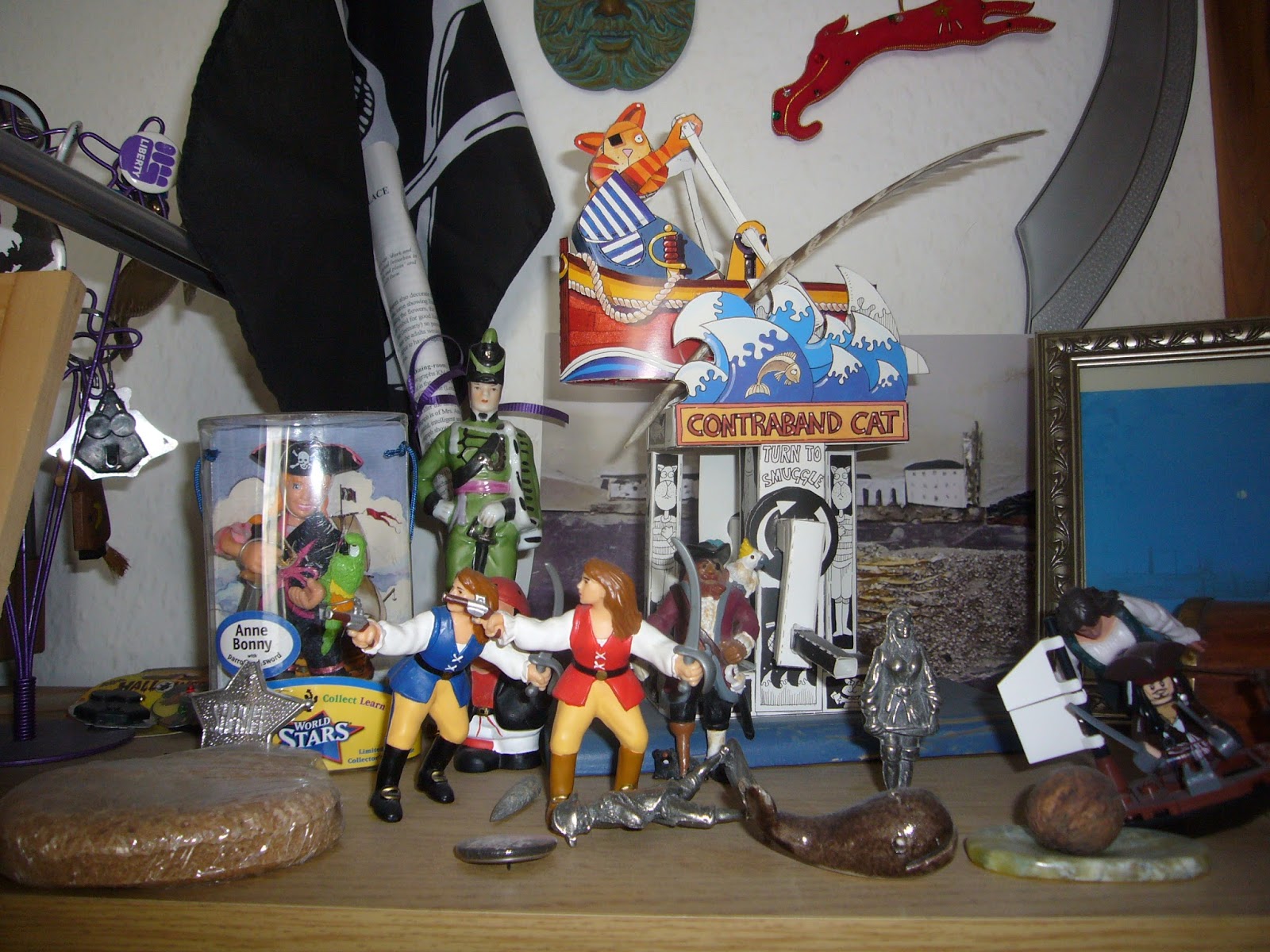
This is my pirate shelf. It holds the things that I collected when I was writing Pirates!. Sculking in the background is a soldier boy who just might be about to be promoted to desk top proper.

I know that these pictures will fill some people with horror, but I like having these things around me. They remind me of what I find most exciting about writing - having ideas, the process of creation, the books, the places I've made up, the characters I've grown to love.  There's not an award, a certificate, or framed review in sight.

I'm wondering what other people have on their desks. Anyone care to share?


Celia Rees

www.celiarees.com