Showing posts with label Dickens. Show all posts

Tuesday, 14 November 2017

The World’s First Novel by Lesley Downer

One day, a little over a thousand years ago, a Japanese court lady picked up her writing brush. In those days Japanese noblewomen lived in seclusion. The only men they could expect to see throughout their entire lives were their fathers, brothers, sons and, if they had one, their husband. The woman - no one knows her name but she has gone down in history as Murasaki Shikibu - was a lady-in-waiting at the imperial court.
Lady Murasaki at her desk
by Utagawa Kunisada (1786 - 1865) 1858

Some time around 1006 - sixty years before the Battle of Hastings, a couple of hundred years after Beowulf and a couple of hundred years before Chaucer - she started writing a story to entertain her mistress, the empress. Like the sultan listening to The Thousand and One Nights or the readers of the instalments of Dickens’s novels, the court ladies clamoured for more.

Murasaki Shikibu was unlikely ever to have a love story of her own, so - perhaps a bit like Jane Austen - she dreamt up the ultimate man and fleshed him out. Prince Genji, the result of her imaginings, was handsome and charming, but also kind-hearted. He was human and flawed. As she told his story he developed and changed and grew older. He suffered terrible losses and tragedies. What Murasaki wrote was amazingly modern, all about relationships and character and feelings. It is moving and gripping and spellbinding and reads like the freshest of page turners. It was the world’s first novel.

In The Tale of Genji Murasaki recounts Genji’s adventures, travels, love affairs and tragedies. A breaker of hearts and fatally prone to falling in love, he’s an adept in the arts of perfume mixing, poetry writing and calligraphy. In his society court ladies keep themselves hidden inside their palaces. He exchanges poems with women he’s never seen and decides if they’re worth meeting on the basis of their handwriting and the quality of their poems. It’s a world quite Proustian in its delicacy and beauty and eternal leisure.
Ox carts - The Tale of Genji
by Tosa Mitsuoki (1617 - 1891) 

This was a society with a very different ethos from our own. Women were never openly seen by men. Noblewomen lived in vermilion-painted palaces (the aristocracy were the only people who counted, as far as Murasaki was concerned) and when visitors called, they received them hidden behind screens. When the women went out they trundled around the tree-lined boulevards of the capital, Heian-kyo, in magnificent ox-drawn carriages, hidden from view, though they made sure there was an exquisite silk sleeve dangling gracefully out of the window so the passing crowd could imagine just how beautiful and cultured the hidden lady was. There was much standing on tiptoe and peeping through lattice fences, not just by the men, trying to catch a glimpse of these elusive creatures, but also by women, when someone like Prince Genji passed by.

In The Tale of Genji men regularly enter ladies’ palaces at night, make love to them in the pitch dark without ever having seen their face and leave at daybreak. The servants, being well trained, studiously ignore the intruders though they are well aware of who they are, as each man wears a distinctive perfume which he has mixed himself.
Spot the lady - hidden behind the screens
Tale of Genji by Kano Hidenobu (late 17th/early 18th century)

Some of the most memorable episodes in The Tale of Genji are humorous. At one point, Genji hears about a princess who lives all alone (apart, of course, from her maids, who don’t count). One day he happens to hear her playing her zither with such skill he assumes she must be very beautiful. He sends her poems, but she is so shy she doesn’t answer, which only piques his interest further. Finally he sneaks in. There is a delicious scent of sandalwood emanating from her clothes, surely evidence of extraordinary beauty. But when he wakes up the next morning and finally sees her he discovers that, far from being beautiful, she has a huge red nose and, worse still, wears very old-fashioned clothes. He’s so horrified he doesn’t even send the customary morning-after poem until evening. But in the end his tender heart is touched and he takes her too under his wing.
Heian Shrine, Kyoto, modelled on Heian Palace 
(794 - 1227), which Lady Murasaki knew.

The early part of the tale is full of stories like these, poignant, sometimes humorous, sometimes tragic, detailing Genii’s youthful indiscretions and misadventures, at the end of which he has gathered a brood of women who each live in an apartment in his palace. But as Genji gets older, the story gets darker; in all it is some 54 chapters and 1000 pages long. He suffers, he has terrible failures and disasters and in the end loses the person dearest to his heart - Murasaki, after whom the author is named.

By the time I sat down and read the whole novel I’d been living in Japan for several years. I knew Heian-kyo, Genji’s and also Murasaki’s city, very well. It exists like a ghostly presence underlying the streets of Kyoto, its modern name. The vermilion buildings and green-tiled roofs of Heian Shrine are an exact replica, scaled down a little, of the imperial palace that Murasaki knew, which stood until 1227. In spring the gardens, lake and delicate pavilions are swathed in clouds of cherry blossom. And you can still imagine the ox carts with their huge wooden wheels rumbling up and down the long straight streets of the City of Purple Hills and Crystal Streams, as the poets called it.

The Tale of Genji suffuses Japanese culture and Japanese society. It features in everything from art to the incense guessing game, and episodes from it form the plots of many Noh plays. It enormously coloured the way Japan looked to me. Japanese, I should add, are usually amazed to hear that I’ve read and love The Tale of Genji. For them it’s like Beowulf, so difficult that they too can’t read it in the original and rely on modern Japanese translations.
Lady Murasaki might have glimpsed
yamabushi mountain priests like these from
 the window of her oxcart as she passed
Yasaka Shrine, Kyoto (first built 656 AD) 

As a postscript, if you’re inspired to read The Tale of Genji, you should borrow, buy or steal the Arthur Waley translation. Scholars will tell you it’s not impeccably accurate. Waley took liberties, he changed details. If what you want is a precise, perfectly accurate translation, you could try Edward Seidensticker’s version or Royall Tyler’s magnificent two volume set with copious footnotes and a very interesting introduction. But if you read either of those you won’t be swept off your feet and fall madly in love with Genji and be transported away and unable to stop reading. For that you’ll have to go to Arthur Waley.

Lesley Downer’s latest novel,The Shogun’s Queen, an epic tale set in nineteenth century Japan, is out now in paperback. For more see www.lesleydowner.com.


Saturday, 29 June 2013

Charles Palliser interviewed by Linda Buckley-Archer

We are delighted to welcome our June guest, Charles Palliser, whose best-known book so far is The Quincunx. It is also a pleasure to welcome back Linda Buckley-Archer to the blog, who was one of our original History Girls. Sit back and enjoy a real treat!

The quintessentially English Charles Palliser was, in fact, born in the USA, in Massachusetts, near Boston. He arrived in England at the age of three and lives here still, in North London. A former academic, he read English at Oxford and taught nineteenth-and twentieth-century literature at Strathclyde University in Glasgow prior to becoming a writer. He is best known for The Quincunx, an epic work of gothic Victorian fiction which sold over a million copies worldwide and won him numerous accolades and legions of devoted fans. Publishers Weekly (US) commented that while “quintuple the length of the ordinary novel, this extraordinary tour de force also has five times the ordinary allotment of adventure, action and aplomb.” The Guardian dubbed him “our leading contemporary Victorian novelist.” Following on from The Sensationist, Betrayals and The Unburied (another densely plotted Victorian mystery), his fifth novel, Rustication will be published this November in the US and the UK by W. W. Norton & Company. In anticipation of this exciting event, Charles kindly agreed to talk about his work with erstwhile History Girl, Linda Buckley-Archer.


LBA: The news that you are about to publish a new novel after a break of over ten years, will delight your many fans. Could you give them a flavour of what to expect in terms of genre, story and setting?

CP: The novel is in the form of a diary written by Richard, a boy of seventeen, in late December and early January 1863-64 and so it covers just that month. He comes home in disgrace and finds his mother and older sister in crisis following the mysterious death of his father while he was at Cambridge. From a position of affluence as the family of a high-ranking Church dignitary, they have mysteriously become almost destitute. They are now living in a big but dilapidated old house in a remote village on the South Coast of England where they seem to be ostracised by their neighbours. Each of the three members of the family is lying to the others and concealing various things. They squabble with increasing bitterness as the winter closes in, trapping them in the house together.

Inserted into the diary is a series of obscene and threatening anonymous letters which are spreading terror in the isolated community and are accompanied by increasingly violent acts against livestock.

Suspicion falls on Richard and he is, indeed, a troubled young man. Tormented by sexual feelings he feels guilty about and by remorse for the offence which led to his suspension from University, he resorts to alcohol and drugs and his mental equilibrium is gradually destabilised.

He becomes obsessed by a succession of girls and women whom he stalks and terrifies. Meanwhile he sexually exploits his mother’s maid-servant of fourteen. All this time, as hints and fragments of evidence suggest, a cunning plan is being carried out to commit a murder and pin the blame on an innocent person.


LBA: Like The Quincunx, your latest novel has an intriguing title. For those of us who have not come across the word before, could you define ‘rustication’?

CP: The word “rustication” essentially means something like “being in the countryside”. It has long been used by Oxford and Cambridge Universities (as well as some of the older public-schools) to mean “suspension” from the institution. The origin of that is the idea that if one left Oxford or Cambridge one was, in theory, being sent into the countryside – even though one might be going to a big city. In the novel, my central character, Richard, is suspended/rusticated from Cambridge and returns to the house of his mother and sister which is in a very remote part of the country. So both meanings apply.

LBA: The world that you create is wholly convincing and I was interested to learn that certain aspects of the story have their roots in real-life events.

CP: Yes, there are two main real-life events behind the novel.

I grew up with a story told me by my grandmother and my mother. In the late 1930 my grandparents and mother were living in a remote village in North Wales when someone began sending vicious anonymous letters. The letters mainly accused people of sexual misconduct and my grandmother was particularly evasive about that. My mother thought that was because the letters possibly accused her father - my grandfather - of having an affair. She remembered elements of the story very differently from her mother, which was in itself fascinating. They both told me what a devastating effect the letters had on the community. Not only did nobody know who was writing them so that everybody was a suspect, but nobody knew what other people were being told about themselves. And, of course, the truth or otherwise of the accusations was known only to the victims.

The second is a notorious murder case about twenty-five years ago. The police became convinced that a certain man was the killer of a young woman and they managed to entice him into a lonely-hearts correspondence with a policewoman who, guided by a forensic psychologist, pretended to be turned on by sadistic fantasies and tried to lure him into boasting about violent acts he had committed. The hope was that he would confess to the murder. I read a book that quoted the correspondence and argued that it showed that the man was a psychopath. I formed the opposite opinion and thought he was trying very hard but completely unsuccessfully to imagine what it would be like to be sexually excited by sadistic acts. It turned out that I was right and the man was completely innocent. That episode gave me the idea of writing a novel that would put the reader in the position of reading two texts and trying to decide if the same individual had written both of them and if he was a man with violent and perverted impulses.


I have met Charles and this picture does not do him justice! - Mary Hoffman (ed)

LBA: The fiction of the Victorian era clearly exerts a powerful pull on you. What aspects of the historical period and its literature appeal to you most? If The Quincunx which – to quote the History Girls’ own Essie Fox – “out-Dickensed Dickens”, to what extent did you set out to reference Victorian mystery writers (such as Wilkie Collins) in Rustication?

CP: I’m so immersed in that literature that I don’t even do it consciously. But it seems to me that one of the best ways to keep a reader interested is to do what Wilkie Collins, in particular, does so brilliantly: tease and mislead so that as much as possible is put in doubt until the end.

LBA: To which author (living or dead) would you say you owe the greatest debt?

CP: There are too many. The list would begin with Austen, the Brontes, Dickens, George Eliot, Conrad, Faulkner, James.

LBA: Rustication is a relatively slim volume (certainly compared to The Quincunx), although the first draft, which I read, was substantially longer. How do you approach creating and editing your fiction? Is it a long, drawn-out affair or do you take a disciplined and methodical approach? Dickens and Collins both wrote their novels in instalments and to tight deadlines. Is this something that might have appealed to you?

CP: I wish I could write to a deadline but I seem to have to take a long time and write far more than I should and then in the final phase cut the whole thing in half – as I did with this novel. It’s a very wasteful way to work.

LBA: The ‘envelope’ structure of the novel presents to the reader a journal – the Journal of Richard Shenstone, 12th of December 1863 to 13th of January 1864 – sandwiched between a contemporary foreword and afterword which is penned by a certain ‘CP’. From the reader’s point of view, one of the many pleasures of Rustication is the skilful unravelling of the plot from a tightly restricted narrative viewpoint. How did you set about finding Richard Shenstone’s voice and was it a process you enjoyed?

CP: Keeping to Richard’s point of view was the challenge that made me want to write the book and almost prevented me from doing so. On the other hand, I think I found Richard’s voice fairly quickly but what was more difficult was making it modulate in response to the dramatic events of that single month. He begins the journal as a callow, boastful adolescent. By the end, that voice has changed greatly.

LBA: How did you keep track of the intricacies of the plot? Did you hold it in your head? Were there post-it notes pinned to your walls?

CP: I held the outline in my head but the details of the chronology had to be worked out very carefully on sheets of paper. There are many strands in the novel which had to be woven together in a way that made sense and yet kept crucial facts concealed. Achieving that was frustrating but absorbing.

LBA: You are always very generous in promoting other authors’ work, for example in the regular talks you host at the Stoke Newington bookshop. Is the process of being published something which you personally enjoy?

CP: It’s wonderful to be published but the greatest pleasure is in writing the book.

LBA: Finally, do you have any new projects in mind which you are prepared to share with us?

CP: I work on several novels simultaneously – a dreadful habit! – and one of them is going particularly well. It’s set in eastern Europe under the Nazi Occupation and I’m dealing with the question of how and whether decent values can survive in such conditions.

Many thanks for talking with us!

Monday, 24 December 2012

A MERRY CHRISTMAS, ONE AND ALL!

BY ESSIE FOX 


Santa Claus by Essie Fox


Before taking up writing novels I worked as a commercial illustrator, often selling to greetings cards companies, and the Santa Claus shown above was one of my favourite Christmas designs.


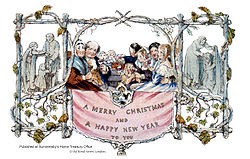
Even in those days I took inspiration from the Victorians - such as in the use of a border of 'scraps'. However, before Queen Victoria's reign there were no commercial Christmas cards – that tradition only really beginning after the introduction of the Penny Post, when Sir Henry Cole had the bright idea of printing up thousands of images which were sold in his London art shop and priced at one shilling each. What an industry that enterprise began!


Sir Henry Cole's first commercial Christmas card


As far as my own jolly gentleman would have been concerned, well, hardly anyone in England then would even have known his name. And yet by 1870 almost every child would recognise the sleigh that was drawn by reindeer, and the stockings full of precious gifts - if only an orange or apple to eat - as a present from Father Christmas.

Illustration by John Leech from Dickens' A Christmas Carol


The two names - Santa Claus and Father Christmas - have now become interchangeable, but their origins are quite different. Father Christmas, on whom Dickens based his Christmas Present was derived from an old English midwinter festival when Sir Christmas, Old Father Christmas, or Old Winter was depicted as wearing green; a sign of fertility and the coming spring. Hence homes were often decorated with mistletoe, holly and ivy. But this visitor did not bring his hosts gifts or climb down their narrow chimneys. He wandered about from home to home, feasting with the families and bringing everyone good cheer; as celebrated in this medieval carol:-


'Goday, goday, my lord Sire Christemas, goday!
Goday, Sire Christemas, our king,
For ev’ry man, both old and ying,
Is glad and blithe of your coming;
Goday!' 


The image of Christmas Present with which we are more familiar now is that of Santa Claus or Saint Nicholas, who 'arrived' in America in the seventeenth century when Dutch settlers imported their own Sinter Klass. And it was in America, in 1822, that Clement Clare Moore wrote a poem for his children which went on to have such a remarkable and enduring influence:-


'He was dressed all in fur from his head to his foot,
And his clothes were all tarnished with ashes and soot;
A bundle of toys he had flung on his back,
And he looked like a peddler just opening his sack.
His eyes how they twinkled! His dimpled how merry!
His cheeks were like roses, his nose like a cherry;
His droll little mouth was drawn up in a bow,
And the beard on his chin was as white as the snow.
The stump of a pipe he held tight in his teeth,
And the smoke it encircled his head like a wreath.
He had a broad face, and a little round belly
That shook when he laughed like a bowl fully of jelly.
He was chubby and plump, - a right jolly old elf –
And I laughed when I saw him, in spite of myself.'


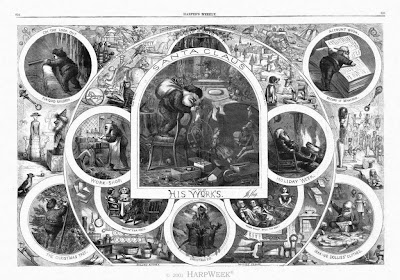
A Visit from Saint Nicholas (now more popularly known as The Night Before Christmas) described the old man’s appearance in detail - and this is what children today will know. His image and 'traditions' are beautifully illustrated in the woodblock print below. Published in 1866 in Harper’s Weekly magazine, it was created by Thomas Nast, and based on personal memories from his own happy childhood in Germany.

Santa and His Works by Thomas Nast


MERRY CHRISTMAS!

Saturday, 22 October 2011

HISTORY YOU CAN LIVE INSIDE by Emma Darwin

A few weeks ago, my daughter's school Chamber Choir was singing Evensong in Southwark Cathedral, so I went along to listen. Many years ago, when I first crossed the Thames to live South of the River (which as all Londoners know is slightly more drastic than crossing the Channel to live permanently in France), in the daytime Bankside was busy with suits, doctors, and wholesale cabbages. But outside the working week it was Tumbleweed Town: anyone who could fled to the salubrious suburbs, and those few who couldn't had nothing to tempt them out of their grim blocks of flats.

Now the council blocks have been done up, there are university halls of residence, lofts and flats and family houses for urban living, there's Borough Market, the Globe, the Golden Hinde, the London Assembly, at least ten branches of Prêt à Manger, and you can walk along the Thames Path, from Deptford on your bank and St Katherine's Dock on the other, to Lambeth Palace and the Houses of Parliament. It's full of people living and working and drinking and talking. In becoming more modern, Southwark has become more ancient: it's once again the mirror-image of the city across the tide that gave birth to it.

Southwark Cathedral wasn't built as a cathedral, but as a church: St Mary Overey (as in, Over the Thames). So although it's a fine bit of Early English Gothic it's not particularly large or complex. But it still has that unity in difference which is the great joy of mediaeval architure: the pointed Gothic arches don't come just in large and small, but can stretch broad or high, vaulting above your head, or stooping to make a canopy over a baby's little tomb. Some of the columns are like bundles of saplings, others are great, ribbed tree-trunks; you walk through puddles of colours where the light from the stained glass windows splashes down as regularly as a wave.

There was a hymn, all solid, Anglican harmony, and then the Responsory: call-and-answer with the choir. And then the choir sang alone, weaving in and out of each other as pitched and patterned by Orlando Gibbons, and I remembered Peter Wimsey, in Dorothy L. Sayers' Gaudy Night, saying to his Harriet, "Anyone can have the harmony, if they'll leave us the counterpoint".

As one of Gibbons' contemporaries nearly wrote: Licence my roving notes and let them go / before, behind, between, above, below... But I couldn't - for good manners' sake - rove on foot during the service, thought I've done so in many other churches. So I sat still, and allowed my mind's eye to rove instead, imagining how as you walk and look the clusters of saplings in the different aisles set to partners and then pass on, the ribs like branches stretching out to join those of another tree overhead; triplets of windows dancing between bigger trunks; the arch that opens to a whole new chapel of variations; the path that leads you on, curls you round the back of the altar and brings you to the centre again, under the still, pendulum point of the crossing.

They say that architecture is frozen music. In which case, I thought, gazing up the column by my shoulder to where it sprang up and out into the vault, music is surely liquid architecture. What I'm sitting in - what those nameless medieval masons built - is a fugue in stone; a fugue that you can live inside. And perhaps a piece of music is therefore a building that sings.

So where does that leave the reader and writer of fiction? Like music, writing can only exist for the reader in time but, unlike music, it can only sing one note at once. The Donne (mis)quotation suggests that poets may be closer to music: their words have explicit patterning, repetition and sound. But fiction does have architecture: a novel has pace, scale and proportion, as I found when I started thinking about writing a novel as building a bridge. Ian McEwan says the first thing he knows about a new novel is "the maths", by which, as Pythgoras and Stravinsky would have agreed, he also means "the music". In fiction we can play as we choose with echoes and repetitions of ideas and images, as well as with sounds, and build them into something which you can live inside: the world of the novel not just in the sense of setting and characters, but a structure of sound and rhythm and image.

And historical fiction? Well, there's your answer: Bankside. Many historical novels take the reader to live in the year and moment of the action: - steam trains screeching and puffing above Dickens' head as he tries to rescue a six year old prostitute; two monks turned out of their priory as Henry VIII's men pull the lead off the roof; families emerging from the Tube station air raid shelters to see if their homes are still standing.

Other historical novels are also novels about history. The Golden Hinde is a replica of Francis Drake's ship that he sailed round the world, and there are modern American schoolchildren clambering about on it, snapping each other on their mobiles. But in the 1970s it was moored across the river, and my sister was on it - only because the Tower queues were too long - when the IRA bombed the Tower, killing one and injuring forty people. The Golden Hinde is a world you can enter and live in, a world at once Now, and many Thens, a world built of ribs and beams: wood, tarred and caulked to sail as well as it did five hundred years ago, dancing over the waves with the wind singing in the rigging. The replica embodies the history that it hasn't actually seen but also what it has seen, as novels about history do: a historical novel is history you can live inside.