
Showing posts with label Ilfracombe. Show all posts

Friday, 14 January 2022

Joy, Happiness, Culture and Refinement - by Ruth Downie

It’s hard to imagine now, but there was a time when, if you didn’t know something and neither did your neighbours, you had to find a book and look it up. When I first worked in a library it was not unusual for people to phone us in search of answers to quiz questions, because unless you owned your own encyclopaedias, there was only one place to find help. So when I started to look at the story of one local library I was amazed at what a struggle its creation had been. Surely everyone would have thought a library was a Good Thing? 
 
Evidently not. 
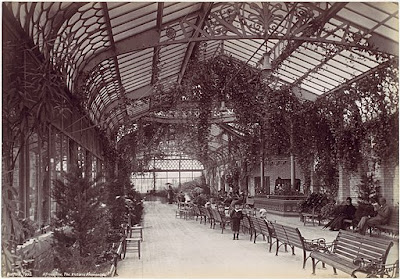
Large Victorian pavilion with plants and seating
Ilfracombe's seafront pavilion, c.1870  

By the later years of Queen Victoria’s reign the small town of Ilfracombe, on the coast of North Devon, was a thriving holiday destination. In the first decade of the 20th century the reading tastes of locals and visitors alike were catered for by no less than five subscription libraries. Readers could thrill to stories by Conan Doyle, Rudyard Kipling and Louis de Rougemont, whose controversial adventures included “Round the World on Wheels”, “Twenty-eight Days Without Food” and the alarming “Shot Through the Head with a Ramrod.” 
 
Victorian gentleman
Louis de Rougemont


Keen to attract customers, the libraries advertised their stock in the newspapers. JS Fletcher’s mystery novel “The Death that Lurks Unseen”, Florence Warden’s “A Lowly Lover” or AEW Mason’s “Miranda of the Balcony” could be borrowed for 3d (just over 1p). Eager readers could have three books at a time for an annual subscription of 21s (£1.05). However, if you couldn’t pay, your chances of enjoying any of the latest tales - including my absolute favourite title, LT Meade’s “Maid with the Goggles” - were slim. There was no mention at all of reference works.

From about 1850 onwards local councils were empowered to set up free public libraries, but take-up was slow. There was a flurry of activity around Victoria’s Golden Jubilee in 1887 but Ilfracombe’s attempts to join in did not begin until early 1899. On 14 January The Ilfracombe Chronicle & North Devon News printed a letter of support from an anonymous ratepayer who hoped the proposed library would prove “a counteractive influence to the public house.” 

The Chronicle’s local columnist, “Man about Town,” was also delighted with the idea, declaring in the same issue that “A library open to all classes, rich and poor, is a great boon to professional men and artizans [sic] alike”.

Unfortunately not all the town’s councillors agreed with him.

“The… speeches of the members,” declared the disgusted Man About Town in his column the following week, “proved… that many of them know nothing at all about the question.” This, he felt, was the only possible reason for the Council’s “utterly inexplicable” veto of the proposal despite widespread public support.

He dismissed the counter-suggestion of a “voluntary library” as “twaddle,” and saw no sense in the decision to consult the ratepayers. Indeed, 94 out of 99 letters sent to the Council chairman were in favour of the scheme.

“In the course of my professional duties,” declared one, “I am constantly brought in contact with students who are hampered in their studies for want of a good reference library.”

Another claimed, “The people of this town are endowed with great natural intelligence, but have been unfairly handicapped in the pursuit of knowledge by the absence of such an institution.”

On 28 January Man About Town returned to the subject for a third week, confident that despite this setback the ratepayers of Ilfracombe would see their own public library before long. Other local papers were not so sure. He quotes the North Devon Journal as being “astonished” at the decision, but the Exeter Gazette concluded that it was “a wise one” in view of other pressing needs for funds. Meanwhile the North Devon Herald pulled no punches. There was, it said, “no valid reason whatsoever why the ratepayers should be taxed… to furnish folks with a very limited selection of books, which they would only grumble and cavil over… the public will always clamour for anything they can see a chance of getting for nothing.”

Portrait photo of smartly-dressed man with white hair and beard
Andrew Carnegie
The Council finally voted to adopt the Public Libraries Act in 1903, but little changed until 1904/5. That was when a knight on a white charger rode into town. In spirit, at least. In body, Dunfermline-born Andrew Carnegie remained in the USA. A man of humble origins, Carnegie had educated himself largely by reading, and subsequently made a fortune in the steel industry. In 1901 he sold his company for $480 million, which made him about twice as rich as Bill Gates is now. Carnegie then devoted himself to philanthropy and, along with much else, his generous grants enabled the setting up of 2509 public libraries across the world. £3000 of his money (about £375,000 today) was on offer to Ilfracombe.

Should the town accept? A Carnegie grant would come with strict conditions, and the recipients were expected to find the library’s running costs for themselves. The council voted to receive the money, but in January of 1905 the Chronicle reported “great differences of opinion” at a lively public meeting:
 
Mr W Pile said "they should put every opportunity of improvement in the way of the young men of the town. (CHEERS)

"…Mr Dadds went on to say that public libraries were a failure nearly everywhere. (HEAR HEAR) What did they read in these libraries? (RUBBISH) The town was expecting to get a Higher Grade School, and did not need the library."

The report offers a great deal more in this vein, suggesting everyone present was having a marvellous time – until the vote. The count was 85 for the library, 100 against.

Nevertheless, plans for a library were approved in 1912. There then follows a long silence, only partly explained by the interruption of the Great War.

On 23 May 1925 the Ilfracombe Chronicle Gazette and Observer ran the subtitle, “Carnegie Trustees want something definite”. This was not unreasonable, as “It is now more than 20 years since the promise was made by Mr Carnegie” and there was neither a library nor any obvious sign of one. The council, still mired in complications over the site, voted to adjourn.

It was not until 1934, 35 years after it was first proposed, that Ilfracombe’s Free Public Library finally opened in the rest room of the magnificent Ilfracombe Hotel - “lofty and airy, flooded with light from the glass dome roof.” (The hotel is the large building on the left in the picture.) There were 820 fiction, 300 juvenile fiction, and 440 non-fiction and reference books. It was created with help of the Devon County library service, which had received substantial help from the Carnegie fund and had set up 463 branches across Devon. The Ilfracombe Chronicle & North Devon News shared the good news on 14 December. 
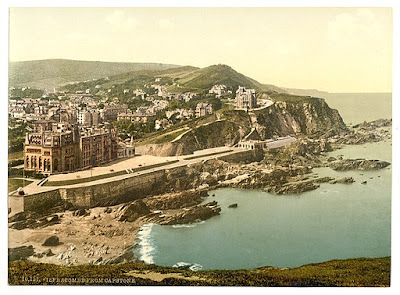
Picture of rocky beach with large seafront hotel
Ilfracombe seafront

“I feel convinced,” announced County Councillor Mr RM Rowe, “that the provision of a public library will not only add to the amenities of this township, but will also bring a large measure of joy, happiness, culture and refinement to the inhabitants.”

The Ilfracombe Hotel is long gone, but the public library which began life there is still bringing joy, happiness, culture and refinement to the town. Sadly I have searched the catalogue in vain for “Maid with the Goggles”. 

*****

Thanks to Ilfracombe Library, who inspired the original research, and Ilfracombe Museum, who provided most of the material. All errors are of course my own.

For a brief summary of the rise of English public library (with occasional refs to NI, Scotland & Wales) visit the Historic England website.

For more on Andrew Carnegie, visit the website of the Carnegie Corporation. 

 *****
When she isn't hanging around museums, libraries and archaeological holes in the ground, Ruth Downie writes a series of murder mysteries. They're set mostly in Roman Britain and feature army medic Gaius Petrieus Ruso, and his British partner Tilla. To find out more, visit www.ruthdownie.com

*****

Photo credits -
Pavilion - Francis Bedford, CC0, via Wikimedia Commons
Louis de Rougemont - George Newnes, Public domain, via Wikimedia Commons 
Andrew Carnegie -User Magnus Manske on en.wikipedia, Public domain, via Wikimedia Commons
Ilfracombe sea front -Photochrom Print Collection, Public domain, via Wikimedia Commons

Friday, 16 July 2021

Santa Claus is not just for Christmas - by Ruth Downie

The title of this post may seem oddly unseasonal, but in addition to his December activities, St Nicholas has a year-round commitment as a protector of sailors. In fact, according to https://www.stnicholascenter.org/who-is-st-nicholas/patron-saint/people# a vast range of people see him as their patron saint. Every time we stumble across one of them below, they’ll appear in bold.

 Stone chapel on hilltop over rocky harbour

This is St Nicholas’s chapel, overlooking the harbour at Ilfracombe in North Devon. It’s also said to be the oldest working lighthouse in Britain: a claim that is hard to dispute because

A) nobody really knows when it was built (probably shortly after 1321, when Walter Stapelton, Bishop of Exeter, ordered the parish church of Ilfracombe to be enlarged) and,

B) nobody knows when it first became a lighthouse. We do know, though, that the light was shining by 1522, because the Bishop of Exeter ruled that the faithful could earn 40 days’ indulgence by contributing to the costs of its maintenance.

The first written evidence for the chapel dates from 1416, when Hugh Herle, Rector of Ilfracombe (and no doubt a preacher), was licensed to celebrate mass here, but the history of the harbour goes back much further - this photo is taken from between the ramparts of the prehistoric Hill Fort that watches over it.

View across harbour from between two grassy mounds

Having been welcomed to the harbour, St Nicholas soon had plenty of sailors to protect. In 1346 Ilfracombe was a big enough port to send 6 ships and 79 men to support Edward III’s siege of Calais. (Or possibly 8 ships and 62 men, depending upon your source.)

Anyway, as one historian observes,* since this came to light, “… there can have been no guide book that has omitted to boast of this proof of the town’s former maritime importance.” One or two guides also delight in pointing out that “Liverpool sent only one”.

Ships’ carpenters, dock workers, chandlers and probably brewers must have worked in sight of the chapel on Lantern Hill. There are also tales of captives and pirates, but perhaps the latter were falsely accused.

Henry VIII’s dissolution of the monasteries ended the chapel’s formal religious functions. It seems to have carried on as a lighthouse, but its other uses are unknown until the nineteenth century and the rise of Ilfracombe as a holiday destination.

At times, had St Nicholas visited his chapel, he could have seen paddle steamers moored six deep against the pier, bringing travellers from Bristol and South Wales. Amongst them we might fit in any number of the faithful, including

Butchers, bottlers, brides, coopers, druggists, embalmers, florists, maidens, orphans, peddlers, poets, prostitutes, ribbon weavers and shoemakers but hopefully not too many thieves.

There were also choristers, although not everyone was impressed:

From PUNCH - Sept 21 1895 - 

'On board our steamer “The Brighton,” to Tenby and back. – I think we must have the “Something-can minstrels” whose performance was so graphically described by Dickens in Pickwick as enlivening Mrs LEO HUNTER’S garden party, when “three of them grunted and the fourth howled”; only that, on this occasion, there were above eight or ten of these minstrel boys from Cardiff, who… sat in the centre of the upper deck, inflicting their delightful melodies on such of the passengers as were unable to get out of earshot.'

On a happier note, between 1866 and 1886 the local lifeboat rescued 45 shipwreck victims from the dangerous waters outside the harbour. 

Plaque commemorating lives saved by lifeboat

For many decades of Queen Victoria’s reign the chapel light was the responsibility of Mr John Davie, whose achievements as a lighthouse-keeper (whilst highly commended) are eclipsed in the modern mind by his achievements as a parent: he and his wife Elizabeth raised a family of thirteen children in a building which is, fundamentally, three rooms and a narrow staircase.

For much of Mr Davie’s tenure, part of the chapel was also used as a reading-room during the tourist season. It’s hard to imagine how this was achieved within the space available, and perhaps the family were not sorry when the advent of cheap newspapers put the reading room out of business. With the help of her daughters, Mrs Davie then used the space to set up a laundry - a hard enough way to earn a living at the best of times, and surely not helped by Lantern Hill’s apparent absence of a water supply.

John Davie died in 1870 and Elizabeth took over as lighthouse-keeper, but not for long.

The chapel’s original builders had heeded the biblical advice to build their house upon the rock (see the photos below) but they hadn’t reckoned on the capabilities of Victorian engineers.

Wooden pew with bare rock visible underneath

Bare rock protruding out into corridor

Ilfracombe was now attracting so many visitors that it was deemed necessary to extend the pier. This involved the rearranging of nature with the help of explosives. As a result, on the night of Sunday January 14th 1872, there was a large and presumably unexpected rock fall on the landward side of the hill. The chapel survived, but it was no longer habitable and the family moved out.

A petition was raised to save Lantern Hill, which was allegedly being demolished to provide infill material for the harbour works “and thus to save the pockets of the Contractor”.

By the time of the 1881 census, Mrs Davie was again working as a laundress. The chapel remained empty, although it must have made a good practice room for the Band of the Artillery Volunteers, since there were no neighbours to disturb.

Lantern Hill also saw occasional religious use - a photo from 1929 shows another group of choristers in white surplices gathered for “The Blessing of the Fishing Nets”. The fishermen's nets can be seen draped over the wall beside them. 

By the end of the second world war the still-empty chapel was in a sorry state. Eventually in 1962 it was restored by the local Rotary club and the council, no doubt including citizens, merchants and Parish clerks.

Small whitewashed chapel area with window behind.
The present chapel area, converted from the original porch.

In 1982 the first christening took place in the chapel since the days of Henry VIII. Appropriately, the infant was a descendant of the Davie family.

The light of the chapel still guides mariners to Ilfracombe harbour, although according to Visitmyharbour.com: 'The light on top of Lantern Hill is not at all obvious and “lantern” is probably still the best description!' Just as well, then, that St. Nicholas also looks out for navigators.

------

 *Lois Lamplugh, “A History of Ilfracombe” 

With thanks to Ilfracombe Rotary Club, who open the chapel and museum display to visitors at selected times. More info can be found at https://www.stnicholaschapelilfracombe.co.uk/, which was a major source of material for this post.
More on St Nicholas can be found at https://www.stnicholascenter.org/

------

Ruth Downie is the author of the MEDICUS series of murder mysteries set mostly in Roman Britain, but just occasionally she likes to come up for air in later centuries.
www.ruthdownie.com


View of sea and cliffs through chapel window

Sunday, 28 April 2019

Beaches and Bombers - by Ruth Downie

North Devon's 'Pages of the Sea' event, Saunton Sands, 2018
Pages of the Sea was a chain of gatherings on beaches across the UK to commemorate the end of the First World War. This summer we’ll see more events on Saunton Sands: this time to honour the soldiers who trained there for the D-Day landings seventy-five years ago.

All this is distant history for my generation, but to my grandparents the First World War was a living memory. The Second World War was a formative part of my parents’ childhood, and it affected them in ways that were impossible to predict.

In 1939 my father was 12 years old, and living in Ilfracombe, a small town just along the coast from the beach in the photo. Sifting through typescript of his unedited memoirs, I came across his account of the chaotic early days of the war, and the unexpected effect they had on his family’s fortunes:
"The day war was declared… all our plans were thwarted, for the air raid siren sounded shortly afterwards, and remembering Stanley Baldwin’s dictum that 'The bomber will always get through' we made our way down to what was then regarded as the safest place in the house - the coal cellar under the stairs. Remember this was early September; we obviously had not bought in the winter coal supply.

"Father was a Sergeant in the local Special Constabulary and so donned his uniform replete with steel helmet, and went off on duty. Mother prayed with us for his safety, and with gas masks at the ready, we awaited a visit from the mighty Luftwaffe.

"Now, of course, it all seems ridiculous. It transpired that the sirens had sounded everywhere (we were all going to get bombed at the same time!). Ridiculous now, but assuredly not then. The whole nation was on tenterhooks, and the authorities were too. It later turned out that a lone aircraft was detected coming into Croydon airport (or ‘aerodrome’ as they were known then) bringing some French military people to London for a conference. Nerves were taut, and off went the sirens. As for us, in obedience to orders, thereafter we kept a stirrup pump and buckets of sand and water in the hall to deal with incendiary bombs. Thus ended our first experience of the war.
'The little town of Ilfracombe changed almost overnight.'
"The little town of Ilfracombe changed almost overnight. Evacuees poured into town by rail - not only children. Thousands of adults left London and other big cities determined to avoid air raids, and the indiscriminate use of gas. Some had obviously made arrangements with relatives, but most simply packed a few belongings, got on the train, and started knocking on doors when they arrived. My parents took in a lady called Miss T— and a Mr and Mrs B—, also from the capital. They turned out to be a Jewish couple hailing originally I think from Russia.

"The holiday season had not yet ended. The town was already full with visitors. Many expected them to return home immediately war was declared, but very few did. They probably thought that this could be their last holiday for some time, and determined to make the most of it.

"In addition to those who were were evacuated here (many of the children came, not as individuals, but with their school), there also descended on the town an influx of troops. Among the first to arrive was a cavalry unit, equipped now with tanks, yet still, strangely being issued with riding breeches. The tanks, or rather their drivers, found Ilfracombe’s narrow streets difficult to cope with. I remember one turning down into our road from the High Street, and taking a lump out of the kerb in the process.

You'll have to imagine the narrow streets in this blurry pic from 1949.
"The breeches were ghastly. Shapeless, baggy and not at all smart. At this point we will leave the tanks and follow the breeches, for reasons which will become apparent.

"Now that we were at war, my father thought it might be an appropriate time to renew links with his old Regiment. The reason for this was that he could see no future for the business he had started. Stock would be difficult to acquire. The ‘season’ wherein most of the business was done was at the least, uncertain. A return to the Army seemed a much more certain means of employment.
A more certain means of employment? 1916, my grandfather seated in the centre.
 "Accordingly, he wrote to the relevant authorities offering his services if required. He was then aged 44. He was asked to wait a while to see how the situation developed, and this is where the breeches come in.
"As I remarked, the aforesaid breeches were unsightly. Answer? Go to a tailor and ask him to ‘wing’ them. This process made them flare out in the right place (the thigh) and become tighter fitting around the seat and lower leg. The soldiers were delighted with the result; the news spread throughout the unit.

"The town was filling up rapidly with Service personnel, every one of whom wore a uniform, and very few of the uniforms fitted. Almost all needed something sewn on (different Regiments had ‘flashes’ of various colours) and many needed repairing or pressing.

"Thus it was that W.B. Hancock, Tailors and Outfitters, never looked back."
Extract from the unpublished memoirs of Bill Hancock, 1927-2014.
 
 
In later years Dad developed a passion for history and one of the periods that especially interested him was the Second World War. His memoirs bring alive not only the experiences of one family, but also the wider context of the upheaval going on around them at the time. 


Pages of the Sea, 2018

At its best, isn’t that what historical fiction does, too?