Showing posts with label Inquisition. Show all posts

Friday, 24 July 2026

Finding the Past, by Gillian Polack


I’m thinking about historical sources. Not just any historical sources, but ones that give us access to everyday lives. There are sources everywhere, but some sources are special. Let me start with the Middle Ages, and then end up in this precise moment in time. Before I can time-travel, however, I need to explain why the sets of sources I will introduce are so very special and why they’re amazingly useful to writers of historical fiction.

Writing is filtered. Every single type of writing we use to find out about the past has particular limits. Customs records tell us what was imported into, say, an English port in 1150, but not who sold it after that, what their lives were like, or what happened to the final imported good. It helps when we combine sources.

Let me begin with cinnamon, imported into that English port in 1150. It began its life in what is now Indonesia. It travelled as far as Egypt, where a Jewish merchant sold it to an English customer. The Egyptian woman who sold it had no idea that the customer was English. She called him a ‘Frankish knight’ (who I will henceforth refer to as ‘Frank’) and was really annoyed that he didn’t know old spice* from new. He overpaid and she didn’t respect him and life was normal. These things are recorded (though not the date, nor that the customer was English) in material from the Cairo Genizah.

A genizah is a safe storage place for documents that should not be destroyed, mostly religious, and mostly using Hebrew script. The Cairo Genizah is one of the most famous surviving, The holdings of the Cairo Genizah are amazing and strange and you can read about them in the famous many-volume study by S.D. Goitein (the easiest place for historical fiction writers to begin) or online (the best place for a quick overview). The 400,000 pages, with dates ranging over 1300 years are a marvellous selection of random documents. From them we know more about how the cinnamon was handled in Fustat (including that the sellers there had no respect for Europeans, who they called ‘Franks’) than we know about any other stage of its journey.

Customs and tariffs are another handy set of sources. They are consistent about imported spices that attract tariffs, but don’t tell us how fresh they are, nor what herbs and spices are grown locally. They contain much useful material, but it’s quite specific in nature.

Recipes tell us a little about what happened to that cinnamon, since it was bought by a knight and he would have lived among more literate people than, say, a peasant. Frank may have donated it to the Church, in which case we know how incense was used, through Church records and other sources. It may have been for gifts or for his own household. 1150 is at least within a generation of the first written cookbooks in Old French. We can see some of the uses of that cinnamon in cooking from the earliest twelfth century cookbooks. We’re reliant on random mentions in sermon literature and related materials for anything else.

Add all these sources together and we can trace that cinnamon.

Not everything is equally traceable. Cinnamon was a luxury spice, so it attracts more records than many other things. Wine also attracts records (including a poem in Old French), as does wool.

If we want detail and exciting information about the past, however, some sources are better than others. One of my favourite sources for England last century is that from the Mass Observation project. But that’s a story for another day. Let’s return to the Middle Ages.

One set of sources (also begun in the Middle Ages but not yet closed) has more information about the everyday than the Cairo Genizah: the records of the Inquisition.

The Inquisition’s archives start with the Albigensian Crusade, and their consistent use by historians begins with the French Annales school of history in the twentieth century. The work I always recommend to introduce the extent of material the Inquisition archive holds is E Le Roy Ladurie’s Montaillou. Le Roy Ladurie used the work of the Inquisition to find out how people lived. That’s the good part. The bad part is that the reason we have such detailed information about lives is because the Church was trying to stamp out heresy: they’re archives resulting from persecution.

In the thirteenth century the heresy was that of the Cathars. After 1492, it was “New Christians:” converts who were still too Jewish. If someone was proven to be a heretic and unable to return to a fold or found to be ‘Judaicised’ beyond redemption, they were burned alive. The price paid for these records is awful. Two scholars re-created the food history of the once-Jews in Spain, and also told us the fate of the person whose food was documented by the Inquisition. Th Inquisition records are a major historical source, and also a terrible one. They record peoples’ lives, and also peoples’ deaths.

I promised we’d end in contemporary Australia, and there is a reason for this. Right now, Australia is creating an archive similar in levels of detail to that of the Inquisition (though covering a very short time) through its Royal Commission into Antisemitism and Social Cohesion.

An Australian Royal Commission is the highest level of inquiry, and it, like the Inquisition, asks many questions to find out what is happening in an area of immense importance and urgency. The trigger for this Royal Commission was the shootings at Bondi, although much of the work of the Royal Commission is on events and issues in the lead-up and after the shooting. Because of the broad focus and detailed question, the Royal Commission is developing deep documentation of the lives of Jewish Australia and their haters and the workings of government at all levels. It is unintentionally creating an immense archive of how Australians see themselves and others and what their lives are like.

Normally I see these things hundreds of years later, but in this case, I’m in the middle of it. I submitted material and every week of the hearings I learn about my own life. It’s quite intense.

This Royal Commission demonstrates just how much work and how many people it takes to create the Cairo Genizah, the Inquisition trial records, or Mass Observation. Even in the age of computers, 20,000 public submissions and week-long testimony into a given subject (all transcribed) is an immense amount of information that has the potential to create some amazing historical fiction… when it is in our own past. Right now, its creation allows us to peek into this kind of vast and detailed records, and helps us interpret them.

Let me give an example. I interpret police records quite differently to even two weeks ago. Before this week, I had to trust narratives about police work, often fictional. This week’s testimony by very senior officers (which is not fully webbed yet, so the link I gave you last paragraph leads you to another week, dealing with universities) showed me how they operate and what frustrates them and how they work alongside other public bodies. My greatest moment of insight was when they tried to explain that they wanted to deal with antisemitism. Their frustration was so clear.

My biggest reminder from these last few weeks, as an historian, is that the past always contains human beings. If we don’t see those humans and can’t hear at least a little of what they’re saying, we need to look further or more deeply.


*This is not a pun, but ought to be.

Friday, 28 June 2019

Rooted out, destroyed and abolished? From the Inquisition to a cosy English Bed and Breakfast. By Ruth Downie

“These poisonous growths in the church of God must be torn up by the roots lest they spread themselves further.” - Pope Urban VIII 

Mary Ward’s idea for a female religious order inspired by the Jesuits was not popular in Rome. It wasn’t popular in her native England either. The Gunpowder Plot was still within living memory, and two of Mary’s uncles had been amongst the plotters. They're shown in the engraving below: Christopher and John Wright, third and fourth from the left. Suspicion of Roman Catholics was rife. This was an age of secret Masses: of underground priests, of spies, tortures and executions.

Engraving of the conspirators in the Gunpowder Plot

Mary originally escaped the turmoil in England by joining a convent in St Omer, but found herself dissatisfied with the cloistered life that was demanded of women devoted to the church. She was convinced that God wanted her to do more.

“There is no such difference between men and women,” she wrote, “that women may not do great things.”

Returning to London, she established an undercover group of women who offered education, encouragement and practical support to persecuted Roman Catholics both in and out of prison. Confident that God wanted her to create an order of women who were free to travel and do his will wherever they went, she and a small group of sisters walked all the way to Rome to seek the Pope’s approval. Here’s a replica of the hat she wore for the journey:

Wide-brimmed black hatUnfortunately Mary was not skilled in church politics, and the church was not skilled in communication. Not realising that the long silence from the Pope meant ‘no’, she went ahead, setting up groups of “Jesuitesses” who ran schools and communities in several European cities. Upon hearing rumours that the Church did not approve and that her groups were being disbanded, she wrote urging her colleagues in Trier, Cologne and Liege to ignore any orders of suppression. She was certain the Pope could not have authorised any such instruction.

The letter was more naïve than heretical, but the damage was done. This was disobedience, and disobedience had to be dealt with. The Inquisition was called in, and Mary was imprisoned while the church decided what should be done with her.

Mary seems to have been remarkably longsuffering in her imprisonment. But while she co-operated with the authorities on the surface, she also kept up a secret correspondence with her friends on the outside. As every schoolchild knows, but apparently Mary’s guardians didn’t, lemon juice dries invisible but can be revealed by warming the paper.

In the end she was not convicted of heresy, but neither was she fully freed. Her groups of “Jesuitesses” were ordered to be broken up and banned forever. As Urban VIII put it in his Papal Bull of 1631, they had been guilty of wandering about at will, “and under the guise of promoting the salvation of souls, have been accustomed to attempt and to employ themselves at many other works which are most unsuited to their weaker sex and character, to female modesty and particularly to maidenly reserve.” Furthermore they persisted in such activities, and were “not ashamed”.

Mary died with her life’s work apparently in ruins. However - some of the communities she founded managed to hang on by the skin of their teeth, although they were not allowed to acknowledge her as their founder.

Georgian-fronted brick building.
The Bar Convent
With no official support they were desperately poor, so it was a great relief to the group in York when Thomas Gascoigne, a member of the local Catholic gentry, declared, “We must have a school for our daughters,” and put up £450 to fund it. Mother Frances Bedingfield, acting in the true spirit of Mary Ward with the lemon juice, purchased a building under a false name, and thus established the first convent in England since Henry VIII’s dissolution of the monasteries.

The Bar Convent is still there: just around the corner from York station and close to the city walls. The sisters who live there belong to an order now called the Congregation of Jesus. They and their predecessors ran the school for almost 300 years, surviving the suspicious searches of officials, a rampaging mob (St Michael was apparently instrumental in seeing them off) and the threat of prosecution for non-attendance at Holy Communion in the local Anglican church. (The case failed when it turned out that the vicar hadn’t bothered to hold a service on the day in question.)

Ornate chapel with white and gold decorationThe convent has given sanctuary to refugees fleeing the French Revolution, to Belgian children and convalescing soldiers in the First World War, and to Bosnian children during the Balkan conflict.
It has also provided a discreet place of worship for Roman Catholics unwilling to surrender to the Church of England. The chapel, built in the 1760’s, is invisible from the outside of the building. I can vouch for the fact that its eight exits (in case a quick escape was needed) are very confusing to outsiders. There's also a hiding-place for the celebrant - a “priest’s hole” - which I never found.

The convent has now survived the departure of the school, which moved elsewhere in the 1980’s. Seeking a new use for the building that would allow it to cover its costs, the Congregation of Jesus hit upon hospitality - and this is where people like me come in.

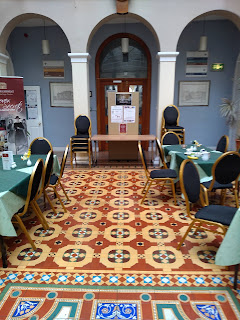
The Bar Convent now offers a Bed and Breakfast refuge for visitors to the beautiful but exhausting city of York. It’s a peaceful haven with enclosed gardens, a stunning glass-roofed Victorian courtyard, a guests’ kitchen, a teashop, and a museum that’s well worth a visit. I stayed there earlier this month for the York Roman Festival and have already booked again for next year.

Dining area with spectacular Victorian tiled floor
The Victorian glazed courtyard dining area
As for Mary Ward - the orders she established were finally allowed to acknowledge her as founder in 1909. A hundred years later, Pope Benedict XVI published a decree recognising her “heroic virtue”. She is, apparently, on the path to sainthood.

Finally, Mary Ward’s time has come.


Sources -
Bar Convent Heritage Centre website 
Bar Convent information leaflet 

Mary Ward - Under the Shadow of the Inquisition, by M. Immolata Wetter 
The History of the Bar Convent by Sister Gregory IBVM, 
Mary Ward by Sr Gregory Kirkus CJ 
Any and all errors are Ruth's own!

Ruth Downie writes murder mysteries set in Roman Britain - find out more at www.ruthdownie.com

Eboracum Roman Festival is a splendid weekend for anyone interested in anything remotely Roman. Ruth's account of it is here. The next one will be held in York on 29-31 May 2020. If you want to stay at the convent, book now!


Sunday, 13 January 2019

The Plight of the Moriscos in 17th Century Spain

by Deborah Swift

Seventeenth Century Persecution in Spain

The Spanish Inquisition is associated with the persecution of the Jews but it is not common knowledge that Muslims were also tried and tortured by this institution. When researching A Divided Inheritance I took a trip to Seville and visited the remains of the San Jorge Castle, the place of imprisonment for victims of the regime. There I saw chilling evidence of this persecution, which the Inquisition applied not only to rival faiths to Catholicism but also to mystics of their own faith.

What made this climate interesting for my novel was that in seventeenth century England Catholicism was repressed, whereas in Spain Catholics were the ruling majority. To understand the climate of oppression for religious minorities in Spain in 1609, one must look back a few centuries to 1248, when Seville, formerly a Moorish city, fell to Christian armies.

Moorish tiles from the Alhambra
.
Symbols of Lost Culture
During the following centuries after moorish Spain was conquered, Christians were determined to expand their dominion over Spain, and in 1492 Muslim Granada fell - a momentous day for Christian Europe, a day of rejoicing, but for Muslims it became a day of eternal sorrow. Precious buildings were sacked and destroyed, atrefacts such as ceramics with islamnic designs smashed. 

Just as the day is marked by celebrations in Spain, in Morocco black flags are hung out to indicate loss and mourning. Some descendants of those expelled still retain the original 15th century keys of their Andalusian homes as a symbol of their lost culture.

After the conquest of Granada by Christians, the Jewish population was driven out, whilst tolerance was promised to its Moorish citizens. So by the seventeenth century the Moors had become indelibly Spanish. Some were genuine Christian converts, and many, like Sancho Panza’s neighbour Ricote (in Cervantes’ novel Don Quixote), and Luisa in my novel 'A Divided Inheritance', thought of themselves as ‘más cristiano que moro’ (More Christian than Moor).

The Burning of Books
A short period of relatively peaceful co-existence between the Muslims and Christians was shattered when the Archbishop of Granada, Hernando de Talavera, was replaced by the fanatic Cardinal Cisneros, and Muslim religious leaders were persuaded to hand over more than 5,000 priceless books with ornamental bindings, which were then consigned to bonfires. Only a few books on medicine were spared the flames. Unsurprisingly, this event led to an armed response from Muslims in the First Rebellion of the Alpujarras in 1499. By 1502 the monarchy had rescinded the treaty of tolerance and Muslims in Andalusia were forced to convert or leave. Those who converted were called Moriscos, which means “little Moors”. 

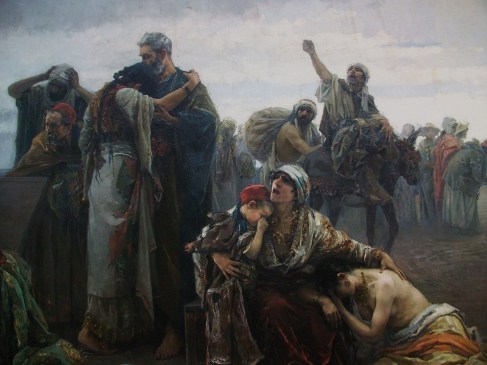
The Expulsion of the Moors from Denia - Painting by Viincente Mostre

A Secret Religion
Many Moriscos professed their allegiance to Christianity while practicing Islam in secret. Every aspect of the Islamic way of life, including the Arabic language, dress and social customs – was condemned as uncivilised and pagan. A person who refused to drink wine or eat pork, or who cooked meat on a Friday might be denounced as a Muslim to the Inquisition. Even practices such as buying couscous, using henna, throwing sweets at a wedding or dancing to the sound of Berber music were un-Christian activities for which a person might be reported to the Inquisition by his neighbour, and obliged to do penance.

Rebellion

Further repression of the Moriscos resulted in a second Rebellion. Fearing the rebels were conspiring with the Turks of the Ottoman Empire, the uprising was brutally suppressed by Don John of Austria. In a spate of atrocities the town of Galera, to the east of Granada, was razed to the ground and sprinkled with salt, after the slaughter of 2,500 people including 400 women and children. Some 80,000 Moriscos in Granada were forcibly dispersed to other parts of Spain, including Seville. Christians from northern Spain were settled on their empty lands. Ayamena and Nicoloao in my story were displaced from Granada before settling in Seville.

As early as the 16th century The Council of State proposed expulsion as a solution to the on-going Morisco 'problem', for which the previous expulsion of the Jews provided a legal precedent. However, the action was delayed because of Spain’s pressing political concerns abroad and because of the drawbacks of losing so many skilled Muslim labourers from the Spanish working population. Muslim labourers and artisans were responsible for much of the beautiful spanish architecture we admire so much today.

Final Expulsion of 400,000 people

Juan de Ribera, the ageing Archbishop of Valencia, who had initially been a firm believer in missionary work, and the conversion of the Moorish population to Christianity, became in his declining years the chief partisan of expulsion. In a sermon preached on September 27th, 1609, he said that Spanish land would never become fertile again until these heretics (the Moriscos) were expelled. The Duke of Lerma, the corrupt chief minister agreed with him. The new king, Felipe III, known as Phillip the Pious for his supposed religious zeal, finally acquiesced to political pressure and in the expulsions began. 

The embarkation order was read out in Seville on January 10th 1610. The entire Muslim population, along with anyone who had converted from Islam to Christianity, was ordered to leave Spain on threat of death. By 1613 it is estimated 400,000 people had been forcibly removed in this mass expulsion from Spanish territory.

This little-known part of seventeenth century forms one of the threads of the narrative in my novel,' A Divided Inheritance'. Read more in this excellent article by Roger Boase in History Today


Thursday, 8 June 2017

'Broomsticks, not Bed knobs' by Karen Maitland


Recently, some national newspapers reported on a story of a husband who was granted a divorce in Italy
'The Ecstasy of Father Jean Birelle,' painted 1626-32
by Vincenzo Carducci
because his wife was said to be possessed by the devil, evidenced by convulsions, throwing a pew in church and levitation. But in the Middle Ages levitation was considered to be the sign of a saint, so when did it become a sign of possession or witchcraft?

In the 10th Century, the Canon Episcopi condemned women who believed they could fly with the goddess in the nocturnal wild hunt. But it was the belief in the goddess to which the Church objected, not the flying. The medieval Church’s complaint against witches was not their magic, but that they made offerings to the old gods and goddesses rather than to the relics of saints. 

During the Middle Ages, numerous saints were reported to be able to levitate or fly including Francis of Assisi and Theresa of Avila. Ironically, it was the very ability of the saints to levitate through the power of God that would later be used as proof that witches could do it through the power of demons. 

St Joseph of Cupertino
Early medieval writers wrote about witches gathering to perform spells both for the good of the community, to end droughts or storms, and on other occasions to work mischief or even murder by magic, but whatever the reason, it was not suggested that they flew there.

But by the 16th century, both the Protestant Reformers and the Catholic Inquisition had decided witchcraft of any kind was heretical, therefore punishable by death. They constructed the elaborate myth of the witches’ sabbat. Prosecutors alleged that as many as 2,000 women would assemble at a remote location to take part. But how could they get there in a single night and be tucked up in bed at home by dawn? They had to fly. 

And with the rise of both the Inquisition and Reformation even a saint’s ability to fly began to be regarded as a sign they might be a secret witch. St. Joseph of Cupertino (1603-63) was denounced to the Inquisition because he could levitate. Levitating nuns were in even greater danger. Magdalena Crucia, Abbess at Cordova, who died in 1560, was persuaded by her confessors that her levitation was not a sign of her devotion, but proof she was a witch.
1681, a child levitating through witchcraft in front
of horrified witnesses.

But the question that troubled the Church was – did witches fly in body or spirit? It was a common medieval belief that the spirit left the body in the form of a mouse while the person slept. If you moved a sleeping person their soul might not find its way back, so the victim would die. St. Martin de Porres and the 20th Century saint, Padre Pio, were both credited with bilocation – the ability to appear in spirit in one place while their bodies were miles away. This became central to an outbreak of anti-witch hysteria in 1683, in Calw, Germany, when children swore they attended witches’ sabbats while their parents watched them sleeping. 

But by the late 16th century, most theologians insisted witches could not travel in spirit, therefore their bodies must be flying. Only God could work the miracle of taking the spirit from the body then restoring it, bringing a corpse back to life. God certainly wouldn’t perform that miracle for a witch. 
Woodcut 1508, Witch flying on goat
with pitchfork

So, witches were depicted riding fantastic beasts, demons or their ‘familiars’ such as cats, goats or foxes – animals associated with Satan. Women ‘bewitched’ neighbours’ horses and they would be found sweating in their stables having been ‘hag-ridden’. 

Witches were also thought to ride shovels, pitchforks, distaffs and forked sticks. Brooms were already linked to magic. If a woman brushed the dust from the room outwards, she would be brushing away the fortune of the house. If she brushed in front of neighbour’s door, she would be stealing their luck. The broomstick probably became the favourite object to depict witches riding as they were associated with women’s work and were a phallic symbol used in peasant weddings, emphasising those sexual orgies of the witches sabbat. 
The Witches Sabbath
1851-1896 by
Luis Ricardo Falero

As for that poor wife in Italy, if only she’d been born a few centuries earlier she might well have been canonised instead of condemned.