Showing posts with label KJ Maitland. Show all posts

Friday, 28 February 2025

'A Happy Accident of War' by Karen Maitland

Daffodils in the hedgerow in Tamar Valley
Photo:Tony Atkin
‘Daffy-down-dilly is new come to town, with a yellow petticoat, and a green gown.’

A traditional nursery rhyme recorded in Songs for the Nursery, 1805


Daffy-down-dilly, is an old name for the daffodil dating back to 1500’s. Other ancient English names for the flower were affodil, affodilly, dilly, daff-a-down-dilly or the Lent lily. And, if you are lucky enough to find yourself in the beautiful Tamar Valley on the border of Devon and Cornwall at this time of year, you will discover that the high banks that line the narrow winding lanes around the villages of Weir Quay and Bere Alston are bursting with daffodils. Not just the plain yellow ones you might expect, but white ones too, and double blooms with twisted petals, or vivid orange trumpets. Between February and May, you can spot as many as 15 different varieties growing wild in the hedgerows and woods there, a riot of perfumed flowers – all as a result of a happy accident from a much darker time in world history.
Wild Daffodil known as the 'Lent Lily'
Photo: Meneerke bloem

As early as 1597, John Gerard noted in his herbal, ‘Historie of Plants’ that ‘The common wilde Daffodill growth wilde in fields and sides of woods in the West parts of England.’ But he added that, unlike the ancient Greek nymphs who went out to gather wild daffodils, Londoners had no need to seek out the wild ones, since daffodils grew ‘in great aboundance’ in London gardens.


But in the sheltered and sunny Tamar valley of Devon, daffodils came into bloom much earlier than the rest of England, not that this was much use to the locals. You can’t eat daffodils and in fact, country folk were wary about even bringing them into the house. There was an old superstition in Devon that if these flowers were brought inside, no ducks would be hatched that year on that farm. On the Isle of Man, daffodils in the house would prevent geese hatching and if daffodils were brought indoors when hens were sitting on eggs in Hertfordshire, it was said no chicks would hatch. 

Flower Women of Covent Garden 
Photo: LSE Library
From 'Street Life in London, 1877
By John Thomson & Adolphe Smith
But by the 19th century, gardens had become a luxury in London and in the other rapidly expanding and overcrowded industrial towns and few city dwellers hatched their own poultry. So, the scented golden daffodils, far from being ‘unlucky’, were prized in the soot-caked towns as welcome sign of spring. Enterprising Devonians began to gathered both wild and cultivated blooms which they sent down the Tamar River by ‘market boat’ to the great port of Plymouth, where the wives of merchants had money enough to spare for such luxuries. 


But with the building of the railways across England, suddenly a very large and lucrative market for daffodils opened up. From 1865 onwards, daffodils grown in the warm fields of the Tamar could be taken by river boat to the railway stations and thence by train to Covent Garden market in London. So, more and more fields were planted up with this botanical gold.

Bere Alston Station, Devon 1930
Photo: Roger Griffith

So, important was the trade that in 1890, a railway station was built at the village of Bere Alston where daffodils and other market garden produce could be loaded directly on to trains for London, eliminating the need to carry them down river by boat. This ensured the blooms reached London faster and in better condition. 

Many different varieties were cultivated in the Tamar valley to extend the flowering season. One, known as the ‘Whitsun Lily’ because it blooms late in May, was a beautiful double white blossom, which had been discovered in a local hedge in 1880, and was so prized in London it was transported packed in boxes lined with blue tissue paper to help preserve its strong sweet perfume.

Maximus superbus
Photo: Uleli

Some varieties they grew were old and native to England, such as the daffodil now known Maximus superbus, a large yellow trumpet with twisted petals which was has been recorded since the mid-16th century. Perhaps Shakespeare was thinking of this one when he wrote in The Winter’s Tale (1610) - ‘Daffodils that come before the swallow dares and take the winds of March with beauty.’ (take is used here in the Elizabethan sense, meaning to ‘enchant’ or ‘bewitch’) 

But the Tamar farmers began to try other varieties too, such as Van Sion, a double star-shaped daffodil developed by a Flemish man recorded as living in London in 1620. In fact – whisper this if you dare – some Devonians even lay claim to making the sweet-scented daffodil a more popular button-hole for the Welsh on St David’s Day than the pungent leek, when a Devon engineer discovered the pretty yellow daffodil known as Sir Watkin in 1810, and introduced it to Wales.

The daffodil business was blooming. But in 1939, came disaster in the form of the World War II. Britain could no longer rely on imported food. All over country, flowers and lawns in parks and gardens were dug up and the land re-planted with food crops. The daffodil fields of the Tamar could not be spared. The bulbs were torn up. But what to do with them? Daffodil bulbs are poisonous so they could not be fed to livestock, but the fields needed to be cleared swiftly. So, the bulbs were dumped in the surrounding hedgerows to rot. But some took root and began to naturalize – rays of golden sunshine in the darkest hours of the war. 

Ice Follies 
Photo: Phil Sangwell

After the war, bulb fields were once again planted, some with new varieties such as the white Ice Follies brought over from the Netherlands in 1953, as a vigorous grower. But as country railway lines and stations were closed, the trade never thrived again in the Tamar as it had before the war, and when rail transport for daffodils finally ended in 1969, the Ice Follies too were dug up and tossed into the hedges and verges. But like their older cousins, these daffodils still run wild in valley, bringing joy.

In some of the former fields left to pasture,
the daffodils still come up each spring.
Photo: Tony Atkin
geograph.org.uk


If you discover a daffodil growing wild and want to know if it is one of the old varieties, a rough guide is that those which existed before 1890, have thin, twisted or rolled petals which are separated at the base, and often twisted leaves too. Varieties developed since 1890 have broader flatter petals that overlap at the base. Enjoy your dilly spotting this spring!


Friday, 30 August 2024

'How to Fake a Dragon' by Karen Maitland

A Jenny Haniver
Photo: M.Violante

It is so important to take children to museums, I mean proper museums with real objects in glass cases, not ones simply filled with interactive computer screens.

I vividly remember a childhood trip to a museum where I became enthralled by a dry, brown creature in a case that looked exactly like a mummified imp with bat-like wings, spiky tail, and a demonic, human-like face. I felt I was staring at a grotesque that had come to life and flown down from the roof of a gothic Cathedral. The label stated that the dried imp was a 'Jenny Haniver', a fake, but it looked as real as any of those two-headed chicks, shark pups or goat embryos preserved in jars, which lined our biology lab at school.

And the sight of that creature fascinated me so much as a child that, decades later, the image would wriggle to the surface of my mind and become a clue to an assassination plot in my Jacobean thriller ‘Rivers of Treason.’

'Little Dragon' form of Jenny Haniver
(Made from a stingray in 18th Century)
Photo: Didier Descovens
Museum de Toulouse


The term Jenny Haniver is used to refer to the corpse of any real animal that is fashioned to resemble a mythological creature such as a demon or dragon. Jenny Hanivers started to be made in great numbers in 16th and 17th centuries, the centuries of exploration, when travellers and sailors were returning to Europe with tales of the wonderous animals they had encountered. Jenny Hanivers were usually fashioned from the carcass of a ray, skate or devil fish that had been tied into a monstrous shape and dried, resulting in a mummified specimen. Since these flat fish have eyes and mouths that resemble human or mammalian faces, the features could be moulded into grotesque expressions. They also have barbed tails and so was possible to make them look like demons or small dragons by cutting and shaping the body to create wings or limbs before drying the carcass. 

Face of a Ray fish
Photo: JoshBerglund19


These fakes were manufactured in great numbers in the ports of Belgium and Holland, where they were sold as curios to mariners and travellers to take back home, to show the monsters they’d encountered on their voyages. It has been suggested that one possible explanation of the origin of the name may be the French phrase jeune d’Anvers Anvers being the French name for Antwerp– which English sailors corrupted into Jenny Haniver

Jenny Hanivers were crafted to look like imps, baby basilisks, newly hatched dragons, wyverns and even the legendary ‘sea monks’ and ‘sea-bishops’ which were believed to conjure storms at sea. 


Sea Monk & Sea Bishop
Illustrations from 1669
Taken from a woodcut of 1558
Carver: Conrad Gesner (1516-1565)

An illustration of a Jenny Haniver appeared in Konrad Gesner’s Historia Animalium in 1558, where Gesner firmly states that these are simply dried rays, and that people shouldn’t be tricked into believing they are dragons or monsters. However, the tales of the creatures encountered by European sailors visiting tropical islands, as well as the skins and often badly stuffed specimens brought back by those exploring the Americas, only served to convince a public who had never seen such animals before that these fakes might also be real.

Later, in the 19th century, people in Europe paid to view dried mermaids brought back by merchants and sailors from Japan. Japanese fishmen had learned to supplement their income by creating grotesque little mermaids from monkeys and fish. The fishermen would claim they had found a mermaid alive in their nets, who before she died, had warned of a terrible plague about to sweep the land from which people could only be saved if they wore a mermaid charm. Naturally the fishmen ensured that they just happen to have these charms for sale.


Mummified mermaid
Archivio fotografico 
Museo Civico di Modena

And it seems we are still just as willing to believe in strange creatures from distant realms as our forebears did. In 2023, two small mummified ‘alien’ corpses from Peru were subject to months of scientific investigation and journalistic speculation about whether these diminutive, three-fingered beings could possibly be real ‘aliens’ from outer space or an elaborate hoax. The consensus of most scientists in the end was they were composites of pre-Columbian human remains and animal bones coved in plaster or glue. But the question remained, were they created as part of an ancient Peruvian burial rite or mocked-up in our own century by someone out to make money, just like those creative Jenny Haniver makers of Antwerp? Human nature doesn’t change!

A Jenny Haniver
Photo: Vassil
Museum d'Histoire Naturelle de Geneve, 
Geneva

............................

Rivers of Treason, set in 1607, is the 3rd book in the Daniel Pursglove thriller quartet by KJ Maitland. Book 4, Plague of Serpents, is out now.


Friday, 1 March 2024

'Inigo Jones - Inventor of the Glitter Ball' by Karen Maitland

Inigo Jones (1573-16520
Artist: William Hogarth (1697-1764)
National Maritime Museum, Greenwich

Today, we mainly remember Inigo Jones as an architect, but he actually got his first shot at designing a building, a shopping-mall – the New Exchange on the Strand, for Secretary of State and arch spy-master, Robert Cecil – after coming to prominence as a designer of costumes, scenery and special effects for the grand royal masques staged for James I and his Danish wife, Queen Anne. And the special effects Jones created for the stage were remarkable. 

Inigo Jones was born to a Welsh clothmaker in Smithfield in London in 1573. He travelled to the Court of King Christian of Denmark in the retinue of the Earl of Rutland and it seems likely that Queen Anne was introduced to Jones through her brother, Christian. Jones was first employed to design the sets and costumes for a masque for her in back in England in 1604, alongside the controversial playwright, Ben Jonson, with whom he had a creative but stormy relationship. 

Scene of Witches from 'The Masque of Queens'
By Ben Jonson
Artist: Henry Fuseli (1741-1825)
Yale Center for British Art

Royal masques were elaborate allegorical plays incorporating music and dances, staged to celebrate anniversaries and events such as Twelfth Night. The queen and her ladies took part, posing in classical costume or riding on the backs of mechanical animals, while professional actors spoke their lines, though the actors often got too drunk in the ‘green-room’ to remember them. But Jones’ audiences and royal patrons demanded that each masque should be even more spectacular than the last. 

The stage Jones devised for the first royal masque was four feet above the ground, forty-foot square and could be wheeled into place. Hand-operated machinery below the stage allowed the mechanical creatures to move. A curtain painted with landscapes, dropped to the floor to reveal a fairy court or the sea made to roll onto the shore by raising and lowering painted cloths. Actors appeared to be ride through the waves on giant sea-horse or shells carried by sea monsters.

Masque Costume - 'A Star'
by Inigo Jones
Using only candle flames, oiled cloth, coloured glass and prisms, Jones managed to create lighting effects that could suggest a nocturnal glade with twinkling stars, or a blazing desert with a scorching sun. He would make the audience gasp by suddenly switching from white moonlight to brilliantly-coloured torchlights. He sometimes had lights in glass cases lowered from the ceiling that moved around above the stage to distract the audience from scenery and prop changes 

He produced clouds that moved across a sky and fake trees which half sank into the stage before opening their branches to reveal the performers. He devised mechanical monsters, which appeared to move on their own and designed the most extravagant, often transparent costumes, some of which were worn by Queen Anne and her ladies. A Venetian ambassador attending a performance of ‘Pleasure Reconciled to Virtue’ in January 1618, was shocked to observe that several of the ladies’ costumes left them bare breasted.

Masque Costume
'A page like a Fire Spirit'
by Inigo Jones

By 1611, Jones had introduced side wings - scenery that poked out from the sides of the stage and were angled to create the illusion of perspective, as well as places of concealment for the actors. He also introduced shutters that slid in from both sides and closed together, and could be drawn in and out to reveal different scenes. 

From medieval times, English audiences had been accustomed to gods and angels being lowered down from the ceiling onto the stage, but Jones managed to produce chariots, clouds and giant birds on which actors could appear to fly right across the stage.

On one occasion, Jones had a specially mixed perfume puffed across the audience at a key moment – the original smelly-vision – and he even invented the glitter ball: a large, revolving, silver ball decorated with gold that hung above the dancers, sending sparks of light darting round the set. 

The cost for staging the masques varied enormously from an extravagant £3,000 in 1609, to around £719 two years later. Perhaps some costumes and devices had been recycled. Certainly, Queen Anne raided the vast numbers of sumptuous gowns left by Queen Elizabeth for fabrics, jewels and embroidered panels to decorate costumes for herself and her ladies. 

Inigo Jones and Ben Johnson were well paid for their efforts. For their work on one of the masques, each received £40 in fees, but not as much as the instructor who schooled the ladies-in-waiting in their dances for the same masque, who was paid £50 – about two and half times the annual salary of a skilled tradesman. But given the drunken antics of the court ladies and their outrageous flirting, perhaps the poor dance tutor had earned it.

Inigo Jones' costume design for
a nymph for'Tethy's Festival'
by Samuel Daniel

But Jones’s royal patrons were to prove his undoing, for when Civil War broke out, Jones was assumed to be a royalist, and forced to flee. He was finally arrested, and lost everything he worked so hard for, sadly dying just three years after the execution of King Charles I.

*

For anyone interested in reading more about this remarkable man and his amazing and turbulent life, I thoroughly recommend the fascinating book ‘Inigo – The life of Inigo Jones, Architect of the English Renaissance by Michael Leapman, pub. Headline, 2003 

*

KJ Maitland’s final novel in her Jacobean quartet, ‘A Plague of Serpents,’ set in the aftermath of the gunpowder plot, will be published in April 2024.


a

Friday, 1 September 2023

'The Secret lies in the Thimble' by Karen Maitland

17th Century silver thimble
Photo: Llangefni

In my Jacobean novel Traitor in the Ice, one of my characters passes a secret note to another folded into a band and hidden inside a thimble. This method of passing secret or coded messages was frequently used in times of religious persecution during the Tudor period and probably for centuries before that, and was still being used during the 17th century English Civil War. A band of folded paper was easily concealed in a thimble, which, even in a room crowded with people, a woman could causally set on table for the recipient to pick up, or it could be slipped into a work basket. Even the decoration on the thimble itself could be used as a coded message.

But the practising of concealing things in thimbles has a much older origin and is linked to what the thimble has come to symbolise. 

Thimbles have been excavated from ancient Chinese sites dating as far back as the 206BC to 220CE, as well as from Roman sites, such as Herculaneum and Pompeii, buried when Vesuvius erupted in 79CE. 


Copper-alloy thimble ring c. 1400-1600
Found in East Sussex
Photo: Andy Stanley
The Portable Antiques Scheme/
The Trustees of the British Museum

In the Middle Ages, most thimbles made from brass or copper alloy and were used by men, women and children. For sewing coarse cloth, they used topless thimble rings, pressing the needle with the side of the finger, and for finer cloth and embroidery, they used bee-hive shaped thimbles. 

By Tudor times, the giving of elaborately decorated thimbles as a lover’s token or an occasion gift was well established. These were often engraved with initials, coats of arms, and mottos, or decorated with emblems in the forms of birds, flowers and animals. Queen Elizabeth bestowed thimbles studded with precious stones on her favoured ladies-in-waiting.


C. 1708, a child's silver  thimble
with machine made circular punch marks
Photo: Kult Adams, Bristol City Museum
The Portable Antiques Scheme/
The Trustees of the British Museum

In 1693, John Lofting, a Dutch thimble manufacturer set up a thimble factory in Islington, in London, England, before moving his production to Buckinghamshire to take advantage of water-power. He was able to turn out two million thimbles per year, such was the demand. 

But thimbles had become far more than tools for sewing, they had taken on symbolic meanings too. Traditionally, a ring, a coin and a thimble are baked into a wedding cake for guests to share. The person who gets a ring will find happiness. The one who gets the coin will become wealthy, but the one who gets the thimble with remain unwed, a ‘spinster.’ The same applied, if a girl was gifted three thimbles, presumably because that meant she’d had three suitors and had not settled for any of them. 

'First Sun' by Camille Martin (1861-1898)
Photo: Vassil
Museum of Fine Arts of Nancy

The more important meaning of thimble, though, was protection and good fortune. A thimble is one of the most common objects metal detectorists unearth in fields and gardens. Many were simply lost there. At harvest time, field hands often wore thimbles to protect their hands when binding straw, and women and children would join menfolk for the harvest, and continued to sew or mend while resting from the heat of the day. So many thimbles were probably mislaid. But some seemed to have been deliberately placed in the earth, and contain scrolls of paper, grains of cereals, hazelnuts, crystals, and pebbles, many found with scraps of cloth inside. Some of these clothes, of course, would have been rags used as padding to keep the thimble snug to the finger, but not all. 

Since thimbles symbolised protection, if a woman was anxious about a son going off to war, a daughter giving birth, or a lover on a sea voyage, she’d write their name on a piece of paper and tuck it into a thimble, which she’d then bury in the earth to protect them. If she couldn’t write, she’d use some scrap belonging to the person, such as a strip cut from a garment or a fragment of something they'd used, even a piece of a consecrated wafer from Mass.

Copper- alloy thimble c.1400-1600
Found on the Isle of Wight
Photo: Frank Basford, Isle of White Council
The Portable Antiques Scheme/
The Trustees of the British Museum

The thimble could also be used to protect the whole household from the plague, or as a prayer for a good harvest. So, while thimbles unearthed with a grain of wheat or corn in them can simply be the result of them being lost during harvesting, sometimes a grain of corn might have been put inside deliberately. 

Often too something red would be added – a red bead, rowan berry or red thread to keep what was inside safe, and ensure it couldn’t be taken by evil spirits to cause harm. In a curious blending of the two superstitions, some years ago, I was thrilled to be given two Victorian silver thimbles by an elderly lady, which were tied together by a red cord. But I was warned never to cut or untie the red cord or tie a third thimble to the cord, for fear of bad luck.

Right up until the 1940’s, the tradition was that if a wife of a famer or farmworker died, a strip of cloth cut from her dress would be stuffed into her thimble and thrown out on to the field where she had worked. If a corpse of a woman was proving difficult to get inside a coffin because of stiffness or size, it was said that if her thimble was cast into the coffin first, her body would follow easily.

A Nürnberg thimble
Cast brass 14th Century
Photo: Llangefni

So if you are lucky enough to dig up an old thimble in your garden, do check carefully inside it before you wash the mud out.

If want to discover more, a good starting point is thimbles (colchestertreasurehunting.co.uk). It has a fascinating piece on the history of European thimbles, including why ‘Empress Maria Theresa of Austria. sent spies to Nürnberg to steal the secret of the thimble making,’ together with some excellent photographs of thimbles found in fields and gardens, dating from 12th century onwards to help you date yours.


Friday, 3 March 2023

'Putting it on Ice the English Way' by Karen Maitland

'Scheherazade and Shahryar'
Artist: Marie-Elenor Godefroid (1778-1849)

When I was a little girl, I was enchanted by the idea of someone reclining on silken cushions on a hot sultry evening, sipping iced sherbet. I think image must have come from Scheherazade and the 'The Tales of the Thousand and One Nights'. But it was only as an adult, I wondered how Scheherazade would have got ice to put in her fruit cocktails on those hot Arabian nights, centuries before fridge-freezer was invented.

A bizarre legend says the 16th century Mughal emperor Babur, who was very fond of iced sherbet, used to send his servants to the mountains of the Himalayas to hack off a chunk of ice or snow, every time he fancied a glass, but this must have caused quite a delay in the drinks service. Ice clearly needed to be stored.

The simplest technique was to take ice or compacted snow from mountains or from frozen lakes and store in underground to preserve it through the summer. In the 4th century BC, Alexander the Great, on his campaigns, had pits dug and covered with vegetation to keep ice through the heat of summer in order to preserve food.

Entrance to Icehouse, Brantwood
Photo: Peter James

Down through the centuries, ice harvested in winter was stored in natural caves, or in deep underground cisterns and tunnels beneath towns, which had often been dug by earlier civilisations for water or shelter. But this meant that the ice was frequently stored some distance from where it was needed, a great disadvantage on a hot summer’s day. So, by the 17th century in Europe, purpose-built ice-houses were in use for wealthier houses.

The oldest known ice-house in England that still exists is in Felbech Hall, Norfolk built around 1633. It is reached via a tunnel and is 28ft deep. But England’s climate was unsettled and since it had its own mini-ice-age beginning in first decades of the 17th century when the Thames regularly froze for weeks, the construction of ice-houses didn’t become widespread until after the Civil War.

The first ones were circular pits dug into some shady spot in the grounds of a manor house or palace, with thickly thatched roof, a wooden floor with holes to drain off the water, and the narrowest-possible door near the top, which was insulated with straw. This style was a direct import from the continent. 

Icehouse at Battle Abbey
Photo: Nilfanion

The English quickly evolved their own version consisting of brick-lined, conical pits which could store ice for up to two years. Many refinements were added including vermin grids and air-traps in the drains helping to keep damp air out in order to slow the melting.

But the biggest problem the English had was where to get the ice to store in them. We don’t have snow-capped mountains close at hand and even our winters don’t regularly produce thick blocks of ice on lakes or falls of deep snow. The answer lay in bowling greens and shallow ponds.

Interior of Ickworth Icehouse
Photo: Bob Jones

In medieval and Tudor times, abbeys and great houses had a series of ponds, usually created by diverting a natural stream, in which fresh fish were fattened to feed the huge households. Often villages too had their own medieval fish ponds. By digging out new shallow ponds and connecting them to the old fish ponds or streams by sluice gates, it meant that if the temperature was likely to drop over-night, these ‘freezing pools’ could be flooded and, because they were very shallow, ice would form on them where it wouldn’t in deeper water.

In the morning, the thin sheet of ice was collected, smashed into tiny grit-like pieces, poured down into the ice-house from an opening above and pounded to compact it.  A film of water might be spread over it to ensure it formed a solid block.

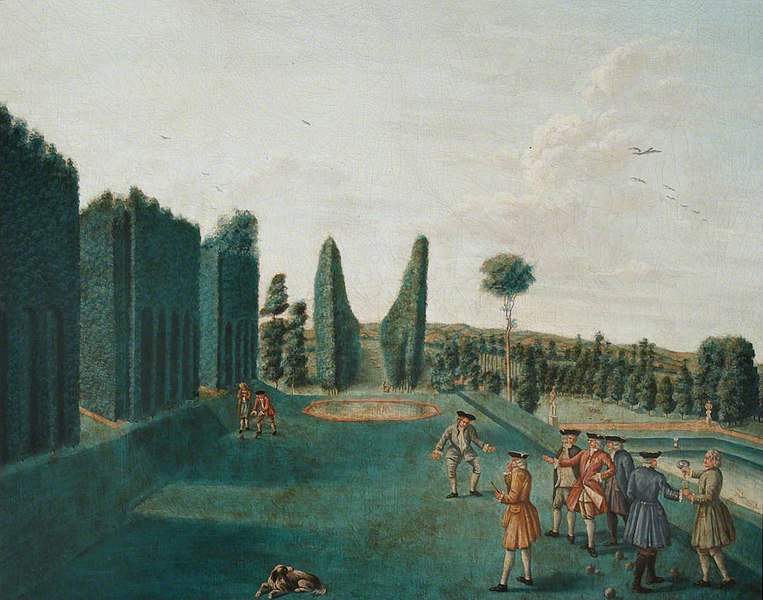
'The Bowling Green and Octagon Pond'
Circa 1700's. Artist Unknown
Hartweel House, Buckinghamshire
National Trust

Many great houses had a bowling green or a croquet lawn surrounded by little grassy dyke to keep the balls in play, and these too were often deliberately flooded in winter, if a frost was expected, to make ice.

By the eighteenth century, ice was being transported by barges all over England having been harvested from the marshes where again it formed easily in shallow bog pools, even when the weather was not cold enough to freeze lakes. But the ice, having been made from fishpond water or marshes was too dirty to be put directly into drinks or food. It could only be used to chill containers of food or bottles. The English had to wait until clean ice could be imported from abroad before it could actually be added to their drinks.

Ice Cutting on the St. Lawerence River
Montreal, Quebec
Photo Alexander Henderson, circa 1870

The first import from Norway proved a bit of a disaster, since by the time customs had decided ice was ‘dry goods’ they were left with nothing but a warehouse full of water.  But by 1830, 150 tons of imported ice was stored beneath the Haymarket in London, collected by steam-driven cutters from lakes in Scandinavia or the Great Lakes of America, brought over by ship and transported round England by barge.

The American lawman, Bat Masterson, (1853-1921) once said, ‘We all get the same amount of ice. The rich get it in summer. The poor get it in winter.’ But finally, that was changing – people could buy clean ice cheaply for their kitchens and in time, cooks in even in modest households could attempt Mrs Beeton’s famous ice creams and lemon-ice recipes.

As for sipping iced sherbet while reclining on silken cushions – it’s still on my bucket list!

Ice Formation Edge of pond
Photo: ThomasLendt


Friday, 4 March 2022

'Keen As Mustard' by Karen Maitland

Black Mustard Flowers
Photo: Aryan Murmu

The second in my new Jacobean thriller series, Traitor in the Ice, is set in Battle Abbey in 1607, then occupied by the redoubtable dowager and recusant, Lady Magdalene, Viscountess Montague. When her grandson, Anthony Viscount Montague, inherited his estates in 1595, the 22-year-old wrote a rule book for the servants of his household detailing the duties of each officer and servant, from the high steward to the scullery man. While all the other servants were assigned a long list of tasks, I was intrigued to discover that the Sculleryman, had only two duties – to clean and safely store all the pewter and silverware, and ‘to have a single regard to the tempering and making of mustard with good seed and to the well keeping and serving of it.’ 

Preparing the mustard doesn’t sound like a task that would occupy much of the working day, but when you realise how important mustard was to the Tudor and Jacobean household and the vast quantities they used, it was a key job.

Thomas Tusser (1524-1580) in ‘His points of Good Husbandry’ advises –

Maids, mustard-seed gather, for being too ripe. 

And weather it well, ere ye give it a stripe:

Then dress it, and lay it in soller up sweet

lest foistiness make it, for table unmeet.

                            (Soller – a dry loft or upper room)

Black Mustard, Brassica nigra, in seed
Councillor's Marsh at Le Verdon-sur-Mer, France
Photo: Touam (Herve Agnoux)

Mustard seed, when ripe scatters from the stem at the slightest touch, so had to be gathered before it was fully ripe. Maver in 1615, says this should be done early in the morning when the dew was still on it. Depending on the quantity to be harvested, the whole plants were usually gathered up in the maid’s skirts or in a sheet carried between two poles, to minimise the loss of seed.

When dried, the plants were lightly beaten on a hurdle or put into linen bags and ‘striped’ with a thin cane to dislodge the seed. The chaff was blown off, and the tiny seeds sorted by hand or sieved to get rid of pieces of stem and husk. Another method was to wash the beaten seed, so that husk floated off, then put the seeds into a cloth bag, dry them, then stamp on them to crush them, before sieving to make a fine mustard flour. 

They could also be ground up using a pestle and mortar or quern, but this had to be done carefully to avoid getting mustard dust and oil in the eyes which could be an irritant. By the Elizabeth period, those who could afford it, equipped their sculleries with mustard mills alongside other utensils such as a bread grater and a mortar for spices. But grinding wasn’t the end of the process. The mustard then had to be made into a sauce.

Black Mustard Seeds. Photo: Sanjay Acharya

A 17th century recipe for mustard to be eaten with beef, calls for one and half pints of mustard seed to be ground into honey, olive oil and vinegar.

A more eye-watering sauce was made by soaking slices of horseradish in vinegar, squeezing them out, and adding sugar and a chopped onion to the vinegar. You used this flavoured vinegar to mix into your mustard flour to make a cooking sauce, which you spread beneath beef before braising it, or poured over slices of brawn. 

Mustard was also eaten with Poor Jack, dried salt cod, also known as haberdine, served in the cheaper inns or taverns. The fish was inexpensive, but had little flavour, so was consumed with large quantities of mustard. At the other end of the social scale, in wealthy households, plaice, ray and ‘White,’ pickled fish such as herring, ling, or whiting, was also served with mustard sauce. Minced salmon was dressed in a mustard, sugar and vinegar sauce. Goose, wild duck, gulls, woodcock and young herons came served with a mustard sauce, as did rabbit.

British mustard pot, John Gold, 1793
Huntington Museum of Art, West Virginia, USA
Photo: Daderot


Perhaps Voltaire (1694-1778) had a point when he said, ‘In England there are sixty different religions, but only one sauce.’ Actually, the English Tudors and Jacobeans had a large array of different sauces, but mustard sauce was the one consumed in vast quantities by both the farm labourer and the wealthiest noble, and this was because all were agreed mustard was excellent for the digestion. ‘Let such whose stomachs are so weak they cannot digest their meat or appetite it, take of mustard seed a dram.’ Culpepper (1616-1654)

But while the English could scarcely eat a meal without mustard, the Scots viewed mustard consumption as a sign of weakness. They had long prided themselves on eating their meat with only the good natural gravy that sprang from the juices. In the 1630s, Robert Monro of Opisdale, was appalled by the Scottish soldiers serving in the armies of the King of Sweden whose ‘stomackes could not digest a Gammon of Bacon or cold Beefe without mustard,’ which he saw as evidence of moral degeneracy and feebleness among the once-tough Scottish soldiers.

USA Newspaper ASdvert 1922
Mustard still advertised as 
good for the digestion.

But mustard wasn’t just used in cooking. Horseradish and mustard are often found growing wild together on old monastic sites and near medieval inns. In the days before heat-gels, aching bones, stiff joints and muscles, the result of spending long, cold days walking or riding, could be eased with ointments made from a mixture of mustard and horseradish, sometimes provided as charity by monasteries, but which innkeepers also sold to suffering travellers. A body rub with the same ointment before setting out was a good way to keep out the cold. Mustard was also used as a cure for all kinds of other ailments, but as with early recipes, it’s not always clear which type of mustard they were using. White mustard, black mustard, hedge mustard, treacle mustard and garlic mustard were all used in cooking and medicinally, but modern botanists class some of these plants as being from different families.

Throughout the Middle Ages, households mostly grew the mustard they required for their own use, not least because young mustard greens were considered an excellent pick-me-up and purge after the long winter months of salt meat and dried beans. Medieval monasteries and manor farms supplied some surplus seed for market, but in Tudor times in ever-expanding cities such as London, many people no longer owned an herb patch, and mustard started to be collected on a commercial scale in the country to be sold in the city. 

It was usually transported in the form of solid dry balls, hence Shakespeare’s biting insult in Henry IV when Poins is described as having ‘wits as thick as Tewkesbury mustard.’ In Tewkesbury and elsewhere, cannonballs in iron mortars were used to grind the mustard seeds, which women had gathered from hedgerows and fields. Legend has it when Henry VIII visited Tewkesbury in 1535, he was presented with mustard balls covered in gold leaf.

Hedge Mustard, Sisymbrium officinale
Photo: Ian Cunliffe CC BY-SA 2.0

To make the balls, mustard had to be mixed with a variety of other ingredients to bind it, such as pease-meal, flour, wine or spices and then they were dried. An Italian recipe of 1465, combined the mustard with pounded raisins, cinnamon and cloves. When the ball was crushed and mixed into milk or vinegar, wine or cider, the result was an ‘instant’ sauce. This made it particularly useful for provisioning travellers or using onboard ships.

Not everyone was impressed with the result, though. Peter Mundy 1608-1667 noted in his journal that Tewkesbury mustard ‘is much spoken off, made up in balls as big as hen’s eggs, at 3d and 4d each, although a farthing worth off the ordinary sort will give better content in my opinion, this being in sight and taste much like the old dried thick scurf that sticks by the sides of a mustard pot.’

Treacle Mustard or Wormseed
Principly used in Tudor times 
to counteract poisons
Photo: Jason Hollinger

But whether it was for eating or rubbing on, the household and servants in Battle Abbey would have been connoisseurs of mustard, and if Viscount Montague’s sculleryman didn’t ‘cut the mustard’ and temper his seeds perfectly, his wages would have been ‘moonshine in the mustard pot,’ a delightful Jacobean phrase, meaning he’d be paid nothing.


Writing as KJ Maitland, her new novel, Traitor in the Ice, the 2nd in her Jacobean crime thriller series, is published on 31st March 2022, by Headline.