Showing posts with label Maggie Brookes-Butt. Show all posts

Friday, 16 January 2026

Hunting for Hellfire by Maggie Brookes

 I felt as though I'd inadvertently stirred a hornet's nest when an Instagram / Facebook post I made about a chance visit to West Wycombe in Buckinghamshire was viewed more than 22,000 times. Some of the comments made me itch to investigate further.

My original post said, 'West Wycombe looks like a quiet English village until you spot the bizarre ball on top of the church tower, the Hellfire caves and the extraordinary mausoleum for the Dashwood family. They were all constructed in the mid-18th century by Sir Francis Dashwood, founder of the Dilettanti Society and co-founder of the Hellfire Club.' I suspect it was the hashtag '#hellfire club' which created the viewing frenzy. (Note to self ­– write a novel abut a licentious secret society!)

Fraser Whitelock of High Wycombe responded first: 'St Lawrence's was built on top of the hill, on a pagan site. Later extended and a crypt added said to be an exact recreation of Syrian Sun Temple. The Golden Ball was used as a messaging system using the sun's reflection, linked through buildings such as Crystal Palace, through line of site, (sic) linked across the channel to Paris.  The Hellfire Caves were dug to access underground water systems, the re routed to help flood and create the lakes in Dashwood's grounds, so he could stage epic battles between Spanish galleons he had transported to West Wycombe village.'

Anthony Mealing, also from High Wycombe and a Listed Building Consultant at Garret McKee Architects responded: 'The Dashwoods had two Spanish Galleons transported to West Wycombe, and rebuilt them for battle reinactment (sic) on his lake. Spanish galleons were being taken in Barbados by privateers, and pirates. Also although it is told that locals dug the tunnels, it was actually Cornish workers. The obvious connections between pirates, Cornwall, mining, and overwhelming Masonic connections in the village. Stokes the fire a little more.'

Fraser Whitelock came back: 'I used to knock around the village as a teenager.  The tunnels in the High Street exist. I've seen them.  Used to dare each other to go in them.  No one did....  Don't get me started on Templar history in Wycombe.....'

Head spinning, I set out to see what I could discover. 

The National Trust told me that there was indeed an Iron Age ('pagan') settlement on the hill, dating from the 4th or 5th century BC, and later, the Saxon village of Hæferingdune or Haveringdon. Sadly its population was decimated by the Black Death in the 1340s, and those who remained moved down into the valley to the current village, named West Wycombe. The medieval church of St Lawrence remained on the hill. 

Then, in 1723, the 15-year-old Sir Francis Dashwood inherited his father's estates and Baronetcy. As a young man he did the Grand Tour and developed a taste for classical art and architecture, and a reputation for wild behaviour.  In the 1730's he started the Society of Dilletanti, which his political enemy Horace Walpole said was a 'club for which the nominal qualification is having been to Italy, and the real one, being drunk.' Later Sir Francis founded the Divan Club, for men who had visited the Ottoman Empire. He liked to dress up. This painting was made in his Divan Club outfit.

He seems to have begun the excavation of the 'hellfire caves' to quarry chalk for a new road, and give employment to local men who had suffered three successive bad harvests. A long winding tunnel runs a quarter of a mile into the hill, with many passages and chambers leading off it, including a Banqueting Hall. The caves are said to be the largest man-made chalk cavern in the world.  The 'Inner Chamber' is reputed to lie directly under St Lawrence church, signifying heaven and hell.

Sir Francis continued to love founding questionable 'dining clubs'. The one which is now known as the Hellfire Club, wasn't called that by him.  He called it the Order of Knights of West Wycombe, or The Order of the Friars of St. Francis of West Wycombe. Not such a catchy hashtag! This painting of him by Hogarth shows him as 'St Francis' worshipping a naked Venus.

Members of the not-called-the-hellfire-club may have included important 18th-century figures including William Hogarth, John Wilkes, Thomas Potter and John Montagu, 4th Earl of Sandwich, though no papers about the club survive. Benjamin Franklin was a close friend of Sir Francis who visited the caves on more than one occasion. The club motto is popularly believed to have been a quote from Rableais: 'Fais ce que tu voudras' (Do what thou wilt).

Horace Walpole (who we have to remember was the author of the first Gothic novel, as well as Sir Francis' political rival) wrote this, about meetings at Medmenham Abbey on the Thames, also owned by Sir Francis: 'Its practice was rigorously pagan: Bacchus and Venus were the deities to whom they almost publicly sacrificed; and the nymphs and the hogsheads that were laid in against the festivals of this new church, sufficiently informed the neighbourhood of the complexion of those hermits.'

The 'inner temple' of the Hellfire Caves.

But Sir Francis was more than a hell-raiser. He spent most of his life extending and converting the Queen Anne house at West Wycombe into a Palladian mansion with landscaped grounds full of follies. He bought pictures, sculptures and books. In 1732 alone, he purchased over £2700 in books from a bookseller in Amsterdam. 

In the 1750s he had the tower of St Lawrence's Church raised and crowned with an 8 ft wooden ball covered in gold leaf, possibly inspired by the Dogana in Venice. 

Dogana Da Mar, Venice

Various sources say the West Wycombe ball contains seating for six to 10 people. It was described by the author John Wilkes as 'the best globe tavern I was ever in'. 

Back to the comments about the golden ball on my Facebook post:

Craig Jay said 'I remember as a child you could climb the steps into it. I believed it to be a small card room for a select group of hellfire club members to illicitly gamble. Did the earl of sandwich bring a packed lunch?'

Adela Hollingsworth replied 'My mum went inside it when she was a child but it hasn’t been open to the public to enter for years.' 

 Sarah HR wrote: 'There are seats inside and they looked used to me when I looked into it 55 years ago.'

St Lawrence's church, West Wycombe
What about the signalling from the ball? A book about the Dashwoods published in 1987 reports a suggestion that Sir Francis Dashwood used a heliograph to signal through a porthole in the golden ball to his friend, John Norris (1721–1786), who had erected a tower, now known as the Camberley Obelisk, near his home at Hawley, Hampshire, 21 miles to the south. I haven't been able to find any evidence that signals continued across the Channel, and of course the Crystal Palace wasn't built till 1851, but it's a good story, and I love a good story.

The inside of the church was also remodelled in a classical mode, though perhaps not based on a temple at Palmyra. The painted ceiling, by Borgnis, was apparently an adaptation of Robert Wood’s drawings of the Temple of the Sun at Balbec. 

I also failed to find evidence of the two Spanish galleons, though the National Trust says that Sir Francis kept a frigate on the lake, using it to re-enact sea battles as entertainment for guests. Cannonballs dredged from the lake are on display in the house.

Not wanting to be forgotten, Sir Francis also built the Grade One listed  Dashwood Mausoleum on the edge of the hill.

In true Dashwood style, there’s an urn containing the heart of the poet Paul Whitehead, steward of one of Sir Francis's 'clubs'.  In the centre stands a pedestal and urn dedicated to his wife Lady le Despenser, who must have been a long-suffering woman. 

Unsurprisingly, the house and gardens have featured in many TV dramas and films, including Downton Abbey, The Crown, Bridgerton, Belgravia, adaptations of Daniel Deronda, Cranford, Little Dorrit and Howards End, episodes of Endeavour and Foyles War and movies A Clockwork Orange, The Duchess, I Capture the Castle, Bridget Jones' Baby and the one Sir Francis might have loved the most, Pride and Prejudice and Zombies.  

Alongside his secret societies and his collecting, Sir Francis was a politician, who became the Chancellor of the Exchequer, then the 11th Baron le Despencer, Postmaster General and finally the Lord Lieutenant of Buckinghamshire. 

I wondered where Sir Francis got the money to do all his renovations, rebuilds and to fund his wild parties? His father and uncle were successful merchants, who served on the board of directors for both the Royal African Company and the East India Company. As such, their investments were deeply implicated in Britain’s international slave trade. Although we don't know if Sir Francis owned enslaved people, his grandson received government compensation for emancipation of slaves.

 Back on my Facebook feed, Anthony Mealing wrote ' The Dashwoods were slave owners up until 1835 with the end of Empire Slavery (the empire territories) when they received government compensation for emancipation of slaves on three plantations they then had an interest in, Barbados Spring Plantation 161 Enslaved, Barbados Over Hill Plantation 109 Enslaved, Barbados Ashton Hall Plantation 83 Enslaved... From the UCL records.'

What about the link to the Knights Templar? A medieval manor house in what is now High Wycombe known as Temple Wycombe was owned by the Knights Templar from 1227. When they were dissolved it passed to the Knights Hospitallers, who held it until the dissolution of the monasteries by Henry VIII. Of course this was long before the Dashwoods of West Wycombe. A branch of Morrisons now stands on the site.

 Finally there's a mysterious comment from Robert Fox: 'Not forgetting the praying wall in the High Street, where you can see where people have knelt.'

So far my searches haven't turned up any other mention of this wall. I guess I'll have to return and take a look. If I dare.

Maggie Brookes, novelist and poet. Author of  historical novels The Prisoner's Wife and Acts of Love and War. As Maggie Brookes-Butt: Wish, New and Selected Poems.

Instagram: Maggie __Brookes 
Facebook: Maggie Brookes-Butt

Further reading about Sir Francis:  https://www.artandthecountryhouse.com/essays/essays-index/sir-francis-dashwood-connoisseur-collector-and-traveller   Jason M. Kelly is Director of the IUPUI Arts and Humanities Institute and Professor of History in the Indiana University School of Liberal Arts at IUPUI. 


Friday, 17 January 2025

January Floods by Maggie Brookes

On Boxing Day it was 20 years since the terrible tsunami in the Indian ocean. Remembering our shock on hearing about that disaster, which killed 230,000 people, started me thinking about floods which have happened nearer to home, all of which occurred in January. 


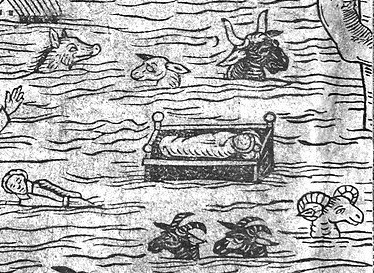
'A true report of certaine wonderfull ouerflowings of waters, now lately in Summerset-shire, Norfolke, and other places of England : destroying many thousands of men, women, and children, ouerthrowing and bearing downe whole townes and villages, and drowning infinite numbers of sheepe and other cattle' William Jaggard, 1607.

It was hardly an exaggeration. The great flood of the 20th Jan 1606 (or 30th January 1607 using the modern calendar) is thought by some to have been a tsunami, though others argue that it was a storm surge. At mid-day, a 'massive hill of sea'  swept up the Bristol channel and poured into the low-lying farmland of Somerset and Wales, killing an estimated 2,000 people. About 200 square miles of farmland were destroyed. Whole villages and much livestock (perhaps 'infinite numbers!') were swept away. Puritan pamphleteer William Jones described the scene:  'so violent and swift were the outragiouse waves, that ... in lesse then five houres ... many hundreds of people both men women, and children were then quite devoured.'  


Where they could, people climbed trees, ' Many there were which fled into the tops of high trees, and there were inforced to abide some three daies, some more, and some lesse, without any victuals at all, there suffring much colde besides many other calamities, and...through ever much hunger and cold, some of them fell down againe out of the Trees, and so were like to perish for want of succour...'


 '... Othersame, sate in the tops of high Trees as aforesaid, beholding their wives, children, and servants, swimming (remediles of all succour) in the Waters. Other some sitting in the tops of Trees might behold their houses overflowne with the waters. some their houses caryed quite away: and no signe or token left there of them.'

Plaque in Kingston Seamore Church, Somerset.

William Jones was certain that the flood was God's warning to his people of England to mend their ways, but the flood which carried away the Devon village of Hallsands on January 26th 1917 was a wholly man-made disaster.

Hallsands in 1885, before the flood

In the 1890's dredging for gravel and sand began off-shore to provide building materials for a new naval dockyard in Plymouth. By 1900 the level of the beach had fallen considerably, and the villagers petitioned their MP to get the dredging stopped. But the damage had been done, and when a great storm raged on the night of January 26th. Waves broke through doors and windows, waking the inhabitants. Imagine their terror as they leapt from their beds, gathered up their children, and set out to climb the cliffs behind the village in pitch darkness.

The remains of Hallsands village

Four houses had been swallowed by the sea by midnight. And the next day brought no respite, as another high tide washed away a further 25 houses, leaving only one standing. Nobody died, but 128 villagers were left homeless and without means of earning a living. Their claim for compensation took seven years.

The ruined village of Hallsands (sea level) 

It isn't only rural and coastal areas which have suffered from January floods. On 7 January 1928, thousands were made homeless when the Thames flooded in central London, pouring over the embankments, flooding the city from Greenwich and Woolwich right up to Hammersmith and Putney. This was caused by a mixture of nature and man-made interventions: a sudden thaw, a high spring tide, a storm surge and heavy rain all combined with dredging which had been carried out to deepen the Thames which created a funnel effect for the surging tide.

Tide level at Tate gallery.

Tube stations along the river filled up with water, the House of Commons was flooded, Turner paintings were damaged at the Tate gallery and the Tower of London moat filled up with water. 4,000 people were made homeless, though only 14 died. In a typically British way, mobile animal hospitals were set up for pets which had been injured in the floods. The slums and warehouses of Millbank were worst hit, and many were demolished and later replaced by office blocks.

Mobile animal hospital.

The worst January flood of modern times happened during the night of the 31st of January 1953 when the north sea storm tide killed more than 300 people down the East coast of England and Scotland, plus 224 lost at sea. This terrifying night-time flood was caused by a combination of a high tide with a storm, said to be the worst storm to hit Scotland for 500 years. It hit between Orkney and Shetland, then surged south, flowing over sea walls in 1,200 places, forcing 30,000 people from their homes. 58 people died when Canvey Island in Essex was flooded, 37 died at the seaside village of Jaywick, and 41 more at Felixstowe in Suffolk, where wooden prefab homes were washed away. As the tide overspilled the Royal Docks in London's East End, 200 people were made homeless and sheltered in Canning Town Town hall.


Part of the problem was a lack of communication. When a high tide occurred at Kings Lynn, killing 36 people, it was assumed to be a local event, and no warnings were issued down the coast and more than 60 people died some hours later on Canvey Island. If they'd been warned, there would have been enough time to evacuate them. More than 900 miles of coastline were damaged at a total cost estimated at £50 million. But there was incredible bravery too. Four men were given the George medal for their courage in wading into the waters and rescuing people.


Following the 1953 storm, coastal defences were improved right along our North Sea coasts and a Storm Tide Warning service was created. But some people remained homeless for a long time. In March 1953 108 families were moved into these caravans in Harwich, where they lived until December 1954.


Floods have already happened this January around the country, and no doubt there will be more, partly because of human-caused global warming, and building on river flood-plains, but also just because it's winter. Let's hope we get adequate warning.


Maggie Brookes, novelist and poet. Author of  historical novels The Prisoner's Wife and Acts of Love and War. As Maggie Brookes-Butt: Wish, New and Selected Poems, published January 27th 2025.

Instagram: Maggie __Brookes 
Facebook: Maggie Brookes-Butt

Friday, 19 July 2024

Casting my vote by Maggie Brookes


Whenever I cast my vote I feel I can hear the cheers of all the women suffragists and suffragettes who worked so hard to win that right for me, but when I was posting my ballot paper this time, I wondered how many countries in the world still don't give women the right to vote. 


I was amazed and pleased to discover that technically it's only one. In Vatican City elections only cardinals of the Catholic Church (all men) are allowed to vote for a new pope. However, in looking this up, I discovered that the right to vote and the experience on election day can be two different matters. For example in Kenya, a 2019 United Nations report registered concern about harassment or violence against female voters. Voting can also involve a long and sometimes dangerous walk to a polling station, and in some areas it's culturally unacceptable for pregnant women to be seen out in public, which obviously limits voting.


At the recent UK election, voters were asked to present ID at the polling station for the first time. This seems sensible, but in some countries it can work against women. A report from the Borgen Project said that in Egypt women are less likely than men to have an ID card, and even if they do, their husbands often 'look after them' and simply refuse to hand them over, preventing them from voting. Also, having to reveal their faces in public can also put women off voting if they normally wear a niqab. Not to mention the attitudes of the men. In Nigeria in 2016 President Muhammadu Buhari said, 'I don’t know exactly what party my wife belongs to. Actually she belongs in the kitchen, the living room and the other rooms in my house.'

President Muhammadu Buhari

Of course there are countries where there is no suffrage at all. Brunei hasn't held a national election since 1962, there haven't been elections in Eritrea since its independence in 1993, and a recent election in the United Arab Emirates granted suffrage to only 12% of all men and women.

But hang on. I've disappeared down a research rabbit-hole (this happens all the time to us novelists) and this is supposed to be a history blog, so when did women first get the vote? I've always assumed it was after the first world war, but I realise I'm looking back through a Western, patriarchal lens.

In 1639, a young nun called Marie Guyart (later known as Marie of the Incarnation) set sail for Quebec in 'New France' where she was keen to convert the 'savages.' 

Marie of the Incarnation

Working with the Iroquois women, she discovered, 'These female chieftains are women of standing amongst the savages, and they have a deciding vote in the councils. They make decisions there like their male counterparts, and it is they who even delegated as first ambassadors to discuss peace.' It turned out that many First Nations peoples of North America had a matrilineal system, where belongings and wealth were passed down from mother to daughter and yes, they even had voting rights. Unfortunately, the settlers did not adopt this system, and when women were given the vote in Canada in 1917 that did not even include First Nation people, who weren't allowed to vote until 1960. Canadian First Nation people did not win the vote until 1960.

Back in the Old World, I've always thought of Mary Wollstonecraft's A Vindication of the Rights of Woman, published in 1792, as being the very first call for equality for women, but a limited form of women's suffrage had already been introduced in Sweden during Age of Liberty (1718–1772) and also in the Corsican Republic in 1755. 

Mary Wollstonecraft

Sometimes women were given the vote by accident: in a new British Colony called Sierra Leone, all heads of households were given the vote in the 1792 elections because nobody expected a third of them to be African women!  In a similar way in New England in 1756, Lydia Taft became the first legal woman voter when her husband Josiah died, leaving her as the largest landowner in Uxbridge, Massachusetts. In a community calling for 'no taxation without representation,' they had no option but to allow her to vote in local town meetings, 164 years before women were enfranchised in the USA.

Uxbridge, Mass.

Coming into the 19th century, there are odd instances of female suffrage on small islands and territories. The Pitcairn islanders who were the European descendants of the mutineers of HMS Bounty were allowed to vote from 1838 – including the women – and some women on the Isle of Man had the vote from 1881. In the United States in 1869 the Territory of Wyoming decided to try to attract new settlers by giving women the vote. It's not clear whether that was a success!

A little later, in 1893, the British colony of New Zealand became the first country in the world in which all women had the right to vote in parliamentary elections, though they were not allowed to stand for election. In the following year, South Australia allowed women both to stand for election and to vote.

But of-course it took women's huge contribution to national life during the First World War, before the UK Parliament finally passed the 1918 Parliament (Qualification of Women) Act. It was only one page long and gave women the vote if they were over the age of 30 or property owners or UK university graduates. (At a time when most universities did not confer degrees on women, no matter how brilliant!) Unfortunately, although my own grandmothers were working, married women, they were not yet 30 in December 1918 and very far from being property owners or graduates, and so would not be able to vote for another ten years.

It took some other countries a lot longer to give women the vote, the most surprising laggard being Switzerland. It took till 1991 for The Swiss canton of Appenzell Innerrhoden to give women the vote, and women as a whole in Switzerland only gained the right to vote at federal level in 1971.

In the UK the 1918 Act also gave women to right to stand for Parliament and seventeen women took up the opportunity, though only one was elected: the Sinn Fein candidate Countess Constance Markievicz, who never took up her seat. The first woman to actually take her seat was the American Nancy Astor after a by-election in December 1919. Two years later Margaret Wintringham joined her in the House of Commons.

Margaret Wintringham MP

I wish I'd talked to my grandmothers about how this huge change seemed to them. I do remember my maternal grandmother's excitement when Margaret Thatcher was elected as our first female Prime Minister in 1979. I wasn't aware at the time that the first ever female PM in the world had been elected almost twenty years before! Sirimavo Bandaranaike had become Prime Minister in Sri Lanka (then Ceylon) in July 1960 after the assassination of her husband.

Sirimavo Bandara

 Then the first woman was elected president of a country in 1980. VigdĂ­s FinnbogadĂłttir of Iceland won the 1980 presidential election as well as three subsequent elections, remaining in office for 16 years.

A quick look at the number of women in government in any given country gives a clue to the levels of equality and the likelihood of women exercising their right to vote, though the countries with biggest percentages of women in parliament might be surprising. The Interparliamentary Union report of 2019 cites Rwanda ahead of the front runners with 63%, and Cuba and Bolivia not too far behind with 53%. The UK came in with 32% at the time. Down at the bottom of the league table were Solomon Islands with 2%, Oman with 1%, Yemen with 0.3% (one woman - go you!) and Micronesia and Papua New Guinea with none.

Chile's first female president Michelle Bachelet has observed, 'When one woman is a leader, it changes her. When more women are leaders, it changes politics and policies.'

Michelle Bachelet

In June 2024, there were 27 countries with women as Heads of State and/or Government. However, UNwomen.org points out this means that 'at the current rate, gender equality in the highest positions of power will not be reached for another 130 years.' It also notes that the 'five most commonly held portfolios by women cabinet ministers are Women and gender equality, followed by Family and children affairs, Social inclusion and development, Social protection and social security, and Indigenous and minority affairs.'   So, we still have a way to go.

However, the good news is that following the UK election two weeks ago in July 2024, 263 women were elected to the British parliament, representing taking  40.5% of the total seats, including 50 black and minoritised women MPs. I can hear those cheering suffragettes now!


Maggie Brookes. Novelist and poet. Author of Acts of Love and War and The Prisoner's Wife.
Instagram Maggie__Brookes  Facebook: Maggie Brookes-Butt