Showing posts with label Maria McCann. Show all posts

Friday, 7 February 2020

The Best Historical Fiction for LGBT History Month - chosen by Anna Mazzola


February is LGBT History Month in the UK and therefore an excuse to pull together my favourite historical fiction novels that explore gender and sexuality throughout the ages.


THE SONG OF ACHILLES BY MADELINE MILLER


An exquisitely-written reimagining of The Iliad, told from the point of view of Patroclus, Achilles’s lover. An entirely fresh take on the Trojan War and its heroes by the author of that other extraordinary novel, Circe.


AS MEAT LOVES SALT BY MARIA McCANN


McGann’s thrilling and erotic debut is a tale of obsession and murder set during the violence of the English Civil War. Dark, complex and unflinching. Everyone should read McCann’s novels immediately.


DAYS WITHOUT END BY SEBASTIAN BARRY


Set in the 1850s and ’60s, during the wars the U.S. fought against the Sioux and the Yurok, and the Civil War, this is a stunning and deeply moving story of two soldiers—an Irish immigrant, Thomas McNulty and his brother-in-arms, John Cole.


THE SEALED LETTER BY EMMA DONOGHUE


The Sealed Letter explores the story of a divorce trial that scandalised mid-Victorian London, focussing on the reluctant involvement of Emily Faithful and her relationship with the seemingly less-than-faithful half of the marriage, Helen Smith Codrington. An intriguing and cleverly-written mystery.


FINGERSMITH BY SARAH WATERS


Really I could have included most of Sarah Waters’ books here, but Fingersmith remains my favourite: a glorious mystery and love truly with a truly gripping plot.
Also featuring a wonderful cast of villainous characters, brilliant use of 19th century slang (‘Pigeon, my arse!’) and the best twist in the business.


REGENERATION BY PAT BARKER


The Regeneration trilogy is an incredible fictionalized account of the relationship between army psychiatrist Dr Rivers and a group of interconnected patients, including Siegfried Sassoon and Wilfred Owen. It blends brilliantly the horrors of war with gay life in Edwardian England and the newly emerging science of psychology.


THE COLOUR PURPLE WALKER


An epic and heart-breaking tale of perseverance as well as an exploration of race, gender, family, and sexuality in 1930s Georgia. The novel is, among many other things, a story of love between women.


MUSSOLINI’S ISLAND


In 1939 a series of Sicilian men were taken from their homes and imprisoned on the island of San Domino in the Adriatic Sea. Their crime? They were gay. Out of this little-known slice of history, Sarah Day has created a fascinating and beautifully written novel.

And coming soon...


Do also look out for Neil Blackmore's The Intoxicating Mr Lavelle, sauntering your way in April 2020: a dark and funny romp through the Grand Tour - The Favourite meets the Talented Mr Ripley in 18th century Europe.


_____________________________________

Anna Mazzola is a writer of dark historical fiction. 

https://annamazzola.com
https://twitter.com/Anna_Mazz

Monday, 12 March 2018

Hidden Gems


In my role as The Times' reviewer of historical fiction, I read a lot of books. I've also been a judge for the Historical Writers Association in two of the past four years. I estimate that over those four years I have read more than 300 works of historical fiction. Most engage, some disappoint, a few utterly transport me.  But there is, from what I can see, minimal correlation between excellence and sales.

I was thinking of this on Wednesday night. I was at a talk by the brilliant writer of comic spy novels, Mick Herron. Mick told us that he had made slight ripples with his first six books. He wrote primarily to amuse himself. His career is a story of late blooming. He changed publishers and his new outfit, John Murray have championed him onto the bestseller lists.

But this is, as he said, unusual these days. It is all about the debuts. Make waves with your first book and a decent career beckons. Make ripples, and you will bob unnoticed forever. It is, to the say the least, dispiriting.

In further musings, I thought of those writers of historical fiction whose books ought to thunk into the public consciousness with a tremendous splash. The underrated ones. The unsung ones. The ones whose prose shimmers in the darkness.

I thought I would share a few of those on my very subjective list.

Maria McCann.
Maria McCann is a historical ventriloquist. There is no writer of historical fiction I know whose words feel so steeped in time and place. She is the queen of authenticity. Her first two books were set in the seventeenth Century. Her debut, As Meat Loves Salt, is a dark tale set in the English Civil War. Her third, Ace, King, Knave, used thieves cant to bring the eighteenth century to life. McCann has garnered praise, fans, and even a slot on the Richard and Judy list - but this doesn't seem to have translated into an extensive audience. Why not? It's a mystery.

Philip Kazan.
Oh, how I love Philip Kazan's novels. My favourite is his last one, The Painter of Souls, about the early life of Filippo Lippi. It has everything you would want a in a book about early Renaissance art: beauty and an unmatched sense of place. But it also has a joyousness to it. Lippi loves life. It's easier I think, to write tragedy than joy. Kazan's next book is out next month. It's a departure - moving to the second World War in Greece. I'm almost scared to start it; I just keep looking at it and stroking it.

Livi Michael
The War of the Roses has enjoyed a flurry of popularity in recent times. There have been some big names tackling the interminable toing and froing of Henrys and Edwards. I am an admirer of Toby Clements' Kingmaker series. But Livi Michael's trilogy of books Rebellion, Succession and Accession ought to be widely lauded. They are astute, vibrant and beautifully written.


I asked around among my writer friends. Who should be more successful than they are? ME was the unspoken answer, but with typical generosity, other names were proffered. Jason Goodwin and Susan Fletcher were new names to me, but were championed by writers who know their stuff. Carol Birch, too, was mentioned. I adored her book Jamrach's Menagerie and yes, she definitely gets a spot on the list.

Who else should we be lauding, History Girls?

Thursday, 30 January 2014

You're never alone with Tineola by Maria McCann


When I spotted the first one, I didn't realise its significance.  Tineola Bisselliella is small, dull, and shuns light, so it isn't particularly visible, which is more than can be said for the destruction its grubs wreak on garments and furnishings.  Since I keep my clothes on an open rail in the room where I sleep, I wasn't happy about blasting them with poisons. I opted for conservative treatment: constantly turning the clothes on the rail and holding them in front of the window since the grubs drop away if exposed to daylight.

As I shook out each garment, I recalled Chaucer's Wife of Bath bragging that her lovely scarlet clothing suffered no moth damage because she was forever out and about in it.  When I first met with Dame Alice I was a teenager studying for A-levels and read her statement as a sly joke, equating adultery with good housewifery.  Now I know that wearing clothes outdoors, instead of folding them away in a chest, would indeed have kept down the moths, as would cold weather.  Our centrally heated houses with warm dark wardrobes are Moth Paradise: one reason I knew nothing about clothes moths back in 1972 was that we lacked the central heating and double glazing that extend their breeding season.  I find myself wondering how well mediaeval people understood why frequently worn clothes got fewer moth holes in them.  Did they notice the grubs falling away?  They were undoubtedly interested in finding solutions for such problems: the medical encyclopaedia Hortatus Sanitatis includes illustrations showing bed bugs and a woman combing lice out of a young man's (or boy's?) hair. 

Some terrifyingly large bed bugs and lice


In fact grooming routines go back beyond the middle ages, ancient history or even prehistory.  They are our inheritance from our primate ancestors.  Clean, Virginia Smith's wonderful 'history of personal hygiene and purity', shows how the animal behaviour knows as COBS (care of body surfaces) is the origin not only of such human grooming as parasite removal but also of much more sophisticated procedures such as cleaning wounds and massaging painful limbs.   

Monkey doctor and cat patient

Back to my moths.  It wasn't until I was reading in bed and a moth swooped out from the bedclothes that my skin began to crawl ― all right, it's a cliché, but an appropriate one.  In the modern world, we conceive of 'personal space' as a certain volume of air containing our own (clean, insect-free) body and garments.  Yet for centuries most of our ancestors had virtually no personal space in our sense.  Even royalty, who had more living room than most, had to share it with such democratic intruders as the clothes moth, the flea, the louse and the bed bug.   These were so much a part of everyday life that John Donne's  'The Flea' takes it for granted that his mistress will laugh rather than be insulted at the suggestion that both poet and mistress are flea-bitten.    But I am a child of the twentieth century, a post-Victorian.  What I felt was anxiety (suppose the moths never went away?  The internet is full of horror stories about people having to move house) and a flicker of irrational shame.


A woman tormented by fleas

Perhaps it was the presence of bugs that enabled Donne to think of fleas as comparative light-weights.  Even royalty had the occasional brush with the bed bug: two rival firms claimed to be bug-destroyers to George III.   Queen Victoria also had an official bug-catcher, the attractively named Mr Tiffin, who claimed to have found a bug in the bed of Princess Charlotte.  Bugs give off a foul odour (this at least warns people of their presence)  and the bites they inflict are agonizingly itchy.  Worst of all, they can walk upside-down, which means they can ambush you.  The British Museum warned in 1949: 'There are well authenticated records of people isolating their beds by means of saucers of paraffin placed under the legs so that the bugs could not climb up, and retiring to rest with a pleasant feeling of having foiled their enemies, only to be disturbed later in the night by bugs dropping from the ceiling.' [1]  It's not surprising, then, that 'lousy' is one of our older derogatory terms, dating back to the fourteenth century. 

An unrelenting battle against these pests formed the background to most human lives.  Like the plague, a disease carried by rat fleas, insect infestations peaked and dwindled according to the season but never quite went away.  At various periods women laboured to control infestations by sweeping out soiled rushes, beating fabrics and 'shifting' linen as frequently as their resources allowed.  Society developed polite strategies.  Boys were taught to sweep off their hats as a sign of respect while taking care to conceal the interior of the hat, where lice might be lurking (but what happened if the nits were clearly visible on your hair?).  Our ancestors' predilections for hats, bonnets and caps make sense in terms of cold houses, fear of 'chills', notions of modesty (in the case of women's hair) and a dislike of tanned faces.  Headgear might also serve, however, as a barrier against lice.  Despite the horror stories about nests of wildlife in high hair (not necessarily apocryphal ― see below) the extremely high styles were only popular for a comparatively brief period during the eighteenth century.  In contrast,  it's been suggested that the eighteenth-century male habit of wearing a wig over a shaven head might be an effective strategy against lice, especially if both head and wig were scrupulously cared for. 

Bottle for hair or wig powder 

In a different context, decorative cutting and peeling of fruits rendered them more attractive and advertised the culinary expertise of the household but was also a way, in an age before pesticides, of checking that nothing nasty was concealed beneath the skin and ensuring no guest would find 'the only thing worse than a worm', namely half a worm.     

How did it feel to know that creatures lurked everywhere, often in intimate contact with one's body or even inside it?  Weevils in the flour and the cheese, woodworm in the wainscot, cockroaches beneath the rug, rats and mice in the loft and the kitchen, silverfish in the cupboards, fleas in clothing and furnishings, bugs in beds, spiders everywhere.  Herbs were used to discourage or expel worms within the gut, but what of those worms which were thought to cause toothache?  How maddening to go about in the belief that worms were steadily boring into one's teeth.  The dividing line between self and world was fragile and permeable.    

Nowadays we understand that even the cleanest bodies are colonised, though not quite in the same way as our ancestors did.  We are used to the idea of yeasts in the body, of 'good bugs' in yoghurt.  It seems that the distinctive scent of human fingertips is created by microorganisms which colonise the sweat glands there; when I first discovered this, I felt queasy but there was no reflex of conditioned shame. Similarly, the man who wrote to the London Magazine in 1768 about seeing the coiffeur 'open his aunt's head' (dismantle her elaborate pomaded hairstyle, after she had worn it for over two months) seems to have found the vermin within repellent but not particularly shameful.  Nor did the hairdresser appear at all embarrassed.  'When the comb was applied to the natural hair, I observed swarms of animalculas running about in the utmost consternation and in different directions, upon which I put my chair a little further from the table and asked the operator whether that numerous swarm did not from time to time send out colonies to other parts of the body? He assured me that it could not; for that the quantity of powder and pomatum formed a glutinous matter, which like lime twigs to birds, caught and clogged the little natives and prevented their migration.'[2] 

Personally I'd find it easier to confess to petty theft than to 'swarms of animalculas' in my hair.  But then, I'm from a generation for whom verminous infestations carried a powerful stigma but were a very real possibility.  Until 1962 I lived in what was considered a slum, a Victorian terrace long since demolished.  The combination of urban and industrial grime with the conviction that 'cleanliness is next to godliness' meant that a dirty house was shameful (women would ostentatiously scrub their front steps) yet the houses were difficult to keep clear of vermin.  Rats were the biggest fear.  To discourage them, tins that had held fish or meat were burned in the fire to remove all food traces and only then put in the bin.  As far as I'm aware we didn't have rats, but we did have mice and cockroaches.  My father worried in case I put my fingers into the mouse traps.  My mother (who would be horrified if she knew I was writing this) came downstairs each morning, stepped onto the carpet and shuddered as a crackle informed her that she had just crushed a cockroach.  She saw these insects as a badge of shame and bitterly resented the woman next door who (she believed) was causing the infestation by lack of cleanliness.  'Then they come in here!' she moaned.  For all I know, the woman next door cherished a similar resentment against my mother.  The defining emotions were shame and disgust.  One of the worst things you could say about anyone was that their house 'had to be fumigated' (uttered in a shocked whisper).  It was like saying they were damned.

Nowadays people call Rentokil without embarrassment,  seeing infestation as a force of nature rather than a sign of depravity.  I'm glad that pointless shame is a thing of the past and I agree that while Donne could turn a flea bite to a weapon of seduction,  a body spotted with itchy blotches would be death to eroticism for a modern reader.  Yet I like to see the presence of lice, fleas and worse in historical fiction, along with the human responses to them.  They were, after all, like the poor: always with us.



[1] Quoted in McLaughlin, T.  Coprophilia
[2] McLaughlin, pp 113-114

Saturday, 20 April 2013

Landscape by Maria McCann


We have today a post from one of our marvellous team of Reserves, Maria McCann.


With Jane Borodale, Jane Feaver, Gabrielle Kimm and Michael Arnold, I recently took part in a Historical Fiction Day at the splendid Weald & Downland Open Museum in Sussex.  The topic for our panel was landscape.  I found myself focusing on it as I'd never done before: what could I say about my use of landscape in fiction?  What did I find most important and compelling when writing about it?

I began by considering the psychological relationship between characters and their physical environment.  This has always interested me: how would characters have understood the country surrounding them?   Would they conceive of it mainly in terms of inheritance, of money, of physical labour and the many skilled tasks that make up farming, in terms of an enduring (benign or oppressive) social order?  Would rusticity seem a refuge, or a banishment from everything that gave variety and savour to life?  Which modern associations and resonances would be alien to them? 

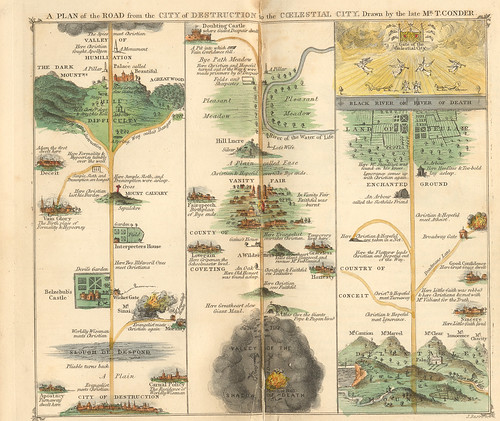
Religion would certainly shape their perceptions to some degree.  At this point I recognised something more, something central to my own work that had previously been almost invisible to me.  (My unconscious, like the shoemaking Elves, had done most of the work when my analytical mind was off duty; I won't say that I was entirely unaware of it, but I'd never looked at it head-on before.I realised that lost Edens and false paradises have always been central to my work, as have journeys, expulsions and the whole concept of life as pilgrimage that finds its most developed expression in The Pilgrim's Progress but stretches right back to the Biblical metaphor of the narrow path to salvation versus the broad road that leads to Hell.     


Engraving by Thomas Conder.  Photo: Jo Guldi.    Licence: see flickr.com/photos/landschaft/7035370

As we all know, journeys in the past were slow and inconvenient, events in their own right.   Novelists  are often advised to cut journeys from their narrative and jump straight to the arrival, but I love journeys (in fiction as well as in life) and am fascinated by their psychological resonances.  It's many years now since I was a religious believer, but at some point during my upbringing that metaphor of the true and false roads obviously sank deep. 

Two years spent teaching pastoral texts to seventeen-year olds also had its effect.  Some pastoral themes are very similar to those of the expulsion from Eden - nature, lost innocence - and during that time I became aware of pastoral's enduring appeal.  Amorous herdsmen may have vanished from Arcadia, but not from Brokeback Mountain.  Nymphs bathe al fresco to advertise shampoo and Italian peasants are still flirtatious at ninety thanks to the simple country goodness of Bertolli margarine.  People who have never heard of the word 'pastoral' still respond to the imagery: we still yearn for that impossible place, the countryside as it never was.
 
As a result of mulling over these influences, I'm now much more aware that in my own work,  landscape is sometimes in realistic mode, sometimes symbolic (though I hope not anachronistic), sometimes both, according to the demands of the narrative, while the characters' responses to it are mediated by the ideas by which they interpret the world.  Jacob Cullen, the tormented narrator of As Meat Loves Salt, is troubled by repetitive nightmares while working the land (a detested job, perceived by Jacob as futile) in an idealistic Digger commune: 

'Often, of late, I flew over Hell and looked down on the damned, whose punishment it was to mine rocks with picks and spades.  They flowed over the black surface like ants.  From time to time a flame would lick up and burn some of them off.  The rest kept digging.' 

His friend Ferris (who conceals a love letter inside a map, something I noticed with amusement when re-reading the novel)  dreams of the same commune becoming not an Eden (for 'Eden may not be regained') but the next best thing,  'a happy and prosperous Israel.'  He reads the landscape in terms of the opportunities it holds out for freedom and self-determination: not damnation, but redemption.   

In The Wilding, the shallower and more complacent Jon Dymond congratulates himself on being not an outsider, but 'a proper village man, woven in': a true countryman, living the pastoral idyll.  His self-satisfaction, however, cannot last: his Eden carries the seeds of its own destruction.

In future, when I begin a new piece of writing it will be with a deepened awareness of my own ways of working with landscape.  There are other aspects yet to explore, in particular why I keep coming back to lost Edens and find them so resonant.   Is there a connection with a traumatic house move at the age of six?  I rarely dream of landscapes but for many years now, houses where I've lived in the past have made regular appearances in my dreams.  I'd like to unravel that strand since I suspect there's creative energy bound up in it ― but this blog isn't the place for doing so. 

What are your thoughts on landscape?  And is there some important aspect of your work of which you are now aware, but which wasn't obvious to you at the time of writing?