Showing posts with label Mary Anning. Show all posts

Thursday, 30 May 2019

Cabinet of Curiosities by Charlotte Wightwick - the ammonite on the mantelpiece

Searching for inspiration for this month’s Cabinet of Curiosities, a Google search (note: other search engines are available) reminded me that the original Cabinets often contained wonders of Natural History. This in turn made me think straight away of my own tiny pieces of natural history, a crystalline ammonite and a few chunks of belemnite found on the beach at Lyme Regis.

These are both common fossils – I spotted the belemnites myself, and the ammonite came from the same hour’s fossil-hunting tour (albeit from the guide, whose eye was much keener than mine) – but they bring me enormous pleasure despite that.

Fossils from Lyme in turn make me think of Mary Anning. As a scientist, she’s one who was long neglected, although in recent years her importance has started to be recognised.

Mary was born in 1799, the daughter of a carpenter. Her father supplemented the family’s earnings by selling fossils from the beach to the gentry who were starting to visit Lyme. When he died, Mary and her brother continued to sell their finds as a way of supporting themselves and their mother.

Mary became highly skilled, not only at finding new fossils, but also at understanding them. Her notes and drawings are detailed and exact. She made some of the most important and spectacular finds of the period, just as palaeontology was opening up whole new worlds of ancient creatures. She was a pioneer especially in the discovery of ancient marine reptiles such as plesiosaurs and ichthyosaurs. Men like William Buckland, the Reverend Conybeare, Gideon Mantell and Richard Owen all benefitted from Mary’s discoveries and expertise.
Mary Anning. Source: Wikimedia Commons

But as a woman – and a working class woman at that – she stood no chance to joining any of the learned scientific Societies in London, or even seeing her name in print as an expert writing about her finds. Nor did they usually even pay her especially well: money was a concern for most of Mary’s life. Mary died of breast cancer in 1847, at the age of 47.

In recent years, Mary’s story has become increasingly well-known. You can find it told (and her finds clearly labelled as hers) in museums such as the Natural History Museum, and several biographies exist. Her importance has been recognised by the scientific establishment. Her story has also been told through historical fiction including Tracy Chevalier’s Remarkable Creatures and by our very own Joan Lennon in the Daughters of Time anthology. Currently there’s a film in production which will help to bring her name to an even wider audience, as well as campaigns to get her onto the new £50 note and for a statue of her to be erected in Lyme.

Ms Anning was clearly a highly intelligent woman, who was knowledgeable, skilled and a true expert in her field. She lived at a time when incredible new discoveries were being made, and which she contributed to enormously. In many ways she was remarkable. But in others she was entirely unremarkable – or at least similar to countless women and working class people throughout history, who have got on with the hard grind of daily living, doing whatever needs to be done to make ends meet, knowing that they were likely to receive little credit and less glory for their hard work.

My ammonite sits in pride of place on my living room mantelpiece, a tiny monument to the wonders of Nature, and to the countless people like Mary who have contributed to our understanding of nature, science and history.
My own tiny ammonite, which nonetheless has
pride of place on my mantelpiece. 


You can find out more about Mary Anning at https://www.nhm.ac.uk/discover/mary-anning-unsung-hero.html and about the campaign to erect a statue in her honour at https://www.maryanningrocks.co.uk/


Wednesday, 30 August 2017

The 'Poo Table': August's Cabinet of Curiosities by Charlotte Wightwick


I hope you all had a great Bank Holiday Weekend. Mine was brilliant: I stayed with friends in Weymouth. The sun (unusually, for Bank Holiday) shone and we had a great time at the beach and barbequing. While I was there, I started to think about what I should include in this month’s Cabinet of Curiosities, and I remembered another trip to the Jurassic Coast, last year.

The Jurassic Coast is a 95-mile long World Heritage Site, made up of sedimentary rocks which together form a near-complete record of 185 million years of history. Last summer we took a day trip to Lyme Regis. Obviously, I was excited to see the Cobb (famous to all Jane Austen fans as the site of Louisa Musgrove’s accident in Persuasion).

But the Jurassic Coast – and perhaps in particular Lyme Regis - not only has some of the best fossils in the world, but was also home some of the most dramatic scientific discoveries of the early and mid-nineteenth century. Regular readers of this blog will know I have a strong interest in the early fossil hunters and scientists, and their discoveries (see January’s Cabinet of Curiosities http://the-history-girls.blogspot.co.uk/2017/01/cabinet-of-curiosities-first-dinosaur.html )

So I was looking forward to the fossils: seeing them and learning more about them, maybe even finding some for myself on the beach. (Which I did, by the way!)

What I didn’t expect to find, but what forms today’s entry for the Cabinet of Curiosities, was a table made of fossilised poo.

William Buckland's coprolite table, Lyme Regis museum
The technical term for fossilised faeces is a coprolite, and they are surprisingly common.

You can find the ‘Poo Table’ (as it is un-technically called) in the excellent museum at Lyme Regis. It belonged to William Buckland, first Professor of Geology at Oxford University and later Dean of Westminster. He spent a lot of time in Lyme, working with the fossil hunter Mary Anning. One type of fossil they studied resembled strange round stones. Anning observing that were often found within – or very close to - the skeletons of the sea creatures she had excavated. Buckland reported to the scientific world that these were fossilised faecal matter from the sea creatures, opening up a whole new area of study.


William Buckland, c. 1845
 Despite this, the table in the Lyme museum does not appear to be made from coprolites from the Lyme area – they are more likely to have come from Edinburgh, from a trip Buckland made in 1834.

I would love to say that the reason I’ve chosen this table is because of its symbolism, as an artefact of an amazing time in scientific history. I could talk about the importance of the discovery of coprolites in understanding the reality of the prehistoric world. Or I could talk about the relationship between Mary Anning – who was, until recently, largely excised from the historical record - and the ‘scientific gentlemen’ like Buckland who often took the credit for describing and interpreting her discoveries.

Mary Anning (and dog Tray), before 1842
 But I’m afraid my motivations are considerably less academic. In the museum is the following label:

"[William Buckland’s] son Francis remembered this table in his father’s drawing room where ‘it was often admired by persons who had not the least idea of what they were looking at. I have seen in actual use ear-rings made of polished portions of coprolites… and have made out distinctly the scales and bones of the fish which once formed the dinner of a hideous lizard.’ The ‘belles’ who wore the ear-rings had no idea what they were made of."

Who can resist the idea of prim Victorian ladies placing their tea cups demurely on the Dean of Westminster’s side table, with no idea of what it was made of? Or wearing jewellery, thinking only that they were the height of fashion and not that they were wearing something which, if they had known, they would not be able to discuss in fashionable society? Even better, perhaps some of them knew perfectly well what they were doing, and the joke was on the more ignorant members of that society who admired them?

We can’t know – but it is tremendously good fun to speculate. At least it is if you have my childish sense of humour. In my own defence, it’s clear I’m not the only one to find the even the idea of coprolites entertaining. John Shute Duncan, a contemporary of Buckland, wrote the following verse (quoted in Deborah Cadbury’s ‘The Dinosaur Hunters’.)

“Approach, approach ingenuous youth

And learn this fundamental truth

The noble science of geology

Is firmly bottomed on Coprology”

Lavatory humour, it seems, like so much else, is not a modern invention.


Sources:

http://www.lymeregismuseum.co.uk/lrm/wp-content/uploads/2017/03/buckland.pdf

Deborah Cadbury - The Dinosaur Hunters: A true story of scientific rivalry and the discovery of the prehistoric world (Harper Collins, 2000)

Photos of Buckland and Anning from Wikimedia Commons.  Photo of coprolite table my own.

Tuesday, 25 April 2017

Mary Anning by Miranda Miller


   Just before Easter I spent two very enjoyable days in Lyme Regis, on the Jurassic Coast , a World Heritage Site that stretches from Exmouth to Studland Bay. The layers of sedimentary rock along that coast reveal the history of Earth across 185 million years of the Triassic, Jurassic and Cretaceous periods. The beaches around there are still crowded with fossil hunters particularly in ‘fossiling weather’ – when it is wet and stormy with a strong tide and a choppy sea. This section of the coast is one of the most active landslip sites in Europe and as the cliffs fall into the sea they reveal their secrets.

   I became interested in Mary Anning, the self-educated fossil hunter and collector, and read Tracy Chevlier’s vividly imagined novel about her, Remarkable Creatures, as well as Shelley Emling’s biography, The Fossil Hunter. Anning was the daughter of a cabinetmaker and amateur fossil hunter in Lyme Regis and when she was a baby she survived being struck by lightning which, people said, accounted for her unusual mind. Her father died in debt in 1810 and a year later, when Mary was twelve, she and her older brother Joseph thought they had found the skull of a crocodile. Anning then spent a year extracting the rest of the fossil from the 205 million-year-old Blue Lias cliffs on the beach. She sold the six foot long skeleton to a private collector for £23. It was not a crocodile but an Ichthyosaurus, a “fish-lizard.”

   Fossil collecting was dangerous because the cliffs could collapse at any moment and in one of these landslides Mary’s beloved dog, Tray, was killed. She taught herself an immense amount about fossils and found her first complete Plesiosaurus skeleton in 1823. She also found various Pterosaurs and a Squaloraja skeleton.


   Here she is selling her fossils in Lyme Regis. Museums and collectors all over the world bought them and her knowledge was respected. She became friends with distinguished geologists, including Henry De la Beche, William Buckland,Richard Owen andAdam Sedgwick, one of Charles Darwin’s tutors. The famous French anatomist, Georges Cuvier, doubted the validity of the Plsiosaurus she
found, with a neck that contained 35 vertebrae, when he first examined a detailed drawing. Cuvier probably suspected it was a forgery but the geologist William Conybeare defended Anning’s find and Cuvier eventually wrote that her fossil was genuine, and a major discovery.

   This amazing woman taught herself geology, paleontology, anatomy and scientific illustration. But because she was working class, and a woman, she was never completely accepted by the 19th century British scientific community and admiration was always tempered with condescension. In 1824 Lady Harriet Sivester, the widow of the former Recorder of the City of London, wrote in her diary after visiting Mary Anning:

". . . the extraordinary thing in this young woman is that she has made herself so thoroughly acquainted with the science that the moment she finds any bones she knows to what tribe they belong. She fixes the bones on a frame with cement and then makes drawings and has them engraved. . . It is certainly a wonderful instance of divine favour - that this poor, ignorant girl should be so blessed, for by reading and application she has arrived to that degree of knowledge as to be in the habit of writing and talking with professors and other clever men on the subject, and they all acknowledge that she understands more of the science than anyone else in this kingdom."

   Mary never published a scientific paper of her own—men wrote up her finds. She wrote sadly, "The world has used me so unkindly, I fear it has made me suspicious of everyone." She never married, and was poor until a friend convinced the British Association for the Advancement of Science to provide her with an annuity of £25 per year shortly before she died of breast cancer.


   Although the Geological Society marked her death in a president’s address, they didn’t admit the first female member until 1904. In 1865 Charles Dickens, with his wonderful eye for snobbery, wrote an article about her, Mary Anning, The Fossil Finder:

“She met with little sympathy in her own town, and the highest tribute which that magniloquent guide-book, The Beauties of Lyme Regis, can offer her, is to assure us that "her death was, in a pecuniary point, a great loss to the place, as her presence attracted a large number of distinguished visitors." Quick returns are the thing at Lyme. We need not wonder that Miss Anning was chiefly valued as bait for tourists, when we find that the museum is now entirely broken up, and the
specimens returned to those who had lent them.”

    Many of her finds will never be associated with her name because the records were lost long ago. Now, however, The Lyme Regis Museum stands on the site of the house where she was born and there is an annual Fossil Festival at Lyme Regis. The Geological Society has placed one of her ichthyosaur skulls and a portrait of her and her dog in their front reception hall and The Natural History Museum in London has made her and her finds the main attraction of their Fossil Marine Reptiles gallery. In 2010, a hundred and sixty-three years after her death, the Royal Society included Anning in a list of the ten British women who have most influenced the history of science.

   Fossils, of course, played a vital role in the gradual birth of the earth sciences and in the investigation of such theories as continental drift, plate tectonics and evolution. Studying fossils helps palaeoclimatologists discover how life forms reacted to climate changes in the past so that we can begin to predict how the oceans might react to climate change today. Mary Anning’s discoveries were the beginning of a revolution in our knowledge of the history of life. Many of the early collectors were clergymen who were forced to question the Old Testament's account of creation a generation before Darwin’s theory of evolution. This is still relevant at a time when Donald Trump has just appointed the creationist, Jerry Falwell Jr, the president of Liberty, the largest Christian university in the world, Liberty, to lead his higher education reform taskforce.


Wednesday, 5 March 2014

Mary Anning in My Mind - Joan Lennon

Mary Anning (1799-1847) was a fossil finder along England's Jurassic Coast, during the earliest days of the new science of paleontology. The theme on History Girls this month is Cranky Ladies in History, and Mary certainly had plenty of reasons to be unhappy, fed-up, angry, obstreperous, or, indeed, eccentric. (Tricky, these transatlantic translations ...) She had money worries, serious health problems, and more than her fair share of griefs, and she was under-valued by a scientific community made up largely of rich guys with beards. There are very few contemporary images of her other than the ones below:

sketch of Mary Anning by Henry De la Beche


painting by B.J. Donne (Mary is meant to be pointing at a fossil, not telling her dog Tray to stay)

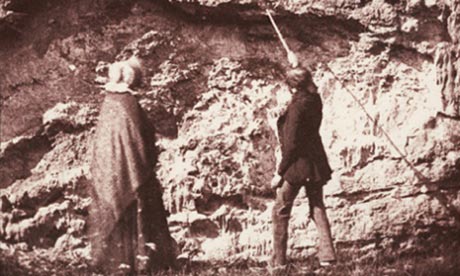
Salt print photograph by William Henry Fox Talbot ("The Geologists" 1843) which may or may not include Mary Anning as the lump on the left (see Suzanne Pilaar Birch's article in the Guardian here.)

But the thing is, none of these images is a bit like the one of her I have in my mind.  I've been crazy for fossils for as long as I can remember, and I've had a soft spot for Mary Anning for about as long.  Which is why, when the chance to write a story about her in the History Girls' anthology Daughters of Time came along, I jumped at it.  I did my research.  I found out things I hadn't known before.  I felt sorry for all her troubles and trials and frustrations.  I was in awe of her (self)learning and meticulous skill in separating her fossils from the surrounding rock and her revolutionary understanding of their meanings.  But still that was not what I saw in my mind.  For me, Mary Anning will always be a figure running along a shingly beach, with a hammer in her hand and a dog at her side and the next amazing discovery waiting for her in the rocks just ahead.  The girl who could see things that other folk couldn't - exciting things - wonderful things ...  So that's how I wrote her.


Mary Anning:  Best After Storms


Joan Lennon's website.
Joan Lennon's blog.


P.S.  Back in 2010, the first Slightly Jones Mystery was published, all about the theft of the astonishing (and sadly fictional) dragonfish fossil from the then-new Natural History Museum in London - and this is the dedication:

Everybody's heard of Florence Nightingale 
and David Livingstone.  These books are dedicated 
to the Victorian heroes and heroines 
who aren't quite so famous!

This one's for 
Mary Anning, Fossil Finder


Prescient, eh?