
Private Harry Reynolds died in France on 29 October 1914, aged 25. A careerist soldier,
his service was undistinguished. He appears in the army records only when he lost his equipment
and slipped cigarettes to prisoners he was supposed to be guarding.
Harry, who joined up at the age of 14, was 4ft 11, with defective eyes. This short,
unremarkable soldier left no family behind. There is no grave for Harry.
I found his story as part of a fantastic community history
project in Herne Hill, the leafy corner of South London in which I live. The Herne
Hill Society, in partnership with The Charter School and local volunteers, undertook a project to map the men and women connected to Herne Hill who were killed in
World War 1. The team believe that as many as 700 local residents were killed.
On my street alone, there were five telegrams delivered, five families left
bereft.
This is their website and I urge you to explore it: www.memorial.hernehillsociety.org.uk/.

The team has unearthed many heart-breaking stories, including a family which lost its three sons. But somehow, Harry’s story is the one
that has lingered. As historical writers, the lives we focus on tend to be the
ones that are significant: either because they are remarkable, or they are
important, or they fit the narrative pattern we’re seeking to impose.
Harry’s story brings no clarity to the greater picture. It adds
nothing but a single digit to an unbelievably large number. The mud of France
cracked open, swallowed Harry, and sealed again.
Most of us will be invisible to posterity and
to be troubled by that lack of significance is pompous and hubristic. But most of us will
be mourned by someone. Perhaps Harry had friends in the army who missed him.
Perhaps poor, short, squinty Harry had a girl at home.
As the veterans of the World Wars die of old age, we need
new ways to remember the Harrys. The map that this history project has created
is hugely powerful. Children, in particular, need specific stories of flesh and
blood people, not numbers, to force them to empathy. My older children were fascinated and
appalled by the stories of the fallen soldiers who had lived on our road. The
geographic specificity gave them a sense of connection and helped them really think about the lives, and deaths, of these men.
We talk of bringing
history alive, in fiction and non-fiction. To do that demands an emphasis on the commonality of human experience even as we mine the past for instances of
difference and uniqueness.
But London, much as I love it, is a strange and hotchpotch
place which constantly erodes a sense of commonality. People pass through,
neighbours fail to connect. Most of us are incomers to our London villages.
Most of us, too, are not church-goers. We don’t have that sense of belonging to
a place that can make Remembrance Sunday so unbearably moving: I remember, in particular,
being in a village church in Norfolk for one Remembrance Sunday service, and
the surnames of the fallen were the names on the graves and, doubtless, in the records
of marriages and baptisms.
We Londoners live, secluded in our overpriced houses, and disconnected
to our past. We are ancestor-less.
I was thinking about this, as I watched a friend’s ten year old
find the story of a man who grew up in the house next door to her: Lieutenant
John Hood. John was born in Herne Hill, and baptised in the church attached to my kids' old school. He studied at
Cambridge, and was beginning a career as a teacher, before enlisting. He joined
the 29th Siege Battery in France in November 1916 and for the next
two years fought in Belgium and France. John Hood survived the German guns, but caught influenza on 11
November 1918, and died three days later in France.
 |
| An early image of the church where John Hood was baptised. |
One hundred years after John Hood caught influenza, the team
behind the Memorial project organised a two minute silence in the centre of
Herne Hill during the usually busy Sunday market. We stood amid the veg-sellers
and the artisan butchers, the smell drifting past from the cheese stall; the
fat from the burgers spitting and the steam rising from the giant vat of
tartiflette. Kids and dogs and hungover youngsters clutching coffees. All the busyness of a London Sunday. Then a teenager from The Charter School played
The Last Post, and we all fell still.
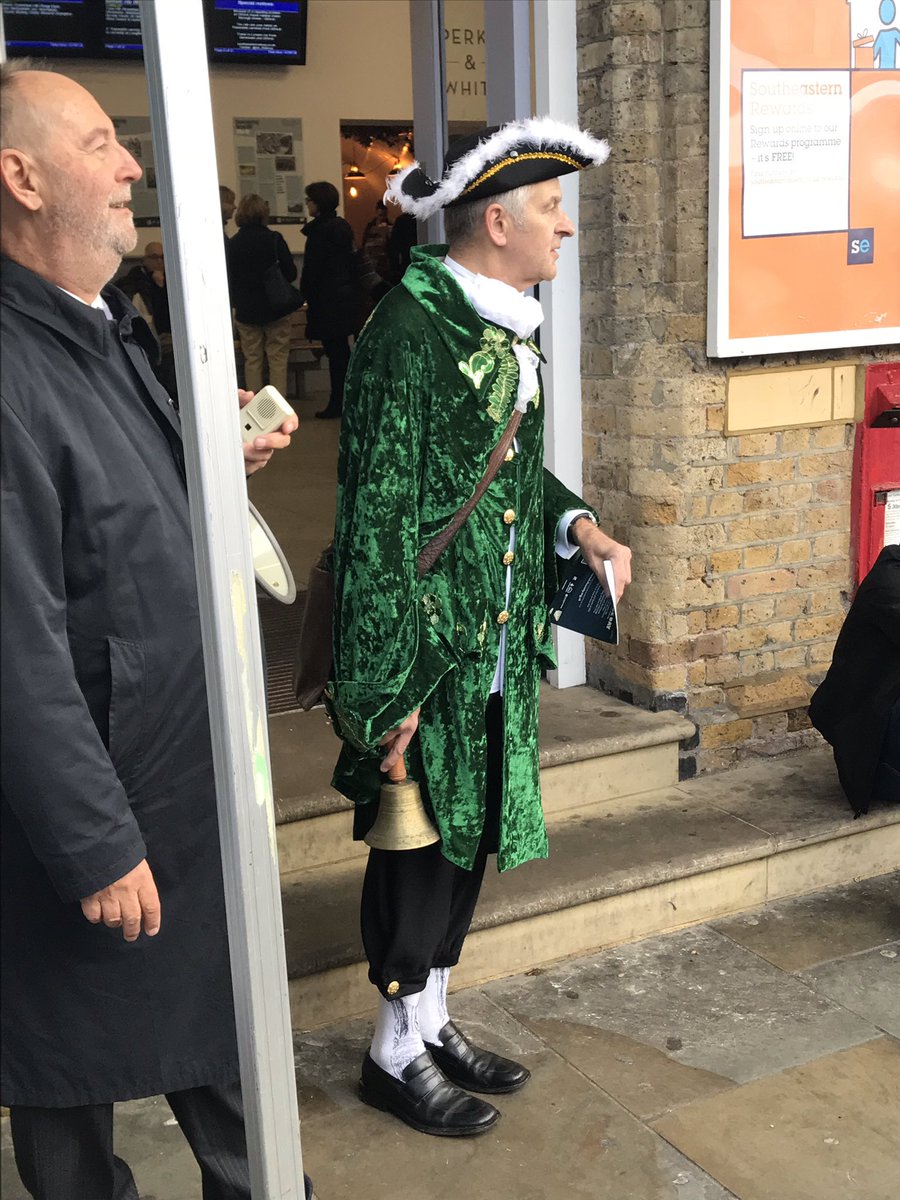 |
| Herne Hill's town crier announcing the silence |
There is a particular intensity to a silence that falls on a
busy London street. I found it deeply moving - all these decent, unremarkable
strangers standing together. It gave me a much needed dose of optimism. I have been dispirited of late by the mood music
of public life, and its combative, fearful timbre. We seem to be more frightened
than I can remember, more growlingly convinced of the coming apocalypse. Frightened people who feel powerless find anger easy.
We have different visions of the peril: for some it is Trump
and Brexit, and the rise of the right; for others Corbyn and a resurgent Marxism.
Then there’s the climate. The decline of the US and the rise of a more brutal
Chinese hegemony. The coming of artificial intelligence. Putin gurning at Europe’s
growing chaos. The likelihood that future generations will, at best, be poorer
than us; at worst, face horrors that we cannot imagine. There’s a competitive edge
to the catastrophising – my vision is more true and more terrifying than yours. We are strangers, gawping at a pick ‘n mix of dystopian futures.
I keep telling myself that there is an impulse in humans to
anticipate an imminent Armageddon. True, yesterday’s silence reminded me that,
sometimes, we are right and the Horsemen do sweep in and scythe us down. But it
also reminded me that within all the tremulous cacophony of modern British life,
there can also exist two minutes of meaningful silence.
@tonisenior
antoniasenior.com


