Showing posts with label seventeenth century. Show all posts

Friday, 15 June 2018

Anthony Bourdain and the history of suicide: the importance of language by Fay Bound Alberti

On 8 June, the BBC reported the sad news that US celebrity chef and television personality Anthony Bourdain had died as a result of suicide. Over the next few days, tributes to Bourdain poured in for Bourdain, who was widely respected not only for his writing and presenting, but also because he was passionate about social and political justice. Bourdain was a vocal advocate against sexual harassment and supported his partner Asia Argento in her sexual abuse allegations against shamed Hollywood producer Harvey Weinstein. 'He taught us about food', said Barack Obama, 'but more importantly, about its ability to bring us together. he made us a little less afraid of the unknown. We'll miss him'.

Anthony Bourdain with then President Barack Obama

Almost immediately the world's media began to speculate about Bourdain's death, detailing every single nugget they could find about its circumstances, asking why he died, how he died and what 'drove' him to 'commit suicide'. Suggested causes ranged from long term depression to a break up with his partner Argento, with whom he was said to be besotted. Argento was accused of cheating on the chef, and appallingly, blamed for causing Bourdain's death. Their mutual friend Rose McGowan wrote a letter on behalf of Argento, reminding the world how wrong-headed this view was: 'Do NOT do the sexist thing and burn a woman on the pyre of misplaced blame. Anthony's internal war was his war, but now she's been left on the battlefield to take the bullets'.

Heated debates about Bourdain's death erupted all over social media. Some suggested he was murdered by Weinstein. Others wrote about the pressure on people to live perfect lives, especially since Bourdain's death swiftly followed that of the designer Kate Spade, who was equally successful, equally admired and apparently content, who died from suicide on June 5. After the detailed descriptions of death came the blame, and then the claims of selfishness; 'From every corner of the world you were loved. So selfish. You've given us cause to be so angry', said the actor Val Kilmer

Suicide is a complex, sad event. And its language is important. Not just the language of blame and selfishness, which is unhelpful at best and destructive at worst, but also the language in which the act of suicide is itself framed. One debate on Twitter concerned whether or not Bourdain 'committed' suicide, a term that is widely used but judgement-laden. Those who pointed out that suicide shouldn't be a 'PC" issue; that we should be able to speak correctly according to terms - and that Bourdain had committed (or undertaken) an act - missed the point entirely.

The reason why suicide is so emotionally and morally fraught is because of its history, as well as the way it has been philosophically framed. The word 'commit' is no longer appropriate in talking about suicide because it is no longer a criminal offence. People commit murder, assaults and fraud, but they do not commit suicide. To suggest that they do is to ignore the complex emotional history behind the phrase, and to frame suicide in a moralising way that provokes a lack of understanding for people who die from suicide, as well as people who are struggling with suicidal thoughts. 

Until 1961, suicide was a criminal act. The Suicide Act decriminalised suicide in England and Wales so that those who tried to kill themselves would no longer be prosecuted (the act didn't apply in Scotland, since suicide was never an offence under Scottish law). Assisting in suicide, or more precisely 'assisting, aiding or abetting suicide' became a distinct offence, which is why people will travel to Swiss clinics to end their own lives through voluntary euthanasia. I was reminded, when I read about Bourdain, of the news coverage of David Goodall, the 104-year-old retired Australian scientist who, in May this year, chose to end his life in a Swiss clinic: 'At my age, and even rather less than my age, one wants to be free to choose the death when the death is the appropriate time', he said.  

David Goodall, bidding goodbye to his family before leaving for Switzerland
The moral outrage that had accompanied Bourdain's death was missing in news reports. Was this because he was older? Because his death took place in an official space? Because it was more dignified? Or something else. Why isn't the decision to take one's own life an individual one, since our lives, in modern philosophical terms, are ours to do so as we choose? Why is suicide illegal?  

The answer lies in religious belief, which for centuries was intertwined with the legal system in the UK. The early Christian theologian St Augustine and the Dominican Friar St Thomas Aquinas both argued that suicide was taking away a life that was not one's own, but God's.  Suicide, from the Latin 'sui' (of oneself) and 'cidiim' (a killing) was a rejection of God's power, sine only God had the right to create and destroy life. 

Saint Augustine of Hippo, attributed to Gerard Seghers
To commit suicide was therefore akin to committing a sin, as well as a criminal offence. And society was cruel to the bodies and the memories of those who died by suicide. If proven to be sane, they were denied a Christian burial and carried to a crossroads in the dead of night. There, their bodies would be placed in a pit with a wooden stake driven through their chests - in case their possessed spirits returned to contaminate the rest of the village. There would be no mourning, no prayers. 

This tradition must have been extremely difficult for the loved ones in an age when religious belief was universal. It was also harsh in other ways: the dead person's family were stripped of any entitlement to the deceased's belongings for they were handed to the crown. Social historians Michael MacDonald and Terence Murphy have written of cases where this happened in seventeenth-century England, when insanity and depression were still regarded as spiritual rather than mental afflictions.  

Not all cultures have been so unforgiving. At the other extreme of suicide as a religiously outrageous choice is self-denial and self sacrifice as a supremely spiritual act. Suicide can be understood to be an act of honour rather than disgrace - most famously in Japan, where Samurai warriors would carry out Seppuku, a ritual form of disembowelment, rather than become hostages of their enemies. 

Seppuku with ritual attire, courtesy of Wikipedia

It is extraordinary to think that suicide in the UK was a crime until 1961. But attitudes to suicide are, as the case of Anthony Bourdain shows, filled with fear and anxiety, as well as anger. They are fraught with ideas of moral right as well as public accountability - who are we responsible for in life, and when is it acceptable to ignore those responsibilities? This is particularly controversial when a person dying from suicide has children.

In the digital age, suicide can be private, but it can also be public. There have been many cases of YouTube suicides, when the death of suffering people is filmed, as well as encouraged, by anonymous viewers. This tragic combination of an individual need for support and a vocal yet unfeeling audience, seems to highlight the desolation of many people who are in search of a degree of empathy or understanding that is not forthcoming. Consider the Logan Paul debacle, in which a YouTuber visited a forest in Japan known for its use as a 'suicide spot'. When they came across a man hanging from a tree, Paul said 'call the police bro', but headed in for a close-up. The 'fun vlog' was posted on YouTube under the heading: 'We found a dead body in the Japanese suicide forest'. The video has since been removed as a result of protests. 

Logan Paul

Suicide continues to divide us in an age of digital spectacle. Paul was vigorously defended by YouTubers and viewers who felt that he was simply reporting the facts. That suicide was a reality and he covered it as such. Where are the lines between reporting and creating sensational events in the digital age, whether they are happy or tragic? And what kinds of languages are needed to talk about suicide in an age where performances of the self are much more instant, public and permanent than ever before? 

Talking about suicide is important, both to respect the dead and their friends and families, but also to prevent people from feeling that suicide is the only choice. We are good at highlighting mental illness in the 21st century as being common and widespread; we are less good at doing anything about it. Mental health services are constantly being cut and the social stigma around self-harm limited many people from finding help. 

There were over 6,000 deaths from suicide in the UK in 2015. The highest rate was in men aged 40-44 years old in the UK (in Ireland it was for men aged 25-34). Suicide rates for women are at their highest in a decade, though far more men die from suicide every year than women. We might say that it's a social problem as much as an individual one, since men are not traditionally encouraged to talk about their problems, or to get help for mental illness. 

Whatever the causes of death from suicide, it's not a criminal or a wilful or a selfish act. It is a result of a person being in so much pain that living has become unbearable. That is not shameful, nor a sign of a person's weakness. And it isn't about blame. We need to move away from the language of 'committing' suicide because it makes a difference in how depression and mental health is framed and understood. 

www.fayboundalberti.com 


Samaritans mental health hotline is open 24 hours a day, seven days a week. It can be contacted at any time from any phone for FREE on 116 123. 


Thursday, 15 June 2017

A Trip to Eyam: The Plague Village by Fay Bound Alberti


For as long as I can remember I have been interested in the history of the plague. I learned about the village of Eyam in Derbyshire while studying at the University of York. And a few weeks ago, I dragged my kids off for an explore. We stayed at the YHA’s Ilam Hall, an enormous, rambling place surrounded by green countryside. Perfect for a cheap base from which to explore points of interest in Derbyshire, including a trip to Eyam.


Ilam Hall, YHA

Eyam is a beautiful village in the Peak District National Park. It is most famous for an outbreak of bubonic plague that occurred in 1665, a year before the Great Fire of London. The present village was founded by Anglo-Saxons, though lead had been mined in the area since Roman times. The village was once industrial but now most of its economy is based on its status as ‘the plague village.’

That story began when a local tailor obtained a flea-infested bundle of cloth from London. Within a week the tailor’s assistant, George Vicars was dead, and more began dying in the household soon after. By pure coincidence when we stopped at Eyam we parked next to the ‘plague house’ where the outbreak had started. This house - like the others in the village where many people died - are a kind of living monument. People living there now must be used to visitors gawking up at the windows, trying to imaging how it would have been to live alongside loved ones dying of the plague: the smells, the sounds, the sights, the fear.


The ‘plague cottage’ of Eyam where the plague first broke out. The names of the dead in this and many nearby cottages are listed on signs outside

As the plague spread rapidly through the village, precautions were taken at the advice of the Reverend William Mompesson, the village rector and his Puritan Minister, Thomas Stanley. St Lawrence church was central to the lives of villagers, just as the church was generally for people in the seventeenth century, many of whom viewed the plague as God’s punishment for wrong doing (a particularly challenging thought so soon after the English Civil Wars). It was there that baptisms, weddings and funerals as well as the daily homilies on obedience and devotion reminded one of one’s place in the temporal and spiritual realms. Standing in the small church today, looking up at the now-faded wall paintings that would once have been brightly painted, one has a sense of how narrow and limited the world would have seemed if one was trapped there. Mompesson started to hold his services outside the church, as people were increasingly reluctant to stand shoulder to shoulder with their neighbours.


St Lawrence church at Eyam, with its famous stained-glass windows depicting the quarantine of the village and the now faded wall paintings. Can you spot the skeleton?

It was Mompesson who encouraged the villagers to isolate themselves from the outside world, quarantining its population rather than allowing the disease to spread further. The sacrifice of the people is told in a stained-glass window commemorating Eyam’s story. The number who died is disputed, but we know that at least half the village died to the plague – upwards of 273 people (the number recorded in the Eyam church register). The danger lasted for fourteen months, and it was far longer before anything like normalcy was resumed.


A list of residents who died from the plague 1665-1666, held in Eyam church

Survival was random. Several who remained alive had close contact with those who died from the plague but did not contract the disease themselves. One Elizabeth Hancock was uninfected though she buried six children and her husband in eight days. The unofficial village gravedigger Marshall Howe also survived.

Critics of the village’s quarantine have recently pointed out that wealthier residents were able to circumvent the ban.  Indeed, Mompesson sent his own children away to Sheffield so that that could escape the quarantine. He wanted his wife to go with them, but she refused, deciding instead to stay with her husband and tend to the people of Eyam. Catherine died of the plague and her grave still stands in the churchyard. Mompesson himself was forever associated with the plague and not universally welcomed at his next parish. He did remarry, however and eventually became Prebendary of Southwell, Nottinghamshire.  


The grave of Catherine Mompesson

Eyam is well worth a visit. Not just for the village itself and the glorious church which is filled with seventeenth-century detail, but also for the attractions around it. Some of these are plague-related – such as the Coolstone or Boundary stone, where money soaked in vinegar (believed to kill the infection) was placed in exchange for food and medicine for the isolated villagers. 

The Boundary Stone


You can visit Eyam museum, too, which was founded in 1994 and which tells the story of Eyam before the plague, as well as the various medical attempts to protect the villagers. This includes the traditional seventeenth-century plague doctor's costume that looks like something from a modern nightmare. The mask had a curved beak, shaped like that of a bird. Straps held the beak in place and the beak held dried flowers, including roses and carnations, herbs and camphor or vinegar. These contents were to keep away bad smells, which were believed to be the cause of plague in the seventeenth century (the theory of miasma being that bad smells were bad 'air' which was the cause of disease). 


The garb of the plague doctor, complete with beaked nose stuffed with herbs and spices. 

Much to the delight of the children, the museum also has waxwork models of people at various stages of bubonic plague, covered in sores and pustules. There is also a lot of information about rats, which spills over into the souvenirs for sale in the shop. Which is how we ended up with a pair of stuffed toy rats, Doris and Dave, who accompanied us on the rest of our tour.  


Doris and Dave explore Derbyshire 


Picture credits: 
The Boundary Stone, Wikipedia. 
Ilam Hall: yha.org.uk 


Saturday, 23 July 2016

Woman healers of the Seventeenth Century, by Leslie Wilson


A Young Lady called Henrietta Boyle, Christian Friedrich Zincke, Wikimedia 


If you think about women in medicine in the past, the chances are you'd think first of all of midwives, and yet, four hundred years or so ago, women were playing an active role in medical care. The philosopher Hobbes said he much preferred 'an experienced old woman' to the 'most learned and inexperienced physician.' Nowadays, people speak perjoratively of 'old wives' tales,' and yet medical research often confirms views that doctors used to dismiss (like getting a cold if your feet get wet).

Far from being amateurs, the women had access to medicines handed down from generation to generation, with proven efficacy. Sir Ralph Verney, writing to his wife in 1647, advised her to give her child 'n phisick but such as midwives and old women, with the doctors approbation, doe prescribe; for assure yourselfe they by experience know better than any phisition how to treat such infants.' Women cured lame legs, brought down swollen arms, worked as oculists.
spearmint, once used to cure watering eyes

Some of these were paid, but others, notably aristocratic ladies, did the work for no pay. One of these was Madam Springett, the mother-in-law, from her first marriage, of the early Quaker Mary Pennington, and I can't do better than to quote from what her daughter-in-law wrote about her in later life.

'She kept several poor women employed in summer, simpling (gathering herbs) for her; and in winter procuring for her such things as she wanted in surgery, physic, and sore eyes. She had excellent judgment in all these, and admirable success; which made her famous, and sought unto out of several counties, by persons of the first rank, as well as those of other classes. She daily employed her servants in making oils, salves, balsams, drawing of spirits, distilling of waters, making syrups and conserves, lozenges and pills.
 melissa officinalis, calming herb and good for digestion

She was so famous for taking off spots and cataracts from the eyes, that Stephens, the great oculist, sent many to her, when the case was difficult.. She cured.. many desperate burns, and cuts, and dangerous sores that came by them.. One very remarkable cure of a burn I shall mention. A child's head was so burnt, that its skull was like a coal: she brought it to have skin and hair, and invented a thin pan of beaten silver, covered with bladder, to preserve the head in case of a knock or fall.'

People came hundreds of miles to consult Madam Springett, and stayed in the area while she dealt with their case, sometimes for months. She could have twenty patients to see in a morning.

Being a lady of substance, she never took a penny for these services, though she did make wealthy patients buy the ingredients for the medicines.

What is clear from the above account is that Madam Springett relied on the expert knowledge of her female herb-gatherers, and also must have trained the servants who made up the medicines. I wonder if some of them subsequently set up as healers on their own account? I would also love to have the details of her cures for cataracts.
eye-bright, for eye problems!


Doubtless some of the illnesses went away of their own accord, and the placebo factor may also have been involved. But dermatological conditions, for example, are notably tricky to treat. I have found myself, through trial and error, that witch hazel is better for the inflammation I get from some mosquito bites than any steroid creams or anti-histamines, and many herbal 'house remedies' remain unattested simply because the big pharma companies aren't interested in testing or developing them.

In those days, you had the choice between a woman who had spent years observing illness and the effects of various herbal substances on them, or a doctor who had trained in what was largely a theoretical discipline, based on 'humours', and eager to let pints of blood from already weakened patients, literally bleeding some of them to death. The women healers were arguably the more scientific of the two.
The doctor's visit, Jan Steen, (Google Art Project)


Women (particularly aristocratic women) also functioned as bone-setters, so when one of the villagers in my novel 'Malefice' broke his leg, Alice Slade, the local 'cunning woman' was called in to set it, because the lady of the manor was in childbed.

However, even in Henry VIII's reign, legislation was being passed to restrict women's work in this respect. As with midwifery, the male doctors formed professional associations and excluded women, though of course household and herbal remedies continued to be practised, but this was more and more confined to the women's own families and friends.

In addition, as the eighteenth century progressed, more and more villages were removed from proximity from the great houses. Blenheim and Nuneham Courtney spring to mind. The lady of the manor must have been similarly cut off. She might still sally out to visit the poor, but only to dole out broths and advice. In Capability Brown's centenary year, it's worth considering how his landscape gardening quarantined the gentry from their 'inferiors.' If you want to see how it used to be, before Brown, Kent et al started holding their noses at the whiff of a cottage, go to Chastleton House in Oxfordshire. It's almost shocking to see how cheek-by-jowel the village is with the great house. Madam Springett's local patients, in such a set-up, would have found it an easy walk to the doctor.


References:
The Working Life of Seventeenth Century Women, by Alice Clark
Experiences in the life of Mary Pennington (written by herself) with preface by Gil Skidmore,  Friends Historical Society.
Malefice, by Leslie Wilson, reissued on Kindle May 2016


Monday, 23 May 2016

FLINTS, CLAY, MUD AND WITCHES ... by Leslie Wilson

When I set out to write a novel about a witch in the seventeenth century (choosing the time that a local witch, from Waltham St Lawrence, was prosecuted and hanged, it wasn't just important to do the historical research, as I've described in a previous blog (Who were the Witches). I had to do what every writer needs to do, to inhabit the world of my book.

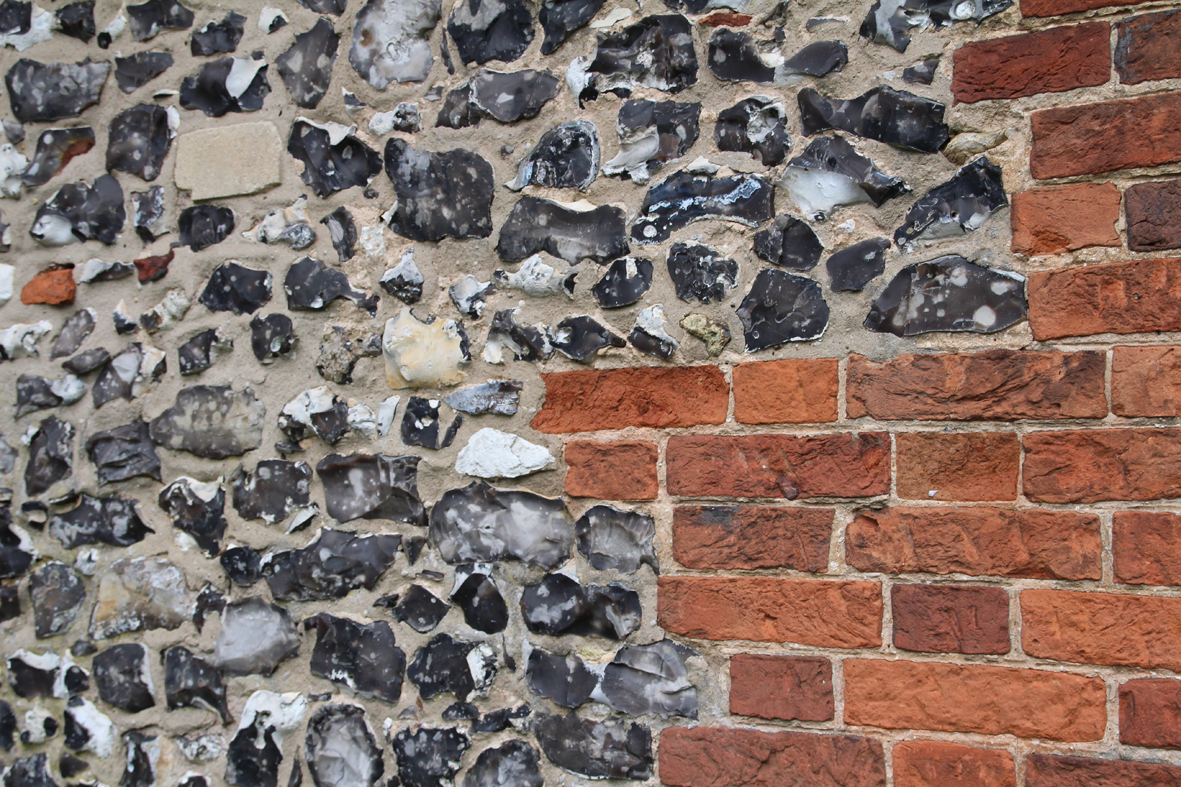
Whitchurch St Leonard, my fictional village, lay in the chalk country of the Thames Valley, where pockets of clay alternate with chalk and gravel, and flints lie everywhere in the soil, as local vernacular building attests.

flints and clay
I have all three in my garden, so when I wrote the first chapter, where the witch's daughter and son-in-law bury her covertly in the churchyard, I had an idea of what they were contending with. They were digging into an existing grave, but all the same:

'Hard work,' says Margaret, Alice's daughter, 'even digging into ground that's been turned before. Flints stop the spade, and the clay's heavy.'


I know all about that, when the spade hits a flint, which could be small, or it could be eighteen inches wide, gnarled, knobbly, and weirdly beautiful, but you don't appreciate that when you're sweating and struggling, trying to find where it ends and get a purchase on it. The strain of that work has written itself into the aches and pains of my poor arms, shoulders, and back. Some things don't change, though I've never dug six foot down into a grave.


The Bell, Waltham St Lawrence, rubble-filled walls.

Opposite my house is a 16th century farmhouse, and while I was writing Malefice, the friend who used to live there took me upstairs and opened a door set into the wall, that led to a cupboard. Inside there I could feel the fill in between the timbers: chalky rubble, horsehair, twigs and rags; the texture of the past. In the days before such houses were lime-washed, their white surfaces must have been much rougher than nowadays, and scratchy, as I described when Margaret remembered pressing herself to a house wall, the day Royalists and Parliamentarians fought in the village street.
bluebells scrambling up an ancient road edge, Kent


Where you can easily find remnants of the past is in the woods, on the bridle paths that were once roads, often deeply sunken with the passage of time. Paved with flints, very often, in this country where it is the local stone, and walkable in dry weather in spring and summer, often mired and squelchy in winter. That's what travel used to be like, and you can get a sense of it still, even if you're wearing high-tech walking shoes or boots.

'You will hear the beat of a horse's feet,
And the swish of a skirt in the dew,
Steadily cantering through
The misty solitudes..'
(Rudyard Kipling, The way through the woods)
Flints paving an old road.


What you don't have is the danger. Recently we walked down Pack and Prime Lane, which leads to Henley from Rotherfield Greys; it was a haunt of footpads, and the packmen who used it had to pack their pistols with powder and prime their flints before they entered. Of course now, it's just beautiful woodland, heaven for dogs. But it was along those laborious, hazardous roads that Margaret tramped, fleeing the village that used to be her home, her thoughts travelling back to her mother's past, and her own.

'Rain and mud, and the road slithers under your feet, you stumble over the huge soft ruts… I wish it wasn't raining.. The people we meet talk about thieves, highway robbers, trying to frighten country bumpkins on the nove who are good for a laugh.'

Once, in the late eighties, I was driving on the A4 a friend at dawn; coming back from a night watch at Greenham Common, and over the Berkshire fields was a thick layer of mist. The picture stayed in my head for a few years, till it was time to use it for Malefice.

'That morning,' says Simon, the village drunk, 'the mist lay in the air like milk in water, can't get drunk on milk, here I am, poor rat-catcher, sober as the devil. Milk in water, and the trees stood out of it, under the trees you fumbled your way, but if you climbed a hill to look for the King's men, you could see the bare black branches fingering out of the whiteness.'

Day after day, when I've walked my dog in the w
inter, I've seen drops of melted frost on the sloe bushes, something Alice yearned for when she was shut up in a stinking seventeenth-century jail. 'She shut her eyes and tried to see blackthorn twigs like gnarly claws in the morning mist, each grasping a small clear bead of water.'


When I was writing Malefice, I was still able to pick up the phone and ask my mother-in-law about farming things; she's gone now. My mother-in-law had really made butter, and I needed to understand about it, because spoiling the butter was something witches did. She did me proud. 'Winter's the best time,' she told me, 'in summer, it just runs through your fingers.' I gave that line to Judith, whose butter the witch Alice supposedly spoiled.

'But what I should have done,' says Judith, 'I should have put the red hot poker in the cream, that day I knew the witch was spoiling the butter..'If you're here,' I should have said, 'have at your eye.' I might have blinded her.' I didn't know that was what you did, and to be sure, it did seem strange when I found out. Surely, the red hot poker wouldn't do the cream much good? But probably you only did that when the butter was already spoiled, and you wanted to get your revenge on the witch.

The Past is another country - and yet there are parts of it that I recognise. What that world of more than three and a half centuries ago shares with ours, still, is a whole lot of imagery, stories, that live in our heads still, even though we've overwritten them with a lot more information. But some of the imagery, I'm convinced, is to do with how the human brain works, and it's hard-wired into us.

witches giving babies to the Devil: Wellcome Trust

Think of the phenomenal success of films like The Exorcist. Possession by evil forces, people with supernatural powers to do harm, people who have an animal alter ego, still rampage through fantasy novels and films, and probably computer games, too, though I don't play them. Have you never looked in a mirror when you've been all alone in the house, and had a frightening fantasy that you might see something terrifying standing behind you?

What was going on in my head when, having done all the research and the reading, I sat down and wrote Malefice, hardly aware of what was going on, just kept typing, and then came out of something like a trance and read what I'd written? It wasn't just stuff from my personal subconscious and image-store that swam up and directed the story, that's for sure.


 To get Malefice on Kindle, go to amazon.co.uk