Showing posts with label Leamington Spa. Show all posts

Friday, 4 November 2022

Anthem for Doomed Youth - Celia Rees


What passing-bells for these who die as cattle?
— Only the monstrous anger of the guns.
Only the stuttering rifles' rapid rattle
Can patter out their hasty orisons.
No mockeries now for them; no prayers nor bells; 
Nor any voice of mourning save the choirs,—
The shrill, demented choirs of wailing shells;
And bugles calling for them from sad shires.


What candles may be held to speed them all?
Not in the hands of boys, but in their eyes
Shall shine the holy glimmers of goodbyes.
The pallor of girls' brows shall be their pall;
Their flowers the tenderness of patient minds,
And each slow dusk a drawing-down of blinds. 


I'm sure many people reading this blog will instantly recognise Anthem for Doomed Youth by Wilfred Owen. It was written in 1917, a year before his death on 4th November, 1918. He was twenty five years old. When he died, Owen was almost unknown - only five of his poems were published in his lifetime - but today, we are nearly as familiar with the details of his life as we are with his poetry. He was born and spent his early years in Oswestry, a Shropshire lad. The death of his grandfather marked a change in fortune. His family moved to Birkenhead for his father to take up a post as Station Master. Owen avidly read boarding school books and The Boys' Own Paper and grew up with a feeling of loss of status, having not attended boarding school, or gone up to Oxford. When he joined up, he was made an officer, thus gaining the status he so wanted. Unfortunately, the generation who were educated in the schools he had envied, were doomed. Junior officers were easily identified by German snipers, marked out by their distinctively different uniforms and their positioning on the battlefield, first over the top, leading from the front, pistol in hand. They were killed in their thousands  Rolls of Honour in every boarding school chapel attests to the numbers lost.   

Wilfred Owen 1893 - 1918


I first discovered Wilfred Owen when I was in the Sixth Form, transfixed by a classroom reading of  'Dulce et decorum est', the sensory overload of horror the poem lays on the reader line after line, conjuring those public school boys, those 'children ardent for some desperate glory', their passing soon to be recorded on chapel walls, celebrated by 'The old Lie: Dulce et decorum est, pro patria mori'.


If in some smothering dreams, you too could pace

Behind the wagon that we flung him in,

And watch the white eyes writhing in his face,

His hanging face, like a devil’s sick of sin;

If you could hear, at every jolt, the blood

Come gargling from the froth-corrupted lungs,

Obscene as cancer, bitter as the cud

Of vile, incurable sores on innocent tongues,—

My friend, you would not tell with such high zest

To children ardent for some desperate glory,

The old Lie: Dulce et decorum est

Pro patria mori.


Dulce et Decorum Est - Wilfred Owen


 It was the Sixties, the Vietnam War was raging, Oh, What A Lovely War! was transferring from the theatre to the big screen, anti-war sentiment was everywhere.  Owen's poems spoke to me, as they do to every generation because no generation since the 1914 - 18 has been untouched by conflict, the reality brought right into our living rooms on the TV News. Over a hundred years after his death, Owen's poetry still resonates as we see the devastation in Ukraine, villages and cities, fields and forests turned into no-man's-land, dead bodies by the sides of roads, soldiers huddled in their trenches, watching the water rise, waiting for the winter that's coming.

Our brains ache, in the merciless iced east winds that knive us..
Wearied we keep awake because the night is silent . . 


..Tonight, this frost will fasten on this mud and us, 

SShrivelling many hands, and puckering foreheads crisp. 

The burying-party, picks and shovels in shaking grasp,

Pause over half-known faces. All their eyes are ice, 


Exposure - Wilfred Owen


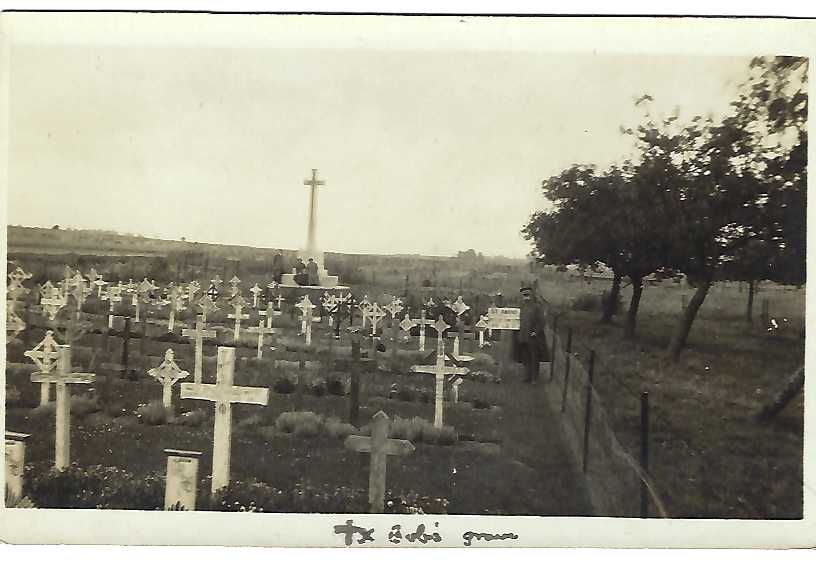
    Wilfred Owen died 104 years ago today, a week before Armistice was declared and the war was over. There is something especially poignant being killed so close to the ending of hostilities.  My Uncle Bob was killed on 14th June, 1918, close enough for the family legend to grow that he was killed in the last days. My uncle’s experience is largely unknown and unknowable. He sent letters to his family, pencil written because he was ‘other ranks’. He also sent water colour sketches of the places, churches and castles he saw behind the lines. He pressed wildflowers he found growing in no-man’s-land, on the borders of the roads he tramped, in the trenches he manned. Poppies, yes, but also Larkspur, Scabious, Ragged Robin. He saw beauty there, as Owen did. We know nothing of his other experiences: the suffering he saw, the fear, the fighting and dying. In that Wilfred Owen speaks for him. He speaks for all of them. 


My Uncle Bob with his family
His temporary grave in Flanders


His name, Pte R. W. Goodway, on the War Memorial in Leamington Spa


Thursday, 18 May 2017

Legendary Heroes and Gothic Ruins - A Walk to Guy's Cliffe by Celia Rees

Guys Cliffe, Warwick

Like many writers, I often go for a walk if I'm stuck, if I need to think my way through a knotty plot problem, map out the next part of the story, or simply to get away from my desk. I live in a small town and five or ten minutes in any direction will take me out into the countryside. One of my favourite walks is to Guys Cliffe, an impressive gothic ruin on a sandstone bluff above the river Avon, about a mile upstream from the town of Warwick.  

Guy's Cliffe is named for Guy of Warwick, the legendary English hero, who fell in love with the  high born and beautiful Felice. To win her hand, he had to prove his valour by battling it out with dragons, a giant boar and the fiercesome Dun Cow which had been ravaging the land hereabouts. He wins the lady's hand but later goes on a pilgrimage to atone for his life as a man of violence. On his return, he became a hermit and retreated from the world to live in a cave above the Avon.

Guy's Cave
The Oratory reputedly founded by him became the chapel of St Mary Magdalene which is still on the site. After the dissolution of the monasteries, the chapel, outbuildings and surrounding land were acquired by a Sir Andrew Flammock who built a Tudor house, completed in 1556.

Guy's Cliffe on the Sheldon Tapestry, Warwick Museum
In the 18th Century, the property was acquired by Samuel Greatheed who built himself a mansion. He was MP for Coventry and an extremely wealthy man, having inherited a large plantation on St Kitts in the West Indies and the slaves that went with it. The house was started in 1751, after his marriage to Lady Mary Bertie and built in the grand palladian style.


The house passed by marriage from the Greatheed - Berties to the Percy family in 1826. They occupied the house for over a century, their graves can be found in the nearby village of Old Milverton's Cemetery, but the last Percy to inherit in 1933 never took up permanent residency. The house  was used as a hospital during the Second World War and as a school for evacuees. In 1947, the estate was broken up and sold. The families who had owned it from the 18th Century were gone, although their names live on as streets in Leamington Spa: Greatheed Road, Percy Terrace, Bertie Terrace and Bertie Road in nearby Kenilworth. Plans to convert the house into a hotel came to nothing and it fell into disrepair. The Free Masons acquired the undercroft and part of the house as a Masonic Lodge in the 1970s. They still use this part of the building but in 1992, during the filming of The Adventures of Sherlock Holmes - The Last Vampyre, the building caught fire, leaving the suitably gothic ruin that we see today. 


Now, Guy's Cliffe is often used for ghost hunts and ghost tours because, of course, there are ghost stories. Oppressive atmospheres, giant black figures, white ladies and even bad boy, Piers Gaveston, but perhaps he belongs to nearby Blacklow Hill and a different History Girls post. 

Celia Rees
www.celiares.com

Tuesday, 18 October 2016

The Camoufleurs of Leamington Spa - Celia Rees

Interior Coventry Cathedral - John Piper


With the 8th Army on the Sangro - Edward Ardizzone
Official War Artists, like John Piper, played a crucial role in recording the impact of the Second World War on the life of the country. Artists painted and drew the Blitz and its aftermath, bombed out buildings, civilians in shelters, the public carrying on regardless. They painted men and women working in factories, on the docks, on the land. They painted and drew soldiers and sailors on active service. They created vivid, powerful, often poignant and intimate pictures of what it was like to live in a country involved in total war. 
In Defence of Albion - Paul Nash
Some artists, however were given a 'bigger' job to do. These were the Camouflage Artists - the Camoufleurs. Artists and designers whose task it was to devise ways to conceal important sites, factories, air fields, power stations, ships, docks and naval installations, from German aircraft and submarines. 

Camouflaged Factory Buildings - Colin Moss


The Camoufleurs were based in my town, Leamington Spa, described at the time as 'a pleasant but mildly dilapidated spa town'. The sudden influx of 'arty types' caused some consternation. Men with long hair and donkey jackets walking round the town in sandals with no socks; women with short hair and wearing trousers. It wasn't what the town was used to. So much so,  that two of their number were briefly detained on suspicion of spying after being seen out in the countryside in an open top Rolls Royce, the driver wearing a fedora. Talk of drinking, wild parties and free love scandalised the natives even further but the Camoufleurs were here to do a serious job. 


The Big Tower Camouflaged, 1943 - Colin Moss
At
the beginning of the war, their work was focussed on disguising strategic buildings from the air. A camouflage officer would fly over the prospective site, take notes and photographs and return to headquarters in the Regent Hotel. Here, notes and photographs were worked up into perspective drawings or three dimensional models if the site was of particular strategic importance. The models were taken to the 'viewing room', a converted Roller Skating Rink at the bottom of the town. They  were viewed in a special chamber on a giant turntable which allowed the model to be seen from different angles under different lighting. A sun, set on a giant arm, could be moved and fixed at any altitude. There was also a moonlight viewing room to deal with the increasing frequency of night raids. The models and accompanying colour charts were then used as guides to camouflage the site with paint and netting.

Spraying Paint on an Airfield for Camouflage - Robin Darwin
There was also a Naval Camouflage Unit based in the Art Gallery in Avenue Road. Their task was to make vessels near invisible to German war ships and submarines. Designs were tested on specially made models in one of the two large viewing tanks.


The Outside Viewing Tank - James Yunge-Bateman 
Quite apart from their camouflage duties, the artists painted and sketched what they saw about them. They painted murals in the British Restaurant (now sadly lost). They painted the people they encountered, the houses and streets they lived in, the day to day life of the  town. 


Grace at the Sausage Hatch - Mary Adshead

Lansdowne Circus, 1943 - Christopher Ironside


The Parade - Dorothy Annan 
 They recorded how the war was affecting the town. The arrival of evacuees escaping the bombing in nearby Coventry. The aftermath of Leamington's one and only bomb. Digging for Victory - Newbold Common given over to cabbages. 

Evacuee in Leamington Spa - Janey Ironside


Morning after the Blitz - Colin Moss

Cabbage Field with Townscape Beyond - Colin Moss
Their camouflage work is now a footnote in history but the paintings that these artists made of Leamington are a unique record of life in a small Midlands town in the Second World War. One particular painting, held in Leamington Art Gallery, has special, personal resonance for me. My family came from Leamington and this picture of Clarendon Street in 1940 after a heavy snowfall, shows my aunt and uncle's house. The woman standing in the doorway could be my Aunty Olive, the little boy with her my cousin, Rodney.  

Leamington, 1940 - Stephen Bone
I would like to thank Leamington Museum and Art Gallery for their recent excellent exhibition, Concealment and Deception: The Art of The Camoufleurs in Leamington Spa 1939 -45. 

Celia Rees

wwe.celiarees.com