Showing posts with label War Poets. Show all posts

Friday, 4 November 2022

Anthem for Doomed Youth - Celia Rees


What passing-bells for these who die as cattle?
— Only the monstrous anger of the guns.
Only the stuttering rifles' rapid rattle
Can patter out their hasty orisons.
No mockeries now for them; no prayers nor bells; 
Nor any voice of mourning save the choirs,—
The shrill, demented choirs of wailing shells;
And bugles calling for them from sad shires.


What candles may be held to speed them all?
Not in the hands of boys, but in their eyes
Shall shine the holy glimmers of goodbyes.
The pallor of girls' brows shall be their pall;
Their flowers the tenderness of patient minds,
And each slow dusk a drawing-down of blinds. 


I'm sure many people reading this blog will instantly recognise Anthem for Doomed Youth by Wilfred Owen. It was written in 1917, a year before his death on 4th November, 1918. He was twenty five years old. When he died, Owen was almost unknown - only five of his poems were published in his lifetime - but today, we are nearly as familiar with the details of his life as we are with his poetry. He was born and spent his early years in Oswestry, a Shropshire lad. The death of his grandfather marked a change in fortune. His family moved to Birkenhead for his father to take up a post as Station Master. Owen avidly read boarding school books and The Boys' Own Paper and grew up with a feeling of loss of status, having not attended boarding school, or gone up to Oxford. When he joined up, he was made an officer, thus gaining the status he so wanted. Unfortunately, the generation who were educated in the schools he had envied, were doomed. Junior officers were easily identified by German snipers, marked out by their distinctively different uniforms and their positioning on the battlefield, first over the top, leading from the front, pistol in hand. They were killed in their thousands  Rolls of Honour in every boarding school chapel attests to the numbers lost.   

Wilfred Owen 1893 - 1918


I first discovered Wilfred Owen when I was in the Sixth Form, transfixed by a classroom reading of  'Dulce et decorum est', the sensory overload of horror the poem lays on the reader line after line, conjuring those public school boys, those 'children ardent for some desperate glory', their passing soon to be recorded on chapel walls, celebrated by 'The old Lie: Dulce et decorum est, pro patria mori'.


If in some smothering dreams, you too could pace

Behind the wagon that we flung him in,

And watch the white eyes writhing in his face,

His hanging face, like a devil’s sick of sin;

If you could hear, at every jolt, the blood

Come gargling from the froth-corrupted lungs,

Obscene as cancer, bitter as the cud

Of vile, incurable sores on innocent tongues,—

My friend, you would not tell with such high zest

To children ardent for some desperate glory,

The old Lie: Dulce et decorum est

Pro patria mori.


Dulce et Decorum Est - Wilfred Owen


 It was the Sixties, the Vietnam War was raging, Oh, What A Lovely War! was transferring from the theatre to the big screen, anti-war sentiment was everywhere.  Owen's poems spoke to me, as they do to every generation because no generation since the 1914 - 18 has been untouched by conflict, the reality brought right into our living rooms on the TV News. Over a hundred years after his death, Owen's poetry still resonates as we see the devastation in Ukraine, villages and cities, fields and forests turned into no-man's-land, dead bodies by the sides of roads, soldiers huddled in their trenches, watching the water rise, waiting for the winter that's coming.

Our brains ache, in the merciless iced east winds that knive us..
Wearied we keep awake because the night is silent . . 


..Tonight, this frost will fasten on this mud and us, 

SShrivelling many hands, and puckering foreheads crisp. 

The burying-party, picks and shovels in shaking grasp,

Pause over half-known faces. All their eyes are ice, 


Exposure - Wilfred Owen


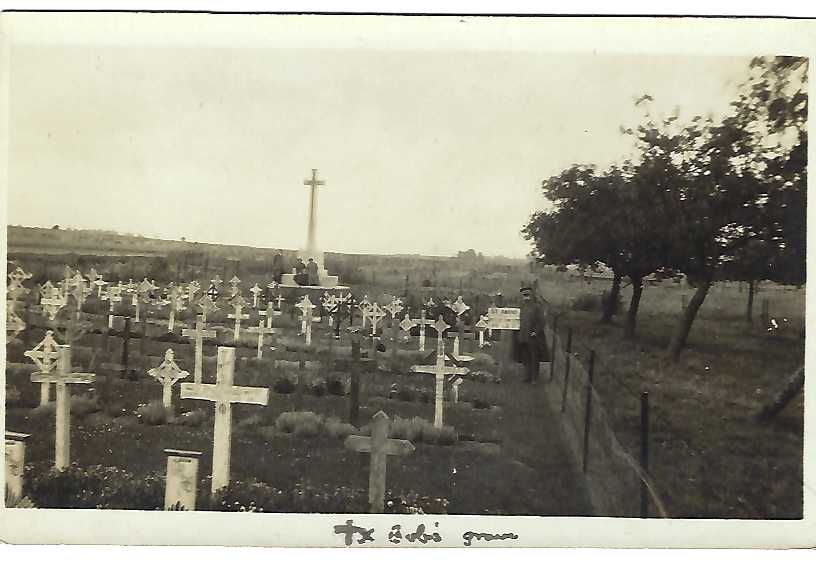
    Wilfred Owen died 104 years ago today, a week before Armistice was declared and the war was over. There is something especially poignant being killed so close to the ending of hostilities.  My Uncle Bob was killed on 14th June, 1918, close enough for the family legend to grow that he was killed in the last days. My uncle’s experience is largely unknown and unknowable. He sent letters to his family, pencil written because he was ‘other ranks’. He also sent water colour sketches of the places, churches and castles he saw behind the lines. He pressed wildflowers he found growing in no-man’s-land, on the borders of the roads he tramped, in the trenches he manned. Poppies, yes, but also Larkspur, Scabious, Ragged Robin. He saw beauty there, as Owen did. We know nothing of his other experiences: the suffering he saw, the fear, the fighting and dying. In that Wilfred Owen speaks for him. He speaks for all of them. 


My Uncle Bob with his family
His temporary grave in Flanders


His name, Pte R. W. Goodway, on the War Memorial in Leamington Spa


Thursday, 22 November 2018

Charles Hamilton Sorley: The Forgotten Poet of WWI by Catherine Hokin

 It Is Easy To Be Dead - Aberdeen Performing Arts
November's commemorations of the end of World War One have had a particular poignancy this year. Not only is it the centenary but the hundreds of acts of remembrance have taken place against a backdrop of Brexit and the break-up of Europe, possibly also the break-up of the Union. This isn't the place to get political but, for those of us with strong connections to our wider European community, there were extra reasons to shed tears this month as we watched the nations coming together to lay their wreathes. It seemed fitting therefore that I got a chance to see Neil McPherson's wonderful play It Is Easy To Be Dead, recently in Glasgow. This tells the story of  forgotten war poet Charles Hamilton Sorley who was born in Aberdeen, educated at Marlborough and killed, aged 20, at the Battle of Loos in October 1915. In his very short life he wrote 38 poems, spurred on, in his own words by his mother's "badgering". Although his name is included on the War Poets' memorial in Westminster Abbey, you'll rarely find him mentioned now, or taught, but at his death the Poet Laureate John Masefield called Sorley "potentially the greatest poet lost to us in that war". 

 Charles Hamilton Sorley
That we don't know him as well as we should is a great loss - his poems are unsentimental, compassionate and filled with a concern for humanity that belies his young age. They were first published in 1916, by his parents, together with a collection of his letters written both from the front and during the lengthy period he spent as a student in Germany in 1914. A trip cut short when Britain came into the escalating conflict in the August of that year. It is this experience I think which marks his work out from his better-known contemporaries - it has certainly been cited as the reason why he does not fit well in the war poets' canon. Sorley did not see the war through patriotic eyes and there is none of the jingoistic language in his work that was more commonly found in early WWI poetry. His letters suggest that he identified more strongly with German values than he did with English ones - while this may be no more than the enthusiasm of a young man on his first trip abroad, it certainly gave him a sense of fellow-feeling. He spoke fluent German and was enamoured with the country and its culture - his poem To Germany written on the eve of the war addresses the common bond he shares with the young Germans about to be plunged, like him, into a madness not of their making:

You are blind like us. Your hurt no man designed,

And no man claimed the conquest of your land.

But gropers both through fields of thought confined

We stumble and we do not understand.

He was under no illusions about the cost of the coming war in terms of the misery it would bring - the poem's last line reads: "until peace, the storm, the darkness and the thunder and the rain." As his father, a professor of moral philosophy at the University of Aberdeen, said of his son in the preface to the volume of letters and poems: ‘He looked on the world with clear eyes and the surface show did not deceive him.’

The title of the play, It Is Easy To Be Dead, comes from perhaps Sorley's best known poem and his last one: When You See Millions of the Mouthless Dead. It was written shortly before his death and found with his kit. It is a beautiful poem; that a twenty-year old had learned to be so aware of the reality of war and the ultimate futility of weeping for the dead makes it a heart-breaking one.

When you see millions of the mouthless dead

 Across your dreams in pale battalions go,
 
Say not soft things as other men have said,
 
That you'll remember. For you need not so.
 
Give them not praise. For, deaf, how should they know 

It is not curses heaped on each gashed head? 

Nor tears. Their blind eyes see not your tears flow.
 
Nor honour. It is easy to be dead. Say only this, 'They are dead.'
 
Then add thereto, ‘Yet many a better one has died before.'
 
Then, scanning all the o'ercrowded mass, should you
 
Perceive one face that you loved heretofore,
 
It is a spook. None wears the face you knew.
 
Great death has made all his for evermore.

Sorley didn't live to see what came next - as we remember those who died in a frighteningly divided world, let's hope we don't live to regret what's coming next for us.