Showing posts with label London Blitz. Show all posts

Wednesday, 29 May 2019

May's Guest - Jacqueline Winspear

This month's guest is the best-selling author of the Masie Dobbs series of crime novels, Jacqueline Winspear. She was born and raised in Kent and emigrated to the USA in 1990. She has written extensively for journals, newspapers and magazines, and has worked in book publishing on both sides of the Atlantic. 

Here she talks to Charlotte Wightwick about the role war journalists played in bringing the USA into World War II, the role of women during war time and the fascination of writing a long-running series. 

The American Agent revolves around the murder of Catherine Saxon, an American war correspondent in London during the Blitz. Can you say a little about the work of war correspondents in London at this time, and in particular your inspiration for Catherine's character?

There were many war correspondents in Britain during the war, not only from the USA, but representing our Commonwealth allies, and those countries already invaded by Germany. However, the focus in this book is chiefly the journalists who reported news of bombing during the Blitz to the USA – via both radio (or “the wireless”) and print media. Obviously, a good number of those reporters were Americans, and of particular interest in The American Agent is the work of Edward R. Murrow, who broadcast for CBS from a small studio in the bowels of the BBC in London...I was drawn to the fact that Murrow revolutionised broadcast news in a manner that set the scene for the type of reporting we see today. Prior to his broadcasts (and he typically broadcast between midnight and 3:00am, a time when Americans would be sitting down to dinner), the BBC was a very formal environment – in the early days the men who read the news would wear dinner jackets and bow ties. Little emotion came into the reporting, and it was very matter of fact, delivered in the clipped tones of Received English.
 
Murrow knew he had to bring in the human factor to have any impact on American audiences, for whom the war was very much “over there and nothing to do with us.” On one occasion he famously took recording equipment into the street to record the footsteps of people running for cover in a bombing raid, and he repeatedly went into shelters to record the voices of ordinary people, and later accompanied the crew of a Lancaster bomber on a raid into Germany. This immediacy began to have an impact on American opinion, and effectively shortened the distance between the two countries... Other reporters had an impact too – Mollie Panter Downes in her “Letter From London” in the New Yorker did her part, as did JB Priestley, Vernon Bartlett and Cecil Beaton with his photography, published in Life magazine. They were, if you will, the agents of change in American opinion.

The character Catherine Saxon is an amalgam. I have been interested in the work of women war correspondents since my early teens, so I’m very familiar with so many of those women who have effectively put their lives on the line to tell the story of what is happening in a war zone. In a way Saxon is a blend of Clare Hollingworth, Marguerite Higgins, Dickey Chapelle and Martha Gellhorn – and so many others I admire. I could go on listing names!

A big theme of the novel is whether or not the Americans will join the war, and the work of the media, undercover agents and propaganda to try and bring that about at this time. Why did you choose to focus on this? 

It’s such an interesting period, and I am drawn to the role of soft propaganda in a time of war – and indeed, in the time leading up to war. In an earlier book, Elegy For Eddie, one of the continuing characters, a writer, is part of a group who are charged with developing appealing stories about Britain – her countryside, industry, people, farm life, children etc. The initiative was to give the people a deeper sense that they had something to be proud of in Britain, and an emotional connection to their country. This was part of the story was based upon fact – there was that emphasis in newspaper and magazine storytelling, as it was clear to the government that another war was on the cards, and they wanted the people to be ready to take up arms and be ready to protect their country – they wanted them ready for war, and most people were reluctant to consider war as they’d lost so much in the years 1914-18. Edward R. Murrow and his “boys” in WW2 were considered to be one of Churchill’s greatest tools in the job of getting the USA behind Britain’s war effort.

Maisie is torn in this novel between her life as an investigator, her voluntary work as am ambulance driver, the child she wants to adopt and the possibility of a new romance. How far do you think these pressures were typical for women of Maisie's generation?

I think multiple pressures are typical for women of any generation! My grandmother had to keep her job and had to consider the safety of her ten children. Many women worked, volunteered and cared for families in dreadful conditions following the repeated bombing night after night after night. I have visited the archive of the WRVS (In the war it was simply the WVS – Women’s Voluntary Service – the “Royal” designation came later), and simply reading the very detailed reports from every woman who worked through the Blitz and subsequent bombings would leave readers in no doubt that multiple pressures were very much the lot of women – and continue to be so today.

This is the 15th Maisie Dobbs novel. What is it that keeps bringing you back to her? And can you give us any insight into what will be coming next for her?

From the time I knew I had not just one novel, but the material for a series, I wanted to move my characters through time. I wanted to see how they grew and changed with experience, and how they were impacted by the events of their day and the trials and tribulations of their lives – creating that overall arc of story keeps me coming back to the series. I wanted to create a saga in the traditional sense, but one underpinned by the journey through chaos to resolution that is at the heart of mystery. Ultimately, life is that mystery, and I am buoyed forward by the journey not only of Maisie Dobbs, but her fellow characters – and history itself. History frames the story – and that is the only “insight” I can give for what comes next!

The American Agent (number 15 in the bestselling Maisie Dobbs series) by Jacqueline Winspear is out now and published by Allison & Busby. Previous titles in the series are being reissued by John Murray.

Sunday, 11 March 2018

1940s hairstyles - describing a character in bobs and curls


When I write I have to have a clear picture of how my characters look, including how they dress and style their hair. So before I began to write about the wartime era I looked into the sort of hairstyles that were around in the early 1940s. 

Hair was worn in a style that was feminine and soft, and always dressed off the face. It was often flat on top, so that a hat could be placed easily. One thing was sure - hair would not have been worn messy. A woman's hair had to always appear styled and neat. In the early 1940s, going out with "bed-hair" would have been social suicide. 

Hairstyles in the 1940s were fuller and longer than those of the 1930s and hair was cut in a rounded U-shape at the back, curving up towards the ears. There were always a lot of layers because the hair was usually worn in curls or soft waves, usually just below shoulder-length. Straight hair was simply unfashionable. 

To achieve the curls, girls who couldn't afford a weekly "wash and set" at the hairdresser would pin up their wet hair in bobby pins each night to make pin-curls. 
If you've ever been tempted, this is a good tutorial on how to set easy pin curls:

https://www.youtube.com/watch?v=yughhvjKf9c

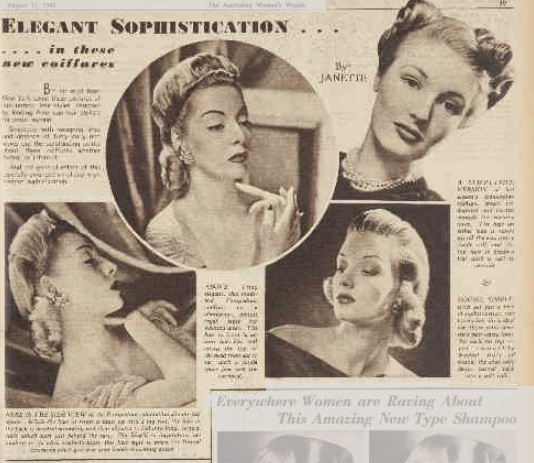
Although the loosely waved page-boy was a very popular style, so was a more sophisticated and set look such as those below. 
"ELEGANT SOPHISTICATION........ in these new coiffures" The Australian Women's Weekly (1933 - 1982) 17 August 1940: 39 (The Homemaker). Web. 9 Mar 2018 <http://nla.gov.au/nla.news-article47116871>


As war rationing really began to bite, women still spent time and effort on their hairstyles, but no longer wanted lots of waves in intricate designs. Hair was worn shorter, in a practical style, still curly with a wave or two at the front. This sort of style looked good under small hats and military hats and could be hidden under turbans if the hair was dirty. One such style was the "Maria" style, which came in 1944 (http://nla.gov.au/nla.news-article59182619)


An iconic war-time hairstyle was the "Victory Roll". The name seems to have come from the corkscrew through the air by RAF pilots before landing, if they had successfully downed an enemy plane. The hair was divided at the front and curled up and out, in a rather aerodynamic form.

Here is Betty Grable, rocking a Victory Roll. 


And if you want to reproduce it, see this tutorial:
http://www.bbc.co.uk/programmes/p01sh5tk


And how did I use bobs and curls to define my characters? Each of the heroines of my five novels to date has specific hairstyle. And just like a girl of the 1940s I found my inspiration in the hairstyles of the movie stars of the period.


A Stranger in my Street (2012) 

Personally, I don't think that there is any hairstyle more elegant than the loose pin curls we associate with 1940s Hollywood. 

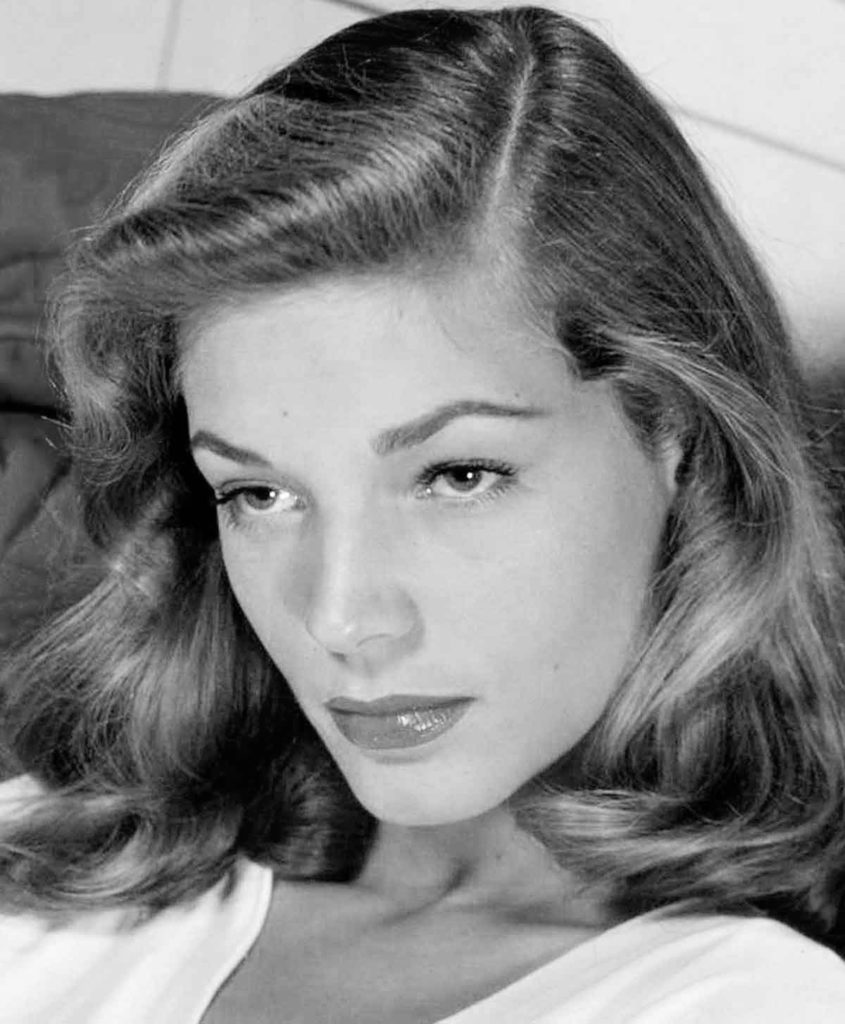
I'm sure that is why sad, sweet Meg Eaton, the heroine of my first novel, A Stranger in my Street, has her light brown hair in a shoulder-length bob.   

In my mind's eye I saw Meg's hair as being similar to this gorgeous photo of Lauren Bacall. 

Taking a Chance (2013)  
https://deborahburrows.com.au/books/taking-a-chance/

The heroine of my second novel, Taking a Chance, is Eleanor (Nell) Fitzgerald. As a fashion journalist with her own newspaper column giving tips on beauty and fashion, I thought that Nell was likely to style her hair into something a little more interesting than a bob. 

So I decided that her signature style would be the "unbroken roll." I got the idea for the hairstyle from an article in The Australian Women’s Weekly of 28 March 1942.
http://nla.gov.au/nla.news-article47488001


But even a fashion journalist has bad hair days. When her hair was not looking its best, Nell puts it into a snood. 

A snood is a lacy hairnet or crocheted bag (often homemade) that gathered up the hair so that it sits on the nape of the neck. 

Here is American actress Carole Lombard wearing a snood. 

Sometimes I wish that snoods were still in fashion, as they hide a lot of sins and (in my opinion) look very elegant. 


http://nla.gov.au/nla.news-article47488001

Apparently it was Vivian Leigh (or, rather, her costume designer in the 1939 movie Gone with the Wind) who was responsible in no small part for the popularity of the snood in the 1940s. 

But that was not the whole story of course. A snood kept loose hair properly and safely confined when women were doing war work in factories. 


A Time of Secrets (2015)
https://deborahburrows.com.au/books/a-time-of-secrets/


My third novel is set among the military intelligence units of wartime Melbourne - the most elegant and European of the Australian cities. 

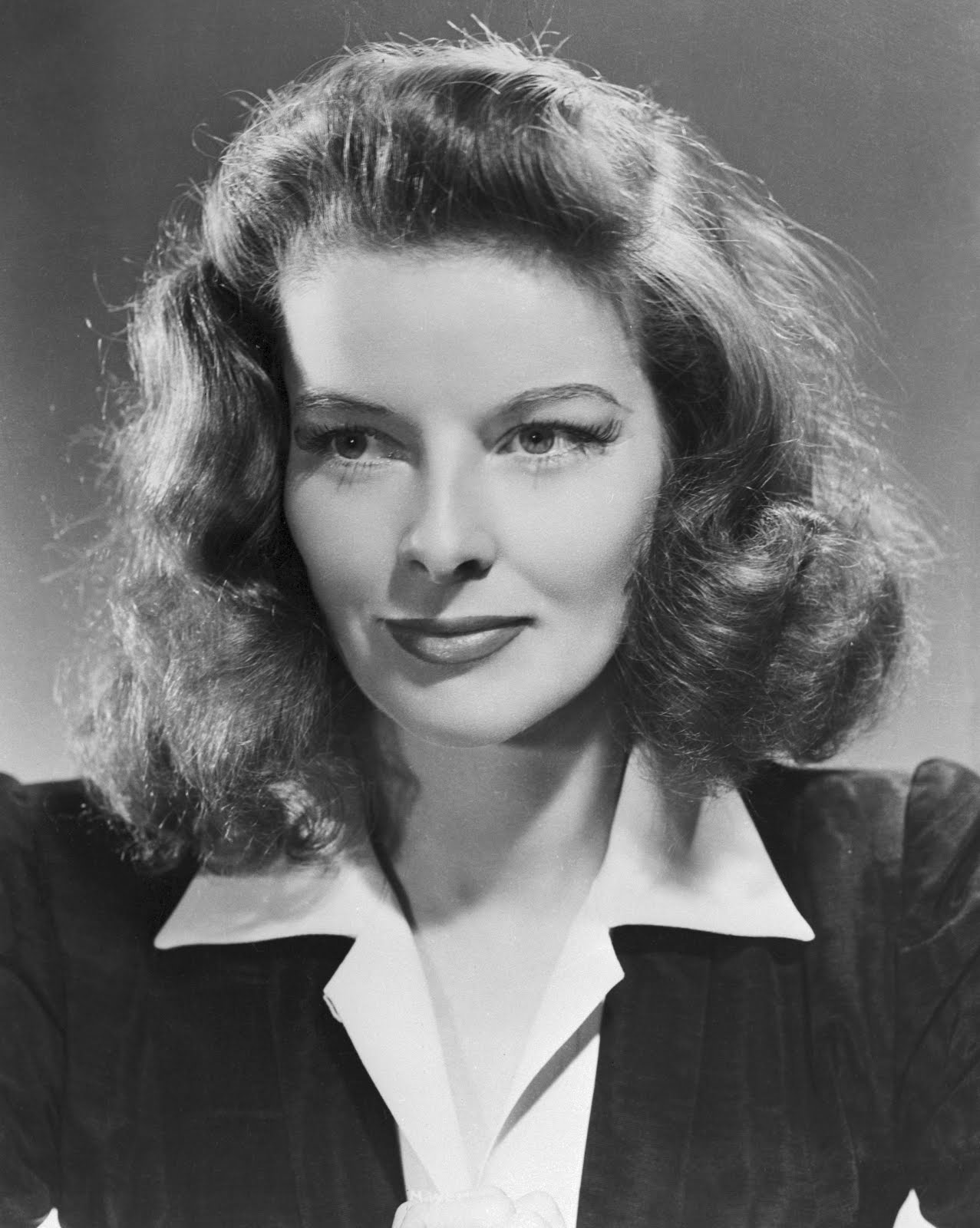
In the book, Stella Aldridge, the pretty, clerical heroine wears her thick, wavy ash-blonde hair at shoulder length and parted at the side. 

The side part was a feature of the 1940s, as it was the foundation for most styles of that era. 
I pictured Stella's hair as being similar to Katharine Hepburn's thick mop.

Ambulance Girls (2016) 

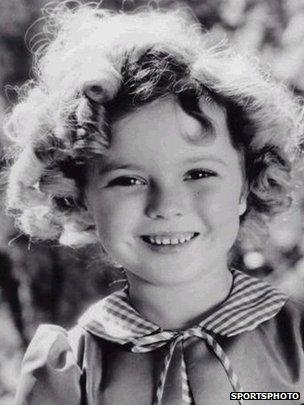
Lily Brennan, the Australian ambulance driver who narrates the first book in my Ambulance Girls trilogy, which is set in the London Blitz, has very curly hair and dimples. This, combined with her small stature, gives her a bit of a “Shirley Temple” look, which she detests. 

Not the most sophisticated hairstyle, but naturally curly-haired girls will understand the difficulty Lily had in making her curls behave.
The very sophisticated Celia Ashwin, “a thoroughbred, from the auburn hair framing her smoothly oval face in a loose bob to her aristocratically narrow hands and feet,” is the heroine of my most recent novel. 

Celia is not impressed when another character likens her to the oh-so-glamourous Rita Hayworth, but I did have the beautiful titian-haired Rita in mind when imagining Celia's full page-boy hairstyle and side part. 

Isn’t she gorgeous?


Wednesday, 11 October 2017

Australia's 'Ambulance Girls' of the London Blitz by Deborah Burrows


I decided that my fourth novel would be set in London, and would deal with the experiences of an Australian girl who drove an ambulance throughout the Blitz.
One thing I always do when preparing for a new novel is to trawl though the digitised newspapers on Trove, the National Library of Australia site. It contains digitised versions of most Australian newspapers from 1830 to 2009 and, as usual, it proved to be a goldmine of information I could use in my writing.  
“WA Girl is ARP Heroine” declared the Perth Daily News on 14 May 1941. Perth girl Stella O’Keefe had become the first Australian A.R.P. [Air Raid Precautions] worker in Britain to be presented to the Queen for outstanding bravery in the London Blitz. 
In November 1940 Stella had climbed to the top of a bombed block of flats to rescue a brigadier, his wife and child. The building’s stairways, corridors, and walls had collapsed and the family was trapped on the ninth floor. It was in the middle of the blackout. Nothing daunted, Stella  “coerced” a man with a torch into assisting her and they made the climb in pitch darkness. From the sixth floor upwards they were forced to crawl. At the top she shouted, “Is there anyone there?” and the brigadier (with typical British understatement) answered, “We are all right but slightly hemmed in with masonry.”

Actually they were in the only portion of the top storey that remained, and were surrounded by the fallen roof and walls. Stella and her coerced male helped them to descend, assisting them “across yawning gaps” to safety.
Stella was quoted as saying:
“Other girls at my station have done stickier jobs than this rescue. I am the only driver who so far has not crashed an ambulance into a bomb crater while going to hospital with wounded in the darkened streets. Many times bombs have been so close that I saw the explosion and disintegration of buildings, but the pressure of the job is so intense that there is no time for fear.”
["WA Girl Is ARP Heroine" The Daily News (Perth, WA : 1882 - 1950) 14 May 1941: 24 (HOME EDITION). Web. 11 Oct 2017 <http://nla.gov.au/nla.news-article83025452>.]
I decided that my heroine, Lily Brennan, like Stella O’Keefe, would be a wisp of a girl with a core of steel, who had no time for fear. 

 “Attractive Victorian mannequin” Norma Hosken had left Australia in the late 1930s to work as a model in London. When war broke out in September 1939 she was in America on her way home. She returned to England immediately and drove an ambulance in London during the worst air raids of the Blitz. Eventually she was promoted to the deputy station officer at Berkeley Square, one of four big posts in the London area.


Norma was interviewed by the Australian Woman’s Weekly on her return to Australia in May 1942, and gave a thrilling account of her experiences.
She said: “Men and women worked on an equal footing. ... The only distinction was in pay. Women received £2/7/6 a week, men £3 odd. There were people of all types. The station officer was a former Cook’s tour man, and there wasn’t much he didn’t know about the topography of London. When things were slack, before the blitz, he used to enliven our lectures with all sorts of historical asides about the streets and buildings. There were Oxford and Cambridge graduates, a man who used to run one of the smartest hairdressing saloons in London, peeresses, and working girls.” 
Norma also described the dangers of simply living in London at that time.
“I was walking in Piccadilly, just passing near the Ritz. Bombs were falling and began to sound uncomfortably close. I was thinking it would be a good thing to go home, when something made me fall on my face. I was just in time. A bomb exploded 15 yards away. Only about 10 yards from me people had been standing waiting for a bus. They didn’t drop on their faces.  They were all killed.”
But Norma was nothing if not resilient.
“For all the horrors,” she informed the reporter, “nothing has been exaggerated about the courage of the people of London, nor of their sense of humour. I look back on it all as a grand experience. In fact, I think I had more laughs in those weeks of the blitz than ever before.”
["Came home to help beat the Japs" The Australian Women's Weekly (1933 - 1982) 16 May 1942: 14. Web. 11 Oct 2017 <http://nla.gov.au/nla.news-article46232300>.]
I decided that Lily Brennan, like Norma Hosken, would get on with all sorts of people and keep a sense of humour despite the horrors to which she was exposed.
The famous Australian soprano Joan Hammond (later Dame Joan) was also an ambulance driver in London. She was the first Australian artist to entertain British troops in the war. 
 [photograph from Wikipedia - fair use]

She said: “When war was declared I joined the women’s Air Force unit, but found when I was called up that it meant four years of flying. This meant it would be necessary to give up my singing. So I compromised and became an ambulance driver, which allows me to sing in my spare time. … I am now replacing opera with old English songs, which the troops appreciate.”
["Sydney Girl Sings For Troops" The Daily News (Perth, WA : 1882 - 1950) 15 September 1939: 6 (CITY FINAL). Web. 11 Oct 2017 <http://nla.gov.au/nla.news-article79428685>.] 
I decided that Lily Brennan would love music.

One article I read described a young Australian woman who managed to avoid the Blitz, but still  have some adventures in her ambulance. Twenty-four-year-old Jean Higgins had left Australia in January 1939 for a holiday tour of Europe, and went to London when war broke out. She returned to Sydney in May 1940 after three months as an A.RP. ambulance driver in “London’s toughest district”. 
She said: “When war broke out I was in London. I enlisted in the Rotherhythe A.R.P. station as an ambulance driver. We were just across the river from the Chinese quarter. Mike Bradley— he used to lead one of the local basher gangs— often used to eat a meal with us. Our ambulances were three-ton furniture waggons— huge pantechnicons. Imagine what it was like for girls to drive them! I ran mine into a tram one day, and the tram came off second best.” 
She reported that her station was wired to A.R.P. headquarters. “When German planes were sighted heading for England a yellow light flashed in our station. Then the girls had to climb into their mackintosh anti-gas suits, grab their gas masks, and drive away from the station. The first time the yellow light went on, I was so excited I drove my waggon half a mile with the brake on. But no bombs ever fell, and I carried only two patients in London —an A.R.P. man with gastric ulcers, and an A.R.P. girl with a broken finger A.R.P. women included duchesses with £20,000 a year, but every woman was paid the same— £2 a week. All the men, from district superintendents to the lowest ranks, were paid a standard of £3 a week.” 
["SYDNEY GIRL WITH A.R.P." Daily Advertiser (Wagga Wagga, NSW : 1911 - 1954) 2 May 1940: 7. Web. 11 Oct 2017 <http://nla.gov.au/nla.news-article144308386>.]
I decided that Lily Brennan, like Jean Higgins, would have been on the trip of a lifetime in Europe when war broke out, then return to London to join the Ambulance Service. And that she would hate the fact that women did the same work but were paid less than men.
 [own copy of magazine]
 Another Australian ambulance driver who was interviewed was Marjorie Plunkett. She arrived in England in 1939 and enlisted with the Paddington section of the London County Council Women’s Auxiliary Ambulance Corps, in response to their plea for 6000 women drivers. 
She said: “The ambulance gear we had to wear! The driving test entailed driving with full gas kit on. That meant gasproof oiled silk overall suit, huge double-breasted jacket, trousers which tied under the arms, elbow-length gloves of the same oiled silk — terribly thick, with no finger space — heavy gum boots, the minimum size being six and my size three. I couldn’t even feel the controls at first. Then there was a helmet which fitted like a knight’s visor, covering neck and shoulders, and then a gas mask covering the entire face, and a heavy tin hat on the head. But we got used to it. “When the first air raid warning sounded, half an hour after the war news broke, we were all over the 64 square miles of the metropolis, learning our hospitals. Try learning 2750 linear miles of streets some time! 
["Adventurous Overseas Trip Of Australian Girl" The Sun (Sydney, NSW : 1910 - 1954) 9 June 1940: 12 (WOMEN'S SECTION). Web. 11 Oct 2017 <http://nla.gov.au/nla.news-article231459602>.]
I decided that, like Marjorie Plunkett, Lily would have to cope with discomfort, but overcome it to get on with the job. 


http://trove.nla.gov.au/ is an amazing resource for any writer of historical fiction set in the nineteenth and twentieth centuries, and I really don't know that I could write my novels without it. 
Ambulance Girls is published by Ebury Press. The next novel in the Ambulance Girls trilogy, Ambulance Girls Under Fire, will be out early next year.