Showing posts with label Victorian women. Show all posts

Friday, 12 February 2021

Revisiting Mary Kingsley - Joan Lennon

[I've been thinking about travel, in these times without, and would like to repost something I did back in 2013 about the intrepid, fiercely intelligent, witty Mary Kingsley.] 
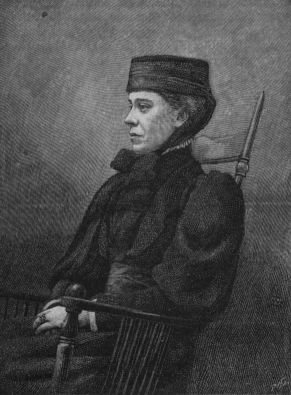
Mary Kingsley was a model Victorian female. She was a good little girl who lived with her parents, helped her mother with the house and her father with his hobbies and interests. She was a good young woman who nursed her parents in their final illnesses. And, at the age of 30, she was all set to become a good old maid, when something amazing happened. She fell in love ...


... with Africa. West Africa, 'the white man's grave'. The Africa of mangrove swamps and malaria, cannibals and crocodiles, 'Fetish' and undiscovered species of fish. It is impossible to do the next seven years of her life any kind of justice in the space of a blog post - this is a woman who collected insects and fish for the British Museum, continued her father's studies in 'pagan' religions, journeyed down rivers and through swamps and up mountains, encountered - and had clear ideas of the differences between - dozens of tribes, and by the end of the her life was advising the British government on their African policies - and doing it all in a long skirt and several layers of petticoats.* She held some views that were very much of the time, and some that were very much her own.**  And she wrote about it all with a turn of phrase as elegant as a lady's ankle.

Take crocodiles, for example:

Now a crocodile drifting down in deep water, or lying asleep with its jaws open on a sand-bank in the sun, is a picturesque adornment to the landscape when you are on the deck of a steamer, and you can write home about it and frighten your relations on your behalf; but when you are away among the swamps in a small dug-out canoe, and that crocodile and his relations are awake - a thing he makes a point of being at flood tide because of fish coming along - and when he has got his foot upon his native heath - that is to say, his tail within holding reach of his native mud - he is highly interesting, and you may not be able to write home about him ...

Or, this discussion of a traveller's options, who finds him, or as it might be, herself tide-trapped in a mangrove swamp:

Of course if you really want a truly safe investment in Fame, and really care about Posterity, and Posterity's Science, you will jump over into the black batter-like, stinking slime, cheered by the thought of the terrific sensation you will produce 20,000 years hence, and the care you will be taken of then by your fellow-creatures, in a museum. But if you are a mere ordinary person of a retiring nature, like me, you stop in your lagoon until the tide rises again ...

Or, the description of a chance meeting with a leopard in a storm:

His forepaws were spread out in front of him and he lashed the ground with his tail, and I grieve to say, in face of that awful danger - I don't mean me, but the tornado - that depraved creature swore, softly, but repeatedly and profoundly ...


Commemorative stamp, May 1969, Great Britain


And this is what she says about this love that took over her life:

The charm of West Africa is a painful one: it gives you pleasure when you are out there, but when you are back here it gives you pain by calling you ... you hear, nearer to you than the voices of the people round, nearer than the roar of the city traffic, the sound of the surf that is breaking on the shore down there, and the sound of the wind talking on the hard palm leaves and the thump of the natives' tom-toms; or the cry of the parrots passing over the mangrove swamps in the evening time; or the sweet, long, mellow whistle of the plantain warblers calling up the dawn; and everything that is round you grows poor and thin ... and you want to go back ...
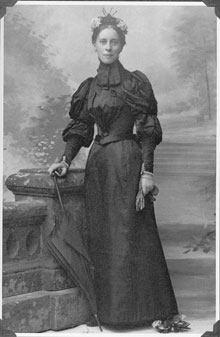


Mary Kingsley (1890s)


The Victorian era produced many fine, strong, distinctive voices, and hers was certainly one of them - as personal and engaging as if she were in the same room. I wish she were!


Mary H. Kingsley (1862-1900)
Travels in West Africa (1897)


* Plenty of petticoats prove an excellent defence when attacked by village geese, or when falling into a fifteen-foot deep game pit studded with 12-inch spikes. It is at these times you realise the blessing of a good thick skirt.

** She defended, for example, the practice of polygamy - it was clear to her that women were far better off being able to share the work and the child care. She also felt strongly that some of the tribes had intellectual strengths greater than the capacity of their language. And she valued the work of the trader over the contributions of the missionary.


[Mary Kingsley died at age 37 from typhoid contracted while nursing Boer prisoners of war in a South African hospital.]


Joan Lennon Instagram

Friday, 3 April 2015

The Victorian Tattoo, by Y S Lee

In my recent novel, Rivals in the City, a young gentleman in 1861 jokes about body art: "'Perhaps I'll have your name tattooed on my arm so there's no doubt as to whom I belong', he said, tucking her hand into the crook of his elbow and resuming their steady walking pace. 'What would you say to your initials in Gothic letters, surrounded by scrolls and hearts?'" I loved being able to include this moment of dialogue because it's such a familiar cultural motif for us now. It's another way of bringing the Victorians closer to us, one of the projects at the heart of my fiction. But it's also rooted in a fairly well-documented tradition.

There are brief mentions of tattoos in Victorian literature. In The Picture of Dorian Gray, Sybil Vane's brother, James, is identifiable as a sailor because of his tattoos. I believe Sherlock Holmes notices and assigns tattoos the same kind of cultural value. According to wikipedia, it was during Captain James Cook's voyages to Polynesia from the 1760s to the 1780s that the idea of tattoo (from the Tahition word, tatau) was introduced into English culture.
Apparently the naturalist Sir Joseph Banks, a member of Cook's expedition, came back to England with a tattoo. (portrait by Sir Joshua Reynolds, 1773)

By the mid-nineteenth century, tattoos were firmly established as the domain of seamen and soldiers - working-class Englishmen who had travelled widely and come into direct contact with tattoo culture.

Tattoos, however, were about to make an interesting social transition. In 1862, when the Prince of Wales (the future Edward VII) toured the Middle East, he acquired a tattoo of the Jerusalem Cross.
The Prince of Wales in Constantinople at the end of his Grand Tour (1862). Somewhere on his body, there is a fresh tattoo. (image via the Royal Collection)

By 1870, the trend had spread not only amongst the English aristocracy, but into the courts of Russia, Germany and Spain. And beginning in the 1880s, upper-class women also began to sport discreet tattoos. One of the most celebrated was Lady Randolph Churchill, who had a "dainty" and "elaborate" tattoo of a serpent entwining her left wrist.
Lady Randolph Churchill, with her signature bracelet. (image via NYPL)
 She frequently covered it with bracelets, but it was described in the New York Times in 1906. Tattoos were fashionable enough that Country Life magazine featured them in an article dated 27 January, 1900 - as if to kick off the new century. As you might expect from Country Life, it described “one of the most popular Masters of Foxhounds in England” who had “tally-ho!” tattooed on his forearm along with a fox’s head and brush and a hunting crop.

Like all fashion trends, however, tattoos were fairly swiftly brought down by mass imitation.
Nora Hildebrandt claimed that she was forced by Indians to receive hundreds of tattoos. The truth was more mundane: her father was a tattoo artist. (image via the Human Marvels)

Once performers like Nora Hildebrandt began displaying her hundreds of tattoos for the horror and delectation of the masses (she travelled as part of P. T. Barnum's American circus), aristocrats promptly lost interest in tattoo art.

I haven't. I've always been intrigued by the idea of a tattoo, yet never been able to choose a single motif or image that I'd want to wear on my body forever. In the meantime, I'll keep reading. May I suggest Margot Mifflin's Bodies of Subversion: A Secret History of Women and Tattoo? To start you off, there are some amazing images pulled from Mifflin's book right here.

Y S Lee is the author of the award-winning Mary Quinn Mysteries (Walker Books). She blogs weekly at www.yslee.com.

Saturday, 23 February 2013

THE (HISTORY) GIRLS' OWN PAPER by Leslie Wilson


I was given a copy of the 1899-1890 Girls' Own Annual when I was a teenager, by an old family friend; I don't know where she got it from: maybe it came from her mother, but she is dead now and I cannot ask her. It's a shame that we often don't ask people things until it is too late. It wasn't the kind of 'Christmas Special' that annuals were in my childhood, just the bound-up numbers of that year. I read them with great interest; the serials - 'Work, Wait, Win'; 'Kathleen's 'Handful,'' Elsie's Victory,' and the truly revolting 'Story of a Summer,' whose heroine, Winifred, gave up the man she loved and who loved her, so that her cousin could have him.

Kathleen's 'Handful.'


A high-risk strategy, if you ask me, but in the story the man obligingly did fall in love with the beautiful but emotionally-constipated Eva (Eva loved him, and Winifred 'knew' that Eva would only love once. Odd, that Victorian superstition. ) Winifred ended up devoting herself to her mother, a tyrannical invalid, and became the Angel in the House, though at the time I didn't know about that image. In the other stories, the heroines, especially Kathleen, were luckily less door-mattish, or I might have ended up binning the volume, and that would have been a pity.I read the advice from 'Medicus' - largely common-sensical - the historical articles, which amused me because I had travelled into history to look back at history. I made some of the 'home-made sweetmeats' toffee, and cocoa-nut tablet. They were good.

The book sat neglected, through my adult life after that - till I began to write about Victorian times, and then I remembered it, feared I had got rid of it, and whooped with pleasure when I found it. It is a mine of things that authors want to ask. I set my novel The Mountain of Immoderate Desires in 1899, just because I had such a wealth of material to hand in that volume. And I made Lily, the heroine of The Mountain, possess some copies of the paper, and use its words - usually in ways that would have horrified the virtuous Christian publisher - for guidance.
How useful I found: 'Dress: In Season and In Reason,' by the 'Lady Dressmaker', when I wanted to envisage the fashions of that era.
I think the lady on the left, particularly, looks as if she would run on wheels. See my post-it in the top corner.
There was a wonderful series of articles called: 'On the Purchase of Outfits for India and the Colonies.' From it I learned that each passenger on the P&O steamers (such as went to Hong Kong) was allowed a whacking 336lbs of luggage and that travellers to the East needed 'the tin boxes with plain pine covers, which are made for the purpose, for, owing to the climate and the insects, everything must be kept in tin, or else it will be spoilt.' Having lived in Hong Kong, I was familiar with the mould-inducing damp and the depredations of cockroaches that made this precaution necessary; and we too kept food in insect-proof containers and tins, if they weren't in the fridge. I also learned that woollen underwear was considered best for really hot climates, something I thought hilarious, till someone told me that really fine wool is excellent for wicking perspiration away from the skin. That was, of course, after I had made fun of my hero Samuel's woollen underwear in the novel, and it had been published. Oh, well..

Later, I found another volume in a second-hand bookshop, for 1899, and I bought that, just for interest. However, I do recommend the GOP for anyone wanting advice on the small domestic details of Victorian life. It was from the 'Answers to Correspondants' column that I discovered that ladies in 1889 were already learning how to operate a type-writer. The 'Girls' Own' title is misleading; the paper was intended not only for teenage girls but for young women setting up as housekeepers and others who wanted to train for a career. So it is a mine of information if you want to find out about Victorian women's work. I'm sure copies can be located nowadays on the web.

The 1899 volume has a set of chatty articles called: 'Three Girl-Chums, and their life in London rooms.' 'Ada is a type-writer in a very good office in the City. She has got on so well that she is earning £100 a year. Jane is a cookery teacher in a distant parish,' and Ada's sister. Marion Thomas lives with them and does the house-keeping for them, but she is working up 'a connection of music pupils.' What may be particularly useful to writers - perhaps to me, some day, is the detailing of the money they spent on their household items - two small enamel saucepans at eightpence-halfpenny and sixpence-halfpenny, a rolling pin at a shilling, weights and scales at fourteen shillings and sixpence - that's an expensive item, but we have upstairs a set of weights and scales perhaps of similar vintage, which my mother-in-law used till her death.

These kinds of minute details might be useful if you wanted to have your characters take a trip to Paris at the period. You could go for six pounds, if you were careful, and the article shows you exactly how. As well as the Louvre, Notre Dame, Chateau de Vincennes, etc, on the list of must-sees is the Morgue, where unidentified corpses were exhibited - supposedly for relatives to find missing loved ones, but in practice it became a ghoulish reality-show. Clearly 'our girls' had strong stomachs.

There's also a series called 'In Mine House,' by Lina Orman Cooper (author of 'The King's Daughter, etc.' Not 'authoress', I noticed with satisfaction.) Miss or Mrs Cooper can tell you just how jam was made in the nineteenth century and of her 'old lady's' (her mother's?) preference for not covering her jam-pots. 'If well boiled and made of fresh sound fruit, it should jell enough to keep without excluding air. A sheet of newspaper laid over the rows of pots' is all that is needed. But your jam-cupboard must be well ventilated. Lina knows how to do DIY, too. 'How well it is when the mistress of a house can wield hammer and gimlet and screwdriver' she tells us, thus driving another nail into the coffin of preconceptions about Victorian womanhood. You may find out, too, what was recommended for the Victorian medicine cupboard: 'some sweet nitre for feverishness, and some pilules of aconite; spirits of camphor for a cold, and a screw of lump sugar;' and many more.
Then there are the above-mentioned 'Answers to Correspondants.' The GOP's answerers supplied quotations the 'girls' wanted, told them how to deal with illness in their children, or 'a wild, unmanageable, girl' (send the clergyman to admonish her first, if all else fails, send her to a Home); opined on their handwriting (often severely), or the poetic offerings they sent up 'quite the usual thing we receive,' one poor girl was brutally told, 'not at all worth printing.' The GOP was often rude or at least forthright. 'The lady always speaks first, not the gentleman, so you were in the wrong, of course'. There is advice about how to train as a nurse, and as a teacher of the deaf; information about a Pension for Protestants on the Normandy coast (why did Protestants need a special Pension of their own? Maybe so that they wouldn't meet Marcel Proust),encouragement for a correspondant wrestling with 'bad tempers and evil thoughts', and a 'regret that we cannot recommend any depilatory.' Just as well; depilatories of the time probably removed your skin into the bargain. There is also advice on how to make a wrist support (perhaps as a result of too many hours at the type-writer?)
My favourite Answer to a Correspondant, however, is the one written to the enterprising young E.M.R.C.  'You ought to be ashamed of yourself. To receive clandestine love-letters, when you owe filial confidence to your mother and submission to her will and judgement, is most ungrateful as well as undutiful. But to take in letters of two men continually, through the blinds of your bedroom window, encouraging them both at the same time, is simply disgusting! 'How shall I squash them?' is a heartless question after so much encouragement. It would be well if your mother were informed of your unseemly conduct and would effectually 'squash' you.'
So who said teenagerdom was a post-war phenomenon?

Wednesday, 5 December 2012

Bicycles and Revolution by Joan Lennon


As we watch these elegant, white-clad, straight-backed ladies weave genteelly in and out, it is hard to remember that they were commiting an act of rebellion.  Snooks were being cocked.  Gauntlets flung.

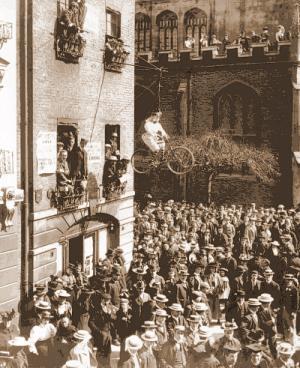
At the end of the 19th century, a bicycle with a woman astride was still a disconcerting sight - a challenge to trouser-wearing men.  In Cambridge, when the question of full degrees for females was being discussed in the Senate, an effigy of a "rationally dressed" lady on a bicycle was hung out of the window of the building opposite, flanked by banners declaring “No Gowns for Girtonites” and “Varsity for Men”. 


(Image: Cambridge Daily News, 21 May 1897.)

The effigy was burned later in the day, and the motion was defeated.  But the ladies went on riding.  They wore bloomers.  They went places without being taken by a man. They started carrying toolbags. 

"Let me tell you what I think about bicycling," said Susan B. Anthony, American campaigner for Votes for Women, in 1896.  "It has done more to emancipate women than anything else in this world. It gives her a feeling of self-reliance and independence the moment she takes her seat; and away she goes, the picture of untrammeled womanhood. I stand and rejoice every time I see a woman on a wheel."

It was a wheel that would not be turned back.  But completely "untrammelled womanhood"?  Not quite.  Even in a world full of "new women" there had to be some standards ... In 1895 the New York World printed a list of Don'ts for Lady Cyclists, which included the following admonitions:
  • Don’t be a fright.
  • Don’t faint on the road.
  • Don’t forget your toolbag
  • Don’t imagine everybody is looking at you.
  • Don’t go to church in your bicycle costume.
  • Don’t wear a garden party hat with bloomers.
  • Don’t contest the right of way with cable cars.
  • Don’t wear white kid gloves. Silk is the thing.
  • Don’t ask, “What do you think of my bloomers?”
  • Don’t let your golden hair be hanging down your back.
  • Don’t allow dear little Fido to accompany you
  • Don’t scratch a match on the seat of your bloomers.
  • Don’t discuss bloomers with every man you know.
  • Don’t scream if you meet a cow. If she sees you first, she will run.
Good advice about cows, though.

Many thanks to Joan Lennon, who is one of our History Girl Reservists, for this fascinating post. You can read about her on the About Us Page.

Monday, 4 June 2012

Victorian Working Women - by Katherine Langrish

For my own nefarious purposes I make occasional visits to the Guildhall Library, London, poring through the long history and development of places like Wapping and Poplar. And I want to share with you today a delighted discovery I made regarding the facsimiles of old Ordnance Survey maps of London which the Guildhall Library – and as far as I can find out, ONLY the Guildhall Library – sells for a modest price in its delightful bookshop.

Here, for example, £2.50 will buy you the 1894 map of Greenwich and the Isle of Dogs, on the massive scale of about 15 inches to the mile, with every dwelling house detailed, plus trees, railways, jetties, wharfs, the positions of stoneworks, shipbuilding yards, manure works, the South Metropolitan Gas Works, soap works, and the General Steam Navigation Company.  Here's a portion of it:


But that’s not all. Turn the map over, and you’ll find not only an essay on the history of the area covered by the map, but – oh frabjous day! – lengthy facsimile extracts from relevant Post Office directories, listing the very names and occupations of all the people on the various streets. And these are utterly fascinating. Look!

West Ferry Road, Millwall (Bridge road to East Ferry road, Manchester Road, and Wharf Rd.)

…here is Ingelheim Place…

PILLAR LETTER BOX
335 Isaac Clarke, grocer
337 & 339 Mrs Elizabeth Phoebe Lewthwaite, pawnbroker
361 Frederick Burt, fried fish shop
363 Mrs Mary Ann Miller, chandler’s shop
365 Mrs Ann Badsey, greengrocer
Chubb, Round & co. fibre works (Elizabeth Place)
367 Glengall Arms, Henry Short
369 Mrs Eleanor Leech, coffee rooms
371 Charles Bolton, greengrocer
373 Miss Annie Geach, chandler’s shop
375 Samuel Brown, chandler’s shop

… here is Cahir Street…

377 Mrs C. Cadman, chandler’s shop
391 William Turner, bootmaker
393 Arthur Phillips, coffee rooms
395 Great Eastern, James Bates

…here is British Street…

397 Mrs Mary Bailey, butcher
403 Charles Newman, coffee rooms
409 Edward Allington, dining rooms

…here is Lead Street…

John George Hames, omnibus proprietor (5 Silver Terrace)
METROPOLITAN FIRE BRIGADE STATION


Now what strikes me about this (apart from the magical bird’s eye view of the street, rather as if the roofs had been lifted off the houses so we could see inside), is that out of those 18 commercial addresses, no less than seven belong to women running their own businesses – which is getting on for 40%. And what a range of occupations they are in engaged in, too! A pawnbroker, three chandlers’ shops, a greengrocer, a coffee room proprietor, and a butcher! On other streets we find women furriers, bootmakers, confectioners, laundresses and drapers; women running refreshment rooms, fruit shops, tobacconists, newsagents, restaurants and libraries.

Let me repeat: actually in charge of their own establishments.

And lest you think this unusual, or perhaps limited to riverside areas, let’s look at 19 addresses on the west side of Drury Lane, where the 1892 directory gives us Mrs Julia Kelf, tobacconist, Mrs Ellen Marshall, confectioner, Mrs Maria Marion Snellgrove, landlady of the Marquis of Granby, Mrs Josephine Winnig, clear starcher, and Mrs Jane Beech, cheesemonger – while in the 1859 Post Office directory for the area around Tower Hill, there is at Number 15, Little Tower Hill, a Mrs Cathryn Dutfield, ‘licensed carman’, and her husband Henry Dutfield, merely ‘carman’ – which looks very much as though it was Cathryn, not Henry, who held the licence from the Worshipful Company of Carmen for her husband’s work as carter and carrier within the City of London. I will finish, from the same directory, with Mrs Phoebe Dwelley of 10, Well Street, Wellclose Square, who is listed as ‘wheelwright’.

An amused stare from a papermill worker, Dartford, 1863


If nothing else, this tells me that our popular picture of Victorian womanhood is very much skewed, on the one hand to the upper middle classes and on the other hand to the very poor. Perhaps there was little or nothing for a gentleman’s daughter to do, other than marry or teach – and certainly there were many starving seamstresses, flower sellers and full or part-time prostitutes: but it looks as though plenty of their lower middle class/upper working class sisters managed to be both busy, competent and comfortable in a wide variety of trades, thank you very much indeed…


Visit Katherine's website
or her blog, Seven Miles of Steel Thistles