Wednesday, 20 February 2019

The problem with historical fiction – Carolyn Hughes

What “problem”, you might ask…
When I first embarked on writing historical fiction several years ago, I edged my way nervously into a genre that I felt instinctively I loved but was also terrified of making a complete hash of. In 2015, a year before I published my first historical novel, I had submitted my doctoral thesis, Authenticity and alterity: Evoking the fourteenth century in fiction. I most certainly did then – and essentially still do – suffer from “imposter syndrome” over my attempts to become an historical novelist. And some of the research that I’d engaged in for that PhD might easily have derailed me almost before I had properly begun. For I’d read more than a few opinions of historical fiction that made me wonder if the whole enterprise was a complete waste of time and effort!
For example:
  • “Historical fiction can never be authentic”
  • “Historical fiction is a lie”
  • “Historical fiction invariably fails to portray the strangeness of the past”.

But, surely, that couldn’t all be true? Otherwise no one would want to read it, let alone write it! For those of you who haven’t come across such negative opinions before, let me explain…

“Historical fiction can never be authentic”

The nineteenth-century novelist Henry James famously disparaged historical fiction. It was not the practicalities of the past that James thought difficult to describe, but imagining with any degree of realism, or perhaps “naturalism”, the inner lives of those who lived in earlier times.
Henry James by John Singer Sargent.
National Portrait Gallery. Public domain.
Yet isn’t imagining the inner lives of characters (historical or fictional) for readers to experience exactly what historical novelists attempt to do?
So, how does a writer make the characters of a novel set, for example, in the fourteenth century, seem to be of their time? I want the readers of my novels to feel they have been immersed in the mediaeval world, but without really noticing its “mediaevalness”. The latter might happen, for example, if they found themselves wondering if this or that thing or image or phrase or thought was “authentic”. To achieve an appropriate degree of authenticity, artefacts and environments must be, or at least seem to be, of their time, and noticeable anachronisms of fact or notion must be avoided, to save throwing the reader out of the illusion. Mindsets (the characters’ thought-world) must be convincing, and language, in narrative and dialogue, must reflect that thought-world, while not necessarily attempting to mimic the actual language of the period.
That all sounds fine in theory but how does it work in practice? James would presumably say it cannot ever work, that historical novelists and readers delude themselves in thinking the novels are in any way authentic. Yet writers surely do their very best to portray their characters and settings with authenticity. They undertake months or even years of research, in history books, in contemporary writings where they exist, and in art, and they use their intelligence and their imagination to transport, first, themselves, and then their readers into the inner lives of their historical characters.
Occasionally, an error of fact or understanding may slip through but, with the effort authors make, and with the eagerness of so many thousands of historical fiction devotees who happily allow themselves to suspend any disbelief in order to enjoy the story, the enterprise (of writing historical fiction) surely is not, as James implied, doomed to failure?
Though actually I think what is true of historical fiction may be true of any fiction... Historical fiction may not be able to fully convey the experiences of the past, but it is difficult for any type of fiction to wholly convey the experience of a character’s life, especially if that character, for example, commits murder, or blasts off into space to save the planet from a rogue asteroid, or perpetrates any number of actions beyond the experience of the average reader.
Although this is, of course, exactly what all novelists, historical or otherwise, attempt to do.

“Historical fiction is a lie”

In 2000, Richard Lee, the president of the Historical Novel Society, gave a talk to an audience of writers entitled ‘History is but a fable agreed upon: the problem of truth in history and fiction’.
The title alluded to a comment attributed to Napoleon, which suggested that history is a form of fiction, for its “truth” depends on who is telling the story: the written history of war differs depending on whether its author comes from the camp of the conqueror or that of the conquered.
Napoleon crosses the St. Bernard, by Jacques-Louis
David
, 1800. Public domain.
But isn’t it also true that, to some extent, the “facts” of history are continually changing, as the latest research inevitably reveals previously unknown information or offers new interpretations of historical truths?
Richard quoted a literary critic who, in a Telegraph book review that year, had said the
“historical novel has always been a literary form at war with itself. The very term, implying a fiction somehow grounded in fact – a lie with obscure obligations to the truth – is suggestive of the contradictions of the genre.”
Richard considered that this critic, and others, misunderstood the nature of historical fiction, for surely all fiction is a lie “somehow grounded in fact”. No one, he said, thinks that either Trainspotting or Bridget Jones’ Diary is true, but rather that “they were in some way drawn from life”. Historical fiction is no more a contradiction than any other form of art, all of which seeks “both accuracy and illusion”.
All fiction is an illusion created by the writer’s imagination. Yet historical, no less than contemporary, fiction must be sustained by a foundation of fact, creating a sense of “authenticity”, in order for readers to accept the illusion as temporary reality. Even fantasy fiction, science fiction and some forms of thriller, despite being illusion writ large, must be founded, if not on fact, at least on sufficient rationality or logic to sustain the illusion.
I found myself almost apoplectic with indignation when I read what that critic had written. He seemed to be implying that historical fiction was somehow “invalid” as a concept. Richard Lee’s comment rings true for me when he suggests that historical fiction, like all art, aims to achieve both accuracy, or perhaps authenticity, and illusion.
Illusion, not a lie.
Richard’s article is an interesting read. If you haven’t read it, it’s still available on the HNS website: https://historicalnovelsociety.org/guides/but-a-fable-agreed-upon-speech-by-richard-lee/.

“Historical fiction invariably fails to portray the strangeness of the past”

What is this “strangeness”? It refers to the very otherness of past times, those aspects of life, in particular mindsets and behaviours, which are unfamiliar or obscure to the modern reader. It will include differences in attitudes and beliefs but also, for an historical novel set in the mediaeval period, perhaps such things as superstition, religious charms, dreams, magic and spells, monsters and mediaeval art, strange ideas and seemingly fantastical happenings that today could be readily explained or dismissed – all of which were normal to people of the time. In other periods, the list might be a bit different, but would still include those things that make that period seem “other” to our own. 

Blemmye from Schedel's World History or
Nuremberg Chronicle (1493). Public domain.
Strangeness is important in an historical novel, but must perhaps not overwhelm. As Jerome de Groot has said in his book The Historical Novel, by exploring the differences of the past compared to the present, historical fiction can make the past “authentically unfamiliar”, and yet still recognisable to modern readers.
The people we encounter on the pages of historical novels are of course familiar to us in many ways: they are mothers and fathers, farmers and carpenters, soldiers and merchants, people with families and concerns and feelings much like our own. But their environment, their habits, their attitudes and beliefs are mostly very different, and it is this dissimilarity, as well as the familiarity, that an historical novelist seeks to portray. Sarah Johnson, in Historical Fiction: A Guide to the Genre, described this as making “the unfamiliar seem familiar”, and the one must be as carefully managed as the other.
However, it is perhaps true that not all historical novelists are entirely successful at achieving this. I imagine we have all read novels that we thought didn’t seem quite “right” for the period, in particular where characters seemed to have far too modern a mindset – overly liberated women, unbelievably “new” men...
In Clio’s Children, a blog for historical novelists, the writer John Yeoman proposed an interesting split between types of historical fiction. One type, which he termed "heritage":
“depicts modern people, sensibilities and conflicts but…cloaks them expediently with props from history’s wardrobe: ruffs and farthingales, gibbets and jousts.”
But, by contrast, he said, serio-historical fiction:
“exposes the reader to a profound whiff of strangeness”.
Yeoman cited a number of novels where, in his view, strangeness could be found, including Umberto Eco’s The Name of the Rose, and I would guess that most of us would agree that the world in Eco’s novel is decidedly “other”.
On the other hand, Yeoman said “we do not find [this strangeness] in Philippa Gregory”. He referred to The Other Boleyn Girl as “a sentimental blend of history and kitsch”, which does seem a bit harsh to me, but one must deduce that, for him, this novel falls into the “props” category. (I should perhaps add that Yeoman insisted that he was not implying any value judgement in defining these two types of historical novel, but was rather just illustrating the differences between them.)
So, to summarise, I have seen it written that:
  • We living in the present can never fully understand the inner lives of people living in the past and therefore may not be able to portray their thoughts and voices with any degree of authenticity;
  • Historical fiction is in itself a contradiction, lies pretending to be the truth;
  • Some historical novels fail to reflect the strangeness of the past, dressing their characters in authentic-looking clothes but giving them modern sensibilities.

In general, I don’t believe that historical fiction does suffer from such “problems”. Indeed I similar problems might apply equally to many types of contemporary fiction. For example, in science fiction, thrillers, murder mysteries and fantasy, novelists attempt to portray all sorts of characters’ inner lives that neither they nor the reader could actually experience. All novels of whatever genre are essentially “untrue” – they are fiction! Even the need for strangeness is not confined to historical fiction, but is required in any novel portraying a world, in time or space, that is very different from readers’ usual experience. 
Having said all that, when I started writing, I certainly did have concerns about my own ability to produce an historical novel with sufficient authenticity and strangeness. Although I was reasonably confident about describing the practicalities of the past, I remained nervous that I might fail to portray my characters’ inner lives truthfully, that they might seem to be modern rather than people of their time, and that the world I was attempting to evoke might not be sufficiently “other”.
Whether I have succeeded or failed is for others to say, but I would be interested to hear thoughts from fellow historical fiction writers about their own experiences of portraying earlier times, and also from readers about whether or not they recognise any truth behind the “problems” I have discussed...

Tuesday, 19 February 2019

The Terminators By L.J. Trafford


In a previous post I examined just how damn dangerous it is being a Roman emperor (click here).
You have a whoppingly high chance of an unnatural death and within that category you are far more likely to be deathed unnaturally by assassination than by any other way. 


 Given the high number of assassinations I thought it might be interesting to examine a few to see if they had anything in common, any key themes or motivations they all shared. I wanted to look at the how, the who and the why of the subject.

Then realising there are 24 emperors who met that end, I decided that we may need a bigger boat in the shape of a Part Two to this subject.

So welcome to Part One of The Terminators.


1) Julius Caesar

No piece on assassination in Ancient Rome is complete without looking at the most famous assassinations of all time; that of Julius Caesar. It’s so famous that it has become part of our cultural conversation. Phrases like “Et tu, Brutus?” and “Beware the Ides of March” are bandied around. That Shakespeare bloke write a play about it. Novelists continue to use it as the pivotal dramatic scene in their books. Who can blame them when it presents such epic themes.


The How

It was, as we all know, the Ides of March (aka 15th March 44 B.C.) Caesar had gone to the Senate House. The stage direction in the Shakespeare play is very to the point, several sharp points that is: 

CASCA first, then the other Conspirators and BRUTUS stab CAESAR 


Plutarch goes into far more detail:

Tullius tore Caesar's robe from his shoulders with both hands, and Casca, who stood behind him, drew his dagger and gave him the first stab, not a deep one, near the shoulder. Caesar caught the handle of the dagger and cried out loudly in Latin: "Impious Casca, what doest thou?" Then Casca, addressing his brother in Greek, bade him come to his aid.


And now Caesar had received many blows and was looking about and seeking to force his way through his assailants, when he saw Brutus setting upon him with drawn dagger. At this, he dropped the hand of Casca which he had seized, covered his head with his robe, and resigned himself to the dagger-strokes.

The conspirators, crowding eagerly about the body, and plying their many daggers, wounded one another, so that Brutus also got a wound in the hand as he sought to take part in the murder, and all were covered with blood. 


The assassination of Julius Caesar, painted by William Holmes Sullivan, c. 1888
{{PD-US}}


The Who 
There were in total sixty conspirators. Which is rather a lot of people to keep a secret this big. But keep it they did.
The two you will have heard of are Cassius and Brutus. But the others we have names for are: Quintus Ligarius, Basilus, Casca, Casca Longus, Decimus Brutus, Cimber, Trebonis, Cassius’ brother Longuinus, Parmensis, Caecilius, Ruga, Spurius, Naso, Aquila, Petronius, Turullius, Laebeo

The key thing to note here is that all of these men are of good families, they are men of high standing who’d held the highest positions in Roman society. Cassius for example was a war hero, a member of Marcus Crassus’ doomed invasion of Parthia. After Crassus and the best part of three legions were exterminated by the Parthians it was Cassius who led the survivors of the slaughter to safety and held the enemy off from over running Syria.

Cimba had been the governor of Bithynia and Pontus.

Trebonius had served as Caesar’s legate in Gaul and held the governorship of Spain. Five months before taking part in the assassination Caesar had appointed him Consul, the highest position available.

Brutus was a close family friend to Caesar, his mother Servilia was Caesar’s long term mistress.
Decimus Brutus was even remembered in Caesar’s will.

Several of the conspirators had served with Caesar. Others had been on the wrong side of the recent civil war between Caesar and Pompey. Yet Caesar had forgiven them and appointed them to positions in government.

There’s a big question hanging in the air. Let’s answer it.


The Why
It’s the Why that makes Caesar’s assassination so interesting to the likes of Shakespeare and Robert Harris.
Caesar had returned to Rome the victor of the civil wars. He’d been given the title of Dictator. This was a position handed to others in the past, but on a purely temporary basis. Caesar had been made Dictator for life.
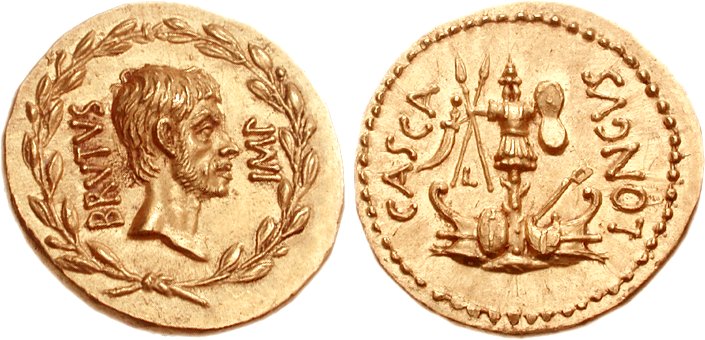
Rome had been ruled by Kings but the last of them, Tarquin had been cruel and tyrannical. He’d been killed by another Brutus, ancestor of our Brutus.
That Brutus had sworn that they would : “never tolerate Kings in Rome evermore, whether of that family of any other."  Livy.
Coin issued by Brutus two years after Caesar's murder

That killing had ushered in the Roman Republic, a system without kings where power was deliberately minimised and shared out so that no one man could overwhelm like Tarquin had.
The conspirators believed that Caesar wanted to make himself King and destroy the Republic. They aimed to get rid of him before he could do so. An anticipatory assassination to preserve the political system they had sworn to serve, to free the Roman people from a future tyranny.

It makes for good dramatic scenes as Brutus and co torment themselves with the terrible task they must complete to save Rome and her people from one man rule.


The Aftermath
With Caesar’s bloody corpse on the floor Brutus, himself saturated in blood, attempted to talk to the Senators present in the house. Unsurprisingly they are pretty freaked out by events and leg it. The conspirators then went to the Capitol Hill. They held up their bloody hands and daggers and declared liberty. Brutus began to make a speech.
And from that point on it all went wrong......

Because although Caesar might have annoyed at least 60 of the posh types of Rome, he was very popular with the people. They weren’t keen on him being murdered, particularly when Caesar’s will was read out and they heard that he’d left every person in Rome a sum of money. Also Caesar, as a successful all conquering general, was held in great esteem by the army too.

Moving down to the Forum for further appeals they faced an increasingly hostile crowd. So hostile they were forced to flee.
The people continued demonstrated their displeasure with Caesar’s death with enough vigour that in the end the conspirators were forced to flee Rome.

Caught up in ideals of their own noble torment they had totally misread the mood. They had assumed that they would be congratulated on their act, that it would be recognised as the great noble deed it was. They’d anticipated a tyranny and acted. But they’d never anticipated or even considered that there might be an opposition. Certainly they hadn’t considered an opposition that might be more eloquent than they were, in the shape of Mark Antony, who might actively seek to punish them for murdering his friend.
They soon found themselves hunted down by Antony and, another beneficiary of Caesar’s will, his great nephew Octavius. They were both fully intent on avenging Caesar. Brutus and Cassius were both killed at the Battle of Philippi.


Was the assassination a success? 
The motivating aim of the assassination of Julius Caesar was to prevent him making himself king and destroying the Republic.
What followed Caesar’s assassination were a series of civil wars that resulted in one man, Caesar’s great nephew Octavius ruling Rome under the name of Augustus and forming a dynasty. The Republic as it had been was over. Rome was now a monarchy in all but name.
So no, it was not a success. It was an utter failure, hastening what it sought to prevent.


2) Caligula


Julius Caesar was assassinated for what he might become in order to preserve the state. Our next assassination is lacking noble ideals. Rome’s third Emperor Caligula had ruled Rome for 3 years and 10 months when he was assassinated at the age of 29. This is an interesting one because the reign is so short. Caesar took decades to build up sufficient resentment to be offed. Caligula manages to really annoy in 3 years and 10 months. Which I think we should take a moment to appreciate.


Right appreciated.

The How 

Suetonius has the tale for us.:

On the ninth day before the Kalends of February at about the seventh hour he hesitated whether or not to get up for luncheon, since his stomach was still disordered from excess of food on the day before, but at length he came out at the persuasion of his friends. 
In the covered passage  through which he had to pass, some boys of good birth, who had been summoned from Asia to appear on the stage, were rehearsing their parts, and he stopped to watch and to encourage them; and had not the leader of the troop complained that he had a chill, he would have returned and had the performance given at once.  
From this point there are two versions of the story: some say that as he was talking with the boys, Chaerea came up behind, and gave him a deep cut in the neck, having first cried, "Take that," and that then the tribune Cornelius Sabinus, who was the other conspirator and faced Gaius, stabbed him in the breast. Others say that Sabinus, after getting rid of the crowd through centurions who were in the plot, asked for the watchword, as soldiers do, and that when Gaius gave him "Jupiter," he cried "So be it," and as Gaius looked around, he split his jawbone with a blow of his sword. 
As he lay upon the ground and with writhing limbs called out that he still lived, the others dispatched him with thirty wounds; for the general signal was "Strike again." Some even thrust their swords through his privates. 


It’s a bloody death isn’t it? Deliberately brutal – note the thrusting swords into his groin. 
Caligula really managed to piss people off, but who were they?


The Who 
Two are named by above, the Tribune Cornelius Sabinus and commander of the Guards, Cassius Chaera. Though you’d have thought the suspicious Romans wouldn’t have trusted a man named Cassius with their personal security. Suetonius says these two succeeded thanks “to the cooperation of the most powerful freedmen and the Guards’ Commanders” 
Bust of Caligula in the Louvre.
Photo by Clio20
I smell a bit of palace intriguing and plotting. Cassius Dio has a little more detail:
“There were a good many, of   course, in the conspiracy and privy to what was being done, among them Callistus and the prefect.

Practically all his courtiers were won over, both on their own account and for the common good. And those who did not take part in the conspiracy did not reveal it when they knew of it, and were glad to see a plot formed against him.” 

Callistus was Caligula’s secretary. See here for an article I wrote examining his slippery life.
So pretty much everyone knew it was going to happen within Caligula’s inner circle. But nobody took any steps to stop it.


The Why
Caligula is the poster boy for the demented ruler. A young man utterly unsuited to ruling who gets steadily more demented, steadily more autocratic and steadily more cruel.
A couple of anecdotes will suffice to give a flavour of Caligula’s rule and why people might want him dead:

At Puteoli, at the dedication of the bridge that he contrived, as has been said, after inviting a number to come to him from the shore, on a sudden he had them all thrown overboard; and when some caught hold of the rudders of the ships, he pushed them off into the sea with boathooks and oars. 
Suetonius


He was no whit more respectful or mild towards the senate, allowing some who had held the highest offices to run in their togas for several miles beside his chariot and to wait on him at table, standing napkin in hand either at the head of his couch, or at his feet. 
Suetonius


If you really want to know more I’d recommend Mary Beard’s documentary for the BBC or alternatively the soft porn film Caligula starring Malcolm McDowell. It’s terrible in the sort of eye popping way Caligula’s court probably was. 

To recap Caligula was possibly mad, definitely cruel and getting rid of him was for the public good. But is that really the why of the situation? No, no its not.

Let us look at chief assassinator and aptly named Cassius.

Chaerea was an old-fashioned sort of man to begin with, and he had his own special cause for resentment. For Gaius was in the habit of calling him a wench, though he was the hardiest of men, and whenever it was Chaerea's turn to command the guard, would give him some such watchword as "Love" or "Venus” 
Cassius Dio


And here’s Suetonius:  

For Gaius used to taunt him, a man already well on in years, with voluptuousness and effeminacy by every form of insult. When he asked for the watchword Gaius would give him "Priapus" or "Venus," and when Chaerea had occasion to thank him for anything, he would hold out his hand to kiss, forming and moving it in an obscene fashion. 


There’s your why for you.
And a good life lesson. Never taunt or humiliate the man who is responsible for your personal safety. Oh and who carries a sword as part of his job


The Aftermath
The only people seemingly not in on the plot were Caligula’s German bodyguard. Who realising their epic job fail tried to make amends by a general massacre. First up were Cassius and Sabinus and their fellow dagger welders. Then some “inoffensive senators” as Suetonius puts it. RIP inoffensive senators.
Then random people, our sources don’t indicate whether they were offensive or not.

In the style of Caesar’s assassins Caligula’s murderers had given absolutely no thought to what happened next. Which I think underlines the personal nature of the assassination, this is not about politics or an unsuitable ruler. It’s about revenge.
Revenge doth not run a government and in the chaos that followed Caligula’s death there were two very different views of what should happen

The Senators rushed to the Senate House and declared the Republic should be restored and there no longer be emperors. Hadn’t Caligula’s rule showed in fully bloody horror the evil of a one man rule?

The Praetorian Guard had in the meantime found Caligula’s uncle Claudius hiding behind a curtain and made him Emperor. 

Proclaiming Claudius Emperor by Lawrence Alma-Tadema{{PD-US}}
 
Was it a success?

If Cassius’ aim was to inflict revenge and pain on the man who’d taunted him then yes it was an amazingly successful assassination.
Also for all those freedmen like Callistus who involved themselves in the plot they rid themselves of a demented boss.
The lesson from Caligula’s assassination is that if you set the bar low for the outcome of your plot, then you can consider it a wild success.


3) Domitian 96AD


Rome’s 11th Emperor fared much better than Caligula in clocking up 15 years of rule before annoying enough people to get killed. 
Statue of Domitian
Photo by Steerpike


The How
In order to assassinate a ruler you need to get close to him. In Caesar’s case his killers knew his schedule and waited for the optimum time and place to get their daggers in. With Caligula it was his own Guards who assassinated him, so they were by his side anyway. In the case of Domitian the ‘how to get close’ part of the plot is really quite ingenious and thought out:

“To avoid suspicion, he wrapped up his left arm in woollen bandages for some days, pretending that he had injured it, and concealed in them a dagger. Then pretending to betray a conspiracy and for that reason being given an audience, he stabbed the emperor in the groin as he was reading a paper which the assassin handed him, and stood in a state of amazement. “ 
Suetonius

Element of surprise rating 8/10. Domitian really did not see this coming. Had the event ended there it would have been an incredibly neat affair. But Domitian wasn’t going quietly.

“The emperor grappled with Stephanus and bore him to the ground, where they struggled for a long time, Domitian trying now to wrest the dagger from his assailant's hands and now to gouge out his eyes with his lacerated fingers.” 
Suetonius

Ouchy. Several other conspirators then rushed in and helped finish Domitian off in a very messy way.
If you’re wondering how we know all this . Well there was a witness . One of the Imperial slaves, a young boy, was tending to the household shrine when it all kicked off.


The Who

The man who did the stabbing was Stephanus, a former steward of Domitian’s exiled niece.
But he was far from the only one involved. Helping him finish off Domitian were Clodianus, Maximus, Satur and a gladiator from the Imperial school. All of them were palace staff.

They were the do-ers but they weren’t the plotters. They were much higher up the Imperial ladder:
Parthenius, Domitian’s chamberlain
Sigerus, another chamberlain
And Entellus, head of petitions.


We know a little bit about Parthienus, for the poet Martial courts his influence in the hope of getting his poems before the Emperor.


ON A TOGA GIVEN HIM BY PARTHENIUS. 

This is that toga much celebrated in my little books, that toga so well known and loved by my readers. It was a present from Parthenius; a memorable present to his poet long ago; in it, while it was new, while it shone brilliantly with glistening wool, and while it was worthy the name of its giver, I walked proudly conspicuous as a Roman knight. 


Martial even writes a poem to celebrate the birthday of Parthienus’ infant son, Burrus.
So here we have three senior members of Domitian’s staff planning his murder and employing other members of the palace staff to enact it.
I think we need to know why.


The Why
Though a capable administrator Domitian had become increasingly paranoid. Though justifiably so given in 89AD a Roman General named Saturnius had initiated a revolt against him. That was fairly easily suppressed but it clearly left its mark on Domitian, not least in his party hosting, which had taken a turn towards macabre: 
Bust of Domitian
Photo by Jastrow

He prepared a room that was pitch black on every side, ceiling, walls and floor, and had made ready bare couches of the same colour resting on the uncovered floor; then he invited in his guests alone at night without their attendants. 

And first he set beside each of them a slab shaped like a gravestone, bearing the guest's name and also a small lamp, such as hang in tombs. Next comely naked boys, likewise painted black, entered like phantoms, and after encircling the guests in an awe-inspiring dance took up their stations at their feet. 
After this all the things that are commonly offered at the sacrifices to departed spirits were likewise set before the guests, all of them black and in dishes of a similar colour. 
Cassius Dio

Yikes. Senators were executed, relatives exiled and a Vestal Virgin buried alive under Domitian’s increasingly paranoid rule: 

He used to say that the lot of princes was most unhappy, since when they discovered a conspiracy, no one believed them unless they had been killed. 
Suetonius


Domitian had a particularly bad relationship with the Senate. The writers Tacitus and Pliny the Younger both served in the Senate under Domitian and it’s clear from them just how frightening it was. Nobody knew when he might pick on them.
But, as we’ve seen, the blow when it came, came not from the persecuted Senators but rather his closest advisers. We are supplied with the reason: 

He had first banished and now slew Epaphroditus, Nero's freedman, accusing him of having failed to defend Nero; for he wished by the vengeance that he took on Nero's behalf to terrify his own freedmen long in advance, so that they should venture no similar deed. Yet it availed him naught, for he became the object of a conspiracy in the following year 
Cassius Dio


Epaphroditus was a freedman of Nero, who had accompanied the emperor on his final flight from Rome. As the soldiers had closed in on Nero, Epaphroditus had assisted him into suicide. This was 27 years before. That’s quite a statement. Clear as glass. And aimed directly at his own staff.
What we can conclude from their actions, particularly Parthienus the recipient of Martial’s kind poems, was that they saw it as a him or us scenario.
This is born out by this little tale:

He invited one of his stewards to his bed-chamber the day before crucifying him, made him sit beside him on his couch, and dismissed him in a secure and gay frame of mind, even deigning to send him a share of his dinner. 
Suetonius
The message was clear. It could be any of them. So they acted.


The Aftermath

Stephanus and the others who had physically attacked Domitian were instantly slain by the Guards.
There was undoubtedly a bit of chaos but the very same day that Domitian was murdered, Marcus Cocceius Nerva was proclaimed by the Senate as Emperor. Take a moment to take that in. THE VERY SAME DAY. 
Statue of Nerva
Photo by Carole Raddato

Was it a Claudius behind the curtain scenario or something quite different? Nerva was 66 years old, an experienced feature of the government and very firmly loyal to the Flavian dynasty of which Domitian was the last. Had he been lined up before hand by Parthienus, Sigerus and Enntellus?

Cassius Dio says yes:

They discussed the matter with various men, and when none of them would accept it (for all were afraid of them, believing that they were testing their loyalty), they betook themselves to Nerva. For he was at once of the noblest birth and of a most amiable nature 

It would certainly explain the speed of the ascension.
Nerva ruled for 2 years, dying naturally at age 67. He became the first of what Edward Gibbon called the Five Good Emperors, an era of prosperity and peace.

So it was a success then? 
As with the other assassinations let us go back to the principle aim. The conspirators were motivated by fear for their lives from an increasingly paranoid boss.
That boss was removed. So a tick for that one.
However did it save their lives? Not Stephanus it didn’t. He was instantly killed. And the chief plotter Parthienus? He lasted incredibly until October the following year when the Praetorian Guard who’d been firm supporters of Domitian stormed the palace and insisted Nerva hand him over.
Domitian had been wildly popular with the army, mainly because he had massively increased their pay, so the question here is surely why did it take so long for them to revenge their emperor?

The answer is quite chilling: because they didn’t know Parthienus was involved. Remember he was the plotter, he didn’t actually take part in the killing. Domitian’s former Chamberlain spent a whole year knowing what he had done and no doubt wondering whether that would be uncovered. That’s got to be stressful. We have to wonder whether he was betrayed by someone on the inside, another palace employee letting the great secret slip?

Nerva was given little choice in the matter, held at knife point by soldiers
Parthienus was handed over. He was executed in a particularly horrible way.

So no it did not save Parthienus’ life for long either. Though maybe if he hadn’t been betrayed we might never have known the man who brought Martial a toga was also behind an Emperor’s murder.


Here we end part one of The Terminators......


L.J. Trafford is the author of the Four Emperors series. Of which assassination and general massacres feature highly.

Monday, 18 February 2019

When is Spring? In Celebration of Imbolc - Celia Rees

St Brigid's Cross - Ancient Symbol of Imbolc
Today, I went out walking and marked the year's turning from darkness to light, from dormancy to life. 

8:05 15th February, 2019, Leamington Spa
We are not so far removed from our ancestors.  Until very recently we were all ruled by the eternal rhythms of sunset and sunrise.

Planet Earth at Night - wikipedia
Now, we have flooded the world with light. We love it so much that it is there 24 hours a day, you can even see it from Space. We are warned not to look at bright screens last thing at night because the brain simply won't know that it is time to sleep. Our love of light and dislike of darkness have changed the natural pattern of our lives, but still we feel it on our pulses, the turning of the year.

We still keep to the ancient calendar that is ruled by the sun. The winter solstice might have been christened Christmas but we are really celebrating the point when the sun begins its slow return. It's an act of faith more than anything. The mornings are still dark, night still comes early. The trees are bare and nothing is growing. Many of us feel 'down' at this time of year, depressed. The third Monday in January, has been designated Blue Monday, the most depressing day of the year.  Electric lights are not enough, screens are not enough. We need the sun.


Then there is a day, often in late January or early February,  when the morning is lighter,  evening  comes later, the sun is brighter, stronger, there's a change in the air.  That's why I think we should re-instate the ancient Celtic Festival of Imbolc. It was traditionally celebrated on 1st of February, but the day was not exact, it could come a fortnight on either side of that date, depending on seasonal variations, the onset of lambing, the blooming of the blackthorn. It was adopted by the Christian church as St Brigid's Day, Brigid herself a christianised version of the Celtic goddess, Brigid. It is immediately followed by Candlemas on 2nd of February, a Christian festival associated with the Virgin Mary. Clues there as to its importance in the Pagan Wheel of the Year and its strong association with the Goddess. 


Imbolc and Candlemas have slipped from our calendar and our consciousness. The nearest date of note is Valentine's Day with its rampant commercialism, tawdry cards and heart shaped balloons. A time, supposedly, for lovers, but how many of us are? The traditional anonymity of the exchange of cards and tokens disappeared a long time ago and  for those of us who are not in a relationship for any number of reasons,Valentine's Day can eclipse Blue Monday as the most depressing day of the year. 


How much better to celebrate the coming of Spring. Not when it has already arrived on 21st March and the daffodils are everywhere, but when we can sense its approach in the lighter mornings and evenings and the drifts of snowdrops carpeting the bare ground. 

6:45 15th February, 2019 Leamington Spa


Snowdrops in Jephson Gardens


Sunday, 17 February 2019

A Tale of Time, Cakes and Travel, or how Bettys came to Harrogate, by Penny Dolan

This is Harrogate, and a queue lines up under a glass shop-canopy that protects them from the brisk, damp Yorkshire weather.

These patient people are waiting for a table within Bettys Tea Rooms where, served by waitresses in starched pinnies, they intend to enjoy morning coffee, lunch, or afternoon tea in a genteel, well-heeled style. Meanwhile, at the shop counters, everyday customers can call in and buy bread, cakes or pastries, or a wide range of tea, coffee and chocolate confectionery.

Like The Stray, the stretch of open grassland that runs round part of Harrogate, Bettys is part of the local tourist industry that likes to offer an image of a stylish spa town, still flaunting the somewhat faded flag of its early twentieth century elegance.

Across the town centre, the antique shops and rare booksellers are few, the plate-glass store-fronts stand empty, the trendy restaurants have come and gone and the town hall has been sold off for luxury apartments so in some ways, Bettys represents a kind of permanence in Harrogate. This is, I feel, a suitable state of affairs as Bettys - the company – reaches its hundredth birthday this year.

Unlike poor Patisserie Valerie and her too-many premises, Bettys has always held tight to her Yorkshire roots and limited the number of its cafes. There are, even now, only six: on Parliament Street in Harrogate; at Harlow Carr Gardens, Harrogate: in Ilkley and in Northallerton; at Stonegate in York and also at St Helen’s Square in York, which boasts an interior inspired by the famous cruise liner, the Queen Mary.

As in all traditional stories, Bettys begins with a poor orphan child, born in 1885. though not in Yorkshire. 

Little Fritz Butzer, the son of a miller and master-baker, was born in Switzerland, His mother Ida died when he was an infant and not long after, fire destroyed his father Johann’s mill. Although his older sister was adopted by relatives, Fritz, only five-years-old, was sent back to the family village to be fostered.

He lived with a farmer who, despite promises, neglected the boy’s care and education and used him as a farm labourer. As soon as possible, Fritz left the farm and went to work as an assistant baker. Over the next years, he worked his way around Switzerland and then into France, learning about confectionery and the skills needed to be a chocolatier.

Even so, how - given his next move - can he have learned so much within what must have been about eleven years? Because, in 1907, at twenty-two, Fritz set off for England, unable to speak much of the language.

Unfortunately – or fortunately - on reaching London, he’d lost the paper giving the address of his destination. All he remembered – says the story - was that the place sounded like “Bratwurst”, a kind of sausage so Fritz was put on the train to Bradford. As an area of Bradford is still called Little Germany, this may not have been as random a suggestion as it sounds and, besides, many were seeking work in the industrial towns of the North. Fritz was employed by Bonnet and Sons, a Swiss confectioner in the city, but he was clearly an ambitious young man.

He moved on to the prosperous Yorkshire spa town of Harrogate, an “Inland Resort” that catered for a variety of visitors, who came to stay for health cures, rest and relaxation, shopping and entertainment and – of course – indulging in the best of food and drink. Originally, the annual visitors came as a diversion during the late-summer Yorkshire hunting season but, by the twentieth century, Harrogate was an upper-class destination all year round. The town’s most glittering season came in 1911, when it was visited by Queen Alexandra and various members of European and German royalty. Offering elegant hotels, prestigious musical performances inside the gilded Kursall, both Winter Gardens and Valley Gardens as a place for sociable promenades, Harrogate was a busy enough place for the enterprising young baker to make his mark.

Fritz married Claire Appleton, his landlady’s daughter, and before long had wisely changed his name to the more anglicised Frederick Belmont. In the summer of 1919, financed by his wife’s family, he set up the first Bettys bakery in Harrogate and in the 1920’s, but the tearooms he established were in Leeds and Bradford.

Then, in 1937, rather boldly, Frederick Belmont chose York for his new venture. It was already the home of three famous Quaker chocolate companies - Rowntrees, Terrys and Cravens – and site he chose was in the heart of the city, directly opposite the Terry’s cafe in St Helen’s Square.

The York Bettys flourished, and like all his other tearooms, would have prided itself on the quality of its offerings, the elegance of its catering, the impressiveness of its window displays, the superiority of its music and the luxury of the private reception rooms. Bettys was distinctive, and at at time when women could not meet away from home in pubs or bars, a valued female environment.

However, during WWII, Bettys in York took on a different character: a smart cocktail bar was installed upstairs and, away from the need for blackout, a bar down below the stairs. At that time, Yorkshire was home to many local air-bases and Bettys became popular with the bomber boys and the Canadian and American pilots. A framed mirror, where the airmen inscribed their names with a diamond pen, is still on show in the York tea-rooms. Not many of those boys would make a return visit to Bettys bar.

Nevertheless, throughout the war, Betty’s survived both bombs and the threat of army requisitioning. Did the supposed glamour of the local aircrews attracted the ire of the military? Or, behind the scenes, did the RAF high-ups defend Mr Belmont’s accounts of the number of meals he served, and the menus he simplified to fit rationing standards - and so keep their favourite Bettys bar open?

Eight years after the end of the war in Europe, Frederick Belmont died. His nephew, Victor Wild, took over as a managing director and oversaw the next decades. There were changes: although Bettys in Leeds became an espresso bar in the 1950’s, it did not survive the era of the mods and rockers and Bettys in Bradford closed too, bringing an end to the cafe in the industrial cities. It was followed by a time of expansion: in 1962, Wild heard that C.E.Taylors, the Yorkshire tea and coffee merchants, was for sale, Wild took action and Bettys became “Bettys and Taylors”. The Wild family remains involved in the company which, after trading for a century, flourishes online, through diversifying into Bettys Cookery School and cookbooks and publications, and, at an everyday commercial level, through the nationwide “Yorkshire Tea” and similar products.

Put together, the Bettys tale does read rather like a novel but there is rather a nice twist to the tale. When the new company was created, two establishments changed hands and brands. Over in Ilkley, the then-Taylor’s Tea Kiosk became another Bettys.

The other change was more significant: it fulfilled the dream Fritz Butzer had dreamed a hundred years before. The Imperial Cafe in Harrogate, which was then owned by Taylors, became a Bettys Tea Room, which is where, when a treat is needed, you can enjoy the most delicious cakes.

I must warn you that visiting Bettys is not at all cheap, but as a wise and rational friend once explained as we sat having a lovely, long and all too rare book chat. “Don’t think of the tea and scones as expensive. Just think of it as renting a table for a couple of hours.” And that, now and again, works for me.

As for the mysterious Betty? There are several ideas as to whom she might have been within the history section of Betty’s website - thank you for all the information -, but there’s also doubt as to whether she even existed. 

With Fritz’s own life-story being as full as this – an orphaned immigrant travelling through France, becoming a baker and confectioner on the journey and creating cafes up here in the North of England - maybe Betty doesn't really need a tale of her own, even for if this year is her hundredth birthday? 

Although it is very tempting to make another one up. . .  Once there was a young orphan girl . . ?

Nevertheless, HAPPY BIRTHDAY BETTYS,
and, additionally, 
in my mind,
all those neat waitresses and waiters in their black and white uniforms,
and the busy shop staff
and all the Bettys-behind-the-scenes bakers,
and the workers and packers in the Taylors factory
deserve a very, very loud cheer and more too.
Hope they will be having a great and grand party sometime this hundredth year too!

And in response to any pedantic queries about the missing apostrophe?
Bettys doesn’t have one.  Officially.

Penny Dolan

pennydolan1@twitter

Saturday, 16 February 2019

Marianne North at Kew - by Sue Purkiss

I first came across Marianne North when I was doing the research for my children's book, Jack Fortune and the Search for the Hidden Valley. Jack is a boy who goes plant hunting in the Himalayas with his uncle at the end of the 18th century. It's an adventure story, but it's also about facing up to your fears, and about respect for tthe environment and for other cultures.

I wasn't able to get to the Himalayas, so I had to find gardens that would give me a sense of the kinds of vegetation found there. Also, Sir Joseph Banks, who had a great part to play in the early development of Kew, is a character in the book - so it made sense to visit Kew, take a turn round the tropical house and the alpine garden, and see if they had any useful books in the shop.

While I was in the shop, I noticed some rather beautiful postcards, with plants and flowers shown in detail in the foreground, and views of landscapes from all over the world in the background. The colours were jewel-like and brilliant, and I had seen nothing like them before. They were by Marianne North, and the originals were in a specially built gallery within the grounds of Kew.

I'm not certain now whether I didn't go to see them because we were on the way out, or whether the gallery was closed for refurbishment - I think it was the latter. Anyway, I didn't go, but I did read up on Marianne, and found that she was a very resourceful Victorian lady, who when her father died and left her comfortably off, decided to devote the rest of her life to travelling to the most far-flung corners of the world in order to paint and study plants. She must have been an incredible character. She knew Sir Joseph Hooker, the director of Kew, and when she had accumulated hundreds of paintings, she offered to pay for a purpose-built gallery at Kew to house them. She oversaw the placing of the pictures, and this is the result: they're all very close together, and each one is stunning.


That first time, I bought a pack of postcards of her pictures. One of them is of number 270: Distant View of Kinchenjunga from Darjeeling. In the foreground luxuriant vegetation clothes a steep ravine, and in the distance are the snow-covered peaks of the Himalayas. It's a beautiful picture. The mountains, framed by the foliage seem like an unattainable image of loveliness. I remembered this picture when I came to the point in the book where Jack's Uncle Edmund, having travelled thousands of miles to reach Hakkim, is told by the Maharaja that he will not be permitted to travel any further. Edmund glimpses this view, and Jack sees on his face a look of longing and despair that makes him determined to somehow overturn the Maharaja's decision, for the sake of his uncle: it's really a turning point in the book - the first time that Jack becomes properly aware of other people's needs and desires.


Well, so yesterday a friend suggested going to see the annual orchid festival at Kew, and I realised that here was my chance to visit the Marianne North Gallery and see it for myself. It was one of those warm, sunny days that you sometimes get in February: perfect. First we went to see the orchids. Apparently orchids grow on every continent, and each year, the festival focuses on a different region. This year it's Colombia, where scientists from Kew have a number of projects on the go. The colours were extraordinary, and there were quirky touches, like this sloth, and the hats perched on top of the cacti.


I don't think Marianne would have approved of the hats, but she would have loved the colours of the flowers.

After the orchids, we  went to look at the Hive, which is this intricate metal structure which mimics the complexity of a beehive. It shimmered beautifully in the sun, but I would love to see it at night, when the hundreds of tiny LED lights must make a glittering display.


And finally we arrived at the gallery. There is another gallery beside it now, which had exhibitions of botanical art, and we looked at this first. This picture of an ancient oak tree is one of a series of graphite drawings by Mark Frith, called A Legacy of Ancient Oaks. The photograph really doesn't do justice to the detail; they are huge, and exquisite, and utterly different from Marianne North's work, which we came to next.


I don't know of anywhere else where paintings are displayed in such a way as they are here. There are hundreds of them, all very close together: they're somehow not overwhelming, but of course you can't take them all in at one visit. I was searching for my special picture, the one of Kanchenjunga, and it took me a long time to find it. On the way I saw landscapes from South America, from Australia, from South America, from Malaysia - from all over the world. And I realised that they don't just show the plants. They show what the world was like in the second half of the 19th century: there are people there too, and the places they lived in. She saw so much, and she captured so much. 

Marianne North

Incidentally, if you look at the cover of Jack Fortune, you may see that there's a reference to Picture Number 270, just in the layout of the cover image. This pleases me very much!