Friday, 26 May 2023

The Marriage Portrait by Maggie O'Farrell, reviewed by Judith Allnatt.

Shortlisted for the Women's Prize for Fiction 2023, the novel opens with a gripping scenario. Sixteen year-old Lucrezia,  bride of less than a year, is taken to a hunting lodge deep in the country by her husband Alfonso 11 d'Este, Duke of Ferrara, and while they dine together she realises that he plans to kill her. I was instantly hooked, not only by the classic 'woman in jeopardy' situation but by the fairy-tale resonance of the setting. The high walled, star-shaped fortress in a wintry forest made me think of both Rapunzel and the Sleeping Beauty. Set in the mid sixteenth century in the Duchy of Ferrara, the world described has both strangeness and a fairy-tale familiarity: there are white ponies, cloaks and squirrel-lined gloves, wax seals, daggers and sleeping draughts. Furthermore, as the story unfolds, fairy tale elements of manipulation by an older generation, imprisonment, love and attempts at rescue are crucial parts of the story.

Allori_Agnolo_Detto_Bronzino_(bottega)_-_Lucrezia
_de_Medici_-_Galleria_Palatina


The narrative switches between Lucrezia's present jeopardy and her backstory, tracing her history from birth through a childhood in which she is marked out as unbiddable, clever and artistic, to an early arranged marriage. The author has a free hand with Lucrezia's  fictional persona but draws on the facts of her situation: she is parted from her family and sent from Florence to Ferrara, a naieve and lonely teenager with a husband 11 years older whose political future depends on producing an heir. Lucrezia did not promptly get pregnant and in less then a year she was was dead. The cause of death given at the time was 'putrid fever', (modern historians consider this to have been a reference to pulmonary TB) but after her death it was rumoured that she had been poisoned - done away with by her husband. 

Browning's poem,'My Last Duchess' a dramatic monologue in the voice of Alfonso draws on this chilling scenario and, as the title implies,  Lucrezia was one in a series. Alfonso married three times and all three marriages were without issue. Browning's poem presents a sinister portrait of the Duke and focuses on his obsessive and unwarranted jealousy. Maggie O'Farrell's presentation of the character is terrifyingly changeable, a sociopath who is ice-cold and manipulative. To both versions of Alfonso, cruelty is simply a means to their own ends.

At her marriage, Lucrezia was caught between two powerful men: her father, Cosimo, Grand Duke of Tuscany and her would-be husband, and had no choice in the matter. Her father's power is brought home to the reader from the outset. In the basement of the Palazzo Vecchio in Florence, he keeps Big Cats: exotic beasts often collected by rulers or accepted as gifts betokening status and reflecting power and strength. (The street at the  back of the palazzo is still called Via dei Leoni). Lucrezia, as a child, witnesses the arrival of a tiger and is desperate to see it.  O'Farrell uses Lucrezia's visit to the tiger, in which she touches its fur without fearsome consequence, to show us her daring and to suggest that something of the creature's power lies within her character, despite her weak position in the hierarchy. At the same time, this strength at her core marks her as different from her siblings and the suggestion that she must have enchanted the beast demonstrates the wariness of others. The motif of the tiger is woven through the novel in connection with the power within Lucrezia that is her selfhood. O'Farrell also makes figurative use of the lions. She recounts that the interconnecting door between the tiger's and the lions' enclosures are accidentally left open and that the lions attack and kill the tiger. Later in the novel we meet Alfonso's right-hand man, Baldassare, who is unscrupulous, devious and brutal. O'Farrell gives him the first name Leonello and both Lucrezia and the reader instantly identify him as a dangerous enemy.

A_Lion_and_Tiger_in_Combat'_by_Johann_Wenzel_Peter

In a world where she and her sisters are not allowed to leave their rooms without permission, Lucrezia finds self expression through art. Fittingly, the author describes the colours, textures and detail around her with a painter's eye, bringing the Renaissance world vividly to life through close observation and imagery. We feel the touch of Lucrezia's  ankle length hair that she can wear 'around herself like a shroud' and  a candle makes 'a trembling circle of waxy light (that) pushes at the blackness'. In the gown she must wear for her marriage portrait with its huge skirt and ballooning sleeves 'her hands appear like the pale and ineffectual paws of a mouse, peeping out of frilled and ornate cuffs'.

As I hope you'll read and enjoy the novel, I won't comment on the conclusion of the narrative other than to say that the use of Lucrezia's paintings, executed on small pieces of wood and then overpainted with pictures of birds and beasts, provide an apt imagery. The final picture one is left with is not that of the marriage portrait, depicting Lucrezia as a powerless, jewelled, static status symbol. O'Farrell's final image of  her protagonist has stayed with me and will continue to do so. 


Friday, 19 May 2023

Meonstoke's "glittering" past by Carolyn Hughes

All the historical novelists I’ve met seem to enjoy researching their books almost as much as writing them – some even more so. Documentary sources are manifold, and what you need to use depends of course on what you need to know. Some authors need to pore over original ancient documents in libraries or archives. If you are writing a novel that depends on the accuracy of the history, or demands insight into the life of a real person, then such delving into original sources is obviously an essential part of ensuring the novel, albeit fiction, can be judged as a good, authentic representation of the times and the people.

For my own novels, The Meonbridge Chronicles, recorded history is not, for the most part, a fundamental aspect of the stories but rather a background against which they are set. Neither my setting nor my characters are real, so I am at liberty to make up everything about them. But that is not to say I don’t strive for authenticity in the way I write about the people and the time – of course I do. Research into the medieval way of life is still very important for me. And I have dozens of books to help me, acquired over the years I have been writing historical fiction. But I do use online resources too, with a suitable degree of circumspection about their likely veracity.

But one online source I do return to time and time again, not because it tells me much about my characters’ “way of life”, but because it gives access to a wealth of fascinating documents that offer all sorts of snippets of information that can feed your imagination as a novelist, is British History Online (BHO).

I first posted a version of this on The History Girls blog back in July 2017, but I thought the idea was worth reprising, for those readers who don’t know about BHO, but also because what I learned about the history of the nearby village of Meonstoke I continue to find deeply fascinating and hope you might too. Alternatively, you might want to explore what BHO has to tell you about the history of your own village, county, town or city.


Browsing the British History Online website can while away many a happy hour in a fascinating, sometimes surprising, experience. If you don’t know of it, BHO is a digital library of key printed primary and secondary sources for the history of Britain and Ireland, with a primary focus on the period between 1300 and 1800.

The website offers an astonishing number of documents. To pick at random from the catalogue index, just to show the sort of documents available…

EXAMPLE 1: Feet of Fines, Sussex
Feet of fines are court copies of agreements following disputes over property. In reality, the disputes were mostly fictitious and were simply a way of having the transfer of ownership of land recorded officially by the king’s court. The records in this series relate to the county of Sussex for the period 1190-1509. I’d need to brush up on my Latin to make sense of the Edward I volumes, although those for Edward III are in English…
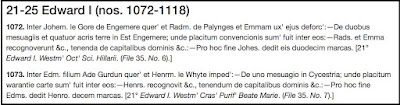
‘Sussex Fines: 21-25 Edward I (nos. 1072-1118)’, in An Abstract of Feet of Fines For the County of Sussex: Vol. 2, 1249-1307,
ed. L F Salzmann (Lewes, 1908), pp. 159-169.
See British History Online [accessed 7th May 2023].

‘Sussex Fines: 11-15 Edward III’, in An Abstract of Feet of Fines For the County of Sussex: Vol. 3, 1308-1509,
ed. L F Salzmann (Lewes, 1916), pp. 88-102.
See British History Online [accessed 7th May 2023].

EXAMPLE 2: Calendar of Close Rolls - Edward III (14 volumes)
The Close Rolls record “letters close”, that is, letters sealed and folded because they were of a personal nature, issued by the Chancery in the name of a particular king or queen. They usually contained orders or instructions. These “calendars” provide summaries full enough, for most purposes, to replace the original documents. However, these particular documents are designated on the BHO as “premium content” and require a subscription to access that I don’t have, but would surely be of great interest to anyone researching into the lives of a particular monarch.

EXAMPLE 3: The Medieval Records of A London City Church St Mary At Hill, 1420-155
Edited by Henry Littlehales, these records were first published by the Early English Text Society in 1905. They are churchwardens’ accounts for the St Mary At Hill parish. The records are at their fullest for the period from 1480 onwards. The volume also has an extensive introduction, detailing the history and liturgical practice of the church, and the impact of the Reformation. Looking at this page, you’d clearly need to understand the notation used for the accounts, but it’s potentially fascinating stuff!
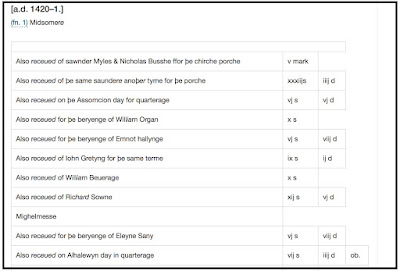
The Medieval Records of A London City Church St Mary At Hill, 1420-1559,
ed. Henry Littlehales (London, 1905),
See British History Online [accessed 7th May 2023].

Anyway, the part of BHO that I generally head for is the Victoria County History for Hampshire. A History of the County of Hampshire: Volume 3: Edited by William Page. This covers eastern Hampshire, including Portsmouth, Southampton, Petersfield and Havant, and was originally published by Victoria County History, London, 1908. See British History Online [accessed 7th May 2023].

The Victoria County History was begun in 1899 and dedicated to Queen Victoria. Organised by county, it provides a vast and detailed record of England’s places and people over many centuries. It has been described as the greatest publishing project in English local history, and it certainly does provide a wealth of information.

The entries I return to in the Victoria County History are those for the Hundred of Meonstoke in the Meon Valley, and the Parishes of Meonstoke.

If you'd like to look them up, see: 'The hundred of Meonstoke: Introduction', in A History of the County of Hampshire: Volume 3, pp. 245-246. British History Online and ‘Parishes: Meonstoke’, in A History of the County of Hampshire: Volume 3, pp. 254-257. British History Online.

The information IS old, of course, written in the nineteenth to early twentieth century. It isn’t brought up to date, as far as I know. But, if the information you are looking for is about the fourteenth century or earlier, as is true for me, that really doesn’t matter.

A “hundred” was a division of the shire. Hundred boundaries were independent of both parish and county boundaries, though they were often aligned, so a hundred could be split between counties, or a parish could be split between hundreds. The Meonstoke Hundred contained a number of parishes and some tithings that were part of other parishes.

The setting for my Meonbridge Chronicles is not actually Meonstoke, but I have a sense that “Meonbridge” lies broadly in the area occupied by Meonstoke and its neighbouring villages, so I was interested to read what the History could tell me about these villages and their development over time. I don’t necessarily use much if any of what I’ve learned in my novels, but research is a thrill in its own right, isn’t it? Just reading this kind of stuff can be a delight.

Various things drew my interest…

For example, the way the structure of the hundred changed over time. At Domesday, Meonstoke consisted of ten parishes, and a tithing from another parish/hundred but, by 1316, it was down to four parishes – Meonstoke, Soberton, Warnford, and Corhampton – plus three tithings from three other and different hundreds (‘The hundred of Meonstoke: Introduction’, Paragraph p3).

Then there is the way that the names of places changed over time, or perhaps were simply recorded with different spellings. So, for example, Meonstoke was Menestoche in the 11th century, Mienestoch or Mionstoke in the 12th; Manestoke or Menestoke in the 13th; Munestoke, Munestokes, Maonestoke or Moenestoke in the 14th (‘Parishes: Meonstoke’, Paragraph p1).

But perhaps what really drew my attention about Meonstoke were the names of some of the owners of its manors – including both illustrious and notorious individuals – which give Meonstoke a seemingly glittering past that sits somewhat strangely with the rather peaceful, out-of-the-way, “backwater” it might appear to be…

The “glitter” derives perhaps from the fact that Meonstoke was always part of the king’s demesne. It formed part of the lands of King Edward the Confessor, and, at the time of the Domesday Survey, being part of the crown’s demesne, it was not assessed. But, in the reign of Henry III, it was divided into three portions and, from then until the 14th century, there were three manors of Meonstoke – Meonstoke Tour, Meonstoke Ferrand and Meonstoke Waleraund (later Meonstoke Perrers), each with a distinct history (‘Parishes: Meonstoke’, Paragraph p4).
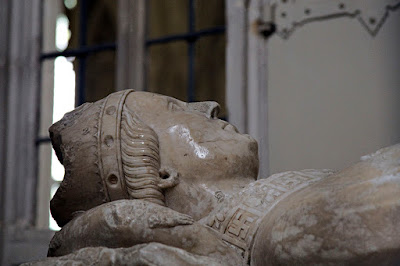
Effigy of William Edington in Winchester Cathedral.
By Ealdgyth [CC BY-SA 3.0], via Wikimedia Commons

Meonstoke Tour was land granted by Henry III to one Geoffrey Peverel but, in 1240, it was back again in the hands of the king, who then granted it to his serjeant Henry de la Tour. The manor remained in the hands of the de la Tour family from then until 1353, when it was sold to no less a personage than William de Edendon (or Edington or Edyngton – medieval spelling was not consistent!), the Bishop of Winchester. In 1366, the then king, Edward III, wanting to reward William for his long service, tried to appoint him Archbishop of Canterbury, but William was already in failing health and he declined the honour. He died in the October in nearby Bishop’s Waltham, and is buried in Winchester Cathedral. The new bishop was William of Wykeham (a Meon Valley man, born in Wickham, and one of the area’s most illustrious sons), who bought the manor from de Edendon’s executors and merged it and the other two manors back into a single “Meonstoke” manor (‘Parishes: Meonstoke’, Paragraph p7).

Lord High Chancellor of Great Britain and Bishop of Winchester, William of Wykeham (1320-1404).
Engraving by Charles Grignion (1754-1804).
Public domain, via Wikimedia Commons. 

Meonstoke Ferrand’s land was granted by Henry III to his Gascon crossbowman Ferrand in about 1233. A Ferrand then held the land until 1305, when it was sold to John de Drokensford, who was bishop of Bath and Wells. For the next fifty years, Drokensfords held the manor, until it seems to have been sold as part of a larger transfer of messuages (dwellings with their adjacent buildings and lands), other land and mills by one Maurice le Bruyn. The buyer we have met already – William de Edendon (Edyington, Edington…), the bishop of Winchester. After his death, Meonstoke Ferrand was also bought by his successor, William of Wykeham, who merged it with the other manors (‘Parishes: Meonstoke’, Paragraph p6).

And so we come to Meonstoke Waleraund, or Meonstoke Perrers, as it later became. And this is the story in the BHO that particularly intrigued me because of its second name… It is first mentioned as a separate manor in 1224, and was held briefly by a de Percy but, in 1229, Henry III granted it to one Fulk de Montgomery. But, two years later, Fulk sold it to Sir John Maunsell, who obtained a grant of a weekly Monday market in Meonstoke and a yearly fair on the “vigil, feast, and morrow” of St. Margaret, and, two years later, also a grant of free warren (permission from the king to kill certain game within a stipulated area) in all his lands in Hampshire.

Sir John was a favourite of the young King Henry III and is thought to have obtained vast numbers of benefices all over the country, perhaps more than any other clergyman, including the provost of Beverley, in 1247, the livings of Howden, Bawburgh and Haughley, the prebendaries of South Malling, Tottenhall, Chinchester [sic – I assume Chichester], the dean of Wimborne, the rector of Wigan, and the chancellorship of St. Paul’s, London, as well as papal chaplain and chaplain of the King. He also served as the Lord Chancellor of England. A powerful man indeed!

Statue of Simon de Montfort on the Haymarket Memorial Clock Tower in Leicester.
By NotFromUtrecht [CC BY-SA 3.0], via Wikimedia Commons

But when Simon de Montfort, Earl of Leicester, grew in power, King Henry was forced, apparently against his will, to deprive Sir John of his possessions, granting them to Simon in 1263. Although, another story says that it was after the battle of Lewes in May 1264, when de Montfort defeated Henry and took power, that he deprived Sir John of all his lands. Whether the “deprival” included Meonstoke I am not clear, but perhaps it was at one time owned by the notorious de Montfort.

However, after the battle of Evesham in 1265, when de Montfort himself was defeated, Sir John was already dead, and Meonstoke passed to another de Percy. But, only three years later, he sold it to Robert Waleraund, and the manor remained in the hands of Waleraunds or their descendants until perhaps 1370 or thereabouts, when the manor escheated (was returned) to the king, Edward III. And he then granted it to trustees for the use of his mistress, the famous, or infamous, Alice Perrers, at which point the manor came to be called Meonstoke Perrers.
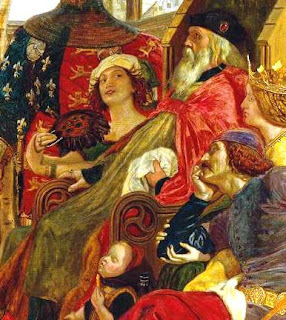
Detail of an imagining of Alice Perrers and Edward III by Ford Madox Brown (1868),
showing Chaucer reading to the king’s court.
Public domain, via Wikimedia Commons

Whether or not Alice ever visited her new manor of Meonstoke Perrers I have no idea, as I believe she had many manors to choose from to rest her head, but it is nice to imagine that she might have spent a night or two at least in the lazy backwaters of the Meon Valley…

However, in 1376, the “Good” Parliament banished Alice and deprived her of her possessions, although in the following year, the “Bad” Parliament reversed the decree and she regained them. But then, in the first Parliament of Richard II, the sentence against her was reconfirmed, and Meonstoke escheated once more to the crown. The manor was put into the hands of stewards until 1379, when the sentence against Alice was yet again revoked, and the manor was granted to her husband, William de Windsor. But, only months later, he sold it to our friend William of Wykeham, bishop of Winchester (and also chancellor to both Edward III and Richard II), who merged it with the two other Meonstoke manors and eventually granted it to his foundation, Winchester College (‘Parishes: Meonstoke’, Paragraph p5).

This must have been the lot of hundreds of manors throughout the country – this toing and froing between owners as their status soared and dived at the whim of those in power. One wonders what the tenants thought of it all? Probably nothing. It was no concern of theirs. They undoubtedly just kept their heads down and got on with their work. I suppose, in many cases, tenants scarcely knew their “lord”, if he or she was of the absentee type, as I am sure all of those I have mentioned here must have been. As far as tenants were concerned, their masters were the reeve and steward or bailiff, and their own lives were lived with no connection to the, possibly illustrious, person who actually benefited from the results of their labours.

Most of this information is pretty “random” and, as it happens, has proved of no use to me in my novels. But that doesn’t stop me finding it hugely fascinating. I have explored the histories of other villages around this part of Hampshire, with some equally intriguing, if not necessarily such “glittering”, results.

If you are interested in the history of old England, you might too find something to intrigue you in British History Online.

Friday, 5 May 2023

The Coronation - Inevitably! - Celia Rees

Coronation Mug - 1953

I'm not a royalist, by any means, but as my allotted History Girls post falls the day before the Coronation, I didn't think that I could ignore this great national occasion. Whatever one's thoughts are about the monarchy (and I have views) this is the History Girls Blog after all and the ritual which is the coronation reaches back deep into history. The order of service and the liturgy extends back to the 10th Century and the ultimate roots of the ritual lie in the Bronze Age, as explained by Tom Holland on The Rest Is History, the superb podcast he shares with Dominic Sandbrook. If you don't already listen, you are missing a treat. 

Coronation Mug - 2023 (attr.Adèle Geras)

 By tomorrow evening, I will have witnessed two coronations. I was three when Elizabeth was crowned Queen in 1953. The world is very different now.  For me, this is neatly illustrated by the different coronation mug designs. There are plenty of mugs for this coronation of traditional design but in 1953 this 2023 design would have been unimaginable.

So very much has changed between now and then. The 1953 Coronation is my clearest early memory.  All the neighbours crowded into the McCauley's sitting room because they were the one of the few families in the street with a television. It was in the corner of the room, encased in a polished wooden cabinet. The screen was very small, the picture black and white and very fuzzy (but that might have been the McCauley's set). I'd never seen television before. I went to see where the horses' legs were then I decided I didn't like it and hid behind the settee. I was eventually coaxed out to sit on my father's knee and watch what seemed like an endless procession of soldiers, sailors, coaches and men on horses. The parading of our own armed forces and those of the Commonwealth. 

For Charles' coronation, the procession through London has been shortened, parred down, modernised. The ceremony inside Westminster Abbey, however, will remain the same.  The robes, regalia, the order of service, go back at least a thousand years. There are two changes: ambergris has been omitted from the holy oil (to make it vegan friendly) and the central ritual, the anointing, will take place behind a screen, not under a canopy. Screen or canopy, the anointing of the monarch with holy oil goes back to the Old Testament, a ritual so sacred that it is kept away from public eyes. In 1953 it was not even televised. All this reminds us that we live in a monarchy and that the monarch is marked out from the rest of us by God. Awesome, in the true sense of the word, and profoundly odd - an ancient mystery being carried out in the twenty-first century.  

To mark the coronation of Queen Elizabeth II, children were given little models of the State Coach as souvenirs. Time and wear have taken a toll on these mementoes but they were much prized and a few have survived. I still have mine and so does my friend, Rachel. 

Coronation coach - attr. Rachel Bagley

Coronation Day, 1953, it rained but everyone went out in the afternoon to celebrate this great occasion. There was an ox roast in the park and a street party which was moved into the Mills' garage when the rain intensified. There were sandwiches, cake, jelly, peaches and evaporated milk. There will be street parties tomorrow, although fewer than in 1953. How will the table differ? I doubt there will be jelly and evaporated milk. No crisps in 1953, no nibbles of any kind. Apparently, the popular 2023 celebratory choices are Quiche and Fizz, unimaginable in 1953, but Coronation Chicken is up there with them.  


1953 Street Party

1n 1953, Coronation Chicken had only just been invented by celebrated cookery writer Constance Spry for the official Coronation Luncheon. It has since become a stalwart of the buffet and a popular sandwich filling. This concoction of chicken, mayonnaise, apricot jam (or mango chutney) and curry powder will be served at street parties on Saturday (see above), a tenuous link to the last coronation. A very 2023 hack on the Coronation Chicken is M&S's Coronation Scotch Egg. A delicacy not dreamed of in 1953.

Coronation Chicken

M&S Coronation Scotch Egg

Enjoy the Coronation of Charles III however you choose to celebrate it and bon appetite!

Celia Rees

www.celiarees.com


Friday, 28 April 2023

VISITING HARRY'S HARROGATE by Penny Dolan

 I am sure that many History Girls have acted, in one way or another, as historical guide for a location, an event, or on a specific study trip. Sharing your enthusiasm with others can be a real pleasure. However, it can also be interesting to be part of an audience being guided around too. All that role demands is your attention, an amount of physical strength and speed of foot, and perhaps a pen and a neat and handy note book. 

Last Sunday, spurred on by idle curiosity, I took a guided tour around my own home, the spa town of Harrogate. I had often seen small groups gathered by the War Memorial, directly opposite the famous Betty’s Tearooms, macs and bags marking them out as visitors. I had also seen, close by, on a tasteful notice-board, details of Harry’s Free Walking Tour.  

Who was Harry, I wondered and what did he have to say about the place?

I joined the queue. Exactly on time, a cheerful man strode across the Parliament Street crossing, wearing a neat blue waistcoat, smart shorts and good walking boots and wielding a tall wooden pole, topped by an unmistakeably easy-to-spot blue and yellow disc, He rested his staff against the flower beds, stretched out his hand in greeting and introduced himself, asked for people’s names in return. His enthusiasm indicated we were in for a good time.

Once, twenty years ago, when we first moved to the town, there were venerable people who were the Harrogate Town Guides. They were, I believe, knowledgeable and independent-minded individuals who were probably under the auspices of the excellent Chief Librarian, who was a local historian. They gave their time up on a voluntary basis and were, as far as I know, part of the life of the town. However, somebody official – a councillor or tourism expert or someone, inspired by the new mood of accountability - decided that the Guides should be brought into some kind of formal group. Maybe they were offered helpful training? Given a set script? Handed forms and rotas to fill in and suchlike? Whatever happened, the result was simple. The Guides stepped away from the new requirements and never returned. Gone. Is that not an excellently tempting scenario, whether true or not?

Anyway, the space they left was there for Harry to fill, freelance and under his own rules, all these years later.

Last Sunday, most of his ‘guests’, as Harry called us, were weekenders from around the North of England. Often his guests are from other countries: one woman there was a Canadian, visiting partly because her RAF parents met in Harrogate during WWII. I liked the way Harry had of making everyone feel welcomed and involved and when I awkwardly admitted being local, he simply beamed and asked what I liked best about the town. Clearly, Harry’s Walk was going to be a briskly positive experience for everyone.

While we stood on a patch of damp grass, Harry quickly described the wider geographical context: what lay to the north, south, east or west of the town. After crossing the road, we paused again. This time he ran us through the area’s early history. We heard of Romans in York; Vikings sweeping down from Lindisfarne, the rule of the Anglo-Saxons, the arrival of William of Normandy’s knights and the building of nearby Knaresborough’s historic Castle, now a picturesque ruin overlooking the gorge of the River Nidd. Harrogate, meanwhile, was little more than a hamlet in a marshy area within the Forest of Knaresborough.

Then, in 1596, William Slingsby, a local gentleman who had visited other spas, discovered a local spring that had similar health giving properties. Over the period a variety of springs or wells were discovered, some sweet and some ‘stinking’ water and Harrogate started to grow. Even so, a large area of common grassland known as The Stray was retained and restricted, and still sweeps distinctively through the middle of our town.

Harry, and his amiability, had certainly kept the interest of the crowd. He led us down Montpelier Hill, indicated Slingsby’s Gin Shop, pointed out the now-empty newspaper office where ghost signs still promised a weekly List of Visitors to the town. We passed the famous Harrogate Toffee shop, skirted the Crown Hotel and turned down a cobbled street an iconic Harrogate setting that often appears in tv dramas about Yorkshire, especially any where there is a posh narrative thread.

Meanwhile, we arrived outside the pretty Pump Room, now a museum. On one wall was a push-button spout and stone basin: this was the old sulphur-water well. Despite the smell, the water was – and sometimes still is - considered an effective digestive treatment, yet nobody reached forward to take a sip from the small glass Harry offered.

Sometimes, as he talked, Harry unrolled a long strip of cloth that was wound around his pole, revealing copies of old printed images from Harrogate’s history: a swift and useful way of sharing information with his small group of listeners. Harry had found most of the pictures while studying in the local history section of the town library in preparation for his walks.

Harry then escorted us around the grassy space known as the Crescent Gardens, pointing out the Royal Baths, once a renowned hydrotherapy centre but now a Chinese restaurant, and told us about the Turkish Baths, the only remaining part of the Royal Baths complex in operation. Although the entrance was tucked away from where we stood, he unrolled a picture of the lavish tiled interior, suggesting it as a place worth visiting, although maybe not for this Sunday afternoon’s visitors as booking and swimwear are essential.

Across the road was the Royal Hall, a grand concert and reception hall. Back in 1903, it was ‘The Kursall’ or ‘Cure Hall’, with entertainment seen as a cure for low spirits. The name was changed before the First World War.  

Harry then described about something that I would have been delighted to witness: there are, though I had never noticed them, two tall green goblet-like structures high above the entrance to the Royal Hall.  Once, he explained, great jets of orange flame burst upwards from these goblets to show visitors that the next entertainment was about to begin. How stunning a sight that must have been! The hall was renowned for its early use of gas lighting, thanks to an incredible local entrepreneur, Mr. Samson Fox, mentioned in one of my past History Girls posts.

Harry pointed out the Majestic Hotel behind, higher up the hill, often seen in the background to a popular Harrogate travel poster and then we walked steadily on, past the now-empty Town Council Offices, built in 1930, towards The Old Swan, that most historic of Harrogate’s hotels, and renowned as the location of ‘missing’ crime writer Agatha Christie’s rediscovery.

I admired the ease and professionalism with which Harry handled the group, sending one person ahead to wait, marking a specific point, while he brought the general crowd and any stragglers firmly and merrily along, chatting and answering questions all the while. 

Harry had been a butler and was always involved in hospitality: from childhood within his parents pubs through to a career that included looking after prestigious guests at The Ritz in London and, more recently, as a manager at a Betty’s Tearoom in Yorkshire. Each of these posts demanded more and more hours indoors. Now Harry was doing what he liked best: enjoying life out in the fresh air and sharing his love of his adopted town of Harrogate with visitors.

Harry looped us back, past the Mercer Art Gallery with free entry to all its exhibitions, and in to the Valley Gardens. We strolled through a beautiful, well-kept and old-fashioned grounds with its formal flower beds, a covered Promenade, a winding stream, boating pond, a small elegant cafe, and more, still overlooked by the ornate towers of what was once the Royal Baths Hospital.  As we walked, he explained that Harrogate was home to several governmental organisations during World War II, especially the RAF. 

Winston Churchill was a frequent visitor to Harrogate too. I once heard tales of Winston running races in his bath chair down the steep curve of Cornwall Road, but was that true? Would the library know? Back we turned, back in the direction of the War Memorial, glancing across at the back of the old Winter Gardens. This buildin, now the grandest pub interior in the Wetherspoon’s chain, is well worth a quick glance inside if you can add a moment's imagination.

One has to grab the good moments and still-existing sights in this tourist town now. Sadly, many of the town’s public buildings have been sold, or are up for sale or for redevelopment. What the town will look like in the future, I did not know and I did not want that grim thought to be part of the day’s experience. Onward.

The last stretch wound through the charming shopping area known as the Montpelier Quarter, then up the hill again. The walk had lasted about an hour and twenty minutes, moving at a happy pace, and had included more information than included here. It was also free, although donations were accepted. 

Harry ended his Walk with the heart-rending story about the solitary young Swiss immigrant who, in 1907, came to Yorkshire, eventually founding Betty’s famous Cafe. It was a most suitable ending and maybe if you are ever in town, you can join Harry’s Walking Tour, and hear the tale from Harry himself?

Additionally, what made the guided walk valuable to me, though I knew much of the history, was the space and time it gave to reflect on Harrogate, and to appreciate its odd but interesting past.

Even if it was told by a History Boy.

Penny Dolan

Friday, 21 April 2023

Portrait of Omai - Sue Purkiss

In recent months, you may have read about a drive to keep in Britain a portrait by Sir Joshua Reynolds of a young Polynesian man called Omai, or Mai. The portrait, painted in 1776 or thereabouts, carries the massive price tag of fifty million pounds. The owner is unknown: the price, apparently, is in line with market values. It is at present at the National Portrait Gallery. The government blocked an export licence for the painting for some months on the grounds not just of its quality, but also of its historic significance. No British buyer, or consortium of buyers, was able to raise the full price: but it seems that a deal has been brokered with the J Paul Getty Museum in California, whereby the painting will alternate between that museum and the NPG. It's not ideal for a painting to be shipped across the ocean - but perhaps, in a way, it's fitting: because that's exactly what happened to its subject.

Joshua Reynolds' portrait of Omai.


So who was Omai, and why is he such a significant figure? Well, he was a young man in his early twenties, who came from a Polynesian island called Huahine, not far from Tahiti. His father had been killed during ongoing disputes with another island, Bora Bora, and he wanted revenge. We would have known nothing about him had it not been for the fact that in the 1770s, Captain James Cook, highly-skilled navigator and map-maker, was exploring the Pacific. Specifically, he had been tasked by the British Government with mapping the Transit of Venus, an important astronomical event. Observations of this occurence would be highly valuable for future calculations, and needed to be made from a number of sites all over the world - including in the south seas.

Captain James Cook an official portrait from 1777.


Now at this time, little was known about the vast Pacific Ocean or the lands which bordered on it. But Cook had just returned from a voyage to the area, and he and the gentleman botanist, Joseph Banks, who had accompanied him, were the talk of the town because of their thrilling and exotic discoveries. They had spent a good while on the island of Tahiti - or Otaheite, as it was first known to them. Banks in particular had thrown himself into the Tahitian lifestyle with great enthusiasm, taking full advantage of Tahitian society's very different approach to sexual mores in particular. Tahiti seemed to the British sailors like Paradise, with its balmy climate, its lush and beautiful vegetation and seas, and its friendly people. When Cook recived the commission to map the transit, and realised he needed to establish a base in the South Pacific to do so, he knew that Tahiti was the perfect place. And so a second voyage to the south seas was planned.

It was on this second voyage to Tahiti that Cook met Omai. (Omai was the name by which he became known in London: at home he was called Mai, or Mae.) Omai wanted to sail with the British when they set off for home, in the hope of acquiring weapons with which to subdue the Bora-Borans.

Cook himself was not very enthusiastic about the idea. On the first voyage, Cook had agreed to the request of another Tahitian to go with the Europeans when they left: this was Tupia, a skilled navigator and clever individual who knew the islands well and acted as a translator. But on this second voyage, he didn't see the point of taking Omai, who was a pleasant young man but had no particularly useful skills. And perhaps too he foresaw some of the problems that might arise from transplanting Omai from his home to the inconceivably different environment of London.

(Tragically, Tupia and his son had both died without ever reaching Britain: Cook was very careful of the health of his crew, and had taken various measures which successfully combatted the dreaded scourge of scurvy. But when his small fleet stopped at Batavia on the way home for essential repairs and to take on fresh food, they found it to be an unhealthy, disease-ridden place. Not a man had been lost to sickness before they arrived there, but now fever swept through the crew. Many died, including Tupai and his son, and most of the others, including Cook, were weakened by sickness.)

Cook eventually agreed that Omai could come on board. He didn't travel on Cook's ship, The Resolution, but on an accompanying ship, Adventure, commanded by Thomas Furneaux. When he arrived in London, he was taken up enthusiastically by Banks and introduced in society, and quickly became all the rage. London was thrilled by the expoits of Cook and Banks, and by all these exotic new discoveries: it was a thoroughly exciting time when science and art were blossoming, and Banks, young, wealthy and charismatic, (who had not been with Cook on his second voyage), was at the centre of it all. Omai was introduced to the King, George 111 - apparently taking his hand and declaring 'How do, King Tosh!' The King must have been charmed, because he gave Omai an allowance, which enabled him to buy clothes, furniture, a suit of armour and heaven knows what else. And of course, there were the portraits: not only the one by Reynolds, but others, including this one of Omai, Banks and Solander, a fellow botanist and great friend of Banks. Omai must have seemed to a sensation-hungry society like the physical embodiment of the new lands which were being 'discovered': and it couldn't have hurt that he was tall, handsome, and charming.

Omai, Banks and Solander - by William Parry


But he was very young, and not surprisingly, his head was turned by all this attention. The plan had always been for him to be returned home after a few years, and Cook did indeed drop him off back in Polynesia on his third and final voyage to the south seas. According to Vanessa Collingridge, in her informative and entertaining biography of Cook, all did not go well. Cook surmised that Omai would not fit easily back into island life, and so it proved. He showed off his treasures to the islanders, and boasted of his expoits; for their part, they laughed at him and mocked his pretensions, and once he'd given away his newly-acquired riches, they abandonned hime. He hugged Cook when they parted, distraught at having to part from his friends. Cook did his best, had a house built for him and left him with various animals, but it was all to no avail: Omai died two years later - I have not been able to find out in what circumstances.

So what light does this shine on the historic signicance of the portrait? It's not simple, as issues to do with colonialism and empire never are. In an article in The Guardian (7/3/23), Simon Sebag Montefiore writes: 'The figure of Omai... possesses an idealised majesty of the 18th century's "noble savage" combined with a Roman senator's adlocutio dignity amid an idealised Arcadian landscape. Yet Omai's defiant and proud gaze makes him fearlessly himself. In other words, the portrait combines the confidence of Britain on the eve of world power, the majestic dignity of an adventurous Polynesian, the masterpiece of a genius - and the singular thrill of this incandescent meeting of all three.'

Yes, indeed. But I can't help thinking of the young man at the heart of it all. I suppose his experience was rather like that of a modern-day rock-star or footballer, who has to learn how to handle a sudden influx of huge wealth, adulation and fame. Some cope, others don't. Omai didn't. 

And, although Cook respected the indigenous peoples he met - at least to start off with - and sought not to exploit them, he nevertheless left behind unwanted gifts - diseases, animals which he brought with the best of intentions but which had deleterious effects on the native flora and fauna - and so much else that the collision of two such different societies carried with it. Omai's fate can perhaps be seen as a symbol of all that, too: the meeting of indigenous peoples and Europeans has rarely ended well. As, indeed, it didn't for Cook himself: on his third voyage, tired, suffering from ill-health and far from the cool, thoughtful and respectful commander of his first two Pacific voyages, he lost control of a difficult situation and was killed.

Yes - there's a great deal behind the portrait of Omai.

I first became interested in Sir Joseph Banks and Captain Cook when I was researching my children's story about plant-hunting, Jack Fortune and the Search for the Hidden Valley. That period, at the end of the 18th century, is such an interesting one: and Banks was influential in so many ways.