Showing posts with label Armada. Show all posts

Friday, 3 January 2025

The Armada at Anstruther by V.E.H. Masters

Early one morning in November of 1588 the villagers of Anstruther on the East coast of Scotland awoke to find a ship in their harbour with over 250 starving Spanish Armada sailors and soldiers on board. We know this because the local minister of the time, James Melville, wrote about it in the extensive diaries he kept. 

I discovered Melville's diaries as I came to the end of writing my first book in series, The Castilians, about the 1546 siege of St Andrews Castle, sixteen miles away. Fascinated by the story of the Armada that came to the East Neuk I determined to write about it next – until fellow author Margaret Skea pointed out the length of time which separated the two events. 'A lot can happen to your characters in forty years,' she said.

And so I wrote, The Seton Chronicles, a five book series which spans the remarkable changes as the reformation took hold in Europe and has my characters fleeing for their lives through Geneva, Antwerp, Venice, Frankfurt and Constantinople. But now, in the final book in series, The Pittenweemers, I finally returned to Scotland, delving into James Melville diaries once more to explore the remarkable story of the Armada in Anstruther.

James VI of Scotland was a ten month old baby when he last saw his mother Mary Queen of Scots, who had been held prisoner by the queen of England for nineteen years. Nevertheless he corresponds regularly with Elizabeth and pleads with her to spare Mary, even suggesting that someone whose father had executed his own bedfellow should not follow suit. 

Queen Elizabeth I - Armada portrait

His pleas were disregarded and Mary, Queen of Scots was beheaded by her cousin Elizabeth of England in 1587. That a queen appointed by God should behead another queen, also appointed by God, sent shock waves around Europe. Philip of Spain, already made furious by Sir Francis Drake's piracy on Spanish ships and attack on Cadiz began to gather the largest fleet ever seen, often by 'acquiring' merchant ships within his domain. His purpose was nothing less than to conquer England.


Scotland had been Protestant for 28 years and tales of the coming of the Spanish Armada along with rising fears about the year 1588, which had long been prophesied as catastrophic had people fearful – actually terrified would be more accurate. Here's my character Will, minister of Pittenweem, thoughts on the matter … 

It was an unusually stormy summer with a resulting poor harvest and an inevitable rise in food prices, and that, combined with the increasing rumours of various sightings of the Spanish Armada off Scotland, caused grave anxiety amid Will’s flock. Given the disquietude, Will considered it most unfortunate that there continued to be an outpouring of predictions about the significance of the year. Sitting at a board strewn with papers one morning in early August, he leaved through a discourse written by an Englishman. 

This Richard Harvey was claiming they should all expect either a dissolution or a wonderfull horrible alteration of the worlde in this year of our Lord fifteen hundred and eighty-eight. Harvey wrote in tortured tones, Will could almost hear his voice and a certain relish in his doomsaying, that the disorder would swell until it culminated in a thunderous crescendo, after which irrevocable changes would be embedded – or ‘poof’, Will flicked his fingers – the world would be consumed by a fiery cataclysm. But then, judging by what the astrologers were discovering, that was not so improbable. Comets did shoot across the sky, and what was to prevent those blazing implements of Satan from crashing into the world? And the movement of stars could and did cause an imbalance in the body’s humours – and all this was yet another way in which God punished sinners.

Will sat staring at his desk unseeing for a long time. Eventually he stood up, went out into the rain-soaked garden and gazed up at the ominous dark clouds forming and reforming above. These astronomers and astrologers were like a den of dragons blasting out burning air imputing all failings of nature, accidents of misfortune, oversights and errors to the skies and revelling in their prophecies of perdition. 

Nevertheless, his heart did quail when he thought on the most recent prophecy, which claimed that it was in this year the impact of the perilous conjunction of the planets five years ago was to be realised. Yet if the world was to be blessed by the second coming of Christ, as some prophesied, then that could only be a matter of joy – after the cataclysm. 


And James Melville writes of attending the General Assembly of the Church of Scotland in Edinburgh and  how terrible was the fear, piercing was the preaching, earnest and fervent the prayers amid the abounding sighs and sobs, for if Philip took England he would likely then take Protestant Scotland.


August of 1588 and the 130 odd ships that make up the Armada are defeated by the smaller and more manoeuvrable ships under the direction of Sir Francis Drake – and the terrible storms. Around sixty ships are blown up the East coast of Scotland many foundering off Orkney, Shetland, Fair Isle, Ireland and one on Norway. Every attempt to return to Spain was thwarted and the sailors, soldiers, priests and interpreters of the Armada not unnaturally assumed that God had turned against them.


El Gran Grifón ran aground off Fair Isle with over 300 hundred men on board. The captain, Gómez de Medina (not to be confused with the overall Armada commander, the Duke de Medina Sidonia) had rescued men from other ships which sunk, in direct contravention of King Philip's orders. The few households on Fair Isle were unable to provide food for starving men and fifty died. It is of note that there's no reports of them taking from the islanders by force and the captain, known to his men as El Buen – The Good – lived up to his epithet.


                  Armada Chest, complete with complex locking system, at Traquair House

The Spanish may not have had any provisions left but they had gold. Gómez de Medina found his way to Orkney, rescued his men and acquired a ship. It was November by now and the storms had not much abated. Their ship foundered off Anstruther and Medina came ashore to seek help. Here's the scene again from the perspective of  my character Will …

Medina continued as though the interpreter hadn’t spoken. ‘His glorious grace King Philip brought together a mighty fleet and army to avenge the intolerable wrongs and grievous injustices inflicted upon the peoples of the Spanish Empire by the treacherous nation of England. But for our sins, God has turned against us, driving us past the coast of England and subjecting us to storms sent by divine providence over the past several months. Many of our ships have sunk in merciless seas or been dashed against inhospitable shores. Those few of us whom God has chosen to survive have endured bitter cold and suffered great hunger. We come here to kiss the hand of the king of the Scots ...’ Medina paused here and bowed low once more ‘... and beg of you to render us assistance.’

Will watched James Melville and sent up a prayer that he would show a true spirit of kindness, as Jesus Christ would have done.

Melville began to speak. ‘Our friendship cannot be great, seeing your king and you are friends to the greatest enemy of Christ – the Pope of Rome. Our king and we defy that son of Satan and his cause against our neighbours and special friends of England.’ Melville paused to let the translator catch up. ‘And yet we, as Christians of a better religion, are moved by compassion. A compassion that is not manifest to our merchants residing among you with peaceable intent pursuing their lawful affairs who have been violently taken and cast in prison, their goods and gear confiscated and their bodies committed to the cruel flaming fire in the cause of religion. But among us you will find nothing but Christian pity and mercy, leaving God to work in your hearts concerning religion as it so pleases Him – for we will give you assistance.’ 


And so Melville permitted two hundred and fifty men to come ashore. The people of the village were so horrified at the sight of these starving mostly young and beardless men that they ran into their houses and brought them food.

Rumour has it that James Melville was rewarded for his largesse with some of the Spanish gold – and he did build a rather large manse soon after.


Those who came ashore in Scotland and Ireland – many of whom were slaughtered as they staggered up the beaches for their clothes and 'gold' – made their way to Edinburgh, perhaps expecting a sympathetic welcome since James VI was the son of the poor beheaded Mary, even if he was a Protestant.  The Catholic leaning nobles wined and dined the captains however the men, somewhere in the region of a thousand of them including priests, were starving vagrants on the streets. Eventually ships were sent and they were re-patriated to Spain.

The Seton Chronicles


Gómez de Medina's ancestors were Jews and his grandfather was burned at the stake – a point of significance within my overall story of The Setons, since some of my characters are Conversos (Jews who were forced to convert to Catholicism). King Philip had demanded that all his captains be 'pure' but those tasked with checking this ran out of time to inquire of the Inquisitor of Seville about Medina's family background.  

Truth is so often much stranger than fiction – and this is what I love about writing historical fiction! 


V.E.H. Masters is the award winning author of the best selling series The Seton Chronicles. Her first novel The Castilians is set in her home town and tells the story of the siege of St Andrews Castle. You can find out more at https://vehmasters.com/ where three free short stories telling more of The Setons are available to download. 


References:

Armada by Colin Martin and Geoffrey Parker

The Diaries of James Melville – National Library of Scotland


Friday, 20 November 2015

Before and After the Armada - by Ann Swinfen


Battle of the Armada
The defeat of the enormous and well-trained Spanish Armada fleet by the smaller English fleet in the English Channel during the summer of 1588 is probably one of the most famous naval battles in history, along with Salamis, Lepanto and Trafalgar, not least because the outcome hung in the balance until a strong southwest wind drove the Spanish ships into the North Sea.

As the English said afterwards, in thankfulness mixed with perhaps a touch of complacency, ‘God blew his winds and they were scattered’.

However, events before and after the great battle, which culminated off Gravelines, are rather less well known. Elsewhere in this blog I have written about the retaliatory expedition by England against Spain in 1589, known as the Counter Armada (http://bit.ly/1DNSaAB) but other events surrounding this iconic date are interesting.
 
Robert Dudley, Earl of Leicester
Elizabeth’s beloved Robert Dudley, Earl of Leicester, had strong connections with the Dutch House of Orange and with the Low Countries. He was active in persuading the English government to support the United Provinces in their struggle against their Spanish overlords in the Low Countries, who persecuted the Dutch Protestants, and he served for some years as governor-general there. Leicester’s intentions were excellent, but his dealings with the Dutch were not always tactful, although the two nations were united in their Protestant faith and their hatred of Spain.

Leading the Spanish army in their north European territories was the Duke of Parma, a skilled and experienced commander, the greatest general of his day, who totally outclassed Leicester. In battle after battle, the combined English and Dutch forces were defeated or just managed to hold back the Spanish. In one, the battle of Zutphen in 1586, Leicester’s nephew, the gifted and much-loved Sir Philip Sidney, was fatally wounded, dying on 17 October, not quite 32 years old.
 
Sir Philip Sidney
Leicester remained in the Low Countries, although relations with the Dutch leaders were becoming strained. His original principal ally, William of Orange, charismatic leader of the United Dutch, had been assassinated by a Spaniard in 1584, and Leicester himself may have begun to suffer from ill health. (He was to die in 1588, shortly after the defeat of the Armada.) His position was further undermined in late 1586 by Elizabeth’s antagonism to his planned extension of the military campaigns, and her refusal to provide adequate finance for his dwindling army, which was short of rations, materiel, and pay.

Matters came to a head at the siege of Sluys. This vital deep-water port on the Channel was in the hands of the United Provinces, but was eyed greedily by the Duke of Parma, who laid siege to it on 12 June, 1587. King Philip of Spain had long been planning a combined naval and land-force invasion of England. The port of Sluys would provide an essential piece in the invasion plan.
 
Siege of Sluys 1587
The garrison at Sluys was provided by an English regiment, commanded by Sir Roger Williams, together with Dutch allies. Williams was a Welshman, an experienced soldier (later to write a book on military theory) and a determined Protestant. Leicester himself valued him highly. Williams and his soldiers made a courageous stand against Parma, but the odds were against them. Having cut off Sluys from all supply routes by land or sea, the Spanish began their bombardment on 24 June. The garrison was short of food, but, even more dangerously, short of gunpowder and shot. They fought valiantly until all their supplies were exhausted, leaving them helpless. On 4 August, they were forced to surrender.
 
Alessandro Farnese, Duke of Parma
Parma permitted the defenders an honourable withdrawal, but the soldiers had suffered terribly. Of the survivors, it is estimated that some seven hundred were seriously wounded. Conveyed back to England, the injured soldiers packed out London’s hospitals (an episode included in my novel The Enterprise of England.) The defeat at Sluys, the number of wounded, and the loss of this crucial port to the Spanish was the cause of serious demoralisation in England.
 
Armada signal station in Devon
Thanks partly to poor communications between the Spanish invading navy and the Spanish army stationed in the Low Countries, Philip of Spain’s intended two-pronged attack on England failed, and Sluys did not, after all, play a major part in the conflict the following year. His intention, planned on paper in faraway Spain, was for his navy to cripple the English fleet, then convey his army across the Channel in barges to carry out a land invasion, marching north from the south coast to seize London. (A remarkably similar operation, in the opposite direction, to the D-Day landings nearly four hundred years later.)
 
Seventh day of the Armada battle
The Spanish Armada was defeated, its ships scattered, the Spanish army still confined to the Low Countries. England could celebrate. And did. Church bells were rung. Services of thanksgiving were held. Bonfires were lit on street corners throughout London and other towns. And no doubt a good many citizens passed the night away at drunken parties.

But that was not quite the end of the story.

The English fleet returned, bearing the heroes, the soldiers and sailors, who had saved England from invasion. But while the civilians celebrated, the men on the ships waited. And waited. Where was the pay they had been promised? Where, indeed, was the food to feed them? Supplies ran out. No one seemed to have planned for this. No one was prepared to take responsibility for them. It was not the first time, nor would it be the last, when a returning victorious army was to prove a neglected embarrassment.

The men remained on the ships, many of them tied up at Deptford, and they began to fall ill. And then to die. Men who seemed healthy enough one day would not rise the following morning, having died inexplicably in the night. Others would collapse suddenly and without warning. Some terrible disease was rife amongst the men, and in panic the authorities refused to allow them to land. It is now believed to have been both typhus and ‘the bloody flux’ (dysentery). This may have saved civilian lives, but it meant that the very men who had fought and saved the country were left to starve and die of disease. In their droves. This was the discreditable end to the Armada story.


Sadly, it was not unique.

Ann Swinfen
http://www.annswinfen.com

Wednesday, 20 May 2015

The Counter Armada and Historical Forgetfulness - by Ann Swinfen

Why do we remember certain episodes in our history and teach them in our schools, while we conveniently forget others?

When I was a graduate student, I shared a room in the university with a French girl from Poitiers, also studying for a postgraduate degree. We became good friends, and one day I asked her (tactfully!) if there was any archaeological evidence remaining of the Battle of Poitiers. She looked at me in total mystification.


It seems that schoolchildren in Poitiers are taught nothing about the Battle of Poitiers.

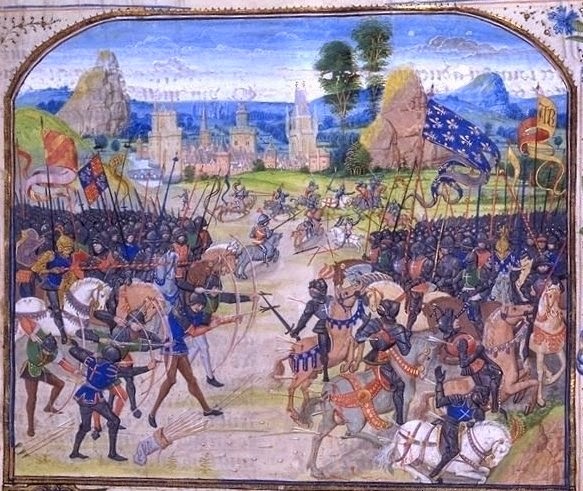
For those who aren’t familiar with this bit of the Hundred Years War, the Battle of Poitiers took place on 19 September, 1356, and was one of a series of victories by Edward the Black Prince over the French. An English army of approximately 6,000 inflicted a massive defeat on a French army of approximately 11,000 – in other words, nearly double their number. There were a few hundred English casualties. The French suffered around 2,500 killed and wounded and 2,000 prisoners. Poitiers schoolchildren, it seems, are not encouraged to remember the battle.


A short walk from our home stands Broughty Castle, guarding the mouth of the river Tay and thus a major ancient naval route from the North Sea to Dundee, Perth and the heart of Scotland. In the mid sixteenth century the merchant communities of Scotland’s east coast had important trading links with the Low Countries and the German states. Like them, this part of Scotland had become Protestant. The government of Scotland, however, was in the hands of the Regent, Mary of Guise (French and Catholic), during the minority of her daughter Mary Queen of Scots.

England proposed a marriage between Henry VIII’s young son Edward and the child queen Mary, and sent a mission, backed by a strong navy, which came to be known as ‘the Rough Wooing’. Such marriages were not unknown, the most recent having been that of Henry’s sister Margaret to James IV of Scotland. (English Margaret was thus the child queen’s grandmother.)

Now, at this present time of rampant Scottish nationalism, it may be dangerous to mention something which – like the Battle of Poitiers – tends to be conveniently forgotten. The fact is, the English were welcomed along this Protestant east coast with open arms. Broughty Castle was handed over to the English in the autumn of 1547 without a shot being fired. Sir Andrew Dudley, brother of the Duke of Northumberland, took charge of the English garrison, and sent for a supply of Tyndale’s Bible, eagerly sought by the locals. All the area, including the city of Dundee, joined an alliance with the English and supported the marriage.

Mary of Guise and her French Catholic party, however, had other ideas. They shipped the child queen off to be reared up in the French court (where French became her mother tongue), betrothing her to the heir to the French throne. It was part of the power game being played by the Guise family.

I doubt whether many in this eastern half of Scotland choose to remember that warm alliance with England together with the opposition to the Scottish government and the attempted French take-over of Scotland (for that is what lay behind the French marriage). Another case of selective forgetfulness.

France and Scotland are hardly alone in forgetting inconvenient past events. Few in England have heard of the Counter Armada. (Even my husband, a professor of history, though not a specialist in the Tudor period, admits to not having heard of it until I wrote about it.) Of course, every English schoolchild knows about the glorious defeat of the Spanish Armada in 1588, and the (possibly apocryphal) story of Sir Francis Drake finishing his game of bowls before embarking. What they are unlikely to know about is the misconduct of Drake during the battle, which went on for several days. During the darkness of one night, Drake was supposed to be leading the fleet with a lantern in the stern of his ship. Instead, he slipped away on a little looting expedition of his own, which might have had serious consequences.

However, the great Spanish fleet was defeated by a combination of English seamanship and fighting skills, the incompetence of the Spanish commanders, and weather which favoured the English. The winds which blew the Armada out of the Channel into the North Sea also prevented the launching of the barges which were to carry the experienced Spanish army, then fighting in the Low Countries, across the Channel to invade England by land and march on London. A tactic to be adopted in the opposite direction nearly 400 years later with the D-Day landings in Normandy.


The Armada, a glorious, resounding, never-to-be-forgotten victory!

To understand what happened in the period of euphoria afterwards, we need to remember events over the previous decade or so in Portugal. In 1580, Spain invaded Portugal and drove out the king, Dom Antonio of the House of Aviz. Dom Antonio was now living in England as a guest of Her Majesty, who was always on the lookout for useful tools in her on-going struggle with Spain. For some years many from the Portuguese Marrano community had been fleeing to England. Jews forced to convert to Christianity, they were persecuted by the Inquisition even before the Spanish invasion. It grew much worse afterwards.

With much of the Spanish fleet destroyed, a number of interests came together to propose a ‘Counter Armada’. Elizabeth and many of her advisers saw it as an opportunity to destroy the rest of the fleet before Spain could rebuild. Dom Antonio saw it as the chance to regain his throne. Leaders of the Marrano community in London – including notably the queen’s personal physician Rodrigo Lopez – dreamt of regaining their homeland and rising to positions of importance in the new government. Drake, of course, saw it as an opportunity for his favourite pastime: looting Spanish treasure ships.

Coat-of-Arms of the Aviz family

Funds were raised from the queen, from London merchants, from the Marrano community. The queen, however, tied up her support with such conditions to Dom Antonio and his future government that Portugal would have been financially crippled and effectively a colony of England.

Early in the spring of 1589 the English fleet gathered at Plymouth. A call had gone out for soldiers to join the expedition and a ragtag crowd assembled there. These men had no military training whatsoever. Supplies for the expedition were bought and stored in warehouses in the town. Then everyone waited. A contingent of trained and experienced soldiers was to be shipped over from the Low Countries, where they had been helping the Dutch fight the Spanish invaders. Once again, the winds were unfavourable. Days passed. Weeks passed. The restless recruits broke into the warehouses and stole the food and drink. Some simply went home. Eventually the experienced men arrived and the expedition set sail, with Sir Francis Drake in command of the fleet and Sir John Norreys in command of the army.

There is no room here to tell the full story, which is the subject of my third Christoval Alvarez novel, The Portuguese Affair, but here is the bare outline.


The intention was to sail straight to Lisbon and restore Dom Antonio. His supporters would flock to join the English, and by acting quickly the Spanish could be defeated before they could move more of their army into Portugal. On the way to Lisbon or afterwards, as many Spanish ships as possible would be destroyed. A third objective was to conclude the expedition by driving the Spanish out of the Azores. However, before the English ships could reach Portugal, they had run out of food, owing to the raids in Plymouth. The decision was therefore made to attack Coruña on the north coast of Spain, seize provisions and carry on.

Here was the next blunder. The undisciplined soldiers went berserk in Coruña, and the leaders decided to stay and attack the garrison there. Several fruitless weeks were wasted, while news reached Spain of the expedition and every Portuguese believed to support Dom Antonio was executed.

Eventually the expedition moved on down the coast of Portugal, where they were joined by the queen’s favourite, the Earl of Essex. He had been expressly forbidden by her to join the expedition, but slipped away, with his usual pig-headed arrogance believing he could pacify her and win glory for himself.


Next blunder: the fleet put in at Peniche, where the gallant Essex leapt out of the ship into deep water, causing many of his followers to drown. The local people welcomed Dom Antonio warmly, but soon grew tired of providing for the English army and fleet. At this point the leaders made their fatal mistake – the army and the fleet would part company. Drake would sail the fleet down the coast to Cascais, then up the river Tejo to Lisbon. Norreys would lead the army by land to Lisbon, about forty miles across unforgiving countryside with no provisions, unless they could be begged from the locals.

The English army on  more successful campaign

It was a disaster. The men died like flies, of starvation, heat exhaustion, thirst. When the ragged remnants of the army reached Lisbon, there was no sign of Drake, who was busy looting treasure ships on the coast. No supporters of Dom Antonio joined the English, even if any were still alive. Essex shouted a challenge at the gates of Lisbon – let anyone meet him in single combat for the honour of Queen Elizabeth. Laughter from within. The desperate and dying soldiers made one last march of nearly twenty miles to meet Drake and the fleet.

As for Drake’s final betrayal . . . well, you’ll need to read the full story!

It is not known just how many men died on the expedition, but estimates are that something like 15,000 to 20,000 perished, possibly more, mainly on the march from Peniche to Lisbon. The whole expedition was a shameful failure, due to appalling leadership.


Is it surprising that we remember the Armada, but the Counter Armada is conveniently forgotten?

Ann Swinfen
http://www.annswinfen.com