So I’m cheating a bit this month. The Cabinet of Curiosities is supposed to be one object which I’d love to have for myself. However I couldn’t resist talking about the current exhibition at the British Library on Harry Potter; A History of Magic, which is itself a compendium of incredible objects.
It’s a fantastic exhibition, making brilliant use of archive material, historical artefacts and modern technology to create an experience unlike any I’ve been to before. It combines original Harry Potter archive material and memorabilia with historical manuscripts and objects, setting J.K. Rowling’s fantasy world into the context of real historical beliefs about magic, with technology providing an interactive experience for those who want to try their own hands at ‘magic’.
So, for instance, the exhibition includes hand- and type-written excerpts from J.K Rowling’s original manuscripts (complete with editorial suggestions and some entirely unknown scenes which were cut from the final books), novel plans and some of her own early drawings of characters and locations – an absolute treasure trove for fans and fellow writers. There are also a large number of original drawings and paintings from the illustrated versions of the books by Jim Kay, with sound effects and objects from the films too.
The exhibition is organised into a number of different rooms, each of which is dedicated to an individual Hogwarts’ ‘lessons’ – Potions, Charms, Defence Against the Dark Arts, etc. In each case, Rowling’s archive material is cleverly interspersed with manuscripts and objects which explore ‘real life’ historical beliefs surrounding magic.
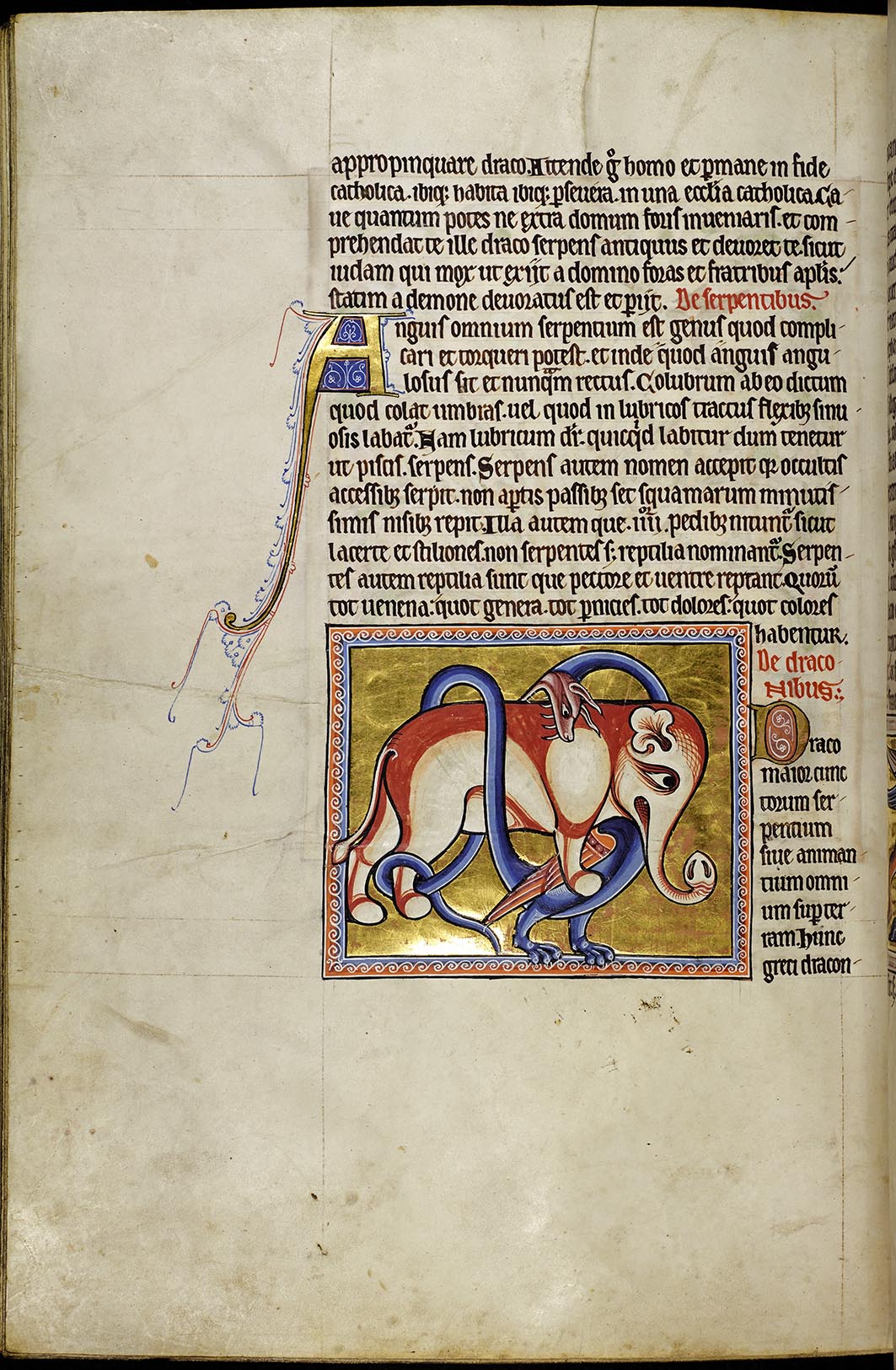
For example, the Herbology room includes Jim Kay’s illustrations of the greenhouses as Hogwarts; J.K. Rowling’s own drawing of Professor Sprout and some stunningly beautiful Herbals from the British Library’s Collection. The Care of Magical Creatures room is another highlight for anyone who loves medieval bestiaries and illuminated manuscripts.
The Astrology room contains stunning early globes, astrolables and orreries, as well as medieval manuscripts with illustrations of centaurs and other mythological creatures relating to the constellations. One of my favourite items in the exhibition was the sixteenth century ‘volvelle’ – a beautiful rotating paper model – of an astrological chart with a dragon at its centre, from Petrus Apianus’ Astronomicum Caesareum. The dragon could be spun in order to determine the latitude of the moon, or to cast horoscopes.
It’s a fantastic exhibition, making brilliant use of archive material, historical artefacts and modern technology to create an experience unlike any I’ve been to before. It combines original Harry Potter archive material and memorabilia with historical manuscripts and objects, setting J.K. Rowling’s fantasy world into the context of real historical beliefs about magic, with technology providing an interactive experience for those who want to try their own hands at ‘magic’.
So, for instance, the exhibition includes hand- and type-written excerpts from J.K Rowling’s original manuscripts (complete with editorial suggestions and some entirely unknown scenes which were cut from the final books), novel plans and some of her own early drawings of characters and locations – an absolute treasure trove for fans and fellow writers. There are also a large number of original drawings and paintings from the illustrated versions of the books by Jim Kay, with sound effects and objects from the films too.
The exhibition is organised into a number of different rooms, each of which is dedicated to an individual Hogwarts’ ‘lessons’ – Potions, Charms, Defence Against the Dark Arts, etc. In each case, Rowling’s archive material is cleverly interspersed with manuscripts and objects which explore ‘real life’ historical beliefs surrounding magic.
For example, the Herbology room includes Jim Kay’s illustrations of the greenhouses as Hogwarts; J.K. Rowling’s own drawing of Professor Sprout and some stunningly beautiful Herbals from the British Library’s Collection. The Care of Magical Creatures room is another highlight for anyone who loves medieval bestiaries and illuminated manuscripts.
The Astrology room contains stunning early globes, astrolables and orreries, as well as medieval manuscripts with illustrations of centaurs and other mythological creatures relating to the constellations. One of my favourite items in the exhibition was the sixteenth century ‘volvelle’ – a beautiful rotating paper model – of an astrological chart with a dragon at its centre, from Petrus Apianus’ Astronomicum Caesareum. The dragon could be spun in order to determine the latitude of the moon, or to cast horoscopes.
Similarly, the Divination room contains a whole raft of artefacts and manuscripts showing how different practices to determine the future have been used through centuries and across continents (another great feature of the exhibition is that it doesn’t restrict itself to European traditions of magic, but looks across continents and civilisations) – and makes use of modern technology to allow younger visitors the chance to look into their own futures.
So, which would be my one object to take home for my Cabinet of Curiosities, if I was allowed? Its tricky. The spinning astrological dragon would have to be up there. But then I’m also enough of a Potter fan to covet one of J.K. Rowling’s own drawings. The beautifully intricate gold filigree case containing a bezoar stone was also stunning.
So, which would be my one object to take home for my Cabinet of Curiosities, if I was allowed? Its tricky. The spinning astrological dragon would have to be up there. But then I’m also enough of a Potter fan to covet one of J.K. Rowling’s own drawings. The beautifully intricate gold filigree case containing a bezoar stone was also stunning.
But the thing I did actually take away with me, apart from a head full of wonder? The exhibition book. As well as beautiful colour photos of many of the exhibits, it also contains some fascinating essays by authors as diverse as astronaut Tim Peake, TV wildlife expert Steve Backshall, and author Anna Pavord. The exhibition’s curator, Julian Harrison, provides the overall foreword. He also tweets regularly, including about his favourite objects from the exhibition, and is well worth a follow @julianpharrison.
To find out more about the exhibition (including whether there are any tickets left! It closes at the end of February) the website is:
https://www.bl.uk/events/harry-potter-a-history-of-magic
If you do get the opportunity, I really would encourage you to go. It’s a wonderful example of how stories, even those set in with a supposedly fantastical backdrop, can stimulate our imaginations about the truth of history and of the world around us.
 |
My object for my Cabinet of Curiosities!
The exhibition book, published by Bloomsbury
|
To find out more about the exhibition (including whether there are any tickets left! It closes at the end of February) the website is:
https://www.bl.uk/events/harry-potter-a-history-of-magic
If you do get the opportunity, I really would encourage you to go. It’s a wonderful example of how stories, even those set in with a supposedly fantastical backdrop, can stimulate our imaginations about the truth of history and of the world around us.