Friday, 3 January 2025

The Armada at Anstruther by V.E.H. Masters

Early one morning in November of 1588 the villagers of Anstruther on the East coast of Scotland awoke to find a ship in their harbour with over 250 starving Spanish Armada sailors and soldiers on board. We know this because the local minister of the time, James Melville, wrote about it in the extensive diaries he kept. 

I discovered Melville's diaries as I came to the end of writing my first book in series, The Castilians, about the 1546 siege of St Andrews Castle, sixteen miles away. Fascinated by the story of the Armada that came to the East Neuk I determined to write about it next – until fellow author Margaret Skea pointed out the length of time which separated the two events. 'A lot can happen to your characters in forty years,' she said.

And so I wrote, The Seton Chronicles, a five book series which spans the remarkable changes as the reformation took hold in Europe and has my characters fleeing for their lives through Geneva, Antwerp, Venice, Frankfurt and Constantinople. But now, in the final book in series, The Pittenweemers, I finally returned to Scotland, delving into James Melville diaries once more to explore the remarkable story of the Armada in Anstruther.

James VI of Scotland was a ten month old baby when he last saw his mother Mary Queen of Scots, who had been held prisoner by the queen of England for nineteen years. Nevertheless he corresponds regularly with Elizabeth and pleads with her to spare Mary, even suggesting that someone whose father had executed his own bedfellow should not follow suit. 

Queen Elizabeth I - Armada portrait

His pleas were disregarded and Mary, Queen of Scots was beheaded by her cousin Elizabeth of England in 1587. That a queen appointed by God should behead another queen, also appointed by God, sent shock waves around Europe. Philip of Spain, already made furious by Sir Francis Drake's piracy on Spanish ships and attack on Cadiz began to gather the largest fleet ever seen, often by 'acquiring' merchant ships within his domain. His purpose was nothing less than to conquer England.


Scotland had been Protestant for 28 years and tales of the coming of the Spanish Armada along with rising fears about the year 1588, which had long been prophesied as catastrophic had people fearful – actually terrified would be more accurate. Here's my character Will, minister of Pittenweem, thoughts on the matter … 

It was an unusually stormy summer with a resulting poor harvest and an inevitable rise in food prices, and that, combined with the increasing rumours of various sightings of the Spanish Armada off Scotland, caused grave anxiety amid Will’s flock. Given the disquietude, Will considered it most unfortunate that there continued to be an outpouring of predictions about the significance of the year. Sitting at a board strewn with papers one morning in early August, he leaved through a discourse written by an Englishman. 

This Richard Harvey was claiming they should all expect either a dissolution or a wonderfull horrible alteration of the worlde in this year of our Lord fifteen hundred and eighty-eight. Harvey wrote in tortured tones, Will could almost hear his voice and a certain relish in his doomsaying, that the disorder would swell until it culminated in a thunderous crescendo, after which irrevocable changes would be embedded – or ‘poof’, Will flicked his fingers – the world would be consumed by a fiery cataclysm. But then, judging by what the astrologers were discovering, that was not so improbable. Comets did shoot across the sky, and what was to prevent those blazing implements of Satan from crashing into the world? And the movement of stars could and did cause an imbalance in the body’s humours – and all this was yet another way in which God punished sinners.

Will sat staring at his desk unseeing for a long time. Eventually he stood up, went out into the rain-soaked garden and gazed up at the ominous dark clouds forming and reforming above. These astronomers and astrologers were like a den of dragons blasting out burning air imputing all failings of nature, accidents of misfortune, oversights and errors to the skies and revelling in their prophecies of perdition. 

Nevertheless, his heart did quail when he thought on the most recent prophecy, which claimed that it was in this year the impact of the perilous conjunction of the planets five years ago was to be realised. Yet if the world was to be blessed by the second coming of Christ, as some prophesied, then that could only be a matter of joy – after the cataclysm. 


And James Melville writes of attending the General Assembly of the Church of Scotland in Edinburgh and  how terrible was the fear, piercing was the preaching, earnest and fervent the prayers amid the abounding sighs and sobs, for if Philip took England he would likely then take Protestant Scotland.


August of 1588 and the 130 odd ships that make up the Armada are defeated by the smaller and more manoeuvrable ships under the direction of Sir Francis Drake – and the terrible storms. Around sixty ships are blown up the East coast of Scotland many foundering off Orkney, Shetland, Fair Isle, Ireland and one on Norway. Every attempt to return to Spain was thwarted and the sailors, soldiers, priests and interpreters of the Armada not unnaturally assumed that God had turned against them.


El Gran Grifón ran aground off Fair Isle with over 300 hundred men on board. The captain, Gómez de Medina (not to be confused with the overall Armada commander, the Duke de Medina Sidonia) had rescued men from other ships which sunk, in direct contravention of King Philip's orders. The few households on Fair Isle were unable to provide food for starving men and fifty died. It is of note that there's no reports of them taking from the islanders by force and the captain, known to his men as El Buen – The Good – lived up to his epithet.


                  Armada Chest, complete with complex locking system, at Traquair House

The Spanish may not have had any provisions left but they had gold. Gómez de Medina found his way to Orkney, rescued his men and acquired a ship. It was November by now and the storms had not much abated. Their ship foundered off Anstruther and Medina came ashore to seek help. Here's the scene again from the perspective of  my character Will …

Medina continued as though the interpreter hadn’t spoken. ‘His glorious grace King Philip brought together a mighty fleet and army to avenge the intolerable wrongs and grievous injustices inflicted upon the peoples of the Spanish Empire by the treacherous nation of England. But for our sins, God has turned against us, driving us past the coast of England and subjecting us to storms sent by divine providence over the past several months. Many of our ships have sunk in merciless seas or been dashed against inhospitable shores. Those few of us whom God has chosen to survive have endured bitter cold and suffered great hunger. We come here to kiss the hand of the king of the Scots ...’ Medina paused here and bowed low once more ‘... and beg of you to render us assistance.’

Will watched James Melville and sent up a prayer that he would show a true spirit of kindness, as Jesus Christ would have done.

Melville began to speak. ‘Our friendship cannot be great, seeing your king and you are friends to the greatest enemy of Christ – the Pope of Rome. Our king and we defy that son of Satan and his cause against our neighbours and special friends of England.’ Melville paused to let the translator catch up. ‘And yet we, as Christians of a better religion, are moved by compassion. A compassion that is not manifest to our merchants residing among you with peaceable intent pursuing their lawful affairs who have been violently taken and cast in prison, their goods and gear confiscated and their bodies committed to the cruel flaming fire in the cause of religion. But among us you will find nothing but Christian pity and mercy, leaving God to work in your hearts concerning religion as it so pleases Him – for we will give you assistance.’ 


And so Melville permitted two hundred and fifty men to come ashore. The people of the village were so horrified at the sight of these starving mostly young and beardless men that they ran into their houses and brought them food.

Rumour has it that James Melville was rewarded for his largesse with some of the Spanish gold – and he did build a rather large manse soon after.


Those who came ashore in Scotland and Ireland – many of whom were slaughtered as they staggered up the beaches for their clothes and 'gold' – made their way to Edinburgh, perhaps expecting a sympathetic welcome since James VI was the son of the poor beheaded Mary, even if he was a Protestant.  The Catholic leaning nobles wined and dined the captains however the men, somewhere in the region of a thousand of them including priests, were starving vagrants on the streets. Eventually ships were sent and they were re-patriated to Spain.

The Seton Chronicles


Gómez de Medina's ancestors were Jews and his grandfather was burned at the stake – a point of significance within my overall story of The Setons, since some of my characters are Conversos (Jews who were forced to convert to Catholicism). King Philip had demanded that all his captains be 'pure' but those tasked with checking this ran out of time to inquire of the Inquisitor of Seville about Medina's family background.  

Truth is so often much stranger than fiction – and this is what I love about writing historical fiction! 


V.E.H. Masters is the award winning author of the best selling series The Seton Chronicles. Her first novel The Castilians is set in her home town and tells the story of the siege of St Andrews Castle. You can find out more at https://vehmasters.com/ where three free short stories telling more of The Setons are available to download. 


References:

Armada by Colin Martin and Geoffrey Parker

The Diaries of James Melville – National Library of Scotland


Thursday, 26 December 2024

Entertaining the Troops in World War II, by Carol Drinkwater


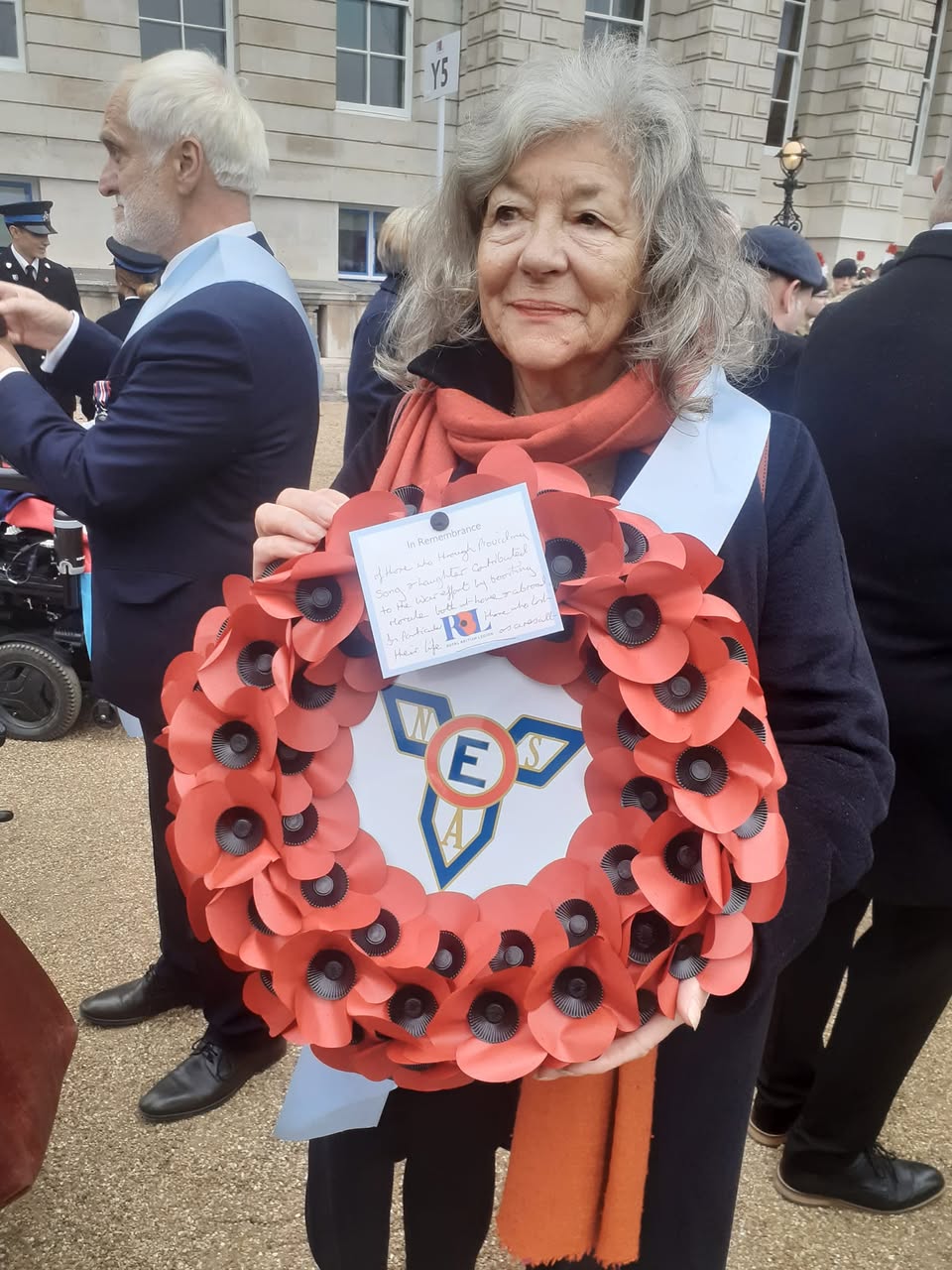
                   A very proud me on Remembrance Sunday, 9th November 2024, in London.

Below, I am in the company of: (left) Alan Wolven in the chair. Alan is a pianist. Now in his nineties, he is still playing. He was entertaining troops from the age of fourteen; (to my right) Suzie Cliff  was marching for her Mum, Doreen Thompson. See, she is wearing her mum's badges. Doreen entertained with ENSA. Colin Bourdiec in the splendid brown trilby, has a very mellifluous singing voice - he was humming and singing to us throughout our long cold wait before the march began. He is an entertainer who specialises in WWII material. On the far right, Steve Wolven, son of Alan.
The sashes we are wearing represent ENSA, the Entertainments National Service Association.


                                                              Remembrance Sunday 2024. 


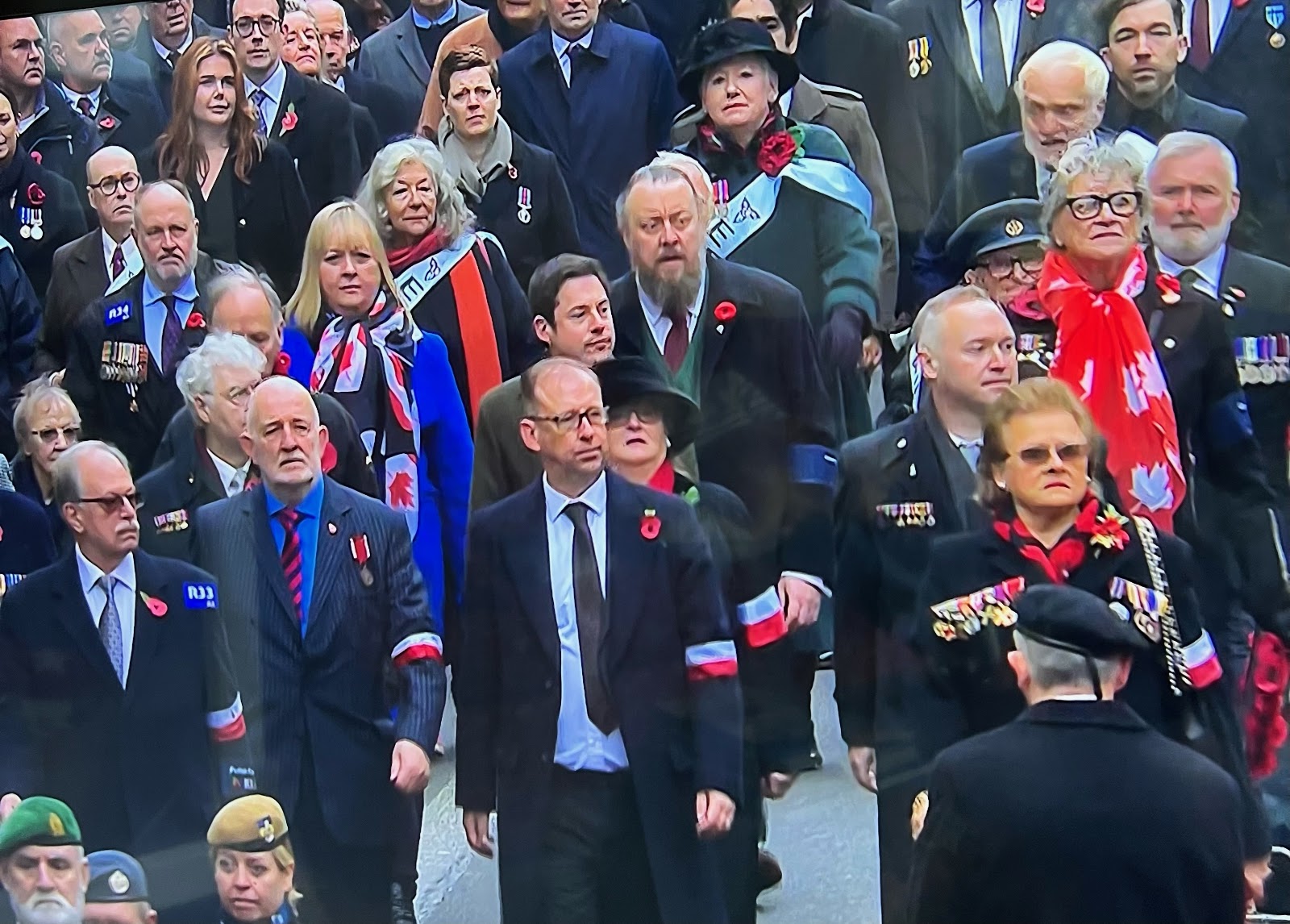
This year of 2024 was the first time that members of ENSA, or family members of those who had entertained troops during WWII, were represented in the march on Remembrance Sunday. We were a tiny band of six but we were strode proudly for the thousands of men and women who had entertained servicemen and women while they were fighting for their country. 

On a personal level, I was marching in memory of my late father. 

Peter Albert Drinkwater (later he used the stage name Peter Regan). This photo was taken, I believe, in Palestine sometime around 1943.

One of the inspirations for much of what I have spent my life doing: working as an actress, travel writing, entertaining, came from my late father who was a musician and an agent. My father signed up with the Royal Air Force in 1940 when he was 18. He wasn't keen on the idea of weaponry, or of any kind of fighting, but he was rather taken with the possibility of entertaining the servicemen and women. "Bringing a smile to their faces." So, he took himself off to the Drury Lane Theatre in London where there were auditions being held for those who wished to join one of the entertainment corps. Because Daddy had already enlisted with the Royal Air Force, the choice available to him was Squadron Leader Ralph Reader's Gang Show entertainment troupes. Daddy auditioned and was accepted.
I am not sure he had had any previous theatrical experience, I doubt it, nothing besides a dream of going on the stage. Even so he was accepted.


Here we are again marching past the Cenotaph, wearing the sash of ENSA. It was a very memorable and moving moment. Our wreath was laid amongst the thousands of others. Red upon red, all those poppies for peace. 

Above is the same small band of six of us. This was while we were waiting to march. In the foreground of this shot is Alan Crowe who is a marvellous individual. It was Alan who managed to persuade the British Legion that representatives from ENSA should be offered the opportunity to march with those who served. Alan is also the man responsible for the raising of funds to build a memorial in honour of all those who entertained.

What is ENSA? 
ENSA is the Entertainments National Service Association. It was established in 1939 by Basil Dean and Leslie Henson (both names my father mentioned frequently during my childhood). Leslie Henson was the grandfather of the television presenter Adam Henson. ENSA was established to provide entertainment for British Armed Forces personnel during World War II. ENSA operated as part of the Navy, Army and Air Force institutes. 

There were many artistes who did not go abroad but spent their time travelling Britain entertaining in service bases, ammunitions factories or gun and balloon sites.
There were several classes of shows from the larger ones to small shows. The B shows were the lesser known stars and including performers who were not known at all.

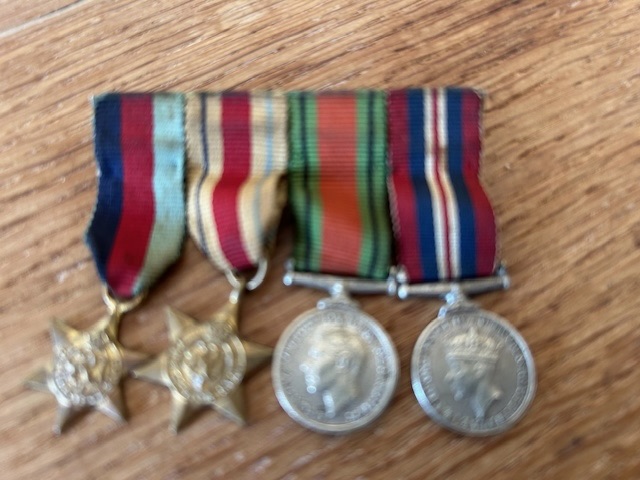
Apologies that this photo is a little blurry. These are my father's medals. I had never really asked myself what they were awarded for until I started to write this History Girls post. The first medal, I believe, is a WWII British Africa star. Daddy would have been awarded this one because he spent all his war in Africa and the Middle East. 

Every ENSA member was awarded the Defence Medal. In Daddy's collection above, it is the third one along.

                                             Dame Very Lynn. 1917 - 2020

Dame Very Lynn, an abidingly famous ENSA artiste was a symbol of the wartime spirit, also a symbol of all that was waiting back home: wives, sweethearts, sisters, mothers. She was greatly loved and became known as the 'Force's Sweetheart'. She was awarded the Burma Star for entertaining British guerrilla units in Japanese-controlled Burma. She was also awarded the War Medal 1939 - 1945.  She and I met on many occasions later when I had started working as an actress and we were involved in various charity shows together. Vera was a truly lovely lady, modest, gracious and generous.

Daddy's War Medal is above: the fourth one along in the pic.

When my father used to recount his tales of those 'exotic' days in Africa, it all sounded such fun and gung-ho but it could also be very dangerous. 

It was compulsory for West End Stars to entertain the troops during at least one six-week tour a year. Sometimes entertainers who were not in the armed forces were sent abroad to entertain. Basil Dean worried that if any of these artistes were captured, they were at serious risk.  If they were caught and not in uniform, Dean feared they might be taken for spies, which was a very real possibility. At Dean's behest uniforms were introduced for those civilians/stars who had accepted to entertain in war zones. The uniforms consisted of standard pattern battle dress and war theatre uniforms such as Jungle Green bush jackets. The only insignia allowed on the jacket was the standard ENSA shoulder titles. Although the civilian performers had no rank, all ENSA performers were granted officer status so that they could use the mess facilities. History has it that the only artiste never to wear uniform was Tommy Trinder who, when offered the uniform, said, "No, thanks. If I get captured, I deserve to be shot!"

As far as I am aware, the only ENSA member killed in the war was a nineteen-year-old girl, a tap dancer and acrobat. Vivienne Hole performed under the stage name of Vivienne Faye. On 23rd January 1945 in Normandy, she was being driven between shows as a passenger aboard a truck carrying stage scenery which strayed into a minefield and exploded. She was buried with full military honours in the Sittard War Cemetery. What a tragic end for one so young and at such a late stage in the war.

When I was a child, RAF Gang Show reunions were held in London on an annual basis. Daddy always attended. He was immensely proud of his contribution to Ralph Reader's shows. Amongst the soldiers he performed with were Peter Sellers and Tony Hancock. Peter Sellers began with ENSA as a drummer. Later when performing with Gang Show units, he developed his extraordinary skills for improvisation. Both Sellers and my father loved to play the ukulele and I have often wondered whether they performed together. My father's ukulele, and his banjo, sit in my writing room and they a great source of comfort and inspiration.

Ralph Reader created twenty-four Gang Show units and two WAAF units. They toured and performed in almost every theatre of war from Iceland to Burma. It is believed that in total they entertained some 3,500,000 servicemen and women. Quite an achievement.

On several occasions Daddy took me along with him to a reunion and I was privileged to spot a few of the famous faces. I remember Daddy discreetly pointing people out to me. At the end of the evening, everyone would get up together and sing "On the Crest of a Wave". Written by Ralph Reader, it was the Gang Show's signature tune. I can still hear it ringing in my ears today.
Not everyone in ENSA went on to make a name for themselves in show business and not everyone was a naturally talented entertainer, but many did become stars in the world of show business.

A little joke: Because sometimes the shows were a bit of a shambles and not always entirely properly rehearsed, the troops used to joke that ENSA actually stood for, 'Every Night Something Terrible.'

As I have written above, ENSA has never been recognised at the Remembrance Day March, 
until this year. We little band of six were the first to march and give the salute for al those wonderful people. Also, importantly, no Memorial exists to honour all those hundreds of thousands who spent the war entertaining others, but there is a move to change this. Below is a crowdfunding site to help pay for the cost of the memorial stone and its placement. If you or someone in your family have ever been entertained by anyone from ENSA, please think of making a small donation.


I have posted the same photo twice because the first version is clearer but cuts out the gentleman standing on the left. My father is the lad giving all the ladies a piggyback. I think these 'girls' performed in the shows with Daddy, or were in military service in Africa. According to Daddy's writing on the pic, it was taken in Durham in South Africa in 1944. If anyone knows who the other man is or can recognise any of the ladies, I would be thrilled to hear from you. 
Please email me at olivefarmbooks@gmail.com

After my generation, there will be no one left to remember all these past performers if no Memorial stone is erected in their memory. There is a link below for donations. Thank you.

Also, below, is a link to an article I wrote for the Mail on Sunday Travel recounting a visit I made this year, 2024, to Alexandria in Egypt. I made the journey partly to follow in the footsteps of my father.

https://www.dailymail.co.uk/travel/article-13582619/Alexandria-Egypt-Carol-Drinkwater.html

My travel book The Olive Route covers many of the countries where my father was stationed in Africa and the Middle East.

https://www.crowdfunder.co.uk/p/ensa-memorial-appeal-1202671

Friday, 20 December 2024

The London Under London by Miranda Miller


This is a photo of the Great Hall of the Guildhall which has been the City of London’s civic and ceremonial centre since the 12th century.  In the Middle Ages the Lord Mayor of London was almost as influential as the monarch. The hall you see today, which dates from the early 15thcentury, has stained glass windows, magnificent carvings and a medieval crypt.  The banners and shields of London’s 110 Livery Companies are on the walls. For six hundred years it has been the setting for state events, banquets and state trials, most famously that of Lady Jane Grey in 1553.  The 16 -year- old who was Queen of England for nine days was found guilty of high treason and sentenced to death in this hall. It survived the Great Fire of London when, as Samuel Pepys recorded, “the horrid malicious bloody flame” destroyed the roof.”  The Great Hall was also damaged in the Blitz when the ancient carvings of Gog and Magog were destroyed, but it was rebuilt yet again.  

 The Guildhall is a fascinating place to visit and, surprisingly, not too touristy. Another reason to go there is to catch a glimpse of Londinium: in 1988, after more than a hundred years of searching, London’s only Roman amphitheatre was finally rediscovered hidden beneath Guildhall Yard by Museum of London archaeologists digging in preparation for building the new Art Gallery.


 The curved band of dark stone on Guildhall Yard you can see in this photo marks out the perimeter of the amphitheatre beneath the piazza. The first Roman amphitheatre was built in 70CE from wood but was renovated in the early 2nd century with tiled entrances and ragstone  walls, and enlarged so that it could seat six thousand people – an astonishing number at a time when it’s estimated that the population of the city was between 45,00 and 60,000. The amphitheatre was used for public events such as gladiatorial games, entertaining soldiers and the public with fights between wild animals, public executions of criminals and also for religious ceremonies. Although these violent spectacles were sometimes criticised, particularly by the growing Christian community, they attracted huge audiences. St. Augustine, writing in the 4th century CE, describes his own reluctant excitement at these spectacles: “He opened his eyes, feeling perfectly prepared to treat whatever he might see with scorn... He saw the blood and he gulped down the savagery... He was no longer the man who had come there but was one of the crowd to which he had come.”


Here is a map of Roman London showing the amphitheatre. 
Londinium soon became the largest Roman settlement in Britain. There were public baths, temples, a fort, a forum, a public square surrounded by shops and an enormous hall known as a basilica. In the 2nd century CE Tacitus describes it as “Famous for its wealth of traders and commercial traffic.” Londinium was a major centre of international trade where merchants imported luxury goods such as wine, oil, and cloth and exported raw materials and slaves. 

After the Romans left in the 4th century, the amphitheatre lay derelict for hundreds of years.  In Peter Ackroyd’s novel The Clerkenwell Tales, set in London in 1399, citizens assemble in the ruins of this building, just a few hundred yards from St Paul’s Cathedral.


A large rock wall in a tunnel

Description automatically generated

These photos show what you actually see when you go down to the amphitheatre, with holograms designed to show you the scale and human proportions. A few months ago, I took my grandsons to see the Guildhall, which is a fascinating building in its own right. Then we took the lift down from the art gallery to the amphitheatre, a really thrilling experience. This place has been at the centre of London life for two thousand years and nobody who is interested in history could fail to be excited by this opportunity for time travel.


www.mirandamiller.info

My ninth novel, When I Was, about a child growing up in London in the 1950s, will be published in March by Barbican Press.


Friday, 13 December 2024

THE FAMILY DOLL by Elizabeth Chadwick


In the earlier days of THE HISTORY GIRLS, we used to have a 'Cabinet of Curiosities.'  I think this family heirloom I am briefly going to talk about would make an interesting addition to the said cabinet.  


 My family has a wax doll that has been handed down the generations in the female line (of my father's side)  to the youngest daughter in the family since the mid 19th century.  It's first owner was a little girl called Mary Lees, who was born on June 9th 1775, fourteen years before the French Revolution.  On her tenth birthday, her uncle presented her with a wax doll in a glass and wooden case and she kept it and passed it on to her daughter in due course.  We know this because there is a note inside the doll's case that tells us her intentions for the doll for when she had passed away. 

"This doll is the property of Mary Blunt and was presented to her by her uncle on her 10th birthday in the year 1785.  And at her death she wishes it to be for her youngest daughter Elizabeth. October 24th 1857"


 Mary Lees married a William Blunt, and the doll became the property of their youngest daughter Elizabeth, born in 1823. Elizabeth passed it to her youngest daughter, Martha, who in turn passed it on to her own youngest, Elizabeth, my great aunt, born in 1901,and now it has come to me. 
We don't know the purchase place of the doll. Oral family history says Paris, but it wasn't written down. She stands in her glass case, blue eyes, bright rosy cheeks and ash-blonde hair, surrounded by a hoop of artificial flowers, and two delightful,  smiling china poodles either side of her body -which is stuffed and encased in linen.  The face and the hands are the only parts made from wax as far as we can tell. She was never a child's toy in the way that toys are played with today, but certainly a treasured piece handed down from mother to daughter through the centuries.  Who knows what she has heard and seen! 

 Her flocked gown is in two layers and the white, semi-transparent upper fabric turns her gown a soft pink.  The under-dress is a fabulous rose-coral.  She has stood in her case down the generations of my family and with her written provenance for two hundred and fifty years. The next custodian will either be my niece or my granddaughter, but that will be decided in time.  For now she dwells with me.  It has been said that she is a bit creepy, but when I look at her smiling poodles, I am totally reassured that she is a benign heirloom.

  I wonder if my great, great, great, great grandmother's uncle ever thought when he gave his niece Mary Lees this doll for her 10th birthday in 1785, that although generations have come and gone, his gift would still be here now, seeing in 2025 with her family.  


Friday, 6 December 2024

Foundling Stories - Stacey Halls and Rose Tremain by Judith Allnatt

In 1747, in a fine room at the splendid buildings of London’s Foundling Hospital, Bess Bright holds her one-day-old baby girl. Alongside other mothers, Bess draws a ball from a bag in a lottery held to decide who will win a place for their child as a pupil. This game of chance is played out under the eyes of invited benefactors, wealthy ladies and gents, who witness the show of human drama. Thus starts ‘The Foundling’ by Stacey Halls. 

In 1850, a baby, wrapped in sacking is abandoned at the gates of a wintry park in London where she is scented by wolves from the Essex marshes. She is found by a policeman, who hears the wolves’ howling and takes her to the Foundling Hospital. Thus begins ‘Lily’ by Rose Tremain. 


A separated family is a powerful engine to drive a story and perhaps the most poignant separation of all is that of a mother and baby. Stories of ‘foundlings’, babies found abandoned by parents or handed over in desperation to foundling hospitals, start with this heart-breaking premise and immediately fire the reader with a strong desire to see parent and child reunited. For me, this desire would probably be enough on its own to keep me reading but the two books above offer so much more in their examining of the relationships of adults caught up in the drama.

Receiving day at the Foundling Hospital. Wellcome Images

https://wellcomecollection.org/works/fgqknntr


In ‘The Foundling’ poverty and the shame of illegitimacy force Bess to give up her baby, Clara. Like other brokenhearted mothers, as well as leaving the baby’s name and details at the hospital she leaves a token to identify her – half of a heart made of whalebone given to her by the baby’s father. All kinds of things were used as such tokens: slips of paper, embroidered ribbons, rings and pierced coins. Then if the mother were able to drag herself out of poverty and also save enough to pay a fee to the hospital for the child’s upkeep (a difficult feat), even when the hospital had given the child a new name they could be sure of reclaiming the right child by describing the token they left with them. 

Token on Marchmont Street, Author: Matt BrownNo changes made https://www.flickr.com/photos/londonmatt/53413014277/
                                  

The story takes a leap and the stakes are raised when Bess, after six years of scrimping, returns to claim her child only to find that a stranger has claimed her the very day after Bess had placed Clara in the hospital’s care. Avoiding spoilers - the exploration of what it is to be a mother deepens as the two women are brought up against each other. The genius of the book for me is the way in which Stacey Halls balances the representation of the needs of the two women so that despite the reader’s natural urge to see mother and daughter reunited there is also feeling for the damaged woman who has claimed Clara. This creates powerful dramatic tension and pulls the reader’s emotions in different directions, resulting in a gripping read that one can’t put down.

The Foundling Restored To Its Mother 1858 painting by Emma Brownlow
 
 1858. Public domain, via Wikimedia Commons
 

In 'Lily', subtitled ‘A Tale of Revenge’, Rose Tremain writes of poverty, cruelty and crime in Victorian London. The infant Lily is first placed in a loving foster family but is then wrenched away and returned to hardship as a pauper at the hospital. Now, as an adult, Lily has committed a murder and lives in fear of discovery. Tremain holds back the nature of the murder and the identity of the victim, masterfully managing the dramatic tension and creating a mystery that kept me turning the pages into the night.
However, the truly fascinating thing for me was the relationship between Lily and the policeman who rescued her as a baby. She feels he may hold the key to her salvation but she dare not confess to him for fear of the rope.

Tremain writes with all her usual subtlety and feeling, imbuing everyday objects with the emotional charge they hold for her characters so that they become powerful symbols of love and loss: a scarf that Lily knits for her only friend at the hospital, a deep, black well at the farm where Lily was happily fostered that comes to symbolise her worst fear of discovery and execution.

One of Tremain’s great strengths is that she looks unflinchingly at human darkness whilst still maintaining a feeling of authorial empathy and understanding. This novel moved me to tears – it is heartrending, compassionate and brilliant.

To find out more about the fascinating history of the Foundling Hospital and see examples of the tokens left by parents, do visit https://foundlingmuseum.org.uk

Friday, 29 November 2024

More Venetian than the Venetians - Michelle Lovric

There is a little corner of Venice that is forever Slav.

I’m devoting this blog to that corner, which is best known for its jewel-box of paintings by Vittore Carpaccio, the artist commissioned by the Slavs of Venice to depict their own saints in their own sacred place, the Scuola Dalmata dei Santi Giorgio e Trifone.

It’s a thousand years since Venice and the Slavs, known as the Schiavoni, were first drawn into a warm and symbiotic relationship by proximate geography and mutual interest. With the Ottomans encroaching ever further west and Mediterranean pirates increasingly audacious, Venice represented both a place and source of safety for the threatened Christian populations of the western Balkans. And Dalmatia in turn stood as Venice’s last line of defence against a Turkish domination of the Adriatic.

In 998 AD, the Dalmatian city-states appealed to Doge Pietro Orseolo for protection. The Venetian fleet swept in, hunting down and suppressing the pirates. Orseolo was welcomed as a liberator. He and his successors took the title ‘Duke of the Dalmatians’.
Domenico Tintoretto, ritratto dei dogi
Pietro Orseolo II ed Ottone Orseolo, Palazzo Ducale,
courtesy of Wikimedia Commons


Over the next four hundred years, the whole Dalmatian coast became part of the Stato da Màr, the name given to la Serenissima’s overseas possessions. Trade relations flourished; so did the population of Schiavoni living in Venice.
 
In 1368, Perast – in modern Montenegro – was named Venice’s "FEDELISSIMA GONFALONIERA" – most faithful flagbearer. In peace-time, the Venetian war standard was held by the Captain of Perast. In times of war, that banner was hoisted on the navy’s flagship. Each year, twelve Perastini, chosen from the most valiant, swore to die rather than allow the Venetian flag to fall into enemy hands. More on this later.
image from Bozholidays website

One of Venice’s great thoroughfares took its name from the Dalmatian merchants who landed their goods there – the Riva degli Schiavoni.
Gabriele Bella, Passeggio sulla riva degli Schiavoni, Querini Stampalia,
courtesy of Wikimedia Commons 

By the mid-15th century there were over 5000 Slavs resident in Venice, of a total population of 120,000. Whether German, Albanian, Greek, Armenian or Jewish, immigrants were welcomed by Venice, because there were simply not enough Venetians to do the work of the city, particularly the more menial, low-paid work. Pragmatically, Venice assimilated and socialised her immigrants – folding them into the existing system of scuole or guilds, by which the city neatly organised her social, religious, economic and civic life. It was also the scuole that commissioned some of Venice’s greatest art.

Each national scuola operated as a nucleus of resident foreigners, who were never fully integrated but defined, accepted and welcomed as insider-outsiders, licensed to provide the manpower and trades Venice needed, while self-governing within their own confraternity. The scuola was a gateway to work, patronage, housing and alms for all new immigrants. Meanwhile, the intimate geographies of Venice gradually bound together all those who lived there, whatever their origin – as did intermarriage. In the wider picture, common causes against common enemies did the same.

So in 1451, the Council of Ten said yes, when Venice’s Slavs asked to set up their own scuola, with a mission to support the Dalmatian community, especially the families of soldiers and sailors who had suffered or died while serving la Serenissima in battle.

The Schiavoni were to meet in the disused hospice of Santa Caterina, leased from the Order of St John of Jerusalem, in Calle dei Furlani in the east of the city. Two hundred confratelli were present on the day of their first meeting. Just under 50% came from the cities of Kotor and Bar in Venetian Albania. Over a third were sailors, crewing the Republic’s galleys; another third were tradesmen, many working on the construction and maintenance of the Venetian fleet.

The aims and responsibilities of each Venetian scuola were embodied in its Mariegola, a book of statutes. The Mariegola established the days of the Schiavoni’s religious services, permitted them to worship in their own language, defined their charitable works including dowries for poor girls, their financial obligations to the State, and also the roles of the different officers. This image of their precious Mariegola comes from the scuola's website.

For its coat of arms, the new scuola adapted the antique heraldry of Dalmatia … three lion heads on an azure base. Azure turned crimson, echoing Venice’s own flag. Dalmatian soldiers and sailors wore red tunics – later jackets – and spoke in their own ‘Illyrian’ dialect, a language heavily contaminated with Venetian.4

The scuola immediately began to acquire relics and sacred art relating to its patron saints, Trifone, George and Jerome.

In 1502 the Venetian patrician Paolo Valaresso presented the scuola with a relic of Saint George that had once belonged to the Patriarch of Jerusalem. The bone fragment was delivered to the scuola on St George’s Day, in a grand musical procession. The fragment joined the precious trove of saints’ remains already collected by the Scuola Dalmata, chief among which was St Trifone’s jaw.

Within five years, Vittore Carpaccio had completed his cycle of paintings there. (Image from the scuola's website).

After various disputes with the Order of St John, the Schiavoni raised their own funds to remodel their building. In 1551, a new façade emerged. The two large windows on the ground floor provided a theatrical framing for charitable acts – the confratelli would distribute food to the poor.

Slav writers, editors and publishers soon became part of the successful Venetian printing industry. Inside and beyond Venice, her Schiavoni were becoming known for their loyalty. Their scuola was recognised – with privileges and indulgences – for the enthusiasm with which they raised money for Venice to pursue war against the Ottomans. Carlo Goldoni prefaced his hit play La Dalmatina, saying that it was "about a loyal nation worthy of La Serenissima".

The odd local insurrection still occurred in Dalmatia and Albania – for we Slavs are a fiery nation! – but many of the Schiavoni resident in the city prided themselves on being almost more Venetian than the Venetians. The Schiavoni were among the few to protest when Venice ceded to Napoleon in May 1797. While the city’s patricians withdrew to their palaces for passive lament, the Schiavoni mobbed the streets, crying "Viva San Marco!" Lower right in the rather fanciful image below – we see the Schiavoni vainly waving their yellow and red Venetian flags against French horses and canon.
Jean Naudet le Beau, Prise de Venise par Napoléon en mai 1797,
Musée de la Révolution française - Vizille,
Wikimedia Commons
Even after Venice fell, her flag still flew in Dalmatia. Perast was the very last Venetian town to cede to Napoleon. Only on August 23, 1797 did the Perastini gather to bury the Republic’s flag under their cathedral’s altar, to prevent it falling into enemy hands. This painting by Giuseppe Lallich (from the Museum of Perast) shows them kissing the flag farewell.

Giuseppe Lallich, Il Bacio di Perasto al Gonfalone di San Marco
painted in 1930. Associazione nazionale dalmata. © Cace 2006


Unknown artist, portrait of
Giuseppe Viscovich, 
courtesy of Wikimedia Commons
Their commander, Count Giuseppe Viscovich (left), delivered an emotional speech about the Gonfalon, or flag: "Our sons will know of us, and the story of this day will be known in all of Europe – that Perast has worthily sustained the pride of the Venetian Gonfalon to the last, honouring it with this solemn act, and setting it down wet with our bitterest universal tears.
"Let us rage, citizens, let us rage, and in these, our last sentiments with which we seal our glorious career under the Most Serene Venetian Republic, we turn towards the flag that represents us, and, upon it, we vent all our sorrow.

"For three hundred and seventy-seven years our being, our blood, our lives were always for you, O San Marco; and, always your most faithful, we have  known You to be with Us, Us to be with You; and on the sea we were always with You, illustrious and victorious. No one ever saw us in retreat, defeated or afraid!

"But what else is left to do for you? May our hearts be your most honoured tomb, and your purest and greatest praise be our tears!
"

Giuseppe Praga, in his Storia di Dalmazia, says – and I agree with him – that these are "words that could be found only to frame a last farewell to a parent, from whom you have received your soul and your life."

Unlike the grander guilds of Venice, the tiny Scuola Dalmata would survive the fall of the Venetian Republic. Of more than three hundred Venetian scuole, only the Scuole Dalmata and di San Rocco saved their confraternities and their art treasures from Napoleon’s closures and larceny.

The Schiavoni’s cry of "Viva San Marco!" was heard once more in 1848, when the scuola’s members took part in the revolt against the Austrians. Among the leaders was the linguist Niccolò Tommaseo, originally from Sibenik. Tommaseo is commemorated in a statue in Santo Stefano. It was a Schiavoni commander, Antonio Billanovich, who began the bombardment of the Austrian’s new railway bridge into Venice.

When bombs fell on Venice in World War I, the Carpaccio paintings were removed from the scuola’s walls and packed in sealed cases. This proved prudent, as the scuola was damaged when nearby buildings suffered direct hits. In 1940, the paintings were again taken to a place of safety. After the war, they were extensively though imperfectly restored, arriving home only in 1947.

Save Venice restored the scuola’s façade 2001 – and will soon also complete the restoration of the paintings, a work dedicated to art historian Patricia Fortini Brown, author of the key work, Venetian Narrative Painting in the Age of Carpaccio.

Venice has never stopped attracting the Schiavoni, generation after generation. Following World War II, many – including my own father, uncle and grandfather – found the Tito regime repressive and left Yugoslavia. My people went to Australia, but many Slavs ended up in Venice, reuniting with old branches of their families who’d emigrated in the time of la Serenissima. I’m always looking for the Lovric name on Venetian doorbells – especially after I discovered a certain Giovanni or Ivan Lovrich, - a writer born in Croatia but living and publishing in Venice in 1776. I never did find the Lovric name on a Venetian doorbell. So in the end, I put one there myself.


The confratelli of the Scuola Dalmata have remained loving custodians of their own Venetian history, setting up a library and archive in the 1980s. They publish books and a magazine. In 1997, the Schiavoni were honoured with this plaque on the Riva named after them. It celebrates the bonds of fidelity that unite Dalmatia with Venice via their five-hundred-year-old scuola
plaque image by Didier Descouens,
courtesy of Wikimedia Commons

It’s no coincidence that Ruskin, in setting up the Guild of St George (the organisation of which I am so proud to be a Companion) chose ‘Guild’ for its title. The word is probably the best translation of ‘scuola’. Both words give the sense of a lay confraternity, a meeting place, a site of good thinking, a state of mind looking to give, rather than take.

And what place needs that more than Venice?  

This blog is adapted from a talk about Ruskin and the Scuola Dalmata that I presented in February 2022 for the Guild of St George, the organisation devoted to Ruskin’s ideas, with Joseph Mydell playing the part of the Master.

Scuola Dalmata website 

The Guild of St George website 
Michelle Lovric’s website