Showing posts with label ENSA. Show all posts

Thursday, 26 December 2024

Entertaining the Troops in World War II, by Carol Drinkwater


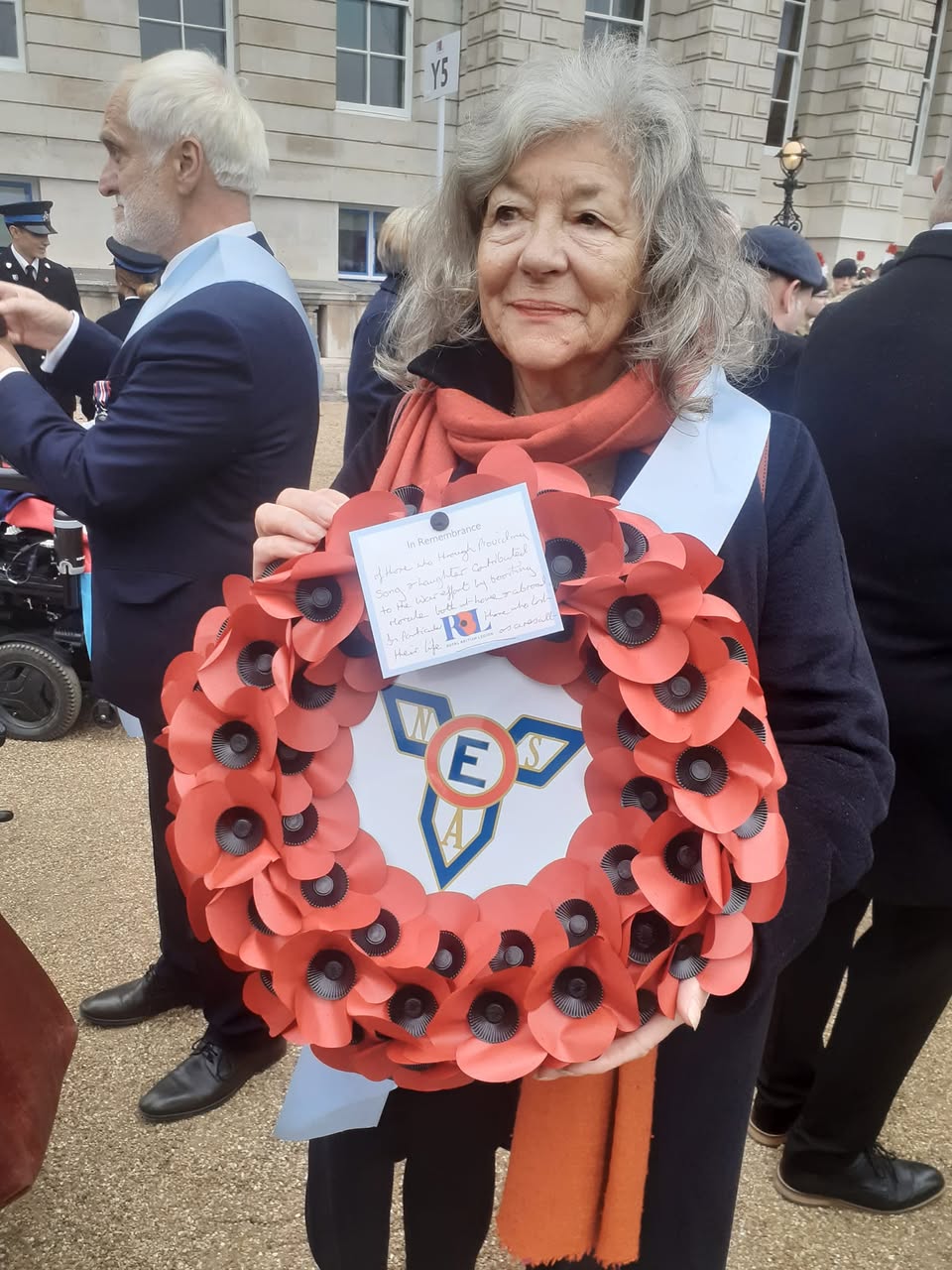
                   A very proud me on Remembrance Sunday, 9th November 2024, in London.

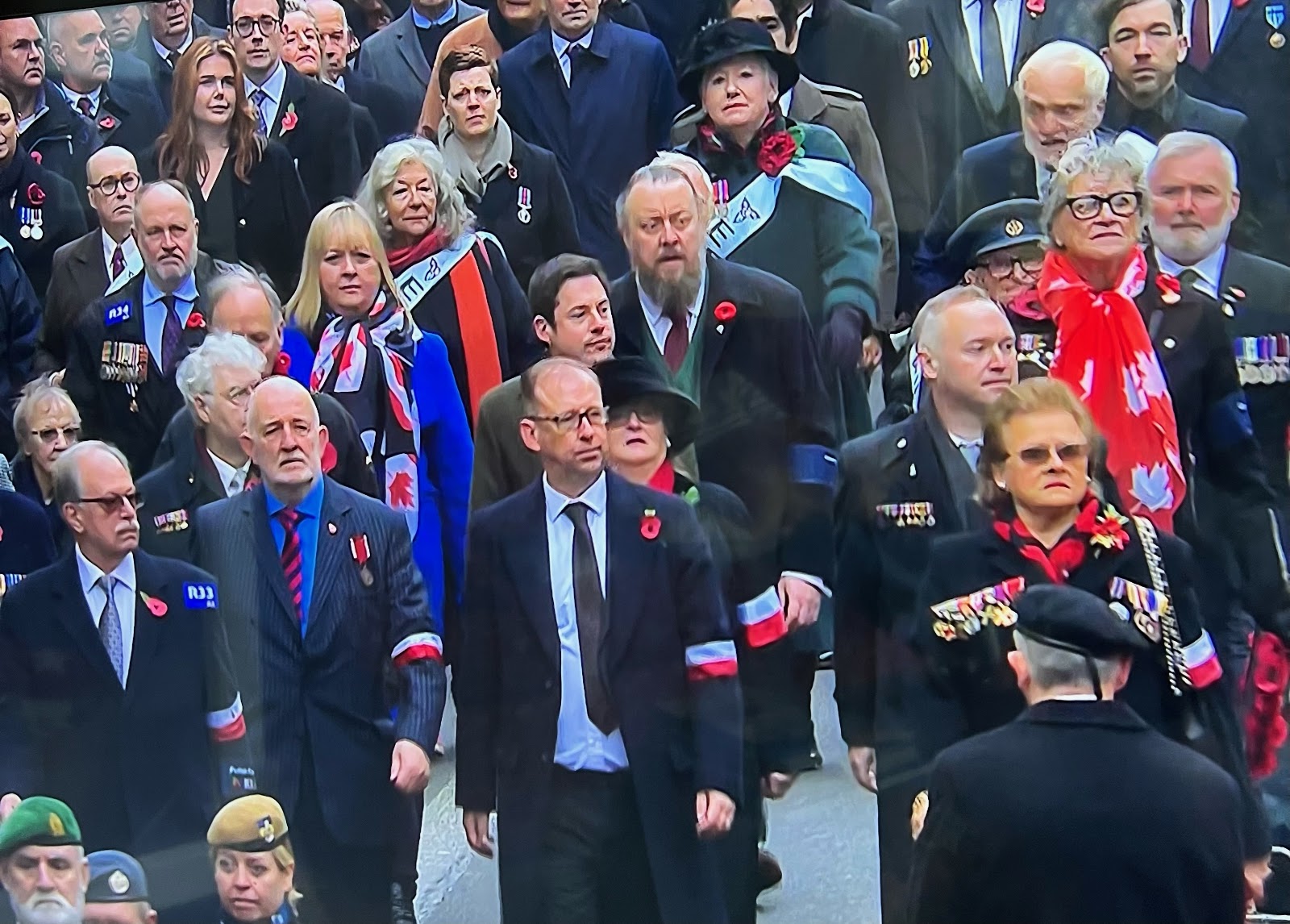
Below, I am in the company of: (left) Alan Wolven in the chair. Alan is a pianist. Now in his nineties, he is still playing. He was entertaining troops from the age of fourteen; (to my right) Suzie Cliff  was marching for her Mum, Doreen Thompson. See, she is wearing her mum's badges. Doreen entertained with ENSA. Colin Bourdiec in the splendid brown trilby, has a very mellifluous singing voice - he was humming and singing to us throughout our long cold wait before the march began. He is an entertainer who specialises in WWII material. On the far right, Steve Wolven, son of Alan.
The sashes we are wearing represent ENSA, the Entertainments National Service Association.


                                                              Remembrance Sunday 2024. 


This year of 2024 was the first time that members of ENSA, or family members of those who had entertained troops during WWII, were represented in the march on Remembrance Sunday. We were a tiny band of six but we were strode proudly for the thousands of men and women who had entertained servicemen and women while they were fighting for their country. 

On a personal level, I was marching in memory of my late father. 

Peter Albert Drinkwater (later he used the stage name Peter Regan). This photo was taken, I believe, in Palestine sometime around 1943.

One of the inspirations for much of what I have spent my life doing: working as an actress, travel writing, entertaining, came from my late father who was a musician and an agent. My father signed up with the Royal Air Force in 1940 when he was 18. He wasn't keen on the idea of weaponry, or of any kind of fighting, but he was rather taken with the possibility of entertaining the servicemen and women. "Bringing a smile to their faces." So, he took himself off to the Drury Lane Theatre in London where there were auditions being held for those who wished to join one of the entertainment corps. Because Daddy had already enlisted with the Royal Air Force, the choice available to him was Squadron Leader Ralph Reader's Gang Show entertainment troupes. Daddy auditioned and was accepted.
I am not sure he had had any previous theatrical experience, I doubt it, nothing besides a dream of going on the stage. Even so he was accepted.


Here we are again marching past the Cenotaph, wearing the sash of ENSA. It was a very memorable and moving moment. Our wreath was laid amongst the thousands of others. Red upon red, all those poppies for peace. 

Above is the same small band of six of us. This was while we were waiting to march. In the foreground of this shot is Alan Crowe who is a marvellous individual. It was Alan who managed to persuade the British Legion that representatives from ENSA should be offered the opportunity to march with those who served. Alan is also the man responsible for the raising of funds to build a memorial in honour of all those who entertained.

What is ENSA? 
ENSA is the Entertainments National Service Association. It was established in 1939 by Basil Dean and Leslie Henson (both names my father mentioned frequently during my childhood). Leslie Henson was the grandfather of the television presenter Adam Henson. ENSA was established to provide entertainment for British Armed Forces personnel during World War II. ENSA operated as part of the Navy, Army and Air Force institutes. 

There were many artistes who did not go abroad but spent their time travelling Britain entertaining in service bases, ammunitions factories or gun and balloon sites.
There were several classes of shows from the larger ones to small shows. The B shows were the lesser known stars and including performers who were not known at all.

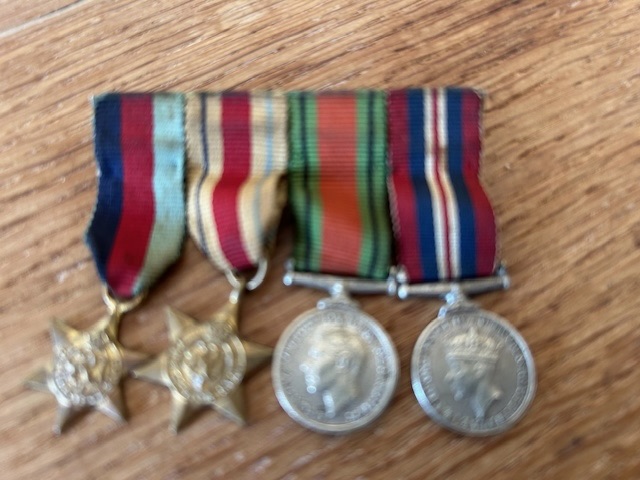
Apologies that this photo is a little blurry. These are my father's medals. I had never really asked myself what they were awarded for until I started to write this History Girls post. The first medal, I believe, is a WWII British Africa star. Daddy would have been awarded this one because he spent all his war in Africa and the Middle East. 

Every ENSA member was awarded the Defence Medal. In Daddy's collection above, it is the third one along.

                                             Dame Very Lynn. 1917 - 2020

Dame Very Lynn, an abidingly famous ENSA artiste was a symbol of the wartime spirit, also a symbol of all that was waiting back home: wives, sweethearts, sisters, mothers. She was greatly loved and became known as the 'Force's Sweetheart'. She was awarded the Burma Star for entertaining British guerrilla units in Japanese-controlled Burma. She was also awarded the War Medal 1939 - 1945.  She and I met on many occasions later when I had started working as an actress and we were involved in various charity shows together. Vera was a truly lovely lady, modest, gracious and generous.

Daddy's War Medal is above: the fourth one along in the pic.

When my father used to recount his tales of those 'exotic' days in Africa, it all sounded such fun and gung-ho but it could also be very dangerous. 

It was compulsory for West End Stars to entertain the troops during at least one six-week tour a year. Sometimes entertainers who were not in the armed forces were sent abroad to entertain. Basil Dean worried that if any of these artistes were captured, they were at serious risk.  If they were caught and not in uniform, Dean feared they might be taken for spies, which was a very real possibility. At Dean's behest uniforms were introduced for those civilians/stars who had accepted to entertain in war zones. The uniforms consisted of standard pattern battle dress and war theatre uniforms such as Jungle Green bush jackets. The only insignia allowed on the jacket was the standard ENSA shoulder titles. Although the civilian performers had no rank, all ENSA performers were granted officer status so that they could use the mess facilities. History has it that the only artiste never to wear uniform was Tommy Trinder who, when offered the uniform, said, "No, thanks. If I get captured, I deserve to be shot!"

As far as I am aware, the only ENSA member killed in the war was a nineteen-year-old girl, a tap dancer and acrobat. Vivienne Hole performed under the stage name of Vivienne Faye. On 23rd January 1945 in Normandy, she was being driven between shows as a passenger aboard a truck carrying stage scenery which strayed into a minefield and exploded. She was buried with full military honours in the Sittard War Cemetery. What a tragic end for one so young and at such a late stage in the war.

When I was a child, RAF Gang Show reunions were held in London on an annual basis. Daddy always attended. He was immensely proud of his contribution to Ralph Reader's shows. Amongst the soldiers he performed with were Peter Sellers and Tony Hancock. Peter Sellers began with ENSA as a drummer. Later when performing with Gang Show units, he developed his extraordinary skills for improvisation. Both Sellers and my father loved to play the ukulele and I have often wondered whether they performed together. My father's ukulele, and his banjo, sit in my writing room and they a great source of comfort and inspiration.

Ralph Reader created twenty-four Gang Show units and two WAAF units. They toured and performed in almost every theatre of war from Iceland to Burma. It is believed that in total they entertained some 3,500,000 servicemen and women. Quite an achievement.

On several occasions Daddy took me along with him to a reunion and I was privileged to spot a few of the famous faces. I remember Daddy discreetly pointing people out to me. At the end of the evening, everyone would get up together and sing "On the Crest of a Wave". Written by Ralph Reader, it was the Gang Show's signature tune. I can still hear it ringing in my ears today.
Not everyone in ENSA went on to make a name for themselves in show business and not everyone was a naturally talented entertainer, but many did become stars in the world of show business.

A little joke: Because sometimes the shows were a bit of a shambles and not always entirely properly rehearsed, the troops used to joke that ENSA actually stood for, 'Every Night Something Terrible.'

As I have written above, ENSA has never been recognised at the Remembrance Day March, 
until this year. We little band of six were the first to march and give the salute for al those wonderful people. Also, importantly, no Memorial exists to honour all those hundreds of thousands who spent the war entertaining others, but there is a move to change this. Below is a crowdfunding site to help pay for the cost of the memorial stone and its placement. If you or someone in your family have ever been entertained by anyone from ENSA, please think of making a small donation.


I have posted the same photo twice because the first version is clearer but cuts out the gentleman standing on the left. My father is the lad giving all the ladies a piggyback. I think these 'girls' performed in the shows with Daddy, or were in military service in Africa. According to Daddy's writing on the pic, it was taken in Durham in South Africa in 1944. If anyone knows who the other man is or can recognise any of the ladies, I would be thrilled to hear from you. 
Please email me at olivefarmbooks@gmail.com

After my generation, there will be no one left to remember all these past performers if no Memorial stone is erected in their memory. There is a link below for donations. Thank you.

Also, below, is a link to an article I wrote for the Mail on Sunday Travel recounting a visit I made this year, 2024, to Alexandria in Egypt. I made the journey partly to follow in the footsteps of my father.

https://www.dailymail.co.uk/travel/article-13582619/Alexandria-Egypt-Carol-Drinkwater.html

My travel book The Olive Route covers many of the countries where my father was stationed in Africa and the Middle East.

https://www.crowdfunder.co.uk/p/ensa-memorial-appeal-1202671

Monday, 27 March 2017

Pamela Gibson of Bletchley Park by Janie Hampton

Pamela Gibson is the oldest surviving person to have worked at Bletchley Park decoding centre during the Second World war. ‘But Bletchley was not my whole life,’ she says in her strong, velvety voice. ‘I’ve had other careers too.’ She also holds the world record for the longest ‘rest’ between jobs as an actor, proving that it’s quite possible to restart a career after 60 years.
Pamela was born in her grandmother’s drawing room in Knightsbridge in 1917, during a zeppelin raid. ‘I was almost called Zeppelina,’ she told me. Her favourite subjects at boarding school were elocution and horse-riding. ‘When the hunt came past, we all dropped our books and followed.’ Her father had been an opera singer and when she left school he sent her to Paris. There she was taught French by Yvette Guilbert, the Moulin Rouge singer portrayed by Toulouse Lautrec. After a few months improving her German in Munich, she attended the Webber Douglas Drama School. One of her first professional parts was opposite Cyril Cusack in The Playboy of the Western World. Then she went into rep; and when war broke out, into ENSA.
‘In 1941 an interfering godmother told me I was wasted on the stage and there was interesting work to be done if I applied to the Admiralty.’ Pamela was interviewed, and offered a secret job. ‘I was torn because my brother Patrick had just been captured in Libya, and was missing, so I wanted to be useful. But on the other hand, I had just been offered my first part in the West End, which was rather thrilling. I asked the man at the Admiralty who’d interviewed me, what he thought. “The stage can wait, but the war can’t,” said the man.’ So she accepted.
‘I thought it would be exciting and I’d be dropped into France as a spy. But I was sent to this big cold house called Bletchley. I suppose I was recruited because of my well to-do background. They thought that if they took in girls from families they knew something about, they were less likely to be German spies. I was very disappointed when I learned that my job was copying words onto index cards. The codes came in broken up and then we had to cross-reference them. There was a separate card for each battle ship, another for the port it was leaving, another for where it was arriving. Some days it was incredibly exciting but mostly it was quite dull, with messages about onions or something.’ Having lived on her own since she left school six years earlier, Pamela refused to live in a stuffy billet or share a room, so she rented a caravan in a field.
Bletchley Park Mansion, Buckinghamshire
By 1944 three quarters of the 9,000 workers at Bletchley Park were women. They were paid half what the men were, and only given temporary contracts. Pamela must have been outstanding as she was one of the few women who was promoted. As Head of the Index, she was in charge of 50 women in Naval Intelligence. ‘I was only promoted because I couldn’t type and at 24 I was quite old,’ she says modestly. ‘Although I was pretty fluent in German and French.’
Naval Intelligence hut, Bletchley Park.  Photo  by Toby Oxborrow.  
The tedium of long shifts was balanced with amateur dramatics, much improved by professional actors such as Pamela, and scripts written by Oxbridge graduates, such as the charming and gifted Wing Commander Jim Rose. ‘The best thing about Bletchley, was meeting Jim.’ At 32, Rose was considered too old to fly, so was put in charge of Air Intelligence at Bletchley Park. He had to decide which de-coded messages to hold back from the Air Force in case their actions then revealed to the Germans that Britain had broken the codes. On their first date, Jim took Pamela to dine at the Savoy. ‘It was very difficult to get a table, so he posed as an Irish peer whom he knew was not in London. Later we discovered that one of his friends had done the same thing, at the same place.’
They were married in 1946, a perfect match: both were cultured, generous and keen to make the post-war world a better place. They moved into a bomb-damaged square in Kensington, a few doors down from my family. When I was born, my parents asked Pamela to be my godmother. She was an unusually thoughtful one: my christening present included not only a silver mug (battered but still loved) but also a Swiss nanny for six months. Apparently Sister Klarli looked after not just me, but also my parents and my three older siblings; and was there for the arrival of my younger sister. Instead of toys for birthdays, Pamela paid for my piano lessons – a present that goes on giving. After the Roses children, Alan and Harriet, arrived, they moved to Zurich where Jim Rose was founder-director of the International Press Institute, an important global force for the freedom of the press.
For ten years after their return to London, Pamela was the school counsellor of North Paddington Comprehensive, caring for pupils who had recently arrived from the Caribbean. When she was 60 she had to retire, but didn’t give up. ‘I had to do something, so I became the vice-chair of the NSPCC,’ she said as if it was as simple as buying the weekly fish. After Jim died in 1999, Pamela, then aged 84, went back to her first career and renewed her membership of Equity, the actor's union. A few acting lessons later, she was cast as Lady Jedburgh in Lady Windermere’s Fan, directed by Peter Hall at the Haymarket Theatre. She also understudied for Googie Withers, then just 83. After only three nights, Googie Withers fell ill and Pamela was called upon to play The Duchess of Berwick. With several more parts over the next five years, she has maintained her position as the actor with the longest period of ‘resting’ between jobs. ‘It was wonderful to get back on the stage after 60 years. Acting helped me get over losing Jim. The fear of going on stage is the best defence against grief.’
Churchill described Bletchley Park as ‘the goose that laid the golden egg but never cackled’. Everyone there had signed the Official Secrets Act and until recently Pamela never spoke of her war-time career. Not even that she had known the computer scientist Alan Turing, though she insists not well. ‘He was polite and intelligent, but he really preferred the company of men.’ Even when the film Enigma about Bletchley Park was released in 2001, she only commented to a few friends, ‘We never wore hats like that.’ When The Imitation Game, starring Benedict Cumberbatch as Alan Turing, came out in 2014 she changed her mind. ‘I realised that everyone else was talking about it, so why shouldn’t I?’ she told me. Suddenly she was in the limelight with appearances in books and on television, and even Desert Island Discs. ‘But we don’t need to be glorified. We were all well protected and properly fed.’
The cast of The Marraige of Figaro,  Bletchley, 1943
Pamela will be 100 years young in November and remains as beautiful and chic as ever. She still entertains friends and grandchildren in the elegant Georgian house in Kensington that has changed little since she moved there 71 years ago. ‘I’ve had a lucky life,’ she says. Nonsense, I’d say it wasn’t luck, but resilience, determination and chutzpah.

Wednesday, 27 January 2016

Joyce Grenfell by Janie Hampton

Joyce Grenfell with her cook Rene Easden, 1938
The writer and entertainer Joyce Grenfell was born 106 years ago this month. By the time she retired in 1973, she had performed on four continents, in front of King George VI, Maurice Chevalier and Igor Stravinsky. She always claimed to be ‘just a housewife’ who happened to walk onto a stage. But while researching her biography, I found that her childhood had prepared her for the limelight. Her mother was Virginian-born Nora Langhorne, the youngest sister of Nancy Astor MP, and they both taught Joyce to mimic accents. Her father Paul Phipps, an architect,taught her to observe people, especially on buses. Brought up in Bohemian Chelsea, she went to smart private schools and was presented as a debutante at Court.  A tall girl with huge feet, she was often the wallflower at society balls. At nineteen she married Reggie Grenfell, a shy accountant.
As a young housewife living on the Astors' estate at Cliveden in the 1930s, she ran the local Women's Institute, wrote poetry for Punch and helped to entertain her aunt Nancy's guests. After one lunch, J.L. Garvin, the editor The Observer, engaged her as the paper's first radio critic. This led to meeting the theatre impresario Herbert Farjeon, who asked her to perform her monologue about the W.I.  Much to the fury of the professionals in his ‘Little Revue’, Useful and Acceptable Gifts was an immediate success.
Joyce and her ENSA pianist Viola Tunnard, c. 1945.
The Second World War brought Joyce more opportunities to perform. After a lunchtime concert at the National Gallery in 1942, she met Richard Addinsell, composer of the ‘Warsaw Concerto’. Together they wrote many successful sentimental ballads including I'm Going to See You Today, which caught the public mood. In 1944 Joyce embarked with the pianist Viola Tunnard on two long ENSA tours across North Africa, the Middle East and India. For 11 months they performed three concerts a day in Nissen huts and tented hospitals.
Arriving in Cairo for some leave, she was targeted by Prince Aly Khan - a lover of race-horses, cards and women.  He wooed Joyce with red roses and dancing by moonlit and although I think she fended him off, she felt guilty all her life for feeling tempted. Infidelity became a theme of many of her monologues: the musician's wife in Life Story, for example, and the French lover in Dear Francois.
Back in London Joyce wrote new songs and sketches such as Travel Broadens the Mind and joined Noel Coward in the first post-war revue, Sigh No More.  'Noel was an actor who wanted to be an aristocrat and Joyce was the opposite, an aristocrat who wanted to be an actor,' the actress Judy Campbell told me. 'Both pulled it off rather well.'
In 1943 Joyce tried straight acting but soon realised that she could not act 'sideways' and anyway, she preferred to have an audience to herself. After that she only performed other people's material in films, such as The Belles of St Trinian's and The Yellow Rolls-Royce, but directors had to accept that she would probably not stick to the script. 'This writer has obviously never met a real Duchess,' she proclaimed on the set of The Million Pound Note.
Donald Swann wrote the music for Joyful Noise, a fake Haydn oratorio sung by Joyce as Miss Clissold, Miss Truss and Ivy Trembly from Wembley, 'who sometimes sings in FFF and sometimes ppp' for the revue Penny Plain in 1951.

After live theatre, Joyce's favourite medium was radio. ‘It's a one-to-one medium, and uses the imagination,’ she said. In 1941 she wrote the first ever one-woman radio show, produced by Stephen Potter, the future author of Gamesmanship. Two years later they wrote and presented How to talk to Children for the BBC Home Service. Their astute social satire, mockery of contemporary etiquette and imaginative use of radio pushed forward radio comedy by a decade. From this emerged the exasperated nursery school teacher and  Joyce's most memorable line, 'George, don’t do that'.  The How series ran for 12 years, using, among others, the voices of Celia Johnson and Roy Plomley. In How to Listen (and How not to) Joyce was the first woman to speak on the Third Programme's opening day  in 1946. She played nine different parts including a Mayfair flapper with a wireless-cum-cocktail cabinet fitted with a 'supersonic incessor switch and hypertonic two-way mega-cycle baffles.' Over the next 30 years Joyce wrote more radio material than any other woman in the 20th century. She also secured the highest fees, rising from 8 guineas in 1939 to 250 guineas in 1963 for The Billy Cotton Band Show.
After the 1954 success of Joyce Grenfell Requests The Pleasure in two provincial tours, the West End and on Broadway, Joyce relied simply on her talented pianist William Blezard and the jewel-coloured costumes designed for her by Victor Stiebel. She combined talent, observation and sheer hard work.  She wrote over a hundred roles for herself, from the Scandinavian visitor at a cocktail party -  'I sink is so nice to say hello and goodbye quick, and to have little sings for eating is so gay', to Shirley's cockney girlfriend, 'You know, Norm’s the one that drives the lorry with the big ears.' Unsuitable, might have been herself – ‘a hat and gloves and pearls type'  singing 'I go jazzy when I hear the beat. I swing and sway in a groovy way'.
Her favourite role was inspired by Sir Alec Douglas-Home's mother-in-law - the wife of an Oxbridge vice- chancellor in Eng. Lit..  A woman with strong values, she apologised for 'the regrettable absence of essential stationary in the visitor's closet.' Joyce’s perfectly-formed short stories contained tiny but revealing slices of people’s lives. Each monologue took anything up to five years to write, yet lasted only two to eight minutes.  ‘I do not improvise, but I do re-create the story every night,’ she said. While 1960s humour was dominated by Beyond the Fringe, the critics said Joyce was too domestic and apolitical. But her shows continued to sell out everywhere from Dover to San Francisco, from Glasgow to Sydney. She made her audience feel that she loved them, as much as they loved her.
Joyce with her friends Benjamin Britten & Peter Pears, 1967.
Her beloved Reggie always encouraged her, while never allowing her to perform anything that was not up to scratch. They both disliked celebrity parties and their hobbies included bird watching and wild flowers. 
Joyce had a strong faith in Christian Science and believed that Goodness was all around, and pain, evil or disease would melt away if ignored. Apart from opening countless fetes, she kept her enormous generosity secret. Young writers such as Clive James and Jeffrey Bernard received clothes and cheques. During the freezing winter of 1962, my widowed mother was taken to hospital and Joyce arrived with steaming casseroles. She would whip a pair of Marigolds out of her crocodile handbag and whisk round the kitchen, as she reminded us to do our homework. It wasn't until she sent us tickets to her show at the Haymarket that I discovered she had an evening job.


Soon after her last live performance at Windsor Castle in 1973, she lost the sight of one eye, but continued to appear on the BBC's Face the Music.  After she died of cancer in November 1979, over 2,000 people attended her memorial service in Westminster Abbey.  As one of those, I had no idea that 20 years later I would be reading her letters and diaries as I researched her biography.

www.janiehampton.co.uk   Books about Joyce Grenfell:

Joyce and Ginnie, the letters of Joyce Grenfell and Virginia Graham, edited by Janie Hampton, Hodder & Stoughton, 1997. Hats Off! Joyce Grenfell's poetry & drawings, edited by Janie Hampton, John Murray, 2001. Joyce Grenfell, the biography, Janie Hampton, John Murray , 2002. My Kind of Magic, a Joyce Grenfell Scrapbook, edited by Janie Hampton, John Murray,  2003. Letters from Aldeburgh by Joyce Grenfell, edited by Janie Hampton, Day Books,  2006.