Showing posts with label 1940s. Show all posts

Monday, 22 July 2019

An Appearance of Serenity: Christian Dior & Fashion in WW2 by Catherine Hokin

 V&A Museum: Wikimedia Comons
London’s V&A is currently hosting one of its most sumptuous exhibitions, Christian Dior: Designer of Dreams. It features clothes from the design house’s founding to the present day and, for anyone with even the slightest interest in fashion who can bag one of the gold dust tickets, it is a visual feast.

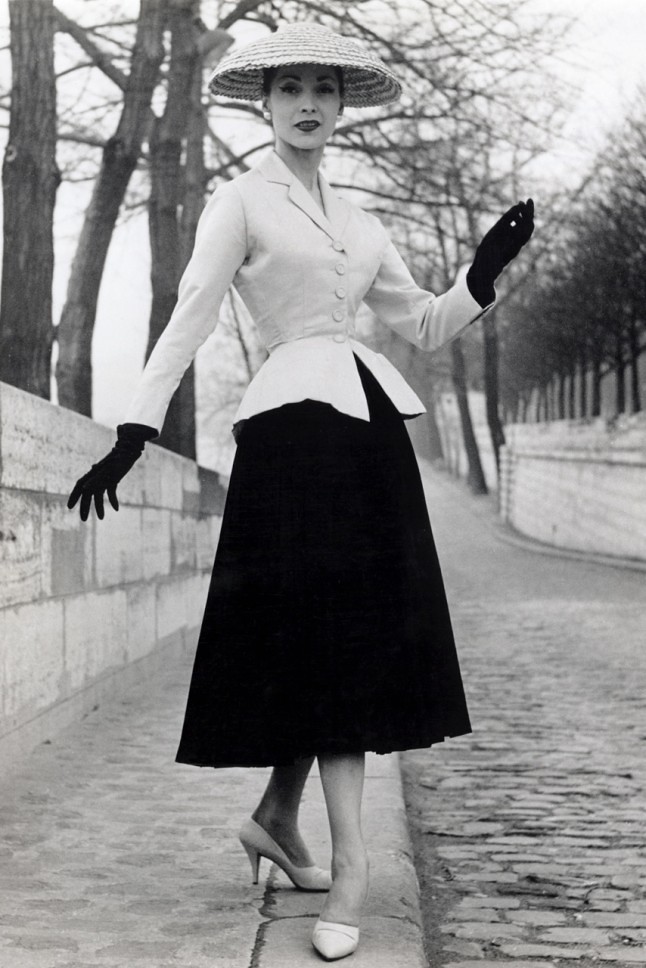
Christian Dior is synonymous with the full skirted, nipped-in-waist fashion revolution launched in 1947 and christened the New Look by American journalist Carmel Snow. At a time when fabric was severely rationed and clothes were plain to the point of austere, his billowing skirts took up to 17 yards of material, required taffeta linings to create their shape and made (in Dior’s words) “flower women” out of the “square-shouldered boxers” uniforms and wartime restrictions had created. Nancy Mitford described the “magic potion” effect of these dresses which were constructed with padding and false hips to give women made thin by rationing the required hourglass shape. Vivien Leigh, Olivia de Havilland and Rita Hayworth were devotees and Dior hosted a private showing of the seminal 1947 collection for the Queen Mother and Princess Margaret. The iconic dress he designed for the Princess’s 21st birthday is part of the current exhibition.

 Carmel evening gown, Andrew Stawarz, Flikr
Dior saw himself as a magician, one of the guardians who would return “French couture … to its traditions of great luxury.” His ethereal creations, in the words of his biographer Marie France Pochna, “brought dreams, drapes and romance back…onto the streets.” The New Look, however, was not universally applauded. One of the criticisms of the current exhibition is that, to quote Rachel Cooke’s Guardian review, “it exists in a bubble”, without context. There were protests in America against styles which were seen as a reversal of the freedoms women had won during the war, under the slogan (coined by the Little-Below-The-Knee Group) “We abhor dresses to the floor!” Closer to home, a 1948 photo shoot in Montmartre’s Rue Lepic led to a model’s dress being torn off by a shortage-hampered public furious at the excess. In Britain, Alison Settle, the editor of British Vogue, was forbidden to even mention Dior by a Board of Trade fearing a run on the country’s restricted fabric supplies. None of this features in the exhibition. Neither does the wider context from which Dior emerged: the fashion industry of occupied Paris.

 Hitler in Paris
An appearance of serenity is a quote from Lucien Lelong, one of pre-war Paris’s leading couturiers, Dior’s mentor (he worked for Lelong from 1941-46) and the man credited for saving the French fashion industry during the German occupation. As with all aspects of the occupation, the story of the fashion industry’s survival is a complex one. The history of WW2 is littered with ruined cities: in May 1940 with the Wehrmacht closing in, Paris could have expected to become the next Warsaw or Rotterdam. Hitler, however, viewed Paris as the model for the Berlin he planned to build. Protecting its culture heritage, albeit stamped with a German ideology, would show the world the National Socialists’ civilised face, and a key part of this culture was the fashion industry.

Germany’s desire to supplant France as the world’s fashion leaders pre-dated WWI. The fall of France in 1940 was seen as the perfect opportunity for this ambition to be finally made good: the first edition of Die Mode, published in January 1941, stated that “the German victory over France has an incisive meaning for fashion.” Other articles continued this theme: the trade publication Manufaktur was quite clear that “the fashion of the past was Paris – the fashion of the future lies with Greater Germany.” The Nazis’ plan, to be put into immediate operation in 1940, was to merge the French couture industry into the German one by physically relocating its ateliers and workers to Berlin and Vienna. Lucien Lelong, in his role as head of the Chambre Syndicale de la Haute Couture (the industry’s official body) was informed of both this and its alternative: the total suppression of the industry. Lelong, argued, and kept arguing, that the industry’s 20,000 workers and fragmented supply chain could not be uprooted and transported and survive. For whatever reason – whether (as he claimed) it was Lelong’s persuasive skills or the pressures of the Battle of Britain and the opening Russian Front – the Nazis dropped their demands and the French fashion industry was left to be just that.

 Dior's New Look Paris 1947
Haute Couture survived in Paris, albeit with mixed fortunes. Lelong continued to show collections as did Jacques Fath, Marcel Rochas and Nina Ricci. Coco Chanel became a supporter of the Vichy. Other designers, including Mainbocher, left. By 1944, 12,000 people still worked in the industry and over 60 salons remained open. The question of collaboration remains a thorny and nuanced one. Lelong remained vocal in his view of fashion’s importance in giving “France an appearance of serenity…the more elegant French women are…the more our country will show…it does not fear the future.” Schiaperelli likened fashion to resistance: every hat that used up material was “a slap in the face of the Nazis.” Berlin appeared to view occupied Paris as a fashion bread-basket: over 200 Nazi wives acquired special permission cards to buy fashion from its salons. Lelong was tried for collaboration at the end of the war but acquitted, ruled to have only co-operated minimally to save jobs and France’s cultural heritage. He stayed in Paris long enough to celebrate his protégé Dior’s 1947 collection but then retired due to ill health.

It is not surprising that Dior, the dreamer and magician, would launch a collection with such a romantic view of the world; it is not surprising a glamour-deprived world, largely, fell in love with it. It is the V&A’s choice to stage an exhibition where context is outside the remit. But it’s a shame. Fashion doesn’t exist in a bubble: from dandies to punks it reflects the world it comes out of and its story runs deeper than simply paying homage, no matter how beautiful the dresses might be. For anyone wanting to read wider than the skirts, can I recommend Nazi Chic by Irene Guenther which tells the story of both Germany and Paris and makes fascinating reading.

Sunday, 19 February 2017

A Lesser-Known Blitz by Katherine Webb


In May last year a friend of mine, and several hundred of her neighbours, were evacuated from their homes in the northern streets of Bath. The reason: the discovery of a five-hundred pound unexploded bomb beneath the playground of a school on Lansdown Road, leftover from World War II. A three-hundred metre exclusion was put in place at once, as the bomb disposal team sought to disable it. Eventually, they managed to move it safely to the Torr Works quarry, where it was blown up, 74 years after it had been dropped.

So, people who live near Bath certainly know that the city was bombed in the war, and I'd known it for some time - it was bombed as part of the Baedeker raids, so called, after the famous travel guides, because the targets were chosen for their cultural importance and beauty, rather than because of any military or strategic significance. Lately, I've been researching the Bath Blitz in more detail, for my next book, and it turns out I'd had no idea of the scale of the bombing.

Bomb-damaged Georgian houses in Bath

Across two weekend nights, from the 25th to the 27th of April, 1942, one hundred and fifty or so German bombers flew over Bath in three bombing raids, two the first night and one the second night. Hundreds of high explosives of various sizes, and incendiaries designed to start devastating fires, were dropped; the exact number will never be known - it is known that many fell into the River Avon, and were swallowed by the mud. One has to assume that they're still down there... The Baedeker Raids, which included attacks on Canterbury, Norwich, York and Exeter, were in revenge for RAF attacks on Rostock, the location of important German factories and shipyards. As well as dropping bombs and incendiaries, some planes dive-bombed to as low as fifty feet, and raked the streets with machine gun fire. The damage can still be seen today - notably in the walls of the old labour exchange on James Street:

Bullet and shrapnel damage in the walls of the old labour exchange

The idea of setting a book in the Bath blitz has been niggling the back of my mind for a long time, and as luck would have it I stumbled across this pamphlet a few years ago, at an antiquarian book fair in Bath:


Produced by the Bath & Wilts Chronicle and Herald later on in 1942, this booklet gives a great overview of the raids, and their effect on the city. It's also a wonderful snapshot of the language and attitude of the press at the time:

'Dr Goebbels may now weep his slimy crocodile tears over "the destruction of historical and art treasures in Luebeck, Bath and Canterbury... Did not Goebbels once boast, "When I hear the word culture, I push back the catch of my revolver"? 

The author, Mr Claude Wimhurst, goes on to describe the grit and spirit of the city, and, in a fine example of stiff upper lip, to declare that the purpose of the booklet is not to 'harrow feelings',  but to 'steel the hearts' of those fighting the good fight, and to serve as a warning to future generations of the horrors and modern warfare. A timely reminder, likely to be ignored, in these days of turbulent global politics. Nevertheless, the history of the raids is harrowing. Of course it is. Four hundred people lost their lives, over a thousand more were injured, and many thousands lost their homes. And whilst this is small number compared to the 32,000 or so souls who lost their lives in London, the human stories that come from those two terrible nights in Bath are every bit as heart-breaking.

Some of the dead from the first night's attacks were laid out in a temporary mortuary in the crypt of St James's church, only for the church to be hit itself on the second night, and badly burnt. In putting out the flames, the fire service inadvertently destroyed all the identification papers on the dead bodies, so that nobody knew who they were, and many had to be interred anonymously. On May 1st, 247 people were laid to rest in a mass grave.

Bath Blitz victims are laid to rest on May 1st, 1942

There are devastating personal histories, described in the Bath Chronicle booklet and in the statistics listed on the excellent Bath Blitz memorial website, bathblitz.org. At no. 3, Howells Court, William and Beatrice Rattray were killed along with their seven children: Christine, 7; Donald, 5; George, 13; Joan, 8; Pamela, 10; Shirley, 2; and William, aged 10. What an unimaginable scene. Sergeant Clifford Ford, a serving soldier, returned on leave to find that his wife, Emily, and their six children had all perished at no. 7, New King Street. A baby girl was found in the wreckage of one house, and taken to Bristol Infirmary, where she died. Of her, the Chronicle records:

'Who she was no one knows. All that can be said about this unknown child victim is contained in the following terse official description which has been preserved: "Age, about two years; hair, fair; eyes, blue-grey; division between top row of teeth; no other distinguishing features." '

One can only assume that whoever was looking after the little girl that night was also killed, and never identified. What a sad end to a tragically short life.

It's easy to spot the gaps in Bath's architecture where Georgian splendour gives way to some 1960s built block of flats or carpark. Often, buildings were not rebuilt until much later, and there is still a ruddy great bomb crater in the lawned centre of The Circus. The famous Assembly Rooms, which had been visited and written about by Jane Austen and Charles Dickens, were badly damaged by an incendiary. They had only re-opened in 1938 after a £50,000 program of refurbishment, and the Chronicle laments that they probably can't or won't be rebuilt again. They were, however, and are now back to their original glory:

The tea room in Bath Assembly Rooms today

The same room shortly after the blitz

Other buildings were beyond saving. One of the oldest mansions in Bath, the Abbey Church House in Sion Hill, was destroyed. Mainly Tudor, the building had foundations dating back to 1138, when a leper hospital stood on the site. Another medieval leper hospital, attached to the Mary Magdalene Chapel on Holloway, was also damaged. Today, it's easy to see, on a walking tour of the city, where the gap left by a bombed-out building has been filled with something more recent - with varying degrees of architectural grace. It's as fascinating to me as peering behind the Georgian facades and finding the medieval, Tudor and Stuart origins of many of Bath's buildings.

King George VI and Queen Elizabeth came to visit, and stood high on Beechen Cliff, in the south of the city, to have a virtual birds' eye view of the damage that had been done. There are familiar stories of making do, of mucking in and not being dismayed. I have always wondered how far that was genuinely the case, or how far merely a statement of intent perpetuated by the media. It must have been utterly terrifying, and the effects of that terror long-reaching in the hearts and minds of the survivors. But the city did mend itself. On April 25th, 2008, Willi Schludecker, then aged 87, came to Bath to lay a wreath during the annual memorial service to the Bath raids. Willi, who died in 2010, was one of the German pilots who'd flown on the raids.


Willi Schludecker, who flew more than 120 sorties for the Luftwaffe during WWII, in Bath in 2008

Sunday, 22 January 2017

Hedda Hopper and Louella Parsons: Hollywood's Killer Queens by Catherine Hokin

Christmas may be over but for movie buffs, fashion lovers and celebrity spotters, the tinsel is still well and truly sparkling. The Golden Globes, the BAFTAs, the Oscars: awards season is upon us. Actresses badly in need of pies are praying their chosen designer doesn't suddenly decide to go 'edgy' (aka mad, see poor Sophie Turner at the Globes); everyone's 'of course I'm happy I lost' smile clashing beautifully with their crazed eyes and reporters stalking their victims for that one illicit look or drunken mishap which will write their mortgage off.

It may not be one of our more attractive traits but human beings love gossip. The word itself was first used in a tattling context by Chaucer when the Wife of Bath refers to a 'gossib dame' and the National Archives provide a rich source of libel cases such as Ellen Bowden's in 1574 when she took Ann Venables to court for calling her a "whore, arrant whore, wedded mans whore and William Colsolls whore" and won 8 shillings for her pains. We gossip and we write it down. Pity the poor Mesopotamian mayor only now remembered because his affair with a married woman in 1500 BC coincided with the time and place of the development of Cuneiform, one of the world's earliest writing systems.

 Scandal Sheets at Mrs Humphrey's Print Shop
Scandal sheets as a source of gossip came into their own in London in the eighteenth century. They were poured over in coffee houses and tea shops by men and women alike who thrilled to snippets about the fabulously named Madame Slendersense and her French dancing master, "Mrs. Manlove, who generally searches into the bottom of such an affair, solemnly protests she saw them go up one pair of stairs together. What they did there, she can't tell, but the lady has been ailing ever since" (The Female Tatler) and comments on fashion as bitchy as anything Joan Rivers used to litter the Oscars' red carpet with, "Mrs. Tawny alias Tawdry, is desired not to be so fantastically whimsical in her dress...nothing is more disagreeable and ridiculous than to see a woman of her years affect the gay, youthful airs of their daughters."

Once the floodgate was opened, there was no stopping it. The circulation battle in the USA between publishers William Randolph Hearst and Joseph Pulitzer was an excuse to see who could print the most scandalous news items. Penny papers in the nineteenth century thrived on lurid gossip and the author Roger Wilkes, in his book Scandal, credits the 1886 divorce case of Lady Colin Campbell with inflaming public demand for society scandals and giving birth to the first newspaper gossip column. Society tittle-tattle is one thing but it was the birth of the film industry that really saw the explosion in the demand for the 'celebrity' gossip machine and created some of its biggest monsters.

 Hedda Hopper & Louella Parsons, Vanity Fair
Wielding a cleverly catty pen is an art. Historian Gary Wills has identified some of our best known classical authors as also being the earliest gossip columnists, including Catullus for this snappy epigram on the subject of an invitation from Julius Caesar: “Join your party?/I might, mighty Czar,/Could I remember/quite who you are.” Step forward a couple of centuries and the pen was being wielded by two of the most dangerous star-makers and star-breakers Hollywood would ever see: Hedda Hopper and Louella Parsons.

It was fan magazines that helped create the idea of "movie stars". Motion Picture Story Magazine was launched in 1911 during the era of silent films and the appetite was insatiable: this magazine was the first of what would become nearly 300 titles in the genre. At the height of their power in the 1940s, Hopper and Parsons' rival columns had a combined readership of 75 million people (half the population of the USA) and the industry was just as much in thrall to them, if not more so, than the public, as Bob Hope said: “Their columns were the first thing we looked at every morning to see what was going on.” Both women had a long association with Hollywood and powerful connections which they exploited ruthlessly, against the stars and each other. Hopper began as a bit-part actress. She appeared in around 120 films, hit hard times (probably because she refused to entertain LB Mayer on his casting coach) but retained enough industry friends to eventually be hired by MGM as a journalist to offset the power of Parsons, her one time friend. Parsons, by contrast, was a journalist from the start whose career went stellar after she forged a friendship with publisher William Randolph Hearst's film actress mistress Marion Davies.

 Time satirising Hopper's trademark hats
Both women were highly skilled at blurring both their own pasts (editing their marriages and their birth dates) and their colourful lives. When it came to their quarry, however, nothing was off limits. Louella’s columns were sprinkled with racist terms such as“swarthy Mexicans” and she once cited Mussolini as her favourite hero. Hedda was viciously vocal about racial intermixing, hated and hunted Communists (she led the attack that drove Chaplin out of the States and destroyed Donald Trumbo) and had no mercy for anyone who gave a story to Parsons rather than her. Louella had informants everywhere, from studios to hairdressers’ salons and doctors’ offices. When Louella received a tip that Clark Gable and his second wife, Ria, were going to divorce, she“kidnapped” Mrs. Gable and held her hostage at her home until she was sure the story was hers first. Hopper ruined Ingrid Bergman's career after she had an affair with Roberto Rossellini and became pregnant - not because of the affair but because she gave the story to Louella. Hopper's attacks on Marilyn Monroe were so vicious, fans wrote letters after Monroe's death blaming Hopper for the suicide - apparently she didn't give a damn about that or about the skunk Joan Bennett sent her as a Valentine's gift. When she was asked by actress Merle Oberon “What inspired all the vicious things you’ve been writing about me?”, her response was simple and really rather chilling: “Bitchery, dear. Sheer bitchery.”

The end of the studio system in the 1950s, the spread of television and the rise of tabloid magazines such as Confidential which was notorious for making up stories with no basis in fact at all (I'm resisting all references to Trump here) changed the relationships between Hollywood, its stars and the public. Parsons and Hopper faded away and, while gossip and some of its perpetrators seem to find continuously new lows in this 24/7 internet world, no other individual writers since have held such long-lasting and dangerous power over other people's lives. I can highly recommend the film Trumbo if anyone wants to know more, Helen Mirren's portrayal of Hopper captures her awfulness to perfection. The Golden Age of Hollywood, or so this period is so often called: proof that layers of gilt and polish and pretence can't hide the poison under the surface. Avoiding a Trump reference really was too much to hope for.