Perhaps you don't tend to think of Arthur as a voyager? Let me explain.
Some of the earliest mentions of Arthur come from
ninth or tenth century Welsh literature
– just glancing references, as if to someone already well-known. The
earliest of all seems to be a couple of lines from the poem Y Gododdin, in
which another warrior is compared with Arthur:
He fed black ravens on the ramparts of a fortress,
Though he was no Arthur.
This makes sense if the historical Arthur really was a fourth or fifth
century British war leader fighting the Saxon invaders, his name perhaps
a nickname or pseudonym: ‘the Bear’, suitable for a fighter who may
have wished to maintain an air of terrifying mystery. Whoever the
historical Arthur may have been, his name soon became associated with
all kinds of older legends connected with supernatural figures from
Celtic mythology, and such stories continued to be told about him in all
parts of Celtic – that is British – Britain, and in Brittany, the
region of France to which many British Celts migrated after the fall of
Roman Britain.
Even in Sir Thomas Malory’s late 15th century ‘Le Morte D’Arthur’ with
its many courtly French additions and sources, plenty of Welsh and
Celtic personages and motifs remain: the most obvious is Merlin himself,
along with the Lady of the Lake who gives Arthur his sword Excalibur: and then
there's Arthur’s shadowy relationship with his half-sisters, Morgause
the mother of their son Mordred, and Morgan le Fay – Morgan the
enchantress, whose name chimes with that of the Morrigan (‘great queen’
or ‘phantom queen’), the Irish Celtic goddess of battle and fertility.
At any rate, Morgan is one of the queens who carry the wounded king away
to the Isle of Avalon after the battle of Camlann.
And when they were at the water side, even fast by the bank hoved a
little barge with many fair ladies in it, and among them all was a
queen, and all they had black hoods, and all they wept and shrieked when
they saw King Arthur.
…‘Comfort thyself,’ said the king, ‘…for in me is no trust for to
trust in, for I will into the vale of Avilion to heal me of my grievous
wound, and if thou hear never more of me, pray for my soul.’
But ever the queen and ladies shrieked, that it was pity to hear.
The keening women, companions of a powerful sorceress, the
ship that carries the heroic king away to the island of the dead, the
island of apples – it all seems familiar, doesn’t it? It recalls stories from classical mythology: the golden apples of the Hesperides, and Jason's voyage to the land of the Golden Fleece and his
meeting with Medea,
Circe’s niece, a priestess of Hecate - who was the goddess of childbirth, death and
necromancy, doorways and crossroads, magic, torches and dogs. Medea is an often ruthless figure of great power, who
near the end of the Argonautika calls on the spirits of death, the
hounds of Hades, to slay the bronze giant Talos. In other versions of
her legend, she is the owner of a magical cauldron which can restore
life to the dead. Jason's voyage, too, is clearly an Otherworld journey.
And it happens that there is an early, and highly cryptic, account of a
voyage by Arthur to the Underworld. It’s the marvellous Welsh poem
Prieddeu Annwfn,
preserved in the single 14th century manuscript of The Book of
Taliesin, but dated (cautiously) by internal linguistic evidence to
around 900 AD.
Here’s a link to the poem, with notes. It's an account of a raid led by Arthur, in his ship Prydwen, on Annwn, the Welsh underworld. But why? What was he going there for? What prize did he hope to bring back?
In the poem Annwn is described by a number of different epithets. No one has a clue
if these are simply varying descriptions/manifestations of the same
place, or intended for different locations which Arthur and his men
encounter along their way. It may not matter much, but
the latter would fit in well with the island-hopping itinerary of Greek and Celtic heroes in
ships - Jason, Ulysses, Maelduin, even Saint Brendan - gradually approaching their Otherworld destination through a transformed and
numinous sea-scape.
The
Prieddeu Annwfn tells how Arthur and his men travel to
Caer Sidi, ‘The Mound Fortress’;
Caer Pedryuan, ‘the Four-Peaked Fortress’ – also described as
Ynis Pybyrdor, ‘isle of the strong door’. They travel to
Caer Vedwit, ‘the Fortress of Mead-Drunkenness’,
Caer Rigor, ‘Fortress of Hardness’,
Caer Wydyr, ‘Glass Fortress’,
Caer Golud, ‘Fortress in the Bowels [of the Earth?]’,
Caer Vandwy, ‘Fortress of God’s Peak’, and
Caer Ochren, ‘Enclosed Fortress’.
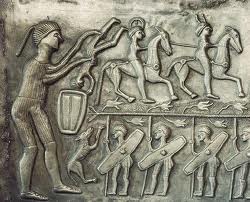
The aim of the expedition was to bring back a cauldron from the lord of
Annwn. We're not thinking blackened kitchen pots here: we're thinking
inspirational, magical, perhaps sacred items like the 1st century BC
Gundestrop cauldron,
above. One of the many scenes on its sides depicts a pony-tailed
warrior dipping a man into another such cauldron headfirst, probably to
restore him to life:
In my personal favourite among Alan Garner's children's books, 'Elidor', the children bring four treasures out of the
Mound of Vandwy. corresponding to the
Four Treasures of the Tuatha de Danaan:
a spear, a sword, a stone and a bowl: 'a cauldron, with pearls above
the rim. And as she walked, light splashed and ran through her fingers
like water'. Taken into the workaday world of 1960's Manchester, the objects change appearance, and Helen finds she is carrying
only 'an old cracked cup, with a beaded pattern moulded on the rim.'
Once these treasures have been buried in the garden for safekeeping,
however, all kinds of strange disturbances begin to occur, culminating
in the eruption of the unicorn Findhorn onto the city streets.
Here’s the second stanza of the
Prieddeu Annwfn:
I am honoured in praise. Song was heard
In the Four-Peaked Fortress, four times revolving.
My poetry, from the cauldron it was uttered.
By the breath of nine maidens it was kindled.
The cauldron of the chief of Annwfn: what its fashion?
A dark ridge around its border, and pearls.
It does not boil the food of a coward...
And before the door of hell lamps burned.
And when we went with Arthur in his splendid labour,
Except seven, none rose up from Caer Vedwit.
Most of the poem's eight stanzas end with a variation on the recurrent line:
‘Except seven, none returned’: by ordinary standards the expedition
appears to have been disastrous, but this is no ordinary poem. Fateful
and gloomy, mysterious as Arthur himself, all we can gather from it is
some sense of a venture, by ship, by sea, into the Otherworld, and -
perhaps – a description of a mound or island where a youth, Gweir, is
imprisoned, lapped with a heavy blue-grey chain. Of a four-peaked
fortress with a strong door, guarding a cauldron full of the magical
life-giving mead of poetry, warmed by the breath of ‘nine maidens’.
In the medieval story of Culhwch and Olwen in the Mabinogion, Arthur
sails to Ireland in his ship Prydwen to steal the cauldron of Diwwnach
Wyddel: not just any old cauldron either, for it’s also listed in ‘The
Thirteen Treasures of the Island of Britain’ as the cauldron of Dyrnwich
the Giant, which will not boil the food of a coward. Clearly the same
cauldron as that which Arthur went to find in Annwn, and doubtless the
same also as the Irish Cauldron of the
Dagda, from which 'no man ever went away unsatisfied'. Lastly, also in the Mabinogion, the
Welsh hero Bran is the keeper of yet another magical cauldron which
restores the dead to life. And he too is the hero of a mystical voyage.
It seems as though the courtly queens who carry the medieval Arthur away to the Island of Apples are latest in a long line of goddesses who like Hecate presided over the doorways into death, and who could restore the dead to life. How old is this legend of magical, life-giving cauldrons? As old as
Medea's? Older? Is hers the ultimate origin of the witches' cauldron that we
find in 'Macbeth'?