
Showing posts with label Mabinogion. Show all posts

Thursday, 18 December 2014

King Arthur the Voyager - by Katherine Langrish


Perhaps you don't tend to think of Arthur as a voyager? Let me explain.

Some of the earliest mentions of Arthur come from ninth or tenth century Welsh literature – just glancing references, as if to someone already well-known. The earliest of all seems to be a couple of lines from the poem Y Gododdin, in which another warrior is compared with Arthur:

He fed black ravens on the ramparts of a fortress,
Though he was no Arthur.

This makes sense if the historical Arthur really was a fourth or fifth century British war leader fighting the Saxon invaders, his name perhaps a nickname or pseudonym: ‘the Bear’, suitable for a fighter who may have wished to maintain an air of terrifying mystery. Whoever the historical Arthur may have been, his name soon became associated with all kinds of older legends connected with supernatural figures from Celtic mythology, and such stories continued to be told about him in all parts of Celtic – that is British – Britain, and in Brittany, the region of France to which many British Celts migrated after the fall of Roman Britain.

Even in Sir Thomas Malory’s late 15th century ‘Le Morte D’Arthur’ with its many courtly French additions and sources, plenty of Welsh and Celtic personages and motifs remain: the most obvious is Merlin himself, along with the Lady of the Lake who gives Arthur his sword Excalibur: and then there's Arthur’s shadowy relationship with his half-sisters, Morgause the mother of their son Mordred, and Morgan le Fay – Morgan the enchantress, whose name chimes with that of the Morrigan (‘great queen’ or ‘phantom queen’), the Irish Celtic goddess of battle and fertility. At any rate, Morgan is one of the queens who carry the wounded king away to the Isle of Avalon after the battle of Camlann.


And when they were at the water side, even fast by the bank hoved a little barge with many fair ladies in it, and among them all was a queen, and all they had black hoods, and all they wept and shrieked when they saw King Arthur.


…‘Comfort thyself,’ said the king, ‘…for in me is no trust for to trust in, for I will into the vale of Avilion to heal me of my grievous wound, and if thou hear never more of me, pray for my soul.’

But ever the queen and ladies shrieked, that it was pity to hear.

The keening women, companions of a powerful sorceress, the ship that carries the heroic king away to the island of the dead, the island of apples – it all seems familiar, doesn’t it?  It recalls stories from classical mythology: the golden apples of the Hesperides, and Jason's voyage to the land of the Golden Fleece and his meeting with Medea, Circe’s niece, a priestess of Hecate - who was the goddess of childbirth, death and necromancy, doorways and crossroads, magic, torches and dogs. Medea is an often ruthless figure of great power, who near the end of the Argonautika calls on the spirits of death, the hounds of Hades, to slay the bronze giant Talos. In other versions of her legend, she is the owner of a magical cauldron which can restore life to the dead. Jason's voyage, too, is clearly an Otherworld journey.

And it happens that there is an early, and highly cryptic, account of a voyage by Arthur to the Underworld. It’s the marvellous Welsh poem Prieddeu Annwfn, preserved in the single 14th century manuscript of The Book of Taliesin, but dated (cautiously) by internal linguistic evidence to around 900 AD. Here’s a link to the poem, with notes. It's an account of a raid led by Arthur, in his ship Prydwen, on Annwn, the Welsh underworld. But why?  What was he going there for? What prize did he hope to bring back?

In the poem Annwn is described by a number of different epithets. No one has a clue if these are simply varying descriptions/manifestations of the same place, or intended for different locations which Arthur and his men encounter along their way. It may not matter much, but the latter would fit in well with the island-hopping itinerary of Greek and Celtic heroes in ships - Jason, Ulysses,  Maelduin, even Saint Brendan - gradually approaching their Otherworld destination through a transformed and numinous sea-scape.

The Prieddeu Annwfn tells how Arthur and his men travel to Caer Sidi, ‘The Mound Fortress’; Caer Pedryuan, ‘the Four-Peaked Fortress’ – also described as Ynis Pybyrdor, ‘isle of the strong door’. They travel to Caer Vedwit, ‘the Fortress of Mead-Drunkenness’, Caer Rigor, ‘Fortress of Hardness’, Caer Wydyr, ‘Glass Fortress’, Caer Golud, ‘Fortress in the Bowels [of the Earth?]’, Caer Vandwy, ‘Fortress of God’s Peak’, and Caer Ochren, ‘Enclosed Fortress’. 

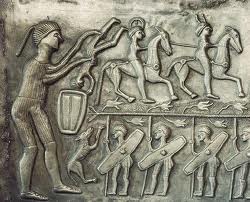
The aim of the expedition was to bring back a cauldron from the lord of Annwn.  We're not thinking blackened kitchen pots here: we're thinking inspirational, magical, perhaps sacred items like the 1st century BC Gundestrop cauldron, above.  One of the many scenes on its sides depicts a pony-tailed warrior dipping a man into another such cauldron headfirst, probably to restore him to life:


In my personal favourite among Alan Garner's children's books, 'Elidor', the children bring four treasures out of the Mound of Vandwy. corresponding to the Four Treasures of the Tuatha de Danaan:  a spear, a sword, a stone and a bowl: 'a cauldron, with pearls above the rim.  And as she walked, light splashed and ran through her fingers like water'. Taken into the workaday world of 1960's Manchester, the objects change appearance, and Helen finds she is carrying only 'an old cracked cup, with a beaded pattern moulded on the rim.' Once these treasures have been buried in the garden for safekeeping, however, all kinds of strange disturbances begin to occur, culminating in the eruption of the unicorn Findhorn onto the city streets.


Here’s the second stanza of the Prieddeu Annwfn:

I am honoured in praise. Song was heard
In the Four-Peaked Fortress, four times revolving.
My poetry, from the cauldron it was uttered.
By the breath of nine maidens it was kindled.
The cauldron of the chief of Annwfn: what its fashion?
A dark ridge around its border, and pearls.
It does not boil the food of a coward...

And before the door of hell lamps burned.
And when we went with Arthur in his splendid labour,
Except seven, none rose up from Caer Vedwit.

Most of the poem's eight stanzas end with a variation on the recurrent line: ‘Except seven, none returned’: by ordinary standards the expedition appears to have been disastrous, but this is no ordinary poem. Fateful and gloomy, mysterious as Arthur himself, all we can gather from it is some sense of a venture, by ship, by sea, into the Otherworld, and - perhaps – a description of a mound or island where a youth, Gweir, is imprisoned, lapped with a heavy blue-grey chain. Of a four-peaked fortress with a strong door, guarding a cauldron full of the magical life-giving mead of poetry, warmed by the breath of ‘nine maidens’.

In the medieval story of Culhwch and Olwen in the Mabinogion, Arthur sails to Ireland in his ship Prydwen to steal the cauldron of Diwwnach Wyddel: not just any old cauldron either, for it’s also listed in ‘The Thirteen Treasures of the Island of Britain’ as the cauldron of Dyrnwich the Giant, which will not boil the food of a coward. Clearly the same cauldron as that which Arthur went to find in Annwn, and doubtless the same also as the Irish Cauldron of the Dagda, from which 'no man ever went away unsatisfied'.  Lastly, also in the Mabinogion, the Welsh hero Bran is the keeper of yet another magical cauldron which restores the dead to life. And he too is the hero of a mystical voyage.

It seems as though the courtly queens who carry the medieval Arthur away to the Island of Apples are latest in a long line of goddesses who like Hecate presided over the doorways into death, and who could restore the dead to life. How old is this legend of magical, life-giving cauldrons?  As old as Medea's?  Older? Is hers the ultimate origin of the witches' cauldron that we find in 'Macbeth'? 


Sunday, 6 October 2013

Quests for the Holy Grail... can they ever succeed? – Katherine Roberts


One of my characters, Rhianna Pendragon, has just finished a Grail Quest. Her quest has been a long one, taking place over four books and coming to a conclusion in the final title “Grail of Stars”. Although this series is aimed at younger readers, writing these books has taken me to some surprisingly grown-up places. Let me take you on my quest.

First of all, it helps to know what you’re looking for!

So what exactly is a ‘Grail’?
The Grail by Arthur Rackham

Many people think first of a cup or chalice. This arises from the Biblical story of the cup used by Christ at the Last Supper to offer his disciples wine. “This is my blood,” he tells them. “Drink in remembrance of me”. Later, so the story goes, Joseph of Arimathea used the Grail to catch Christ’s (real) blood as it dripped from his crucified body. Hence the name 'Holy' Grail.

Cauldron of Inspiration, warmed by the breath of nine maidens

In Celtic tradition, the Grail is a magical bowl or cauldron. Sometimes called the Cauldron of Annwn, the Cauldron of Inspiration, or the Cauldron of Rebirth, it appears in the Mabinogion and may be used to bring the dead back to life.

Roman goddess with cornucopia

A grail might also be a platter or plate, a cornucopia (or horn of plenty) magically overflowing with food, a book full of knowledge, or even a magic stone.

Obviously, there is more than one aspect of the Grail, and I think it can actually take any shape you wish, appropriate for your own quest. At the start of her quest, Rhianna does not know exactly what her Grail looks like, although she has a vision of a dead knight on a ship holding something "too bright to look at" in his hands.

Next, we need to know where our Grail is hiding.

If you continue with the story of Joseph of Arimathea, he hid out in a tomb where Christ's blood sustained him, then carried the cup to Britain and settled at Glastonbury, which at the time was a Roman outpost. The Grail found its way into Corbenic Castle, where it was kept under guard by maidens and a maimed (or wounded) king, sometimes called the Fisher King. Gradually, over the centuries, the location of this magical castle was forgotten, until it turns up again in Arthurian legend, when a vision of the Grail appears to the Knights of the Round Table floating on a beam of light, inspiring them to ride out in search of it.

A vision of the Grail appears at the Round Table

Another story claims the Knights Templar took the Holy Grail from Jerusalem during the Crusades and kept it in a secret location until their order fell from grace, when the Grail (together with the fabled Templar treasure) was lost from history and passed into legend.

The pagan Cauldron, on the other hand, has always belonged in the Celtic otherworld of Annwn, where those seeking its magic need to travel beyond the earthly realm to find it.

Since my series is set in the Dark Ages shortly after the Romans left Britain, I decided Rhianna and her friends must sail through the enchanted mists to look for their Grail - echoing the Celtic tales.

Who quested after the Grail?


In Taliesin’s story Spoils of the Otherworld, King Arthur and his warriors sail to the Celtic otherworld in search of the Cauldron of Annwn. They find it on an island in a castle of glass, where it is guarded by nine maidens. But in the end they have to abandon their mission, because the castle’s magical defences prove too dangerous. Only seven men return home.

How Sir Galahad, Sir Bors and Sir Percival were fed with the Sanc Grael
In later Arthurian legends, Sir Percival makes it into the Fisher King’s castle, but fails to ask the right question and leaves empty-handed. Sir Lancelot reaches the castle too, but finds the gates barred to him because of his adulterous love for Arthur’s queen Guinevere. Sir Bors gets into the castle, but does not try for the Grail. Only young Sir Galahad, the most pure-hearted of all the knights, is allowed to gaze upon the Grail - but instead of taking it back to Camleot for his king, he ascends, fulfilled, to Heaven.

Indiana Jones finds the Grail in the Last Crusade, guarded by an ancient knight in a cave protected by lethal traps.  Here, he is presented with a choice of vessels ranging from beautiful jewelled goblets to plain wooden cups. He chooses the right cup and uses it to heal his dying father of a mortal wound – only to lose his Grail again when his enemies seize it from him and try to take it across the seal into the world of men.

Dan Brown’s The Da Vinci Code takes a different approach to the Grail, based on the text Holy Blood Holy Grail, where the Grail is actually the bloodline of Christ, surviving to the modern day in the form of the hero’s female companion. Following the Knights Templar trail, his characters chase clues across the world, ending up at the Rosslyn Chapel in Scotland, and giving Scottish tourism a welcome boost along the way.

Monty Python also sent King Arthur and his knights in search of the Grail, taking a comic approach to the legends that sees his brave knights using coconut shells instead of horses and fighting killer rabbits - great fun!

There are countless other books and films containing quests for Grails of all shapes and sizes, and now young readers have Rhianna Pendragon's quest for the Grail of Stars.

Rhianna needs the Grail to wake her father King Arthur from his death-sleep in enchanted Avalon and restore him to the throne of Camelot. In the normal course of events, she would succeed in her quest and the series would have its happy ending. But  - as a sharp-eyed librarian pointed out at an early event for the first book “Sword of Light” - we already know her quest fails, because so far Arthur has not returned.

Cue time-twisting plot to get out of a sticky corner? Well, no… Arthur might not have returned from Avalon to save us all yet, but that doesn’t necessarily mean Rhianna fails to find the Grail, because something else could easily happen after she wakes the king to prevent him from returning to Camelot. I decided it would be too much of a let down if she didn't find the Grail at all, so on the cover of book 4 you’ll see Lady Nimue (the mermaid) handing Rhianna something rather Grail-like… but from the Grail Quests mentioned above, we already know that finding the physical object is no guarantee of success! The quest for the Grail has always been a spiritual one. In the end I decided the only way to write a true Grail Quest would be to allow Rhianna herself to tell me the outcome... which brings me to the question Sir Percival failed to ask.

In the legends, this traditional question is “Whom does the Grail serve?” In book 1, the villain Mordred (upon waking terribly injured from his duel with King Arthur) gets this question twisted and asks: “Who commands the Grail?” This is clearly the wrong question, since four books later Mordred loses his quest for the throne of Camelot because of his thirst for power.

Rhianna’s question is different. Lady Nimue asks her “What does the Grail contain?” At first Rhianna (like me when I began writing the series) doesn't know - her first impulse is to answer "stars" but the song she has learned from Merlin says "the Grail said to hold all the stars in Heaven" so she changes her mind. Only towards the end of the final book does she realise what her Grail really contains, and that led me to a natural conclusion for the series.

As an author, I often feel I'm on a quest as I write a book. I suppose my Grail – my ultimate quest – would be the perfect book, which contains all the energy I meant it to contain when I began writing, which makes my readers laugh and cry in all the right places, which is enjoyed by everyone in the world from six-year-olds to great grandmothers, which brings Hollywood knocking at my door, which means I can buy my dream castle and fill the stables with unicorns... oh, but wait! If I wrote that book, the perfect book, then I would never DARE write another word! There could be a good reason Sir Galahad did not take his Grail back to Camelot, and I think the truth is you can never quite find the Grail, at least not in this world.

part of a collage created at a workshop for book trailers
Watch the trailer HERE.

So what does your Grail look like? (And would you really want to find it?)

***

Katherine Roberts writes fantasy for young readers.

Her Pendragon Legacy series for young readers is now complete:
1. SWORD OF LIGHT (hardcover, paperback & ebook KINDLE OFFER 99p)
2. LANCE OF TRUTH (hardcover, paperback & ebook)
3. CROWN OF DREAMS (hardcover, paperback & ebook)
4. GRAIL OF STARS (hardcover only, paperback & ebook publish in February)

More details from www.katherineroberts.co.uk

Saturday, 18 February 2012

Meon Hill - A Valentine's Day Death - Celia Rees


For me, Valentine's Day is not just a time for cards and flowers. I grew up in the West Midlands and every Valentine's Day, the local T.V. (ATV Today, we had it on before Crossroads) had a feature about the gruesome murder of of Charles Walton up on Meon Hill, just outside Stratford-on-Avon. Walton was killed in 1945 but the case was unsolved and had overtones of witchcraft. Enough to fascinate my brother and me (we were both fans of Dennis Wheatley) and to stick in my head.

The details of the murder were, indeed, bizarre. Walton was murdered on 14th February, a significant date in itself, but associated by the old calendar with the Celtic Festival of Imbolc. He was an old man, in his seventies, and out on the hill hedging and ditching. He was a farm labourer, living in a little cottage in the small village of Lower Quinton. When he didn't come back for his dinner, his niece went to look for him. She found him with his throat slashed with his own bill hook which was still embedded in his neck. He was pinned to the bank by a two pronged pitch fork and a large cross had been carved into his chest. It looked very like a ritual murder and Walton had a reputation for witch craft. The only thing that was missing from his body was an old tin watch. He was rumoured to carry a scrying mirror, a piece of mica, in the back of it which he used to overlook people and ill wish them.

Whatever the motives, the locals shut up like clams and eventually the famed Fabian of the Yard was brought in to try and crack the case. He never did, It was his only unsolved murder. It was said that he came back every year to walk the hill, re-visit the site, go for a pint in the pub and remind the villagers that he had not forgotten. He always believed that they knew the perpetrator but held to a code of silence. The village of Lower Quinton, which lies beneath the hill, is a small place, a few farms and a collection of cottages clustered round a green and a pub, the College Arms. It must have been quite isolated back in 1945 and, even now, it often seems eerily deserted. It's rare to see anyone about and it is still impossible to find anyone willing to talk about the case.

On one of Fabian's visits, he encountered a black dog. When he asked a boy if he had seen the beast, the child ran away. Later that day, a black dog was found hanging in a tree. This might just have been an incident of macabre cruelty, perhaps to warn him, but there were long associations with black dogs in the area. Walton himself was known to have encountered a black dog nine times in his youth. After the last occasion, he learnt that his sister had died. These black dogs were not regarded as ordinary hounds, but manifestations of the Barghest and the other black dogs of British Folklore. Meon Hill was said to be hunted over by the Cwn Annwn, the spectral hounds of the Mabinogion; another legend says it was the Yell Hounds, the Devil's Dandy Dogs, following Herne the Hunter, harrying the souls of the unshriven down to hell. Meon Hill itself is rumoured to be the haunt of fairies - and of witches who still gather there. It is a place regarded with superstition, even dread, by some living thereabouts. There are those will not walk on the hill in the daytime, let alone at night.

The stories are many and odd and exert a fascination. I've revisited the place several times in fiction. The first time was with Colour Her Dead, now long out of print. I changed the name of the hill, the village beneath it, the details of the case, but kept the unsolved nature of the crime. What interested me was the missing watch. With so much time elapsing, I began thinking: what if it turned up in a junk shop somewhere - in nearby Stratford, say? Put there by someone clearing somebody's effects with no idea that this is vital clue to an unsolved murder. What could happen then? So are books born. I changed the victim to a child and the watch to a handful of beads found in a junk shop by 17 year old Jude who likes to make her own jewellery. It has been out of print for ages, but I was pretty proud of Colour Her Dead. Very Ruth Rendell, even though I say it myself.

The next time Meon got a mention was in The Fool's Girl. Shakespeare coming home on May Day, after Beltane. I took a bit of poetic licence, but the hill is visible for miles around and he might just have been able to see it from the old road between Stratford and Oxford. He would certainly have known it and its reputation. The hill even appears in my new book, This Is Not Forgiveness, under the guise of Beldon Hill, casting its spell, exerting its powerful natural magic in a whole new way.