Showing posts with label Eleanor Marx. Show all posts

Wednesday, 17 January 2018

ELEANOR MARX by RACHEL HOLMES: Reflections by Penny Dolan


January arrived, bringing time to edge myself back to mid-Victorian London, the time and setting for my long-neglected novel. Looking along the shelves for the right book to nudge my mind along, I spotted one inviting title. The book was ELEANOR MARX, written by RACHEL HOLMES, her biography of Karl Marx’s youngest daughter. Another point in its favour was that I had seen YOUNG MARX at THE BRIDGE theatre, and the play set questions murmuring in my head about the man and his family.


The biography certainly covered the time-span of my “work-in-progress”. Eleanor Marx was born in 1855, but earlier in the 19th Century was there on the pages, looking back at the young lives of both her parents. The book seemed a good “starter” to glance though, so I began on the first chapters . . . and then I kept reading, way past the point of any practical research. 


 Eleanor Marx, as revealed by Rachel Holmes, is a wonderfully compelling character and, furthermore, the sweep of her life reads like the plot of a classic novel. 

Eleanor - or Tussy to rhyme with Pussy - was the daughter who took on Marx’s great legacy and who most inherited his cause and philosophy. Her German parents, Karl Marx and Jenny von Westphalen, had come to London as poor refugees. Marx was in trouble with the authorities in Germany and in France and under suspicion here in England. Times were hard: Marx earned little or nothing from his writing and his family relied on subs from friends, loans from distant relatives and the local pawn-broker to survive life in the London slums. Penniless and hungry, the family flitted between rented rooms, always accompanied by Helen Demuth, their live-in maid-servant. Illness was always a worry and only three of Jenny’s babies survived to full adulthood.

One constant in the household was Marx’s closest friend, Friedrich Engels, the son of an industrialist, whose money kept the small family afloat. Closer than many brothers, these two men - Marx and Engels – debated and created the whole anti-capitalist philosophy and movement. The girl Eleanor must have been there by the fireside, listening and witnessing many of these discussions, having her life shaped by their words.

Eleanor never went to school - unlike her two older sisters who benefited from a burst of prosperity- but she was too curious about everything to stay uneducated. She learned to read and write early, and was an eager student of subjects she valued, taught by various friends and by her father. Surrounded by books, if not much else, Eleanor loved reading Grimm’s folk tales and reciting Shakespeare’s plays and was a keen little letter-writer herself. She grew up speaking German, French and English and, as an adult enjoyed learning languages. As Eleanor moved into her teens, she began helping her adored father with his work, notes, translations and correspondence. By the time she was sixteen, her own life was becoming absorbed in social struggle, and in the dilemma of balance relationships between man and woman equally.  
Yet this is only the start of Holmes sweeping biography. Through the pages, we see Eleanor living so closely with all the social struggles of the nineteenth century that she almost seemed a kind of Mother Courage to me. What was particularly valuable about this biography is the very width of its context. 

Eleanor was involved with so many of the significant events and movements of the age: the Paris Commune of 1984; the rise of Irish Home Rule & the Fenians; protests and demonstrations against industrialisation, suffrage, the fight for an eight hour day and equal wages, child labour, and education for all.ot limited by "Victorian England": as a refugee and an immigrant, with sisters and relatives living across Europe, she never loses an international perspective, and nor does this book.

Although Eleanor trained as an actor, she had little success but nevertheless those same skills, and the warmth of her personality, made her into a great public communicator. She travelled constantly as a speaker, even to America to speak to the worker’s unions, and was acknowledged almost everywhere for her knowledge and understanding of her father’s arguments, beliefs and philosophy.
 
Holmes looks into this revolutionary age, revealing some uncomfortable truths such as the lack of empathy between “society suffragettes” and working-class women; the active animosity between the various anarchist and parliamentarian Socialist parties; the English workers general rejection of European Socialist perspective and solidarity, the rise of antisemitism and more. Despite some progress, this was not a trouble-free time, nor was her own personal life free of conflict and deep tragedy.

However, as I read about the different issues she faced, it was impossible not to feel that Eleanor Marx’s life echoed then with many questions and problems that exist - maybe in growing intensity - in our 21st century society, which adds a darker note the journey.

Yet, reading this biography, there is no doubt that Eleanor Marx was remarkable. Through Rachel Holmes enthusiastic writing, she is shown as a truly impressive woman in her own right. And on she goes, through these great flowing pages of history, constantly organising, writing; campaigning; addressing conferences and rallies; travelling and serving her father’s cause, as she tries to face the hidden costs in her own life. One can only admire her generous heart and her bold hope for the future. A remarkable book too - and the end of her story had me in tears.

Penny Dolan


Saturday, 6 June 2015

Welcome to the Marx Memorial Library: Lydia Syson talks to archivist Meirian Jump

In April I wrote about the Conscience and Conflict exhibition of British artists' responses to the Spanish Civil War, which closes tomorrow. If you've been lucky enough to see it, either in Chichester or Newcastle, you may have noticed some wonderful loans from the Marx Memorial Library, home of the British International Brigade archives.  This rich and varied collection is just one reason to visit the Library, which now offers twice-weekly guided tours. I've been talking to the MML's new(ish) archivist and development officer, Meirian Jump, pictured here at work in the reading room in front of a mural by Viscount Hastings, painted in 1934.


      What exactly is the Marx Memorial Library, and what is it that makes this ‘hidden gem’ so special?

The Library has a fascinating history and has been at the heart of the British labour movement for over 80 years. It was founded in 1933 by a group of socialists, communists and labour movement activists in response to the Nazi book burning in Germany, and as a memorial to mark 50 years since Marx’s death. It's a registered educational charity and independent library which covers all aspects of the science of Marxism, the history of socialism and the working class movement.

Marx House itself is a beautiful mid-eighteenth century Grade II listed building looking over historic Clerkenwell Green, where the London May Day rally has gathered since 1890. [Note: Read an account of Clerkenwell's radical history written when the library first opened here.] It was originally built as a charity school for the children of welsh artisans residing in the area. It has a history rooted in London’s radical tradition; the International Working Men’s Association met here, it was home to socialist printing house Twentieth Century Press and Lenin worked here in exile.


Not only does the building itself tell this fascinating story, but it's home to unique collections documenting the struggles of working people spanning centuries.  We hold a library of over 45,000 volumes, but also archival collections on the Spanish Civil War, the local print unions and radical publishing, to name but a few.  [Find out more here.]

You must have uncovered new surprises every week when you started work here – what, for you, are the highlights of the collections?  And what do newcomers get most excited about on the new guided tours? 

Yes! I have been working here for just under 6 months. One of the central aspects of my role is to ensure that we know exactly what we have in the building. Just after I started over Christmas I spent several days in the library digging around in the basement getting a handle on the collections. As you can imagine, this was a lot of fun.

It is difficult to pick highlights or favourites, and, as you mention, we are always uncovering new things. I personally love browsing the complete run of Daily Worker / Morning Star newspapers we hold. Fascinating stories of strikes, demonstrations and struggles can be traced through their front pages. We are also carrying out a complete inventory of our poster collection. We have over 3,000, and many of them are very visuall striking, as well as being illuminating historical sources.

Visitors often get excited about the posters, and also about the Lenin room, which is a real highlight of our guided tours. Members of the public can visit the tiny office where Lenin worked in exile editing ‘The Spark’, a Bolshevik newspaper. It is very atmospheric.


Archivists and librarians are the unsung heroines and heroes of anyone who writes about history, whether fiction or non-fiction, for children, adults or inbetweeners.  What drew you to the profession, and particularly to your role at the MML?

I’ve always enjoyed research and working in libraries and archives. I also love working with people, and helping people, which – despite the stereotype – is a key part of any archivists work!

Working as the Archivist at the Marx Memorial Library is a dream come true for me. I first studied here as an undergraduate looking at the Aid Spain Movement and the British International Brigades, and was immediately taken by the Library’s unique atmosphere and phenomenal collections on twentieth-century history. It was a personal family connection that first got me into this area of research. My grandfather Jimmy Jump was one of the 2,500 people who volunteered to fight against Franco’s forces in Spain when the civil war broke out in 1936. My grandmother was an exile from the civil war and came over to Britain with the 4,000 Basque refugee children in 1937. As you can imagine, being able to play an active part in making the archives of the International Brigaders held at the library available to wider audiences is incredibly rewarding.


Next year sees the 80th anniversary of the outbreak of the Spanish Civil War.  Can you tell us how the MML will mark this? 

The upcoming anniversary is a great excuse to ‘launch’ our Spanish collection to broader audiences. We have some exciting plans in the pipeline.

We’ve applied for funding to employ a project archivist who will (fingers crossed) ensure that the collection is professionally catalogued in full. The catalogue will be made available on our website. This should make an enormous difference to researchers who will be able to search for people, places and events in the collection.

We’re also planning on digitizing some components of the collection. We have wonderful visual material in the collection including photographs, posters and pamphlets. We plan on making these available on our website, and using them in an education pack aimed at school children. We believe it is really important that the Spanish Civil War and the story of the Brigaders form part of the syllabus of secondary school pupils.

I don’t want to give too much away, but we also anticipate putting on a series of cultural and academic events to mark the formation of the International Brigades, in partnership with the International Brigade Memorial Trust.


As an archivist, what are your feelings about the gains and losses
of digitization?  Is ‘aura’ at the back of your mind when you’re handling the original Hammersmith Socialist Society banner for example, back from the recent William Morris exhibition at the National Portrait Gallery, or do practical concerns about conservation and damage override your emotional response to the artefacts in your care?

I think digitization plays a very important role in ensuring that information from archival collections is more widely available online, and in ensuring the long term preservation of collections and items that might be damaged if put out on display or made available to researchers in the reading room. 

However, its importance can be overplayed. People often have an idea that if archives are ‘digitised’ problems of preservation and access are ‘solved’. Digital files also need to be properly stored on a server, backed up, and indexed or catalogued so that they can be found again.

Sometimes only the original will do! - the type of paper, the detail the camera won’t pick up on, evidence of how the item was used before and – as you mention – the hard-to-define feel of the artefact. I particularly found this with a letter written by Eleanor Marx that we have in our collection. It is currently out with conservators and soon to be put on display at the Library, alongside her portrait. Being able to read that very letter, hand-written by Eleanor in the building where she herself spoke feels very special.


Even for those ‘in the know’, the Marx Memorial Library hasn’t always been the easiest place to penetrate – what’s now changed and what are your hopes for the future?  Since the last election, there’s been a lot of talk about politics being far less ‘tribal’ than it used to be.  Is that something the MML can turn to its advantage? 

That’s right. My central aim at the Library is to open its doors and to engage with a wider audience. There really is no point in having all these phenomenal resources that tell such an important story about our history, if nobody knows they’re here and people aren’t using them.
A lot has changed, but there’s still a way to go. It is now very easy to join the library, we are open four days a week, we have launched guided tours of the building twice a week on Tuesdays and Thursdays. We are also looking into getting a new sign put up so we are a bit easier to find! More generally we are hoping to put the library on the map with events like our May Day open day and our upcoming exhibition on Socialist Opposition to the First World War.

I think you’re right. We have an important role in engaging with people across the spectrum including people who weren’t brought up with a knowledge of this history and who wouldn’t necessarily think of themselves as ‘Marxists’. You can see this in our education programme. We are putting on ‘entry level’ classes and are covering a much broader range of topics including socialist art and historic memory. We are revisiting the displays in the library too. We don’t want to assume knowledge and want to be as inclusive as possible.


And if people want to consult the archives or take a guided tour…? 

The reading room is open to researchers Monday-Thursday 12-4; the guided tours take place Tuesdays and Thursdays at 1pm. Information on our classes can be found on our website or by emailing admin@mml.xyz. We also have special events coming up including two fundraising theatre performances, panel discussions and book launches.

Thank you, Meirian Jump!

Lydia Syson's most recent book, Liberty's Fire, is set during the Paris Commune of 1871 and was published by Hot Key Books in May this year.



Wednesday, 6 May 2015

Ways of Seeing (The Paris Commune) by Lydia Syson

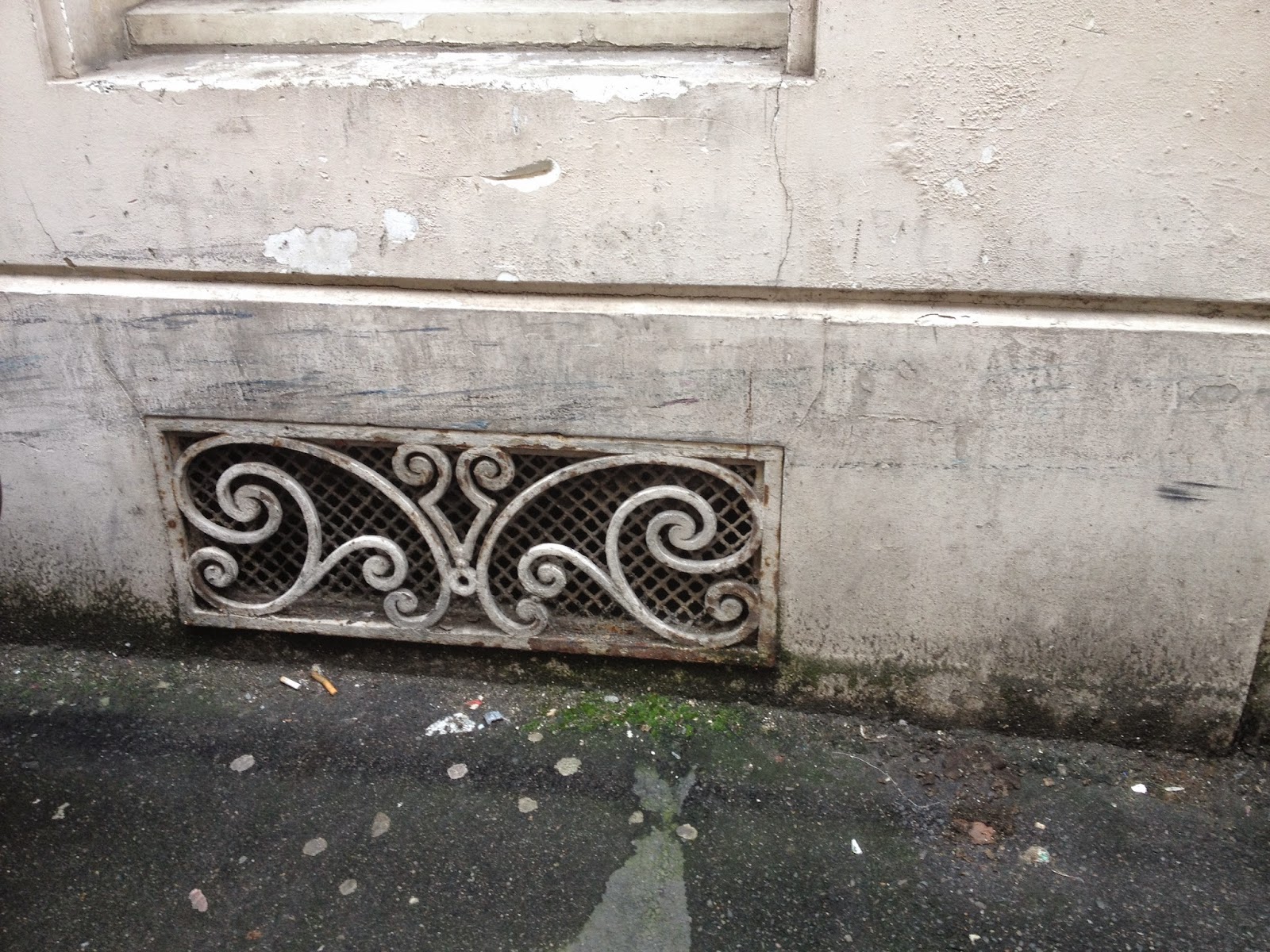
I spent a lot of time thinking about point of view when I was writing Liberty’s Fire.  So many of my sources saw Paris as a stage, a spectacle, a panorama, and I kept trying to find a way to convey this without becoming overly theatrical myself.  But while I was actually walking the streets of Paris, I often found myself looking down.  I stared at the paving stones, and thought how different they were from London slabs, and how much better for building barricades:


 I became an expert in ventilation shafts for cellars:


Their different sizes and gratings. . .


And how they could be blocked up. . .


Thanks to Guy Endore’s The Werewolf of Paris (the forefather of the werewolf sub-genre, which is set in 1871 and, despite this lurid cover, impressive in its historical accuracy) I even discovered the name for these openings in French: soupirail(Another new word I learned was ‘délation’, which has a very interesting history in France.)  


In the last days of the Commune, a rumour sprang up that would be the death of many women. 
‘The Emancipated Woman Shedding Light on the World’
1871, Lithograph by J. Lecerf
 “Petroleuses!” writes novelist Lucien Descaves in his spirited introduction to that rare thing, a published memoir by an active Communarde, Victorine B. [Brocher]. “Until the last days of the Paris Commune, during the red week, this designation was fatal to the unlucky women who received it from a vindictive concierge, a perfidious neighbour, a passing hallucinator, from no matter whom. . . But much later, in exile, the word marked the shoulder not just of refugees, but even their friends.” (Souvenirs d’une morte vivante*, 1909)


Paris Incendie, night of the 24-5 May 1871, Michel Charles Fichot

Paris was in flames: the Tuileries Palace was burning, part of the Louvre, the Hôtel de Ville, the Finance ministry. . .the river ran red with the reflected conflagration.  The situation felt apocalyptic.  The world decided to blame women, who had already been far too active in the Commune, with their club oratory and public pronouncements, their vigilance committees and the Union of Women.  Of course they were represented as ugly, impoverished, unnatural, wicked women with loosened hair and dishevelled clothing.  Femelles’ (‘bitches’), so maddened and unsexed or oversexed by politics that they would rather see Paris destroyed than give up their dangerous socialist ideals. 

In his 1873 illustrated catalogue of Commune ‘types’, Bertall naturally includes a Picture of ‘a pair of pétroleuses’ stealing out at night with petrol cans and matches.  He cheerfully admits that even if they didn’t exist, thanks to the fact that plenty of women had been summarily shot by soldiers on suspicion, ‘they existed in every one’s imagination’ and so the mania continued long after ‘the Insurrection’.  For weeks people bricked up cellar openings and even keyholes.  Bertall’s pétroleuses represent feverish panic rather than reality, ‘an embodiment of what all the World believed in, and feared at the Moment.’
 

Bertall’s image is relatively kind.  Another shows a petroleuse with a pig's snout.  They are furies, viragoes, tigresses.  They had to be punished, and they were.

The word ‘pétroleuse’ has been almost forgotten now, but it quickly became one of the most powerful and most negative political symbols of the nineteenth century, according to Gay Gullickson, author of Unruly Women of Paris: ‘The female incendiary became an international symbol, not only of the Commune itself, but also of the evils of revolution.’  

Fifteen years after the invention of the pétroleuse, Eleanor Marx Aveling’s rallying introduction to Lissagaray’s History of the Commune explains the necessity for her translation:
‘To most English people the Commune still spells ‘rapine, fear and lust’, and when they speak of its ‘atrocities’ they have some vague idea of hostages ruthlessly massacred by brutal revolutionaries, of houses burnt down by furious petroleuses.  Is it not time that English people at last learnt the truth? Is it not time they were reminded that for the sixty-five hostages shot, not by the Commune, but by a few people made mad by the massacre of prisoners by the Versaillese, the troops of law and order shot down thirty thousand men, women, and children, for the most part long after all fighting had ceased?’

Eleanor Marx
A year later her call for the truth was echoed, rather surprisingly, by a public schoolmaster best known for the anthem ‘Forty Years On’, in a lecture to the Harrow Liberal Club on 31st October 1887.  Edward Bowen decided to put together an outline of the facts as he’d experienced them because, he said ‘there are no books on the subject which are even approximately truthful’.  (I'm not sure if he includes Lissagaray's or simply hadn't come across it.)  Bowen's account is vivid, balanced, humane and also quite angry.  He concludes - and most contemporary historians agree – that shells from Versailles forces on the heights of Montmartre caused some of the fires, while others were probably started deliberately and strategically by retreating soldiers of the Commune.

‘A crime…a barbarous act…to destroy the monuments of history’ says everyone, but remember you are speaking of men who did not look on the glories of Louis XIV and the trophies of art as we do. I think they saw in them big buildings into which a common man was never allowed to penetrate, which existed for the pleasure of emperors & courtiers, and moreover, buildings the blaze of which might give the defenders some twenty-four hours longer life in this world.’

©Charles Deering McCormick Library of Special Collections,
Northwestern University Library
As for the women incendiaries, Bowen is categorical:

’Every woman who looked ragged, or who could not stammer out a good account of herself, fell under suspicion, and no sooner was the cry of petroleuse raised than all hope for that woman was gone.  No one knows how many wretched creatures perished under the accusation.  Well, it was false from first to last.  Not one single woman was ever proved to have acted thus from one end of the week to the other.  If you wish to know on what authority I say this, it is on the authority of the chief law officer of the Versailles government.’

Liberty’s Fire is published by Hot Key Books on May 7th.  Full details of all my sources can be found on my website, where I’ve also written about some of the real women who supported the Paris Commune, such as Louise Michel, Nathalie Lemel, Elizabeth Dmitrieff, André Leo, Paule Minck and Anna Jaclard.


* I consulted a translator friend about how best to render Souvenir d'une morte vivante in English and she immediately assumed it was a book about zombies – the ‘living dead’.  Horror and the Commune are rarely far apart. ‘The old world is dying away, and the new world struggles to come forth. Now is the time of monsters’ (attributed to Gramsci) is the epigraph for a compelling article by Eric Smith analysing the Paris Commune as an important but unacknowledged source for the ‘deep social distress’ expressed in Bram Stoker’s Dracula: it’s expressed in red fogs, rats, Dracula’s pseudonym ‘de Ville’ which recalls the burning of the Hôtel de Ville, and Lucy Western as the ‘oblique invocation of the quasi-mythic female agent of the latter-day Commune, the reviled petroleuse, the loathsome embodiment of the Commune’s political/libidinal excess’. Appalled at the brutality with which the Commune was suppressed, massacres on a scale which dwarfed the endlessly decried execution of hostages, the narrator of The Werewolf of Paris concludes that we are all monsters now.  Why pick on werewolfs?