Showing posts with label Eleanor of Aquitaine. Show all posts

Wednesday, 24 August 2016

ELEANOR OF AQUITAINE: Going the Distance by Elizabeth Chadwick


It is now four and a half years since I was contracted to write three novels about the life of Eleanor of Aquitaine - THE SUMMER QUEEN, THE WINTER CROWN and THE AUTUMN THRONE. I chose to write about Eleanor in the same way that I choose to write about all my subjects. I  become interested in them, and that interest will sometimes develop into a full blown curiosity that only a more in depth exploration will satisfy. 'Who were you really?' I ask myself, and then I set out on a voyage of discovery.

With Eleanor there were already many biographies and novels in circulation and I had enjoyed reading several of them especially Sharon Kay Penman's marvelous fiction series of books about Henry II and the rise of the Angevin 'Empire.'
Eleanor had also appeared in secondary and cameo roles in many of my own novels and as a result I had conducted a certain amount of surface research into her background, which had contributed to my deepening curiosity.

Articles online tend to stress what a 'kick-ass' feminist she was, way ahead of her time in all she did. Leading her first husband a merry dance and meddling in French politics for example.  Galloping off on crusade dressed as an Amazon and sleeping with her own uncle. Holding courts of love in Poitiers.  Scandalously marrying the young Duke of Normandy after having slept with his father and then being imprisoned by him for encouraging her sons to turn on him when she became insanely jealous of his mistress Rosamund de Clifford.

Eleanor's popular biographers have encouraged many of these dubious points of view.  However, when I began digging, I came across other opinions from historians working more sedately in the background of academia, suggesting that the majority of these notions were anachronistic and at best on shaky ground.  The most forward thinking academics were also of the opinion that Eleanor was a woman firmly grounded in the 12th century culture of her own lifetime, and while formidable and intelligent she was in no way exceptional when set against other high-ranking ruling women of her period, and in some cases had less authority.  The Empress Matilda, for example, or Melisande of Jerusalem or Adela of Blois.  However, the voices of reason were being drowned out by the brash clamour of colourful scandal tales and by the desire people have to always choose the juicy story over the sometimes more prosaic reality.

As a writer of fiction I knew I had to pick my way carefully.  I had to find my Eleanor and make her as real as possible for me and for my readers.  I needed the spotlight I shone on her to contain both the drama and story telling that is the essential lifeblood of historical fiction.  I wanted to illuminate Eleanor's life from a different angle while maintaining integrity toward her and doing her justice.

As I read my way through various reference works on Eleanor, it became clear that what was known about her was actually not very much and that conjecture and imagination had so often superseded fact that it had become fact itself - until one began digging.  I found her variously described by her biographers as a saucy hot-blooded blond who needed her sexuality keeping in check (no evidence), a curvaceous black-eyed brunette whose figure never ran to fat in old age (no evidence) and a good-humoured green-eyed redhead (no evidence). An oft-cited portrait of her at Chinon turned out to be highly likely a man, very possibly her son, Henry, the Young King. She was also frequently misrepresented in books and online articles by images from a 14th century German work, the Codex Manesse, which has nothing to do with her. 
A queen from the German 14th century
Codex Manesse - often falsely  portrayed
as Eleanor
 Biographer Amy Kelly, coming from a literature rather than history background, among other dubious notions, had promulgated the whole courts of love theory which has now been discredited, although the idea remains dear to the hearts of popular history. Victorian biographer Elizabeth Strickland is responsible for Eleanor's reputation for gadding about on the Second Crusade dressed as an Amazon.  Her source for this scandalous happening goes no further back than 1739. There is no evidence for this story before that date, but it has come to be accepted by many as the truth. (See Inventing Eleanor: The Medieval and Post Medieval image of Eleanor of Aquitaine by Michael Evans).
There is the matter of the scandal of her supposed affair with her uncle Raymond of Poitiers en route to the second Crusade when Eleanor demanded an annulment of her marriage from Louis VII.  I discuss the unlikeliness of this one on my own blog Living The History. Eleanor of Aquitaine, Raymond of Poitiers and the Incident at Antioch  She is also supposed to have slept with her second husband's father Geoffrey le Bel, but since the chroniclers concerned were hell bent on bringing the Angevin monarchy into disrepute and were notorious gossips, it would seem prudent to err on the side of caution in that assessment. Geoffrey is supposed to have warned his son off marrying Eleanor, but since Geoffrey and his father had been desperate for years to get their hands on Aquitaine, I somehow doubt that warning would have taken place.  Indeed, I suspect that Geoffrey would have been keen to see his son marry Eleanor the moment the annulment with Louis VII was announced.

Many of the biographies and online articles (especially the latter) tell us that Eleanor incited her sons to rebel against Henry II because she was enraged that he had taken a young mistress, Rosamund de Clifford, and was treating her like a queen.  Seriously?  Eleanor would raise an empire-wide rebellion, dragging her sons into a war with their father because she was jealous of Henry's philandering with a baronial nobody?   It's a bit insulting to promote the idea that a savvy, intelligent woman such as Eleanor was some sort of emotional harpy who would throw over an entire kingdom because her husband, already known for sleeping around, was carrying on with another woman. Would the same be said if she was male?  What about the political machinations that were happening at the time as Henry undermined Eleanor's  authority as ruler of Aquitaine and held their sons firmly under the thumb?  Might that not just have been more pertinent to the situation than a supposed jealous snit over a mistress?

The outcome of the rebellion was that Eleanor was kept under sometimes harsh house arrest for the next fifteen years before her release on the death of Henry II.  I suppose this is the point where she becomes her most 'kick-ass' as a widow with the powers of adviser, mother and co-ruler of Richard I's domains while he was absent on the third crusade.  Here there is not so much digression between the narratives of popular and academic - perhaps because Henry II is now out of the picture and Eleanor is no longer the young and beautiful heroine, prime territory for sex and scandal,  but an older lady with iron in her soul. The sex and scandal mongers now turn their gaze on her eldest son and begin the dance of whether or not he was homosexual (cue eye-roll).

One of the things that fascinated me about Eleanor and one in which she truly was ahead of our time, even if not her own, was the amount of energy she had and how indefatigable she was right up until her last days.  She died at the age of 80, which was a marvelous span in a period without life-saving operations and medication. Most octagenarians, even the robust ones, these days are swallowing a raft of tablets to keep them up to scratch.

Like many of the medieval aristocracy  Eleanor had a peripatetic lifestyle.  As a girl she would have been constantly on the move throughout Aquitaine with her parents. At 13 she married the soon to be Louis VII and shortly after their wedding in Bordeaux, travelled up to Paris. Then it was back to Poitiers and then a return to France where again, the court was constantly on the move. Around the age of 23, she set off for Jerusalem with her husband on the Second Crusade. This took them down through Germany, Hungary, Romania, Bulgaria to Constantinople (modern day Istanbul) across the Bospherous, across Anatolia under constant attack, eventually to Antioch and then down the coastal strip to Jerusalem.  Eleanor and Louis returned home 4 years later via Sicily and Rome on what must have been one of the 12th century's most extreme military come sight-seeing expeditions. (Louis just loved his shrines).

Information board from Old Sarum. Click to enlarge.
Having divorced Louis and returned to Poitiers, Eleanor then married the young Duke of Normandy and future Henry II of England, 9 years her junior - and he had to be in order to keep up!  When he became King of England, Eleanor crossed the Channel with him and added that country to her map of lands where she had set foot.  During Henry's reign she was constantly on the move across the vast Angevin dominions that stretched from the Scottish borders to the Pyrenees - or at least until she was caught up in a rebellion with her sons and Henry imprisoned her for the next 15 years.  That slightly curtailed her globe trotting, although later on in her house arrest she did journey between England and Normandy.  Perhaps her incarceration was a rest for her and gave her time to gather her strength and fortitude.

 When Henry died, Eleanor was released from imprisonment and was immediately back on the road, holding England safe until Richard arrived.  Appointed 'chairman of the board' during Richard's absence, she was herself absent for a time. She accompanied Richard to France to see him on his way, and then set out to Navarre to collect Richard's bride Berenguela, and bring her to his winter quarters in Sicily.   After a brief stopover in Pamplona, Eleanor and Berenguela crossed the Alps in midwinter on a horseback and on foot, with Eleanor now around the age of 65.  They would have spent Christmas Day in transit on mountain roads. Once over the Alps in the winter ice and snow, it was down to Rome and then across the straits of Messina to Sicily.

Barely had Eleanor arrived when she learned that her son John was making trouble back in England and Normandy and she had to turn straight round and head home.  Her respite was just 3 days.  Travelling between England and Normandy she kept an eye on matters, until the news arrived that Richard had been captured and held to ransom by the Emperor of Germany. Following a frantic flurry of money gathering to raise the ransom, she crossed the Channel again and headed to Germany, to Speyr to bring the ransom and fetch her son from captivity. By this time she was approaching seventy.  After this she tried to retire to a quieter life at the Abbey of Fontevraud which lay on the borders of Anjou and Poitou.  But the gentler times were not to last.  Richard died in 1199 and Eleanor, now 75, rushed down to Chalus in the Limousin to hold him in her arms as he died.  She then returned to Fontevraud to bury his body beside that of his father.

Her final son John came to the throne and she was requested to go to Aquitaine and take the homage of all of her vassals, which entailed travelling the region to do so. And then she was sent on a diplomatic mission to Castile to bring back one of her grand daughters who would then marry Louis, dauphin of France and hopefully cement an alliance/truce between the houses of Capet and Anjou.  So once more, she found herself, now 76, crossing mountains in winter, this time the Pyrenees, to bring back young Blanche of Castile to her marriage.  Eleanor did not go to Paris with her, but returned to Fontevraud, where soon after she suffered from a bout of ill health - which could well have been brought on by a mixture of grief and exhaustion.

There was one final journey. In 1202, threatened by warfare close to Fontevraud, she evacuated the convent and started down toward Poitiers.  However, when she stopped at the small castle of Mirebeau along the way, she found herself besieged by her teenage nephew Arthur, rival claimant to the Angevin throne.  Eleanor sent desperate word to John, who dropped his own campaign and rode like the wind to rescue her, arriving in the nick of time as Arthur's army were breakfasting on roast pigeon while Eleanor was barricaded in the keep.  Arthur was captured and the 78 year old Eleanor set free from her peril.  This was to be her final journey and adventure and she returned to Fontevraud and died there in April 1204.  It is thought that she had a say in the design of her own effigy and those of Henry II and Richard I, as well as the now lost effigy of her daughter Joanna.  If so, then she has portrayed herself reading a book - very likely intended to be of a religious nature, so even in death she is active, while her husband and son, lie  in state.  Since reading was often a communal affair and books read aloud, then perhaps Henry and Richard now have to listen to her for eternity! 

The majority of us will never pack in that much travelling or drama in our lives, and perhaps would not want to!  I am amazed at how much strength and fortitude Eleanor possessed. Her indomitable will is what I see as her true strength, right through to the core.  Yes, in the end a 'kick-ass' woman, but one of her own time and making and for whom I have the deepest admiration and respect.

The Autumn Throne is published in the UK by Sphere on September 1st and by Sourcebooks in the USA on October 1st.


Friday, 24 October 2014

GUESS WHO - or the debate over the Radegonde mural in Chinon. By Elizabeth Chadwick

In 1964 an interesting an intriguing discovery was made at an ancient chapel in Chinon dedicated to St Radegonde. The story goes that a piece of plaster fell off the wall and revealed a mural of five mediaeval figures - two of them crowned - riding out to hunt.  The discovery having been made in the Angevin heartland and the figures appearing to date to the 12th century caused a stir among historians and art historians.  The original finder, Albert Heron, thought that the figures represented among others King John, his wife Isabelle of Angouleme, and her second husband Hugh of  Lusignan. Debate as to the identity of the riders has continued ever since, with the most popular vote (to judge by biographical book covers and photographs in said books) identifying the lead crowned figure as Henry II and the middle one as his wife Eleanor of Aquitaine with sundry other family personages suggested for those surrounding them.
Ever since setting eyes on this mural, I have  found it curious that so many people believe the middle crown figure to be Eleanor of Aquitaine, even while I understand their reasoning. She is always linked with her husband Henry II and they are larger-than-life personalities who automatically take precedence in people's minds. St Radegonde was an important Saint in the territories held by Eleanor of Aquitaine, so the reasoning goes that it must be her. But without actual names written identifying the figures, it can only be guesswork - and perhaps flawed guesswork at that. 
How do we know the lead figure is Henry II?  We don't; it's another assumption, but the circumstantial evidence points that way because we know from contemporary evidence that Henry II was red haired,  The mural is at Chinon which is solidly in his territory and the figures clearly date in terms of the style of their clothing to the late 12th century.  Since Richard the Lion heart was also a redhead, it might be argued he is also a candidate for the rider on the white horse.
The 'Henry II' figure detail from the
Chinon mural

Alison Weir thoroughly debates the issue in her biography of Eleanor of Aquitaine. She believes the lead character is Richard because 'Richard's effigy at Fontevraud shows him bearded, whilst Henry II's is clean-shaven. Given the special relationship between Richard and his mother, it follows that the crowned woman is Eleanor herself.'  I beg to differ, While Henry's effigy at Fontevraud does indeed show him beardless, Weir has rather ignored the detail that Gerald of Wales portrayed Henry in life as bearded - see illustration below, and drawn either from life or at the least from Gerald's living memory of a man he knew well by sight.
There may be many reasons for Henry's non-beard at Fontevraud. Perhaps to show how dignity and power had been stripped from him in death - a sort of emasculation, It's interesting to note that while Richard I's tomb effigy at Fontevraud is fully bearded (a black beard strangely enough, probably the result of later restoration). 

Henry II complete with beard.  Illustration by
Gerald of Wales who knew him.
So, having dealt with the matter of the beards, let's assume that the lead figure is indeed Henry II. Who are the four figures following him?  Weir believes like many others that the crowned middle figure is Eleanor and that the young woman riding at her side may be either Berengaria of Navarre who was Richard's wife or Eleanor and Henry's daughter Joanna, Countess of Toulouse. She also believes that the two young men behind Eleanor are her grandson Otto of Brunswick, and possibly Arthur of Brittany, or John. She thinks the mural may have been painted in 1196 when Eleanor was in residence at Fontevraud.
A couple of ideas she refutes are the opinions of historian and Israeli professor Nurith Kenaan-Keder, who said in an article dated to 1998 that the mural either depicts King John with Eleanor of Aquitaine and Isabel of Angouleme or else that it is Eleanor being led into captivity by Henry II in 1173/74 and being accompanied by her daughter Joanna and two of her sons including Richard to whom she is giving a falcon as a symbol of passing on the ducal power. I agree with Alison Weir that neither of these theories stands up to scrutiny.  A mural of Eleanor being led into captivity would hardly be a subject for the wall of this chapel.
Studying the mural myself and being au fait with 12th century costume, it seemed to me that all the figures in this mural are male.  Only men pin their cloaks high on the right-hand side. No woman ever does.  I have been collecting manuscript images of the cloak fastenings of men and women of the 12th century for some time and I have not found a single woman with a right hand shoulder pin. It doesn't happen. Nada, nope, no. They just don't dress like that.
Queen with open cloak, king with the standard shoulder
pin on his cloak. I could show you dozens of other such images
So the figure that is sometimes mentioned as Joanna, sometimes as Isabel of Angouleme, isn't female at all. And the crowned figure in the centre isn't female either. But he is still an important personage. He has a wonderful fur-lined cloak of the kind only seen on high nobility, and he has his crown the same as the lead figure, although I have been reliably informed by historian Henk T'Jong (who is a mediaeval clothing expert and agrees with me that these are all men)  that this headgear is in fact  representative of jewelled fur hats - still very high status!
So if we rejig our ideas of who these figures might be, it  becomes a lot less messy. The foremost figure on his fine white horse is Henry II and he is leading out his four legitimate sons on a hunt. There's his eldest son the Young King wearing the other jewelled hat and flashing his fur-lined cloak to further emphasise his stylishness and status. He was crowned in 1170 during Henry's own lifetime to absolutely secure the succession. So you have two Kings in the picture. The slighter, more youthful figure at young Henry's side is his younger brother John. There's around 11 years difference between them. When their father had suffered a serious illness in the early 1170s, he charged his eldest son with taking John under his wing and caring for him should the worst come to the worst which young Henry had agreed to do. So this may well be symbolic of that bond. The two figures following behind are Henry II's second and third sons Richard Count of Poitou and Geoffrey Count of Brittany. Those little caps with the stalks that they are wearing, are very indicative of young 12th century high status men about town. The Falcon itself on 'Richard's' wrist may or may not be symbolic of an act of homage.
I've recently read  Inventing Eleanor: The Mediaeval and Post-Mediaeval Image of Eleanor of Aquitaine by Michael R. Evans published by Bloomsbury academic. He has something very interesting to say about the Chinon mural. Leading art historian Ursula Nielgen wrote a detailed study on the mural in 2004:  'Les Plantagenets et la chapelle de Sainte Radegonde de Chinon: un image en debat.'  Nielgen believes that all five figures are men and that there is nothing in the hairstyles or figures of the supposed 'women' that differentiate them from the 'male' figures. She postulates a date the rebellion of 1173/4 when the family had been reconciled all except for Eleanor. That makes total sense to me given what I know of Henry's personality. I have seen it said that the Eleanor figure has longer hair, but I have seen plenty of examples of men with that length of hair, and the leading Henry figure is not exactly short of a lock or two in that area is he,  so that argument doesn't hold water.
My conclusion is that these figures are male, Eleanor of Aquitaine has absolutely nothing to do with it. They depict Henry II and his four sons, not only riding out to the hunt, but riding out into the future, the pater familias leading his heirs.

Mural photographs courtesy of John Phillips. 
Elizabeth Chadwick is working on a trilogy of novels about Eleanor of Aquitaine. The Summer Queen and The Winter Crown have been published and she is working on The Autumn Throne.

Sunday, 24 August 2014

FINDING 'ALIENOR': The Journey so far by Elizabeth Chadwick.

 It doesn't seem a minute since I was sitting over lunch with my agent and editor discussing my next project, which we decided would be three novels on Eleanor of Aquitaine.  Her life story had been on my radar for quite some time while I worked on other projects in which she often appeared in cameo roles. The more mini performances she had, the more my curiosity grew and the more I wanted to write about her.  It didn't matter to me or my editor that a few other authors had recently written about Eleanor. She was their particular version, as was right, and mine would be mine - and very different.

Following on from THE SUMMER QUEEN, September sees the hardcover publication of the second book in the trilogy, THE WINTER CROWN and I am currently  working on the final book The Autumn throne. (we decided on a seasonal theme, although without the seasons in order and just three of them - like a gestation). How time has flown.  

So, how has it been for me and Eleanor so far? 

The first thing I did to make my Eleanor different to the majority was to change her name to Alienor, which is the French version and how her name was written and spoken in her own lifetime.  One source tells us it is supposed to mean 'Another Aenor' since Aenor was her mother's name. Another version (the Histoire de Guillaume le Mareschal, written within 20 years of her death and from eye witness reports) says that it was an amalgam of 'Pure' and 'Gold'.  Personally I don't see why both cannot be correct. It wouldn't be the first time a double pun has been used. The bottom line was that I chose to go with the version of the name that was hers from birth.

Mural of hunting party in the chapel of St Radegone, Chinon. The middle
figure is said by some to be Eleanor of Aquitaine. Others say the figure is
probably male and represents the Young King with his three brothers.
photo courtesy of John Phillips.
I soon discovered when trying to find out what she looked like, that everyone had their own notions and that her biographers played fast and loose with the none existent facts and invented notions of her appearance either from their own fantasies or from enthusiastic but misplaced reliance on questionable evidence. You will hear it mooted that Alienor's visage may be viewed on a mural in the chapel of St Radegonde at Chinon, but such evidence is conflicting and far from proven with points argued for and against her identity as middle crowned figure.

Some biographers envisage her as a sultry brunette with a superb figure, others declare that she was a blue-eyed blond, and still others belive she was a green-eyed red-head. All of this is speculation without proof since no description of her colouring has come down to us.   A scrap of evidence exists in that she had a paternal ancestor named William 'L'Etoupe' which means 'Straw Head'  i.e. he had fair hair, but who is to say he passed it down to his several times great grandaughter?  Nevertheless,since this is at least family evidence, I have made my Alienor blue-eyed and dark blond.

Appearance was only the start of the dilemmas. There was Alienor's age when she married her first husband. Older biographies say she was fifteen. Newer research with better scholarship puts her at thirteen. Twelve was the age of consent for a girl in the Middle Ages, and so Alienor was within that parameter, but the difference between thirteen and fifteen, even though only two years is a telling one. Alienor is often portrayed as a sexy, controlling siren, in charge of her own destiny and able to wrap her seventeen year old first husband around her little finger. But when you look at it from the angle of her being thirteen, her father newly in his grave, and adult movers and players surrounding her like vultures round a kill on the plains of the Serengeti, then you have a very different scenario on your hands.

I found myself constantly having to make choices between opposing takes on situations that meant big changes for the way I portrayed Alienor. For example some biographers had her gadding off on the second crusade with wild enthusiasm - she couldn't wait to escape the stultifying confines of the French court. Others more conservatively suggested that actually she might rather have stayed at home and ruled France in Louis' absence and was in fact coerced into going.  There's no proof either way. I chose the path of reluctance for my Alienor because it seemed to better suit the person I was seeing as I read between, through and under the lines.

Another controversy - I think everyone agrees she was controversial - is the supposed affair she had with her uncle Raymond of Poitiers. I have spoken of this before, and you can read my take on the business here I would add that I am delighted that a recent biography of Melisande of Jerusalem, a contemporary of Alienor's, written by historian Sharan Newman, agrees with my take on the matter that it is highly unlikely  Alienor slept with her uncle.

Effigy head of Henry II. Cast Court version V&A
It was interesting when I came to the matter of Eleanor first meeting the future Henry II in Paris in 1151 where she and the 18 year old young Duke of Normandy are thought to have arranged a marriage alliance between them as soon  as her marriage with her current husband Louis VII was annulled. Biographers have speculated that they fell for each other in Paris and that it was lust at first sight, never mind the skulduggery of interesting politics.  I took a step back and asked myself about the situation. Alienor was indeed in the act of procuring an annulment from Louis (or he from her, depends who you read) and she would need to marry again in haste once the deed was done. A rich woman still of childbearing age and with vast lands to her name, could not remain unwed for long. Either by rape or by negotiation she would be a bride again on a very fast turnaround.

Effigy plaque of Geoffrey le Bel
The eighteen year old Henry came to court with his father to negotiate on various political issues. His father at the time was thirty eight and Count of Anjou. A man in the prime of his life, renowned for his good looks and education. Henry had been conceived when he was just nineteen years old. For decades he and his family had been trying to draw Aquiitaine and Poitou into their field of influence. Geoffrey had tried to betrothe Henry to one of Alienor and Louis's daughters some years earlier, but the plan had fallen through when Louis had turned the offer down. Now, here under their noses was a golden opportunity. My question is: Who actually brokered that marriage deal?  Geoffrey le Bel who was still head of the household, the pater familias and in charge of operations, or his 18 year old son, still in training, accomplished though he was? Here was a woman nine years older than Henry, a woman and queen with whom Geoffrey had been accustomed to dealing for almost 15 years. Alienor at that point was of Geoffrey's circle, not Henry's. She had been queen of France while Henry was still tied to his nurse's apron strings.  That they met each other and were not averse to the match is plain, and that they went on to  to produce at least 8 children during their marriage, some at relentless one year intervals, shows that they were compatible, but Geoffrey's very presence at the French court as head of his household and the past history of the Angevin counts to make that link with Aquitaine, tells a story of political wheeling and dealing that seems to me to be obvious, but often overlooked.

As a caveat, Geoffrey is said to have warned Henry against the match with Alienor, declaring he had already slept with her and therefore the union was blasphemous in the eyes of God, but I suspect that the chronicler in question was on a mission to blacken Alienor's name and call Henry into disrepute because he had quarrelled with him. I also think he may have got the wrong man, but that's a whole different path of speculation!  It stands to reason that Geoffrey, known to be eager for the alliance of Aquitaine and Anjou, would wholeheartedly approve the match. Of course, having an uppity older wife himself in the Empress Matilda, he may have cautioned Henry about just how to treat such a woman!

THE WINTER CROWN, the middle novel of my Alienor trilogy, covers Alienor's marriage to Henry II as far as 1174 when he brought her to what is now Old Sarum and imprisoned her there and thereabouts under varying degrees of house arrest for 15 years for her part in supposedly encouraging his sons to rebel against him. It has been a fascinating novel to write and the controversies and differing opinions surrounding Alienor have continued.  There's the view that she turned against Henry because he deserted her for his mistress Rosamund Clifford, but that doesn't hold water when viewed against Alienor's political astuteness and the fact that whores and concubines were a natural part of court life.  Far more likely to have driven her to oppose Henry, was his attempt to annex Aquitaine to England, Normandy and Anjou by underhand means. He marginalised her and he sought to undermine her power. That's what it was about, not a spat over a favourite concubine.
Then there's the suggestion that she ignored her children and wasn't much of a mother. Again, that doesn't hold water in terms of the fact that wherever she travelled she usually had at least two of them with her. While in the usual medieval aristocratic sense the children were attended by a plethora of wet nurses and carers to whom the children became attached, Alienor was generally there in the background somewhere.  How she and the children interacted and behaved with each other is not known, but all of them in their early lives at least had contact with her, except perhaps Joanna and John who would have been little more than toddlers when they were sent to Fontevraud while Alienor dealt with matters political. Even so she had contact with these youngest children at a later stage in their lives, giving sanctuary to one in a time of distress and need and fighting tooth and nail for the other.

I am now in the middle of the first draft of THE AUTUMN THRONE, the final novel in the trilogy, and wondering what other discoveries and controversies await me as I research and write. I am enjoying finding out, and going off the well worn paths to find fresh trails!


Saturday, 24 May 2014

THE SUMMER QUEEN: Finding Eleanor of Aquitaine by Elizabeth Chadwick.


In early June in the UK and  July 1st in the USA, my novel THE SUMMER QUEEN is being published in paperback.  It's the first in a contracted 3 book series about Eleanor of Aquitaine.
I find it entertaining that my UK publishers have called her 'History's most powerful woman' on the jacket shoutline, because personally I'm not sure that she was in her own lifetime. I suppose she is immensely powerful in that the myths, legends and misinformation about her have created a massive groundswell of interest that keep her at celebrity level even today.

The novel was published in hardcover in the UK this time last year and since then I have received numerous reader letters saying 'I love Eleanor of Aquitaine. I didn't think anything new could be said about her, but you have surprised me and refreshed my awareness...you have made me stop and think.'

So, how did I come to add my own work to this frequently trodden path and what's my take?
I had been thinking about writing my own novel about Eleanor for some time. The twelfth century is one of my main stamping grounds as a writer and Eleanor has often had cameo roles in my novels. I had a couple of biographies of her on my book shelves as part of my general reference works and I often came across her in reading other research pieces. I  encountered her in fiction too at times and my curiosity about her grew down the years.  What was she really like?

On reader and history buff forums she was frequently described as a 'powerful woman ahead of her time.' The view was that she was dominant and feisty and would allow no man to put her down or quell her spirit. She was also an alluring femme fatale, accused of having affairs with her uncle and her second husband's father.  Following a marriage to the milksop Louis VII of France who found her too hot to handle, She had a passionate marriage with Henry II, rebelled against his love affair with Rosamund de Clifford, for which Henry imprisoned her for 15 years. Once free, she acted as regent for her son Richard and continued to lead a full and dramatic life until retiring in her last years to the convent at Fontevraud.

My UK editor was keen for me to tackle Eleanor - a woman from history with sales potential if ever there was one! Even in a crowded market place we felt there was room, and I certainly had a gut instinct that there was far more to be said about this remarkable woman if the detritus and accumulated greasepaint could be removed and original colours restored.I soon discovered that it was more easily said than done, not least because audiences have a fondness for that greasepaint and for that 'powerful woman ahead of her time.' The legend has often become the reality.

As I embarked on my research in detail, it  became clear that her biographers couldn't agree on anything about her; indeed some appeared to be writing novels of their own in the guise of biography. The academics frequently disagreed with the popular histories and with each other.  I found Eleanor married to Louis of France at both 15 and 13. Did it matter?  Well yes if I wanted to tell her story with integrity. The age of 13 as opposed to 15 would make an enormous different to the way I crafted her character. The one is barely out of childhood, the other is more knowing. (as it happened I went with 13 because no one else had written from that vein and it was the academics, not the biographers who were mostly arriving at that conclusion based on good reasoning and recent research).

 I found Eleanor variously described  as having snapping black eyes, black hair and a curvaceous figure that never ran to fat in old age, or as a red head with humorous green eyes, or as a saucy hot-blooded blond whom her father was desperate to marry off before her promiscuous nature got the better of her. All very entertaining but there is not a single existing proven  description of Eleanor of Aquitaine that answers to any of those claims. She was given half-brothers who never existed - as I explained in an earlier History Girls blog. The half brother who never was  She was claimed to be a wild Amazon who gaily led her ladies on the 2nd crusade as if it was one long picnic. Or alternatively she was forced into going by her husband Louis VII.  The latter was portrayed as a god-fearing milksop whom Eleanor dominated, despite strong evidence of his violent temper and vicious mood swings. She had a passionate incestuous affair with her uncle or she didn't. My take on it is here: Raymond of Poitiers She had an affair with Geoffrey le Bel Count of Anjou or she didn't. She arranged her own divorce - or she didn't. She indulged secret liaisons with the young Henry of Anjou in Paris under her husband's  nose or she ... you get the picture.  No one could agree and most of the opinions were boiling down to personal biases and speculation. They might as well have been novels rather than non fiction.

 Weaving my way through the differing accounts has proven both frustrating and utterly fascinating.  Eleanor's story has been constantly reinvented to suit each generation and for all that has been written, we actually still know very little and assume an awful lot about her.I love this article written by Ragena C. DeAragon titled 'Do we know what we think we know: Making assumptions about Eleanor of Aquitaine.' Do we know what we think we know.

My own take on Eleanor, having trawled the biographies and other works is that Eleanor was a woman very much of her time doing her best within the boundaries of what society would permit. Any attempt to push those boundaries was immediately and sometimes brutally squashed by her husbands, although she was nothing if not resilient. As to power: She was living at a time when the boundaries of royal women's power was in a state of flux and being redefined. During her marriage to Henry II, she actually wielded less power than any recent previous queen of England had done. Although never crowned queen, I include her mother in law Empress Matilda among them.

Perhaps the reference book I found most useful when writing The Summer Queen was this one - It's not so much a biography as a series of essays about Eleanor's life and times, and it sets out to put in context some of the myths and legends about her, and to debunk some of the more resilient myths. It's the sensible person at the party who doesn't get drunk and makes it home in one piece with their virtue intact!
Currently the best book out there (in my opinion) for telling it like it was
rather than being a modern wish fulfilment list.
For those interested in the research books I used while writing The Summer Queen, I thought I'd list a handful of the other works consulted, warts and all.   I leave you to make up your own minds, as I  made up mine - and then brought my choices to bear in faceting Eleanor's story.

These aren't all by a long chalk, but they are the ones most pertinent to Eleanor herself (or perhaps not!).
Pretty good, but makes mistakes based on mistakes
by other historians. .
Another fairly good one
Beautifully written, but outdated and the whole courts of love thing
is more than high suspicious and has since been debunked. Massive
pinches of salt and back up confirmation needed.
Interesting and somewhat fanciful take but worth
reading. Have the salt ready again.
The same as the Boyd.  Check the sources.
There are several errors. Salt in plentiful quantities
required.
One of the curvaceous figure brigade. Fairly outdated
but still worth the read in order to collect a broad spread
of information.
Very outdated and containing some wrong information
but again, useful to peruse.
Not strictly about Eleanor but I had to
add it because it's another of the sane ones
about the life, times and culture of the period.

More essays.  A good one.
.
.
.
.


Tuesday, 24 December 2013

IF IT'S CHRISTMAS IT MUST BE CHINON... the festive season itinerary for Henry II

Medieval kings, especially Angevin ones were a busy,  peripatetic bunch.  If they stayed in the same place more than a week it was a miracle. The task of government in the Angevin period was a hands on one. The King had literally to be seen exerting his authority and the royal itinerary was one of pillar to post and back again across England, and vast swathes of what is now modern day France, not to mention Ireland.  Accommodation was generally the Medieval equivalent of a five star hotel, often with a splendid few days' hunting laid on for the benefit of the King and courtiers.  Much of the royal finery was carried in the baggage wains that lumbered to the same destinations as their sovereign, although frequently along different roads or earlier in the day.

I thought it might be interesting to look at where King Henry II spent the Christmas feasts of his reign from 1154 - 1188 (he died before Christmas 1189). Christmas gatherings were politically important events. While there was sport, mirth and merriment and largesse, it went hand in glove with meetings, with decisions of policy and government, with the declaration of interest and the issuing of charters.
As an aside with reference to the entertainments, we know that one Roland le Pettour held his estates in Norfolk for the performing of one particular festive jape for King Henry II.  His brief was to appear at court each Christmas and perform a 'leap, a whistle and a fart' for the royal entertainment. The particular service was hereditary and the responsibility was passed on to his son.  What can I say?  Having watched the inimitable Mrs Brown's Boys on television, not a lot changes!

To the itinerary:
Beginning in 1154:  Henry had been crowned King of England at Westminster Abbey on December 19th, aged just 21 years old.  Red-haired, freckled, grey-eyed and bursting with energy, this was the promising start to a magnificent new reign after a generation of bloody civil war.  Henry's wife, Alienor of Aquitaine was most probably crowned with him. She was 7 months pregnant with their second son, and their heir, William was two years old.
The Christmas celebration itself was held at the manor of Bermondsey across the river from the Tower of London.  Westminster royal Palace was not an option for the new king and queen. It had been neglected during the civil war and was something of a ruin.  Indeed, it was the first task of Henry II's newly appointed chancellor, Thomas Becket to put Westminster Palace in order and make it splendiferous.

1155.  Christmas was held at Westminster this time around, so presumably Becket had pulled out all the stops and made the place habitable for a gathering.  By January 1, Henry was busy in Canterbury.

1156.  No one is quite sure on this one, but Bordeaux is a likely candidate.  Certainly Henry was in his wife's lands rather than his own northern climes.  Sadly during this year he and Alienor had lost their firstborn son - cause unspecified. They had also had a daughter, christened Matilda after her formidable grandmother the Empress Matilda.

1157.  The King and Queen were at Lincoln this year.  In September Alienor had produced another son, Richard, later to become Richard the Lionheart.

1158. Cherbourg this year. Alienor had been in England until late in the year where she had given birth to yet another son, Geoffrey.

1159. The royal pair spent Christmas at Falaise in Normandy. Earlier in the year Henry had tried and failed to take Toulouse which Alienor claimed belonged to her. What the atmosphere was like at this gathering is anyone's guess.
The donjon at Falaiser

1160. Henry and Alienor were at le Mans in Anjou this time.

1161.  Christmas was kept at Bayeux in Normandy this year.  In October, Alienor had given birth to her second daughter, also christened Alienor at Domfront.

1162. Henry and Alienor were intending to spend Christmas somewhere in England but because of bad weather in The Channel, had to keep the festival at Cherbourg.

1163. Christmas this year was at Berkhamstead and marks a sign of the growing discord between Henry II and his recent Archbishop, Thomas Becket.  The castle, although belonging to the Queen, had been loaned to Becket on a chummy personal basis.  Now, with the dispute over criminous clerks looming large, Henry made a point of taking Berkhamstead for his own use and ousting Becket.

1164. 1164 was another Christmas spend in England, at the royal castle of Marlborough in Wiltshire.

1165.  Henry and Alienor spent Christmas apart.  He was in Oxford busy with politics and she was in Angers in Anjou, perhaps still recovering from the birth of their third daughter Joanna. Was the marriage in trouble or was it just politics?  We just don't know, but it is more likely the former, even if trouble was looming.

1166. Another Christmas apart for the royal couple.  Henry was in Poitiers, the heart of Alienor's great Duchy of Aquitaine, and he was joined by his almost 11 year old son Prince Henry.  Alienor, meanwhile, was in Oxford giving birth to their last child, John.

1167. This particular year the royal couple managed to have a family Christmas at Argentan, although some sources say Rouen.


1168. The Christmas court this year was definitely at Argentan and Henry was still there at New Year.

1169.  This year Henry was at Nantes in Brittany for Christmas with his third son Geoffrey who was Count designate of Brittany.  This was definitely politics. Queen Alienor inthe meantime was keeping her own court and Christmas in Poitiers.  Many historians and novelists see this period as the time of the split between Henry and Alienor, with her returning to her Duchy and occupying herself with her own concerns.  There is the suggestion (rather fanciful) that Henry had taken up with a nubile young mistress, Rosamund de Clifford and that Alienor had gone off in a jealous snit, but given Alienor's political acumen, it's not a likely scenario, even if it is soap-operishly romantic and dramatic.

1170.  Henry and possibly Alienor were at Bures for Christmas not far from Bayeux.  It's from Bures, supposedly on misunderstanding Henry's orders, that the four household knights set out to cross The Channel and murder Thomas Becket on the steps of Canterbury Cathedral  on December 29th.

1171.   Henry spent Christmas 1171 in Dublin, sorting out the Irish and keeping away from all the furore over Becket's slaughter. Alienor was probably in Poitiers.

1172.  In 1172, Henry and Alienor got together again at Chinon in Anjou.
Chinon

1173.  King Henry was in Caen. During the last year his sons Henry, Geoffrey and Richard had rebelled against him, as had their mother and he was still busy dealing with uprisings and insurrection.  His sons were still rioting but he had captured Alienor and imprisoned her. She spent Christmas at his pleasure, but we don't know where, although Chinon and Falaise are both likely.

1174.  Henry spent Christmas at Argentan.  Alienor, now a permanent prisoner for the rest of his reign, was confined to various fortresses in the south of England, predominately Old Sarum and Winchester.

1175. Henry was at Windsor with his eldest son Henry, now reconciled.

1176.   Henry spent Christmas at Nottingham with his two youngest sons Geoffrey and John. His oldest son Henry was at Argentan with his wife, daughter of Louis VIII, and Richard was at Bordeaux.
Restored gatehouse of Nottingham Castle

1177  Henry was at Angers.

1178  Henry kept Christmas at Winchester with his sons Geoffrey and John. There is no mention of Alienor being there, but she may have been.

1179  The venue for Christmas this year was Nottingham for the second time.

1180  This time the King was back across The Channel at Le Mans.

1181  This year Henry spent Christmas at Winchester

1182  Henry was at Caen.

1183 Henry spent Christmas at Le Mans and Prince John now 17 was with him.  Henry's eldest son, Henry had died in rebellion against him in the summer of that year.

1184  This was a big family gathering year. Christmas was spent at Windsor with Alienor joining the court, together with her sons Richard and John, her daughter Matilda who was now Duchess of Saxony with her husband and their children.

1185.  Christmas this year was at Domfront.

1186. Henry kept Christmas at Guildford with Prince John.

1187.   Henry was in Normandy, at Caen this year.

1188  Henry spent the last Christmas of his life at Saumur in Anjou.


So in his 35 year reign, Henry II spent 12 Christmases in England,  2 in Aquitaine,  12 in Normandy, 1 in Ireland, 1 in Brittany and 6 in Anjou. All travel courtesy of horse, wagon, and occasionally Shanks' pony.

A Happy Christmas/festival/holiday break to all wherever you happen to be!

Elizabeth Chadwick


Tuesday, 24 September 2013

It Ain't Necessarily So.... by Elizabeth Chadwick

When I embarked on my novel about Alienor of Aquitaine, The Summer Queen,  I wanted to know what she looked like, so I checked around to see if there were any sources that described her physical appearance.  If there were any, I didn't want to commit a faux pas by giving her the wrong physical attributes at the outset.
As a less experienced author, influenced by other writers of both fact and fiction, I had in the past given her long, raven-black hair.  But now, with a three book contract under my belt and Alienor centre stage rather than peripheral, I felt I needed to nail the truth if it was out there.  After all, even in the medieval period, primary sources do yield hints and descriptions.  There are vivid ones of  Alienor's second husband Henry II that portray him as a choleric red-head with sparkling grey eyes, his height just above average but not tall, and his build chunky.  Women tend to be less well represented in primary sources beyond stock phrases about their beauty or nobility (or perfidy) but personal physical attributes are rare.  However, I embarked on my search and hit the many biographies and histories produced about her and her family to see if there were any pointers.  The research told me plenty, but not quite what I was looking for...

W.L.Warren in his biography of Henry II calls Alienor a 'Black-eyed beauty.' 


Frank McLynn in Lionheart and Lackland: 'Eleanor of Aquitaine had a dark complexion, black eyes, black hair, and a curvaceous figure that never ran to fat even in old age.'

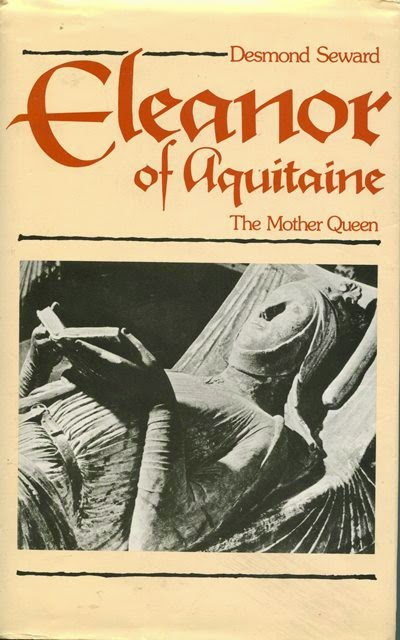
Desmond Seward  In Eleanor of Aquitaine the Mother Queen: 'She was a beauty - tall with a superb figure that she kept into old age, lustrous eyes and fine features (it is likely that her hair was yellow and her eyes blue).'

Douglas Boyd  in Eleanor April Queen of Aquitaine: 'Her face was humorous and alert, framed by long auburn hair flowing freely from beneath the coronet.  Her eyes according to legend were green and fearless.


Alison Weir  in Eleanor of Aquitaine, By the Wrath of God Queen of England: 'It is more likely that she had red or auburn hair since a mural in the church of Sainte Radegonde in Chinon which almost certainly depicts Eleanor and was painted during her lifetime in a region in which she was well known, shows a woman with reddish-brown hair.'

Marion Meade in Eleanor of Aquitaine: A Biography: 'Eleanor, exceptionally beautiful at fifteen, had matured into a saucy, hot-blooded damsel, and perhaps he (her father) feared that, unproperly chaperoned, she might grant excessive courtesies to some ardent knight...If she conformed to 12th century Europe's ideal standards of feminine beauty...she must have been blond with grey or blue eyes set wide apart.  Her nose would have been straight, her skin white, and she would certainly have had a long, slender neck, firm breasts, and perfect teeth.'

So, after my trawl, I had her as a curvy, hot-blooded brunette, an insatiable gorgeous blond teenage sex-pot, and an alert, good-humoured green-eyed red-head.

These are all 'factual' secondary sources, and it's interesting what a variation of opinion there is, the more so because there is NOT ONE SINGLE description of Alienor of Aquitaine in any written source and there are no proven visual sources either despite Alison Weir's 'almost certainly' remark. Her opinions of the Chinon mural portrayal is optimistic to say the least when studies now tell us that the clothing on the crowned figure is male and it is probably her eldest son Henry the Young King. Which makes total sense given that the mural shows Henry II riding out followed by four people and he had four surviving sons by Alienor. When he made his will, he left John the youngest, to be cared for by the Young King, which also makes sense of the more child-like figure riding beside the crowned one. The scholarly interpretation immediately stymies the green-eyed red-head theory.

click to enlarge.  Photo courtesy of John Phillips.  Henry and (most likely)
his four sons in the chapel of St. Radegonde at Chinon

Marion Meade's comment about a 'saucy, hot-blooded damsel' is astonishing as there is not one iota of proof that Alienor's early personality tended in this direction.  It's all assumption built on incorrect understanding of medieval mindset and primary sources.  For example, Alienor is often stated to have been louche in her attitudes because her grandfather led a scurrilous life, writing very explicit crude poetry and running off with another man's wife, making her his mistress and refusing to give her up even when excommunicated for the sin.  But Alienor was only around 3 when he died, hardly old enough to have been corrupted.  There is no evidence that her own parents were as flamboyant as the generation before.  Then, when one looks at the wider field, one finds that scurrilous rude poetry was the norm of the day everywhere. One only needs to look around at  works such as The Fabliaux, to see that William IX of Aquitaine was operating within the cultural flow, not outside it.  When one looks at Alienor's first husband, Louis VII of France, who was in later life renowned for his piety, then one also finds a scurrilous grandparent in Philip I, who guess what... ran off with someone else's wife, made her his mistress, had children with her and was excommunicated for refusing to give her up.  Obviously such decadent relatives in the family line, didn't prevent Louis from treading a moral path, so why should the same turn Alienor into a 'hot and saucy damsel?' 

With reference to the hair colour again, I was interested to find in Alienor's ancestry, a Duke of Aquitaine called William 'L'Etoupe' meaning 'towhead' i.e. he had blond hair.  So that is how I have protrayed her in The Summer Queen because at least it's one proven genetic marker amid all the rampant speculation!

It fascinates me how historical non facts become historical facts and how writers supposedly producing factual works can get the details so utterly round their necks. Do they crib from earlier works?  Do they make it up as they go along?  Have they read the 'fact' so often that they believe it?  The myth and the made up are so often repeated that eventually they become the truth.  Having made Alienor a blond, I was taken to task by one reader who said that it was genetically impossible for Eleanor and Henry II (a red-head) to have produced dark-haired Prince John.  Now, I know that the reader's grasp of genetics might have been slightly off kilter as it is possible for a red-head and a blond to have a dark-haired child, but the point I am making here is that yet again, we don't know what colour Prince John's hair actually was. That he's almost always portrayed in films and novels as a saturnine type (probably in keeping with the vagaries of his nature)  has sunk into people's notion of his appearance and has become accepted fact.

King John hunting, 13thC.  He's a blond here!

The above examples are just localised,  based on my own trawling of a subject during research. There are many more abounding throughout the centuries and far less trivial than physical appearance. I'm sure people could cite examples from their own delving into particular historical passions.  History is not just set of opinions seen from different angles, but is often made up how we want it to be or how we have imagined it, and often becomes a false fact because we don't have the necessary awarenesses ourselves to view the fully rounded picture.

Gershwin was right in Porgy and Bess.  It ain't necessarily so!


Friday, 24 May 2013

THE ALIENOR VASE: A wedding present with a history by Elizabeth Chadwick


On the occasion of their wedding in July 1137, the future Louis VII of France, approximately seventeen years old, bestowed upon Alienor of Aquitaine his bride of thirteen, an array of wedding gifts so magnificent that the chroniclers of the time, rather than list individual items, just described them as treasures that it would have taken the tongue of Cicero to describe.

Alienor may have reciprocated in largesse, but we don't know because the chroniclers do not tell us. However, we do know she gave him one gift because it's still with us today, and carries its history  by way of an inscription round the ornately decorated base. It is one of the few surviving artefacts remaining with a direct connection to Alienor the woman, the others being a stained glass window in the Cathedral of St. Pierre in Poiters, and her tomb effigy, in which she had a say when it came to the design (and will probably be the subject of a blog post another time).

When Alienor presented the vase to Louis, (called here a vase for convenience's sake, we do not know what its original function was)  the jewel-encrusted mountings at the top and base did not exist. It was a pear-shaped piece of rock crystal worked in a honeycomb design containing 22 rows of small, hollowed-out hexagons.  That was it.  No gold, no embellishment. Alienor had inherited the object  from her grandfather, the notorious Duke William IX of Aquitaine, a crusader, soldier, and composer of sometimes beautiful but frequently bawdy verse.

Carved rock crystal containers have existed from antiquity, the Eastern Mediterranean appearing to be their source of origin at the outset.  The craft of rock crystal carving flourished throughout the Middle East and was a known technique in the Roman Empire. However, the Alienor vase is the only item known to have been worked in this particular honeycomb design in rock crystal.  Others exist but their medium is glass and the Alienor piece is utterly unique.

The Medieval world believed that rock crystal was fossilized ice and valued the material greatly. There are references to rock crystal drinking cups in love poetry composed in Moorish Spain, so perhaps the vase was originally one of these, or due to its great value, may have been a display piece.  Indeed, it is likely that the object came from Moorish Spain as a gift to Alienor's grandfather,  the aforementioned William IX of Aquitaine from the Emir Imad-al-dawla of Sarragossa, and would have entered his possession around 1120 during the time he was on battle campaign in Spain.

Experts are unsure of the dating of the vase - dates between the 6th and 9th centuries have been mooted, but  it was already an antique when it came into the possession of the dukes of Aquitaine.  It was obviously a very precious object for Alienor to present it as a fitting gift  to her husband on their wedding day.

On June 11th 1144, Louis gave the vase to Abbot Suger at the dedication of the magnificent  church of St. Denis.  Suger was an avid collector of precious stones and objects of artistic merit, and the vase was as fine addition to the collection. He used it as a communion vessel.
ambulatory of St. Denis

Why did Louis give the rock crystal vase to him? Historian Ralph Turner in his biography of Alienor of Aquitaine suggested that it was an offering to St. Denis in the hope that Louis and Eleanor's barren marriage might be blessed with a child. (a daughter, Marie, was born the following year). It might have been that Louis valued Suger as an adviser and spiritual mentor and wanted to please him.  Suger later wrote that Louis had given him the vase as 'a tribute of his great love.' What Alienor thought is not recorded, but we shouldn't put a modern interpretation on this if we speculate on her feelings. Wedding gifts in the Middle Ages were frequently expected to be bestowed in patronage to the Church. There is no need to think as one biographer has suggested, that Alienor was deeply upset that Louis gave the vase to Suger. It is just as likely that it was a mutual offering.

Now in possession of the object, Suger set about putting his stamp on it.  To beautify it perhaps, and make it worthy of his treasury, or perhaps to make sure that it was never going to be given back, he had a base and a neck fashioned for the vase from gilded silver.  On the base he set an inscription in niello, then a layer of filigree set with gemstones and decorated with more filigree work and fleurons.  He had the neck of the vase similarly adorned.  The inscription around the vase reads in translation from the Latin:

As a bride, Eleanor gave this vase to King Louis, Mitadolus to her grandfather, the King to me, and Suger to the saints.'


Suger died in January 1151 before Louis and Eleanor divorced.  The vase, now a communion vessel remained in the treasury of St. Denis down the centuries, but following the unsettled period of the French Revolution came to its new home in the Louvre where together with other items from the treasury of St.Denis it can be viewed by visitors to the museum.  I wonder what its original carver would have thought if he could  see it now?

Photographs of the Alienor Vase courtesy of John Phillips.

Bibliography.
The Eleanor of Aquitaine Vase by George T. Beech in Eleanor of Aquitaine Lord and Lady edited by Bonnie Wheeler and John C. Parsons.

Eleanor of Aquitaine by Ralph V. Turner

The Louvre - website Treasures of St.Denis