Exmoor is easily bypassed by travellers to the south-west: most people head straight on down to Devon and Cornwall, to Dartmoor and Bodmin - probably without realising what a varied and beautiful area they're missing.
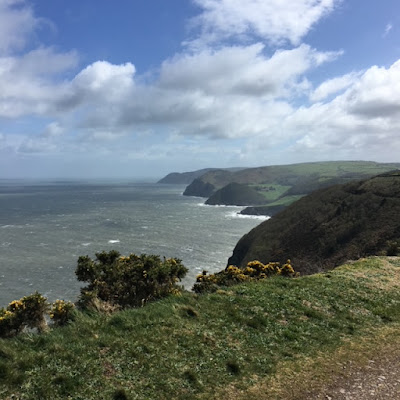 |
| The Exmoor coast |
Exmoor became a National Park in 1954. Roughly three quarters of it is in Somerset: the remaining quarter is in Devon. It sits on the west coast of England, and is nineteen miles across at its widest, and twelve miles north to south at its deepest. It has a stunningly beautiful coastline (which forms part of the South West Coast Path), steep wooded combes (narrow valleys), energetic, noisy rivers and streams, temperate rain forests (where lichens and ferns grow on trees, and the grass underfoot is soft and starred with wildflowers) - and it has, of course, the moor itself, the home of graceful red deer and sturdy Exmoor ponies: bare, windblown, desolate on a grey day, starkly beautiful on a sunny one.
It's not only modern visitors who have bypassed Exmoor. Even the Romans appear to have taken a look and decided not to bother - there is little evidence of their activity in this area. It's not an easy terrain to farm, the stone is not the kind you can easily build with, and the weather is challenging. It's gentler on the west side, but in the east, spring is a couple of weeks later than elsewhere. And up until the nineteenth century, there were few dwellings where you could take shelter. No wonder gangs like the Doones could roam with impunity. Even today, there are only a few small towns and villages scattered across vast areas of what looks like wilderness.
We've visited the area for many years - my mother-in-law loved it, and moved near Porlock to live in her later years. But over the last couple of years, we've spent more time on the eastern side, not far from Simonsbath, Withypool and Exford. And this is the heart of the original Exmoor Forest: a large area claimed by the Crown after the Conquest. Like the other royal forests - but probably even more so - it wasn't actually a forest. At the centre of the moor is a spindly, wind-bent tree called the Hoar Oak. It's one of the very few trees there is on the open moor, and it clearly struggles to survive. But there were deer, and they belonged to the Crown - even if the Crown, far away in London, seldom bothered to claim them. For hundreds of years, the moor was administered by Wardens. There were even two female Wardens, Sabina Pecche (from 1295-1308) and Margaret Boevy, who took over from her husband and was the Warden for eight years at the beginning of the eighteenth century. It was her husband, James, who built Simonsbath House in 1654, said to be the only house in the Forest till 1815. (S H Burton, Exmoor, publ 1952)
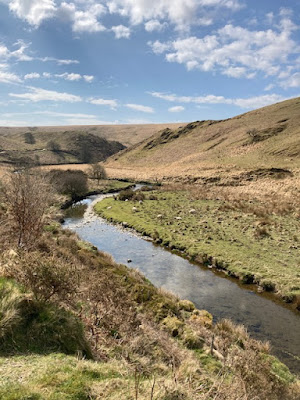 |
| The Barle valley |
We have a favourite walk which starts at Simonsbath. It goes along the River Barle, one of those busy, bubbly rivers that dances over rocks and pebbles, attracting dippers, grey wagtails and dragonflies among many other creatures. At the beginning, the path is edged by extraordinarily gnarled and twisted beech trees, such as you see all over Exmoor: I'll come back to them later. The woods are soon left behind, and on either side of the valley swoop low, bare hills. At the right time of year you may hear cuckoos and curlews, and you may well see deer grazing in the distance - till one among them lifts its head, sensing danger (us), and off they move with a swift and graceful lope.
.jpg) |
| The Barle again, near to where the remains of the mine workings are. |
After a little while, as you approach an Iron Age fort called Cow Castle, you may notice on the left a few oddly shaped humps. Last year, three people were sitting here chatting. They told us that two of them were about to put on wet suits and explore some nearby mine workings - and that the odd humps were all that remained of some mineworkers' cottages.
We were surprised. This had always seemed to us an intensely rural landscape: it was difficult to imagine industrial paraphernalia in this setting. Yes, our new friends told us: in the nineteenth century there had been a man called Sir John Knight, who had bought the whole Forest in 1818. His son had been convinced that there was iron to be found - and so there was, but not, as it turned out, in sufficient quantity to be worth getting out of the ground.
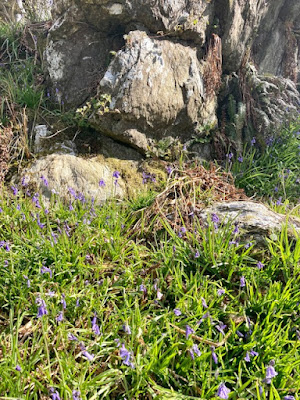 |
| Bluebells and imported rocks in the Knights' wild garden |
This rang a bell with me. Back in Simonsbath, the car park was at the foot of wooded slopes rising up above the river. It was spring, and there were bluebells, pink and yellow primroses and white wood anemones. There were paths through the trees, and a few huge white stones, rather artistically placed. A nearby information board explained that this had been planned as a sort of wild garden by the Knight family, and work was under way to restore it.
Intrigued, I found out more - chiefly from a book about Exmoor published in 1952, by a teacher and lover of Exmoor called S H Burton. Sir John Knight was an industrialist who owned foundries in the West Midlands at the beginning of the nineteenth century, in the middle of the industrial and agrarian revolutions. The pressure was on to make better use of the land - to grow more, for an increased population. Meanwhile, the Crown commissioners wanted more timber to build ships for the navy after the depredations of the Napoleonic Wars. So when Sir Thomas Acland put in an application to renew his lease as Warden of Exmoor, it was turned down; the commissioners decided the ancient Royal Forest should be split up and sold, and trees should be planted there.
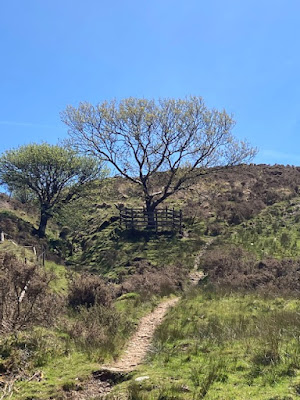 |
| The Hoar Oak, which is supposed to be in the middle of the moor. |
Well, the first part happened: the second was more of a challenge. If the commissioners had trekked across the Chains to see the valiant, but stunted, Hoar Oak, they would have known that these moors were not a natural home for trees. But they didn't. Sir John managed to buy up most of the land, and he determined to make it profitable.
It wasn't easy, and he encountered a lot of failure along the way. Early on, he built a dozen farms, and encouraged his tenants to break the ground and try out some of the new methods, such as rotational farming. They needed to bring in lots of lime - not found locally - to counter the natural acidity of the soil; it was expensive, it was hard, and it didn't really work. The first lot of tenants were unsuccessful. But, undeterred, the Knights - John and later his son Frederic - brought in local men who understand the land, and they learned to work with it, focusing on livestock rather than on trying to grow unsuitable crops.
.jpg) |
| A hedge that got away. |
And back to those extraordinary beech trees. I have seen and admired them, in a vague sort of way, for over thirty years. But I've only just discovered their history. It was Robert Smith, Frederic Knight's innovative land agent, who had the idea of planting beech hedges as a protection from the weather. Beech hedges hang on to their dead leaves all through the winter, until the new leaves appear, quite late in spring. So they form a barrier. Thousands of beech seedlings were planted, and the hedges were properly, painstakingly, tended, with the shoots being partially cut through and then laid, creating an effective screen against the weather.
In recent years, that practice has become less popular - it's expensive and time-consuming. Some - many - hedges are still lain in the traditional way, but others are cut by machine, and still others have escaped: they're now beech trees, rather than tamed hedges. But because of the way they were originally planted - on banks, often faced with stone - you get these extraordinary twisted roots - and the banks are home to tiny ferns, primroses, mosses and lichens: quite lovely.
So another thing to thank the Knights for. And one last word on that. We recently went to see the work of an artist called Jo Minoprio, who has a gallery near Landacre Bridge. She does beautiful paintings, but also extraordinary photographs, many of which were of what appeared to be a small wood, at a place which Jo told us was called Three Combes Foot. We went to see it: it's high up, in a pretty bleak part of the moor. It's not, in fact, a wood. It was originally created as a sheep pound - by the Knights: one of their farms, Larkbarrow, is nearby. It was a space surrounded by a hedge, which gave it some protection against snow and other forms of inclement weather. But it's no longer in use, and so the trees have grown, and now it's like entering a hushed and peaceful glade: quite extraordinary.
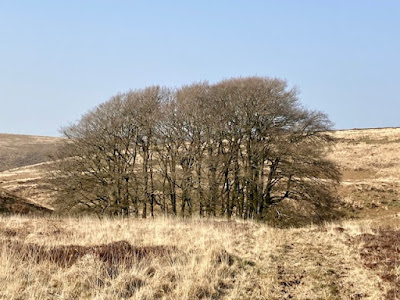 |
| The sheep pound - I tried, but it was difficult to take a picture which did this place justice. |
It fascinates me that a landscape which looks so wild is actually not so wild after all: in fact much of it has been shaped by two generations of one family, quite recently. Before the Knights came to Exmoor, few people lived or farmed there. And they didn't conquer the land: much of it is still wild. But they loved Exmoor, and they did the best for it. and what became of them? Well, sadly, Frederic's son - also Frederic - died at the age of twenty eight, and that took the heart out of his father. He and his wife are buried at Simonsbath. After doing so much for Exmoor, they slipped away into history.
But now their wild garden is being restored, and they are remembered again. They achieved a great deal.
But I'm quite glad that the iron mines didn't work out.



.jpg)


.jpg)

