Showing posts with label Hardwick Hall. Show all posts

Tuesday, 29 January 2019

Height and Light by Kate Hubbard

Photo credit: Nick Tucker

Our guest for January is Kate Hubbard. She is interviewed here by Charlotte Wightwick.
Kate Hubbard has worked variously as a researcher, teacher, publisher's reader, freelance editor and book reviewer. She currently works for the Royal Literary Fund as a Royal Literary Fellow. Her first book, A Material Girl: Bess of Hardwick, 1527–1608, was published in 2001. She is also the author of Serving Victoria: Life in the Royal Household, which was shortlisted for the Costa Biography Award. Kate divides her time between London and Dorset. Her interest in Bess of Hardwick began with her love for Bess’s only surviving house, Hardwick Hall. 
A few months ago Mary Hoffman reviewed a book on this site called Four Queens and a Countess. At the end she said,"Bess of Hardwick remains the real star of this book and I'd love to read a book just about her. She was one of the most remarkable women to emerge in Renaissance England and lived a life as eventful as any queen's." 

Kate Hubbard has granted that wish!
CW: Your book is both a biography of a woman and an account of the explosion of Elizabethan grand domestic building. Why did you choose to explore these themes together?

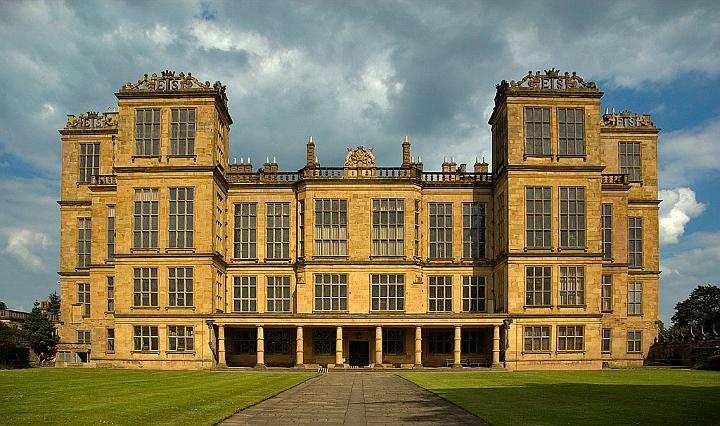
KH: I particularly wanted to write about Bess as a builder, something I felt hadn’t been much explored in previous biographies. Elizabethan England was of course a great era of building, but as a woman builder Bess was unique - building was generally the preserve of men. I felt Bess's four houses - Chatsworth, the Old and New Halls at Hardwick and Owlcotes - could tell us something about her - her pride, her ambition, her ego, her love of order and height and light. Bess started work on Hardwick New Hall as a widow of nearly seventy and that in itself seemed remarkable to me. And the fact that she chose to plaster her initials - ES - all over the house, outside and in.

CW: Why do you think so many of the Elizabethan nobility turned to architecture as a way of displaying status?

KH: For the Elizabethan nobility houses were visible manifestations of wealth and status. If you’d made a fortune, you built a house, and ideally a bigger and better and more extraordinary house than your neighbour. Glass, for example, was extremely expensive, so few could afford the kind of vast windows that you see at Hardwick (Sir Christopher Hatton and the Earl of Leicester also built ‘lantern houses’ - houses with great expanses of glass). Architecture was also a means of displaying wit - Elizabethans loved puzzles and riddles - houses built in the shape of a letter, or designed on geometric principles (like Hardwick). The more ingenious the design, the more admirable and covetable. Interiors were important too - it actually cost more to furnish a house than to build it - and the quality of your tapestries and hangings said as much about your income as your taste. 
19th century depiction of Hardwick Hall
CW: How far was Bess an unusual woman for her day and class? Was she the exception or do you think we just know more about her given her political connections and the survival of Hardwick?

KH: Bess’s life is of course particularly well documented, but I think she was unusual for her time, and class. She came from a gentry, not an aristocratic family and she didn’t have the benefit of a fine humanist education, like many noble-born Elizabethan women. There were other powerful Elizabethan women, at least powerful in the realm of the domestic - women who managed their husbands estates for example - but Bess was certainly unusual as a business woman. And she was a very canny one. She amassed quite an empire of land and property, coal and lead mines, glass works etc. and she had a very lucrative sideline in money-lending. 
Bess when Countess of Shrewsbury
CW: As well as illuminating Bess' life, Devices & Desires also provides a vivid insight into the daily lives of the workmen and others who worked on her buildings. How far was this important to you when writing it?

KH: I wanted to give a sense of daily life, as lived by Bess, her family, servants and workmen. Many volumes of Bess's household and building accounts survive and they tell us a great deal about what was being bought and eaten and worn, who was being paid what etc. It’s a great help that these accounts have all been transcribed - otherwise reading them would be almost impossible task.

CW: What was the most enjoyable or unusual part of researching the book? Was there anything that surprised you?
Hardwick Hall today
KH: I much enjoyed staying at Hardwick during the research and writing of the book. Not in the house itself - sadly! - but in a lodge in the ruins of the Old Hall, which is as close as you can get. Every morning I would open the curtains and there would be Hardwick, rearing up before me, lit up by morning sun. It was particularly nice to be there after hours, when the National Trust visitors had gone home, and when I was occasionally allowed to wander around the house on my own. And I also loved visiting other Elizabethan houses, especially Smythson (Robert Smythson provided a plan for Hardwick) houses, in and around Derbyshire. 

Many thanks to Charlotte Wightwick and Anna Redman of Vintage for ensuring this guest posr went up on time. And of course to Kate Hubbard for the interview

Friday, 13 May 2016

WHO IS THE GIRL IN THE GLASS TOWER ? Elizabeth Fremantle

Arbella as a girl
In advance of the publication of my new novel I thought I'd introduce my extraordinary protagonist, Lady Arbella Stuart.

Through her great grandmother Margaret Tudor, and as the nice of Mary Queen of Scots, Arbella had a strong claim to the English crown and was raised in the belief that she would be the heir of Elizabeth I.

In the final years of Elizabeth's long reign there was much covert political jostling to establish who would eventually take the throne. But the fear of being usurped meant that the ageing Queen refused to publicly name her successor. The nearest she came to doing so was to say of Arbella, 'One day she will be even as I am.'

Arbella's position as presumed, though unofficial heir, made her a potential focus for Catholic plots. Though she was raised a Protestant the prevailing fear was that she might be kidnapped and encouraged to convert whilst still young so the plotters could then launch a coup to place her on the throne as a Catholic puppet queen. For this reason she spent her youth in virtual imprisonment, cloistered away at the magnificent Hardwick Hall in Derbyshire under the strict rule of her ambitious grandmother Bess of Hardwick.

Hardwick Hall

However the political climate changed irrevocably in the last year of Elizabeth's reign and it was Arbella's cousin James who eventually succeeded, leaving Arbella in political limbo. She was released from Hardwick and called to court but her royal blood made her at best a valuable bargaining chip on the royal marriage market or, at worst, a dangerous pretender to the throne. But Arbella refused to be held a fugitive at her cousin's court and made a courageous bid for freedom at great personal cost.

Arbella later in life
A remarkable, highly intelligent and complex woman, yet headstrong and deeply flawed, Arbella with her poignant and profound desire for freedom, fascinated me from the moment I first read about her. She was a prolific letter writer so it was easy to engage with her authentic voice and thereby build a sense of how she might become a character in The Girl in the Glass Tower.

In my novel I have claimed poetic license and woven Arbella's story through with that of the poet Aemilia Lanyer. Lanier was another extraordinary woman of the period, remarkable for being the first English female published poet. 

Possibly Aemilia Lanyer
Lanyer is sometimes cited as a candidate for Shakespeare's 'Dark Lady' but as I found no hard evidence for this I have not included it in the book. At age 18 she became the mistress of the Queen's cousin henry Hudson who was forty years her senior and thereby had an entry to court circles. Her groundbreaking, project was a long poem in defence of Eve and other misunderstood women and as a tragically misunderstood woman herself, Arbella fits well into Lanyer's scheme. 

The actual link between the women is tenuous but Lanyer addressed a poem to Arbella and they may well have known one another at court. But it seemed to me apt to place these two women side by side in The Girl in the Glass Tower as their stories chime together.


READ AN EXTRACT ON THIS LINK

Tap. Tap. Tap on the window.
Something, someone wanting to be heard. Waiting to be free.
​Tudor England. The word treason is on everyone's lips. Arbella Stuart, niece to Mary Queen of Scots and presumed successor to Elizabeth I, has spent her youth behind the towering windows of Hardwick Hall. Her isolation should mean protection – but those close to the crown are never safe.

Aemilia Lanyer – writer and poetess – enjoys an independence denied to Arbella. Their paths should never cross. But when Arbella enlists Aemilia's help in a bid for freedom, she risks more than her own future. Ensnared in another woman's desperate schemes , Aemilia must tread carefully or share her terrible fate...

​The Girl in the Glass Tower brilliantly explores what it means to be born a woman in a man's world, where destiny is strictly controlled and the smallest choices may save – or destroy – us.
The Girl in the Glass Tower will be published by Michael Joseph on June 2nd

For those interested in reading more about Arbella's life Sarah Gristwood's excellent biography, Arbella: England's Lost Queen, is a must.

Friday, 13 March 2015

AN ENCHANTED CASTLE – Elizabeth Fremantle visits Bolsover


I visit many historic houses when researching my novels but occasionally a place seduces me completely. One of these was Bolsover Castle in Derbyshire.


I had been on a research trip to Hardwick Hall as I’m writing about Arbella Stuart who spent much of her youth there. Hardwick creates an impression, its vast windows, its symmetry, its gallery stretching endlessly, all combine to for instant impact. I knew that Bolsover Castle was nearby and had been in the same family but didn’t fall in the compass of my research so had intended to give it a miss, particularly as I felt nothing could compete with the glamour of Hardwick, but I had a spare morning and so drove the short distance to Bolsover in the October drizzle.

It was deserted and I wandered about alone entirely captivated. Like Hardwick Bolsover is perched on a promontory looking out over the Derbyshire countryside and Smythson, the architect of Hardwick was involved in its creation, as was his son, but there the similarities end. Bolsover has nothing of the grandeur and size of Hardwick but what it lacks in splendour is made up for in its abundance of charm.

The older parts of the house, set in a long rambling curve of golden stone, blackened with age in places, have fallen into ruin, but the sense of how the spaces might have been lived in is easy to see. The riding house, built around 1660, with its viewing gallery, timber beams and sand floor, still stands. It was the pride of William Duke of Cavendish, whose dedication to the equestrian arts was unprecedented for an English nobleman of the period, making him the epitome of the cavalier. I plan to return for one of the costumed equestrian events that are held in the spring, to see the riding school in all its glory and used as it was intended.


The jewel in the crown of Bolsover though, is the Little Castle, built by Charles Cavendish (father of William) between 1612 and 1617 is a castle in miniature and is entirely intact. It is surrounded by a circular wall with a walkway that offers a view of the both buildings and the rolling landscape beyond. The Little Castle’s interiors, even sparsely furnished as they are, have a feeling of luxury that makes up for their diminutive proportions. The intricate fireplaces, vivid murals and painted panelling have all been carefully preserved and restored and lend the place an air of frivolity that is quite beguiling and at times a little decadent. The Marble Closet, a room lined in rich marble and adorned with risqué depictions of Venus, is clearly designed with a gentleman in mind.

On walking through the rooms, the Heaven Closet, the Elysium Closet, the Star Chamber, each with its own particular character, Bolsover worked its enchantment on me, making me search for ways to put it in my fiction. Perhaps in my proposed novel about Charles I’s Queen, Henrietta Maria, I will be able to work in the 1634 royal visit to Bolsover for a feast and performance of Ben Jonson’s ‘Love’s Welcome.’ Otherwise it will have to be a book about Margaret Cavendish the wonderfully eccentric author and thinker who was the second wife of the William the cavalier duke.


Visit the English Heritage Bolsover Castle page to find out more.

Go to elizabethfremantle.com to discover more about Elizabeth Fremantle’s novels.

Thanks to English Heritage for the images.