Showing posts with label Miranda Miller. Show all posts

Friday, 26 July 2024

Angelica Kauffman by Miranda Miller


Angelica Paintress of Minds, my novel about the eighteenth -century artist Angelica Kauffman, was published by The Barbican Press in 2020. Publication was carefully timed to coincide with an exhibition of her work at the Royal Academy. Then Covid happened and the exhibition, together with so much else, was cancelled. So you can imagine how delighted I was when this excellent show opened at the Royal Academy in March. I particularly admire her portraits and self -portraits. 

 
This portrait she did of the great actor David Garrick displays her talent for empathy and warmth. While she was painting it in Naples in 1764, she said he kept trying to make her laugh, his wit and enjoyment of each other’s company led to a flirtation. Garrick sent this verse to St James’s Chronicle:

While thus you paint with Ease and Grace,

And spirit all your own;

Take, if you please, my Mind and Face,

But let my heart alone.


This has been a wonderful year for Angelica Kauffman and for women artists in general. She is one of the stars of a fascinating exhibition at Tate Britain: NOW YOU SEE US: WOMEN ARTISTS IN BRITAIN 1520–1920 (on until October 13th). At last, it seems, women artists are being taken seriously. The exhibition tells the story of their long battle to be allowed to pursue an artistic education. Artemisia Gentileschi and Angelica Kauffman were only able to become painters because they grew up in their fathers’ studios. 


This painting of Venus and Cupid inducing Helen to fall in love with Paris shows her gift for presenting mythology from the point of view of women. Kauffman and the botanical artist Mary Moser were amongst the founder members of the Royal Academy of Arts. Even so they were excluded from life drawing classes because it was “indelicate” for a woman to stare at a naked man, and no other women were admitted until Laura Knight was elected to the RA in 1936.

Almost all the paintings in this exhibition are of women as well as by them; it seems that women often preferred to sit for other women. There are some interesting discoveries, for example Frances Reynolds, the sister of Joshua, painted an excellent portrait of Elizabeth Montagu, the leader of the Bluestockings. By the mid-nineteenth century the fight to be valued as artists merged with the wider campaign for women’s rights which is, I think, why this exhibition is so important.

Julia Margaret Cameron was given a camera in 1863, and her photographs are now considered to be some of the finest ever taken. The Slade was founded in 1871 based on a financial bequest from Felix Slade, who became its namesake. It was, and still is, part of University College London (UCL), which had been founded in 1826 as London's first university and the first university in Britain to be entirely secular. The Slade admitted women students on equal terms with men from its founding. The barrier to life drawing was finally broken down. and they quickly outnumbered male students. I was surprised to see that In the First World War there were women war photographers, such as Anna Airy. 


Miranda Miller’s ninth novel, When I Was, will be published next March by Barbican Press. www.mirandamiller.info.


Friday, 22 December 2023

 Queen Square by Miranda Miller


Most references to queens in London are memorials to Queen Victoria but this statue in the gardens of Queen Square is of Queen Charlotte, the wife of George 111 who was treated for mental illness by Dr Willis in a house nearby. The pub on the corner of the square, called the Queen’s Larder, is said to be on the site of the house where she stored his favourite foods in a cellar when she visited him. I should add that, like so many of the best stories, it’s quite possible that this is an urban myth; In Alan Bennett’s play and subsequent film The Madness of King George Dr Willis appears to have treated the King in the White House at Kew - but I’m a novelist, not a historian, and I was comforted by this touching story recently when I spent a lot of time sitting in the gardens after visiting a dear friend in the National Hospital for Neurology and Nerosurgery.

Judged by the rather low standards of royal marriages, George 111 and Queen Charlotte were in fact a devoted couple who lived together for 57 years. Here their modest lifestyle is mocked in a cartoon by Gillray:

The king dines off a boiled egg, using the tablecloth as a napkin to save money, while his wife tucks into a huge bowl of sauerkraut. Their own unpretentious habits made the wild extravagance of their oldest son, the Prince Regent, later George IV, particularly annoying and the King famously detested his oldest son who in turn despised his father.

What was the recurring mental illness the King suffered from throughout his reign? Doctors at the time simply said he was mad when he talked incoherently, had seizures and panic attacks and was quite incapable of ruling the country.  Later doctors thought that he was in fact suffering from a rare hereditary blood disorder, porphyria, and more recently many think his illness might have been a bipolar disorder. At different times the royal physicians entrusted the daily management of the king’s illness to specialist “mad-doctors," particularly to the Reverend Francis Willis and, later, to his sons.  

The Willises used a straitjacket to restrain the King, enforced his confinement and insisted on a strict medical regime to bring down his “fever” and “turbulent spirits”, including vomits, purges, bleeding, blistering, the application of leeches and regular doses of medicine.Although this treatment sounds harsh to us, they were considered kinder and more considerate than other “mad-doctors” in the 18th century. This is the medal Dr Willis issued when he believed he had “cured” the king:


An inscription on back of the medal declaims: Britons Rejoice, Your King's Restored, together with the date, 1789.  Sadly, twelve years later, King George suffered a relapse and his symptoms returned. 


In the 18th century Bloomsbury was considered a healthy place to live, being on the northernmost edge of London with views across to Hampstead Heath. The novelist and diarist Fanny Burney and her musicologist father Dr Burney lived in Queen Square. There was a girls’ school known as the girls’ Eton, where Boswell’s daughter was a pupil. The young ladies had a coach in their schoolroom so that they could practise getting in and out of a coach decorously.

The philosopher and reformer Jeremy Bentham had a house round the corner in Queen Square Place. He has been described as the spiritual founder of University College London, which now dominates so much of this area. When Bentham died in 1832, he asked in his will for his body to be preserved and his skeleton, dressed in his own clothes, topped by a wax head, now stands in a glass case on the ground floor of UCL's Student Centre. According to another irresistible story (which may or may not be another urban myth) Bentham’s “Auto-Icon” attends meetings of the College Council and is solemnly wheeled into the Council Room. His, or its, presence, is supposedly recorded in the minutes with the words:  Jeremy Bentham - present but not voting.

Many French refugees lived in Queen Square after the French Revolution and there were a number of shops selling books and prints. The square was also known for its charitable institutions, including the Roman Catholic Aged Poor Society and the Society of St Vincent de Paul. 

There seems to be an interesting feminist thread running through the history of the square from the mid-19th century; Joanna Chandler, a remarkable medical pioneer who cared for her paralysed grandmother as a child, founded the National Hospital for the Paralysed and Epileptic, which is now the world famous National Hospital; the Royal Female School of Art  was in Queen Square from 1861 and Elizabeth Malleson, the suffragist, started the Working Women's College at number 29.  The London County Council Trade School for Girls was housed here from 1910, and later the Technical College for Women. There was also a women-only Turkish bath in nearby Queen Square Place. 

The Art Workers' Guild, which is still at number 6, was founded in 1884 by architects, artists and designers, including John Ruskin and William Morris, who lived in the square.


Now Queen Square is a surprising oasis of peace where you can sit in contemplation, just minutes away from the ferocious traffic of Southampton Row. The square is still dedicated to the pursuit of mental and physical health; the National Hospital for Neurology and Neurosurgery and the Royal London Hospital for Integrated Medicine are here and Great Ormond Street Hospital for children is in the street which leads east from the square. As well as the statue of a benign looking Queen Charlotte there’s a plaque marking the spot where a bomb from a Zeppelin raid landed on the gardens in 1915. Luckily no one was killed. During the Second World War thousands of people slept in an air raid shelter below the square. There’s a little sculpture of Sam the cat, in memory of the nurse, cat lover, and local activist Patricia Penn, who lived nearby, and a very old water pump that has been converted into a lamp. On the benches in these quiet gardens, doctors, patients and their anxious friends and relations snatch a few calm minutes.


Friday, 23 December 2022

Exmouth Market by Miranda Miller


   I’ve always loved street markets and I’m sad that now, like all retail shopping, they’re being strangled by the internet. One of my favourite streets to walk down is the pedestrianised  Exmouth Market in  Clerkenwell. Who can say why certain streets lift your spirits? This one does, and this morning I decided to find out more about its history. Several shops are now empty, it isn’t flourishing as much as it was before the pandemic but it’s full of interesting, unusual shops, tempting restaurants and delicious foodie stalls.  


   This street and the wider area have a rich history, which started when a spa was discovered in the area in the 17th century. Exmouth Market was built on land formerly known as Spa Fields. Tea-gardens and other resorts grew up in this area from the late seventeenth century, and house-building began to take off in the second half of the eighteenth century,


   At number 56 the great clown Joseph Grimaldi once lived in an elegant 18th century house. His father, Giuseppe, was an Italian immigrant, also a performer. Joey was 9 when his father died and he became the family's breadwinner, performing as Little Clown, a child prodigy who eventually became the most popular entertainer in Regency England. He developed the role of the Clown in the harlequinade that was part of the traditional pantomimes at Drury Lane, Covent Garden and Sadler’s Wells, which is just round the corner from Exmouth Market. His style of clowning had its origins in the Italian commedia dell'arte of the sixteenth century, and It’s because of him that clowns became known as “Joey” He invented what is still the classic clown face, painting a white base over his face, neck and chest and then adding red triangles to his cheeks, thick eyebrows and large red lips set in a grin. His most famous catchphrases  were "Here we are again!", and "Shall I?", before some piece of mischief, which prompted the audience to yell back, "Yes!". His best-known song was "Hot Codlins", an audience participation song about a seller of roasted apples who gets drunk on gin while working the streets of London. I wish I’d see nis act, don’t you?


   His first wife Maria, the daughter of the Sadler’s Wells Theatre manager, died during childbirth. After this tragedy he distracted himself by often performing two shows a night, one at Sadler's Wells and the other at Drury Lane. 

A person in a white dress

Description automatically generated with low confidence


   This is a portrait of his second wife, Mary Bristow, by John James MasquerierDuring one of his crazy routines, Grimaldi accidentally shot himself in his foot. His mother arranged for a dancer called Mary Bristow to attend to him in his sickness. They fell in love, married and had a son, Joseph Samuel, who tried to copy his father’s successful career but failed and became an alcoholic.


   Like so many comedians, Grimaldi suffered from depression and used to joke, "I make you laugh at night but am Grim-all-day". A story is told, that ought to be true, that he once went to a famous doctor to ask for a cure for his depression, but didn’t give his name. The doctor recommended that he should go to see a performance of Grimaldi the clown to cheer him up. The patient stared sadly back and said, “I am Joseph Grimaldi.”

   His stage act was so physically exhausting and damaging that when he was only 43 he was diagnosed with "premature old age". The Times noted in 1813:

"Grimaldi is the most assiduous of all imaginable buffoons and it is absolutely surprising that any human head or hide can resist the rough trials he volunteers. Serious tumbles from serious heights, innumerable kicks, and incessant beatings come on him as matters of common occurrence, and leave him every night fresh and free for the next night's flagellation."


  Here he is at his farewell appearance at Drury Lane in 1828 – too weak to stand.

    In his last years, Grimaldi lived in relative obscurity and became an impoverished alcoholic despite all the money he had earned.  He outlived both his second wife and his son. When he died,  aged 58, he was buried in St James Church, Pentonville Road. The church has since been demolished but the grave remains in what is now Joseph Grimaldi Park. Clowns from all over the country, gather each year to remember Joseph Grimaldi  at the annual Grimaldi Church Service, which now takes place on the first Sunday in February from 3pm. at All Saints Church, Livermere Road, Haggerston, London E8. Here is a recent photo of them gathered in full motley – make-up and costume – to respect the memory of the “King of the Clowns” and the “Michelangelo of buffoonery.”

   Exmouth market and the area around it went on to become a centre for London’s Italian community. The late nineteenth century Anglo-Catholic Church of Our Most Holy Redeemer looms over  the street, which became a market in 1892.  It was described  as  “one of the market streets of the poor … Stalls of fruit and vegetables, of cat's meat and embroidery, jostle one another.” A contemporary novel evokes an evening scene here with “naphtha lamps flaring, the smell of butchers' shops, the pease pudding, gutters full of vegetables. “ 

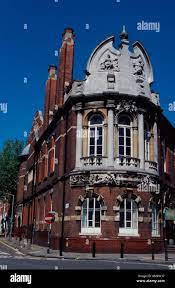
   The market later declined and the street might have been abandoned to be carved up by property developers but, fortunately, it’s now in a conservation area. Whenever I approach it, I stare up admiringly at Finsbury Town Hall, a dazzling monument to late Victorian confidence built in a flamboyant style known, apparently, as Flemish Renaissance Revival. It’s full of gloriously indulgent turrets, carvings, friezes , domes and fake medieval windows. Finsbury stopped being a separate borough in 1965 when it was merged with Islington, but this eccentric building has survived as a dance academy and venue for weddings. 

                                                         Happy Christmas, everyone!

.


Friday, 24 June 2022


Time and the City by Miranda Miller


World’s End is a poetically named area of London. In the 17th century, when this remote area lay beyond the village of Chelsea in Middlesex, there was a popular tavern here, with gardens leading down to the river. Most people would have arrived by boat and it was probably called "The World's End" because of its distance from London and the dangerous roads leading to it.


 Later, Cremorne Gardens occupied a large site running between the Thames and the King's Road. These lively pleasure gardens offered restaurants, a theatre, a banqueting hall, dancing, entertainments such as balloon ascents and the first ten-pin bowling alley in Britain.Pauline Violante,“The Female Blondin”, was paid to cross the Thames on a tightrope, wearing  Albanian costume. She walked from Battersea Bridge to the Cremorne Gardens, watched by 20,000 people.


The gardens could be entered from the north gate on Kings Road or by boat from the Cremorne Pier.  In 1856, a French visitor to London described this scene:

“A variety of attractions. One moves on methodically from the one to the other at the sound of a large bell which a man rings as he leads the way, the crowd trotting along behind him…In a Chinese bandstand an orchestra struck up a scottische. A minute later the carefully level open space was filled with couples…people here dance with their hips and their shoulders, seeming to have little control over their legs…frivolous young things improvise all sorts of indecorous antics.”

In 1877 the gardens were closed down “after protests by the Chelsea Vestry”–probably because of their reputation as a place for cruising, illicit assignations and prostitution. The original tavern was replaced by a Victorian gin palace.


That’s history. At which point does memory become history? I’ve known this part of London all my life. Recently I visited a friend who lives in Stadium Street, and as I wandered around in a post-Covid daze I reflected that I’m now so old that some of my memories of these streets are history (the usual definition of a historical novel is that most of it took place more than fifty years ago).


 One of my earliest memories is of walking down to the river here hand-in –hand with my father after Sunday lunch; throwing stale bread to the swooping screaming gulls, watching small boys diving into the river, envying mysterious people who lived on houseboats. During the years of rationing my mother bought illegal chickens and steak treats from a black-market butcher called Henry whose shop was in World’s End. In our greedy family Henry was a hero.


 This area was heavily polluted by smoke from Lots Road Power Station which once provided energy for most of the underground railways and trams in London. Dark streets stank of the brewery opposite, in Battersea, shrouding everything in its yeasty beery breath. Battersea Power Station loomed over the murky skyline like an ogre’s upside-down table as filthy traffic roared past on the embankment. This part of London, just a few hundred yards away from the grand houses of Cheyne Walk, was very poor. When I was twelve, I was invited to tea by a girl who lived down there. Barefoot children played on the pavement and my conventional parents thought her mother, a journalist, was wildly bohemian to live there. 


A few years later my first boyfriend dropped out of school and sat for months in a grimy basement in Ashburnham Road, philosophising and listening to Bob Dylan records, fascinating me by his negative energy. Iris Murdoch’s 1964 novel, Bruno’s Dream, brilliantly describes these streets. In my teens, I bought imaginative clothes at a boutique called Granny Takes a Trip on the King’s Road. Psychedelic designs on the front of the shop changed every few months, bringing colour and fun to this dreary area. 


Now I’m a granny, wandering around this strange and familiar part of London in a post-Covid daze. On the day I revisited this area the end of the world did feel quite close – it was soon after the Russian invasion of Ukraine and politicians were making terrifyingly casual references to using nuclear weapons.


In the late sixties many of these streets of small decaying houses were demolished and the World's End Estate was built: seven high-rise tower blocks of varying heights linked by low-rise blocks that form walkways in the sky. Thousands of people were housed here – an immensely ambitious social housing scheme that could never happen now.


 Down by the river there was once a 28-acre estate, Sandford Manor House. Nell Gwyn is thought to have lived there, the poet and essayist Joseph Addison lived nearby and, later, so did the ceramicist and potter William de Morgan.  In the 19th century part of the declining estate was bought by a gas company and the rest  was used as a railway coaling dock. In the 1980s this industrial wasteland was transformed into Chelsea Harbour. 


I walked past Lots Road Power Station, which is being converted into shops and luxury flats, to get the train at Imperial Wharf, past a yacht marina, a pier for river boat services, elegant towers and strange new buildings slender as credit cards. 


Cities, like people, reinvent themselves and physically, visibly, embody new ideas. Our memories are buried in bricks and mortar, the present pushes out the past but, in the mind, different times coexist. 


Miranda Miller’s eighth novel, Angelica Paintress of Minds, about the 18th century artist Angelica Kauffman, is published by Barbican Press. www.mirandamiller.info.


Friday, 27 December 2019

Angelica Kauffman by Miranda Miller


   My eighth novel, Angelica, Paintress of Minds, will be published by Barbican Press in June. to coincide with an exhibition of her work at the Royal Academy.
   A few years ago I had the good fortune to be awarded a Royal Literary Fund Fellowship at the Courtauld Institute, then housed in Somerset House. I became fascinated by the history of the building itself and by the story of the foundation of the Royal Academy there in 1768. In the library, deep in the basement, I found two excellent books: James Fenton’s School of Genius, a wonderful introduction to the eighteenth century art world in London, and Angelica Gooden’s biography of Angelica Kauffman, Miss Angel. Until then I only knew her paintings from visits to Kenwood House.
   Angelica’s mother was Swiss and her father, an unsuccessful painter, was Austrian. She grew up in her father’s studio and he soon realised that she was immensely talented. He used to ask her not to sign her paintings and would pass them off as his own. Other successful painters, including Artemisia Gentileschi and Élisabeth Vigée Le Brun, were also the daughters of painters; without such a background it was very hard for women to acquire an artistic education. Angelica was a prodigy, as can be seen from this self portrait she did when she was thirteen.

   In addition to being a talented artist Angelica had a beautiful singing voice. This painting dramatizes the decision she had to make in her youth to choose between painting and singing. All her life she performed as a good amateur singer and played the harpsichord. The great classical scholar Winckelmann said of her, ‘she sings with our best virtuosi.”

   After establishing herself as a painter in Italy Angelica came to London in 1766, when she was twenty-five. She became so successful that a word was coined, Angelicamad. She painted Queen Charlotte and other members of the royal family and her work was reproduced in engravings, as cameos by Wedgwood, on teapots and on Worcester, Meissen and Derby porcelain. The new invention of transfer printing made these items much cheaper and she gained an international reputation. Her popularity had a price; male artists could do as they liked but ‘paintresses’ always had to be decorous or risk losing their aristocratic patrons. Angelica was under enormous pressure to behave as ‘Miss Angel,’ the affectionate name her friend Joshua Reynolds gave her. Astonishingly, she was so well liked and respected that she survived the potential scandal of her first bigamous marriage to a fake Count. 

    I stared at this painting by Zoffany of the life drawing class in Old Somerset House and was intrigued to see that portraits of Angelica Kauffman and Mary Moser were on the wall, staring down at the proceedings like ancestors. Although they were both alive and founder members of the Royal Academy, as women they were not allowed to attend life drawing classes there because respectable ladies were not supposed to look at a naked man.
   After fifteen triumphant and lucrative years in London, Angelica was terrified (as a  Catholic) by the Gordon Riots and she decided to return to Italy with her second husband, Zucchi, a Venetian artist.
    I discovered that Angelica spent her last twenty-five years in Rome, a city where I lived in my twenties and which I love. 
 
    In my novel Angelica, as an old lady, is living in her house at the top of the Spanish steps. As she looks back on her life she is afraid of the new century which is destroying the world she knew and finds herself isolated because her husband and most of her friends have died or left Rome. She has a valuable art collection and expects the soldiers of Napoleon, who she detests, to arrive at any minute and loot it.
   In her studio, Angelica stares at her self portraits and relives her journey from a poor background to international fame. She draws us into her fascinating past through her self portraits and the portraits she has painted of her friends, including Antonio Canova, Germaine de Stael, Emma Hamilton and Goethe. This is a novel about a gifted and powerful woman with a kind heart. Like us, she lives at a time of bewildering change and fears the unknown future.
   Slowly, my interest developed into a passionate engagement with Angelica and the many interesting people she painted and befriended. Every time I encountered a new name - Reynolds, Canova, Goethe, Madame de Stael and many more - I had to stop writing my novel and read a book, or several books, about them. Thanks to a generous grant from the Authors’ Foundation I was able to return to Rome and also to visit Weimar to learn more about Goethe, with whom I believe she was unrequitedly in love.   This is the portrait she did of him, which Goethe disliked because he didn't think it made him look heroic enough.


   In order to make a successful career as an artist Angelica had to battle against powerful waves of misogyny. Those battles are still being fought; it was not until 1936 that another woman, Laura Knight, was elected as an RA. Finally, generations of talented women artists are beginning to be recognised. This is the right moment to rediscover Angelica Kauffman’s life and work.


Thursday, 25 July 2019

Cornwall by Miranda Miller


    Holidaying in Cornwall last month, I was struck by the two very different faces of the county: the beautiful, cheerful, prosperous coast and the strange ruined melancholy industrial buildings that lie abandoned on many cliffs and moorlands. It still feels quite remote and in fact many Cornish people don’t consider that Cornwall is an English county at all but a British country, Kernow. The Cornish nationalist movement demands a devolved legislative Cornish Assembly with powers similar to those in Wales and Scotland.

   Before the railways arrived, the journey from London to Penzance took at least two days by road. By the 1860s the rail journey had reduced this to twelve hours. A traditional Cornish tale claims that the devil would never dare to cross the River Tamar into Cornwall for fear of ending up as a pasty filling. Tourists didn’t come either until the nineteenth century.

   Virginia Woolf’s father, the literary critic and historian Sir Leslie Stephen, rented Talland House overlooking St Ives Bay in Cornwall, which he described in an 1884 letter as “a pocket-paradise with a sheltered cove of sand in easy reach (for ‘Ginia even) just below”. For her first twelve years she spent a few months each year at Talland House. The Godrevy Lighthouse could be seen in the distance and although Woolf set To the Lighthouse on the Scottish Isle of Skye, much of its imagery comes from her time in Cornwall.

    For nearly four thousand years before the first tourists arrived Cornwall was an important producer of tin, which when mixed with copper forms the alloy bronze. Although there are few Roman sites in Cornwall it is thought that they mined here. After the Romans left Cornwall remained under the rule of local Romano-British and Celtic elites and there were strong links with Brittany.

   Miners had the right to look for tin in any open land, as laid out in the Charter of Liberties to the Tinners of Devon and Cornwall in 1201. The same Charter also allowed miners to be exempt from military service and to pay lower taxes.

   In the eighteenth century deep mining of copper was made possible by the invention of pumping equipment to remove some of the water from underground and Cornwall became the greatest producer of copper in the world.  A Cornishman, Richard Trevithick, developed high pressure steam engines which, mounted on wheels, became the world’s first locomotives.

   A miner's life was always hard and brutal. Arsenic, which was used in insecticide and in paint, is a by-product of the processing of copper and tin. Because it is so poisonous workers needed to keep their mouth, nose and skin covered at all times, using clay to protect their skin at work. Women and girls didn’t go underground but were an essential part of the mining industry. Known as ‘Bal Maidens’, these women helped to separate tin from other mined substances.“Bal” is a Cornish word for mine.

    By 1839 about seven thousand children were working in the Cornish mines. Sons often followed their fathers down into the mines from the age of twelve. One particularly dangerous job they had to do was sweeping arsenic out of the flues.

   Temperatures underground sometimes reached 60 c. The miners worked stripped to the waist and after their shifts their bodies were covered in red dust from the lodes of tin, copper and zinc they exploded out of the bare rock. Death and injury from rockfalls and explosions were quite common and many miners developed bronchitis, TB and rheumatism. Few miners were fit to work beyond the age of forty.

   Then tin lodes were discovered in Australia, the Far East and South America, creating huge competition for the Cornish mines. Many mines closed in the 1890s and there was a “Cornish diaspora”, as miners left Cornwall to seek their fortunes in other mining areas across the world.
  
    This is the South Wheal mine, used in filming the TV series Poldark.

     The remaining mines still employed a lot of men and despite the dangers of the job it was lucrative. “Some weeks I would bring home £180 thanks to the bonuses,” said one ex-miner.“The average wage in Cornwall at that time (in the 1960s) was £12 a week.”

   Then, in October 1985, the price of tin crashed from over ten thousand pounds a ton ton to about three and a half thousand pounds a ton. This was because new alluvial tin was discovered in Malaysia and Brazil and also because the United States released their tin stockpile reserve onto the open market at the London Metal Exchange. Overnight, the remaining Cornish mines became unviable.

   In 1998, after more than three hundred years, one of the biggest mines, South Crofty, was forced to close with losses of thirty-three million pounds. Thousands of people were thrown out of work and towns such as Camborne, that once had thriving mines, now feel sad and impoverished.

   In 2016 a Canadian company, Strongbow Exploration, acquired a one hundred per cent stake in South Crofty, along with mineral rights over a further seven thousand hectares of land across Cornwall. A spokesman said: “We wouldn’t be doing this if we didn’t think South Crofty could open again. It was the jewel in the crown of an area with a rich mining history, and we believe that there’s a really good chance we can get it open again. We are extremely optimistic and feel that if everything goes well the mine could be open by 2021, and by open we mean with tin coming out of the ground.”


Tuesday, 25 June 2019

Emanuel Swedenborg and William Blake by Miranda Miller


    For years I’ve passed Swedenborg House in central London but haven’t dared to go in. The reason for my curiosity is because ever since adolescence I’ve loved the paintings, illustrated books and poetry of William Blake, who was influenced by Swedenborg’s ideas.


   So I was very pleased to be invited to a book launch in the Magic Lantern Room there by my friend Sally Kindberg a few weeks ago. Swedenborgianism bases its teachings on the writings of Emanuel Swedenborg, who was born in Stockholm 1688. He was a polymath who had a brilliant career as a theologian , scientist,  inventor, philosopher  and mystic.


   Here’s a drawing from his notebook (in 1714) of a flying machine. The pilot was supposed to sit in the middle and use paddles on the wing, like oars on a boat, to propel himself through the air. Swedenborg commented, “ The art of flying is hardly yet born. It will be perfected and some day people will fly up to the moon.” He studied anatomy  and physiology  and anticipated the neutron concept. He also believed that slavery should be abolished, observing that the inhabitants of the interior of Africa had preserved a direct intuition of God. As a result the first abolitionist society was founded by Swedenborgians in Sweden in 1779.


   When he was in his late fifties and living in London he had a vision of Christ,  who told him that he had been chosen to interpret the Scriptures and reform Christianity; he was to be given freedom to roam in the spirit world. He spent the remaining 28 years of his life writing about his adventures there and his conversations with angels, demons and spirits from, amongst other places,  Jupiter, Mars, Mercury, Saturn, Venus and the Moon.  His best known books are Heaven and Hell and The Heavenly Doctrine, in which he claims that the teachings of the Second Coming of Jesus Christ have been revealed to him. Swedenborg has been described, intriguingly, as a “secret agent on earth and in heaven.” Swedenborg called his movement The New Jerusalem Church but it only became an  institution after his death. Blake commented, “It is so with Swedenborg; he shews the folly of churches & exposes hypocrites”


   Swedenborg died in London in 1772 – apparently on the precise day he had predicted. He had, and still has, many followers. It has been suggested that his ideas influenced Joseph Smith, the founder on Mormonism. Writers who were interested in his ideas include Conan Doyle, Ralph Waldo Emerson, Henry James, Immanuel Kant, Balzac, Helen Keller, August Strindberg, Edgar Allan Poe, Walt Whitman and W. B. Yeats. Jorge Luis Borges called him “the most extraordinary man in recorded history.“ His unorthodox beliefs were a magnet for dissentors and intellectuals interested in radical politics which, in the late eighteenth century, were often linked to mysticism.


   William Blake is seen here in a portrait by Thomas Philips. In the bookshop on the ground floor of Swedenborg House books by and about Blake are prominently displayed. Alexander Gilchrist, Blake’s first biographer, wrote that “of all modern men, the engraver’s apprentice was to grow up likest to Emanuel Swedenborg.” Some scholars think that Blake came from a family of Swedenborgians and the Irish poet William Allingham imagined the fourteen-year-old Blake meeting the eighty-four-year-old Swedenborg on the streets of London.


   We know that Blake owned and annotated at least three of Swedenborg’s books and he mentions two others in such a way as to suggest that he read them. He and his wife Catherine attended the first General Conference of the New Jerusalem Church in 1789. Blake would have sympathised with the Conference’s endorsement of Swedenborg’s statement that the things seen by the visionary “are not fictions but were really seen and heard in a state in which I was broad awake.”  Like Blake, Swedenborgians had to defend themselves against charges of “enthusiasm” and madness. The Church that Blake visited was a development of the non-orthodox Theosophical Society which was established in 1783 by a printer with a Methodist background, Robert Hindmarsh. We know that a number of Blake’s friends and fellow artists were Swedenborgians and met in the Theosophical Society (in 1785 renamed as The British Society for the Propagation of the Doctrines of the New Church).


   In Blake’s epic poem Jerusalem he speaks of a “Jerusalem in every individual man, ” a very Swedenborgian idea. Both men had unconventional ideas about marriage and sexuality. In Visions of the Daughters of Albion Blake describes sexual violence, linking sexual liberation with human freedom. Oothoon rages at her lover Theotormon for his “hypocrite modesty.” She describes herself as “A virgin fill’d with virgin fancies”; in accordance with the ideal of the virtuous woman at the time, she is not allowed to express her true sexual desires. In a paradise on the coast of Africa similar to the one described by Swedenborg in his Plan, Oothoon describes a utopian future time of free love, when “Love! Love! Love! happy happy Love!” can be “Free as the mountain wind”


   Many Swedenborgians shared another of Blake’s deepest concerns: opposition to slavery. In his long poem America Blake’s revolutionary spirit, Orc, is referred to as “the Image of God who dwells in the darkness of Africa.


    Later Blake seems to have turnied sharply against the Swedenborgians and satirized them in The Marriage of Heaven and Hell (1790-93). “How do you know but ev’ry Bird that cuts the airy way, Is an immense world of delight, clos’d by your senses five?” Blake began to mistrust the church's emphasis on the avoidance of sin and eventually accused Swedenborg of “Lies and priestcraft” while the New Jerusalem Church split into factions. Swedenborg's greatest error, according to Blake, lay in his failure to understand the real nature of evil.


   Blake saw Heaven and Hell not as real locations but as representations of the human heart. For him, angels represented conservative values whereas devils were rebels; Blake saw himself as a revolutionary devil and also used the concepts of Heaven and Hell in his own polemic against the materialistic philosophies of Locke, Bacon and Newton.

   Blake’s private mythology, which make many of his beautiful poems hard to follow, was certainly influenced by Swedenburg’s writings and I find this a helpful approach.


Saturday, 25 May 2019

Venice by Miranda Miller


      I first fell in love with Venice when I was ten and since then I’ve been back many times. Heightened awareness of climate change made my recent visit even more moving. In November last year high winds combined with a seasonal high tide put much of Venice under water and created havoc as schools and hospitals were closed and people were advised against leaving their homes. Climate change related art has dominated the Venice Biennale this year. One of the more surreal sights in this dreamlike city is a white skyscraper floating past the end of a medieval street - actually a monstrous cruise ship, which damages the fragile lagoon ecosystem and pollutes the waters. Il mare la chiama - the sea is calling its bride, Venetians say when wind stirs up the water of the lagoon. There’s a very real danger that the sea will destroy its bride.

   Thomas Mann compared entering Venice by one of the road or railway bridges to entering a palace through the back door. I’ve always used that door but now the approach is even more dazzling because of the Alilaguna, a frequent boat service from Marco Polo airport that takes you to every part of the city. On this visit I had time to explore some corners of the city I hadn’t seen before.


    The church of S. Pietro di Castello has stood on this site since at least the 7th century. In the very early days there was a annual festival here when betrothed couples came to the church, the girls carrying their dowries in a little chest. In 944 Istrian pirates stormed the island and abducted the girls, with their dowries. The Doge led his fleet, pursued them, and triumphantly returned with both the girls and their money. This bizarre scene was reenacted in the Festa delle Marie for five hundred years. Now S. Pietro is a Palladian church with a sleepy grassy campo in front of it. It was Venice’s cathedral for two hundred and fifty years, until Napoleon deposed the last Doge and made San Marco, formerly the state church of the doges, the cathedral.


    This is Gam Gam, my favourite kosher restaurant, just by the main entrance to the Ghetto. The origins of this word, which has spread all over the world, can be traced to the word gheto, which in Venetian means a foundry. This are was once an island where Venetian Jews were confined after sunset by decree. As Jews from all over Europe settled here each synagogue belonged to a different nationality—German, Italian, Spanish, and Sephardic. Last month it was heartbreaking to see armed soldiers guarding the ghetto against the violence of neo fascist anti-semitic groups like Casa Pound.


   Torcello is one of the more remote islands in the lagoon. Venetians call it Torre e Cielo, towers and sky. Once twenty thousand people lived here and there were convents, a bishop and a thriving wool industry; then people left as malaria struck and canals silted up. Torcello is now more commercial than it used to be with some shops, cafes and restaurants, but has very few permanent inhabitants. On our last visit we met one of them - an old man playing chess with himself outside a house with a ‘for sale’ sign. He asked Gordon to stay and play chess with him but we were worried we’d miss the last boat back to Venice so we hurried on (and have felt guilty ever since). This year we noticed his house was boarded up, with an ATM machine where his front door used to be.


   In 1678 Vivaldi was born in a campo, or piazza, round the corner from where we were staying, He taught the violin to the girls in a nearby foundling hospital, the Ospedale della Pietà, and was later promoted to music director. He was nicknamed il Prete Rosso, the Red Priest, because of his red hair (not his politics). It was frustrating to find that, of the vast quantity of covcerti and operas he wrote, only The Four Seasons seems to be regularly performed now in Venice. Many of his concerti were composed to celebrate splendid ceremonies like this one.


    Before  Napoleon conquered the Republic there were four great Ospedali in Venice that combined medical care with charity work. Their musical ensembles of orphaned girls, or cori , were remarkable in a society that disapproved of professional female musicians, apart from a few adored operatic divas. In 1743 Jean-Jacques Rousseau heard one of these choirs at the Ospedale dei Mendicanti and described their singing as “far superior to that of the opera, and which has not its like,either in Italy or the rest of the world.” These talented girls had to perform in raised galleries which had grating that hid the female singers and musicians from the eyes of the audience.


    On another walk we wandered into Ospedale. surely the most beautiful working hospital in the world. On the Campo San Giovanni e Paolo there appear to be two great  Renaissance churches next to one another; one of them, with a magnificent façade, is actually the main entrance to Venice’s hospital,  an extraordinary complex of ancient and modern buildings that includes the Historical Medical Library, the Museum of Anatomic Pathology and a fascinating Pharmacy Museum.


   This is the entrance to Arsenale, the shipyard of Venice during the great days of its empire. Founded in the twelfth century, it’s a huge walled area that still covers over a hundred acres and once employed two thousand workers. By the sixteenth century a galley could be built here and launched in a day. It’s guarded by the lions of St Mark and at the bottom of the door you can see sculptures of the Greek gods and allegorical figures. The statue of Nike, the winged goddess of victory, was added after the Venetian fleet helped to win the great sea battle of Lepanto in 1571. There’s also a bust of Dante and a quotation from Canto XXI of his Inferno, where he compares hell to the pitch made in the fiery depths of the Arsenal.


   April 25th is both the Feast of St Mark, the patron saint of the city, and also the anniversary of the day in 1945 when American troops liberated Venice from Nazi and Fascist domination. A series of plaques all over the city, near bridges, remind you of the names of individuals who died fighting fascism (similar plaques in the pavement all over Berlin are memorials to Jewish families who once lived there). !n Giardini, the gardens where much of the Biennale takes place, young Venetians sang traditional songs and complained about their housing problems. We watched as an elderly crowd assembled to reminisce about the war and then marched off carrying a banner celebrating the courage of the Partigiani, or Resistance.

     This photo shows the remembrance festival for Resistance fighters held last year in St Mark’s Square.


   The permanent residential population of Venice is now only 53,000 people, most of them older, and each year about a thousand residents move away from the city. Venice is visited  every year by twenty million tourists - who sometimes wonder why Venetians are less friendly than most other Italians. One hopeful development is the rise of the ASC, the Social Assembly for the House, a grassroots movement that helps families under threat of being thrown out of their homes by landlords who can, of course, make far more money out of renting their apartments to tourists than to young Venetians. Combined with the threat of climate change, there is a real risk that depopulation will turn Venice into a wondrous museum.