
Showing posts with label Peter Blake. Show all posts

Saturday, 18 July 2015

Shadow Boxes - Celia Rees

I've always been fascinated by Wunderkammer, Cabinets of Curiosities, things in boxes, the stranger the better, so I was delighted to hear about Joseph Cornell's Wanderlust Exhibition at the Royal Academy .
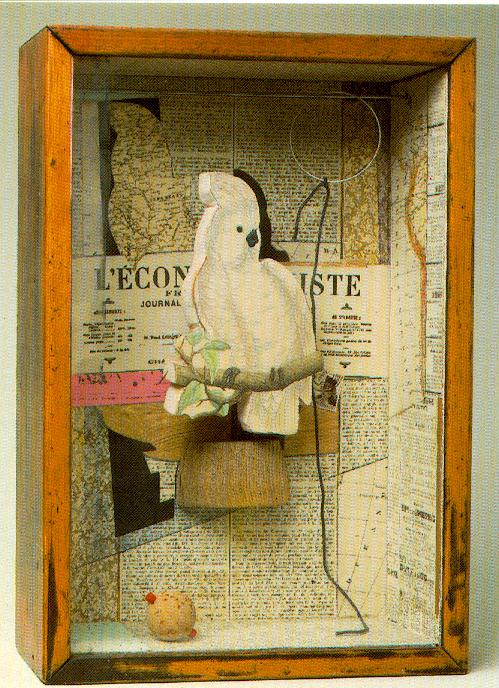

A Parrot for Juan Gris 
Winter 1953-54


Joseph Cornell was born in Nyack, New York, Christmas Eve, 1903. He rarely stirred out of his native state but his art took him to far distant places. He didn't set out to be an artist, yet his work can be found in the Museum of Modern Art in New York, the Guggenheim, the Smithsonian and museums all over the world. He began as an obsessive collector. He wandered the streets of New York in his lunch hour, haunting the second hand shops, dime stores and flea markets collecting old books, prints, photographs, keepsakes and odd bits and pieces from clay pipes to watch springs. On day, in 1931, he went into a gallery looking for a particular photograph and stumbled into an exhibition of surrealism. He was instantly attracted to the collages of Max Ernst and began making his own assemblages of images at his kitchen table. Gradually, he developed the glass fronted 'shadow box', boxed assemblages of found objects, which became his art form. 


Untitled (The Hotel Eden), 1945

His collections of found objects and ephemera allowed him to travel and explore realms of the imagination and creativity without ever leaving his basement in Queens. He became an 'armchair voyager', creating little worlds and stories captured in boxes, caught behind glass. He used maps and postage stamps, timetables and hotel advertisements, postcards and photographs, Baedeker guides and compasses. The viewer is drawn into an evocative world of distant exotic places, but they are places that never existed, realms of the imagination, something akin to fairyland. I think this is why I find his creations so fascinating. 


Pharmacy, 1943

Cornell was admired by many of his contemporaries - from the Dadaist Marcel Duchamp to Willem de Kooning and Mark Rothko. His influence can be seen in the work of later artists, like Peter Blake and Damien Hirst. 

Naples, 1942


Cornell's shadow boxes speak to me in a particular way. I find them inspirational and exciting, a visual expression of something familiar yet oddly disturbing. When we write anything, particularly when we write of the past, of places that can no longer be seen or visited, it is as though we are doing the same thing as Joseph Cornell but in words. The found objects, the printed ephemera of a particular time, pictures, postcards, paintings and photographs are the kinds of things we collect when we are writing. An exhibition like this makes me want to create my own shadow boxes made from the visual reference I've used to create a particular book. Perhaps I will one day. 

Untitled (Tilly Losch),  c. 1935. 

Tuesday, 30 July 2013

The Cabinet of Curiosities - Celia Rees


This engraving in Ferrante Imperato's Dell'Historia Naturale (Naples 1599) is the earliest pictorial record of a Cabinet of Curiosities. The original Cabinets were not cabinets at all but rooms and this one  is full, floor to ceiling, with books, stuffed animals, horns, tusks, skulls, skeletons, shells, different kinds of man-made instruments. On the walls there are shelves and built in cabinets holding fossils, mineral samples, specimen boxes and covered jars.  The visitors are pointing, looking round in awe and wonder at the fantastic display. Indeed, in Germany, such collections were called Wunderkammer, wonder rooms.

These rooms might contain all sorts of other things, too. Mixed in with the natural history specimens might be small sculptures, clockwork automata, ethnographic specimens (beads, masks, clothing, weapons, everyday objects) from faraway locations. There was no division between fact and fiction. Among the stuffed fish and birds there might be a unicorn's horn (generally the tusk from a narwhal) or the purported remains of some other mythical creature.  These cabinets brought together specimens from all over the known world: Ming porcelain from China, artefacts from the Americas, Japanese footwear. 


It is no coincidence that many of the classic collections were made in the 16th and 17th Centuries at the time of European expansion and exploration. The cabinet might also contain articles from different periods of history: from pre-historic flint axes to Roman, Greek and Egyptian artefacts. Different belief systems were displayed together: religious icons and relics were placed alongside pagan images and amulets, instruments used in alchemy, objects associated with witchcraft. There was no real attempt to categorise. Some of the specimens were genuine, others undoubtedly fake, but this didn't seem to matter. These were collections of the strange, the unusual, the exotic, the curious; collected by the curious, to entertain, stimulate, intrigue the curious mind.  


These collections were the foundations of our modern museums. The jumble of objects would be teased apart and categorised to become the basis of modern branches of study: natural history, natural sciences, zoology, ornithology, geology, palaeontology, archaeology, ethnography, anthropology, and so on. 


John Tradescant the Elder
John Tradescant the Younger


The Musaeum Tradescantianum, established in Vauxhall, in London held the collection of curiosities assembled by the John Tradescants,  Elder and Younger: travellers, explorers and collectors. The collection was eventually acquired by Elias Asmole and in 1691, it became the nucleus for the Ashmolean Museum in Oxford. Some of the original exhibits are still on display.  


John Tradescant the Younger described the collection thus:


‘Now for the materialls themselves, I reduce them unto two sorts; one Naturall, of which some are more familiarly known & named amongst us, as divers sorts of Birds, foure-footed Beasts and Fishes, to whom I have given usual English names. Others are lesse familiar, and as yet unfitted with apt English termes, as the shell-Creatures, Insects, Mineralls, Outlandish-Fruits, and the like, which are part of the Materia Medica; (Encroachers upon this faculty, may try how they can crack such shels) The other sort is Artificialls, as Utensills, House-holdstuffe, Habits, Instruments of Warre used by severall Nations, rare curiosities of Art, &c. These are also expressed in English, (saving the Coynes, which would vary but little if Translated) for the ready satisfying whomsoever may desire a view thereof'.


Philippa Gregory's novels Earthly Joys and Virgin Earth give an excellent fictionalised account of the lives of the Tradescants. 

Sir Hans Sloane's extensive collection formed the foundation of the British Museum and the Natural History Museum. The British Museum was first opened to the public on its Bloomsbury site in 1759. It has changed a great deal since then, but my favourite area is the Enlightenment Gallery installed in the former Kings Library which re-creates the variety of objects, from  the Magician John Dee's skrying mirror to sea shells, that characterised the museum in the mid 18th Century. 

British Museum
British Museum


In the 18th Century collecting was what a gentleman with any pretensions to learning and culture did. I made sure when I was writing Sovay, that Sovay's father, Sir John, had his own Cabinet of Curiosities. In his case, his Library. 


The shelves were stocked from floor to ceiling with books on every possible subject. The walls were studded with chronometers and barometers. Globes and astrolabes stood about on the floor. Cabinets held stuffed birds and animals, samples of rocks, minerals and fossils. Every surface was crowded with bits of machinery, brass-crafted devices for generating this, measuring that. 

His collection was based on Matthew Boulton's at Soho House, Birmingham. What collections contained, reflected the pre-occupations and passions of the time. 

My favourite museums are the ones that still retain some of this eclectic flavour, whose collections still have the feeling that these things have been brought together by one man's curiosity.  I can spend hours in the Pitt Rivers in Oxford or the Wellcome Collection in London.
Wellcome Collection

Pitt Rivers Museum
Every time I go, I see something different. Both contain an extensive collection of the weird and grotesque which give something of the feeling of wonder, fascination, even horror, that the first Cabinets of Curiosity must have evoked. 

The Cabinets did not just give rise to some of our greatest  museums, the bizarre, freakish, exotic and grotesque would be exhibited in fairground sideshows and commercial freak shows.


Peter Blake: Museum For Myself
Cabinets of Curiosities, Wunderkammer, were also seen as 'memory theatres'. They contained 'found' objects that the collector had acquired while excavating, exploring, or travelling, on the Grand Tour, for example, souvenirs in other words. Things that had attracted that individual's attention for some reason, ignited their curiosity. I like Peter Blake's idea of a Museum For Myself, of creating one's own museum, full of items of some personal significance or importance, objects of interest or fascination, or simply ones that one can't quite part with, can't bear to throw away.


Peter Blake's Museum of the Colour White
This is a gift to the compulsive collector. It gives us permission to do something that other people think is utterly pointless, and something to do with the useless objects that we collect. It is also very creative. Collections can be made and unmade, arranged and re-arranged.

As you can probably guess, I do have my own Cabinet of Curiosities. I also have a printers' block that contains smaller objects.


My Cabinet of Curiosities
Printers' Block with Smaller Objects


It's not just me, my friend Barbara has one, too.

Barbara's Cabinet


I wonder if anyone else has a similar collection and where it is housed?

This is part of a History Girls Project where we will be collecting our own virtual Cabinet of Curiosities. I can't wait to see what it will contain. 

Celia Rees