
Showing posts with label Royal Academy. Show all posts

Tuesday, 16 February 2016

Gorgeous Gardens, by Sue Purkiss

If winter's getting you down and you're longing for a walk in a sun-drenched garden, heavy with the perfume of brilliantly coloured flowers and tinkling with the tranquil sound of fountains, fear not; you can avoid the expense of a holiday in warmer climes and the inconvenience of airport queues by wending your way instead to the Royal Academy, where a luscious exhibition entitled Painting the Modern Garden lies drowsily waiting for you to open the gate, wander in, and breathe in the beauty.


Claude Monet is the linchpin of the exhibition. The first two paintings both show the garden he had as a young man, in Argenteuil. One is by him; the one above is by his friend Pierre-Auguste Renoir, and it shows Monet painting. Gardens had become very popular in France by the time the Impressionists were painting; Pissarro and Caillebotte were also enthusiastic - not just about painting gardens, but about creating them. For Monet, of course, it was a passion which continued throughout his life.

But the exhibition is far from being just about Monet. Each room has a different theme. After Impressionist Gardens, we get International Gardens, which features paintings by John Singer Sargent, Max Liebermann, and a Spanish artist, Joaquin Sorolla, whose painting of the garden at his house in Madrid is suffused with warm pinks and reds, with heavy roses dripping from a rambler that climbs up against the terracotta wall. It's redolent with the heat of summer in Spain, but also with the oasis of shade a garden can provide.


Then we return to Monet's Early Years at Giverny, which is of course the garden he's famous for. This section tells the story of the development of the garden, giving us a sense of Monet as a highly skilled and respected gardener as well as an artist: here are seed catalogues, a letter he wrote when planning permission for the extension to the garden, which involved diverting water from a nearby river to create the waterlily pool, was initially turned down. And here too are rows of plants, cuttings, perhaps: which remind us of the work behind the beauty. I noted down the words of a garden writer on seeing some of the first pictures of the pool and the lilies: 'No more earth, no more sky - no more limits.' They must have seemed astonishing: revolutionary.

The next room is called Gardens of Silence. There are no people in these gardens. They have an other-worldly feel to them: these are not gardens for every day. This one is by another Spanish painter, Santiago Rusinol. I found it mesmerising, with the pale, ghostly tree in the centre set against the backdrop of glowing autumnal copper and gold, which is echoed in the colour of the circle of rose bushes. Rusinol was apparently fascinated by the Alhambra and other secluded Moorish gardens in Andalucia. This garden was in Aranjuez, and it was part of a great and formerly glorious royal garden. The dramatic, hot colours contrasted with the vivid green of the foreground perhaps suggest the drama of the history of Spain, as well as its southern heat and light.


I really liked the paintings by Emil Nolde which were in the next section, Avant-gardens (Nice title!). I can't find a reproduction of any of those in the exhibition, but they had gloriously rich, vibrant colours. One was a close-up of vivid blue hyacinths, scarlet tulips, the bright green verticals of stems and leaves, and egg-yolk yellow narcissi; another had white peonies and gold and purple irises.

Gardens of Reverie was probably my least favourite room. But then we were back to Monet's Later Years at Giverny. He was still painting the same beloved garden; but now, in 1918, with the horror of the First World War coming closer and closer, he poured his pity and his horror into a painting of a weeping willow with an orange trunk. The brush strokes writhe and twist as if tortured: there is a palpable sense of pain and sadness - agony, almost. He said sadly, 'Others can fight. I can paint.'

But then, finally, we come to the massive paintings of the water-lily pool which he made after the war. And with these, there is a sense that he was expressing through paint harmony, serenity and balance restored. Paintings to gaze on. Paintings to make you feel better. Paintings to sooth the savage breast. This small picture can only hint at their beauty - if you can, do go and see the real thing!



Saturday, 18 July 2015

Shadow Boxes - Celia Rees

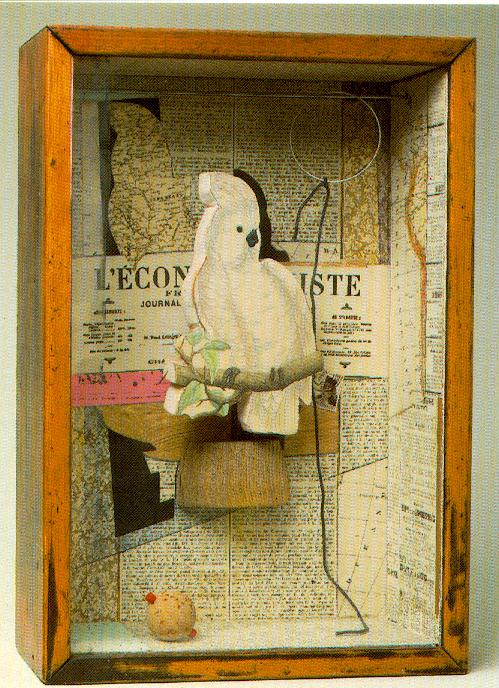
I've always been fascinated by Wunderkammer, Cabinets of Curiosities, things in boxes, the stranger the better, so I was delighted to hear about Joseph Cornell's Wanderlust Exhibition at the Royal Academy .


A Parrot for Juan Gris 
Winter 1953-54


Joseph Cornell was born in Nyack, New York, Christmas Eve, 1903. He rarely stirred out of his native state but his art took him to far distant places. He didn't set out to be an artist, yet his work can be found in the Museum of Modern Art in New York, the Guggenheim, the Smithsonian and museums all over the world. He began as an obsessive collector. He wandered the streets of New York in his lunch hour, haunting the second hand shops, dime stores and flea markets collecting old books, prints, photographs, keepsakes and odd bits and pieces from clay pipes to watch springs. On day, in 1931, he went into a gallery looking for a particular photograph and stumbled into an exhibition of surrealism. He was instantly attracted to the collages of Max Ernst and began making his own assemblages of images at his kitchen table. Gradually, he developed the glass fronted 'shadow box', boxed assemblages of found objects, which became his art form. 


Untitled (The Hotel Eden), 1945

His collections of found objects and ephemera allowed him to travel and explore realms of the imagination and creativity without ever leaving his basement in Queens. He became an 'armchair voyager', creating little worlds and stories captured in boxes, caught behind glass. He used maps and postage stamps, timetables and hotel advertisements, postcards and photographs, Baedeker guides and compasses. The viewer is drawn into an evocative world of distant exotic places, but they are places that never existed, realms of the imagination, something akin to fairyland. I think this is why I find his creations so fascinating. 


Pharmacy, 1943

Cornell was admired by many of his contemporaries - from the Dadaist Marcel Duchamp to Willem de Kooning and Mark Rothko. His influence can be seen in the work of later artists, like Peter Blake and Damien Hirst. 

Naples, 1942


Cornell's shadow boxes speak to me in a particular way. I find them inspirational and exciting, a visual expression of something familiar yet oddly disturbing. When we write anything, particularly when we write of the past, of places that can no longer be seen or visited, it is as though we are doing the same thing as Joseph Cornell but in words. The found objects, the printed ephemera of a particular time, pictures, postcards, paintings and photographs are the kinds of things we collect when we are writing. An exhibition like this makes me want to create my own shadow boxes made from the visual reference I've used to create a particular book. Perhaps I will one day. 

Untitled (Tilly Losch),  c. 1935. 

Tuesday, 13 January 2015

MORONI: the portrait as a portal to the past – Elizabeth Fremantle

I discovered Giovanni Battista Moroni when seeking inspiration for characters and atmosphere for a novel I was writing, set in the late sixteenth century and encountered his tailor in the National Gallery gazing out at me through time. Often the sitters in Italian portraits of this period seem trussed into their finery, worn by their clothes, displaying their status, but not this tailor. Rather, his white notched doublet, cut in the fashionable peas-cod style looks worn in like a favourite garment, slightly baggy at the elbows and a little creased, and not at all alien as garments such as this often do in portraiture, stiff and peculiar and uncomfortable. The ruff too, is small and unobtrusive and an ordinary, thin leather belt follows the contours of his waist. Indeed it is only the hose, voluminous and slashed, like the hideous bubble-skirts of the eighties, that seem unfamiliar reminding us of the four hundred and fifty years that separate us from this man.

He gazes at us with a beguiling directness, as if he has overheard us talking about him and wants us to know.  He appears confident in his everyday clothes, with no need of the accoutrements of status to shore him up. His head is tilted slightly, his hair cropped short and a beard and moustache give him the look of any young man you might see on the streets of London today – no silly hat with an ostrich plume for our no-nonsense tailor. I always thought it was Caravaggio who coined the portraits of ordinary people performing the manual labours of quotidian life but this tailor predates Caravaggio's work by a good twenty years. There he is, living and breathing, his mind churning, on the gallery wall collapsing time – you can almost hear the sound of his shears cutting through the marked out cloth, feel the velvet beneath his fingers. The effect is utterly disarming.

My greatest frustration on discovering Moroni was that his body of work was scattered around the world and that an 'unfashionable' artist like him was unlikely to be the subject of a solo show. He never achieved the status of Titian or Bronzini, not through lack of talent, for it is clear his work stands up next to theirs, but more likely because he remained a provincial artist in his own time. He had a moment in the nineteenth century, when the National Gallery dedicated an exhibition to him (perhaps the Victorians liked his uncomplicated and understated directness) and then in the nineteen-eighties when the same gallery hung a number of his works as part of a Venetian exhibition. Strictly speaking though, Moroni was not part of the Venetian school, coming from Bergamo not far from Milan and working in Albino and Trent but never straying towards the regional capitals where he might have been noticed by Vasari and included in his exhaustive catalogue of renaissance painters, The Lives of the Artists, another reason, perhaps, as to why Moroni was ignored for so long.

So imagine my delight when I discovered that the Royal Academy were to put on an entire exhibition of his work and I would be able to encounter all the images, the fuzzy cousins of which I had scrutinised online. Work in reproduction can never satisfy like the real thing, it is flattened, divested of life, offering only a partial experience, like Plato's shadows. But to see the body of Moroni's work, the early paintings, mostly devotional: a pastel Christ hovering on candy-floss clouds; a serious man praying before the virgin; an ancient, goitered woman gazing at a prayer book, all revealing an attention to detail and humanity that is the precursor to his later portraits.

For me it is the portraits that are Moroni's triumph; each one reveals his extraordinary rendition of the particulars of jewellery and clothing, the variety of fabrics exquisitely depicted and so lifelike you can sense their weight and smell and how they would feel beneath your fingers. Just look at the genial Gerolamo Albani with the frizz of his white beard, that would tickle were you to kiss him on the cheek, and the luxury of his spotted fur, soft as a cat, a finger keeping the place in his book as if he was disturbed while reading.  But beyond these textures it is the deep exploration of his sitters' expressions revealing something of what lies beneath and the way they appear to examine the viewer, as with the Portrait of a Young Lady who scrutinises us, as we do the same to her. What is it behind that challenging look, is it disapproval, has she been interrupted or is it that shyness that is often mistaken for disdain? Perhaps she is disturbed by our scrutiny.

The Exhibition is on only until 29th January and I urge you to go.

https://www.royalacademy.org.uk/exhibition/giovanni-battista-moroni

Find out about Elizabeth Fremantle's historical novels on her website ElizabethFremantle.com