by Marie-Louise Jensen
In honour of our July celebration of Jane Austen, I thought I'd draw readers' attention to the research done by Janine Barchas in her work Matters of Fact in Jane Austen: History, Location and Celebrity.
This came to my attention through some coincidences.
When I set my second YA novel The Lady in the Tower at Farleigh Hungerford Castle near Bath, I had no idea at all that I was treading in Jane Austen's footsteps. I had no idea until Janine wrote to me and told me that her daughter was reading my novel (bought on holiday in New Zealand, as far as I remember!) and she had realised that it was set in the very castle that she had researched in connection with Austen's Northanger Abbey.
All Austen fans remember Catherine Moorland's disappointing, abortive drive to Blaise Castle with the dreadful John Thorpe. In her book, Barchas points out that this was a ludicrous trip to a castle so far away when there was a very popular ruined castle within six miles of Bath - an easy drive. Farleigh was, according to Barchas, a popular day-trip for visitors to Bath, and full of the kind of gruesome Gothic history that would have appealed so much to Catherine Moorland. Barchas further proposes the theory that Northanger Abbey was based on Farleigh Castle. Once that connection is made, it seems blindingly obvious. Jane Austen's family, she tells us, had a guide book including Farleigh Castle and it is even annotated in her hand. It is very likely she visited the castle herself.
There are many dark tales connected with Farleigh Castle. Austen alludes to the murder of John Cotell by his wife Agnes. His body was allegedly burned in the kitchen range and she and two servants were later prosecuted for the murder. This is echoed in Austen's novel when Catherine Moorland suspects General Tilney of doing away with his wife at Northanger Abbey.
This incident had only a brief reference in my novel; I was more drawn by the tale of Lady Elizabeth, locked in the Lady Tower for several years. But it's strange to realise that I was inspired to write a story by the same location as Jane Austen without knowing it.
I can thoroughly recommend Janine Barchas' book on Austen. It's a fascinating read, and reveals many things, among others Austen's subtle sense of humour. Much is still amusing for a modern audience today, but other things require context. For example, Barchas points out that Thorpe was the name of the local map maker in Bath in Austen's time. Giving John Thorpe his name when he cannot find the way to Blaise Castle and doesn't know about Farleigh Castle is a little dig that only locals would have understood. There are many gems like this in Barchas' research.
Showing posts with label The Lady in the Tower. Show all posts
Saturday, 15 July 2017
Thursday, 15 October 2015
Executions
by Marie-Louise Jensen
This is a gruesome post. If you are squeamish, don't read on.
I was asked to talk to Year 7s and 8s last week about my book the Lady in the Tower and about the Tudors. It's not a recent book and I've never spoken specifically about it before, so I had a reread and a think and the thing that struck me most was the deaths by execution.
Really, the monarchs of that time, and especially Henry VIII were unfettered psychopaths and mass murderers.
Execution was so common; and it was a grand day out for all the family - take a picnic, take the kids.
Poor people were hanged at Tyburn. Mostly their main crime was just that; poverty. The same law for rich and poor, but as we know, the rich have no need to steal. Although they often do, just in more sophisticated ways.
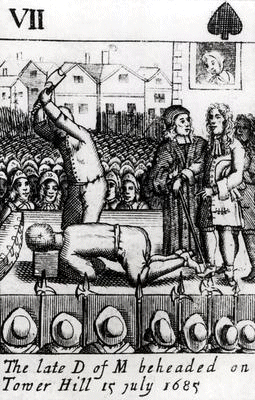
But hanging was deemed too brutal for the nobility. They got to be beheaded instead on Tower Hill instead. Lucky them. Interestingly they also got to step up onto the scaffold with a priest, who would be offering religious comfort, and there they had to pay and forgive the executioner before execution. Yes, really.
I asked the class how much they'd pay him. The overwhelming response was 'nothing'. But I think I'd pay him an awful lot.
Because what good is money once you're headless? And if you've got to lose your head, you really, really want to do it quickly and cleanly. You don't want him taking eleven goes at it, which I believe is the record. There's nothing non-brutal about that.
Anne Boleyn, as is common knowledge, was so afraid of the axe that she begged and was granted, execution by sword instead.
She was also one of only seven nobles to be granted a 'private' execution inside the Tower of London at Tower Green, rather than the public spot of nearby Tower Hill. Five of these nobles were women, revealing that even unleashed psychopaths who murdered on trumped-up charges to protect their own position were aware that some sensitivity was required executing women.
Even inside the tower grounds, there might have been privacy from the masses, but the audiences still numbered up to 200.
And that nice little habit of picking up the severed head to show it to the crowd? Anyone who has always believed that this was to show the head to the crowd is wrong, or at least only partly right. It was mainly intended to triumphantly show the head itself its own body as it lay on the block: we remain conscious for at least 8 seconds after our head is severed, before lack of oxygen causes brain death. I didn't share this detail with the students; I find the brutality of this deeply disturbing as an example of what human beings are willing to do to one another. If only beheading was a practice that belonged firmly in the past in the world.
As for my main character's father, Sir Walter Hungerford: he was beheaded at Tower Hill, with Father Bird, the vicar of Bradford-on-Avon, a month after the execution of his friend and ally Thomas Cromwell. Reportedly he raved and fought his executioners on the scaffold. That's considered to be a sign that he was mad. But you could see him as the only sane and normal person in a sick charade (if it hadn't been for some of his more dastardly acts towards his own family).
After an execution, the family were handed the body to bury while the head was boiled ready for display on a spike on London Bridge. The final step in the gruesome pageant of power and death.
As for hanging, drawing and quartering or burning at the stake - well, that wasn't divided into commoner and nobility. These tortured fates were reserved for those the king really, really hated.
This is a gruesome post. If you are squeamish, don't read on.
I was asked to talk to Year 7s and 8s last week about my book the Lady in the Tower and about the Tudors. It's not a recent book and I've never spoken specifically about it before, so I had a reread and a think and the thing that struck me most was the deaths by execution.
Really, the monarchs of that time, and especially Henry VIII were unfettered psychopaths and mass murderers.
Execution was so common; and it was a grand day out for all the family - take a picnic, take the kids.
Poor people were hanged at Tyburn. Mostly their main crime was just that; poverty. The same law for rich and poor, but as we know, the rich have no need to steal. Although they often do, just in more sophisticated ways.
But hanging was deemed too brutal for the nobility. They got to be beheaded instead on Tower Hill instead. Lucky them. Interestingly they also got to step up onto the scaffold with a priest, who would be offering religious comfort, and there they had to pay and forgive the executioner before execution. Yes, really.I asked the class how much they'd pay him. The overwhelming response was 'nothing'. But I think I'd pay him an awful lot.
Because what good is money once you're headless? And if you've got to lose your head, you really, really want to do it quickly and cleanly. You don't want him taking eleven goes at it, which I believe is the record. There's nothing non-brutal about that.
Anne Boleyn, as is common knowledge, was so afraid of the axe that she begged and was granted, execution by sword instead.
She was also one of only seven nobles to be granted a 'private' execution inside the Tower of London at Tower Green, rather than the public spot of nearby Tower Hill. Five of these nobles were women, revealing that even unleashed psychopaths who murdered on trumped-up charges to protect their own position were aware that some sensitivity was required executing women.
Even inside the tower grounds, there might have been privacy from the masses, but the audiences still numbered up to 200.
And that nice little habit of picking up the severed head to show it to the crowd? Anyone who has always believed that this was to show the head to the crowd is wrong, or at least only partly right. It was mainly intended to triumphantly show the head itself its own body as it lay on the block: we remain conscious for at least 8 seconds after our head is severed, before lack of oxygen causes brain death. I didn't share this detail with the students; I find the brutality of this deeply disturbing as an example of what human beings are willing to do to one another. If only beheading was a practice that belonged firmly in the past in the world.
As for my main character's father, Sir Walter Hungerford: he was beheaded at Tower Hill, with Father Bird, the vicar of Bradford-on-Avon, a month after the execution of his friend and ally Thomas Cromwell. Reportedly he raved and fought his executioners on the scaffold. That's considered to be a sign that he was mad. But you could see him as the only sane and normal person in a sick charade (if it hadn't been for some of his more dastardly acts towards his own family).After an execution, the family were handed the body to bury while the head was boiled ready for display on a spike on London Bridge. The final step in the gruesome pageant of power and death.
As for hanging, drawing and quartering or burning at the stake - well, that wasn't divided into commoner and nobility. These tortured fates were reserved for those the king really, really hated.
Subscribe to:
Posts (Atom)