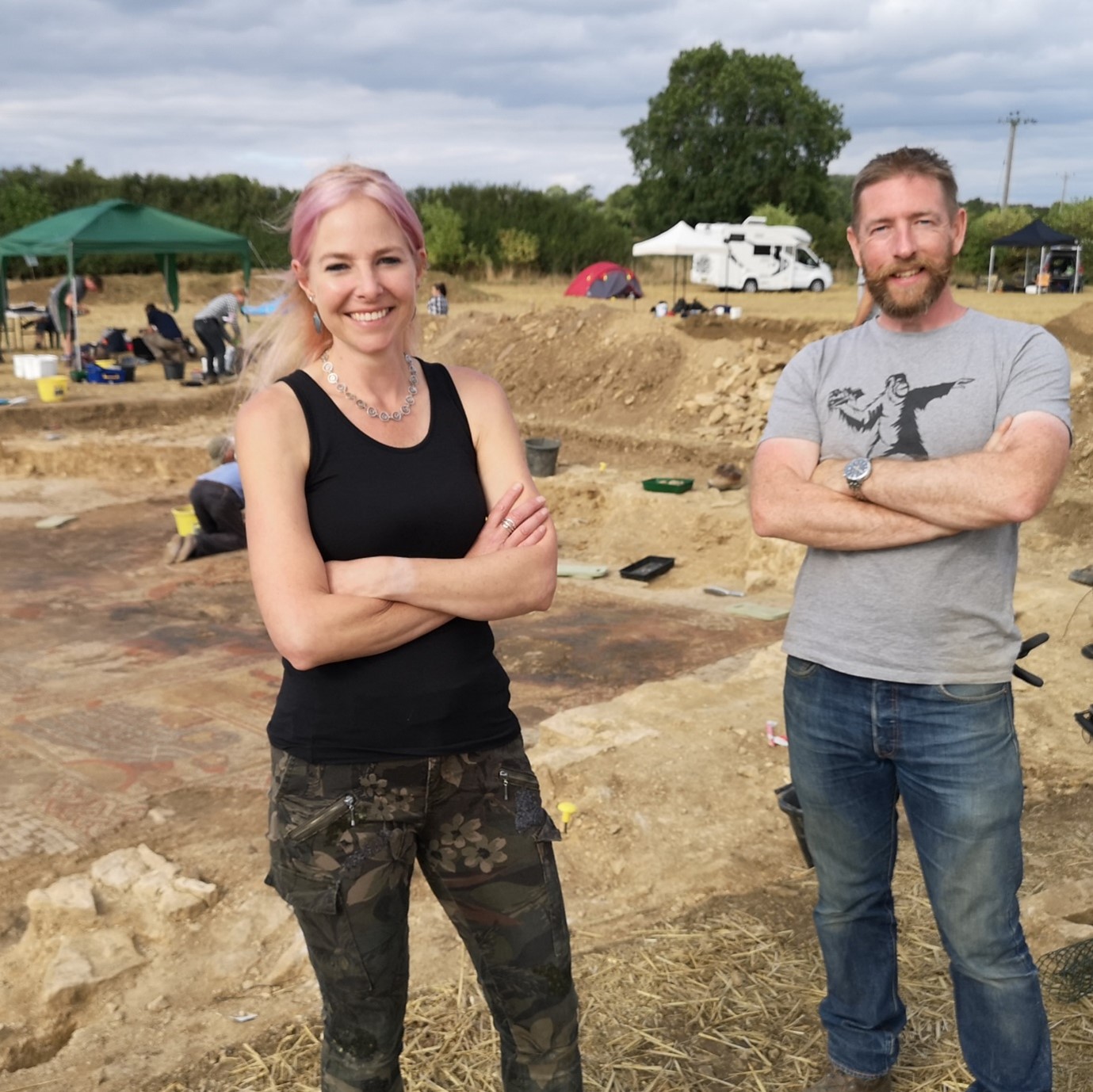
Professor Alice Roberts from BBC Two's 'Digging for Britain' and Jim Irvine, who discovered the Roman Villa and its mosaics. © Jim Irvine.
A chance discovery during a walk in the fields during lockdown became breaking news in late November 2021. Jim Irvine, engineer and son of a farmer, realised that he had stumbled across a Roman Villa, complete with stunning mosaics which have been hailed as ‘the find of the century’. The Villa complex is believed to have been occupied between the 3rd and 4th century AD, probably by a wealthy individual with a knowledge of classical Greek and Roman literature.
The remains of the mosaic measure 11m by almost 7m and it is thought to have been the floor of a large dining or entertaining area where it would have been designed to impress visitors to the Villa. Three panels tell the story (almost like a cartoon strip) of Achilles’ battle with Hector at the conclusion of the Trojan War. Mosaics appeared in private and public buildings across the Roman Empire, and often depicted characters from mythology and history. However, the Rutland mosaic is so far unique in the UK (and one of only a few across Europe) in showing scenes from Homer’s Iliad. Homer’s epic poem, based on events in the Trojan War, was composed in the 8th or early 7th century BC. The mosaic also depicts Hector's body being ransomed for gold, a scene not in Homer's Iliad but in a lost version of the Trojan War by the Greek playwright Aeschylus (who lived in the 6th to 5th century BC).
Caroline K. Mackenzie spoke with Jim Irvine about the story behind the headlines, the serendipity of a swarm of bees, and the thrill of being part of BBC Two’s ‘Digging for Britain’ with Professor Alice Roberts.
Please could you tell me a little bit about yourself and how long you and your family have been farming the land?
My Dad’s family own the farm. He and his brother own the land between them and my Dad is the tenant farmer. I have been working on the farm since I was a kid and I have walked in the field where the Roman Villa is for over 30 years.
I am an engineering director of a company in the hydrogen production business. So my actual farming activities are really limited now to evenings during harvest and/or weekends when my Dad needs me to chainsaw up a tree or fix a broken combine harvester!
Please could you tell me the story of how you first discovered the initial signs of a Roman site?
It was a bit of an adventure! During lockdown when six people were allowed to get together, my wife and I and our two daughters saw quite a lot of my parents as they live only a few miles away. One sunny day in the summer of 2020, during that particularly dry period, we decided to go and lark about in the river. As we were going down to the river we had a bit of a run-in with some local bees which the local beekeeper has there and we all got stung. My wife tumbled onto the ground and I had to pull the bees out of her plaits - it was all quite disconcerting.
After we had played in the river, we decided we probably should not go back past the bees again. We decided to walk around the bottom of the field on the other side. The crop had not grown by the river because in the winter of the previous year there had been some flooding. There was about 10m of bare soil which we were trudging along. This is where I spotted a few bits and pieces which were the sorts of things you might see in a local museum: a piece of pottery, part of a hypocaust [a system of central heating in a building that produces and circulates hot air below the floor of a room], and even some oyster shells. Although I could reconcile the piece of pottery with some building rubble from the Victorian house across the river, I couldn’t reconcile the oyster shells as I was pretty sure they had never grown in Rutland!
The orange bits of tile were the first bits that jumped out at me because the rest of the ground is brown with bits of limestone strewn across it from the subsoil. As soon as we started looking closely at the ground, we started noticing more bits. If you walk across the field today, even in the stubble, you can’t really go five paces without spotting some broken bit of building material, or a bit of pot, or a tessera [a small block of stone, tile, glass, or other material used in the construction of a mosaic]. In retrospect I am slightly annoyed at myself as I consider myself to be quite an observant person - how did I not notice this before?!
The field is used for cereal - it gets cultivated, it grows, is harvested, and is re-cultivated. Usually, the best time to discover any hidden artefacts in a field is just after the field has been ploughed and after some heavy rain which washes all the soil off anything like pottery, stone and glass. But in this instance, it was the specific conditions on that small patch of field where the flood had not allowed the crop to grow that led to the discovery. The combination of lockdown, the bees, and the right conditions all conspired to illuminate this find to me. And I have some lovely honey in the cupboard so I forgive the bees for stinging us!
Jim digging in the field under the watchful eye of one of his daughters. © Jim Irvine.
What happened next?
I brought a few bits home and photographed them. I did a lot of work to find out why they might be there. I looked at LiDAR [a detection system which works on the principle of radar], old maps, and the thing that really illuminated it was the overhead Google maps photo which revealed a very obvious crop mark along the outline of the building - you couldn’t miss it! This was also a fluke as the photo was from June 2018, which was when we had a long, hot summer so the crop mark was clearly evident. I looked back at the historical imagery right back to the 1990s, taken at all different times of the year, and there was no evidence of any crop marks at all.
I texted my Dad to ask if he had ever noticed any big bits of stone in the field while ploughing it and he said he had seen a couple of bits. So I sent him the picture!
I then went to where I thought the crop mark was in the field and looked around to see what the topology was like. I walked around the tramlines and looked in the gaps where there were no crops. I found a few more oyster shells on the surface in the mixed-up plough soil. I even dug a small trench along one of the tramlines but didn’t really find anything. At this point the crops were about one month off being harvested, which distorts the heights and makes it hard to see the ground levels.
I kept badgering my Dad to get on with harvesting the wheat! It was towards the end of lockdown and one day we decided that instead of going to the beach we would go to the field. We took the kids and went with some folding chairs, a sunshade, and a picnic. I worked out where I thought the wall would be, based on the crop mark, the GPS on my phone and the position of features like the tram lines in the field, the trees and hedges.
I have always been interested in archaeology generally, but I have never studied it. I had a rough idea of what I thought a Roman Villa might look like, with a courtyard surrounded by buildings with covered areas. But because the crop marks indicated a building with apses, I was thinking more of a medieval building or a church. I had never seen an apse on a Roman Villa, but I had never really looked that closely.
This time when I dug a trench, I found some small tiles at the bottom of the hole - they were tesserae measuring around an inch square. I still didn’t consider it was Roman. I had in my mind it was medieval as there are so many medieval buildings here in Lincolnshire and Staffordshire.
In a portion of the trench I dug, the soil changed to a lighter colour - more like mortar. The soil is quite loamy - limestone mixed with soil - so is easy to dig when it is dry. I dug a couple of feet down making a hole not quite a foot square and there were about 30 tiles at the bottom. I had thought I would find a wall but instead it appeared to be a path around the outside of the building. My Dad came with a pickaxe and some brushes, and we expanded outwards until we reached a number of small tesserae joined together and a pattern started to emerge. We were pretty shocked.
This was the guilloche [a pattern of interwoven strands, resembling rope, often used as a border in Roman mosaics] around the outside of the figured mosaic. We went a bit further and exposed what transpired to be a depiction of a foot and so worked upwards to reveal more of the figure. I should add that we were exceptionally careful as we worked. We only uncovered the bit that was easy to uncover. The Romans did a spectacular job of creating a level floor. I put my mobile phone on it with a Level App and it was completely level in both directions. This made it very easy to dig because you knew what level to put in your spade without digging into the floor. We uncovered quite a bit of the mosaic but stopped where the mosaic had clearly been damaged by something or other - it was sinking down a bit.
As the mosaic was uncovered, the depiction of a face appeared. © Jim Irvine.
When did you realise you needed to call in some archaeologists?
Having discovered some of the mosaic panels, we decided we needed to tell someone about it. After various initial phone calls, such as to the museum in Peterborough, I ascertained that I needed to report it to the Leicestershire Historic Environment Record Officer, Helen Wells. I put a presentation together outlining all the above with photos, and we talked through it all on a video call. Interestingly, someone else had spotted the crop mark and recorded it about a month before I had. Helen suggested we arrange a field walk.
A couple of days later, Peter Liddell, the former county archaeologist, came to the site together with John Thomas and Dr Jen Browning, both from ULAS (University of Leicester Archaeological Services). I remember the four of us peering into the hole that I had dug.
How long did the excavations take and what were the most exciting discoveries?
In the summer of 2020, they secured funding which accommodated some geophysics and an archaeological dig with the help of some volunteers. David Neal, a mosaics expert, came and sketched the portion of the mosaic that was uncovered. I was fortunate enough to be able to help out and was asked to drive the digger. What is great is that they have kept me involved throughout. My Dad doesn’t like reading emails so I am the point of communication for everybody - a bit like the PR guy! It has certainly kept me busy.
I have learned so much having been actively involved in excavation in both years, 2020 and 2021. I have a trowel and I now know how to clean a mosaic and how to record it, having worked with the archaeologists.
There was also the involvement from the BBC Two ‘Digging for Britain’ team led by Professor Alice Roberts. John Thomas at ULAS has worked with them before so the producers contacted him to ask if he had anything going on at that moment. He said “Actually, yes!”. I had the opportunity to work with the Digging for Britain team throughout and we were fortunate that they gave the discovery a lot of airtime - almost half a show was dedicated to it.
David Neal drawing and recording the mosaic. © Jim Irvine.
I gather you had to keep it all secret - that must have been hard!
It was probably the worst kept secret in the area! A lot of my friends knew it was going on and we did have a number of visitors to the site but they all had to keep quiet about it. We were fortunate in that it is quite an inaccessible area so people probably wouldn’t notice it just driving past. Now of course the mosaic has been reburied for its ongoing preservation.
In the first year of excavations it was only open for four or five weeks. The archaeologists came back later to do some further excavation on the other areas of interest such as parallel ditches - a lot of the artefacts were at the bottom of the ditches.
We had uncovered about one third of the room with the mosaic in 2020. In 2021, the plan was to dig a much bigger trench over the whole area. That was when the rest of the room was uncovered and it transpired that the mosaic was about 11m by 7m.
.jpg)
The mosaic itself is a remarkable discovery. Although there are other Roman mosaics in Britain, this is the only one we know of so far depicting scenes from the Trojan War. The three panels show Achilles and Hector fighting from their chariots, Achilles dragging Hector’s corpse around the walls of Troy and finally Hector’s father Priam ransoming his son’s body for gold. Do you recall the moment when the scenes were identified and their significance was realised?
I had a long call from the Leicestershire county archaeologist, Richard Clark. After we had revealed the three panels which each showed a portion of the story, they were able to figure out what it was because of the various details such as the horses, and Priam’s Phrygian cap [an attribute often used in classical Greek iconography to identify Trojans as non-Greek]. Richard explained it to me really clearly and I thought “Wow - that is amazing” because this is a story that has endured from Greek times, through Roman times right up until the present day - you can even watch Brad Pitt in a film about Troy!
This part of the mosaic depicts the ransoming of Hector's body for gold by his father Priam, identifiable by his (red) Phrygian cap. Priam is second from the right in this image. © Jim Irvine.
Was this your first introduction to Homer and his stories of the Trojan war? If so, has it inspired you to learn more about the Classical world and/or Roman Britain?
Being an engineer, I don’t have time to read stories. But I had seen the film about Troy! However, my Classical education is limited. When I was a kid I used to read factual books rather than any mythology books. It is only as I have got older that I have been more interested in History and this discovery is a really good focal point for me. I think Homer’s Iliad is a massive volume and probably beyond my capability to read.
[CKM interrupts to say that a good translation is accessible to anyone - it is quite simply a great story. CKM enthusiastically waves a copy of Homer's Iliad at her computer screen and urges Jim to read it.]
OK - I’ll do that! I don’t feel like I am doing my job properly unless I read it!
My interest in this is really what does this tell us about the Roman people at the time and how they interpreted the Iliad. Did they get this from a pattern book and tell the mosaicist that they wanted these three pictures? Or was it someone who knew about the Iliad and had it written down somewhere and said, “I want you to represent that story for me”? For me, the people aspect is thrilling.
Absolutely. I have been reading Homer's Iliad with my online Classics Club reading group throughout lockdown (see earlier blog on Classics Club) and it is amazing to think that people in Roman Britain may have been reading and enjoying the same story as we are today. Although I haven’t gone as far as commissioning a mosaic floor, one member of the reading group who is an artist created a lovely painting for me depicting, guess what, Hector and Achilles in battle, with the Trojan horse in the background. It seems our desire to have images in our homes of the stories we love has not changed in 1600 years!
Looking forward, are you able to tell me about the future plans for further excavations?
It will depend on funding of course. Historic England and ULAS are co-ordinating some more excavation this year but the plan is not yet formalised. I understand they are expecting to uncover a lot more in terms of square metres than previously.
The whole site has phases of archaeology across it. There are potentially some roundhouses, rectangular buildings, a bath house, and aisled buildings, etc.
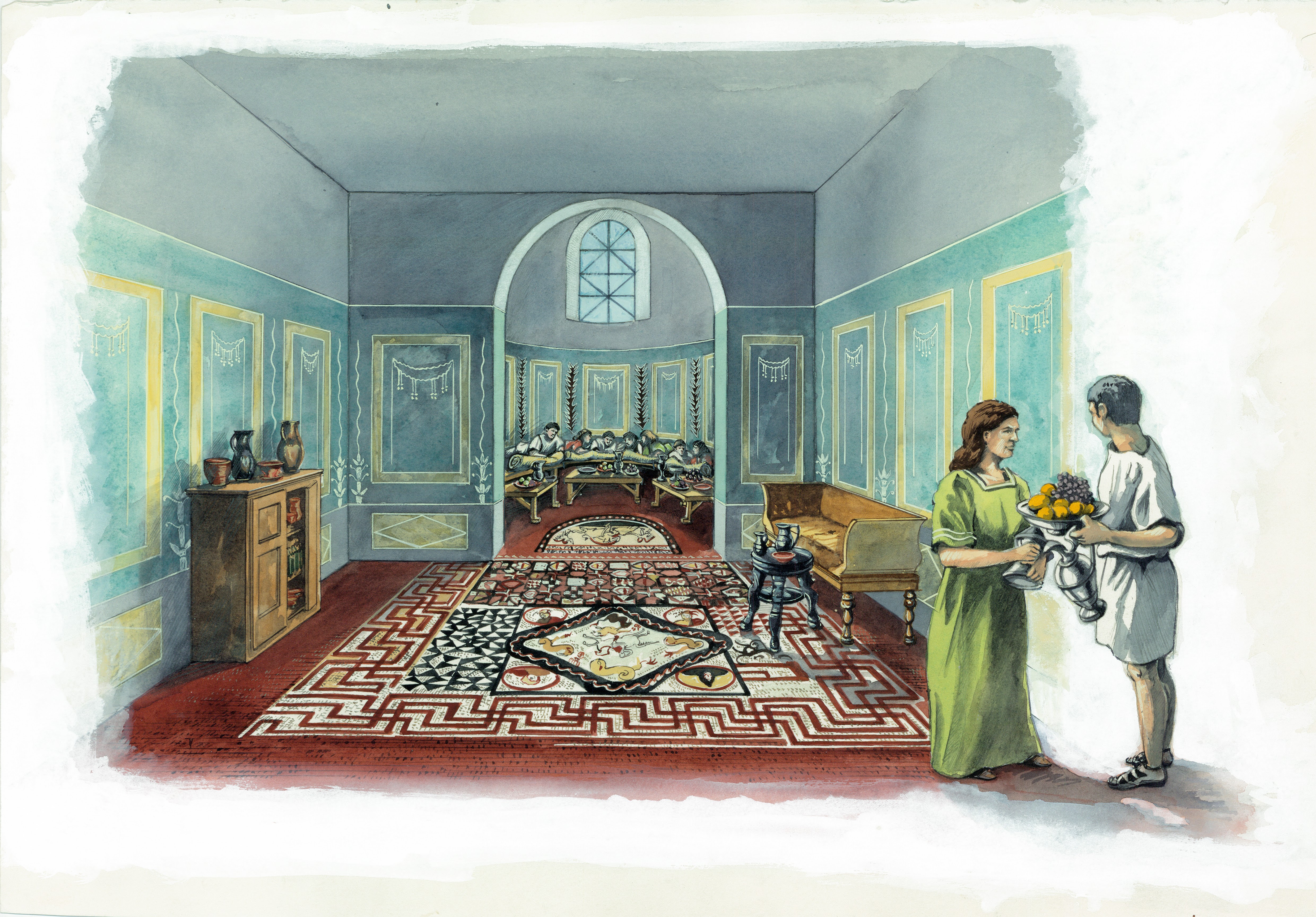
Illustration of the baths at
Lullingstone Roman Villa, Kent as they may have appeared in the late third century AD
. (Illustration by Peter Dunn/Richard Lea.) © Historic England Archive.
Rutland Roman Villa may also have had baths.
What would be your dream discovery on your land?
Gold. (Only joking!)
For me, my main interest is what is the state of preservation of the other parts. I am thinking from an engineering point of view here. Next to the field is an area of unfarmed land of about one acre which is just left wild as it is completely inaccessible - it has not been farmed since big machinery came along. It has trees and brambles on it and is in a horrendous mess - anything underneath it will have roots through it. I am fascinated to learn more about the history of the site from the time when whoever owned it with the mosaic ceased to occupy the site and how it has been maintained as it is today.
My personal view is that for the preservation of things like the mosaic, which is only two foot deep and well within root damage depth, for it not to have been damaged and the walls still to be there must mean it has been continuously inhabited or maintained as farmland since it had a building on it. That is the only way it wouldn’t get destroyed by vegetation over time. We have literally just shaved the top of everything through farming but everything else is pretty much as it was when it fell down. I can’t wait to see it all.
At the end of the last excavation, we discovered another mosaic in an adjoining room to the main mosaic room, and we just exposed the corner of it. There also appears to be a tiled corridor which may be the next part of the building which was in great condition
Is there any chance the mosaic of Hector and Achilles will be uncovered again?
It is well preserved. The first year it was covered in a special washed sand, then a membrane and soil on top of that. When [Professor] Alice [Roberts] brushed off the sand it was exactly as we had covered it up before. I was really emotional about that as I had been thinking about it the whole time, for a whole year, and I hadn’t seen it except for the picture on my phone which I look at every day. So seeing it come back again was a moment of “Wow, this is really great.” We cleaned it last year and it looked amazing. When the sand came off, as you can see in the footage, it looked spectacular and that was really what it looked like. Preservation in situ is the best way to look after these things - it’s not going anywhere. The cost of putting a building over it and having tourist access would be millions of pounds. It is well recorded with photos and David Neal’s drawings. Also, the local museum is going to have a virtual exhibit.
Professor Alice Roberts cleaning the sand from the mosaic. © Jim Irvine.
What was the most exciting part for you of it all?
Driving the digger. (Only joking - again!)
It was great to do the TV and to meet the professionals, [Professor] Alice [Roberts] is really nice, and she knows her stuff about bones! I had the chance to work with her while she was on site and it was very interesting as I had never worked on anything like that before.
The thing that has been most interesting is to have been asked to be involved in the excavations and fieldwork with bio-archaeologists. How many people get to excavate and clean a Roman mosaic? I am quite privileged. I think more people have been on TV or driven diggers than have excavated mosaics!
I would love to do more because you have to really think about what you are doing and understand what you are poking your trowel around to make sure you don’t damage anything. I am pretty careful when it comes to working with small things like this but I can also tell when something is robust and is made to be strong. Working in the field and working directly on the mosaic was great - I was there whenever I got the chance. I cleaned Hector’s face and Priam’s feet goodness knows how many times - not many people can say that!
It must have been an amazing discovery for your daughters as well! Has it inspired either of them to become archaeologists?
My youngest daughter wants to become a palaeontologist but for them it has been rather matter of fact. She is at primary school and her class are learning about the Romans and mosaics. They all wrote to me asking me to tell them something about my experience, which was really nice. This is why I like doing talks about the Villa as I love to tell people about the discovery and to get people interested. It is something that I never thought I would be interested in and I think everyone should have the opportunity to engage in this sort of history.
We have a lot to thank you for, not only for discovering the Villa, but also for being so enthusiastic and keen to share the discovery.
The news broke on the Thursday and the following day when I went to work in my garden shed/home office, I telephoned my boss to ask if I could have half a day off as I had to meet ITN and BBC in a field to do an interview. It was then non-stop for a week. It was great and another new experience for me. As well as learning about history and being involved in an archaeological dig, I was then doing media stuff which I had never done before. The last two years have been a massive thrill for me.
It’s amazing to think that the Roman Villa and its incredible mosaic have been under our feet for a long time and we had not noticed the signs until recently. But my interest and awareness have significantly improved and changed such that I look at every piece of farmland slightly differently now.
*****************************************************
Post script: While writing up this interview, I reflected on the circumstances that led to this remarkable discovery, and the serendipity of the swarm of bees. Stories of bees seemed strangely familiar. I then remembered that in Book 2 of the Iliad, Homer describes the Greeks gathering for a council as resembling a mass of bees ‘swarming out from a hollow in the rock in a never-ending stream’. Later, in Book 12, a Trojan warrior describes two Greek warriors defending the entrance to their fortifications as fierce insects defending their nests: ‘But now, like… bees who have made their houses by a rocky path, and will not leave their hollow home, but face the men who come to hunt them and fight to defend their babies, so these men… will not give way from the gates’. [Translations: Hammond, Penguin Classics.]
What a lovely twist of fate, therefore, that bees played a part in the discovery of the Rutland Roman Villa and its stunning mosaic of Hector and Achilles in battle. Homer’s comparisons of the Greeks with bees and the bees’ role in leading Jim Irvine to the mosaic of Achilles (perhaps the most famous Greek warrior of all) provides yet another link between the stories of 8th century BC Greece, the inhabitants of the Roman Villa in Britain in the 4th century AD, and the family who own the land today.
Many thanks to Jim Irvine for kindly giving the interview to the History Girls and for permission to use his photographs of the dig.
Thank you also to Historic England Archive for permission to use the images of Lullingstone Roman Villa.
 @carolinetutor
LinkedIn: Caroline K. Mackenzie





.jpg)
.jpg)


.JPG)
.JPG)
.JPG)
.JPG)