Showing posts with label VEH Masters. Show all posts

Friday, 5 January 2024

Why did men wear Cod Pieces? by Vicky Masters

I went to see the rock group Jethro Tull perform on several occasions when I was a lot younger. The front man, Ian Anderson, would stand on one leg playing the flute, which was fairly impressive, but what really drew the eye was the glittering codpiece he wore while doing so.

The next time I encountered a codpiece was many years later in a display case amongst the dressing up clothes at Stirling Castle. This was on a whole different level to Anderson's which seemed remarkably discreet by comparison. Indeed, to my 21st century eyes, it was so immodestly large and protruding I was embarrassed to be caught staring at it and moved swiftly on.


 When I came to write my first novel I debated whether my characters should don them or not and wondered if they were indeed commonly worn by the men of Scotland in 1546. I decided to delve, metaphorically, into the codpiece further.

Cod, in this instance, has nothing to do with fish but was the slang for scrotum. Codpieces began as something quite practical – a small piece of cloth to fill the space between tunic and hose, serving the function of the contemporary zip fly and preserving men's modesty. But as the fashion in doublets became shorter, greater covering was required and the codpiece became a fashion statement of itself, and a sign of virility in the early 1500s. 

They were inevitably the provenance of the wealthy, a statement of power and masculine bravado and, as such, were worn by the swashbuckler about town. They were not considered acceptable wear for the humbler members of society – although smaller twill versions have been found.


Often they were decorated with tassels, bows or jewels. Some were large enough to store coins, a handkerchief or even a handy snack. The increased padding provided protection from swords, lances and other implements of war. Here's King Henry VIII's armour, with protective appendage, which can be viewed at the Tower of London.


But the era of the cod piece was also the period when the pox was rife throughout Europe. Treating syphilis involved a range of herbs, sticky unguents and decoctions. Containing it all within a large codpiece helped protect clothing from stains, as well as keeping the poultice in place.

The sumptuary Act of 1562 raises 'the monstrous and outrageous greatness' of codpieces, although the new double ruffs worn at the neck also incurred disapproval. Both were categorised as inappropriate apparel for any but those attending court and the phrase 'aping your betters' was much bandied about.

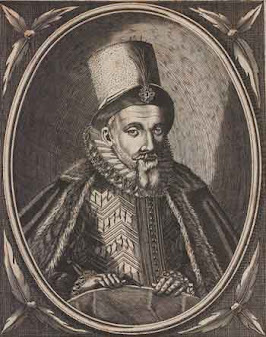
By late 16th century the cod piece had had its day and was replaced by the well padded stomach, known as a peascod belly; the codpiece beneath gradually shrinking in size – as in this Portrait of a Gentleman below painted circa 1580 where the codpiece only peeps out.


As for why Ian Anderson sported one I suspect it was a piece of flamboyant fun that fitted with the overall romance of the clothes of the 1970s. And his was modest by comparison with the 'packages' some other rock stars were creating.

And did I have my male characters sport codpieces...  in my third in series The Apostates one does pop up, which I had some fun with…

Bethia turned to the man on her other side who was wearing a most alarming headdress, consisting of a number of ostrich feathers set in a metal ring around his bonnet. They were dyed in alternating red and green, drawing all eyes to him and making him seem much taller than he was. Each time he turned his head the feathers brushed against the side of Bethia's face.
     'Your plumes are most wondrous,' she said.
     He preened, proud as any cock. 'They are come from Matthaus Schwarz, for he is the king of such designs.'
      Bethia smiled politely.
      'You don't know of Master Schwarz? I thought you were recently living in Antwerp, and he works for the Fuggers who are much in evidence in that city.'
       'I do know of the Fugger Brothers for they are great merchants but I didn't go out much while I lived in Antwerp.'
      'You must be very happy to have left then,' said her companion and she couldn't stop the bubble of laughter escaping.
      They discussed ostrich feathers, and the delicate task of dyeing them so they weren't damaged, until the subject was exhausted at which point he moved onto cod pieces, standing up to display the thrust of his.
      'Look, I had my jeweller provide a few diamonds to make it sparkle and the tassels are of my particular design. It even cunningly holds this,' he said fiddling at his package.
      Bethia knew she should avert her eyes but somehow could not. She waited to see what would emerge. He tugged out a handkerchief, flourishing it to the applause of those around them. 

References:

Grace Vicary, Visual Art as Social Data: The Renaissance Codpiece

Ruth Goodman, How to be a Tudor: A Dawn-to-Dusk Guide to Everyday Life

V E H Masters is the award winning author of The Seton Chronicles. You can find out more about her at vehmasters.com. and if you subscribe to her newsletter there are a couple of free short stories relating to her novels, available only for subscribers


Friday, 7 July 2023

How do you dig a Siege Tunnel?

If you've ever been to St Andrews you'll know it's not only the home of golf and site of Scotland's oldest university but the town itself is steeped in history. Once a great centre of pilgrimage, the cathedral was left in ruins after the Scottish Reformation in 1560. Although I grew up in St Andrews the ruins were simply part of the backdrop of daily life. I was twelve years old before our history teacher, Miss Grubb, took us to visit what was left of the cathedral.

St Andrews Cathedral

We also visited the castle where there is there is the most remarkable siege tunnel, dug in 1546 and the best surviving example of siege tunnelling in Europe from the era.


St Andrews Castle

You enter it from the side of the dry moat via a steep and uneven few steps. Almost immediately you're bent double and for anyone who is at all claustrophobic a quick retreat is in order.


Entrance to Siege Tunnel


Creeping down the central trench, at constant risk of scraping your back on the rough stone above, you come to a fork which leads to a dead end. You retreat and continue along the main tunnel, the sense of being squeezed growing ever greater until you can barely draw breath. Then suddenly the narrow passage ends. There's a wall of rock before you and nowhere to go. Yet looking down you spy an entrance hole.

Dare you squash yourself throughand descend the metal ladder to find out what’s below? Down you tentatively go and the space opens out. 

The tunnel is a tale of two halves and this part is broad and high with steps leading to the sealed off entrance beneath a house in North Street. There’s also a grating visible, which my brother and his friends entertained themselves during school lunchbreaks by howling down from the street above, to terrify (or perhaps create atmosphere for) the tourists beneath.


From the moment I first went down the siege tunnel at St Andrews Castle I was utterly entranced. And when I learned the men who had taken the castle early one morning by stealth, murdered its cardinal in revenge for the burning of a Protestant preacher, and held it against all comers for the next fourteen months called themselves 'the castilians' I felt a shiver of foreknowledge. What a perfect title for a book, I thought… I didn't know then how very long it would take me to write it!


I did however always wonder what the point of tunnelling in was. Surely as soon as the besiegers popped their head up out of the tunnel it would likely be knocked off? When I came to do the research for The Castilians I finally understood.

The information is in the name – I have so far referred to this long underground passage as a siege tunnel and was confused as a schoolgirl why it was called the mine and counter mine.

It was never the intention of Mary Queen of Scots forces (we are in the period of regency and Mary is only 3 years old) to tunnel into the castle, capture the Protestants holding it and thus break the siege. The purpose of digging was to undermine the curtain wall, set explosives beneath it, bring it down and then storm the castle.

This is why, when you go down the tunnel/mine it's a tale of two halves. The first part is low and narrow and clearly dug at great speed. Once you climb down the iron ladder into the second part it's wide and high.

The besiegers began to dig in what was then known as Northgait, now North Street, at the back of a house, and hidden from those patrolling the castle walls. The aim was to dig secretly and deep until they gauged they were beneath the curtain wall. They'd then support the roof of the mine with wooden props, set explosives around the props, light fires and run fast as they could out the tunnel before it blew. The explosion would bring down part of the wall, the troops would charge and the castle would be re-taken.

But…this is the great era of siege warfare and those who are holding the castle are well aware their besiegers will likely try to get them out by undermining the walls. One of the ways those inside the castle could ascertain if mining was happening was to set up bowls of water around the courtyard and see if the water was rippling – a sign of underground activity.

False Start

In the case of the siege of St Andrews Castle those within were fairly certain the besiegers were tunnelling in. The aim then was to counter mine out as fast as they could and intercept the mine before the besiegers got beneath the curtain wall. 

The challenge was to work out where the besiegers were actually digging if they were to intercept them and inside the castle there are a couple of very deep holes to be found – false starts. Eventually they found the right spot… here's an exert from The Castilians

They hear sounds of alarm; it seems they are discovered. Any attempt to stay quiet is given up and they excavate as hard and fast as they can. Someone has fetched Richard Lee and he pushes past Will, directing them to attack the ground beneath, and not before them.

‘We must be quick,’ he hisses, ‘else they’ll have time to set explosives and blow us into eternity.’

Will shovels the rubble behind him to keep the area clear for the miners to work – there’s no time to scuttle back up the passageway with it now. A hole has appeared in the floor of the tunnel. Lee has a man shield the candles, whispering that he needs it dark to see if there’s torchlight shining through from below.

Will, Lee and the two miners all huddled tight together nudge one another: light is shining through. They enlarge the hole, cries beneath them growing loud, then fading. Lee kneels at the edge, and sticks his head through. Will can feel Lee’s body tense, ready to pull his head back. He is a brave man. They wait.

Lee lifts his head out and smiles. ‘It could not be more perfect.’


I still wonder at the amazing feat to dig, and dig so fast. There’s little reference to it in the papers of the time. The French ambassador to the English Court mentions the mine and counter-mine in his letters of November 1546, but by December it’s over and the attempt to break the siege has failed again…

St Andrews Castle


If you’re ever in St Andrews Castle, don’t forget to go down the mine and counter-mine. The entrance is not obvious to find, sited as it in the side of the dry moat. It’s one of the most atmospheric places you’ll ever visit.

And in answer to the question, how do you dig a siege tunnel…by cunning, subterfuge, courage, determination and punishingly hard work.

The Castilians, the first in series of The Seton Chronicles is available as an ebook, print and audio book.


For USA click here


Friday, 6 January 2023

Speaking Scottish by V E H (Vicki) Masters

'Speak properly,' my mother was forever reminding me as a child. By which, of course, she meant don't use Scots - either the words or the grammar. Fortunately my dad did use it, so I know and understand the language of my country. How much richer is Haud yer wheesht than Be quiet.

On one memorable occasion, when Dad came to pick me up from university I introduced him to some American exchange student friends. His greeting was, ‘Aye, and it’s a gey dreich day the day is it no.’ Blank looks all around – although he was right. It was a damp, dreary day.

Because of the general injunction to speak properly I always thought Scots was a form of corrupted, and inferior, English. When I came to write my first book The Castilians, which is set in St Andrews, Scotland, one of the many things that exercised my mind was what would be considered ‘correct’ speak in 1546.

I soon discovered that Scots is a language in its own right. It seems both Scots and English, are descended from the same Germanic language — Anglo-Saxon, although Scots also contains words from and Old Norse, like bairn and kilt, and Dutch, like haar (a sea mist). From the early 1400s it began to replace Latin in formal documents and statutes. Court poets, playwrights and story tellers also started to write in Scots.

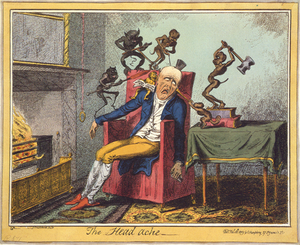
Here’s William Dunbar (1490s) complaining about having a migraine or, as we’d say in Scots, ‘a verrie sair heid.’

Cartoon by George Cruikshank


My heid did yak yester nicht,
This day to mak that I na micht.
So sair the magryme dois me menyie,
Perseing my brow as ony ganyie,
That scant I luik may on the licht

My head did ache last night
And today I could not write.
So sore does the migraine hurt me
Piercing my brow like an arrow
That I can scarce look at the light

(Any errors in translation are entirely mine – and my Scots dictionary)

When Mary Queen of Scots returned to Scotland in 1561 she could barely remember her country’s language after living in France from when she was a small child. French was spoken amongst the nobles but Scots was the principle language and so Queen Mary learned to speak it rather than English.

John Knox, on the other hand, returning to Scotland just in time to make life difficult for Mary, had slipped into speaking English. He’d lived in Geneva for a number of years, where he led an English congregation and also wrote his many works in English, including The First Blast of the Trumpet against the Monstrous Regiment of Women. 

John Knox in full counterblast


There were two main reasons that contributed to Scots ultimately being considered as not ‘proper’ speak.

After the Union of the Crowns in 1603, when James VI of Scotland departed with all possible speed to wealthy London his language, certainly in papers and letters, becomes anglicised.

James VI and I

Here’s an extract from his Counterblast Against Tobacco… A custome lothsome to the eye, hatefull to the Nose, harmefull to the braine, dangerous to the Lungs…  Translated into Scots – ‘smokin’ is verra bad fur ye’. Perhaps a pity he didn’t use his kingly prerogative and ban tobacco at the time, but in any case he increasingly spoke English (no doubt with a good Scottish accent), so the upper classes did, and it rapidly became a sign of wealth, and standing, to speak English – and still is.

Scotland turned Protestant in 1560. A core component of Protestantism was that everyone should learn to read the Bible themselves rather than having the Latin version interpreted by the church. This meant that we needed bibles, and lots of them, quickly. Initially the Geneva version, which was written in English and published in 1557, was adopted. This was closely followed by the King James (sixth and first) version in 1611, also in English. Scotland soon had one of the highest literacy rates in the world – but everyone was learning to read in English, and not the Scots they spoke at home. And surely, the language you are communing with the Lord in must be the correct one to speak…

We did see a revival in the use of Scots in the 18th century, most famously exemplified by that charming philanderer Rabbie Burns, but it was more an entertaining curiosity for the wealthy than any genuine resurgence. Nevertheless Burns saved lots of songs in the vernacular which would likely have disappeared if he hadn’t written them down. 

Robert Burns

He’s probably most famous world wide for Auld Lang Syne (Old Times Past) sung at countless Hogmanay celebrations and then there’s Burns Night on the 25 January every year when the haggis is stabbed with gusto whilst being addressed in good Scots. 

In writing The Castilians I took the decision, since Bethia’s Mother had lived in England, that Bethia would speak an anglicised Scots although I do have some characters who use Scottish words, (I provide a glossary). Initially, I had far more Scots in it, but I did want the book to be read, and understood, widely. It’s always a balance…

Scots is the language of the Lowlands, Orkney and Shetland, and Northern Ireland (Ulster Scots) and even within that there’s much variation. The accent and some of the words used are quite different between say Fife and the Doric of the North East and then again Orcadian. 

But at least Scottish-speaking children didn’t suffer the fate of their Gaelic counterparts (Gaelic was never the language of Lowland Scotland). In the last century, children in the Highland and Islands were often beaten if they spoke Gaelic in school. I was fourteen before I first heard it, on holiday in the Western Isles. Thankfully Gaelic was saved in the nick of time, and is now more widely spoken. And as for Scots, well we’ve hung on tae it despite aywis being telt tae speak properly.

crabbit; scunnersome; drookit; gowk; oxters; guddle; midden; glaikit; besom

For more information on Scots see https://www.scotslanguage.com and also the Scottish Language Bill which the Scottish government is currently consulting on. 
.