Showing posts with label John Knox. Show all posts

Friday, 2 January 2026

Murder at the Palace by V.E.H. Masters

Sited at the other end of the Royal Mile to Edinburgh Castle stands Holyrood Palace. It's built on what remains of an Augustinian Priory and was the site of one of the most grim events of Mary Queen of Scots brief reign as queen of Scotland.


                                       Section of Holyrood Palace where Mary Queen of Scots lived

In the 1500s, which is when my series The Seton Chronicles is set, the palace stood outside the city walls. Inevitably it has been extended and 'modernised' over the centuries and is now considerably larger than it was in Mary's time.

In 1548 the five year old Mary was betrothed to the Dauphin of France and left for there soon after, evading a most determined effort by the English Crown to marry her to Prince Edward, son of Henry VIII.

It was a miracle that Mary arrived in France safely for the ship was beset by storms, with weather in August worthy of the worst of January, and a voyage which would normally have taken five days took fifteen. Scotland didn't want to let her queen go was the prevailing opinion.


In my book The Conversos I tell the story of this journey from the perspective of my character Will who, alongside John Knox, was a galley slave for nearly two years in punishment for their part in the siege of St Andrews Castle _ which is the subject of my first book The Castilians.

Here's an extract that gives a flavour of the journey – and they really did have to replace the rudder during a storm. 

The weather holds and they make good progress over the next few days. Ireland is behind them and they are off the Cape of Cornwall when the wind again strengthens and the sea makes a final attempt to hold them. Worse, they see ships appear – and soon it is shouted that English ships are giving chase. Will rows, looking out each time he’s in a standing position when the ship crests a wave. He feels a knot tight in his chest, knows he doesn’t want that bonnie wee lassie caught by English corsairs – even if it means he’s freed. Bung between his teeth, he pulls as hard as he can, and there’s no need for the sous-comite to ply his whip.

Another shout goes up after what feels like hours, but it is no more than one bell. The English are turning back. Will’s heart lifts, but only until he realises why... the wind is howling across the bare masts. Soon he is so lashed by the waves it’s as though he stands beneath a waterfall. Night falls and the seas rise higher and higher.

All around him men cry and shiver with fear as white spumes rush towards them out of the darkness.

The man at the wheel is roped on, so difficult is it to stay in place. Then there’s a thump and the ship shudders from stem to stern. They cease to make any headway and lie wallowing. The lamps from the escorting galleys disappear into the darkness and the stars are blacked out by the clouds.

A drag anchor is flung out to keep them pointing into wind, while the rumours run up and down the ship: they have hit a whale; they have holed on a reef; the ship is sinking. But then it transpires the rudder is broken and they cannot steer. The wind dies suddenly; they must be in the eye of the storm. It is eerily still, as the unquiet ghosts, who follow them, dance around in the darkness.

Men are hung over the lee side – Will cannot imagine anything more terrifying – and remarkably are able to replace the rudder.

This is the last attempt by God, or Satan, to prevent Mary reaching France. A few days later, after some easy sailing, they are moored off a town with a tall cathedral, a bishop’s palace, and a sandy beach. The wee queen disembarks with her coterie of small maids and ladies-in-waiting around her. She is a remarkable child, Will thinks. Not only pretty with her smooth skin and dainty manners but also a child of great courage and steadfastness. He fears she will need it in this precarious life and prays she will be safe and happy in France. He knows John Knox would not approve of Will’s sentiments but this is his queen and he owes her his allegiance, whatever her religion. 


Mary had a happy life in France. King Henri II was fond of her and she in turn of the royal family of which she was part. She returned to Scotland in 1561 aged nineteen dressed in white – the shade of mourning – because her husband, father-in-law and mother had all died within a year of one another. And she came from the warmth and luxury of Renaissance France to a bleak and chilly Scotland, which was experiencing a little ice age.

The chambers of Holyrood Palace were dull, dreary and comfortless but Mary didn't travel light. She brought with her forty five beds, five canopies, twenty coverings and twenty bolts of tapestry, plus paintings, jewellery and other furnishings. All of this was taken south by her son, James VI, when he became king of England, Ireland and Wales after Elizabeth I died.

Mary made the best of things which wasn't easy as a Catholic in a now Protestant Scotland. She was naturally drawn to people who shared her faith and love of music. David Rizzio, an Italian, became her secretary and close companion. 

Starved of entertainment in an austere Reformation Scotland where singing (apart from psalms), dancing and theatre were all disapproved of she, supported by Rizzio, provided it all within her court – for which the reformer John Knox openly castigated her, even having her in tears one day.

Rizzio (pictured below) was deeply unpopular with the Scottish courtiers who surrounded Mary, including her husband Lord Darnley. There were even rumours that Rizzio was the father of her unborn child. 


One night when she was having supper in the small room off her bed chamber with Rizzio and her ladies, a large group of men burst in including Darnley. Mary was six months pregnant at the time but they pushed her out of the way and grabbed Rizzio. He was dragged into the bedchamber where he was butchered in front of her. 

David Rizzio was stabbed fifty four times with Lord Darnley taking a lead in the attack. His blood stains the floor still – although I suspect it may have been occasionally re-reddenned over the subsequent centuries because it looked remarkably bright when I recently visited Holyrood Palace.

            Murder of David Rizzio by William Adams - painted significantly later in 1833

Mary gave birth a few months later in a small chamber in Edinburgh Castle with a number of men watching to verify the birth of the future monarch. Darnley was called to see his new son, who would become James VI, and gazed down as Mary held the babe in her arms.

'My Lord,' she said, 'God has given me a son begotten by none other than you.'

Darnley blushed, one would hope shamed by the accusation he'd made of Mary's adultery, and bent to kiss his son. She never forgave Darnley for Rizzio's murder and when Darnley in turn was murdered a few months later she was held partly responsible. He was a vile man and here's the re-telling of a quarrel had with Mary over dinner during a stay at Traquair House a few months after their son's birth and as reported by its owner.

Mary, who was feeling unwell, whispered in her husband's ear that she thought she may be with child again and could she be excused from the stag hunt on the morrow. 
Darnley replied, 'Never mind, if we lose this one we can make another.
The laird rebuked him sharply, saying he did not speak like a christian whereupon Darnley replied,
'What! Ought we not to work a mare when she is with foal?'

Holyrood Palace fell into disuse once Mary's son became king of England and removed there. By the 1800s, with the popularity of Sir Walter Scott's novels, Scotland became a place for those of romantic sensibilities to visit and the story of Mary Queen of Scots and Rizzio's murder drew visitors especially to Holyrood.


In the first year it opened there were over 67,000 visitors and they had to fence off her bed to stop people touching it. But of course it wasn't her actual bed and when Sir Walter Scott stage managed George IV's successful visit to Scotland the dilapidated bed was replaced by one of red damask. Indeed there is nothing much left of Mary's time beyond the audience room ceiling (pictured above) which was commissioned by Mary's mother, Mary of Guise, to celebrate Mary's betrothal… and, of course, Rizzio's blood stains are also to be found. 


V.E.H.Masters is the award wining and best selling author of The Seton Chronicles. She lives with her husband, and two cats, in the Scottish Borders.  You can find out more on her website here: https://vehmasters.com/, And there's also some short stories available there - free to download.


References

Mary Queen of Scots Bedchamber - a talk given at Holyrood Palace

Visit to Traquair House

Rizzio is the Scottish spelling of the Italian pronunciation. His name was actually spelt Riccio.


Friday, 6 January 2023

Speaking Scottish by V E H (Vicki) Masters

'Speak properly,' my mother was forever reminding me as a child. By which, of course, she meant don't use Scots - either the words or the grammar. Fortunately my dad did use it, so I know and understand the language of my country. How much richer is Haud yer wheesht than Be quiet.

On one memorable occasion, when Dad came to pick me up from university I introduced him to some American exchange student friends. His greeting was, ‘Aye, and it’s a gey dreich day the day is it no.’ Blank looks all around – although he was right. It was a damp, dreary day.

Because of the general injunction to speak properly I always thought Scots was a form of corrupted, and inferior, English. When I came to write my first book The Castilians, which is set in St Andrews, Scotland, one of the many things that exercised my mind was what would be considered ‘correct’ speak in 1546.

I soon discovered that Scots is a language in its own right. It seems both Scots and English, are descended from the same Germanic language — Anglo-Saxon, although Scots also contains words from and Old Norse, like bairn and kilt, and Dutch, like haar (a sea mist). From the early 1400s it began to replace Latin in formal documents and statutes. Court poets, playwrights and story tellers also started to write in Scots.

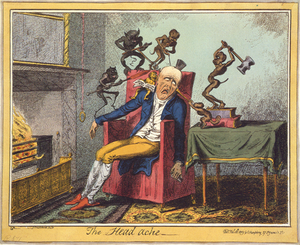
Here’s William Dunbar (1490s) complaining about having a migraine or, as we’d say in Scots, ‘a verrie sair heid.’

Cartoon by George Cruikshank


My heid did yak yester nicht,
This day to mak that I na micht.
So sair the magryme dois me menyie,
Perseing my brow as ony ganyie,
That scant I luik may on the licht

My head did ache last night
And today I could not write.
So sore does the migraine hurt me
Piercing my brow like an arrow
That I can scarce look at the light

(Any errors in translation are entirely mine – and my Scots dictionary)

When Mary Queen of Scots returned to Scotland in 1561 she could barely remember her country’s language after living in France from when she was a small child. French was spoken amongst the nobles but Scots was the principle language and so Queen Mary learned to speak it rather than English.

John Knox, on the other hand, returning to Scotland just in time to make life difficult for Mary, had slipped into speaking English. He’d lived in Geneva for a number of years, where he led an English congregation and also wrote his many works in English, including The First Blast of the Trumpet against the Monstrous Regiment of Women. 

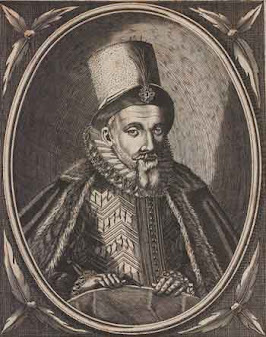
John Knox in full counterblast


There were two main reasons that contributed to Scots ultimately being considered as not ‘proper’ speak.

After the Union of the Crowns in 1603, when James VI of Scotland departed with all possible speed to wealthy London his language, certainly in papers and letters, becomes anglicised.

James VI and I

Here’s an extract from his Counterblast Against Tobacco… A custome lothsome to the eye, hatefull to the Nose, harmefull to the braine, dangerous to the Lungs…  Translated into Scots – ‘smokin’ is verra bad fur ye’. Perhaps a pity he didn’t use his kingly prerogative and ban tobacco at the time, but in any case he increasingly spoke English (no doubt with a good Scottish accent), so the upper classes did, and it rapidly became a sign of wealth, and standing, to speak English – and still is.

Scotland turned Protestant in 1560. A core component of Protestantism was that everyone should learn to read the Bible themselves rather than having the Latin version interpreted by the church. This meant that we needed bibles, and lots of them, quickly. Initially the Geneva version, which was written in English and published in 1557, was adopted. This was closely followed by the King James (sixth and first) version in 1611, also in English. Scotland soon had one of the highest literacy rates in the world – but everyone was learning to read in English, and not the Scots they spoke at home. And surely, the language you are communing with the Lord in must be the correct one to speak…

We did see a revival in the use of Scots in the 18th century, most famously exemplified by that charming philanderer Rabbie Burns, but it was more an entertaining curiosity for the wealthy than any genuine resurgence. Nevertheless Burns saved lots of songs in the vernacular which would likely have disappeared if he hadn’t written them down. 

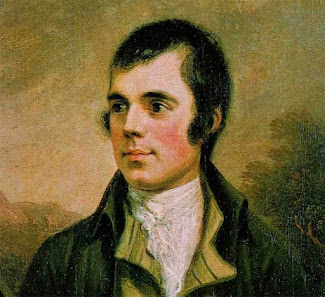
Robert Burns

He’s probably most famous world wide for Auld Lang Syne (Old Times Past) sung at countless Hogmanay celebrations and then there’s Burns Night on the 25 January every year when the haggis is stabbed with gusto whilst being addressed in good Scots. 

In writing The Castilians I took the decision, since Bethia’s Mother had lived in England, that Bethia would speak an anglicised Scots although I do have some characters who use Scottish words, (I provide a glossary). Initially, I had far more Scots in it, but I did want the book to be read, and understood, widely. It’s always a balance…

Scots is the language of the Lowlands, Orkney and Shetland, and Northern Ireland (Ulster Scots) and even within that there’s much variation. The accent and some of the words used are quite different between say Fife and the Doric of the North East and then again Orcadian. 

But at least Scottish-speaking children didn’t suffer the fate of their Gaelic counterparts (Gaelic was never the language of Lowland Scotland). In the last century, children in the Highland and Islands were often beaten if they spoke Gaelic in school. I was fourteen before I first heard it, on holiday in the Western Isles. Thankfully Gaelic was saved in the nick of time, and is now more widely spoken. And as for Scots, well we’ve hung on tae it despite aywis being telt tae speak properly.

crabbit; scunnersome; drookit; gowk; oxters; guddle; midden; glaikit; besom

For more information on Scots see https://www.scotslanguage.com and also the Scottish Language Bill which the Scottish government is currently consulting on. 
.


Tuesday, 25 December 2012

PLAING, DANSINK & SINGIN OFF FYLTHY KARRELLS by Eleanor Updale

Merry Christmas everybody!  

Scottish Presbyterians having a good time - From The llustrated London News 1855
When I was young, my mother told me that I was very lucky to live in England because the people of Scotland had no fun at Christmas: for them it was just another day.  According to my mother, they kept their celebration for the New Year, and that festival was no match for our orgy of food and garish plastic the week before.  Years later, I married a Scotsman and found out how wrong she'd been.  As children, hundreds of miles apart, we had simultaneously twiddled the knobs of our new Etch-a-Sketch machines and wondered at the technical ingenuity of The Magic Robot as we scoffed mince pies in a sea of torn wrapping paper on Christmas morning. 

The image of the dour Scottish Christmas goes back a long way, and a little light is shed on it by an exhibition of documents I visited the other day  in the wonderful Robert Adam rotunda of Register House in Edinburgh.


 'Exhibition' is rather a fancy word for the tiny display, which takes up  a single glass case, but I want to share its charming selection of Christmas vignettes with you.


John Knox's statue in Edinburgh
First, to those drab times: which of course are associated with John Knox and his ferocious followers, who, in the 1550s and 60s, prefigured Cromwell and the English Puritans with their attacks on Christmas celebrations for their 'popish' and pagan associations. 

 Quite how much success they had in suppressing the festivities is unclear.  One of the documents in the exhibition shows how, in December 1574, St Nicholas Kirk Session in Aberdeen admonished fourteen women for plaing, dansink & singin off fylthy karrells on youll day. 
So, as so often, the official line on how people should behave and what people actually did were rather different.

A letter from 1694 shows that, more than a hundred years after Knox;s death, the Church of Scotland's opposition to Yuletide celebrations was both persistent and flouted.  Alexander, Lord Montgomery wrote to Sir William Cunningham of Cunninghamehead:

I am to have some friends with me the morrow to keep Crisinmass and if you will doe me the favour to make up the number you shall be most welcome and I hope to eate ane gouse that day will give little offence to presbritray however you may if you please lay the blem upon me

The exhibition jumps forward to the twentieth century with  a marriage register open on Christmas Day 1936 to show the entry for the wedding of Jean Christmas McCormack to Gilbert Reid. The label suggests that many Scots were married on Christmas Day because it was one of the few days in the year that they didn't have to work.  
[I find that a little hard to understand, as Scotland has far more local holidays than England, and if all the shops and restaurants were open on 25th December (as I'm told they were) who was serving in them? But we'll let that one go for now]. 

The sign below the marriage entry notes that. since 1855, when civil registration began in Scotland, seventeen people with the first or middle name 'Christmas' appear in the Scottish registers of births, marriages or deaths.  Many of them were born on 25th December.  Two of them had the surname 'Carol'.

A little digression:
Christmas Humphreys

Older readers of this blog may remember the controversial lawyer, Christmas Humphreys, who led for the Crown in many famous murder trials, including the Evans/Chrisite, Ruth Ellis and Bently cases and went on to become a controversially lenient judge.  Despite his name, he was also one of the UK's most prominent Buddhists.


But back to the Register House documents.  They show that 'Christmas' is also a surname.  Since 1855, forty-five babies have been born into 'Christmas' families in Scotland.

The Statutory Registers include 1,538 children with the first or middle name 'Angel', 2,207 called 'Noel', 328 named 'Star', 2,515 named 'Gabriel', and 28,726 named 'Carol'.  One boy, born in 1901, was given the middle name'Bethlehem'.

The Reverend Robert Walker Skating on Duddingston Loch

So despite the cliched image of the repressed Scottish Presbyterian - most touchingly reinforced in the breach by a picture many of us will have received on Christmas cards this year - it seems that Christmas in Scotland has never been the cheerless day that I was led to expect.  Even in the late sixteenth century, a Kirk Session was complaining about playing cards and dice, masked dancing with bells, selling  yule loaves, cross dressing and 'extraordinary drinking'. 

I hope your family, like mine, is keeping those traditions going today, though you may want to draw the line at singin off fylthy karrells in front of the children.

Here's to a wonderful New Year for the History Girls and all who read the blog.

www.eleanorupdale.com.


PS: Many thanks to all who have been in touch about the eye trouble I mentioned in my last blog here.  The good news is that, at least on electronic devices, reading is becoming a pleasure again.  I downloaded Great Expectations to re-read before seeing the new film, only to discover that I had never actually read it in the first place, and that - as you all know - it is one of the best books in the world!


Please look out for my new book, The Last Minute, published on January 3rd.