Showing posts with label Wolf Hall. Show all posts

Thursday, 1 December 2016

Henry the Eighth's jousting accident by Mary Hoffman

"Henry's the Eighth's jousting accident" and other things we think we know about

This is a post about the minutiae of historical research and how you can't take anything on trust.


One of the things we think we know is that Henry the Eighth had a very bad jousting accident on January 24th 1536. He lost consciousness for two hours and the news of his injury and possible imminent death, conveyed to his queen, Anne Boleyn none too gently by the Duke of Norfolk, caused her to miscarry a male child of 15 weeks.

From then on, his ulcerated legs, his weight gain and his irascible mood swings led to the executions of Anne and of wife number five, Catherine Howard and his divorce (or annulment) from wife number four, Anne of Cleves, the execution of his right hand man Thomas Cromwell etc. etc.

Here is a Documentary from 2014 called Inside the Body of Henry Vlll, which attempts to find out what his medical conditions and injuries might have been. The jousting episode is about 25 minutes in. Note the images of two heavily armed men hurtled towards each other with lances levelled.

Yes, we all know what a Tudor joust looked like - or think we do.

But there is no evidence that this is what happened. The only contemporary record of this accident is found in two letters.

One, from Katherine of Aragon's physician Doctor Ortiz to the Empress Isabella, wife of Holy Roman Emperor Charles V, spent most of its length on how the late queen, who died on 9th January, comported herself in the face of death. But at the end he adds:

"The French King says that King of England had fallen from his horse and been for two hours without speaking. "La Ana" was so upset that she miscarried of a son. This is news to thank God for."
(Calendar of Letters & Papers Foreign & Domestic Henry Vlll 1887, Vol X no. 427)

Ortiz' source was "a letter from the ambassador in France, dated 15 Feb."

The other source is from Eustace Chapuys, the Imperial ambassador, to his employer Charles V:

"On the same day that the Queen was buried this King's concubine miscarried of a child, who had the appearance of a male about three months and a half old, at which miscarriage the King has certainly shown great disappointment and sorrow. The concubine herself has since attempted to throw all the blame on the duke of Norfolk, whom she hates, pretending that her mishap was entirely owing to the shock she received when, six days before, he (the Duke) came to announce to her the King's fall from his horse. But the King knows very well that it was not that, for his accident was announced to her in a manner not to create alarm; besides which, when she heard of it, she seemed quite indifferent to it...."
(Calendar of Letters, Despatches and State Papers Spanish vol 5ii Henry Vlll 1536-1538, 1888) 

Even after the passage of nearly five hundred years, the partisanship is vivid. The divorced Katherine is "the queen"; the new Queen Anne is "the concubine" or "La Ana." Her loss of a child is something to give thanks to God for.

But on the accident, that's it. No opponent mentioned, no confirmation that Henry was actually jousting.


I was writing my latest YA novel, The Ravenmaster's Boy (forthcoming April 2017, The Greystones Press) when I wrote the scene and it was as normally imagined: two armed men thundering towards each other, lances in hand, the clash of bodies, armour, horses. It's dramatic, especially since it's followed by the grim-faced Duke of Norfolk brutally telling the pregnant queen how close to death her husband is.


In Hilary Mantel's Bring up the Bodies, the accident is described thus:
"Rafe says 'the contests had not begun, he was running at the ring, the point of his lance scooped the eye of the circle. Then the horse stumbled under him, man and rider down, horse rolling with a scream and Henry beneath it."

I had read that book twice and yet  the old images were stronger. Maybe I was thinking of the play, also seen twice. Mike Poulton's excellent playscript has the accident happen offstage, after we have seen Henry arming for a joust. Rafe Sadler announces to Cromwell, "It's the King ... King Henry is dead.

At Cromwell's reaction ("Ah.") the curtain falls for the interval and our imagination does the rest.


I've changed the scene in The Ravenmaster's Boy. Once I'd been back and checked those original letters, I saw it as indifensible  to have the King unhorsed by an opponent. Who would that opponent have been, after all? Just because we know Henry sustained an earlier jousting injury in a bout with Charles Brandon, Duke of Suffolk, in 1524, that's not enough justification to put Brandon back in the lists.

In fact a recent PhD thesis by Emma Levitt, cleverly demonstrates, from the use of 16th century tournament score cards that Brandon was super careful never to defeat Henry, though he might have been the better jouster.

All this has made me wonder about the other historical "myths." I knew that Cnut wasn't trying to halt the waves, rather to demonstrate that he couldn't. I know that Marie Antoinette didn't say "let them eat cake!" But what are the others?

Here are some links:

The 20 Greatest Historical Myths ~ Write Spirit

www.writespirit.net/greatest-historical-myths/
The 20 Greatest Historical Myths. If more people knew the facts, a few of the great history-makers would be recognised (anyone heard of Ub Iwerks?), some ...
You visited this page on 29/11/16.

12 Common History Myths, Debunked - BuzzFeed

www.buzzfeed.com/patricksmith/history-myths-that-you-probably-believe-are-true
12 Common History Myths, Debunked. Don't believe everything you learned at school. posted on Feb. 19, 2014, at 4:10 a.m.. Patrick Smith. BuzzFeed News ...

10 American History Myths You Probably Believe - All That Is Interesting

all-that-is-interesting.com/american-history-myths
2 Sep 2016 - The United States has given us a number of important figures and events to assess. These American history myths challenge your ...

10 Myths About Historical Figures We Still Believe - Listverse

listverse.com/2014/07/11/10-myths-about-historical-figures-we-still-believe/
11 Jul 2014 - When you are famous, people expect a little extravagance and peculiarity from you. The weird, outrageous, or simply unusual stories about ...

Historical Myths - A World History Encyclopedia

www.localhistories.org/histmyth.html
Here are some common myths about history debunked.

Top 13 Historical Myths Debunked - European History - About.com

europeanhistory.about.com › ... › Reference and Resources › Historical Myths
There are an awful lot of known 'facts' about Europe's history which are actually false. Everything you read below is widely believed, but click through to find out ...

15 Popular Historical Myths Busted - TheRichest

www.therichest.com/rich-list/most-popular/15-popular-historical-myths-busted/
23 May 2014 - However, history as we know it is filled with false myths and personalities that have nothing to do with the facts and records attributed to them.
Reenactors tell me they get this question all the time. As the women work around the campfire, on-lookers ask whether their hems are wet. Costumed ...

11 Biggest Myths About American History - Mic

https://mic.com/articles/85693/11-biggest-myths-about-american-history
20 Mar 2014 - 11 Biggest Myths About American History Image Credit: WikiMedia Commons. In 2012 the American Council of Trustees and Alumni ...

Myths of the American Revolution | History | Smithsonian

www.smithsonianmag.com/history/myths-of-the-american-revolution-10941835/
Perhaps more than any defining moment in American history, the War of ... Here, in order to form a more perfect understanding, the most significant myths of the ...

Viking History: Facts & Myths - Live Science

www.livescience.com/32087-viking-history-facts-myths.html
Modern perception of Vikings often cast these historic people as savage raiders with horned helmets. In truth, the Scandinavian people were ...

History: Great myths die hard : Nature News & Comment

www.nature.com/news/history-great-myths-die-hard-1.13839
History: Great myths die hard. Héloïse D. Dufour; & Sean B. Carroll. 02 October 2013. Finding that part of the story of Louis Pasteur's rabies vaccine is false, ...


What are your favourites?


Sunday, 13 November 2016

SEEKING THE TRUTH IN A 'BOGUS' HISTORY – Elizabeth Fremantle


A chance encounter with Toby Litt the other day made me go back and take a look at his essay titled Against Historical Fiction. It is an oft-quoted and gently provocative piece that frequently puts the noses of historical fiction writers out of joint by calling their work ‘deeply bogus’ and suggesting the term historical fiction is an ‘oxymoron’. But, though Litt is clearly not a fan of historical fiction, it is easy to take what he says out of context.

He suggests historical fiction is created in ‘bad faith’. Though it is clearly a critical point it is not intended to be insulting or derogatory but to describe the function of fiction about the past and the contract between reader and writer. He takes the term ‘bad faith’, in a philosophical sense, from Sartre, as to mean the vacillation between what is known to be fact and what is purely speculative. He opposes this with history books, which he deems are ‘written in good faith’, meaning by this that they aspire to truthfulness.

It would be tempting to argue that even documented historical ‘fact’ can be subject to unreliability and misinterpretation. We know ‘the truth’ is a slippery concept and that the writers of history often have their own political agendas at play in their work, but it is Litt’s statement about it being only, as it were, ‘proper’ history that seeks, ‘in an honest way,’ to say something ‘useful or truthful about the past’ that interests me more.

What he seems to be saying is that the intentions of the ‘proper’ historical writer and the historical novelist are in opposition to one another. This is tricky territory as it lumps together the aims of all those who set their fiction in the past. Each novelist surely has a different, subjective, aim for his or her fiction. Some may indeed be simply be using history as an exotic screen on which to project stories with contemporary sensibilities, wilfully flouting known 'truths' for the sake of the aims of their particular narrative. Others, though, might be seeking to exploit the imaginative space between the known 'facts' of the past as a way to tell the untold stories, or as attempting to use historical parallels as a way to better understand the present.


Take, for example Arthur Miller’s 1953 play, The Crucible, a fiction which used the Salem witch-trials of the 1660s as a way to speak about the McCarthy investigations into un-American activities that swept through Hollywood during Miller’s time. The parallels of these two events, and Miller’s fictional account of the former, allowed those living through the McCarthy witch-hunts to scrutinise a contemporary event through the lens of a historical parallel.There are many such stories from the past, which could be used to shed light on the present. The recent US election brought to my mind the vilification and downfall of Anne Boleyn – a woman who paid the ultimate price for seeking to operate in a misogynist political arena. Hillary Clinton, like Boleyn, was labelled a ‘witch’, crooked, corrupt, unwomanly, unfit and even as having committed treason. This, for me, makes Anne Boleyn’s story potentially relevant as a feminist narrative. And it is fiction that would have the power and license to put it to work as a mirror to contemporary political misogyny. In this way fiction can be a means to access another, different kind of truth.

The late great Lisa Jardine discussed the role of fiction in history in Radio 4’s A Point of View (2014) in which she talks about her response to Michael Frayn’s play Copenhagen, a fictional account of a meeting between two scientists who each played a role in the development of the atom bomb. She said, ‘Sometimes it takes something other than perfect fidelity to sharpen our senses, to focus our attention sympathetically, in order to give us emotional access to the past.’ So, where the ‘proper’ historical author might be seeking an empirical truth the fiction writer might in turn be seeking an emotional truth; but there is an inevitable blurring of the boundaries between these apparently opposing positions. Facts and events do not occur in a vacuum without a human response. It is the feelings that events inspire that many fiction writers aim to access.

Fiction is simply another mode through which we can understand history. Take Hilary Mantel’s novels about Thomas Cromwell, which go against the prevailing historical narrative of Thomas More as a ‘good’ person and Cromwell as ‘bad.’ Mantel does what a biographer cannot, she depicts Cromwell (a man about whom relatively little is known, given the enormity of his legacy) as a rounded individual, a vengeful and ambitious man who oversaw despicable acts yet also was capable of fierce loyalty and tenderness, who loved his wife and children. She places him as an entire person in her fictional world, extrapolating his love for his daughter from a touching line in his will. This view is assumption – plausible, yet not fact.

But Mantel’s choice of Cromwell as protagonist in her fiction allows us to look at ideas about social mobility, both then and now. The authorial admiration for a man who pulled himself up by the bootstraps from obscurity to high office bubbles up through the text but it doesn't make it any less relevant or useful as a narrative describing both the past and the present. This is not history in the conventional sense but it shines a light into the dark crannies of history making a valid and interesting depiction of an inaccessible past.

We can’t help but regard the past through the prism of our own particular time. So the Cromwell of Robert Bolt’s mid 1960s play and film A Man For all Seasons is different to the Cromwell of Wolf Hall, more than forty years later, precisely because they are speaking to different generations. So when fiction is historical it is also necessarily contemporary. Fiction exists to ask questions and it is a valid enquiry to ask about how we regard the past and how the past impacts on the present.

Many writers now look to the past to tease out the stories of those who lacked a voice in, or were deemed insignificant by, mainstream history. Often the historical record is partial when it comes to such narratives so fiction serves to fill in the gaps. Previous generations have focused on women’s stories almost exclusively from a romantic perspective, as this upheld the prevailing narrative of the time that women were politically unimportant. You only have to look at the way the Victorians chose to see a figure like Katherine Parr as an obedient nursemaid to a tyrannical husband when contemporary narratives see her as a highly intelligent political activist and author. It is possible she was both of these things but we reject the story of obedience now, as it doesn’t fit with our view of how women should behave in the twenty-first century. We increasingly seek out women from the past who sought to define their own existence in a world that denied them that right, as this chimes with our prevailing ideals of feminism. Using fiction to look between the lines of history urges us to scrutinise our present attitudes and better understand them.

The invisible stories are important. The fact that Homosexuals (even the term is only a century old) and ethnic minority groups barely existed in the received western historical narrative doesn't mean they weren't there. And it becomes the role of fiction to imagine a plausible narrative and fill in the empty spaces as authors like Sarah Waters and Toni Morrison have done to great effect. At this moment in our cultural history we are preoccupied with issues about gender identity and multi-culturism so it seems natural that we might also look to the past even if only to see how far we have progressed but also to ensure we don’t return there.

If we are to learn from the past then we must first seek to understand it and fiction is another tool by which we can do this. Jardine quotes Michael Frayn, to make her point. ‘The great challenge is to get inside people’s heads, to stand where they stood and see the world as they saw it, to make some informed estimate of their motives and intentions, The only way into the protagonists’ heads is through the imagination.’ For me this goes some way to demonstrate that though the term historical fiction may seem oxymoronic there is deception in history just as there is truth in fiction and both serve a useful purpose in helping us to understand the present.


References:

Litt, Toby – Against Historical Fiction – Irish Pages, Vol. 5, No 1. Language and Languages (2008), pp 111-115

Jardine, Lisa – A point of view: When historical fiction is more truthful than historical fact, BBC 2014

Elizabeth Fremantle is the author of four novels set in the Tudor and Elizabethan period. For information about Elizabeth Fremantle's fiction see elizabethfremantle.com

Friday, 10 July 2015

Stand in line - Michelle Lovric


description

Here's an almost entirely gratuitous picture of Mark Rylance, the thinking History Girl’s posset.

Just for your pleasure, and mine.

Please excuse the slightly intoxicated tone of this blog. I’ve only just finished watching Wolf Hall, and I am in love with every subtle crevice of Mark Rylance’s face.

When I informed Mary Hoffman of this parish about the new heart-fluttering inside my bodice, she told me tersely, ‘Stand in line’.

And when I mentioned it to Lucy Coats, history writer and fellow Guardian master class teacher, she snarled, ‘Stand in line. The whole internet is in love with Mark Rylance.’

I consulted a third researcher, who shall remain anonymous, only to hear that she nurtures a well accessorized fantasy in which she just won’t return all Mark’s calls and he is growing increasingly desperate. When I mentioned my own predilection for the doe-eyed boy, she growled, ‘Stand in line and take a number.’

I made a very small mouth.

I’m telling myself to sublimate, sublimate, sublimate. But all I can manage is snivel, and … substitute.

Apart from Mark Rylance’s, this is the face that draws me more than any other in the world and in time.
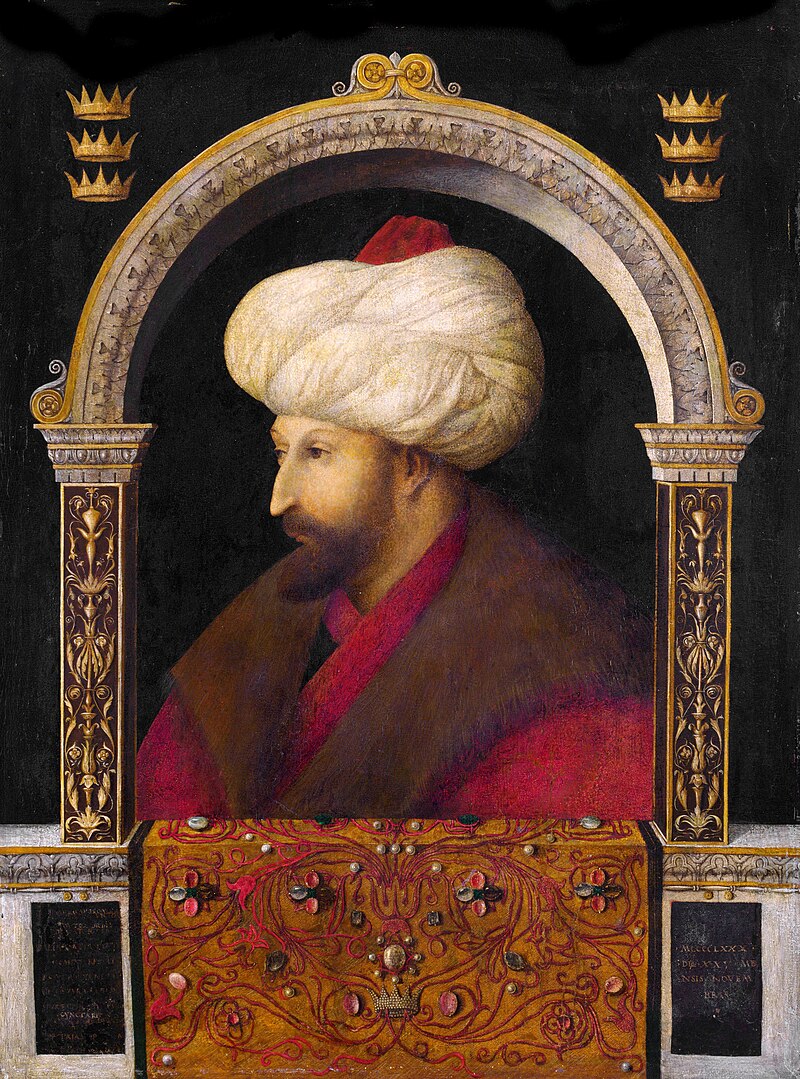
Gentile Bellini 003.jpg

It belongs to Sultan Mehmet II. It was probably painted by Venetian artist Gentile Bellini, brother of the more famous, more luminous Giovanni.

A framed print of this portrait has pride of place in one of three rooms I’ve recently reclaimed for the light in my London home. Long ago, fellow History Girl Laurie Graham, who is a genius with names, christened the two other bedchambers ‘The Princess Grace Memorial Suite’ and ‘The Joan Collins Annexe’. So this new room needed a name of its own too.


We have decided, for obvious reasons, to baptize it ‘The Sultan Mehmet II Mini-Suite’, especially given that its proportions are not exactly palatial. I would estimate that it could host only one substantial eunuch or two medium-sized concubines at any one time. And the latter would have to be on particularly good terms with one another.

The room is both Venetian and oriental in flavour, as also befits one focused on this portrait, which was created at the exact moment that Gothic architecture, with its Arabian arabesques and stone lace, was flourishing in la Serenissima.

Background detail only endears Sultan Mehmet II. He was born in 1432, ascending to the sultanate in 1451. He is famous for his restoration of Constantinople to its former glory after a century of siege, violence and dilapidation. He employed artisans from the entire known world to beautify his city. He loved Italian art and sought an Italian artist to paint his portrait.

His reign was a time of diplomacy between the Ottoman empire and Venice. Sultan Mehmet’s court for a time included Gentile Bellini, whose mission, starting in September 1479, was as visiting artist in residence and general cultural ambassador. Also part of the diplomatic effort was a mission was Bellini’s friend Giovanni Dario (whose house is now known as the most haunted in the city). I have also seen writings that suggest that the arches Bellini painted around the Sultan are based on those inside Giovanni Dario’s house. If this is true, it is a pleasant metaphor … the stones of Venice curve protectively and decoratively over the former enemy, sealing the peace with beauty.

The attribution to Gentile Bellini is not without controversy. Some have suggested that there are suspicious similarities between the sultan and a figure in Marco Palmezzano’s Jesus among the Doctors in the Temple.

This need not concern us here, any more than the fact that … I once saw Mark Rylance walking down my street near the Globe.

Mark Rylance is unavailable but we still have Sultan Mehmet II and that sultry profile.

Another reason to admire our Sultan is that he spoke Turkish and Arabic Greek, Persian, Latin, and Hebrew.

Plus, I present this picture of him smelling a rose.


The picture is taken from the Sarayı Albums Hazine 2153, folio 10a, courtesy of Wikimedia commons. How many men can be painted smelling a rose without looking faintly effeminate? All that emanates from this portrait is a delicate, appreciative sensuality. Only Mark Rylance could smell a rose as sexily as Sultan Mehmet could.

Sultan Mehmet II even looks good in coy three quarter view … as in this ‘alternative’ portrait from an unknown artist that was placed on Wikimedia Commons in 2011.


But I remain committed to Bellini portrait as the perfect representation of a fascinating man. If you want to see the original, you haven’t far to go. It’s at London’s National Gallery. The catalogue entry says, 'The painting is almost entirely repainted, especially in the figure. An old inscription, lower right, gives the date 25 November 1480. The lower left inscription is a more recent reconstruction; it includes the names Mehmet and Gentile Bellini … There is insufficient evidence for deciding whether the picture is a copy or a very damaged original.'

How did it get to London?

Succession time was dangerous in the Ottoman empire. Once can imagine the portrait smuggled out of the imperial chamber in the dead of night after the death of its protagonist. The painting may or may not have been sold in the Bazaar at Constantinople by the Sultan’s heirs. Thereafter it appears to have stayed in what is modern day Turkey for a few centuries.

Constantinople, or Istanbul was the posting of the eminent archaeologist Sir Austen Henry Layard, the man credited with making the bible true, by his excavations at Ninevah and Nimrud … the site of recent Islamic State atrocities against art.

It is said that Sultan Abdul Hamid II was unhappy when Layard was posted away from him in 1880 after a quarrel with Prime Minister Gladstone. Some sources claim that the sultan made a parting gift of this portrait to the exiting ambassador. Layard and his wife Lady Enid were shortly to settle in Venice, where they bought and restored a grand palazzo on the Grand Canal in the late 1870s. It became known as Ca’ Cappello Layard.

They moved their spectacular collection of Italian Renaissance art there and decorated the palace in sumptuous orientalist style. They were frightfully grand, as only English expats can be, with compulsory attendance at their soirees and parties by visiting luminaries.

Alternatively, there is the more picturesque version of the portrait’s provenance that one finds in John Julius’ Norwich’s excellent book, A Paradise of Cities. Norwich explains that Layard loved to tell the story of an anonymous man who accosted him in the street and tried to sell him the picture for the equivalent of £5. I love to think of it wrapped in brown paper with stained string. But the archaeologist refused, doubting its provenance. In the end, the man left the painting on the Layards’ doorstep like a foundling child. Layard was too grand to buy something that might have fallen off the back of a gondola, but he wasn't too fine to look a gift horse in the mouth. The painting was welcomed into Ca' Cappello.

Here is Sir Austen Henry Layard. Photograph by the London Stereoscopic Photographic Company, courtesy of Wellcome Images.


And here is his Vanity Fair caricature from Wikimedia commons. I'm posting it here because, unlike Mark Rylance or Sultan Mehmet, you won't find Layard at my house.


A nephew of Lady Enid recorded that the painting of Sultan Mehmet II was given a parrot for company at Ca’ Cappello Layard. One of the young boy’s duties was to go and cover the portrait with a green curtain at breakfast time, when the parrot performed ablutions that might otherwise have spattered the potentate.

Lady Enid’s copious diaries record many pet parrots. She even took them calling with her, and on holiday. She spoke of green parrots but their exact nature is not known. One was accused of giving her typhoid. Chains are also spoken of. This watercolour drawing of a ‘pet parrot on a perch’ (suitably oriental-looking) is from Wellcome Images.


There is a whole blog to be written about the parrots who lived with famous English expats and their friends on the Grand Canal at this point in time. But those birds are not kidnapping this one.

Henry Layard died in 1894, Lady Enid stayed on in Venice, continuing with a perfervid social life, entertaining Browning (whose parrot was called Jacko), Ruskin and royalty whenever possible.

The portrait of Sultan Mehmet II, like others in the Layard collection, was donated to the National Gallery after Lady Enid died in 1912.  But initially a 1909 Italian law on the export of art blocked the donation. Meanwhile Layard’s heir, Major Arthur Layard, pressed a claim for the Venetian portraits, based on an ambiguity of the wording of the will. Eventually he was compensated, and the Italian prime minister intervened to except the paintings from the export law. The dangers of World War I delayed the transport to London.

Sultan Mehmet II finally arrived on these shores in 1916 – and in my guest bedroom almost exactly a hundred years later.

 (Mark Rylance is also welcome at any time.)


Michelle Lovric’s website
the picture of Mark Rylance is from Wikimedia Commons
the original Sultan Mehmet picture comes from The Yorck Project: 10.000 Meisterwerke der Malerei, via Wikimedia Commons.

Wednesday, 1 July 2015

It's Wolf hall - again!

I know it's been over for some time and we've probably all watched Jonathan Strange and Mister Norrell since then. But I wanted to consider what a TV series does differently from a play, from a book. It doesn't have to be historical fiction but perhaps it illustrates the point best when it comes to visualising the scene.

I've read both Hilary Mantel's books about Thomas Cromwell twice, seen both the plays twice and seen the TV series twice (the last two episodes three times). I can't get enough of Hilary Mantel's creation but it does make me ponder on what the different media do for it.


First on TV the setting, costumes and props - these were all utterly convincing: the interior lighting by candles or fires, mullioned windows, all goods in chests, an illuminated prayer book dazzling in its colours because new. There was great attention to detail. (But see Liz Fremantle's February post for more on that and some reservations).

It's obvious that TV can do some things the stage plays couldn't do, giving us flashbacks to the boy Thomas Cromwell's brutal beating  by his thug of a blacksmith father - the motive to run away to the continent, with which the first book opens.

The TV series opened with the splendidly cast Bernard Hill as the Duke of Norfolk telling Cardinal Wolsey he is done for. The trouble with this excellent start was that we then had to go back to a period when Wolsey was still in the ascendant and could order Harry Percy and Thomas Boleyn around and tell them that Anne Boleyn had to go and marry someone in Ireland.

There was a bit too much of this "non-linear" narrative going on: the captions would have been more useful if they'd had actual dates rather than 'Four years before Wolsey's fall" and suchlike. No such problems with the books or the stage plays.

Wolsey himself was superb. Jonathan Pryce was not an obvious piece of casting: one thinks of him as tall and cadaverous rather than fat and jowly like a cleric who indulged too much in earthly pleasures. But he was very good indeed.

Then so was Paul Jesson on stage. But this is not an argument about who gives the better representation, pitting Mark Rylance against Ben Miles or Damien Lewis against Nathaniel Parker (the last another example of successful casting against type).

What interests me is what the different media can do with the same story. To take just one example - the masque pillorying Wolsey after his death. Hilary Mantel has taken "Cardinal Wolsey Going down to Hell," performed at the house of Thomas Boleyn (Anne's father) and transposed it to Hampton Court. The farce, presumably commissioned by Boleyn, was put on as an entertainment in January 1531, for the new French Ambassador, Claude de la Guiche. "The Duke," whom Mantel reasonably takes to be Thomas Howard, Duke of Norfolk, called for it to be printed.


The Ambassador was evidently not amused and according to Eustache Chapuys, the Imperial Ambassador, "much blamed the earl, and still more the Duke for ordering this fare to be printed." (quoted in Greg Walker's Plays of Persuasion: Drama and Politics at the Court of Henry Vlll (Cambridge University Press 1991)). Not surprisingly, since it portrayed a Cardinal tormented by devils and burning in hell.

Hilary Mantel takes this reasonably well known fact and makes of it something crucial to the plot of both her novels and one that offers an explanation for Cromwell's implacable persecution of the five men executed with Anne Boleyn. Each of the four "devils" is a nobleman (somewhat unlikely as actors in a farce, perhaps, but no matter). Cromwell watches them unmask and reveal themselves to be George Boleyn (Anne's brother), Henry Norris, Francis Weston and William Brereton.

In the novel of Wolf Hall this scene comes less than halfway through and the person taking the part of Wolsey himself is Master Patch, the jester whom the Cardinal gave to the king. In the play it's Mark Smeaton, neatly linking all five executed men to the farce.  Here in the novel  Mantel describes the reactions of the audience to the farce:

"Anne sits laughing, pointing, applauding. He has never seen her like this before: lit up, glowing. Henry sits frozen by her side. Sometimes he laughs, but he thinks if you could get close you would see that his eyes are afraid."

Crucially there is one dissenting voice at the "entertainment" - "Someone calls out 'Shame on you, Thomas Howard, you'd have sold your own soul to see Wolsey down.' Heads turn, and his head turns, and nobody knows who had spoken; but he thinks it might be, could it be, Thomas Wyatt?"

In Mike Poulton's playscript it is definitively Wyatt, who cries, "Shame! Shame on you, Norfolk! Shame!" But Wyatt is a major linking character in the plays and gets a more prominent role than in the books.

In the TV version, no-one cries "Shame!" at all. And that's a shame. It seems no-one at court is brave enough to stand up for the Cardinal, to whom Cromwell's intense loyalty is a constant motif, explanation and motive. In fact it turns into a bit of a Revenge drama, with Cromwell avenging his father-figure Wolsey, who was more benevolent to him than his own flesh and blood parent.

There is a scene where Cromwell watches the four "devils" take off their masks but it is somewhat wasted because of the casting. George Boleyn looks too like Brereton - or is it Weston? The point gets lost and has to be brought out in a later episode where Cromwell is interrogating the accused men in the Tower. If you hadn't read the books, I don't know if you would have "got" it. The whole scene is very brief on TV and there is no sign of Mark Smeaton.


But now we have three ways of "knowing" that at least four of the five men executed before Anne Boleyn took part in the Wolsey farce, does it matter that Hilary Mantel made this up? Surely, only if we come to believe this really is what happened?

Which brings us to the question of how we know our history; is it thorough reading historians or historical fiction. Do we believe that Elizabeth Woodville saved her son from Richard the Third, as Philippa Gregory tells us she did?

As Hilary Mantel says in the Author's Note to Bring up the Bodies, " I am not claiming authority for my version; I am making the reader a proposal, an offer."

As you may have gathered, although I enjoyed it, I liked the TV version less than the other two manifestations of Hilary Mantel's Cromwell stories. It may not be surprising that for me the books come first. There were a couple of show-offy moments on Tv which I positively disliked: Thomas stroking Anne Boleyn's breasts in a scene it took a moment or two to realise was in his imagination and the ridiculous dragging of her body along his dining-table with him about to stick the knife in. It was evidently too much of a temptation to make a metaphor literal.

And it lost a lot of the humour of the books and the plays; in the theatre everyone laughed when Leah Brotherhead said, "Oh, I'm nobody. I'm only Jane Seymour." There were many such touches, replaced on TV by Cromwell's sardonic remarks and occasional swearing.

Still, there was much to enjoy in the minor performances, such as Charity Wakefield's spirited and saucy Mary Boleyn - though it was hard to believe this one would have let Henry walk over her so. And one of my favourite characters, Eustache Chapuys was perfectly rendered by Matthieu Almaric. There was even an effort at his "startling hat" with which Hilary Mantel had such fun in Bring up the Bodies. Sadly, I could not find a picture of him wearing it.


I can't wait for the third book, The Mirror and the Light; the third play, with, please, Ben Miles and Nathaniel Parker, the third TV series, with Mark Rylance and Damien Lewis. I like Hilary Mantel's "offer" very much, in whatever form it comes. But best of all in the books.

What do you all think?


Monday, 13 April 2015

TUDOR FICTION: is it all sex and scandal?

I thought I’d run out of things to say about Wolf Hall when my attention was drawn to Laura Miller’s article in Salon, in which she responds to the TV adaptation of Wolf Hall in the context of other Tudor texts. In it Miller sings the praises of Mantel’s serious approach to a period that she scathingly describes as ‘for chicks,’ applauding the way the author draws out the idea of the Tudor period marking the break from Medieval feudalism and the beginning of the modern world, with the increase of social mobility in figures like Cromwell.

This is all well and good and cogently argued, but Miller also takes an opportunity to serve a crushing and sweeping blow to pretty much all other fictional material set in the period. She compares Mantel’s ‘high-brow’ approach with what she disparagingly terms ‘princess novels’ or Tudor set fiction that is focused on women’s lives. Her main point being that such fiction foregrounds lascivious sex and scandal and in so doing makes it no different to schlocky high-school teen dramas.

Philippa Gregory comes in for a particularly contemptuous drubbing, accused of digging out uninteresting female figures from the past and padding out their stories with romance that has no historical validity. Though Miller makes her point well and there is legitimacy to some of what she says, certainly about the gratuitous soft-porn elements of the Showtime series The Tudors, and the wilful manipulation of history in the teen drama Reign, what she overlooks is the serious nature of some of the themes of much Tudor set fiction.

Even the more commercial, romance led, Tudor novels have a profound darkness that makes them a poor comparison to the teen dramas cited. Yes, there are parallels to situations in which young women are living at close quarters and competing for prestige. Miller correctly points out that in such novels much is made of clothing but refrains from exploring the value and symbolic resonance of women’s clothing in these texts. For the Tudors, an upstart family with a tenuous grip on the throne, clothing was a crucial indication of status and thus merits description. Indeed Mantle also employs, to great effect, descriptions of clothing to create a sense of the importance of the outward representation of rank and affiliation through apparel within the courtly arena, where position and allegiance were of primary significance.

The cumbersome clothing women were laced into was also a part of the broader denial of female freedom in much the same way 21st century women living in fundamentalist Islamic communities are required to cover and restrict their bodies. The early modern female body was a precious commodity and was at once expected to be a site of allure and yet also to be contained and kept out of sight to guard its value.

To view such narratives as inconsequential refuses to acknowledge that for these Tudor ‘princesses’ the stakes were vertiginously high. They describe a world in which young women were brutally murdered for political ends and had to negotiate a dangerous path through a male power structure that gave them no agency.

Surely any woman who can gain even a modicum of power in an oppressively misogynist system merits having her story told, and many of the generation of serious historians who are rediscovering such stories would agree. It is unhelpful to regard all such fiction as romantic clap-trap that uses sex as its narrative drive, when marriage was the primary route to power for women. What is noteworthy about these stories is that it becomes impossible to separate sexual and state policy. Princesses are interesting because of, rather than in spite of, the power that was invested in their bodies, and how they used that power makes for fascinating reading.

By comparing a novel about Anne Boleyn to Gossip Girl, Miller is refusing to acknowledge that these privileged young women are unlike their contemporary counterparts because their stories are inherently tragic – real tragedy that ends in brutal death – when he worst outcome in teen drama is social ostracisation. What could be more pitiful than the execution of of Catherine Howard. Yes, she may have been a shallow girl preoccupied with love (she was seventeen, for goodness' sake) but her life was caught up in a political vortex over which she had no control and as such it is worth inspecting as a means to understand the extraordinary lack of power such women – even queen consorts – had in those days. These women were rendered shallow and infantalised by the paternal hegemony to which they belonged. To compare them with modern women who have sexual and professional freedom, who are educated and, importantly, choose to be largely concerned with superficial matters is missing the point.

Early modern women had no freedom, yet they found ways to make themselves heard. For the first time the humanist project, led in England by Thomas More, encouraged education for women, albeit for a limited and privileged cohort, which was surely an important social change that merits our attention. Take Katherine Parr for example, a minor queen of apparently little political importance, but few are aware that she was one of the first women to publish an original text in the English language. At a time when women were obliged to be silent and submissive, to publish religious political texts was an audacious and dangerous act. Indeed these educated females laid the ground for an unprecedented half-century of female rule in England. To say such lives are not worth examining and reduce them to little more than titillating tales, plays into the hands of the misogyny that sought to silence them in the first place.

Because Cromwell’s story is essentially one of social mobility and money, doesn’t automatically invest it with greater legitimacy, as Miller suggests, indeed it could be said that as women’s bodies were a currency traded at the highest level their stories have equal importance from a socio-economic perspective. Social mobility too was mediated through the bodies of women. Consider how the minor landed gentry such as the Seymours and the Parrs became elevated in such a way. These women’s lives provide a vital key in understanding the period, so please let’s not do as David Starkey has long done, and dismiss them as trivial.


Elizabeth Fremantle is the author of Tudor trilogy: Queen's Gambit, Sisters of Treason and Watch the Lady. ElizabethFremantle.com

Queen's Gambit, about the life of Katherine Parr, has been chosen for World Book Night.


Monday, 23 February 2015

(HOW) DARE WE WRITE HISTORICAL NOVELS? by Leslie Wilson


David Starkey has announced in various media that Wolf Hall is a 'deliberate perversion of history', (though he has neither read the books nor seen the television adaptation so I do wonder how he can assert this). Someone, however, has told him that Mark Rylance, playing Thomas Cromwell, is portrayed as showing grief when his wife and daughters are carried off in a day by the sweating sickness. 'I gather Hilary Mantel has imagined this wonderful tender experience of Thomas Cromwell losing wife and children,' he says, and 'there is not a scrap of evidence for it at all.'


Not all historians hate historical fiction, and many of them are hugely generous towards fiction writers  - I owe an enormous debt of gratitude to Professor Michael Biddiss, for one, who referred me to several useful texts on Nazi Germany and particularly to the invaluable documentary history of Nazism by J Noakes and G Pridham - so helpful, particularly when I was writing Saving Rafael. However, much as I respect and value historians, I do not need their permission to write my fictions.
The thing is (Doctor Starkey), that a novel set in the past is not an easy-read alternative to a history book (however carefully we do our research, and some of us, notably Dame Hilary, do it very carefully indeed. Indeed Hilary Mantel's work is widely respected by historians). The term historical fiction may perhaps be a tripwire here. We are writers of fiction, and some of us choose to write about historical subjects.That means that we apply our imagination to those subjects, which is what writers do, and of course we go to places (like someone's probable response to a bereavement) that historians must in honesty hold back from.
In exactly the same way, I might write a story about someone, say, who is a teacher in a North of England town. There is no evidence that such a character exists or that any given human being ever behaved exactly as this character did. If I cannot find it, it is not incumbent in me to leave it out, because the job of a writer is to say: 'What if? Supposing?' It is to write a story.
My grandmother in the '30s

Actually, I researched the novels I set in Nazi Germany very carefully, but this was because my enterprise was to understand what it was like to be a person who had to live in Nazi Germany. That is - as readers of my blogs here will readily understand - something very important to me. The enormous amount of reading I have done about the period, as well as watching videos, talking to people who remembered those times, reflecting on the things that came to me from my own family, was not directed at making my works good textbooks for Year 9s. Some people have found them so, but what drove me was that need to open a window for myself on twelve dreadful years that marked and scarred my immediate family as well as damaging and bereaving millions of others.
In the end, though, it came down to 'What if? Supposing?' Supposing one of the boy soldiers who were drafted into the German Home Guard in 1945 was the sole survivor of his unit; supposing he met a girl on the run from Berlin, who had a very different background; supposing the interaction and relationship between them changed both of them as they trod the refugee road with the fighting going on round them? Supposing  the girl was jazz-crazy, and could play the harmonica, and supposing a fantasy grew legs and desperate people started to believe it? Then you get Last Train from Kummersdorf.
There's another idea about historical fiction that is popular among the chattering classes, even post Wolf Hall. It is that it is somehow tacky, chocolate-boxy, that the proper enterprise of novelists is to describe the present day (preferably grittily). Now I have no objection to grit, but there was just as much of it around in the past - and indeed there is a whole generation of excellent novels that deal with the undersides of history, some written by fellow-contributors to this blog. 
One of my history teachers at school took this line: she said we should avoid historical fictions, which were always misleading and trashy, and concentrate on fiction written at the time we were studying. Maybe she would have liked to have a go at the English literature syllabus and excise such trashy works as Henry IV Part One, (which I studied for A Level). Also, she must have despised such trivial works as War and Peace, Schiller's Maria Stuart, Vanity Fair, all of Shakespeare's History plays, Büchner's Danton's Death, Eliot's Murder in the Cathedral (which I first saw, incidentally, at Kendal Grammar School with my brother as one of the Women of Canterbury and David Starkey in the star role. The poetry blew me away.)

If the past is another country, it's one that is part of our present. Humans have many means of visiting it and trying to inhabit it; through histories, biography, visiting historical sites, and drama, in which I include the novel. To talk about, mythologise, and speculate on the past is part of what it means to be human, and that makes it a valid subject for literature.

Friday, 13 February 2015

CAN WE TALK ABOUT WOLF HALL, AUTHENTICITY AND KNICKERS? – Elizabeth Fremantle


The airing of Wolf Hall’s small screen cousin has provoked a good deal of discussion: is it too slow; is it too confusing; is it too dark; wasn’t Henry fatter; wasn’t Cromwell more of a monster; is it accurate?

Mark Rylance with director, Peter Kosminsky (Radio Times)

The question of historical truth comes around again and again. The Imitation Game ruffled feathers for, amongst other things depicting Turing as possibly involved in (or knew about and turned a blind eye to) treachery when there is not a shred of evidence to suggest that this might have been the case. People have complained that there wasn’t enough science in The Theory of Everything, without stopping to think that the film is an adaptation of Jane Hawking’s book – it is her version of events not his. Mike Leigh’s Mr Turner provoked tumultuous critical delight over Timothy Spall’s snorting, grunting performance, which I personally found grotesquely over-played. ‘But he was supposed to be just like that,’ people cried in response to my criticism. ‘Based on what exactly?’ I asked. 

Anne Boleyn plus PA (Daily Mail)
We can get so wrapped up in the idea of accuracy that it is easy to forget such a thing is impossible. With Wolf Hall it’s all been about the authenticity, with costume designers talking about how they only used fabrics of the period and correct fastenings – mostly pins, in case you were wondering and not zips, which was the accusation levelled (hotly denied, I might add) at the recent White Queen adaptation. But, I ask myself are they all going commando because as all self-respecting Tudorphiles will know, knickers hadn’t been invented in the sixteenth century.

The ‘authentic’ lighting (mainly candlelight for interiors and nothing outside) has meant a good deal of viewers grumbling about not being able to see anything. ‘Ah but that is how it would have been,’ come the replies. That may be so but to our twenty-first century eyes, used to the brightness of the present, our response to it is jarring and confusing. A Tudor would not have responded in such a way; it would have been the norm, their eyes would have been accustomed to a dimmer world, more in tune with the seasons and fluctuating hours of daylight. What I’m trying to get at is that absolute authenticity remains out of reach, like Plato’s perfect forms, and to try so hard at it can be a futile project.

Rylance as Cromwell
Holbein's Cromwell
I like the gloom of Wolf Hall, not because of its historical veracity, but mainly because it works with the shadiness of its protagonist. Though unfortunately in some of the exterior scenes, shot in the gloaming it looks, on my brand new super-duper-HD TV, rather than atmospherically shadowy, depressingly redolent of low-tech BBC costume drama from the 1970s. But I sympathise with the intention even if the outcome is not necessarily wholly successful because I find myself noticing other things, like the puzzling absence of mud in the exterior scenes and the manicured gravel driveways and the dog that looked suspiciously like a cockapoo and Anne pronouncing his name (Purcoy) phonetically rather than the French way (Pur-cwa) as she would have. Now I'm just being a pedant and the point I'm trying to make is that none of it really matters; what matters is the effect it has.

Lewis's Henry VIII
Then of course there’s the question of Cromwell and his character. Views on this are polarised. A historian friend of mine believes Mantel’s Cromwell is too modern in sensibility. It seems to be Mantel’s project to explore the possibility that Cromwell was a remarkable self-made man, and yes, darkly complex and Machiavellian but not just, to borrow Dairmud MacCulloch’s term, ‘a thug in a doublet’; whereas revisionist historians seek to expose the Reformation, the promotion of which was Cromwell’s life’s work, as an act of monstrous destruction akin to the acts of fundamentalists in North Africa today. We will never find a definitive truth but what is good is that texts such as this open up discussion.
Rhys Meyer's Henry VIII

What a TV show like Wolf Hall is attempting to do is to set itself above the usual costume drama. It’s narrative is convoluted, it refuses to spoon feed us, makes us work hard, makes us think. It says ‘I am authentic,’ suggesting that Jonathan Ryhs Meyers in his hopelessly anachronistic, yet very fetching, faux-Tudor gear, is not – I couldn’t possibly comment. But when we watch TV we know that only a few feet away is a fellow with a big camera and that we’ve seen these actors in other roles, that they’re all pretending. We want to suspend our disbelief, we’re in on the sleight of hand, and do we care if they are wearing knickers? I suspect not.

Elizabeth Fremantle's Tudor novels Queen's Gambit about Katherine Parr and Sisters of Treason about the sisters of Lady Jane Grey are published by Penguin.

Find out more about Elizabeth and her books on elizabethfremantle.com

Tuesday, 2 September 2014

Bruges by Sarah Gristwood


Perhaps we all feel we have a stake in the BBC’s version of Wolf Hall, to be filmed in Bruges this summer. After the Bookers, and the rave reception it’s had on the boards, the book and its sequel, Bring Up the Bodies, have reached national treasure status. But I feel more of a stake than most. Before Wolf Hall, another BBC crew were in Bruges, shooting the adaptation of Philippa Gregory’s The White Queen. And before, either of them, there was me.

Half a millennium ago, before any of us, there was Margaret of York; why I was there, really. I was writing a book, Blood Sisters, about the women behind the Wars of the Roses – and I can tell you, it didn’t come easy. Not only are the written sources notoriously patchy, but it’s very hard to know where to go to get into the mood for that period – or to do visual research, as is sometimes put, politely.

It’s a strange, specific time, that changeover between the medieval world of castles and clashing knights, and the far more familiar Elizabethan era in all its glory. In Britain it’s oddly hard to find . . . some of the Oxbridge colleges, maybe? It was a problem for me – and for the Wolf Hall team too, maybe. Thomas Cromwell’s later career took him to palaces like Hampton Court; but where do you go for his home turf, the City? Where did I go, to find women who predate Hampton Court by half a century? To Bruges. Curled up in a window seat in the Gruuthuse museum - where Margaret of York’s brother Edward IV once took refuge, while the turmoil of the Cousins’ War briefly thrust the opposing Lancastrians back onto the throne – I felt that at last I had finally found the fifteenth century.

In Bruges you don’t even need to gaze at the turret on the Markt from which Margaret of York watched the tournaments in her honour, when she was brought here in 1468 to marry the Duke of Burgundy. You don’t need to take out a second mortgage, as I did, and stay in the hotel which has been made from part of her palace. (The Dukes’ Palace Kempinski, since you ask, and the tower once decorated with marguerites for her name is still there plain to see.) Just to walk the sparsely-vehicled streets is to be clobbered by history. The past – not some mouldering ghost but bustling, prosperous and full of energy, just the way it would have been – is there in the very layout of the streets, in the shops full, now as then, of covetable goodies.

I bought embroidered silk purses and some good modern jewellery; chocolates go without saying; as far as I’m concerned, you can keep the lace and embroidery. Back in 1468, as part of Margaret wedding party, John Paston wrote that for the splendour of the jewels he saw at the Bruges feasts, he ‘heard never of none like to it save King Arthur’s court . . .’ But then he had just been fed on gilded swans, while trained monkeys tossed beads and purses to the company.

The Burg is one of the finest medieval squares in Europe; the outside of the Stadhuis a white Gothic wedding cake. The glowing decorations inside the Heilig-Bloedbasiliek, the Basilica of the Holy Blood, may date in part from the nineteenth century, but the great black chimneypiece in the main chamber of the Bruggemuseum-Brugse Vrije is a Renaissance masterpiece - and that’s even before you’ve headed into museum territory.

Edward IV stayed in the Gruuthuse, across the Dijver canal, with his younger brother, the future Richard III. So did Charles II in his exile, and the carved angels, the tranquil rooms flanked by waterways, gave reassurance to him, too, maybe. From the private chapel of the Gruuthuse, a discreet window looks straight down into the Onze-Lieve-Vrouwekerk, the Church of Our Lady, and the golden tombs of the ducal family, caught with their pet dogs at their feet. It seems to be another of Bruges’s specialties – that combination of colourful richness, and an unexpected intimacy.

On the other side of Onze-Lieve-Vrouwekerk is Sint-Janshospitaal, which did indeed function as a hospital from the twelfth to the nineteenth century. In the old hospital church you’ll find a small museum, Memling in Sint-Jan. Stop in front of Memling’s The Mystic Marriage of St Catherine, and the faces of the saints Catherine and Barbara may be those of Margaret of York, and her stepdaughter Mary of Burgundy.

It’s a cliché that Bruges is the ‘Venice of the north’, firstly for the canals that circle and cross the city. But while Venice is a lateral waterscape of pale dreaming tones, Bruges is vertical and verdant, built in warm brick and of the earth, earthy. Except when it isn’t. Bruges boasts many different brands of charm, for a place so tiny. Up to the north east of the Markt is the Sint-Anna district – what used to be the artisan area – has open streets of small houses, elegant in their simplicity , where the almshouses and folk museum still pay tribute to the city’s craft history.

One of attractions for film makers must be that Bruges offers so many different moods, without ever having to step outside the late medieval past. Ten minutes walk from the craggy medieval buildings of the centre is the Minnewater - the Lake of Love, with swans sailing on the dark water - where the secluded spaces of the Beginhof manage to feel a world away. Founded in 1245 as a beguinage, a refuge for religious-minded women who stopped short of the full nun’s vows, it operated as such until very recently. Past meets present again – it is still a Benedictine convent today.

I mean – if we can just lower the tone for the moment - even the eating in Bruges is the kind of thing you’d expect to find after a careful study of medieval cookery. Rich and satisfying, with sometimes unexpected combinations of flavours. Never mind the mussels and the waffles, and the fries with mayonnaise; there’s also eel with herb sauce, or hare cooked with prunes; carbonnades and chicory. Cherry beer served warm on a cold day; and yes – has anyone warned the BBC? - the weather does tend towards the damp and chilly. Margaret of York arrived in July but it was pouring anyway.

The citizens were impressed that she still got drenched leaning out of the litter to wave to them; but give the girl credit, she knew what was expected - the demands of royal life are still the same today. In Bruges, you do get used the idea things haven’t changed much since the fifteenth century. Wolf Hall is being produced for the BBC by the same firm, Company Pictures, who did The White Queen, which may or may not worry us slightly. But give them credit – they learned one thing, on that earlier production. They knew to come to the right city.


Tuesday, 1 April 2014

Cromwell at the Swan by Mary Hoffman

Achieving the impossible - a review of the RSC productions of Wolf Hall and Bring up the Bodies

Ben Miles as Thomas Cromwell and Lydia Leonard as Anne Boleyn

When I first heard that Ben Miles was to play Thomas Cromwell in the RSC adaptations of Hilary Mantel's Wolf Hall and Bring up the Bodies, my instinctive reaction was "but he's much too good-looking."

I was wrong, of course. Miles has reached that point in his acting career where a piece of imaginative casting like this gives him the chance to throw off the shackles of early romantic lead swoonworthiness and show us what he's really made of. And on the days when both plays are done he has most of six hours to do it in.

From the opening lines of Mike Poulton's brilliant adaptation of Hilary Mantel's two Man Booker prize-winning novels, you know you are a safe pair of hands. After a wordless prologue of Tudor dance when we first glimpse  Henry Vlll, Katherine of Aragon and Anne Boleyn, the scene switches to Cardinal Wolsey's house, where a very wet Cromwell enters.

"Cromwell. Late," says Stephen Gardiner, Wolsey's Secretary.

"Yes - Isn't it?" answers Cromwell, pleasantly putting his rival firmly in his place.

You sense from the beginning that this is not a man to tangle with. And then you are with Cromwell and his master, the Cardinal, and their dialogue sweeps you into the life of this busy, loyal, calculating and intelligent man. You don't need the actual beginning of the book where the young boy Thomas is brutally beaten by his father; there are enough allusions to convey that.

Although Ben Miles really is outstanding as Cromwell, the whole ensemble is strong, with not a false note. Cardinal Wolsey is Paul Jesson, a towering presence even after death, the father figure that earns Cromwell's undying devotion and informs so many of his later actions and loyalties.

Henry Vlll is Nathaniel Parker, again not an obvious choice for the role, but this in an interpretation, not an impression and his growing menace, self-deception and unpredictability are well conveyed.


Just how do you set about adapting a 653 page novel into a three hour play, with interval? Mike Poulton describes it as "taking apart a Rolls Royce engine and reassembling the parts into a light aircraft." You don't get Mantel's voice, that tone that she described to us here on the History Girls as "something between first and third person," but you do get some of the flavour of her personal touches, through the inclusion of details like  Ambassador Chapuys' fantastical Christmas hat, rendered suddenly inappropriate at court through the news of old Queen Katherine's death.

You don't see Cromwell's daughters, snatched away by illness, but they are there  in reference and in the cracking of Miles's voice when he reads the name of Anne Cromwell, written in his late wife's prayer book. We do see Lizzie Cromwell, played by Olivia Darnley, who is also - amazingly - Mary Boleyn, and we get a strong sense of Cromwell's family life, as we do in the books.

Photo by Francesco Guidicini
Hilary Mantel has been criticised for being too kind to Cromwell, for making him too believably human, but surely this is right? We know he was married with three children, two of whom died young and that he was unfailingly loyal to his old master. However ruthless he might have been in his political choices and sense of expediency and self-preservation, that doesn't mean he couldn't have been a loving family man and faithful friend. What she does is present a controversial historical figure in the round and Mike Poulton's scripts do that too.

Only at one point, in Bring up the Bodies, in the scene where Cromwell makes his pact with the Dukes of Suffolk and Norfolk to bring about Anne's downfall, did I feel a lack of sympathy with the main character. And I didn't feel that in the book so maybe there was there a slight loss of nuance.

It apparently took Mike Poulton nine drafts to come up with this masterly transfer from page to stage. You don't sense the effort behind it. He says that members of the audience will miss some favourite scenes and that for me included the peacock-feather Angel wings and the huge Christmas star that so terrified Mark Smeaton when he was shut up with them in Cromwell's house. But the drama worked fine without them and that is the main thing.

The roles of Cromwell's clerk Rafe Sadler and his friend's son, the poet Thomas Wyatt are enlarged to give more opportunity  for confidences and a sense of whom Cromwell trusts. And who could have guessed that mousy little Jane Seymour, played by Leah Brotherhead, could be so interesting and savvy? Well, anyone who had read the books, I suppose.

Ben Miles with Paul Jesson as Cardinal Wolsey
I did wonder about that, about how many of the people in the sold-out Swan Theatre in Stratford would have actually read both titles. I think you probably get much more from the plays if you have, though it could be that people have just been drawn there by the books' and the writer's enormous reputation. And they would have enjoyed the experience too.

What you see is the story arc of the rises and falls of reputations and the fatal consequences when Fortune's wheel spins the characters down to the bottom-most part of their circulation. First Cromwell, then Anne Boleyn and of course, when the third book, The Mirror and the Light, comes out (we hope) next year, the whole pattern will be repeated with Cromwell himself. And that must surely be staged as well, completing his remarkable trajectory from blacksmith's boy to Earl of Essex and the most powerful man in England after the king.

After the king. That is the point. We see how Henry can turn on a sixpence (?a groat) when angered by Ambassador Chapuys. He rounds on Cromwell and the blacksmith's boy nearly wallops his monarch. As Henry's reign progresses, we know he will deteriorate into even more fits of temper and irrationality: Cromwell's fate is already written in the stars if not yet on the page.

This is a fine and subtle adaptation. I particularly admired the way in which we saw only the rehearsal for Anne's execution, not the bloody act itself. Almost every choice is the un-obvious, the rejection of sensationalism and horror in this most violent of love stories.

And the recurrence of the dead Cardinal was just right, reminding us of one of Cromwell's most powerful attachments, the older man who had, unlike the blacksmith, valued him and treated him well.

The plays are transferring to the Aldwych Theatre from 1st May to 6 September and it will be another sell-out. I shall go again, even though only the most expensive seats are left. It will be interesting to see the change from a thrust stage to proscenium. Or maybe the theatre will be adapted? 

Whatever happens, I can't wait.