Showing posts with label aviation. Show all posts

Saturday, 6 May 2017

A Letter to Lilian Bland: Sheena Wilkinson


Dear Lilian

Last month I visited Glengormley, a northern suburb of Belfast, and walked in a park named after you. I was fascinated by the big model of an early plane, and even more fascinated when I found out about your wonderful life and accomplishments. I thought readers of The History Girls would like to know more about you.
Model of the Mayfly, Lilian Bland Park, Glengormley


I’m imagining you first as eleven-year-old Lilian, a wee girl growing up nine miles north of Belfast. You love watching the birds on Carnmoney Hill and imagining what makes them fly. You love ponies and freedom and adventure. You’ve got Big Dreams. Your name may be Bland, but your personality certainly isn’t.

There’s still a decade left of the nineteenth century and you can have no idea of the changes you’ll see in your life. It’s lucky that you’re going to live until you’re 92, as you’ve got so much to pack in. You’ll live in several countries and have more careers than most people could dream of.

Lilian Bland

Actually some of your careers don’t even exist yet. I mean, you’re going to be an aviator – that’s not actually a thing in 1889, but it will be by the time you attend the first British aviation meeting in 1909 and decide that you want to build your own plane. After all, if Louis BlĂ©riot can do it, why shouldn’t you? OK, you’re a woman and you’ve been told women don’t do that kind of thing, but that’s never put you off anything.

Less than a year later, in September 1910, you’ve done it! You’re the first woman in the whole world to design, build and fly your own aeroplane, and it all happens here in Ireland – in Carnmoney, County Antrim. While a few miles away, down in the Belfast docks, a huge team of men start to build the world’s biggest and most luxurious ship, the Titanic, you’re hard at work at your own little biplane glider. Your Mayfly is a lot smaller than the Titanic, and built mostly of bamboo, ash and elm, but its maiden voyage is more successful. 30 yards is a very respectable distance for a maiden flight in 1910.

I love the fact that you call it Mayfly. It’s a pretty name, but that’s not why you choose it: you say the plane ‘may fly, may not fly!’ That makes me think you’ve got a sense of humour, as well being really smart and hardworking. (But I also imagine you clenching your fist in determination that it will fly.)
  

Nothing deters you. You have to wait for ages for the fuel tank for Mayfly’s engine to be delivered, so in the meantime you improvise with a whiskey bottle and your aunt’s ear-trumpet. Because you’re not the kind of woman to wait around forever, and you want to be up there, in the sky with the birds, not earthbound.

Even without your amazing aviation achievements, you’re an all-round star. You keep your love of horses, and insist on riding astride like a man, rather than side-saddle. By the 1920s, most women ride astride but you’re a pioneer in this, as in so much else. I love thinking of you striding over Carnmoney Hill, camera in hand – you’re a great photographer – wearing breeches, covered in engine oil, smoking and never afraid to get your hands dirty. Because you’re more than a dreamer: you’re a doer.

And I don’t quite know how you manage this, but you fit in a career as a journalist too. You’re a sports reporter and photographer for London newspapers, and – back to the ponies here – you’re especially brilliant at capturing the galloping and jumping of horses. It’s all about speed and movement, isn’t it? It always has been, since you used to watch the birds on Carnmoney Hill.


Flying is still your main passion, though. You go on to set up in business selling your own biplanes and gliders. Your dad gets a bit worried about all this flying – it’s a dangerous activity – and he promises to buy you a new Model T Ford if you give it up. You think that’s a pretty good deal, teach yourself to drive the car, and soon you become Ford’s first agent in Northern Ireland.

Maybe driving’s a bit tame for you, though, after all that flying, and you’re soon off on a new adventure – to Vancouver this time. It’s a long journey by sea – I wonder if you watched the seabirds following the ship, and remembered the birds flying on Carnmoney Hill, and your own little Mayfly soaring through the sky?
Carnmoney Hill, north of Belfast, today. 


But Canada’s an adventure too – you help your husband establish a farm, and I bet you’re as successful a farmer as you were aviator, horsewoman, driver, photographer, journalist and businesswoman. You don’t stay in Canada forever, though; you make a final journey back across the Atlantic and settle in Cornwall.

Wherever you are – Carnmoney, Canada, Cornwall – you live the fullest life you can. Girls in the 21st century can look to you for inspiration, as you once looked to the birds.


Sheena Wilkinson


Saturday, 19 December 2015

Those Magnificent Women in Their Flying Machines - Aviatrices of the 1920s and 1930s by Christina Koning


Having just finished my latest novel, ‘Time of Flight’, which is set in 1931, and features - amongst other characters - a number of female flyers, I wanted to make my last post for the History Girls about these wonderful ‘queens of the air’, who did so much to popularise flying in its golden years. One of the most celebrated was Amelia Earhart - pronounced ‘Air-heart’ (1897-1937) - who, apart from setting numerous aviation records, including being the first female aviator to fly solo across the Atlantic, was instrumental in setting up ‘The Ninety-Nines’, an association of women pilots.


In 1920, Amelia visited an airfield at Long Beach, paying $10 for a 10 minute flight in an aeroplane piloted by Frank Hawks. This proved a turning-point for the young enthusiast: ‘By the time I had got two or three hundred feet off the ground,’ she said. ‘I knew I had to fly.’ Like Amy Johnson after her, she saved up for flying lessons and had her first lesson a year later, gaining her pilot’s license in 1923.


Her instructor was the delightfully named Neta Snook (1896 - 1991), who ran a commercial flying school in Virginia (the first woman to do so), and who later wrote about her friendship with Earhart in her book, I Taught Amelia to Fly.

After the enormous popular interest in Charles Lindbergh’s solo flight across the Atlantic in 1927, Amelia was selected, the following year, to take the place of aviatrix Amy Phipps Guest (1873 -1959) as the first woman to make the trip, after the latter decided to drop out. Interviewed after the flight, which was piloted by Wilmer Stultz, Amelia said, with characteristic self-deprecation: ‘Stultz did all the flying—had to. I was just baggage…’ adding, ‘maybe someday I'll try it alone.’

 In May 1932, having undertaken many lengthy flights across America, she got her wish. Setting off from Newfoundland, she arrived, 14 hours and 56 minutes later, in what she hoped was Paris. In fact, it was a field in Ireland - her Lockheed Vega 5B aeroplane having been blown off course. But she’d done it - becoming the first woman to fly solo across the Atlantic. Awards and acclaim followed, but Amelia refused to rest on her laurels. She was determined to fulfil her dream of flying around the world, and, after several false starts, set off in July 1937 with co-pilot Fred Noonan, in her Lockheed Electra 10E. What followed has been the subject of speculation ever since, after the aeroplane disappeared over the Pacific. Was it sabotage, engine failure, or (the most likely scenario) a breakdown of the inflight radio system which caused her to lose her way? 

Amy Johnson (1903 - 1941) was Britain’s ‘answer’ to the woman nicknamed ‘Lady Lindy’ by the American press, and became a close friend of her ‘rival’, several years before Earhart’s untimely death. Born, the daughter of a prosperous businessman, in Kingston upon Hull, Amy went first to university to read Economics, then got a job as secretary to the solicitor William Charles Crocker.

My grandfather Charles Thompson - the model for my ‘Blind Detective’, Frederick Rowlands, in the series of novels of which ‘Time of Flight’ is the latest - worked as a receptionist in the same office, and knew Amy when she was first getting interested in flying. (It’s one of the reasons I knew this book had to have an aviation theme.) This was in 1928; a year later, after saving up and paying for flying lessons at £2 an hour, she gained her pilot’s license, and later the same year became the first woman to gain a ground engineer’s ‘C’ license - a qualification that would stand her in good stead on her record-breaking flight. This was the first solo flight by a woman from England to Australia. Amy was twenty-six years old, and had had only 90 hours’ flying experience when she set out from Croydon Airport on May 5th, 1930 in her De Havilland GH60 Gipsy Moth ‘Jason’, on the first leg of her 11,000 mile journey.
During the course of this epic flight, she averaged 800 - 900 miles a day, battling through rainstorms and fog, and on one occasion was forced to land in the Egyptian desert, on account of a sand-storm. Much of the time she was ‘flying blind’, unsure of her direction - radar had yet to be discovered and the instruments she had to guide her were rudimentary. She was therefore obliged to find her way by the simple expedient of looking down from the open cockpit, and following the lines of rivers and roads. Reaching India in a record six days, she ran into the monsoon, which reduced visibility to zero, and forced her to crash-land. Her engineering skills enabled her to fix the damaged plane, and she took off again for Singapore, sometimes flying so low over the sea that she was skimming the tops of the waves. After yet more hair-raising escapades, she reached Darwin on May 24th - to an ecstatic reception.

‘Amy, Wonderful Amy’ became one the hit songs of 1930; lucrative contracts with the Daily Mail (which had sponsored the flight) followed. ‘The Flying Typist’ became an instant celebrity - a role with which she was far from comfortable. Her passion was flying, and she continued to set records throughout the 1930s, including one for a solo flight from London to Cape Town in 1932, breaking her husband Jim Mollison’s record, set the previous year. Billed as ‘The Flying Sweethearts’ - the press then being as fond of a sentimental headline as they are today - she and Mollison made several long-distance flights together, including one to New York which ended in a near-fatal crash. After the marriage ended, Amy continued to pursue her fascination with speed, taking up rally driving and gliding, and becoming a part of what was then known as the ‘Smart Set’.

I haven’t space to give more than a brief mention to a few of the other distinguished aviatrices of the 1920s and 1930s, whose exploits were no less daring and ground-breaking than those already described. Beryl Markham (1902- 1986) is one of these - the first woman to fly solo across the Atlantic from East to West, a journey she wrote about in her 1942 memoir, ‘West with the Night’, whose style was much admired by Ernest Hemingway (not a man given to praising other writers). Glamorous and headstrong, Beryl was renowned not only for her flying skills but also for her many love affairs - including one with Denys Finch Hatton, the husband of her friend, the writer Karen Blixen, and a member of the notorious ‘Happy Valley' set.


Other celebrated female pilots of the era include two flying aristocrats - both, rather confusingly, with the same first name. Born in County Limerick, Lady Mary Heath (1896 - 1939) began her adventurous career as a dispatch rider during the First World War. In 1928, she became the first woman to fly from London to the Cape - a journey which took her three months. Lady Heath liked to travel in her pearls and fur coat - no doubt a sensible precaution, in those days of open cockpits.


Her extraordinary feat was matched by another Irish aviatrix, Lady Mary Bailey (1890 - 1960), the daughter of the fifth Baron Rossmore, whose 18,000 mile journey across Africa was the longest solo flight ever attempted by a woman. She was modest about her difficult and dangerous achievement, saying in an interview with The Times that she’d been ‘just flying about’, and breaking her journey back to Croydon Airport with a stop-over at the Ritz Hotel in Paris, because, she said, she badly needed a bath! 


Then there was Jean Batten - called ‘The Greta Garbo of the Skies’, on account of her shy and reclusive temperament. Jean was the first woman to fly from London to New Zealand, in 1936 - just one of her record-breaking long-distance solo flights. She, too, was fond of fashion, and always packed an evening dress when flying…


I could go on - but I’ve run out of space and time. So I’d just like to say, ‘Thanks for having me,’ to all my fellow history girls. May your ‘flights’, literary and otherwise, all have safe landings. Over and out!                    

Saturday, 20 June 2015

Was This the First Manned Flight? by Ann Swinfen

Landscape with the Fall of Icarus

Since earliest times, it seems, mankind has looked up at the birds and dreamed of flying. The ancient legend of Daedalus and Icarus embodies both the dream and the potential disaster.


Leonardo da Vinci in the early sixteenth century believed flight was possible and designed several prototype aircraft but – as far as we know – never attempted to fly them. There are many cases documented throughout history of flight enthusiasts making themselves wings out of everything from feathers to cloth and wood. As their attempts generally involved jumping off high buildings (or sometimes bridges), these usually ended either in farce or tragedy.
 
Montgolfier balloon flight 1783
Progress began to be made in the eighteenth century with the development of balloon flight, first carrying animals and then men. These balloons were at the mercy of air currents, so the next step was to invent a means of steering, hence ‘dirigibles’, first developed in the nineteenth century and in regular use during the first World War. 
Dirigibles & other balloons early 20th C

After the tragedy of the Hindenburg in 1937, the inherent dangers of being carried through the skies under a balloon filled with highly inflammable gas were recognised, and dirigibles or ‘airships’ fell out of favour.


Other nineteenth century experiments with flight included the development of gliders and kites which could carry a man.

In the second half of the nineteenth century the new goal was to develop a heavier-than-air flying machine which would carry a pilot, could take off and land safely, and could be steered. The race was on. A host of enthusiasts in different countries – particularly Britain, France, Germany and America – began to experiment with many designs of wing structure, fuselage shape, construction materials, steering mechanisms, and engine types. On the whole, the inventors were secretive and competitive. They wanted to be the first to achieve manned flight in a heavier-than-air machine, and they wanted to be sure no one stole their patents.

It has been generally accepted for many years that the first successful manned flight was in a flying machine designed by the Wright brothers and piloted by Orville Wright on 17th December 1903 at Kitty Hawk, North Carolina. But was it, in fact, the first?
 
Wright Brothers
A young man named Preston Watson was born in Dundee in 1880 into a fairly prosperous family and attended the fee-paying private Dundee High School. He did not go to university full-time, but seems to have attended classes in physics at Queen’s College (then part of St Andrews University, later the University of Dundee). From childhood he was obsessed with the idea of flying and spent many hours on the shores of the River Tay, watching the flight of birds, particularly gulls and – unlike other pioneer aircraft designers – took note of the way they banked when turning, something which was to prove decisive in his later designs. He also shot and examined birds, in order to try and understand the mechanism of their wings.

Preston Watson was a keen athlete, very physically fit, and accustomed to the long training essential to ultimate success, a lesson which was to prove useful in his work on aircraft. A colleague described him as very calm, never dismayed by setbacks.

He was helped financially by his father, although Watson senior was not wholly enthusiastic about his son’s schemes, even on the eve of the first World War, when Preston Watson’s skill and experience would prove invaluable. With this financial assistance, and the help of his elder brother, James Yeaman Watson, Preston built a number of prototype aircraft at the turn of the nineteenth-twentieth centuries. Construction took place in Dundee, but he needed a wide flat stretch of land to attempt flight, which he found near Errol in the Garse o’Cowrie, a stretch of fertile alluvial land to the west of Dundee, lying between the Tay to the south and the hills to the north.
 
One of Preston Watson's early planes
Because the soil is rich this is an area which is intensely farmed, and it was the owners of the Muirhouses and Leys farms who eagerly joined in the project, as well as providing a stretch of ground to carry out the experimental flights. A whole host of enthusiasts lent a hand and witnessed the various attempts.

Preston Watson was responsible for two major innovations. The first was the ‘parasol’ or ‘rocking’ wing, which improved stability and made it possible to bank when turning, the technique he had observed in the flight of gulls. This wing design was considerably more sophisticated than that of the Wright brothers. His second innovation was the invention of the ‘joystick’, a single stick controller for up and down, turn and bank movement, a true breakthrough in aircraft steering. His design was essentially the prototype for the modern system.

In August 1903, Preston Watson made a series of manned, controllable and heavier-than-air flights at Errol which were reported in the local press. These therefore took place some four months before the Wright Brothers’ flight at Kitty Hawk.
 
Preston Watson's third aeroplane
Why, then, is the credit for the first flight given to the Wrights?

At the time, competition between the early inventors was fierce, not to say cut-throat. In subsequent years the Wrights were involved in many legal battles over patents and design claims against their rivals. There is a further twist to the story. The original Wright aircraft is now held by the Smithsonian National Air and Space Museum in Washington, D.C. In order to gain possession of the aircraft, the Smithsonian was obliged to sign a contract with Orville Wright’s estate in which they agreed never to recognise that anyone else was the first to fly.
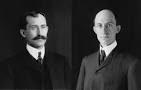
 
Orville and Wilbur Wright in 1905
To this day, they are unlikely to recognise flights by an unknown young Scotsman over remote farmland which took place four months earlier.

The rivalry between designers had more than a personal aspect. The military potential of aircraft was quickly recognised by forward-looking strategists, although the military establishment (especially in Britain) was slow to catch up. After the first flights, the next ten years saw rapid developments in aircraft, and these were the years leading up to the first World War. France was particularly keen to be in the forefront of aircraft design, acutely aware of the growing industrial and military might of her neighbour, Germany.

Britain formed the Royal Flying Corps in 1913, which was to play a significant part in the war, mainly in reconnaissance and bombing, although their planes were often victims of German planes designed more for fighting. Preston Watson, like so many patriotic young men, was eager to volunteer his services to the nation. With his skills, he should have been welcomed with open arms. Instead, he had a dismissive interview with a Major Merrinden. Merrinden told Watson that, at 34, he was too old to be a pilot. This was a lie. The top age was 40. The real stumbling block was the fact that he had not attended a public school. He was turned down as a pilot and told to try for a job at an aircraft factory.
 
Preston Watson
Watson was not so easily discouraged. He trained for his pilot’s license at his own expense and through other contacts was commissioned as a Flight Sub Lieutenant in the Royal Naval Air Service in April 1915. Above all, his experience in aircraft design was of paramount importance. Leo Anatole Jouques, owner of Jouques Aviation Works, contracted to the British government, recognised Watson’s value. Jouques contracted with Watson to build fifty-six planes to Watson’s designs, plus parts for another 150, Watson to receive a royalty for each.

On the morning of 30 June 1915, Preston Watson set out to fly from Eastchurch to Eastbourne, a distance of some sixty miles. The aircraft was not one of his own designs, but a Caudron GIII. The plane was believed to be in good condition, but it had been involved in an accident a fortnight earlier. About an hour later there was cloud and rain above the Cross-in-Hand Inn in Sussex and the field opposite. Several locals heard engine noise followed by a loud explosion. The engine noise ceased and parts of an aircraft fell from the sky. Preston Watson died instantly. He left a widow and two young sons. The elder was himself to die on active service in World War II.


That might have been the end of the story.

However, in the 1950s, Preston’s elder brother, James Yeaman Watson, decided that as a tribute to his brother he would try to establish that Preston Watson had in fact made the first manned flight in a heavier-than-air aircraft. He sought out statements from those who had been present or who had assisted at those early flights and he assembled any surviving documents from the period, although many had unfortunately been lost. His case was roughly dismissed by the leading ‘expert’ at the time, Charles Gibbs-Smith.


In 2014, Alastair W Blair and Alistair Smith published The Pioneer Flying Achievements of Preston Watson. Commenting to the Dundee Courier when the book was launched, Alastair Blair had this to say about Gibbs-Smith’s reaction to James Watson’s efforts to establish his brother’s claim: 'Mr Gibbs-Smith was very scathing in his appraisal of Watson's claim. He seemed to think that someone without a great deal of education and who came from the back of beyond could never have accomplished anything in the field.'

This was clearly not the opinion of Leo Anatole Jouques, who was so keen to build planes to Preston Watson’s designs for the government during World War I. It is difficult now to establish the claim, in the face of the Smithsonian’s contractual agreement (surely a very strange approach to history), despite the eye-witness accounts collected by James Watson.

A full-scale model of Preston Watson’s Plane One, built by the Dundee Model Aircraft Club, will be presented to the Dundee Museum of Transport on 30th June at a celebration in honour of its designer. 

The story of his life and the early history of aviation is told in full in Blair and Smith’s book. Perhaps on the centenary of Preston Watson’s death, we should pause to remember the achievements of this young pioneer of flight.

Ann Swinfen
http://www.annswinfen.com

Tuesday, 19 May 2015

'Amy, wonderful Amy...' - a homage to my aviatrix heroine


With the 85th anniversary of Amy Johnson’s record-breaking flight from England to Australia having passed a couple of weeks ago, and the 75th anniversary of her death coming up next year, it seems an opportune moment for me to attempt my own ‘homage’ to the great aviatrix, by taking to the air myself. This, you understand, was in the spirit of research, since I’m currently midway through a novel - Time of Flight - which is set in 1931 and which deals, amongst other things, with the era’s craze for flying. And so, donning an imaginary leather jacket and flying helmet, I climbed into the cockpit of a decidedly modern version of the Gipsy Moth in which Amy flew the 11,000 miles from Croydon Airport to Port Darwin.


My own flight would last no more than an hour, all told - of which I would take the controls for only a few minutes. But I can honestly say that at the end of it my admiration for my distinguished predecessor had increased a thousandfold. Not for her the luxuries of a closed-in cockpit and state-of-the-art modern technology. She did her flight in a machine made of wood and canvas, with a cockpit open to the elements, and very little in the way of instruments to guide her - not even a radio. She crossed oceans, and battled sandstorms, fog, and Monsoon conditions - as well as surviving several near-fatal crashes. My own flight, though it felt just as daring to me, was a tame affair by comparison.


If I can claim one thing in common with my heroine, it’s that I’ve always believed in taking on challenges - whether it’s white-water rafting on the (very turbulent) Orinoco River, or giving a talk on the Modern Novel to a packed audience at a literary festival with no more than twenty minutes to prepare. So I like to think that - even though I’m nowhere near as brave or as resourceful as Amy Johnson - I can now tip my hat to her remarkable spirit, and feel I’ve experienced something of what she felt, as she took to the skies, that May morning in 1930.


I’m hoping to follow up my ‘maiden flight’ with a slightly more authentic experience - piloting (or at least co-piloting) a 1935 de Havilland Hawk Moth, which is a somewhat more sophisticated version of the plane in which Amy first achieved fame. Here’s a photo of me sitting in the Moth, looking much more cheerful than I suspect I’ll feel when we eventually get off the ground… The things one does for Art.