Showing posts with label letters. Show all posts

Monday, 15 October 2018

Sylvia Plath's Letters Volume 2 by Fay Bound Alberti

I have just finished reading the second volume of Sylvia Plath's Letters, published by Faber and Faber. They make for sober reading. The first volume, published in 2017, covered the period 1940-1956. In those, a smiling, bikini-clad Plath beams out from the front cover, while the pages are filled with the optimism and hope of youth. There are pockets of doubt and difficulty, the hint of rape and a suicide attempt, but also Plath's growing certainty of herself as a writer, a woman and an equal to the towering figure of Ted Hughes, with whom she is forever linked.

Letters, volume 1

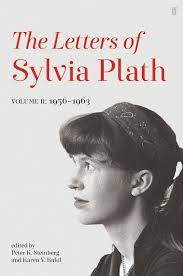
It is evident from the book jacket that the second volume will be a more serious affair. Gone is the summer sun and the happy expression. Viewed from the side and in monochrome, Plath's expression is serious, her hair tied up in a no-nonsense style. In nearly 600 letters, we follow Plath's marriage to Hughes, their movement around the globe and the UK, her library successes and his more immediate recognition, childbirth and child loss, a breaking-down marriage and her suicide at the age of 30.

Letters, volume 2
To Plath, Hughes was a giant, a genius, a literary God. He must be fed steak for breakfast and waited on, his needs tended to. Yet she also resented her domesticity, her entrapment to the demands of her husband - first moving to Devon because he wanted space, searching for childcare in order to write,  and juggling the demands of that writing along babies, cooking, cleaning and tending to Hughes. The marriage was intense. It was also violent. She wrote to her psychiatrist that Hughes beat her when she was pregnant, causing her to miscarry their second child. 

In the foreword to the book, their daughter Frieda meets these claims head on. She writes in defence of her father, justifying his apparent violence towards Sylvia - which is also recorded in Plath's journals - on the problematic grounds that what was meant by 'a beating' is unclear (a hit, a swipe, a push?) and that her mother had been difficult, needy, disruptive. It is difficult to read this perspective, and to compare it with the plaintiveness of Plath's own journals, the constant fretting about existence that hovers at their margins, her need to do right, live right, be right. 

Yet it is clear in Frieda's foreword how difficult it must be to have parents so utterly in the public eye and simultaneously capable of creating division. Plath was better known after her death than in life, with her books The Bell Jar (a semi-autobiographical novel about a nervous breakdown) and her poetry. Her writing is said to have contributed to the development of the confessional style in literature. And yet it is Hughes who is remembered in Westminster Abbey, not Plath.

The Bell Jar, first published in 1963 
Plath's final letters were written just a few days before she died by suicide in her London flat. She had successfully moved back to the city after being left by Hughes (he was unfaithful with their tenant Assia Wevill, who, in a terrible mirroring would kill herself and her daughter in the same way that Plath died). Plath seemed to be getting better; she had been knocked by Hughes' infidelity and the subsequent rejection of some friends, and she struggled with Frieda missing her father. She was convinced that her daughter had 'latent schizophrenia', and she fretted constantly about her wellbeing. 

It took such effort on the part of Plath to reestablish herself, to find childcare, to push herself back into the London scene, that the exhaustion is apparent on the page. Her letters to people become repetitive as she tells one after another about Hughes' adultery and abandonment, the money he is to pay, his family's turning on her, her living in Yeats' house and how that was fate, and finally, the endless illness, colds and flu of her children. 

In the main, Plath's letters have an enforced jollity even when she is struggling. From time to time she was angry and critical with her mother, but she also felt responsible for her, writing to her sponsor, the American author Olive Higgins Prouty, not to pass on information that might cause Aurelia worry. Prouty had suffered with mental health problems too, so Plath felt she was an ally. Plath was convinced that Hughes wanted her to kill herself, something she refused to contemplate. 

But by the beginning of 1963, despite all her contrived hope and determination, Plath was sleep deprived, unwell, lonely and depressed. On 11 February, having previously convinced herself, and her psychiatrist that she was no longer a suicidal 'type', she left out a snack for the sleeping children, took precautions to seal the kitchen and gassed herself in the oven. 

23 Fitzroy Road, London, last residence of Sylvia Plath

Two years after her death, Plath's collection of poems Ariel was published by Ted Hughes. These poems, including the eponymous poem written on her 30th birthday, drew on the pain of abandonment and loss that had followed her marriage breakdown. This is the writing for which she is best remembered. 


ARIEL

And now I
Foam to wheat, a glitter of seas.
The child's cry 

Melts in the wall. 
And I
Am the arrow, 

The dew that flies 
Suicidal, at one with the drive 
Into the red

Eye, the cauldron of morning. 


Sunday, 13 May 2018

The Delivery of Letters - a novelist's dilemma

by Deborah Swift


Despatch Rider 1648
Every time I write a book  there is nearly always a point in the plot where a letter or message needs to be sent, and I am obliged to calculate how long it will take for the letter to reach its destination. And of course someone in the novel is waiting for the reply, which doubles how much fictional time the reader has to wait to find out the outcome. This calculation nearly always involves the speed of a horse and rider, the distance, the state of the road, and the reliability of the postal service. Nowadays, mail is instant - a few seconds and it's on your screen. In the medieval Chronicle of Croyland, (named for its place of origin, the Benedictine Abbey of Croyland or Crowland, in Lincolnshire, England) we read:
' Richard III followed the practice which had been recently introduced by King Edward in the time of the last war with Scotland, of appointing a single horseman for every twenty miles, by means of whom travelling with the utmost speed and not passing their respective limits, news was able to be carried by letter from hand to hand 200 miles within two days.'
This was the beginning of the despatch rider, at first a temporary measure to take mail of national urgency, and later a method of sending mail along organised routes.Under this new 'stage' system, a fresh horse was available every twenty miles, and so a  hundred miles could be covered in a day.

In Tudor times as the court moved from place to place, so despatch routes would be organized between London and the designated palace. The earliest mention of a Master of the Posts is in the King's Book of Payments where a payment of £100 was authorised for Brian Tuke to take on the role February 1512. Tuke was the secretary of Henry VIII and Cardinal Wolsey and was asked to look into the King's Posts. He sent a memorandum to Thomas Cromwell which stated that only the London to Dover route was a regular post, and the rest a hotch-potch of disorganisation, with people pulling carthorses from the fields if a message was urgent.

Brian Tuke by Holbein

Because of this shortcoming, the idea of always having a horse in readiness became essential. So the postmaster was born, a man who would have a horse always available for despatches (and of course he could hire these horses out to private persons too.) On major routes now there would be a postmaster appointed in each town, and they were instructed to have the sign of a posthorn hanging on the door, for the couriers to be able to find the source of their next mount.

For this reason, we often still see the image of a posthorn on our mailboxes, stamps, and on taverns or pubs that were former staging posts. Some are still called the Post Horn Inn, the Horn or the Bugle Horn.


By Elizabeth's reign, entrepreneurs had begun to set up rival companies, until a proclamation was made that the only mail that could be sent abroad was to go by the official posts. By 1598 it was possible to send mail to Ireland via two routes - Holyhead and Bristol. However, unofficial postmasters still plied their trade until the reign of Charles I when Thomas Witherings was apponted Postmaster of England. In April 1633 Witherings was sent on a visit to the Calais and Antwerp to regularise the foreign mail service, and he subsequently became so efficient that he gained a virtual monopoly on the routes from the capital to Bristol, Norwich, Plymouth, Edinbugh, Holyhead and Dover, all places linked to foreign trade.

Mail in Early Modern England was notoriously unreliable. Footpads and thieves lurked on all the highways, and the post was often the target. Some post boys had 'arrangements' with local thieves. Added to this, many roads only had a weekly or bi-weekly service. I soon realised it was no good, as a novelist, thinking that the letter your character has sent would go the same day. It might be a week before the letter even began its journey.

The post was then subject to the vagaries of its individual riders, and in the 18th Century John Palmer of Bath described the problem of postboys:
'an idle boy without character, mounted on a worn-out hack, who, so far from being able to defend himself against a robber, was more likely to be in league with one.'
John Palmer, who owned a theatre in Bath, used a coach to take his theatrical scenery from town to town. Finding this quicker than the mail,  he conceived of the idea of doing the same for the post. The then Chancellor of the Exchequer, William Pitt, allowed him to make a trial run carrying the post between Bristol and London. Under the 'stage post' system the journey had taken 38 hours. The coach, funded by Palmer, left Bristol at 4 pm on 2nd August 1784 and arrived in London just 16 hours later. The government was impressed, so the mailcoach was born.

Royal Mail Coach , Science Museum London

To increase speed and efficiency, mail coaches in England were made to an approved design. Mail was held in a box at the rear where the only Royal Mail employee, who was armed, was allowed to stand. The guard's seat could not be shared with a passenger. The service ran to a punishing schedule, which meant that aside from quick changes of horses, the coach only stopped for collection and delivery of mail. The toll and turnpike gates had to be open by the time the mail coach passed through, and the gatekeeper was warned to open the gates by the blaring of the posthorn.

Mail coaches were able to travel the roads toll-free, but even by Regency times the frequency of foreign correspondence was limited. Just before the advent of the railways, Horne's Foreign Mail Service left St Martin's le Grand  each Tuesday and Friday night. It travelled all night and arrived in Dover at 8.15 the next morning. This gives some idea of the speed and the state of the roads.

Even after researching postal history, I still find myself calculating anew for each novel what sort of length of time my characters might expect to wait for their mail.

BBC  History of the World - Packet Bag

Images from Wikipedia
Bibliography:
From Track to Highway -- Gibbard Jackson
Masters of the Post; The Authorized History of the Royal Mail -- Duncan Campbell-Smith

My website and books www.deborahswift.com Twitter @swiftstory

Thursday, 28 April 2016

What's in a Letter by Julie Summers


I’ve always been fascinated by communication. Not just in its literal form but in what it says about the human condition and how important it is to people to communicate and be communicated with. Throughout my many years of research into the history of the Second World War I have been struck by how much of a difference it made if people could talk to one another, if not face to face then by letter. In fact, sometimes it was enough just to write the letter, as it was in the case of one of the soldiers I wrote about who was a prisoner of the Japanese for 3 ½ years. In February 1942 he wrote to his wife: ‘I am a Prisoner of War.’ The letter goes on to describe the fall of Singapore and then he wrote the following:

'We are going to be linked together through the medium of pen and ink and pencil and paper as we always have been; we are going to continue to put our thoughts on paper. So long as I am able, I am going to write you at least one letter each week. One day you will read these letters … And know without doubt that you are with me … now and always.' 

Charles Steel wrote 182 letters to his wife, Louise, over the period of his captivity but he could only send them to her when he was finally freed in August 1945. He posted them from Rangoon in September and soon received his first letter from her expressing anxiety about how difficult it would be for them to reconnect after so much time apart. He replied: 

‘To hear you talking about cooking for the family is as balm to my soul. . . I am sure that we shall come together quite naturally because I see, quite clearly, a scene in our garden in forty years’ time. You will be reading these letters and I shall be gardening, and I shall come over to you with the loveliest rose I can find. As I pin it to your shawl, I can see you look up and hear you say, ‘Darling, what silly children we were to think that a mere war would alter our love for each other!’ And I shall kiss you, because I shall still love you . . .’


Charles and Louise Steel did indeed come together and were married for over forty years. Margaret, born after the war, is photographed here with them on holiday. 

Today we can communicate a hundred times a day in so many different ways: email, Twitter, Facebook and a dozen other ways I probably don’t know about because I was born into the generation that sent postcards from holiday and rang home once a week from school. In 1940, the postman delivered letters twice, even three times a day. Telegrams were for urgent news, both good and bad, and by the outbreak of war the telephone was becoming more widely used. 

But the bulk of wartime correspondence was by letter and the quantity prodigious. In the six years of war the army postal service handled thousands of millions of letters and parcels to and from conflict zones throughout the world. The army postal service was run by an impressive individual called Major James Drew who was over six feet tall and sported a fine handle-bar moustache. He was so successful in keeping the post flowing that he could guarantee next day delivery of letters in the aftermath of D-Day in June 1944 and parcels to arrive within three days. 

In every diary written during the war there are references to the arrival or non-arrival of the post. Crushing disappointment when nothing came, euphoria at the delivery of a letter from a loved one. And at home the post was just as eagerly awaited. ‘No letter from Jack this week’ or ‘I am sure you have written but I haven’t received any letters from you for a fortnight and I do so worry when I don’t hear from you.’ But ‘bliss oh bliss! Four letters in one day. I jumped into bed, pulled the covers up to my nose and breathed in your news.’ The value of postal communication and exchange of information between servicemen and women and their families is hard to overestimate. 

‘Letters for us stand for love, longing, light-heartedness and lyricism. Letters evoke passion, tenderness, amusement, sadness, rejoicing, surprise.’ These words were written by Diana Hopkinson. As a deaf woman she was particularly lonely without him. She and her husband corresponded for over five years, the words on paper giving meaning to her life without him. While she was stirring the jam or playing with the baby, washing her clothes or mending their shoes, the letters, full of love and passion, humour and tales of far-away places she would never visit but in her mind’s eye, filled her thoughts and kept her going throughout the war.

One very special set of letters came to my notice when I was writing the chapter in my book When the Children Came Home. This was correspondence between families separated by the Atlantic Ocean. In 1940 Sherborne School in Dorset sent 125 girls aged between six and sixteen to Branksome Hall School in Toronto. For some this was the opportunity of a lifetime, for others it was less happy as they missed their families, but for all it meant that the only form of communication was the letter. Sandra B had been a teenager when she arrived in Toronto. She wrote: ‘My family were most supportive. They had written twice a week. I had written home without constraint, and I felt that they had kept pace with the ways I was changing: they had both been to North America and were well travelled.’ Coming home, however, was difficult and she found that Britain had changed. Canada was where her heart was and she returned in 1947, marrying a Canadian boy the following year. She went on: ‘I consider myself Canadian, British Columbian, but my roots are still British. My mother, brother’s family, aunt, husband’s family are still there. In retrospect I feel I had the best of both worlds and was exceptionally lucky to come to Canada. Because of the age I came out, I do not feel that I was adversely affected; maybe my attitudes were already formed. I feel it made me more self reliant.’ Undoubtedly, in her mind, the ability to communicate openly with her parents had given her the courage to do what she felt was right for her.

Today we no longer communicate by letter. That is something that has changed in the last fifteen years and I rue it. Nothing gives me more pleasure than seeing an envelope with spidery writing plopping onto my doormat. It is almost bound to contain a story and I feel a tingle of excitement as I slit it open to see what little bit of life is going to be shared. Some years ago I received a letter which started: ‘My name is William Mortimer Drower and your grandfather was kind to me when I got into a spot of trouble in the camp gaol.’ That is a story I shall tell you next month. Please be patient. It is worth it…