by Caroline Lawrence
Which famous story has a character whom we first meet in a kind of shed, who is persecuted by men in authority, has a special affinity with children, is gentle and meek, performs healing miracles, whose message can be summed up in the words "be good", who sacrifices his life to save another's, who dies, is resurrected to joyful cries of "He's alive!", who reappears dressed in white, promises to be with his friends always and who finally returns to the heavens from whence he came?
It's the 1982 film
E.T. the Extra Terrestrial.
Think about it: Eliot first meets ET in a shed-like garage, finds he's being hunted by scientists who want to "dissect him or something"; ET is "seen" only by children, at first. In one scenes he heals Eliot's cut finger by touching it. He tells Eliot's sister to "be good". He and Eliot become so empathically linked that when E.T. starts to die, Eliot sickens, too and so E.T. cuts the link to Eliot – essentially his life support – and allows himself to die, thereby saving Eliot. But when E.T.'s "family" come back from space his heart begins to glow again and he comes alive again. (Think of those pictures or statues where Jesus is shown with a glowing red heart!). Before E.T. leaves, he touches Eliot's forehead with his finger and says, "I'll be
here". Then he ascends into the heavens, leaving a rainbow-like star above.
E.T. was directed by Steven Spielberg, who is Jewish and had no conscious intention of re-creating the Christ story. In an interview I heard a few years ago, Spielberg told the story of how some Jewish kids who played extras on the film said to him, "This story's about Jesus!"
"No, it isn't," said Spielberg, then paused, frowned and added, "At least not consciously."
Isn't that amazing? That one of the highest-grossing films ever made essentially tells the Jesus story, and yet the director wasn't consciously aware of it.
Martin Scorsese, another film director, came up with one of my favourite quotes: He said, "I have a hard time telling the difference between going to the movies and going to church."
Scorsese, a New York born Catholic, directed such films as Taxi Driver, Raging Bull, Goodfellas and the controversial
Last Temptation of Christ. I think Scorsese means that when you've seen a good film you come out of the cinema feeling inspired, encouraged, warned, loved, and with a renewed sense of awe for God's love and grace.
That's how some films make us feel, and I'm not just talking about so-called "religious films" like
The Passion of the Christ or
Ben-Hur. Many secular films can inspire the sort of feelings we'd like to have when we leave church on Sunday. (One of my favourite inspirational films is
WALL-E.) I think it's because of the huge power that stories have in our lives.
As a professor at Oxford, C.S. Lewis wrote several academic essays on Christianity. Then one day he had a revelation about the power of story from his colleague J.R.R. Tolkien. He realised that stories are far more powerful than even the most beautifully presented academic argument. So he wrote
The Narnia Chronicles.
As a writer, I'm deeply interested in story structure. I regularly attend screenwriting classes put on by an organisation in London called
Raindance. In 2004 I attended one by Christopher Vogler, who used to work for Disney Studios in the 70's. Shortly after he left film school, Vogler read a book that changed his life. It was a book called
The Hero With a Thousand Faces by Joseph Campbell, an anthropologist who studied myths from different cultures. Campbell noticed that people from different parts of the world – without contact with each other – told very similar stories.
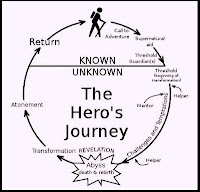 |
| diagram of the Hero's Journey |
As Vogler read Campbell's book, he identified twelve steps common to every hero's journey and realised it could provide powerful plot structure. His revelation was confirmed when he was invited to an early screening of
Star Wars. With a shock of recognition, he realised that George Lucas had been reading Campbell, too. Vogler left Disney not long after that screening of
Star Wars, and for over 30 years he's been teaching these 12 steps of
The Hero's Journey in seminars and in his book,
The Writer's Journey, a must-read for any would-be screenwriter.
This Easter Monday, I thought it would be interesting to see if those Twelve Steps could be applied to the Story of Jesus.
1. The Hero's World
The gospel writer Mark (and Mel Gibson in
The Passion of the Christ) begin when Jesus is an adult. Jesus seems to be the ordinary son of a Jewish carpenter in Nazareth in the reign of the Roman Emperor Augustus. Then one day the Herald comes. "And so John came, baptising in the desert region and preaching a baptism of repentance for the forgiveness of sins..." This Herald is someone known to Jesus. His cousin John, called the Baptist.
2. The Call to Adventure
As Jesus was coming up out of the water, he saw heaven being torn open and the Holy Spirit descending on him like a dove, and a voice came from heaven: 'You are my Son, whom I love; with you I am well-pleased.'
3. Refusal of the Call
The moment Jesus comes up out of the water and hears God's voice, he realises what he probably never consciously dared to think: he is the son of God, the Messiah. He may have
suspected it before, but I don't think he knew for sure. This is a
huge revelation and he needs a month in the wilderness to wrestle with the implications. I don't know if you could call this a "refusal of the call", but he certainly has a struggle. It's interesting that Satan, the Threshold Guardian as well as supreme enemy, challenges his revelation. "
IF you are the son of God", he says repeatedly, "then prove it by doing such-and-such."
4. Meeting the Mentor
Although angels ministered to Jesus in the desert, Jesus' mentor is God the Father speaking through the Holy Spirit.
5. Crossing the Threshold
Jesus returns from the desert and begins his ministry. He Crosses the Threshold when he comes out of the desert and crosses the Jordan into Galilee. Just stop to think how many people in the Bible crossed rivers. In Christianity, crossing a river is a symbol of baptism. When we are baptised, we cross a threshold from our old life to a new life.
 |
| Dali's Christ Crucified |
6. Allies, Enemies, Tests, Training and Oracles
As soon as Jesus leaves the wilderness and crosses the Jordan, his ministry begins. He meets and calls his disciples, and is opposed by religious leaders. Various people prophesy about him. He undergoes many tests and trials. He teaches, heals, casts out demons, forgives, and performs many miracles. Miracles like the raising of Lazarus must have given him courage for the Supreme Ordeal. At times, he must have wondered whether he was mad to think he was the Son of God. He was human, after all.
7. The Approach to the Inmost Cave
For Jesus there will be an actual cave, and a literal visit to the underworld. That journey which so many heroes took in the Greek myths, Jesus did in reality. According to 1 Peter 3.19-20 he went to the underworld for three days and preached to the spirits of the unsaved. But that is still ahead. First he must face
8. The Supreme Ordeal or Visit to Death
Jesus submits to torture and crucifixion. Films like
The Passion of the Christ give us some idea of the agony he went through. But we can never really grasp the horror of his mental and physical anguish.
11. Resurrection
After three days in the cave – in the underworld – Jesus is resurrected.
10. The Road Back
Galilee was never Jesus' real home. He returns to his real home when he ascends to heaven.
9. The Reward
Just as the reward in most Myth-based films is rescuing a person or persons, so Jesus' reward is rescuing us from Death. Holman Hunt's famous painting
The Light of the World shows how Jesus becomes a sort of Herald to knock on the door of our life. We can Refuse the Call if we wish. This image reminds me of 2004 film,
The Polar Express. The conductor on the train holds a lamp and invites children to join. But he never insists. The Conductor says this: "The thing about trains... it doesn't matter where they're going. What matters is deciding to get on."
12. Return with the Elixir
Finally there is the return with the elixir. According to Campbell (and Vogler), the hero often looks different and often has new powers. The "elixir" in the Story of Jesus is salvation for everyone, Jesus reconciling God and Man outside space and time.
In the 1930's, C.S. Lewis and J.R.R. Tolkien were dons together at Oxford. They were both Christians and both writers, and they met regularly with others to discuss various aspects of writing in a literary group called the Inklings. On one occasion, Lewis, Tolkien and another friend were up all night discussing Myth and its relation to Christianity. Tolkien and Lewis both loved ancient myths, particularly the Greek and Norse myths. But Lewis disapproved of Tolkien using myths in the books he was writing. He called them "lies breathed through silver" and suggested that a Christian shouldn't use so-called pagan stories.
But Tolkien argued that "pagan myths" point to the truth of Jesus Christ.
This was a huge revelation in Lewis's life and he suddenly realised that the "story of Christ is a myth working on us in the same way as the others, but with this tremendous difference: it really happened."
Recently I was listening to a podcast called
Mythology and the Spiritual Journey with Jungian psychologist Dr Richard Naegel. He quotes Joseph Cambell, who said, "Myth is what we call someone else's religion."
Naegel points out, "You don't call your own religion a myth. When you live in a myth you know it to be true... A living myth acts like a lens to align your inner world to your outer world... Stories are about meaning. The weave past, present and future. They give us a place in the universe. "
And I'll end with a quote from one of my own mentors, the late Blake Snyder, who taught with passion and humour about Hollywood storytelling in his
Save The Cat books, seminars and podcasts. "Why do we have to go through this storytelling process again and again?" he said in a 2008 podcast for
The Writing Show. "Couldn't we just be told one story and then get it? I think it's because stories keep us on track. We need a miracle every day."
[This blog is a shortened and updated version of
one first posted in Dec 2004]
Caroline Lawrence writes historical fiction for kids set in Ancient Rome and the Wild West. Christopher Vogler will be teaching a masterclass on The Writer's Journey at Raindance, London on April 28th & 29th.


_-_Nationalmuseum_-_40086.tif.jpg)


