Showing posts with label science fiction. Show all posts

Tuesday, 5 September 2017

Science Fiction from 1752 - Joan Lennon

"In one of the planets that revolve around the star known by the name of Sirius, was a certain young gentleman of promising parts, whom I had the honour to be acquainted with, in this his last voyage to our little ant-hill..."

Thus begins Voltaire's scifi romp Micromegas, published in 1752.  You can read the whole story in its English translation from the eminently addictive Public Domain Review here. A treat for the mathematicians and philosophers among you, it's also a quirky pleasure for those of us who are neither.  I loved the great man's flamboyant comparisons, such as when one character makes a derisive, but mistaken, first judgement of Saturnians, "just as an Italian fidler laughs at the music of Lully, at his first arrival in Paris."  When Micromegas and his new friend, the Saturnian philosopher, decide to go on a jaunt through the solar system, the philosopher's girlfriend berates him - "our five moons are not so inconstant nor our ring so changeable as thee!" - and bustles off to find herself a new beau.  When the rambling aliens reach Earth, their enormous size (did I mention that Micromegas is 34 kilometres tall? while the Saturnian dwarf is only a mere 12 fathoms in stature, so that when they walked together it was "like a very little rough spaniel dodging after a Captain of the Prussian grenadiers") makes them wonder if there is any intelligent life to be found, so what do they do?  Coming across a, to them, minuscule boatload of human philosophers returning from a trip to the Arctic, they create a hearing tube out of their fingernail clippings to catch their tiny voices!

Great literature?  Of course not.  But a guy with a big brain having some fun?  Just look at that smile!


a pastel portrait from 1735 
by Maurice Quentin de la Tour 
of Francois-Marie Arouet (1694-1778), known as Voltaire


P.S.  On no level would I compare myself to Voltaire, but my little ears pricked up when he wrote of his character being "a wonderful adept in the laws of gravitation, together with the whole force of attraction and repulsion, and made such reasonable use of his knowledge, that sometimes, by the help of a sunbeam, and sometimes by the convenience of a comet ... glided from sphere to sphere, as a bird hops from one bough to another."   Not a million miles from the way my own comet-riding Drivers manipulate their meteor herds in Walking Mountain.  Me and Voltaire - techno-babble buddies! 


Joan Lennon's website.
Joan Lennon's blog.

Monday, 6 June 2016

Utopian visions

Regular readers of this blog will probably be familiar with Louise Michel, teacher, poet and revolutionary heroine of the 1871 Paris Commune, but she’s not exactly a well-known figure in the English-speaking world. Yet. If The Red Virgin and the Vision of Utopia, the new graphic biography by Mary M. Talbot and Bryan Talbot, has anything like the success of their remarkable first collaboration, Dotter of Her Father’s Eyes – and it certainly deserves to – this could be about to change.

Michel is hardly obscure.  In fact she’s legendary.  She’s iconic.  In France (and indeed New Caledonia) there have been schools and streets and squares named after her, not to mention two International Brigade battalions and a Metro station.  She romanticised her own life in her memoirs, and has been mythologised ever since.  She was a saint, but a trying one, as an imagined contemporary in The Red Virgin and the Vision of Utopia admits.  By embedding her biography within not one but two other narratives, the Talbots subtly acknowledge all this and simultaneously reframe Michel in an entirely new way.  She emerges as an inspiring if imperfect visionary, whose utopian dreams and desires for a more perfect world might actually, by implication, be one day within our reach.


I won’t give away its surprising outer envelope, but the main story begins with Michel’s death, and the arrival of her coffin at the Gare de Lyon in Paris on January 22nd 1905.  Michel’s formidable face is framed by a wreath of red carnations, but she’s not named, and the reader is left to work out why crowds are gathering, and red flags flying. As the cortège leaves the station, in a scene which manages to look both forwards and back to the proclamation of the Commune at the Hôtel de Ville on March 26th 1871, we see a young woman holding up a sign for Mrs Charlotte Perkins Gilman.  America’s famous feminist is on a European lecture tour. Michel’s story will emerge in conversation between Gilman and Monique, the daughter of fellow revolutionary who stood on the barricades with Michel.  A little later, the unnamed one-eyed Communarde joins them.
The double narrative hinges on an imagined meeting in London.  As far as I’m aware, Gilman only once encountered Michel and her fellow anarchists, Kropotkin and Reclus (‘desperately earnest souls’), at the alternative meeting arranged in London 1896 after the anarchists had been banned from the International Socialist and Labour Congress.  She was impatient with what she perceived as the weakness of the anarchists’ philosophy.  In the Talbots’ versionGilman, who will eventually write Herland, instead recalls a delightful evening spent with Michel around that time discussing their shared obsession with utopian novels. (‘She was full of fantastical ideas.’)  Monique and Gilman reflect on fiction’s potential as ‘food for the mind’, and sci-fi becomes a creative lens through which The Red Virgin can view the life of a nineteenth-century political radical.
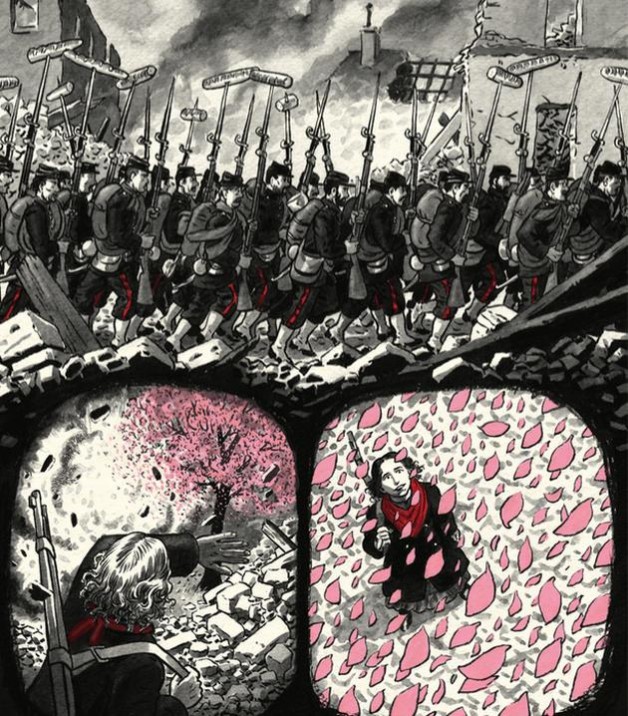
In an otherwise almost exclusively black-and-white visual narrative, splashes of red link flowers, flags, banners, scarves, pens, books, and a giant octopus.  There are a few other significant shifts in colour. The sky turns rosy at the pivotal moment on March 18th when the French government sent the regular army soldiers to steal Montmartre’s canon from the city militia, the National Guard.  Later, in two wordless images, a missile hits a cherry tree: chassepot on her shoulder, Michel looks up through an explosion of pink blossom.  Here the Talbots exquisitely evoke the hope and destruction of the ‘temps des cerises’, and also Michel’s ‘curious aesthetic’ – a slightly disturbing capacity to see beauty in bombs, to be enchanted by revolutionary destruction.
red_virgin_mary_bryan_talbot_cape_02-628x716
The graphic format lends itself particularly well to interacting narratives: hard white frames seperate the Gilman/Monique conversation from the soft blurred edges of the story it narrates.   But when it comes to the massacre in Paris that followed the invasion of the Versailles army – the paving stones ran with blood as the city burned – all borders vanish.  The horror can’t be contained.  A fog of ash descends like snow, and the flies gather over thousands of lime-sprinkled stinking corpses.
Louise Michel Bloody Week Talbot
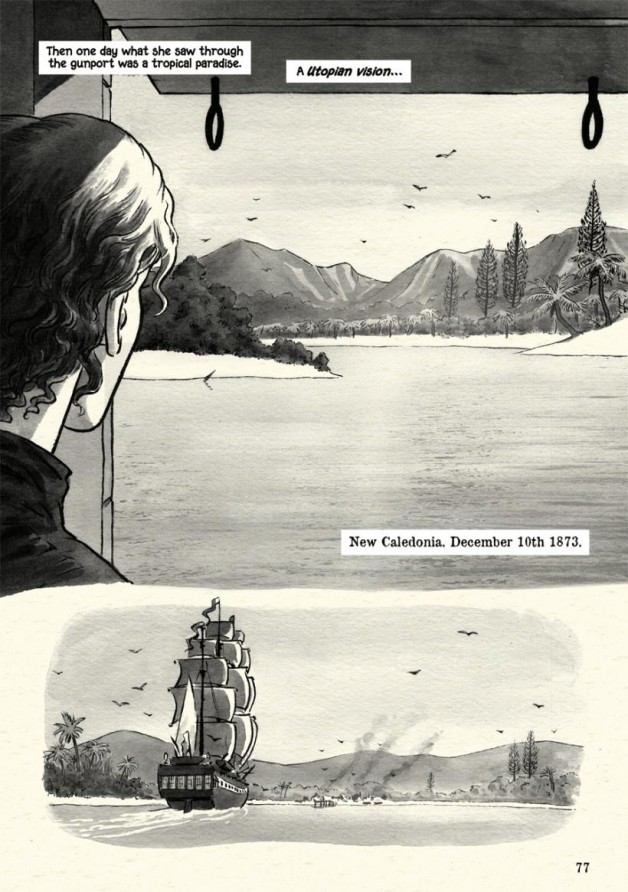
The Commune only lasted 72 days, and rightly takes up about half of this book.  Naturally I’d hoped the rest would take in a little more of Michel’s life in London, including perhaps her school in Fitzrovia, and her houseful of cats, but tight selection is precisely the art of a biography like this. The sequence depicting Michel’s deportation to New Caledonia and her support of the indigenous Melanesians’ revolution more than compensates.  It cleverly reveals the double-standards and blindspots not only of her fellow Communards-in-exile but also Charlotte Perkins Gilman, showing just how unusual Louise Michel was in her empathy for all the oppressed of this earth, regardless of race, class or gender.  She was equally zealous in her attention to needy animals.
Published on the 400th anniversary of More’ Utopia, this book both simplifies and complicates the story of the Commune and its thinkers and activists; it does so beautifully, by putting the imagination centre stage, and looking at the past with an eye always on the future.

red_virgin_mary_bryan_talbot_cape_01-628x892

The Red Virgin and the Vision of Utopia by Mary M Talbot and Bryan Talbot was published by Jonathan Cape last month. This review was first published on my own website: www.lydiasyson.com. More Paris Commune reading recommendations here.

Monday, 3 February 2014

The History of the Future - by Eve Edwards

Over Christmas I chanced upon the original Starwars films (parts now called IV and V) being shown on TV.  These were the cult films of my school days - I collected the bubblegum cards and played games based on the world in the playground.

I can't show the Death Star due to copyright but here is Mimas,
a moon of Jupiter that looks just like it! Thanks to NASA.
'These are classics, so much better than the new ones,' I announced confidently to my fifteen year old son so we sat down to watch.

Oh dear.

Yes, they are much better than the more recent clutch of three, saved by a knowing humour missing from the solemnities of parts I-III, but I had forgotten just how stilted the love dialogue was in them - or maybe I didn't notice.  Add to that, I now see how much they reflect their era of late 70s, early 80s - they are a little history of what we thought the future would look like (though technically Lucas claims them for long long ago in a distant galaxy...).  Good (American) guys fighting an evil empire - the men's hair - the futuristic white Leia costume that somehow look like a Biba trouser suit - the 70s is everywhere - I'm sure you know what I mean.  Even the sexual politics is very much of its time - Leia a kind of Germaine Greer fighting for her rights among the masculine warriors while the Hollywood male (Harrison Ford) manages to quell her with a kiss.  I missed this as a kid but now wish Leia had kneed him in the place where he did most of his thinking.

That set me thinking how futuristic films and novels are so often the best way of accessing the preoccupations of the present.  To change my metaphor, they are a boiled down stock of all most intense flavours swirling around in society.  One of the first futuristic novels I can think of is Mary Shelley's The Last Man (1826).
This is probably her most interesting novel after Frankenstein.  The scenario is a dystopian one of debates about monarchy and republicanism all swept away by a terrible plague that wipes out all but the lead character - The Last Man.  You don't have to think for very long to see how this reflects her era of the failing romantic spirit, the fears of everything being cancelled by death.  So many of her own generation were dead by then; on the larger political stage, France had gone from beacon of revolutionary ideas back to creaky old monarchy.  The mid 1820s had seen a banking crisis (sounds familiar?) and Mary Shelley was living a marginal existence trying to raise her son.  No wonder all the best days seemed in the past.  (The  human world ends in 2100 by the way; from the increasing alarming pace of climate change, maybe she knew something when she picked that date? Or is that just my 'spirit of the age' showing?)

Next major work I thought of was The Time Machine by H G Wells (1895).  Much better know, you are probably aware that this captures the ripples of the Darwinian evolutionary debate with a society that has divided in to useless, pretty Eloi and underground predators, Morlocks.  There are also fascinating reflections influenced by the Marxist debate of where class and society is going.


And then there is Zamyatin's We (written 1921) - one of the best reflections in the Russian revolution even though it is sci-fi. And George Orwell's 1984 (1949) - we haven't come to the end of the lessons that teaches us, have we?  The examples are popping up everywhere now I am looking for them.

So that leads me to the rather pleasing conclusion that to understand the past we need to be familiar with the future.  I'd love to hear you thoughts as this is a huge topic and I'm sure you'll have your own gems to share.