
Sunday, 25 May 2014

A FORGOTTEN STAR by Eleanor Updale

Sometimes you only find out about your home town when someone comes to visit. So it was that on Monday I came across this grand, but somewhat neglected,Victorian memorial poking up from behind a tree in Edinburgh.


Unusually for this city (and for most others, I expect) it commemorates a woman. Even more unusually, it honours someone who wrote for children.  


Clearly, Catherine Sinclair (1800-1864) was well known in her day, and yet I had never heard of her.   
What a shame.  It turns out that she was quite something.  
There isn’t much about her on the internet (though I am indebted to the National Library of Scotland’s site on forgotten authors). This may be a picture of her - but the site on which is appears gives no source for it.

http://www.librarything.com/pic/224250

All the academic children’s literature sites say Catherine Sinclair was the first author to depict naughtiness in children’s fiction.  Never having read any children’s books from before her time, I am in no position to argue with that, though it's tempting to think that they got the idea from her own preface to her most successful children’s book, Holiday House (first published in 1839). The introduction reads like a critique of 21st century education policy and pushy parents:


The minds of young people are now manufactured like webs of linen, all alike, and nothing left to nature… The most formidable person to meet in society at present is the mother of a promising boy, about nine of ten years old… but, if the axiom be true that “a little learning is a dangerous thing,” it has also been proved by frequent, sometimes by very melancholy experience, that, for minds not yet expanded to maturity, a great deal of learning is more dangerous still, and that in those school-rooms where there has been a society for the suppression of amusement, the mental energies have suffered, as well as the health.


Needless to say, Sinclair’s stories are very much of their time, with lashings of religious moralising, but nevertheless they romp along. Beneath the antique language comes an almost shocking (to today’s sensibility) freedom for her young protagonists, with their easy access to scissors, matches and open windows. The adults are far less monochrome than in some of today’s books. There’s a fearsome childminder, of course, but also benign grown-ups willing to recognise genuine contrition in the young.  

The main purpose of the books is to amuse, but they give young readers a chance to try out transgression in the safe playground of print, and to imagine the consequences for themselves and others. For today’s adult reader they are are a gentle reminder that our immersion in the lives of our children, and our cultivation of prolonged psychological terrors to replace the quick discipline of the Victorian nursery might not necessarily be an unmitigated good.


Among Sinclair's thirty or so books are works for adults, including
Modern Accomplishments, or The March of Intellect, a novel gently satirising the expectations Victorian society had for young ladies of good birth.  


It was an international best seller.  The book’s frequent (and heartfelt) assertions of the importance of religious principles help make way for very entertaining exposures of cant and posturing. As a contemporary critic put it in the Inverness Journal:
...we admire the high tone of moral courage which she has displayed in attacking glaring absurdities, which are deeply injurious in their effects, and are often more easily checked by being thus held up to general observation and to ridicule, than by bitter personalities or by a graver style of rebuke.


The saving grace is Sinclair’s generous understanding of those whose behaviour she criticises.  That’s what makes the books worth reading today. And her writing style is sometimes downright beautiful.   
Here’s a little bit, chosen more or less at random. All you need to know is that after a torrent of misfortunes, Colonel Neville, his wife (Lady Olivia) and their only surviving child are in improving spirits as they travel through the Scottish countryside.  Then their coach overturns.  Neville’s wife is unconscious, and he finds the corpse of his daughter:


...nothing awoke him from a stupor of overwhelming grief, till the sudden remembrance of Lady Olivia’s precarious situation roused up the manly energy of his character.  By a powerful effort he stifled his agony, and reflected how much must be done to screen the worst from her knowledge, till she was prepared for the blow; and in silent but bitter anguish Colonel Neville withdrew from the scene of his misfortune and placed himself beside the couch of his suffering wife, resolved that no tongue but his own should reveal to her the last and greatest of all her bereavements.  Night and day he watched with fervent anxiety beside her pillow fearful lest some imprudent attendant, or some accidental circumstance might prematurely disclose it all, and dreading, yet almost longing for the moment when their tears should be mingled together, and might give vent to the the deep tide of sorrow that had so nearly overpowered him.


As someone who has been reduced to a stupor of overwhelming boredom by the fake nineteenth century prose of the Booker winning The Luminaries, I can only say that it is an absolute joy to read the real thing.


But perhaps the most impressive fact about Catherine Sinclair is what she did with the proceeds of her work. In a city starkly divided between the very rich and the abject poor, she took practical action to improve the lives of the least fortunate around her.  She established a mission school, kitchens where the poor could buy a sustaining meal, and a water fountain for people and animals which stood at the junction of Princes Street and Lothian Road until 1926.
Alas, I can’t show you a picture of that, because the only image on the Internet appears to be in copyright, but you can see it here.


In the face of public protest, the fountain was moved to make way for Trams. Funnily enough, there might be room for it again now. The latest tram works have created a pedestrian refuge on the site.  But the dismantled stones are almost entirely lost. Only the top section survives. It sits rather oddly (and unexplained)  by a cycle path near the Water of Leith. It's not far from a Boys' Brigade centre whose predecessor Catherine Sinclair funded, but there is no indication that those who placed the stone there in the 1980s were aware of the link.

This is how the remains of the fountain top looked on Wednesday.


Back in central Edinburgh, the worn-out inscription on the grand memorial lists Catherine’s good works, but the lettering has eroded almost to the point of illegibility. 


The memorial stands only a few yards from Charlotte Square, where the Edinburgh International Book Festival takes place every year.  It’s at the junction of North Charlotte Street and St Colme Street.  If you’re up for the festival, do take a look - particularly if you are there on August 6th, which will be the 150th anniversary of Catherine Sinclair’s death.  I might pop along with a flower.

Here’s  a possible epitaph for her - in her own words - from the preface to Holiday House:


Those who wish to be remembered for ever in the world -- and it is a very common object of ambition -- will find no monument more permanent than the affectionate remembrance of any children they have treated with kindness...But above all, we never forget those who good-humouredly complied with the constantly recurring petition of all young people in every generation, and in every house -- “Will you tell me a story?”




Saturday, 24 May 2014

THE SUMMER QUEEN: Finding Eleanor of Aquitaine by Elizabeth Chadwick.


In early June in the UK and  July 1st in the USA, my novel THE SUMMER QUEEN is being published in paperback.  It's the first in a contracted 3 book series about Eleanor of Aquitaine.
I find it entertaining that my UK publishers have called her 'History's most powerful woman' on the jacket shoutline, because personally I'm not sure that she was in her own lifetime. I suppose she is immensely powerful in that the myths, legends and misinformation about her have created a massive groundswell of interest that keep her at celebrity level even today.

The novel was published in hardcover in the UK this time last year and since then I have received numerous reader letters saying 'I love Eleanor of Aquitaine. I didn't think anything new could be said about her, but you have surprised me and refreshed my awareness...you have made me stop and think.'

So, how did I come to add my own work to this frequently trodden path and what's my take?
I had been thinking about writing my own novel about Eleanor for some time. The twelfth century is one of my main stamping grounds as a writer and Eleanor has often had cameo roles in my novels. I had a couple of biographies of her on my book shelves as part of my general reference works and I often came across her in reading other research pieces. I  encountered her in fiction too at times and my curiosity about her grew down the years.  What was she really like?

On reader and history buff forums she was frequently described as a 'powerful woman ahead of her time.' The view was that she was dominant and feisty and would allow no man to put her down or quell her spirit. She was also an alluring femme fatale, accused of having affairs with her uncle and her second husband's father.  Following a marriage to the milksop Louis VII of France who found her too hot to handle, She had a passionate marriage with Henry II, rebelled against his love affair with Rosamund de Clifford, for which Henry imprisoned her for 15 years. Once free, she acted as regent for her son Richard and continued to lead a full and dramatic life until retiring in her last years to the convent at Fontevraud.

My UK editor was keen for me to tackle Eleanor - a woman from history with sales potential if ever there was one! Even in a crowded market place we felt there was room, and I certainly had a gut instinct that there was far more to be said about this remarkable woman if the detritus and accumulated greasepaint could be removed and original colours restored.I soon discovered that it was more easily said than done, not least because audiences have a fondness for that greasepaint and for that 'powerful woman ahead of her time.' The legend has often become the reality.

As I embarked on my research in detail, it  became clear that her biographers couldn't agree on anything about her; indeed some appeared to be writing novels of their own in the guise of biography. The academics frequently disagreed with the popular histories and with each other.  I found Eleanor married to Louis of France at both 15 and 13. Did it matter?  Well yes if I wanted to tell her story with integrity. The age of 13 as opposed to 15 would make an enormous different to the way I crafted her character. The one is barely out of childhood, the other is more knowing. (as it happened I went with 13 because no one else had written from that vein and it was the academics, not the biographers who were mostly arriving at that conclusion based on good reasoning and recent research).

 I found Eleanor variously described  as having snapping black eyes, black hair and a curvaceous figure that never ran to fat in old age, or as a red head with humorous green eyes, or as a saucy hot-blooded blond whom her father was desperate to marry off before her promiscuous nature got the better of her. All very entertaining but there is not a single existing proven  description of Eleanor of Aquitaine that answers to any of those claims. She was given half-brothers who never existed - as I explained in an earlier History Girls blog. The half brother who never was  She was claimed to be a wild Amazon who gaily led her ladies on the 2nd crusade as if it was one long picnic. Or alternatively she was forced into going by her husband Louis VII.  The latter was portrayed as a god-fearing milksop whom Eleanor dominated, despite strong evidence of his violent temper and vicious mood swings. She had a passionate incestuous affair with her uncle or she didn't. My take on it is here: Raymond of Poitiers She had an affair with Geoffrey le Bel Count of Anjou or she didn't. She arranged her own divorce - or she didn't. She indulged secret liaisons with the young Henry of Anjou in Paris under her husband's  nose or she ... you get the picture.  No one could agree and most of the opinions were boiling down to personal biases and speculation. They might as well have been novels rather than non fiction.

 Weaving my way through the differing accounts has proven both frustrating and utterly fascinating.  Eleanor's story has been constantly reinvented to suit each generation and for all that has been written, we actually still know very little and assume an awful lot about her.I love this article written by Ragena C. DeAragon titled 'Do we know what we think we know: Making assumptions about Eleanor of Aquitaine.' Do we know what we think we know.

My own take on Eleanor, having trawled the biographies and other works is that Eleanor was a woman very much of her time doing her best within the boundaries of what society would permit. Any attempt to push those boundaries was immediately and sometimes brutally squashed by her husbands, although she was nothing if not resilient. As to power: She was living at a time when the boundaries of royal women's power was in a state of flux and being redefined. During her marriage to Henry II, she actually wielded less power than any recent previous queen of England had done. Although never crowned queen, I include her mother in law Empress Matilda among them.

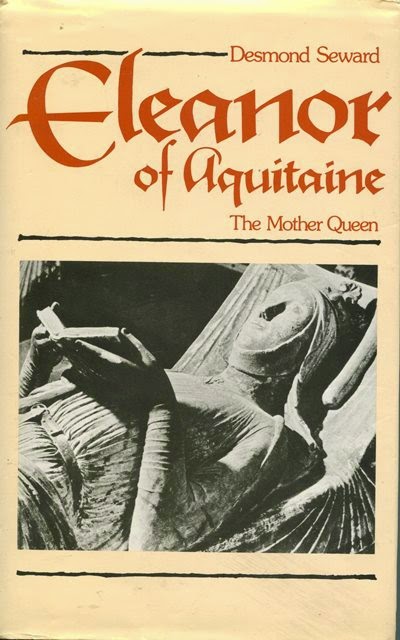
Perhaps the reference book I found most useful when writing The Summer Queen was this one - It's not so much a biography as a series of essays about Eleanor's life and times, and it sets out to put in context some of the myths and legends about her, and to debunk some of the more resilient myths. It's the sensible person at the party who doesn't get drunk and makes it home in one piece with their virtue intact!
Currently the best book out there (in my opinion) for telling it like it was
rather than being a modern wish fulfilment list.
For those interested in the research books I used while writing The Summer Queen, I thought I'd list a handful of the other works consulted, warts and all.   I leave you to make up your own minds, as I  made up mine - and then brought my choices to bear in faceting Eleanor's story.

These aren't all by a long chalk, but they are the ones most pertinent to Eleanor herself (or perhaps not!).
Pretty good, but makes mistakes based on mistakes
by other historians. .
Another fairly good one
Beautifully written, but outdated and the whole courts of love thing
is more than high suspicious and has since been debunked. Massive
pinches of salt and back up confirmation needed.
Interesting and somewhat fanciful take but worth
reading. Have the salt ready again.
The same as the Boyd.  Check the sources.
There are several errors. Salt in plentiful quantities
required.
One of the curvaceous figure brigade. Fairly outdated
but still worth the read in order to collect a broad spread
of information.
Very outdated and containing some wrong information
but again, useful to peruse.
Not strictly about Eleanor but I had to
add it because it's another of the sane ones
about the life, times and culture of the period.

More essays.  A good one.
.
.
.
.


Friday, 23 May 2014

The History Girls: Eglantyne Jebb, The Woman Who Saved the Children, ...

The History Girls: Eglantyne Jebb, The Woman Who Saved the Children, ...: Ninety-five years ago this month, in May 1919, a remarkable woman called Eglantyne Jebb, and her sister, Dorothy Buxton, changed the world. ...

Eglantyne Jebb, The Woman Who Saved the Children, by Clare Mulley

Ninety-five years ago this month, in May 1919, a remarkable woman called Eglantyne Jebb, and her sister, Dorothy Buxton, changed the world.

Many years ago, I worked as a rather struggling corporate fundraiser at Save the Children. One day I came across a line written by Eglantyne, the charity’s founder, when she was also finding it hard work to raise funds. ‘The world is not ungenerous’ Eglantyne wrote, ‘but unimaginative and very busy’. That struck a chord with me, and I became rather intrigued about this woman, who spoke with such immediacy but who is so little known today.


Eglantyne Jebb at her Save the Children desk, c.1921


In 2001 I went on maternity leave to have my first child - thereby showing far less dedication to the cause than Eglantyne, who never had children of her own and worked tirelessly for the charity until she died. As I had two weeks before my due date, I decided to spend a some time finding out a bit more about Eglantyne.

Looking through the papers in Save the Children's archive, then in the charity’s basement, I came across the leaflet below. Although entitled ‘A Staving Baby’, the photograph actually shows a little girl from Austria who is two-and-a-half year old. Her disproportionately large head, compared to her body, is the result of malnutrition.


Eglantyne's leaflet, 1919


In the top right hand corner you can just see Eglantyne’s scribbled word ‘suppressed!’ The exclamation mark shows her personal indignation at the policy of the British Liberal government to continue the economic blockade to Europe after the First World War as a means of pushing through the harsh peace terms of the Treaty of Versailles. Eglantyne believed that the British public was unaware of the terrible human cost of this policy and set out to change things.

In the spring of 1919 she was handing out these leaflets in London's Trafalgar Square, a traditional site for public protest. One account even has her chalking up the pavements with her messages ‘Fight the Famine’ and ‘End the Blockade’, in suffragette style. Eventually, the government had her arrested.

When her case same to court that May, Eglantyne knew that legally she did not have a leg to stand on as her leaflets had not been cleared by the government censors under the Defence of the Realm Act, which was still in place. Nevertheless she insisted on conducting her own defence and, focusing on the moral case, she gave the court reporters plenty to pad out their stories with.

The Crown Prosecutor is the only person in this story with a name to rival Eglantyne’s. He was called Sir Archibald Bodkin, and he did not spare Eglantyne in his condemnation. She was found guilty and fined £5. ‘This’, she wrote to her mother, ‘is the equivalent of victory’, because she could have been fined £5 for every leaflet she had distributed, over 800, or even been given a custodial sentence.

Furthermore, after the session had officially closed, but before the court had been cleared, Sir Archibald came over and pressed a £5 note, the sum of her fine, into Eglantyne’s hands. Technically she had been found guilty, but clearly in the Crown Prosecutor’s eyes Eglantyne had won the moral case. This would be the first donation towards a new fund that Eglantyne and her sister Dorothy now vowed to set up – the ‘Save the Children Fund’.

Daily Herald, 16 May 1919


As you can see from the photo above, of the front page of The Daily Herald, the British newspapers gave the story prominent coverage. Eglantyne was also featured in The Times, The Mail, The Mirror and The Guardian.

But Eglantyne knew that, pleasing though this coverage was, publicity alone would not feed the starving children of Europe. Determined to capitalize on the publicity, she and Dorothy decided to hold a public meeting and see if they could win further support for the cause. Being ambitious women, they booked the biggest venue they could find: the Royal Albert Hall. Reports tell us that in the event, there were not enough seats in the hall for the numbers of people who arrived.

Crowds queuing to hear Eglantyne Jebb and Dorothy Buxton
talking at the Royal Albert Hall, 19 May 1919


However, to their horror, Eglantyne and Dorothy soon realized that many of the audience had arrived with rotten fruit and vegetables to throw at the ‘traitor’ sisters who wanted to give succour to 'the enemy'. At first Eglantyne nervously mumbled her words, but her voice rose with her passion, until she called out; ‘Surely it is impossible for us, as normal human beings, to watch children starve to death without making an effort to save them’. The crowd in the hall were shocked. Then, in the silence, a collection was spontaneously taken up.

Within ten days Eglantyne, Dorothy and the fledgling Save the Children Fund had invested in a herd of dairy cows to provide a sustainable source of nutrition to the children of Vienna. Thousands of lives were saved, and that was just the start…

The Woman Who Saved the Children,
A biography of Eglantyne Jebb
by Clare Mulley


I am proud, and very grateful, to have worked, even just for a few years, at Save the Children, an organisation which is still doing such wonderful work to save the lives, and improve the life chances of millions of children all over the world. If anyone would like a copy of my biography of the extraordinary and inspirational Eglantyne Jebb, which won the Daily Mail Biographers Club prize, you might like to know that all author royalties go to Save the Children.

Clare Mulley www.claremulley.com


Thursday, 22 May 2014

A Visit to Sheikh Faisal Bin Qassim Al Thani Museum by Kate Lord Brown


Driving west of the city into the desert, I often passed a sign to 'Sheikh Faisal's Museum' on the way to Al-Samriya where you can ride Arabian ponies on the date farm, but it's only last month that a school holiday 'staycation' allowed enough time to visit. The museum has something of a legendary status among expats - it has, it's said, something for everyone. Islamic antiquities? A collection of dazzling quality and depth. Sports cars? Everything from some of the earliest cars in the region to a Formula 1 racer. From fossils to Crusader arrow heads, a passable homage to the 'Bar at the Folies-Bergere', Sufi drums, muskets, swords, butterflies, priceless carpets, calligraphy, furniture inlaid with mother of pearl, and an entire Syrian palace room rebuilt next to displays of dhows and aeroplanes. Among other distinctions it is the world's largest private collection of armory.

Sheikh Faisal generously opened his private collection of 15,000 objects from four continents to the public in 1998, and shared treasures amassed over 55 years of collecting. I was particularly interested and touched to see rooms devoted to other cultures and religions. As a collector of Islamic antiquities the Sheikh clearly has a marvellous eye, and the huge collection has been housed in a purpose built desert fort, constructed along traditional Qatari designs. 


After leaving university, my first job was as an art consultant, curating Orientalist and contemporary Arab art for collections destined for palaces and embassies - and this collection has something unique, I think. It feels organic - like each piece has been chosen with love, and there is a joyous quality to it. I was also surprised by the colour - living here you grow used to the bleached tones of sand, sky, sea, and grow thirsty for colour. I loved the exuberance of the carpets and textiles. 

The museum is both a noble, philanthropic gesture to preserve and share the region's history at a time when it is hurtling towards the future and developing rapidly, and the extraordinarily rich private collection of a man with a great eye for beauty. If you ever visit Doha, a visit will be the highlight of your trip - in the meantime, I hope you enjoy and are inspired by a short virtual tour. Here are a few of my favourite things:


A traditional Qatari interior


Dhows 


Sufi drum


Syrian Palace


Crusader arrow heads


Prince Ali Rida of Lorestan


If you are in Doha, you can call to arrange an appointment to see the collection. Entry is free, and there is no cafe or shop so pack plenty of water for the trip to the desert. Allow at least half a day for your visit. Further details: http://www.fbqmuseum.org/index.php/about-us.html