Showing posts with label First World War. Show all posts

Friday, 19 January 2024

Ally Pally Prison Camp by Maggie Brookes


Growing up in North London, Alexandra Palace has always been on my skyline. The first palace opened on Queen Victoria's 54th birthday, burning down 16 days later, but being immediately rebuilt.

When I was young, I would confuse the radio mast on top of one of its towers with the Eiffel tower. In my teens it was the place we went roller skating, fulfilling its original purpose as the 'People's Pleasure Palace'. As I grew up and went to work for the BBC, I equated it with the birthplace of television and a major TV production centre. It wasn't till much later that I read a paragraph in a local history book which told me it had been a civilian internment camp during the first world war. I immediately became interested, and my research was eventually published in a book which combined extracts of memoirs and letters with photographs, paintings and my own poems.


I discovered that at the beginning of the war it had been kitted out as a temporary home for the thousands of Belgian refugees who were flooding into Britain as the Germans over-ran their homeland. Then in 1915, after the sinking of the Lusitania, when anti-German riots broke out, about 42,000 German, Austrian and Hungarian men between the ages of 17 and 55 were rounded up and taken to internment camps, also known as concentration camps. 3,000 civilian men were imprisoned at Alexandra Palace in North London. The artist George Kenner was one of them, and this blog features his wonderful paintings.


Many of the men who were taken to Ally Pally in 1915 had left Germany as children, many owned business in England. Most lived in London and had English wives and children. They were the lucky ones. The unlucky ones were taken to a camp at Stratford, run by a sadistic commandant.

They were marched up the hill where they were registered, queuing in the rain and having all their belongings examined. They were rich and poor, bankers and barbers, waiters and stockbrokers. The prisoners were divided up into three battalions, and because this was England, the divisions were based on their social class.


The skating rink was for Battalion C, the business and professional men like George Kenner. The Great Hall (now used as a vast exhibition space) was the sleeping quarters for Battalion B, the working class, and a thousand men slept there. Their beds were within an arms length of each other and there was no privacy. They kept their few belongings under their beds.

One of the men who slept in the Great Hall with the labouring classes was a Hungarian tailor called Benny Cseh, whose pitiful letters to his wife Mabel are in the Imperial War Museum. Much of their correspondence concerns a 2s 6d postal order which went missing, and the fact that she sent him pears which became squashed. He described his day: 'We get up at 6am, breakfast at 7am, go outside till 12. Dinner at 1, go out till 7, out till 9, bed at 10pm. Every morning, running round the horse race track.'

Another man whose letters are in the Imperial War Museum was the young RH Sauter, the nephew of John Galsworthy, and a Harrow educated aspiring artist. He lived in one of the towers with the upper classes, in far superior conditions.

The men occupied themselves according to their status and experience, running a post office, laundry, carpenter’s workshop, tailor's shop and barber's shop. Many were employed in the kitchens, where the great organ bellows powered the ovens. In 1915 the menu was reasonably good, including stewed meat, goulash, corned beef and herrings. Those with money could buy cakes, cheese, butter and jam.


The men could receive letters and parcels and were allowed a weekly visit, which seemed to range in time from 15 minutes for labouring men, to 2 hours for the upper classes. Benny Cseh describes the agony of the short visit: 'I was very much disappointed with your visit. Not with you my dear, but with the time, as I did not know how to divide that 15 minutes between you and Ilona. I have been told she was crying for me when you left.'

Paul Stoffa's memoir details the visits: 'It was pathetic to watch the painful excitement of the men whose visitors were due that afternoon. Long before three o’clock they assembled with their little bundles of flowers and toys for the children.' The visitors were 'elegant young women with engagement rings on their fingers, poor working women with a bevy of half starved children… None of the women visitors came empty handed: but their parcels had to pass the censor first. Whilst some of the well-to-do men received huge parcels containing all manners of expensive delicacies, the small packets containing perhaps only a pinch of tea and a diminutive piece of butter, bore eloquent testimony to the self-sacrificing affection in which these poor women held their husbands.'

As well as finding work to occupy themselves the men gave lectures, calling themselves the 'University on the Hill.' They used the theatre for Sunday services, started an orchestra and had a weekly cinema. Their favourite was Charlie Chaplin. In the summer they sailed boats which they’d made themselves, on the boating pond. One man, called Otto Weiss, was allowed to keep canaries in cages.


As the war drew on, the civilian internees where joined by prisoners of war billeted at Ally Pally on their way to other camps and even a group of missionaries, captured in West Africa. But not all the prisoners were what they seemed. One man had been taken from a German ship and was classed as an enemy alien, until someone realised that the language he was speaking was Welsh! There were even reports of an escape, during an Zeppelin air raid, though this is impossible to verify.

As time went on, conditions at Ally Pally grew more harsh, and the diet became 'rice, rice, rice, three times a day with swedes and turnips and salt herrings.' They were served biscuits which were broken and full of worms and maggots. They sent some for analysis but the report said the worms were harmless and they should eat them. More fights erupted over food than any other cause.


Two camp heroes emerged from adversity: the deputy commander, Major Mott, and one of the prisoners, the anarchist / socialist Rudolf Rocker. He managed to get many important concessions for the prisoners but became very ill during the harsh winter of 1917 when the heating in the Great Hall wasn't working and everyone froze. 'It was terrible at night; the coughing and groaning kept us all awake.'

The food and physical conditions became worse and worse, but there were things which caused more mental anguish. There was no welfare state of course, and the men had no means of supporting their wives and children. The Society of Friends, the Quakers, sold the toys the prisoners made and took food parcels and clothing to the wives and families.

The constant noise, and constantly being surrounded by so many people caused many men to have nervous breakdowns. So many in fact that a Swiss doctor studied the condition which he called ’Barbed Wire Disease.'

Throughout the war, the YMCA ran classes, Rudolf Rocker gave lectures about art and literature, and the men found something to do according to their class and habit. 400 allotments were cordoned off on the slopes of Ally Pally, and of all the ways of passing the time, this seemed to have the most positive effect.

Finally, the end of the war drew near, and the men spent the morning of November 11th 1918 in great nervous excitement, until, at 11am guns were fired, to mark the end of the war.

A little later, newspapers arrived, which set out the armistice conditions. RH Sauter wrote this in a letter on Armistice Day: 'I have just read the armistice conditions and now I see the real ideals for which the money-grubbing lawyers of the 23 nations have been fighting. Here one is living among the defeated … it is upon their fathers, their mothers, their relatives and friends that these conditions of slavery have been imposed. The whole of Germany, one great internment camp. I see the child of this very day, like a ghost, haunting the future, another war.'


When I first read that, I was so shocked and appalled that even on armistice day it would seem obvious to an ordinary young man that another war was inevitable, that I decided to end my book at that point. But for the men at Ally Pally, life went on. Slowly, slowly they were called to hearings, to decide who could stay in Britain. Many were deported back to Germany. Rudolf Rocker was deported, but was refused entry by Germany. George Kenner, the artist whose paintings feature in this article returned to Germany where two of his children died in the great depression, before he eventually went to America.

And the century rolled on, towards another war …


Huge thanks to Christa Bedford for permission to use the wonderful paintings by her father George Kenner.


Sunday, 28 April 2019

Beaches and Bombers - by Ruth Downie

North Devon's 'Pages of the Sea' event, Saunton Sands, 2018
Pages of the Sea was a chain of gatherings on beaches across the UK to commemorate the end of the First World War. This summer we’ll see more events on Saunton Sands: this time to honour the soldiers who trained there for the D-Day landings seventy-five years ago.

All this is distant history for my generation, but to my grandparents the First World War was a living memory. The Second World War was a formative part of my parents’ childhood, and it affected them in ways that were impossible to predict.

In 1939 my father was 12 years old, and living in Ilfracombe, a small town just along the coast from the beach in the photo. Sifting through typescript of his unedited memoirs, I came across his account of the chaotic early days of the war, and the unexpected effect they had on his family’s fortunes:
"The day war was declared… all our plans were thwarted, for the air raid siren sounded shortly afterwards, and remembering Stanley Baldwin’s dictum that 'The bomber will always get through' we made our way down to what was then regarded as the safest place in the house - the coal cellar under the stairs. Remember this was early September; we obviously had not bought in the winter coal supply.

"Father was a Sergeant in the local Special Constabulary and so donned his uniform replete with steel helmet, and went off on duty. Mother prayed with us for his safety, and with gas masks at the ready, we awaited a visit from the mighty Luftwaffe.

"Now, of course, it all seems ridiculous. It transpired that the sirens had sounded everywhere (we were all going to get bombed at the same time!). Ridiculous now, but assuredly not then. The whole nation was on tenterhooks, and the authorities were too. It later turned out that a lone aircraft was detected coming into Croydon airport (or ‘aerodrome’ as they were known then) bringing some French military people to London for a conference. Nerves were taut, and off went the sirens. As for us, in obedience to orders, thereafter we kept a stirrup pump and buckets of sand and water in the hall to deal with incendiary bombs. Thus ended our first experience of the war.
'The little town of Ilfracombe changed almost overnight.'
"The little town of Ilfracombe changed almost overnight. Evacuees poured into town by rail - not only children. Thousands of adults left London and other big cities determined to avoid air raids, and the indiscriminate use of gas. Some had obviously made arrangements with relatives, but most simply packed a few belongings, got on the train, and started knocking on doors when they arrived. My parents took in a lady called Miss T— and a Mr and Mrs B—, also from the capital. They turned out to be a Jewish couple hailing originally I think from Russia.

"The holiday season had not yet ended. The town was already full with visitors. Many expected them to return home immediately war was declared, but very few did. They probably thought that this could be their last holiday for some time, and determined to make the most of it.

"In addition to those who were were evacuated here (many of the children came, not as individuals, but with their school), there also descended on the town an influx of troops. Among the first to arrive was a cavalry unit, equipped now with tanks, yet still, strangely being issued with riding breeches. The tanks, or rather their drivers, found Ilfracombe’s narrow streets difficult to cope with. I remember one turning down into our road from the High Street, and taking a lump out of the kerb in the process.

You'll have to imagine the narrow streets in this blurry pic from 1949.
"The breeches were ghastly. Shapeless, baggy and not at all smart. At this point we will leave the tanks and follow the breeches, for reasons which will become apparent.

"Now that we were at war, my father thought it might be an appropriate time to renew links with his old Regiment. The reason for this was that he could see no future for the business he had started. Stock would be difficult to acquire. The ‘season’ wherein most of the business was done was at the least, uncertain. A return to the Army seemed a much more certain means of employment.
A more certain means of employment? 1916, my grandfather seated in the centre.
 "Accordingly, he wrote to the relevant authorities offering his services if required. He was then aged 44. He was asked to wait a while to see how the situation developed, and this is where the breeches come in.
"As I remarked, the aforesaid breeches were unsightly. Answer? Go to a tailor and ask him to ‘wing’ them. This process made them flare out in the right place (the thigh) and become tighter fitting around the seat and lower leg. The soldiers were delighted with the result; the news spread throughout the unit.

"The town was filling up rapidly with Service personnel, every one of whom wore a uniform, and very few of the uniforms fitted. Almost all needed something sewn on (different Regiments had ‘flashes’ of various colours) and many needed repairing or pressing.

"Thus it was that W.B. Hancock, Tailors and Outfitters, never looked back."
Extract from the unpublished memoirs of Bill Hancock, 1927-2014.
 
 
In later years Dad developed a passion for history and one of the periods that especially interested him was the Second World War. His memoirs bring alive not only the experiences of one family, but also the wider context of the upheaval going on around them at the time. 


Pages of the Sea, 2018

At its best, isn’t that what historical fiction does, too? 


Sunday, 27 January 2019

Save the Children Centenary by Janie Hampton


Eglantyne Jebb (1876-1928)
This year is the 100th anniversary of the founding of Save the Children, one of Britain’s most notable charitable institutions. It was started by two indominatable sisters, Eglantyne and Dorothy Jebb. Their father was an English land-owning barrister and founder of a literary and debating society, while their mother started a charity for ‘Home Arts and Industries’. Both Anglican parents gave their daughters a keen sense of social justice, and a responsibility to challenge inequality; their French governess Heddie taught them about Prussian oppression; while their unconventional aunt Bun taught them carpentry, fishing and even how to make lead bullets.
As one of the first female students at the University of Oxford, Eglantyne attended meetings of the Christian Socialists and the Salvation Army. The established church did not appeal to her and she felt a close, personal relationship with the God who had chosen her to do His work. She had one complaint ‘which does for every­thing,’ she said, namely: ‘The world is wrong.’ As a young woman she investigated the working and living conditions of the poor, although she was sceptical about the effect of upper-class philanthropy, and her own poor health prevented her from doing much. At the age of 40 her health improved, and the injustices and suffering of the 1914-18 world war provided the motivation she needed. She became a passionate, dedicated and inspiring champion of children’s rights – though didn’t actually like individual children very much.
Dorothy Buxton (1881-1963)
Dorothy Jebb went to Cambridge University and in 1904 married Charles Roden Buxton whose family had been steeped in political campaigning since the 18th century. Both Charles and his brother Noel were radical Liberal, and later Labour, MPs who campaigned against the Macedonian massacres and together survived an assassination attempt in the Balkans. Their great grandfather was the slave liberator Thomas Fowell Buxton MP and their great great aunt was the prison reformer Elizabeth Fry. Dorothy, Charles and their children lived in unfashionable Kennington, London, among the people whose hardships they hoped to alleviate.
During the First World War, Dorothy and Eglantyne were distressed by the demonisation of the German people in the British press. To emphasize the common humanity of all Europeans, they published Notes from the Foreign Press. Dorothy was a member of the radical Women’s International League for Peace and Freedom, and believed that all governments shared responsibility for the suffering caused by war, and were creating a humanitarian crisis across Europe that could not lead to lasting peace. In 1916 she and Charles both joined the Independent Labour Party and became Quakers.
After the Armistice in 1918, the British government continued to blockade German ports, which led to a devastating famine. In 1919 the sisters founded the Save the Children Fund to help humanitarian agencies already working on the ground. They understood that controversy would help to raise awareness, so Eglantyne distributed leaflets in Trafalgar Square showing starving Austrian children. She was arrested, taken to court and fined. However, as well as gaining valuable publicity, she managed to persuade the prosecuting counsel to make a donation.
When Eglantyne asked Randall Davidson, the Archbishop of Canter­bury, to make an appeal on behalf of the children starving in Europe, he showed no interest. So she wrote to Pope Benedict XV. Clare Mulley, a former History Girl and Eglantyne’s biographer, recounts: ‘Pope Benedict had already been impressed by Miss Jebb’s lobbying to end the British economic blockade of Europe after the Armistice. In December 1920, he took the unpre­cedented step of issuing an encycli­cal, Annus Iam Plenus (On Children of Central Europe), in which he asked Catholic churches around the world to collect for Save the Children. It was the first time that the Roman Catholic Church had sup­ported a non-denominational cause.
‘Just before the appeal, Miss Jebb and her colleague Dr Hector Munro, who had witnessed the famine in Vienna, were granted a papal audience. Because she had been brought up in the Church of England, Miss Jebb was nervous about jeopardising the meeting by some slip in etiquette. In the event, her anxiety was forgotten in the drama of the moment: the Pope had fallen behind schedule, and, as Miss Jebb’s appointed slot approached, “The man who was showing us the way turned to us with violent gesticulations,” Miss Jebb later recounted to her sister. “Then he turned round again, and, to my utter amazement, took to his heels and ran. He was wearing a purple flowing garment like a dressing gown, which blew out all around him as he ran, so that he had the odd appearance of a purple ball bounding along the corridor.
“There was nothing for it but to run, too. Grasping my mantilla to prevent it falling off, I ran after him, through one gorgeous antechamber after another, where groups of soldiers and gentlemen-in-waiting turned to look. At last, through an open door, he turned, apparently too breathless to speak, with a wild wave of his arms. Precipitating myself in his wake, I perceived a small lonely figure, like a ghost, standing stock-still in the vast room, and, recollecting that popes always dressed in white, dropped on one knee. To my relief, I found that Dr Munro had run, too, and was making the poorest attempt at a genuflexion that I ever saw.” ‘
Dr Munro was not im­pressed by Eglantyne’s “attempt to curtsey” either, but the Pope didn’t notice. After asking many questions, he donated £25,000 to launch the appeal, insisting that it should be allocated to all children, irrespective of their faith. This prompted Archbishop Davidson to change his mind, and soon many other faith groups, from the Jewish community to the Theosophists, followed. Save the Children became a global appeal on an unequalled scale.
Children starving in the 1921 Russian famine were helped by Save the Children
Although Dorothy had the initial idea for the charity, her radical political activities were well known, and vilified by the right-wing British press. When in 1921 they claimed that Save the Children was aiding the next generation of German militants and Russian Bolsheviks, she handed over the reins to Eglantyne.
Save the Children was soon working in 24 European and Asian countries, assisting children regardless of their nationality, religion or their parents’ politics. In 1924 Eglantyne’s Declaration on the Rights of the Child, was adopted by the League of Nations. It later evolved into the United Nations' Convention on the Rights of the Child, which remains the most universally accepted human- rights instrument in history. ‘Miss Jebb had launched an international aid operation, saved the lives of thousands of children, redefined how child welfare oper­ates, and had written social policy of permanent world significance, all in an era when women did not even have the vote,’ wrote Mulley. Yet like so many successful women, she still felt a failure. Only eight years later, at the age of 52, she died of heart failure.
SCF began working in Africa in the 1930s.
Exhausted by fundraising and campaigning, and haunted by dreams of child famine victims, in 1923 Dorothy had a nervous breakdown. After her recovery, she campaigned on behalf of refugees from Germany and against concentration camps, and in 1935 went there to challenge Hermann Goering. She knew it was probably futile, but felt doing nothing was worse. She died in 1963, aged 82.
SCF assisted children affected by war in Britain, 1939-45 .
Eglantyne and Dorothy rebelled against both class and gender restrictions, and their belief in the importance of humanitarian aid and internationalism remains as relevant today as ever. Save the Children today works with more than 10 million children in 120 countries.
The Woman Who Saved the Children by Clare Mulley won the 
Daily Mail Biographers’ Club Prize. All the author's 
royalties from this book go to Save the Children.

Sunday, 2 December 2018

The Opposite of Historical Fiction - by Gillian Polack


One of the reasons I went to France earlier this year was to check for myself what happened in the Somme region after World War I. I read many accounts, but they couldn’t tell me what I needed to know. What did I need to know? The cultural impact of war.

Historical fiction builds culture. It gives so many of us pathways into understanding how our world sees its past and how people might have lived in it. As fiction, it has fuzzy boundaries, and this is an important part of creating that wonderful past. Some writers use the fuzzy boundaries to create adventure, and some use it to create small private worlds that readers feel they can step into. Some use it to create trauma and let us see the horror of the past. Whatever the writer chooses, they are adding to culture.

I used to think that war added to culture, too. This is because some aspects of war do precisely that. We’ve just had a flurry of memory of poets who died in World War I. Those terrible, beautiful, simple rhymes came from horror and represent death. Exquisite and agonising, they are a core part of how we see that war.

There is a Somme tourism that specialises in military matters. In July, I met a few of the tourists along the Somme, they followed the routes and visited the sites and the museums. There were so many Australians. I talked with some of them. A few were there for family who died. They wanted to see a piece of paper or find out more about a man or where he died. Another group was there because they want to commemorate the war in this hundredth year. A few were there to remind themselves that they vowed “Never again.”


This is also cultural creation. These personal reactions to damaged lives and to a damaged landscape are part of our healing, and we talk about that, but they’re also part of the act of cultural creation. We create a culture of memory when we engage in war tourism. We’re remembering the war and giving it sets of values. Culturally, it’s how we connect past to future. 

This doesn’t simply roll into historical fiction. Most historical fiction writers will take the emotions that rise from seeing death and the culture we use to explain those emotions and that death and will weave it into the fabric of their novel. Thus one type of cultural creation feeds into another type. It can be beautiful. It can be sensible. It can be tragic. From any direction, however, it’s cultural creation, often of a powerful kind. It has the power of drawing from several cultural elements and bringing them together and triggering emotions.

None of this is the opposite of historical fiction. The opposite of historical fiction is not the scarred landscape, nor is it the scarred lives. We’ve given them story. We’ve created culture for them and we’re very busy creating culture for them every day.

The opposite of historical fiction is the past that never makes it into story. One of the reasons humans commit genocide is to wipe the stories of people, their cultures, their memories, their very existence from the planet. This is an aspect of culture that’s so hard to talk about that we often dump the story and add numbers together to turn it into data. 

This is a terribly difficult subject, for so many reasons, so I’m going to give you just two examples of how these things are the opposite of history. If there’s enough interest, I can post more on it, for it’s part of my research into cultural fabric. Only if there are readers who want, however, for it’s a difficult subject to write about.

My first example will concern World War I and my second, World War II.


In and around Amiens, I talked with people and I took pictures of places and I visited museums. I needed to understand how families from the region recovered after the war. A man I spoke to was from a town that no longer exists. He told me that his family lost everything and that, a hundred years ago, they moved to Amiens to start again. He is a ceramicist and I bought a salt shaker to remind myself that every single bit of the physical culture for that family had to be re-created. 

We don’t think of locals who never travel more than 20 miles from the place of their ancestors as refugees, but some of the losses the ceramicist's family suffered are the same as the losses refugees suffer. The family didn’t lose their country, or their language. Some of the culture could be re-created and all the oral culture and the cooking and the family stories survived… unless they were linked to physical items. The destruction of private property was so immense that families are still trying to rebuild their physical heritage. They will never get all of it back. It's gone.

Local heritage for that region has big holes. The opposite of historical fiction. Not lack of evidence. Destruction of all the objects that link us to the past. If someone had a mourning brooch… it’s gone. If someone had a chair passed down from the Middle Ages and carefully preserved... it’s gone.  No number of salt cellars can replace the loss of the family kitchen, in the house the family had lived in for as long as records exist. The house itself is gone.


This is not restricted to the Somme. It’s everywhere where towns are destroyed and people are forced to move. Culture is simplified in a brutal way and when it is rebuilt, it’s not the same.

My second example is represented by the one book I hoped was stolen when 1209 books were taken from me by thieves. It’s the cookbook I’ve not had the courage to cook from. 

We all know stories about World War II. We (the broader cultural 'we') don’t tend to read a lot about the women sent to the concentration camps and the death camps. Several groups of women, historians have discovered, sat around talking food. We know (for historians have investigated) that some of these women starved to death while they were remembering recipes and dinner parties.

How do we know they were talking food? There are manuscripts, written down on whatever material they could obtain and hidden so that even if they died, people would know who they are. So that their families might have their recipes. So that there was memory. So that their history lived.

I can give you any number of reasons why the recipes might have been written down in such terrible circumstances, but that’s guesswork. That’s me trying to re-create the culture that has been destroyed. All we have are the recipes and any notes the recipe-writers gave us.

One of these collections has been translated into a cookbook. In Memory’s Kitchen. This is the book I needed to understand. The one that hurts when I see it. 

It hurts right now, because it’s on my desk because researching the Somme and writing this blogpost has brought me to a realisation. When the recipes of these murdered people sit unread on shelves in libraries, they’re part of the culture death those who killed them so desire.

We know that Jewish women on the verge of death wrote down their favourite recipes. That’s all we take into our culture. 


Yet these amazing women gave us a gift. Something that ought to be wiped from the planet with the women's lives sits right now on my desk and tells me, “We do not have to accept such destruction. We can remember this group of women through what they have given us.” 

I need to make something from that cookbook, soon. I need to remember these women and their culture and not share in the erasure of people from the planet.

There’s a Jewish festival that starts tonight. This is a good moment to make that impossible step and to move one small part of a destroyed past into living culture.

Tuesday, 27 November 2018

French view of the First World War by Janie Hampton

During the last four years we have seen the First World War from many angles. But how did the French see it? A few years ago I found two large-format bound volumes of the magazine L’Illustration in the street with a notice ‘Take Me’. Being an obedient citizen, I did. And then wondered what to do with them. Now I am glad I did not throw them out.  My school French can read the titles and the subject matter but not the detail. So I share with you some of the 100s of illustrations, drawn and photographed.

A fictional village in Alsace the day after German occupation
- suddenly the residents are very patriotic
French soldiers crossing the Canal d'Yser under fire....
..while officers of several armies enjoy life in the Café du Paix in Paris...
...and their daughters play in the Bois de Boulogne...

...and refugee children from the North hope for morsels of food.

Aeroplanes were a new weapon of war..
...but the French Army relied on donkeys for transport in the trenches.
...and reinforcements from the 43rd Battalion of Senegal.
L’Illustration dealt with subjects other than war, including the dangers of high heels (with X-Rays of damaged ankles to prove it); how to bottle apples; and the Russian Revolution (the editor of L’Illustration did not seem to like the Bolsheviks). In December 1918, advertisements reappeared on the back page. 
At the end of the war, there were celebrations across France. 
..while German prisoners-of -war wondered 'What next?'
Nearly 130,000 prisoners were taken at La Somme in August 1918.
France, depicted as a lovely woman, thanks a French soldier for saving her....
..while a surprised 'America' glares at a conquered 'Germany'.
After the war, soldiers rescued a bronze sculpture of  Eve, made by Auguste Rodin
in 1881 and buried in a garden in Douai, northern France
The British Prime Minister Lloyd George was awarded a double-page  portrait on the last page of L'Illustration 1918.
www.janiehampton.co.uk

Monday, 12 November 2018

Remembering all the Harrys


Private Harry Reynolds died in France on 29 October 1914, aged 25. A careerist soldier, his service was undistinguished. He appears in the army records only when he lost his equipment and slipped cigarettes to prisoners he was supposed to be guarding.

Harry, who joined up at the age of 14, was 4ft 11, with defective eyes. This short, unremarkable soldier left no family behind. There is no grave for Harry.

I found his story as part of a fantastic community history project in Herne Hill, the leafy corner of South London in which I live. The Herne Hill Society, in partnership with The Charter School and local volunteers, undertook a project to map the men and women connected to Herne Hill who were killed in World War 1. The team believe that as many as 700 local residents were killed. On my street alone, there were five telegrams delivered, five families left bereft.

This is their website and I urge you to explore it: www.memorial.hernehillsociety.org.uk/.


The team has unearthed many heart-breaking stories, including a family which lost its three sons. But somehow, Harry’s story is the one that has lingered. As historical writers, the lives we focus on tend to be the ones that are significant: either because they are remarkable, or they are important, or they fit the narrative pattern we’re seeking to impose.

Harry’s story brings no clarity to the greater picture. It adds nothing but a single digit to an unbelievably large number. The mud of France cracked open, swallowed Harry, and sealed again. 

Most of us will be invisible to posterity and to be troubled by that lack of significance is pompous and hubristic. But most of us will be mourned by someone. Perhaps Harry had friends in the army who missed him. Perhaps poor, short, squinty Harry had a girl at home.

As the veterans of the World Wars die of old age, we need new ways to remember the Harrys. The map that this history project has created is hugely powerful. Children, in particular, need specific stories of flesh and blood people, not numbers, to force them to empathy. My older children were fascinated and appalled by the stories of the fallen soldiers who had lived on our road. The geographic specificity gave them a sense of connection and helped them really think about the lives, and deaths, of these men. 

We talk of bringing history alive, in fiction and non-fiction. To do that demands an emphasis on the commonality of human experience even as we mine the past for instances of difference and uniqueness.

But London, much as I love it, is a strange and hotchpotch place which constantly erodes a sense of commonality. People pass through, neighbours fail to connect. Most of us are incomers to our London villages. Most of us, too, are not church-goers. We don’t have that sense of belonging to a place that can make Remembrance Sunday so unbearably moving: I remember, in particular, being in a village church in Norfolk for one Remembrance Sunday service, and the surnames of the fallen were the names on the graves and, doubtless, in the records of marriages and baptisms.

We Londoners live, secluded in our overpriced houses, and disconnected to our past. We are ancestor-less. 

I was thinking about this, as I watched a friend’s ten year old find the story of a man who grew up in the house next door to her: Lieutenant John Hood. John was born in Herne Hill, and baptised in the church attached to my kids' old school. He studied at Cambridge, and was beginning a career as a teacher, before enlisting. He joined the 29th Siege Battery in France in November 1916 and for the next two years fought in Belgium and France. John Hood survived the German guns, but caught influenza on 11 November 1918, and died three days later in France.


Image result for st paul's church herne hill
An early image of the church where John Hood was baptised.

One hundred years after John Hood caught influenza, the team behind the Memorial project organised a two minute silence in the centre of Herne Hill during the usually busy Sunday market. We stood amid the veg-sellers and the artisan butchers, the smell drifting past from the cheese stall; the fat from the burgers spitting and the steam rising from the giant vat of tartiflette. Kids and dogs and hungover youngsters clutching coffees.  All the busyness of a London Sunday.  Then a teenager from The Charter School played The Last Post, and we all fell still.

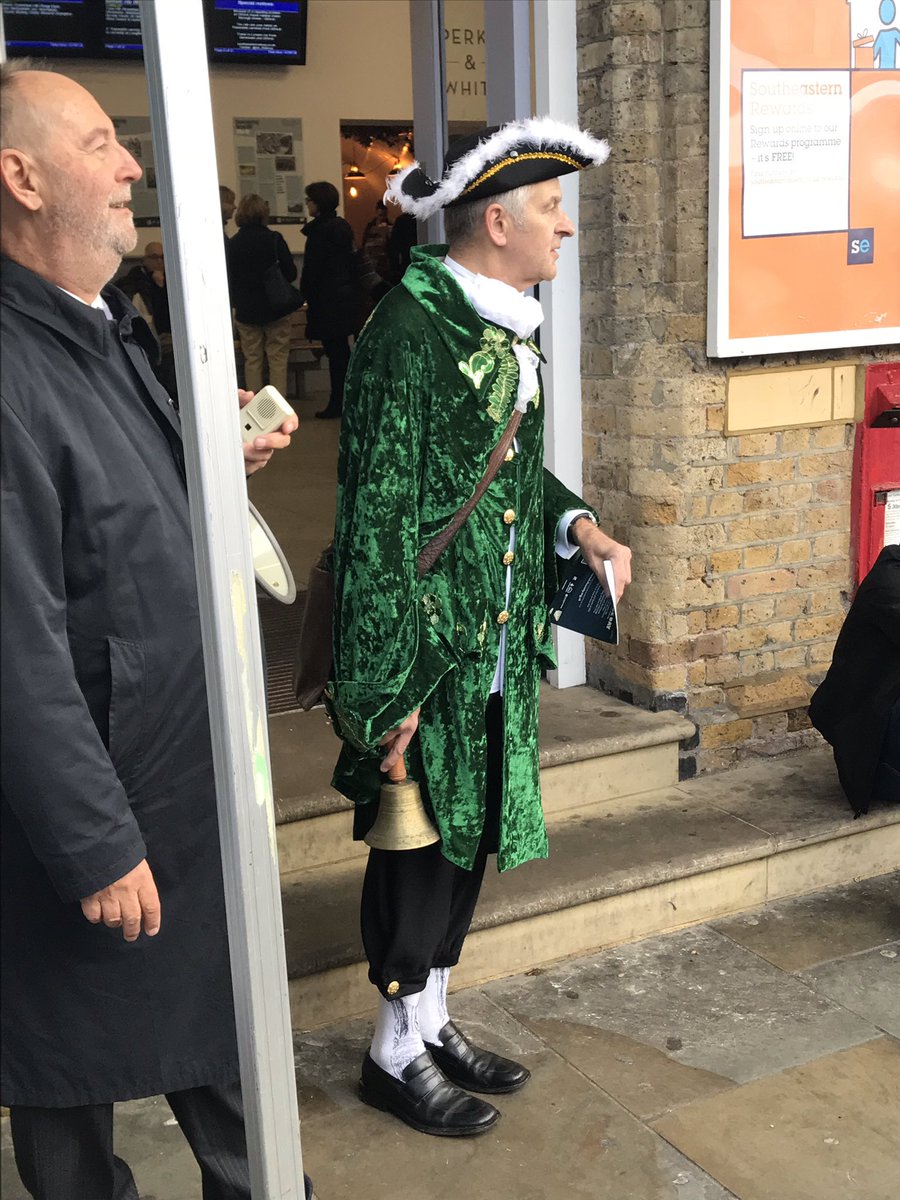
Herne Hill's town crier announcing the silence

There is a particular intensity to a silence that falls on a busy London street. I found it deeply moving - all these decent, unremarkable strangers standing together. It gave me a much needed dose of optimism. I have been dispirited of late by the mood music of public life, and its combative, fearful timbre. We seem to be more frightened than I can remember, more growlingly convinced of the coming apocalypse. Frightened people who feel powerless find anger easy.

We have different visions of the peril: for some it is Trump and Brexit, and the rise of the right; for others Corbyn and a resurgent Marxism. Then there’s the climate. The decline of the US and the rise of a more brutal Chinese hegemony. The coming of artificial intelligence. Putin gurning at Europe’s growing chaos. The likelihood that future generations will, at best, be poorer than us; at worst, face horrors that we cannot imagine. There’s a competitive edge to the catastrophising – my vision is more true and more terrifying than yours. We are strangers, gawping at a pick ‘n mix of dystopian futures.

I keep telling myself that there is an impulse in humans to anticipate an imminent Armageddon. True, yesterday’s silence reminded me that, sometimes, we are right and the Horsemen do sweep in and scythe us down. But it also reminded me that within all the tremulous cacophony of modern British life, there can also exist two minutes of meaningful silence.

@tonisenior 
antoniasenior.com