Tuesday, 7 January 2014

THAT WOMAN by Anne Sebba. A review by Adèle Geras

What do you know about the Duchess of Windsor? Probably you think you know quite a lot. Certainly the story of the King's Abdication in 1936 has been the subject of so many tv and movie variants that we all have our version of the story. I myself want most of all now to read GONE WITH THE WINDSORS by fellow History Girl Laurie Graham. The interest of the world peaks from time to time, and, for example, when the Duchess's jewels were put up for auction, images of gem-studded flamingos and the like filled the newspapers. The tale of a world well lost for love, the received wisdom about an American gold-digger determined to worm her way on to the throne of Britain are hard to shake in many people's minds.
Anne Sebba, an experienced biographer and also a very good writer, has taken this narrative and through a great deal of research and access to many new documents, including the Duchess's own letters has presented us with a person who's altogether more complicated. She married twice, determined from a very young age not be be poor. Her first (very unhappy) marriage was to a naval officer called Earl Winfield Spencer and she was only 20 when she married him. Ernest Simpson to whom History has given the role of complaisant husband and well-known cuckold, was someone to whom Wallis remained attached in many ways even after she'd begun a relationship with the Prince of Wales. Sebba quotes from letters written by Wallis herself which provide good evidence for the assertion that she was far less keen on Edward than he was on her. She had no wish actually to be Queen and the impetus for the Abdication came both from  Edward and also, much more interestingly, from the Establishment which on the face of it were not backward in condemning Wallis as a divorced harpy with an eye to the main chance.
And this was the reason: the Abdication was a consummation devoutly to be wished for political reasons. Edward was far too friendly with Hitler, Mussolini and their cronies and was deemed likely to turn Britain into a Fascist realm if he became King. He was also thought of as practically certifiable by many people and his brother Bertie, later to become George VI, was regarded as much better suited to be a monarch. So, it was to preserve the future of the monarchy that the liaison was outwardly discouraged but tacitly not in the least disapproved of.
The very last page of all in the paperback edition shows a headline from the Daily Express which reads "I am willing to withdraw if such an action would solve the problem." So in this account of Wallis's life, we feel we are getting a glimpse into the motivations of someone who's not in the least what we've been expecting. Sebba is very good at giving us as much medical information as she can. She catalogues the reactions of doctors at Wallis's birth, for instance, where her gender alignment gave some cause for concern. And of course, Sebba deals sensitively with the end of the Duchess's days, under the hawk eye of the lawyer, Suzanne Blum. It's a desperately sad and lonely end and whatever one's feelings about Wallis, it's tragic to think of her wasting away, no more than skin and bone, all alone in that huge house in Paris. I do recommend this book to anyone interested in the period, both for its new insights and also for its intelligent and clear-eyed look at someone who, whatever you think of her, was both a star and conscious of being one. Wallis was, for instance, miffed to have been knocked off the front pages of newspapers by Marilyn Monroe and demanded to know who this person was, who was in the process of attracting to herself so much media attention. It's a fascinating story, very well told.

Monday, 6 January 2014

Popular History Posts - Katherine Roberts

Just think what I could have done with a blog...


My thoughts on blogging range from "what a great way to reach readers all over the world!" to "complete waste of time" depending on my current mood and Amazon rankings. If you blog, you'll probably have your own opinion that falls somewhere inbetween. The fact is blogging takes time (and good blogging takes a lot of time), and whether that time and energy is well spent when you're also trying to write a book is questionable at best.

The ideal solution for authors might be to use our blog posts to give a subtle shoutout for our published books - that's the way our publishers see them working, I'm sure. But all evidence points to this being a real turnoff for readers - and I know Ms Hoffman frowns upon too much self-promotion on this blog. Posts that give genuine value in themselves, however, are likely to spread far and wide - either because they are entertaining, or educational, or just somehow hit the zeitgeist where it hurts. Such posts get passed around the world by word-of-mouth (or, more likely these days, tweet-of-virtual-beak) in much the same way as word of a good book gets around, seemingly by magic. A great blog post can therefore lead to the book... but if a book is strong enough to generate its own word-of-mouth, then what purpose does a blog post by its author serve?

It's a chicken and egg question, which I'm not even going to attempt to answer here. But as a mathematician, I find statistics interesting. So, since this is my first post of the New Year when people traditionally take stock of such things, I thought I would look up the stats for my own monthly posts on this History Girls blog and see which ones have proved most popular (they are all still live, so if you're curious to know why then just follow the links below to read the full post).
 
Not so popular
As I suspected, those posts ranking lowest are the ones I wrote to please my publisher. Nobody is much interested, it seems, in Camelot Castle, Dark Age Breakfasts, or Quests for the Holy Grail...which is a shame, since these are subjects I obviously feel quite passionate about or I would not have spent more than two years of my life writing a series of books based upon them. However, a couple of these "please the publisher" posts also sneaked into my top ten, so perhaps it's not the subject matter that is unpopular, but simply the way I wrote about it? (Note to self: same might apply to books.)

Interesting for some
'Midlist' posts, gathering several hundred views each, include Historical Plots, Retro Reading Lists, and How to Become an Author... mostly career/writing posts, which appeal to a slightly larger online audience but still not a large number of readers.

Popular
My top ten posts on this blog are, in reverse order:

10. From Anne Frank to War Horse (children's historical books)
9. Grand National Memories
8. In Search of King Arthur's Crown
7. Ten things you can't do with a Kindle
6. Why I didn't write The Hunger Games
5. The Suffragette who Died to be Heard 
4. Ancient Egyptian Adventures
3. A Brief History of the Olympic Torch
2. Have Written a Fairytale - will travel?

And way ahead of all of these, with well over a thousand views and counting:

1. Did Joan of Arc hear the Voice of God?

Which is interesting when you consider Quests for the Holy Grail ranked so low, but perhaps encouraging that, in 2014, God (or possibly Joan of Arc) still ranks above Fairytales, the Olympic Games, Ancient Egypt, the Suffragettes, King Arthur, the Grand National, several popular children's titles, and Amazon's Kindle!

*** Happy New Year to all our dedicated bloggers and readers! ***


Katherine Roberts writes fantasy and historical fantasy for young readers. Her latest series is the Pendragon Legacy quartet about King Arthur's daughter. All four titles are now available in hardcover, paperback and ebook. More details at www.katherineroberts.co.uk/page3.htm

Sunday, 5 January 2014

January: a Whistle Stop Tour - Joan Lennon

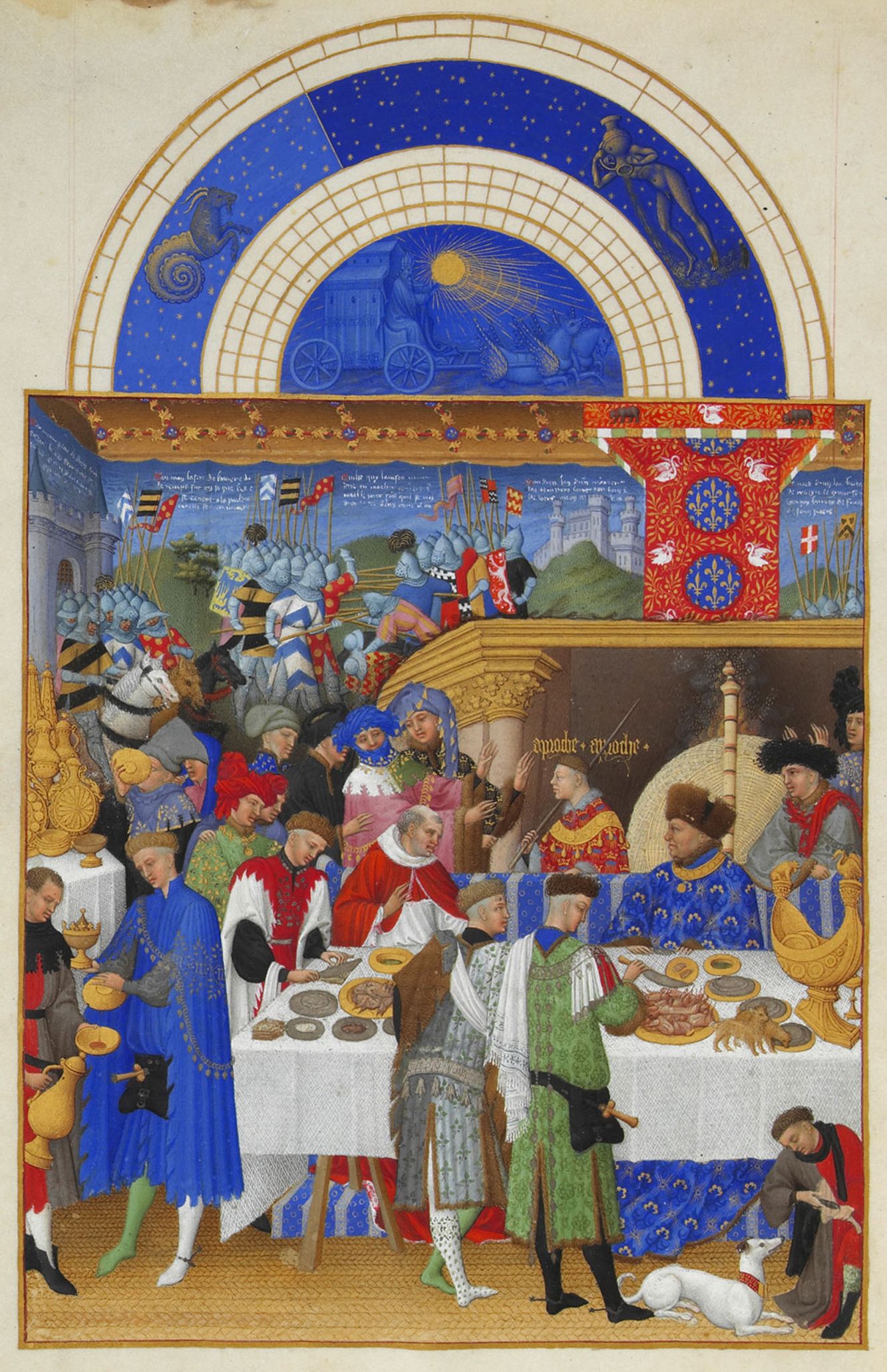
It's January, when many of us heave a sigh of relief that the (relentlessly) festive season has passed again, more or less successfully, and we can subside, stroll or leap (depending on mood) back into the arms of whatever it was we've had to set aside.  But, while waiting for the coffee to brew, spare a moment for the month herself, and how artists have been seeing her down the years ...


January from Les Tres Riches Heures of the Duc de Berry 
(between  and 

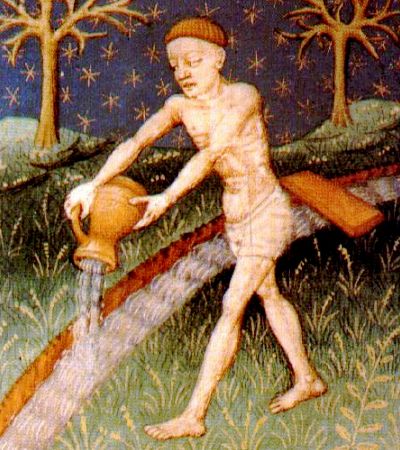
Aquarius in his pants 
(from a medieval book of astrology)

                 Woodcut illustration of Aquarius by Johannes Regiomontanus, 1512. 
                              (clothed.  So much more comfortable.)


Skating 
(early 1820s)


January by Grant Wood 1940 
(painter of American Gothic and a complete surprise to me!)

There, the coffee's ready.  Off you go now.


P.S. I also learned the following:

January starts on the same day of the week as October in common years, and starts on the same day of the week as April and July in leap years. In a common year, January ends on the same day of the week as February and October in a common year, and ends on the same day of the week as July in a leap year. In all years, January begins and ends on the same day of the week as May of the previous year. (Wikipedia)

I find this interesting, not in itself, but in the fact that someone thought someone else out there might actually want to know.  Dear geeks, we love you all.


Joan Lennon's website.
Joan Lennon's blog.

Saturday, 4 January 2014

A Teenager at Work in 1960 by Ann Turnbull

I had just turned seventeen when I started work in London in 1960.

I'd spent the past four years at technical school on a commercial course.  This involved shorthand and typing, general studies and O-Level GCEs.


My first job was at the headquarters of the National Union of Teachers.  For this change of lifestyle my mother provided me with two suits: an olive green one of hers, and a new navy-blue one.  There were many rules about dress in those days.  Your skirt should not show below the hem of your coat; your slip should not show below your skirt; bra straps must never show; necklines were high and cleavage unseen.  Hair was permed or put in rollers or pin curls at night to give it body.  To protect it from the weather we all wore printed nylon headscarves.


I loved being out at work.  By the beginning of 1961 I was earning £10 a week - a good wage at the time.  I paid my parents £3 a week, and probably paid about the same amount again in train fares from north Kent.  The morning train journey was crowded, and most people smoked, so a thick fug filled the carriage.  You usually had to stand, and men would open their newspapers and rest them on your head.  I soon began to think about moving to a bedsitter in London.

In 1962 I changed to a job in the litigation department of a firm of solicitors in Fleet Street.  Solicitors' offices demanded high standards and were always busy, and I enjoyed that.  The work was interesting, since it involved people and conflict.  Solicitors in those days did not advertise, and they certainly didn't chase accident victims.  Their headed notepaper was discreet and simply carried the name and address of the firm; the word "solicitors" did not appear.

All the solicitors working there were men, and from well-to-do families.  We girls each worked for one of them.  My boss, although quite a young man, always addressed me as "Miss Turnbull"; our relationship was friendly but formal.

In the secretaries' room we would chat about boyfriends, hairstyles, nights out, wedding plans.  Girls expected to be engaged by around eighteen or twenty, and married at about twenty-two.  Soon after, they would leave to have a family.

By now I was earning ten guineas a week, plus luncheon vouchers worth 2/6d each.  I flitted in and out of the shops in the Strand in my lunch hour, buying lipsticks and eye-liner and little straight knee-length dresses.  Fashions were changing, getting freer.  I abandoned my girdle and walked down the Strand feeling wobbly-bottomed.  I grew my hair long and wore it hanging loose - though I put it in a topknot for work.  In the evenings I'd go out with a boyfriend to pubs or folk clubs where everyone smoked and your eyes smarted and mascara ran.


Around this time I left home and, for the next few years, lived in a succession of bedsits and flats in central London.  A cheap bedsitter cost about £3.10s.0d., and would have a gas-ring - on which I attempted nothing more adventurous than Vesta curries.  I often ate out in Wimpy bars and cheap cafes.  Dalton's Weekly was the place to find accommodation.  Shared flats often had ads for a "third" or "fourth" girl, but many of these said "graduate preferred".  I had never met a graduate, and I developed an aversion to these elite people who couldn't face sharing with the likes of me.

Moving those few miles to live in London gave me the freedom of the city.  I loved London, and still do.  The Sixties - that fabulous decade - did not begin in 1960, but by 1963 it was on its way.  I moved into a mixed-sex flat.  I heard the voice of Joan Baez for the first time - a transforming experience.  I hung out in CND headquarters in Carthusian Street.  I went to Bunjie's folk club off Leicester Square.  I went on demos.  I went to student balls at UCL (yes, I finally got to know those graduates!)  I had some of my poems printed in small magazines, and in evenings and lunch-hours I sat and wrote my big historical novel and dreamed of publication.

Friday, 3 January 2014

Christmas songs - like 'em or loathe 'em? by Eve Edwards

Now the New Year has arrived and we are packing away the tinsel and glitter, I wanted to ask if you have a favourite or a hated Christmas song?  If so, I'd like to hear about it because something happened to me this Christmas.  I have developed a serious aversion to the popular versions of seasonal songs, even the good ones.  As for Frosty, Rudolf, Santas stuck up chimneys: you all make me want to emigrate to a country with no Christmas traditions.  I suppose there is a perverse pleasure in listening to the Beach Boys' doing 'We Three Kings' - it is truly so awful I say listen to it at your peril - but mostly the songs manage to squeeze out all trace of Christmas cheer in me, particularly when I hear them in shops.

This is not a new phenomenon.  My grandmother (b. 1910) worked in stores all her life and I remember her bemoaning the tape-on-loop of Christmas songs which was played from November onwards - this memory is from the 1970s and maybe started even earlier in her career.

It started me thinking about the history of Christmas music as annoyance.  In Dickens' A Christmas Carol, Scrooge, of course, hates carols (adding another layer of meaning to the title). I find myself sympathising with him as one young caroller

stooped down at Scrooge's keyhole to regale him with a Christmas carol: but at the first sound of
 'God bless you merry gentleman! May nothing you dismay!'
 Scrooge seized the ruler with such energy of action, that the singer fled in terror, leaving the keyhole to the fog and even more congenial frost.

The boy does it to punish Scrooge as everyone knows he hates all Christmas sentimentality and yes, it is very annoying to have a carol shouted at you through the door.  When we lived in London we had one bunch who came round in about October and only knew one verse - and collecting for themselves, we guessed.  They were not successful.

The tradition of annoyance is much older though and can be traced to the old British and Irish tradition of mummers.  The tradition still going strong in many parts of the country.  Near where I live, in the villages south of Oxford, there are still bands of these mummers going about at Christmas as a kind of rough carol singers and play performers, often using the pubs as their venues (drinking and Christmas songs have a long history too!).  The key is they are disguised by their costumes so the behaviour has a carnival element of topsy-turvy about it.  They are worlds away from shop muzak and use annoyance for the right reasons: the shaking up of the social order, reminder of older practices, the release of a (E P Thompson) Customs in Common style under-class energy.

Thinking back to some of the best loved carols, there is a hint of this in the words, isn't there?  'So bring us some figgy pudding…we won't go until we've got some etc.'  There a menace to the words if sung vigorously enough!

In modern England, this is perhaps more a memory than a reality (I imagine the costumes cover a fair amount of bankers and doctors) but mummers I've seen are happily untidy and amateur - not sickly slick like many other Christmas traditions.

Perhaps you'd like to tell me your favourite and least favourite example of Christmas music in the comment section below?

Happy New Year!


Thursday, 2 January 2014

Normal service will be resumed tomorrow

Lucy Inglis, the History Girl whose post should go up today, is without reliable Internet access because of storms. Bear with us and you will be able to read Lucy's post next month.

Thanks

Mary Hoffman

Wednesday, 1 January 2014

A big fanfare by Mary Hoffman


This is a really big day on the History Girls blog, so I hope you are not too hungover to focus! I can now announce with great excitement that we have produced our first ever publication. Daughters of Time will be published by Templar on 1st March 2014 and is a collection of stories written by some of our number about remarkable women, from Boudica to the protestors at Greenham common.

It's intended for readers of 9+ years and so our contributors are thirteen of those History Girls who write for children (some of us do both of course). It took a while after Templar approached us to work out which women we wanted to cover and who would write about whom but by the beginning of the year we had an outline that has now morphed into a book that is at the printer's!

Of course we could have done it all differently: there were so many subjects to choose from. So we have added a list of further women for readers to explore.

The anthology sprang from a post by Adèle Geras, a History Girl who was writing about the influence of the book Our Island Story on a whole generation of children. In the comments, another History Girl, Louisa Young, suggested that we should create a modern version of Our Island Story, with each of us writing one story and Adèle editing it.

An illustration from Our Island Story by H.E.Marshall

Adèle quickly rejected the editing suggestion but the idea of our producing an anthology one day got itself lodged in a few minds and Templar enterprisingly called our bluff. After that, the rest was details. Oh, and writing it of course, but it's always like that with books (I currently have one announced in another publisher's catalogue consisting of a title and cover and not yet much else).

In the end, I edited Daughters of Time and a dozen other History Girls contributed to it with me. Adèle's story was about Eleanor of Aquitaine, a very remarkable woman indeed, who was Queen of first France and then England. But we see her here in a private capacity, comforting a sick girl.

Eleanor of Aquitaine

We begin with Boudica - or rather with her resourceful and brave daughter, written about by Katherine Roberts, move on to Aethelfled, a rather less well known ruler, who was daughter of Alfred the Great and inspired Sue Purkiss to write her story, Lady of the Mercians. But it's not all about royal women.

We have Kath Langrish's touching story of the unhappy maid to Dame Julian of Norwich, Dianne Hofmeyr writing about Elizabeth Stuart, who escaped being both victim and puppet of the Gunpowder Plot and Marie-Louise Jensen on playwright Aphra Behn.

Mary Wollstonecraft, by John Opie

Penny Dolan introduces us to Mary Wollstonecraft and Joan Lennon takes us back to the childhood of fossil-hunter Mary Anning. Catherine Johnson completes a trio of Marys with the one called Seacole, a heroine of the Crimean War. Celia Rees writes about Suffragette Emily Davison, Anne Rooney about daring aviator Amy Johnson and Leslie Wilson - from her own experience - about the women anti-nuclear protestors of Greenham Common.


So a pretty varied bunch of subjects. I chose Lady Jane Grey, to liberate her reputation from the passive victim as portrayed  by Paul Delaroche in the famous and inaccurate painting of 1833, now in the National Gallery in London.

The Execution of Lady Jane Grey
I wanted to show how much she was still in charge of her own fate, however much the powerful men around her wanted her to be their political pawn. As a sixteen-year-old with a mind of her own and a will of steel.

In many of the stories, History Girls have introduced and created young women alongside the historical figures, to provide a way in for young readers, allowing them to see through the eyes of girls from the Middle Ages to the end of the 20th century, who found themselves part of events bigger than themselves.

We are launching Daughters of Time at the Oxford Literary Festival on Sunday 30th March at 2pm, when I will chair a panel consisting of Celia Rees, Penny Dolan and Leslie Wilson. And there will be several other contributors there to sign copies. We hope to see you there but, if you can't make it, then we hope you will read the book.


Daughters of Time by The History Girls, Edited by Mary Hoffman Templar, £7.99 paperback,
ISBN: 9781848771697 March 2013.

Now also available on Kindle. (updated June 2014)

For further details and review copies, please contact Laura Smythe on laurasmythecontact@gmail.com or 07881555530

Mary Hoffman and The History Girls are available for interview