Monday, 5 December 2016

The Goldfinch - Joan Lennon

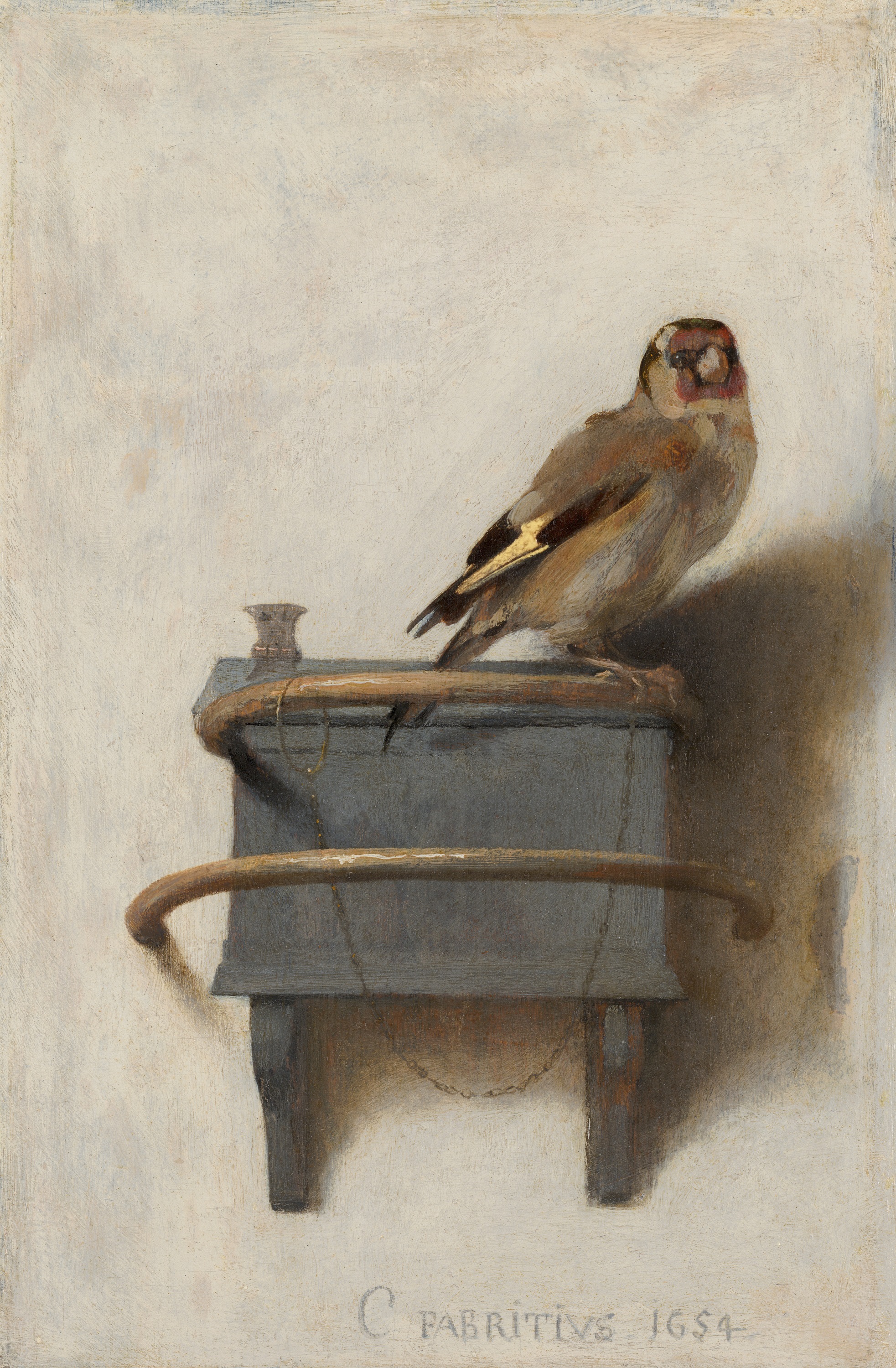
By the time this post goes up, I will have seen this little gem in the flesh.  But if I hadn't watched that BBC 4 documentary on Still Life back last year (I posted a HG blog about it here) and got all excited about, among other things, 17th century Dutch painting, I would most likely not have bothered.  Or even noticed.  


It's The Goldfinch by Carel Fabritius (1622-1654) and it is on loan for just 6 weeks from the Royal Picture Gallery Mauritshuis in The Hague to the National Gallery of Scotland in Edinburgh.  You'll need to get a shift on if you want to visit it there, as it leaves again after 18th December.  


The visiting Goldfinch, in situ at the National Gallery of Scotland.  
As you can see, Housekeeping is taking this special visitor in its stride.

If, however, Edinburgh isn't within visiting distance for you, here is a short video of the rather sweet Senior Curator Tico Seifert, speaking about the painting's importance and Fabritius' place in art history - a student of Rembrandt and an inspiration to Vermeer.  (Don't be cross that he doesn't actually show you the painting - I suspect moving the camera was going to be a step too far.  I liked the helpful human podium for his notes which gradually drifts into frame ...)

The Goldfinch.  Tiny.  Beautiful.  The sort of image the word exquisite was invented for.


Joan Lennon's website.
Joan Lennon's blog.
Silver Skin.

Saturday, 3 December 2016

Ōtūmoetai Pā: an 18th century fortified village by Debra Daley

Last month I wrote about the discovery in my neighbourhood of extensive food storage pits of late 18th century origin that had once belonged to the large pā, or fortified village, above the shore of Ōtūmoetai peninsula in New Zealand’s Bay of Plenty. The find was an exciting one since there are relatively few material traces of Māori life before European settlement. The dimensions of the storage pits suggested that at least two thousand people were living in and around Ōtūmoetai Pā at the time of James Cook’s first expedition to New Zealand in 1769. In this month’s post, I would like to write a little more about this particular local pā, which was home to the Ngai Tamarawaho hapū (clan) of the Ngāi Te Rangi tribe. 

An impression of the pā at Ōtūmoetai in the Bay of Plenty, New Zealand. Philip Perry.
Ōtūmoetai Pā covered an area of about four acres, centred on an escarpment that looked over Tauranga Harbour and out towards the South Pacific Ocean. The pā was a complex construction encompassing outer barriers of ditches, banks, palisaded ramparts and fighting stages on multiple terraces. These earthworks were arranged around inner fenced compounds where kin-groups lived in groups of timber-framed dwellings with reed walls and thatched roofs. The naturalist Joseph Banks, who had been on board Cook’s first expedition to New Zealand, described Māori dwellings (whare) as ‘mean and low', but conceded that 'they most perfectly resist all inclemencies of the weather.’ The interior of the whare (house) was spare. A fire burned in the centre of the single room upon the floor and the entrance served for a chimney. Tools and weaponry were stored in the house and high-born families kept intricately carved boxes containing feathers and other valuable items for personal adornment, but there was no furniture except for a square of boards joined together for a bed, with a mattress made of a thick layer of grass and dried ferns. Latrines and rubbish heaps for food scraps and waste served each cluster of houses. A typical pā of this time can be seen in the lithograph made by artist John Webber, who accompanied Captain Cook on his third Pacific expedition.  

John Webber. The inside of a hippah in New Zealand, 1784. The lithograph shows a pā (or ‘hippah’) with houses constructed of reeds in the Marlborough Sounds.
The dwellings are similar in a sketch of a pā in Wellington made some sixty years later by Captain William Mein Smith, a surveyor-general engaged by the New Zealand Company in 1839, and in photographs taken by Herbert Deveril later in the 19th century. 

Captain W. Mein Smith. Pipitea marae, Wellington, c.1840.

Herbert Deveril. Te Rangi Tahau on the porch of his whare, c.1875.

The site of Ōtūmoetai Pā was, and is still, an advantageous one. A tidal estuary, the waters of the large bay, and the ocean beyond provided an abundance of food. Women gathered shellfish and men went out fishing with bone hooks and flax nets weighted with stone sinkers. These accomplished offshore sailors paddled their canoes to outer islands to collect obsidian and immature petrels (muttonbirds) for food, and red ochre for body painting. Mauao, the volcano at the harbour’s entrance, was a useful place marker. A favoured hapuku (groper) fishing spot could be found by lining up Mauao’s western slope with a tall tītoki tree that grew at the rear of the pā. This venerable tree, still extant, is now more than three hundred years old.

Joseph Jenner Merrett. A Meeting of Visitors,  c.1843. View of a pōwhiri (welcome)
between two Māori groups outside Ōtūmoetai Pā with the outline of
Mauao (Mt Maunganui) in the background. Tauranga Libraries.

To the west of the pā, rainforested hills provided berries and bird life, and timber, and eeling places in the rivers that flowed into the sea. In a pattern that continued well into the twentieth century, Tauranga Māori made use of these rich resources by migrating between inland areas and the coast to gather food and tend crops. Excess was preserved – fish were wrapped in fern leaf, shellfish threaded on blades of rushes, birds stored in fat in gourds – and kept in raised storehouses together with large calabashes of water.
Flax and kūmara (sweet potato) were the principal crops and they were treated with reverence. Each flax plant was regarded as a family, the central shoot being the child and the leaves surrounding it the parents. In order to maintain the plant’s vitality, only the outermost leaves – the grandparents – were harvested. Women softened the blades of flax by beating them with stone pounders. They wove the flax into hoop nets and cordage, plaited it into mats and baskets and worked it into a silky fibre for clothing, which was similar in weight and drape to sweat-shirt fabric.

Gottfried Lindauer. Women Weaving Flax Baskets, 1903. Auckland Art Gallery.
Māori wore a diversity of garments – cloaks, aprons or kilts or a ‘girdle of many platted strings made of leaves’, and various closely woven mats worn next to the skin. Both men and women bored holes in their ears, which were kept extended by plugs of feathers, bones or wood. Sometimes women wore bracelets or anklets made of shells or small bones, while the men hung greenstone tiki around their necks or the tooth of a shark or a whale. Women sometimes wore their hair short, cut with sharpened shells, or tied it behind the head, or wore it at shoulder length. On occasion, women cropped their hair as a mourning gesture.

A woman photographed by the Foy Brothers, late 19th century,
with cropped hair decorated with huia feathers.
British Museum. 
Sydney Parkinson, the botanical artist on the Endeavour in 1769, recorded that men on the east coast of the North Island '... had their hair most curiously brought up to their crowns, rolled round, and knotted.' Parkinson’s portrait of a chief shows an example of the style. Long hair was oiled and bound it in various ways with flax and adorned with combs, carved from wood or whale, bird and human bone, and feathers.

Sydney Parkinson. Portrait of a New Zeland Man, from a sketch made in 1769.
Many men and some women wore facial moko (tattooes) to varying degrees.
Kūmara tubers were planted in spring with some ceremony in scattered communal gardens. Everybody worked in the gardens, including rangatira (chiefs) – but they were exempt from carrying the small gravel, obtained from the bottom of streams, which was brought in baskets during the winter by women to prepare the planting ground.

Kūmara tubers. Before the planting began, prayers were offered to Rongomātāne,
the god of kūmara, and other cultivated plants, to secure goodwill with regard
to the harvest. 
The tubers were planted in mounds in soil that has been amended with wood ash and were considered tapu until they were ready for harvest. Low fences served as breaks against the prevailing westerly wind at Ōtūmoetai, which can be gusty in early summer with a tendency to dry out the soil.

Te Parapara Māori Garden, Hamilton Gardens. Photograph by Michal Klajban.
A storehouse overlooking a mounded kūmara garden. Māori used a cord
to plant the rows of kūmara in a straight line. The seed tuber was set
with its sprouting end towards the warmth of the north.

The mauri (life force) of the kūmara, and hence the fertility of the crop,
were protected by carved, wooden atua kiato (god sticks)
fixed around the perimeter of the gardens.

After harvesting in autumn, the kūmara was steamed and dried before being stacked on the sand-strewn floors of underground pits over winter. The pits at Ōtūmoetai had the capacity to hold up to a tonne of tubers.

Once the kūmara had been harvested and placed in storage, the people could lead a more itinerant lifestyle, trading, or gathering other foodstuffs needed for winter. They might wander the beach or the banks of streams looking for good water-smoothed cobbles that could be used to crush the red ochre brought back from Motiti Island, or for heating the earth ovens in which food was cooked. Joseph Banks described the ovens as ‘holes in the ground filled with provision and hot stones and covered over with leaves and earth’. Small fish and birds were generally roasted over an open fire on a skewer. Kūmara, taro, large fish and dogs were cooked in the ovens.
 Cook and Banks marvelled at the vitality of the Māori they encountered. That is hardly surprising given a diet that was simple and moderate, plenty of fresh air and exercise, and an absence of sugar and alcohol. They tended to be taller and more robust than Europeans, Banks noted. He was particularly struck by the number of healthy old people in the population. Some even appeared to be in their eighties, ‘and of these, few or none were decrepid, indeed the greater seemd in vivacity and chearfullness to equal the young, indeed to be inferior to them in nothing but the want of equal strength and agility.’ Aged men and women in Māori communities were held in esteem for their experience and wisdom. 

William Hodges. Sketch of a Māori woman carrying a child, 1773.
Children were treated with indulgence, Joseph Banks observed.
For forty or fifty years after the first contact with Europeans, Māori at Ōtūmoetai continued to flourish. The lack of accessible timber at Tauranga  – the result of previous land clearance by Māori for pā and for crop cultivation – meant that the area held little interest for early Europeans looking for opportunities to exploit New Zealand's hardwood forests  – and shore whaling efforts and sealing were centred elsewhere in the country. The large Māori population at the Bay of Plenty eventually attracted missionaries and traders, but this occurred later than in some other coastal areas of New Zealand. Flax was a resource where the Bay of Plenty had an advantage, and this eventually featured in later Māori and European industry.
Ōtūmoetai Pā had the distinction of never being conquered by enemies, but the eventual military defeat of Tauranga Māori in the New Zealand Wars of the mid-19th century led to the confiscation of their land by the Crown. The people at Ōtūmoetai were forced to leave their ancestral home and the land was allocated to soldier settlers.

Tori Tupaea, the last great Ngaio Te Rangi chief of Ōtūmoetai Pā.
Image Mike Dottridge.


Friday, 2 December 2016

Food in fiction, from fantasy stew to johnny cakes, by Gillian Polack


This last fortnight I’ve been indulging in comfort reading and comfort cooking. I need a couple of hours safety in my day in order to cope with our current interesting times. My reading time has been spent about equally in fantasy worlds and in the world of Georgette Heyer. All of this convinces me that it’s time to talk about food again.

Medlars, picture by Gillian Polack


One of the ways in which I judge the success of the invention in a novel (any novel) is how well the writer handles food. Georgette Heyer is comfort reading partly because she understands that food and the social habits that surround food are essential to her stories. She skips over many things, but seldom food. 

She doesn’t describe it rapturously or gluttonously: she uses it as an essential part of the lives of the characters. Her female characters can go whole days without ever needing to use a toilet, but when Elinor Rochdale rocks up to a strange house in The Reluctant Widow and no-one is prepared for her coming, there are only cold meats and maybe bread and butter on offer. In a well-run household there would be more choices, but the house Elinor discovers is not well run in any way. People must eat, even in poorly-run households, but people may not eat safely or may not have much in the way of choices but starvation is just that and only applies to those living in appalling circumstances. Heyer’s Regency is imaginary and so a lot of the ugly side of society is missing: no-one starves, although people may skip meals or have sadly restricted choices. Food is at the service of story.
Food in a good novel is always at the service of the novel. Even if the author doesn’t mean it to say something, it is part of the story. When an author doesn’t consider food properly and just shoves it in willy-nilly, it’s the reader who pays.

Dried barberries, picture by Trudi Canavan


Until Diana Wynne Jones mocked the ever-present stew in adventure fantasy travel in her The Tough Guide to Fantasyland travellers eating stew appeared far too often in a certain kind of fantasy novel. It was important to feed people felling tyrants or achieving noble quests, and ‘stew’ was a simple concept that worked for those who had never made a decent stew from scratch. By ‘from scratch’ I mean ‘first trap your hare and wild-harvest your carrots’. Decent stew is not a recipe suitable for exhausted people who need nourishment instantly and who are on the run or on a quest.

The writers who used stew in this way had a particular need in their writing. It wasn’t just to feed travellers. Others have used random nuts discovered (in or out of season) or stale bread to serve the same function in the story. They might be depicting a sense of camaraderie around a campfire, a feeling of solidarity or a moment of hope. A hot meal in the midst of panic gives that moment of comfort and equates in reading terms to my choice of novels right now.

Food isn’t just for keeping people alive. Not in fiction and not anywhere. It tells us what level of luxury we live in, what friends we have, how far we’re social beings and far solitary, how much we as individuals luxuriate in or ignore our senses. So if stew can’t be used in quite the way it has been in fantasy novels, what can?

Dried white mulberries, picture by Trudi Canavan


There are many choices, and they all relate to the function the food serves at that precise moment and also to the culture drawn on for the novel. When I was a child, damper was our stew-equivalent for a moment of camaraderie around a fire. Or, if we had a pan, johnny cakes. Johnny cakes are ‘journey cakes’, I suspect (though have never actually demonstrated). 

I and my friends took our sense of mood form the folklore and folksongs we were taught. This is how that bonding can be developed, even if there’s no time or capacity to cook a stew. The song that pushed me to think about journey food was called “Four little Johnny cakes” and a version of it can be found here. http://folkstream.com/042.html It’s all about comfort. All about a pause in travel for refreshment, physical and emotional. The food can be cooked quite quickly, on a single pan, or has been pre-cooked. It has associations with wandering the roads and carrying a swag: the food of swaggies or stockmen.

I’m using Australian terms quite intentionally here, for another thing that writers do when they haven’t thought through things properly is to use the language of their youth or of the fiction they write. How many US readers however, know what a squatter is or care about swaggies? The rules were different. The history is different. The words we write with are not culturally neutral. 

Picture by Gillian Polack


It’s easier to remember that these terms are not culturally neutral if I use less-familiar ones. Saying “johnny cake” in my fiction would have to be backed by some suggestion as to what a johnny cake is, for my readers might not have grown up with (probably didn’t grow up with) that song. I could use the song, or I could joke about the griddle cake Alfred burned (if it was historical fiction) or I could describe the delectable aroma, or... there are many techniques open to writers. The trick is to remember to use them. A good historical fiction novel will use a dozen in a chapter, for they are what bring the detail to life for the reader when one is talking about a distant time.

Flour and water and a bit of salt and a bit of raising agent and maybe a few currants and you have a johnny cake. It takes a very few minutes over a hot pan. If you don’t have a hot pan then you find a stick and make damper. A somewhat wetter dough, wound around the stick and then cooked over a hot fire. These are the travel foods of my childhood. We drizzled honey over our lightly burned damper and made a wonderfully sticky mess. Damper can be savoury and it can be cooked in a dying fire or a dutch oven. 

Flour and water are the traditional cooking ingredients of many travellers, because flour could be carried in a small flour bag and water is a survival necessity. Much more real than stew, in that way.
Alas, for flour and water, the writer has to work that much harder to get the sense of camaraderie around a campfire, or eating a hot meal together I a time of difficulty. Not all foodstuffs serve the same narrative goals with the same ease.


Stew is not impossible while travelling. Soup is even more possible. But they need planning, time and cooking equipment. This is where it’s really handy to look at what travellers actually ate at various times in various places in history. How far from village to village, farm to farm was it? Was it customary for stray travellers to be fed if they arrived when a meal was being served or (for whatever reason) were travellers left unwelcomed? Did voyagers steal chickens from farmers or buy them or forgo fresh meat? Did they walk into a shop and buy equipment and did that equipment include special bags to carry flour and salt and ground coffee and travel soup? Did they travel with a cart, a mule, a horse, a boat? The reader doesn’t have to know all this – if a writer develops the right model for their tale, it will make the story a lot more evocative and mean that food can be used in all the various ways: it’s not just a matter of making sure that characters don’t starve.

Research doesn’t have to be theoretical. Right now, I know a bit more about portable soup than I ought. This is because I’ve been making it. A lot. I know that chicken doesn’t work so well (the bones are too brittle) but that duck is splendid and beef bones with a little meat on are best of all. Of all the beef I tried, Belted Galloway farmed in an old-fashioned way made the best portable soup. I know the exact mount to cook it down to in order to make ‘soup glue’ which has so little moisture that it can be packed in paper and taken on board ship. One smallish cube of my portable soup makes 2-3 mugs of real soup. And I can make quite tasty soup this way. In fact, I have duck soup in my freezer right now and am using it instead of stock cubes in my stews. It makes the best stews ever. My version, however, takes three to five days to make, over low heat. There’s no way of speeding it up and still having a safe and tasty end-product. I’ve tried. It’s wonderful travel food, but it takes planning or resources.

I cook things like this on writing days. This is the wonder of the modern kitchen. I have to keep an eye on my big saucepan, but I don’t have to tend a fire. Before iron stoves were invented quite recently, it wasn’t so easy to make.


This explains the bread and the mutton and the johnny cakes and the fish. It also makes a kind of travel stew possible if you have a pan and a fire and some meat and some vegies. If travellers carry enough baggage and have a good cook in the company, it’s possible to have the comfort food.
It takes a lot of set-up, however. A slice off a piece of mutton bought from a farmer and a piece of bread or damper to eat it with, or a johnny cake (or four) – these are more likely for that Western European based fantasy world than a travel stew. Georgette Heyer, of course, simply finds an inn for her travellers and, if they arrive at an odd hour, someone has to argue with the innkeeper until food is produced. Food is at the service of story in a good novel, always.

Thursday, 1 December 2016

Henry the Eighth's jousting accident by Mary Hoffman

"Henry's the Eighth's jousting accident" and other things we think we know about

This is a post about the minutiae of historical research and how you can't take anything on trust.


One of the things we think we know is that Henry the Eighth had a very bad jousting accident on January 24th 1536. He lost consciousness for two hours and the news of his injury and possible imminent death, conveyed to his queen, Anne Boleyn none too gently by the Duke of Norfolk, caused her to miscarry a male child of 15 weeks.

From then on, his ulcerated legs, his weight gain and his irascible mood swings led to the executions of Anne and of wife number five, Catherine Howard and his divorce (or annulment) from wife number four, Anne of Cleves, the execution of his right hand man Thomas Cromwell etc. etc.

Here is a Documentary from 2014 called Inside the Body of Henry Vlll, which attempts to find out what his medical conditions and injuries might have been. The jousting episode is about 25 minutes in. Note the images of two heavily armed men hurtled towards each other with lances levelled.

Yes, we all know what a Tudor joust looked like - or think we do.

But there is no evidence that this is what happened. The only contemporary record of this accident is found in two letters.

One, from Katherine of Aragon's physician Doctor Ortiz to the Empress Isabella, wife of Holy Roman Emperor Charles V, spent most of its length on how the late queen, who died on 9th January, comported herself in the face of death. But at the end he adds:

"The French King says that King of England had fallen from his horse and been for two hours without speaking. "La Ana" was so upset that she miscarried of a son. This is news to thank God for."
(Calendar of Letters & Papers Foreign & Domestic Henry Vlll 1887, Vol X no. 427)

Ortiz' source was "a letter from the ambassador in France, dated 15 Feb."

The other source is from Eustace Chapuys, the Imperial ambassador, to his employer Charles V:

"On the same day that the Queen was buried this King's concubine miscarried of a child, who had the appearance of a male about three months and a half old, at which miscarriage the King has certainly shown great disappointment and sorrow. The concubine herself has since attempted to throw all the blame on the duke of Norfolk, whom she hates, pretending that her mishap was entirely owing to the shock she received when, six days before, he (the Duke) came to announce to her the King's fall from his horse. But the King knows very well that it was not that, for his accident was announced to her in a manner not to create alarm; besides which, when she heard of it, she seemed quite indifferent to it...."
(Calendar of Letters, Despatches and State Papers Spanish vol 5ii Henry Vlll 1536-1538, 1888) 

Even after the passage of nearly five hundred years, the partisanship is vivid. The divorced Katherine is "the queen"; the new Queen Anne is "the concubine" or "La Ana." Her loss of a child is something to give thanks to God for.

But on the accident, that's it. No opponent mentioned, no confirmation that Henry was actually jousting.


I was writing my latest YA novel, The Ravenmaster's Boy (forthcoming April 2017, The Greystones Press) when I wrote the scene and it was as normally imagined: two armed men thundering towards each other, lances in hand, the clash of bodies, armour, horses. It's dramatic, especially since it's followed by the grim-faced Duke of Norfolk brutally telling the pregnant queen how close to death her husband is.


In Hilary Mantel's Bring up the Bodies, the accident is described thus:
"Rafe says 'the contests had not begun, he was running at the ring, the point of his lance scooped the eye of the circle. Then the horse stumbled under him, man and rider down, horse rolling with a scream and Henry beneath it."

I had read that book twice and yet  the old images were stronger. Maybe I was thinking of the play, also seen twice. Mike Poulton's excellent playscript has the accident happen offstage, after we have seen Henry arming for a joust. Rafe Sadler announces to Cromwell, "It's the King ... King Henry is dead.

At Cromwell's reaction ("Ah.") the curtain falls for the interval and our imagination does the rest.


I've changed the scene in The Ravenmaster's Boy. Once I'd been back and checked those original letters, I saw it as indifensible  to have the King unhorsed by an opponent. Who would that opponent have been, after all? Just because we know Henry sustained an earlier jousting injury in a bout with Charles Brandon, Duke of Suffolk, in 1524, that's not enough justification to put Brandon back in the lists.

In fact a recent PhD thesis by Emma Levitt, cleverly demonstrates, from the use of 16th century tournament score cards that Brandon was super careful never to defeat Henry, though he might have been the better jouster.

All this has made me wonder about the other historical "myths." I knew that Cnut wasn't trying to halt the waves, rather to demonstrate that he couldn't. I know that Marie Antoinette didn't say "let them eat cake!" But what are the others?

Here are some links:

The 20 Greatest Historical Myths ~ Write Spirit

www.writespirit.net/greatest-historical-myths/
The 20 Greatest Historical Myths. If more people knew the facts, a few of the great history-makers would be recognised (anyone heard of Ub Iwerks?), some ...
You visited this page on 29/11/16.

12 Common History Myths, Debunked - BuzzFeed

www.buzzfeed.com/patricksmith/history-myths-that-you-probably-believe-are-true
12 Common History Myths, Debunked. Don't believe everything you learned at school. posted on Feb. 19, 2014, at 4:10 a.m.. Patrick Smith. BuzzFeed News ...

10 American History Myths You Probably Believe - All That Is Interesting

all-that-is-interesting.com/american-history-myths
2 Sep 2016 - The United States has given us a number of important figures and events to assess. These American history myths challenge your ...

10 Myths About Historical Figures We Still Believe - Listverse

listverse.com/2014/07/11/10-myths-about-historical-figures-we-still-believe/
11 Jul 2014 - When you are famous, people expect a little extravagance and peculiarity from you. The weird, outrageous, or simply unusual stories about ...

Historical Myths - A World History Encyclopedia

www.localhistories.org/histmyth.html
Here are some common myths about history debunked.

Top 13 Historical Myths Debunked - European History - About.com

europeanhistory.about.com › ... › Reference and Resources › Historical Myths
There are an awful lot of known 'facts' about Europe's history which are actually false. Everything you read below is widely believed, but click through to find out ...

15 Popular Historical Myths Busted - TheRichest

www.therichest.com/rich-list/most-popular/15-popular-historical-myths-busted/
23 May 2014 - However, history as we know it is filled with false myths and personalities that have nothing to do with the facts and records attributed to them.
Reenactors tell me they get this question all the time. As the women work around the campfire, on-lookers ask whether their hems are wet. Costumed ...

11 Biggest Myths About American History - Mic

https://mic.com/articles/85693/11-biggest-myths-about-american-history
20 Mar 2014 - 11 Biggest Myths About American History Image Credit: WikiMedia Commons. In 2012 the American Council of Trustees and Alumni ...

Myths of the American Revolution | History | Smithsonian

www.smithsonianmag.com/history/myths-of-the-american-revolution-10941835/
Perhaps more than any defining moment in American history, the War of ... Here, in order to form a more perfect understanding, the most significant myths of the ...

Viking History: Facts & Myths - Live Science

www.livescience.com/32087-viking-history-facts-myths.html
Modern perception of Vikings often cast these historic people as savage raiders with horned helmets. In truth, the Scandinavian people were ...

History: Great myths die hard : Nature News & Comment

www.nature.com/news/history-great-myths-die-hard-1.13839
History: Great myths die hard. Héloïse D. Dufour; & Sean B. Carroll. 02 October 2013. Finding that part of the story of Louis Pasteur's rabies vaccine is false, ...


What are your favourites?