Showing posts with label 17th century. Show all posts

Friday, 30 August 2024

'How to Fake a Dragon' by Karen Maitland

A Jenny Haniver
Photo: M.Violante

It is so important to take children to museums, I mean proper museums with real objects in glass cases, not ones simply filled with interactive computer screens.

I vividly remember a childhood trip to a museum where I became enthralled by a dry, brown creature in a case that looked exactly like a mummified imp with bat-like wings, spiky tail, and a demonic, human-like face. I felt I was staring at a grotesque that had come to life and flown down from the roof of a gothic Cathedral. The label stated that the dried imp was a 'Jenny Haniver', a fake, but it looked as real as any of those two-headed chicks, shark pups or goat embryos preserved in jars, which lined our biology lab at school.

And the sight of that creature fascinated me so much as a child that, decades later, the image would wriggle to the surface of my mind and become a clue to an assassination plot in my Jacobean thriller ‘Rivers of Treason.’

'Little Dragon' form of Jenny Haniver
(Made from a stingray in 18th Century)
Photo: Didier Descovens
Museum de Toulouse


The term Jenny Haniver is used to refer to the corpse of any real animal that is fashioned to resemble a mythological creature such as a demon or dragon. Jenny Hanivers started to be made in great numbers in 16th and 17th centuries, the centuries of exploration, when travellers and sailors were returning to Europe with tales of the wonderous animals they had encountered. Jenny Hanivers were usually fashioned from the carcass of a ray, skate or devil fish that had been tied into a monstrous shape and dried, resulting in a mummified specimen. Since these flat fish have eyes and mouths that resemble human or mammalian faces, the features could be moulded into grotesque expressions. They also have barbed tails and so was possible to make them look like demons or small dragons by cutting and shaping the body to create wings or limbs before drying the carcass. 

Face of a Ray fish
Photo: JoshBerglund19


These fakes were manufactured in great numbers in the ports of Belgium and Holland, where they were sold as curios to mariners and travellers to take back home, to show the monsters they’d encountered on their voyages. It has been suggested that one possible explanation of the origin of the name may be the French phrase jeune d’Anvers – Anvers being the French name for Antwerp– which English sailors corrupted into Jenny Haniver. 

Jenny Hanivers were crafted to look like imps, baby basilisks, newly hatched dragons, wyverns and even the legendary ‘sea monks’ and ‘sea-bishops’ which were believed to conjure storms at sea. 


Sea Monk & Sea Bishop
Illustrations from 1669
Taken from a woodcut of 1558
Carver: Conrad Gesner (1516-1565)

An illustration of a Jenny Haniver appeared in Konrad Gesner’s Historia Animalium in 1558, where Gesner firmly states that these are simply dried rays, and that people shouldn’t be tricked into believing they are dragons or monsters. However, the tales of the creatures encountered by European sailors visiting tropical islands, as well as the skins and often badly stuffed specimens brought back by those exploring the Americas, only served to convince a public who had never seen such animals before that these fakes might also be real.

Later, in the 19th century, people in Europe paid to view dried mermaids brought back by merchants and sailors from Japan. Japanese fishmen had learned to supplement their income by creating grotesque little mermaids from monkeys and fish. The fishermen would claim they had found a mermaid alive in their nets, who before she died, had warned of a terrible plague about to sweep the land from which people could only be saved if they wore a mermaid charm. Naturally the fishmen ensured that they just happen to have these charms for sale.


Mummified mermaid
Archivio fotografico 
Museo Civico di Modena

And it seems we are still just as willing to believe in strange creatures from distant realms as our forebears did. In 2023, two small mummified ‘alien’ corpses from Peru were subject to months of scientific investigation and journalistic speculation about whether these diminutive, three-fingered beings could possibly be real ‘aliens’ from outer space or an elaborate hoax. The consensus of most scientists in the end was they were composites of pre-Columbian human remains and animal bones coved in plaster or glue. But the question remained, were they created as part of an ancient Peruvian burial rite or mocked-up in our own century by someone out to make money, just like those creative Jenny Haniver makers of Antwerp? Human nature doesn’t change!

A Jenny Haniver
Photo: Vassil
Museum d'Histoire Naturelle de Geneve, 
Geneva

............................

Rivers of Treason, set in 1607, is the 3rd book in the Daniel Pursglove thriller quartet by KJ Maitland. Book 4, Plague of Serpents, is out now.


Friday, 1 March 2024

'Inigo Jones - Inventor of the Glitter Ball' by Karen Maitland

Inigo Jones (1573-16520
Artist: William Hogarth (1697-1764)
National Maritime Museum, Greenwich

Today, we mainly remember Inigo Jones as an architect, but he actually got his first shot at designing a building, a shopping-mall – the New Exchange on the Strand, for Secretary of State and arch spy-master, Robert Cecil – after coming to prominence as a designer of costumes, scenery and special effects for the grand royal masques staged for James I and his Danish wife, Queen Anne. And the special effects Jones created for the stage were remarkable. 

Inigo Jones was born to a Welsh clothmaker in Smithfield in London in 1573. He travelled to the Court of King Christian of Denmark in the retinue of the Earl of Rutland and it seems likely that Queen Anne was introduced to Jones through her brother, Christian. Jones was first employed to design the sets and costumes for a masque for her in back in England in 1604, alongside the controversial playwright, Ben Jonson, with whom he had a creative but stormy relationship. 

Scene of Witches from 'The Masque of Queens'
By Ben Jonson
Artist: Henry Fuseli (1741-1825)
Yale Center for British Art

Royal masques were elaborate allegorical plays incorporating music and dances, staged to celebrate anniversaries and events such as Twelfth Night. The queen and her ladies took part, posing in classical costume or riding on the backs of mechanical animals, while professional actors spoke their lines, though the actors often got too drunk in the ‘green-room’ to remember them. But Jones’ audiences and royal patrons demanded that each masque should be even more spectacular than the last. 

The stage Jones devised for the first royal masque was four feet above the ground, forty-foot square and could be wheeled into place. Hand-operated machinery below the stage allowed the mechanical creatures to move. A curtain painted with landscapes, dropped to the floor to reveal a fairy court or the sea made to roll onto the shore by raising and lowering painted cloths. Actors appeared to be ride through the waves on giant sea-horse or shells carried by sea monsters.

Masque Costume - 'A Star'
by Inigo Jones
Using only candle flames, oiled cloth, coloured glass and prisms, Jones managed to create lighting effects that could suggest a nocturnal glade with twinkling stars, or a blazing desert with a scorching sun. He would make the audience gasp by suddenly switching from white moonlight to brilliantly-coloured torchlights. He sometimes had lights in glass cases lowered from the ceiling that moved around above the stage to distract the audience from scenery and prop changes 

He produced clouds that moved across a sky and fake trees which half sank into the stage before opening their branches to reveal the performers. He devised mechanical monsters, which appeared to move on their own and designed the most extravagant, often transparent costumes, some of which were worn by Queen Anne and her ladies. A Venetian ambassador attending a performance of ‘Pleasure Reconciled to Virtue’ in January 1618, was shocked to observe that several of the ladies’ costumes left them bare breasted.

Masque Costume
'A page like a Fire Spirit'
by Inigo Jones

By 1611, Jones had introduced side wings - scenery that poked out from the sides of the stage and were angled to create the illusion of perspective, as well as places of concealment for the actors. He also introduced shutters that slid in from both sides and closed together, and could be drawn in and out to reveal different scenes. 

From medieval times, English audiences had been accustomed to gods and angels being lowered down from the ceiling onto the stage, but Jones managed to produce chariots, clouds and giant birds on which actors could appear to fly right across the stage.

On one occasion, Jones had a specially mixed perfume puffed across the audience at a key moment – the original smelly-vision – and he even invented the glitter ball: a large, revolving, silver ball decorated with gold that hung above the dancers, sending sparks of light darting round the set. 

The cost for staging the masques varied enormously from an extravagant £3,000 in 1609, to around £719 two years later. Perhaps some costumes and devices had been recycled. Certainly, Queen Anne raided the vast numbers of sumptuous gowns left by Queen Elizabeth for fabrics, jewels and embroidered panels to decorate costumes for herself and her ladies. 

Inigo Jones and Ben Johnson were well paid for their efforts. For their work on one of the masques, each received £40 in fees, but not as much as the instructor who schooled the ladies-in-waiting in their dances for the same masque, who was paid £50 – about two and half times the annual salary of a skilled tradesman. But given the drunken antics of the court ladies and their outrageous flirting, perhaps the poor dance tutor had earned it.

Inigo Jones' costume design for
a nymph for'Tethy's Festival'
by Samuel Daniel

But Jones’s royal patrons were to prove his undoing, for when Civil War broke out, Jones was assumed to be a royalist, and forced to flee. He was finally arrested, and lost everything he worked so hard for, sadly dying just three years after the execution of King Charles I.

*

For anyone interested in reading more about this remarkable man and his amazing and turbulent life, I thoroughly recommend the fascinating book ‘Inigo – The life of Inigo Jones, Architect of the English Renaissance’ by Michael Leapman, pub. Headline, 2003 

*

KJ Maitland’s final novel in her Jacobean quartet, ‘A Plague of Serpents,’ set in the aftermath of the gunpowder plot, will be published in April 2024.


a

Friday, 7 October 2022

Rediscovering Shōgun - by Lesley Downer

‘In 1600 an Englishman went to Japan and became a samurai ...’               


In the late 1970s I lived in a provincial town an hour’s train ride from Kyoto. Most weekends I’d go to visit. Each time I’d look for a new temple to explore and spend the day there.

One day I wandered into a little temple called Kōtō-in. I sat on the veranda, gazed at the sand and rock garden and idly picked up the English-language leaflet. The temple, I read, had been founded in 1601 by Hosokawa Tadaoki, a samurai lord whose wife had been a Christian convert and who was a famous bowman. There in one of the paper shoji screens was the very hole through which he had shot three arrows - one after the other, with perfect precision.

Map of Japan with picture of Will Adams meeting
shogun, 1705, by Pieter van der Aa

I was staggered. It was the very story that I was reading at that moment in Shōgun. Hosokawa was Buntaro. This was Buntaro’s temple! Clavell had changed his name but not his story. Did that mean that all of Shōgun - despite the changed names - was true?

Reading it again more than forty years later, having spent much of that time absorbed in Japanese culture and history, I’m hugely impressed with how accurate it is, not just in the historical detail but in Clavell’s insight into how it feels to be Japanese.

James Clavell
Clavell led quite a life himself. Born in 1921 into a Royal Navy family, he was captured by the Japanese and interred in Changi prison throughout most of World War II. He went on to become a screenwriter and director in Hollywood. He wrote his first novel, King Rat, in 1960. Shōgun was published in 1975 and sold more than 15 million copies. Apparently it took him three years to research and write and he didn’t plan it out. Some of the plot twists, he said, were as much of a surprise to him as to the reader. He died in 1994.

Closeup of Will Adams meeting the shogun,
1705, Pieter van der Aa

For some reason everyone thinks that Shōgun is not literature. I was interviewed once by Mariella Frostrup and was supposed to speak on books on Japan. She was horrified when I began with Shōgun.

Literature or not, it is undoubtedly one of the most enjoyable books you will ever read and a brilliant source not just of Japanese history but of east west relations at the time, not to mention ships and nautical matters. Clavell’s skills as a screenwriter are readily apparent. Shōgun is dramatic, cinematic, a master class in historical fiction, immersing you in seventeenth century Japan and keeping you hooked from beginning to end.

William Adams the Pilot
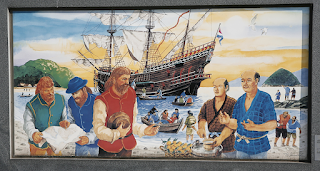
Will Adam's ship Liefde lands in Japan -
monument  in De Liefde arrival memorial
park, Kurushima, Usuki City, by N. Tamada 

Clavell takes as his starting point the true and amazing story of William Adams (1564 - 1620), shipwrecked in Japan in 1600, the first Englishman ever to arrive there. Adams was a contemporary of Shakespeare, a ship’s pilot who under Sir Francis Drake helped repel the Armada and fought in the ongoing war against Spain and Portugal. The Japan in which he found himself was at an equally pivotal moment. It was the climax of the warring powers era, when samurai armies battled to control the country. The Portuguese had arrived half a century earlier and were making converts and sizing the place up for colonisation. The last thing they wanted was a Protestant Englishman turning up to tell the Japanese that the outside world was not as they portrayed it. Adams revealed their deceit and changed the course of Japanese history.

Clavell leaves the framework of history pretty much as it is. But he changes the names of the players which allows him to fictionalise freely, taking liberties with the details to make the story even more gripping and exciting. Readers are kept on their toes, anxious to find out how the characters will weather the next terrible ordeal that befalls them.
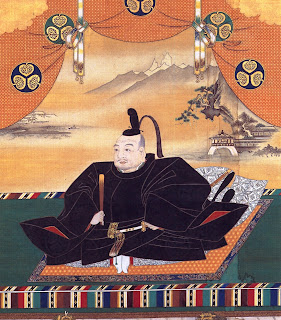
Tokugawa Ieyasu
by Kanō Tanyū (1602 - 1674)

The story begins in the stinking claustrophobic innards of Blackthorne’s storm-tossed ship, the Erasmus, ‘two hundred and sixty tons, a three-masted trader out of Rotterdam, armed with twenty cannon and sole survivor of the first expeditionary force sent from the Netherlands to ravage the enemy in the New World.’ Most of the Dutch crew are dead or dying of scurvy. The survivors are on the brink of mutiny.

Only one man can control them - Blackthorne, tough, competent, fearless and, as we soon discover, the best pilot on the planet. We learn about their nightmarish two year voyage, in which all the other ships in the fleet were lost, and the rough Elizabethan world that he comes from. As a Navy man, Clavell lards his tale with colourful and authoritative detail about ships, seas and how ships work, the job of the pilot, who commands the ship, and the importance of rutters - the annals which pilots kept, laying down their routes and recording their daily activities.

After the horrors of the tempest comes a complete change of pace. Blackthorne wakes up in a small house in a fishing village in Izu. We see Japan through his eyes - the neatness, cleanliness and occasional nakedness, the Portuguese priest who declares him a pirate and demands he be killed, the samurai casually lopping off a man’s head. Clavell has a lot of fun with cultural differences such as the bath, a daily necessity to a Japanese but a death sentence to an Elizabethan Englishman. The bath becomes a marker of how Blackthorne is adjusting, as he starts to compare the sparkling clean Japanese houses and cities with the disease-ridden filth back home.
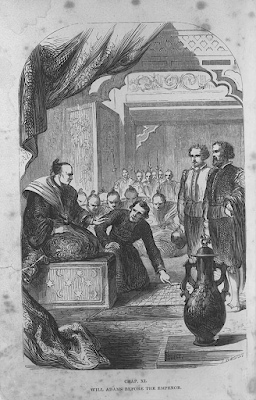
 
Will Adams meets Shogun Tokugawa
Ieyasu - by William Dalton 1866

Like Gulliver in Lilliput, Blackthorne and his crew endure a series of humiliations and ordeals, which Blackthorne overcomes through sheer obstinacy, refusal to be cowed and the quickness of wit to fathom how to get by in this disorienting new world.

As the canvas broadens we meet an extraordinary range of people and start to see their world through their eyes as well as through Blackthorne’s. We also begin to discover how much goes on that Blackthorne knows nothing about.

We meet Mura the village headman, ‘small and lean with strong arms and calloused hands’ and a secret judo master; it’s many pages before we find out who he really is. Then there’s Omi, the handsome young samurai, who behaves with suitable disdain to Blackthorne and his crew and equally suitable deference to his uncle, Yabu, the daimyo of the region.

Yabu is a wonderful character, ‘short, squat and dominating,’ forever plotting who to betray in order to advance his own interests. He’s fearless and without scruples and finds death, his own and others’, both erotic and poetic. Early in the story he is trapped at the bottom of a cliff by the incoming tide. Having ascertained that there is no escape he sits down calmly to compose his death poem. Blackthorne meanwhile desperately seeks to rescue him even though Yabu has committed terrible deeds that make them deadly enemies. Yabu survives and continues to be a lethal yet strangely likeable and entirely untrustworthy presence throughout the book.

The women too are vividly portrayed. There’s Kiku the courtesan, exquisitely beautiful yet down to earth too. Her kimonos ‘sigh open’, ‘whisper apart’. Like a flower, her task is to rise above earthy reality, to laugh gaily and take men’s minds off whatever is going on around them, no matter how terrible. There’s also Gyoku-san, the Mama-san, who knows everyone’s darkest secrets, wielding them to advance her own position while appearing to be utterly humble, as a person such as she, on the bottom rung of society, has to be.

Will Adams with daimyo and attendants
by William Dalton 1866 

Meeting the Shōgun
The canvas expands to encompass the entire country as Blackthorne arrives in the giant metropolis of Osaka and is ushered into Osaka Castle, a gargantuan fortress which ‘makes the Tower of London seem like a pigsty.’

Here he meets Toranaga, Clavell’s name for the great warlord Tokugawa Ieyasu (1543 - 1616) who was to become shōgun, taking over the whole of Japan and bringing about 250 years of peace. Toranaga is a consummate politician and statesman who controls and manipulates whatever happens and gives nothing away. He’s also likeable, warm and funny.

Blackthorne also meets Mariko, the Christian convert, modelled on Gracia, the wife of the warlord famous for his archery skills. Buntaro, Clavell’s fictionalised Hosokawa, is rather a tragic character. ‘A short, thickset, almost neckless man’, he is a brilliant warrior and a poet with the bow, utterly loyal to his lord. But he is also a man of terrifying rages, driven mad by his hopeless love for his wife.

Mariko is tiny, beautiful and fearless, a true samurai, prepared to die for her lord. She becomes Blackthorne’s interpreter, confidante and ultimately lover. She shows him how to flourish in this alien world by becoming more Japanese, finding inner peace.

Tokugawa Ieyasu by
Utagawa Yoshitora (1836 - 1880)

Blackthorne communicates with his crew in Dutch and in Portuguese with Mariko, the Japanese Christians and the Portuguese fathers and seamen. With Mariko he also has a secret language of love - Latin; though the two have to be wary. There are always samurai around who may turn out to be secretly Catholic and to understand them.

At one point Mariko and Blackthorne are talking. ‘How childish’, she says to herself, ‘to speak aloud what you think.’ Like children, the westerners are what they appear to be. The Japanese conversely are eternally acting. Apart from Blackthorne, who is an outsider, they all know that this is how you play the game. Clavell gets a lot of fun out of the difference between what the Japanese say and what they’re thinking, let alone what they really intend to do. It’s a key distinction that Japanese recognise between one’s true feeling and the face that one chooses to present to the world.

As the story goes on the focus changes. Blackthorne slips into the background as we step more and more inside the fascinating and complex mind of Toranaga. Clavell spends a great deal of time unravelling the great daimyo’s innermost thoughts as he plays everyone like chess pieces in order to achieve his ultimate aim - to master and bring peace to Japan. Which is why the book is called quite accurately Shōgun.

There are occasional errors. Clavell confuses the shamisen (a lute) and the koto (a zither). He uses the wrong tea for the tea ceremony, and there are small mistakes with the Japanese language. Some of the names are a little odd. But none of this matters. The book is written with such verve that we are totally swept up in the excitement of the narrative and barely notice the occasional small hiccup.

To read Shōgun is to be picked up and thrown into Japan at one of the most exciting moments in its history. For Clavell totally gets Japan. He gets it right, it’s totally convincing, which makes it a great and very satisfying read even for a Japan hand after forty years of engaging with the country.


All pictures courtesy of wikimedia commons.

Lesley Downer is a lover of all things Asian and an inveterate traveller. She is the author of many books on Japan, including The Shogun’s Queen, an epic tale of love and death, out now in paperback. For more see www.lesleydowner.com.


Friday, 1 April 2022

SALT in the 17th and 18th Century #Salt #History #Artisan

 by Deborah Swift 

Salt comes from two main sources: sea water, and the mineral halite (also known as rock salt). Salt is something we take for granted nowadays, forgetting that the term for our pay, the salary comes from the Latin salarium, originally denoting a Roman soldier's allowance to buy salt.

Near where I live in Lancashire and Cumbria, there is a long history of panning for salt in the Morecambe Bay. In 1748, William Brownrigg’s The Art of Making Common Salt mentions ‘sleeching’ on Morecambe Bay. Sleeching, I discovered, is scraping up salt-impregnated sand and silt, then watering out the salt to produce a concentrated brine, then boiling in 'saltcotes' –  small huts installed with lead pans over a fire.


But as canals and railways allowed the cheap transport of salt from inland mines and abroad, coastal salt-making gradually faded away, and by the 1860s it had almost entirely disappeared. One of the biggest producers of salt was Lion Saltworks in Cheshire and you can find a wonderful post and pictures,like the one above, about it here.

Norwich, Nantwich, Middlewich

Many towns and cities in England end in –wich  (or wych) and these are traditionally associated with salt production.  The suffix -wich derives from an Anglo-Saxon word meaning roughly "a dwelling or fortified place" and usually these were places with trading activity on low-lying coasts or on salt marshes, so many of these towns were also active in producing salt, which was a major and lucrative export.

White Gold – Salt from sea water

During the Early Modern Age, salt production from seawater was a profitable industry and soon became Scotland's third-largest export after wool and fish. It was deemed so valuable by the 18th Century that people called it "white gold”. The remains of nine salt pan houses and a windmill can still be seen at St Monans in Fife, Scotland, and the industry remains in the names of places like Prestonpans. The picture below is of salt harvesters in Brittany. 


New Forest Salt

Lymington in the New Forest, on the Solent estuary, is a town that began as an Anglo-Saxon village and is recorded in the Domesday Book as "Lentune". From the Middle Ages and up to the 19th century, Lymington was well-known for its salt making 

On a visit to Lymington in the 1690's traveller Celia Fiennes writes of Lymington as having a few small ships, but “the greatest trade is by their salterns” and she gives details of how the seawater was pumped through pipes into iron or copper pans situated into the salt-houses where it was evaporated away by boiling rapidly over coal fired furnaces. A vast amount of salt could be made in a single pan beneath which the furnace was kept blazing away all day and night (see the picture). By the middle of the eighteenth century there were about one hundred and fifty active salt pans. 

Read more about Celia Fiennes here, on the English Heritage site. The picture of the boiling off of water over a furnace is from National Gallery of Scotland.


A Tax on Salt

Salt was a precious and valuable commodity used the world over, as it is an essential nutrient. In 1641, during the commonwealth period, the previously abolished salt tax was reintroduced to raise money for Parliament. However the tax was revoked on the King’s return in 1660 and not reinstated until 1693 under the reign of William III. The tax was originally set at two shillings a bushel on foreign salt, but only one shilling on native salt to protect English salt workers.

Salt Wars

In the early 17th century, while well-known nutmeg wars were fought between Dutch and English merchants over imported and exotic "East Indian" spices, a different but equally intense rivalry erupted as traders in the Netherlands tried to secure their salt supply for the processing of herrings, butter and cheese.

The Baltic and Poland had extensive salt deposits, but the best supplies were controlled by the Spanish monarchy, in Portugal and the Caribbean, where salt more suited to herring was produced. Throughout the 17th century, the problem of salt supplies determined the Dutch attitude to the Spanish and Portuguese, and affected these empires’ prosperity in the Dutch "Golden Age".

 Want to know more? The history of salt is fascinating and far too big for a single post. Watch this interesting video on the history of salt.

https://www.youtube.com/watch?v=DFOxbmgr4so

Or read Mark Kurlansky's Salt 


Deborah Swift is the author of  nine books set in the 17th Century, as well as others set in the 20th Century. Find her at www.deborahswift.com or chat with her via Twitter @swiftstory


Friday, 5 March 2021

'Mighty Hills of Water' by Karen Maitland


Plaque marking the flood of 1606/7 in
Kingston Seamore Church
Photo: Anthony Wood
Fact is not truth – that’s something both the historical fiction writer and readers know well.

My new historical thriller The Drowned City, is set in the aftermath of a 17th century disaster when a storm-surge or a tsunami devastated the west coast of England and Wales. The bare facts are these –  In January 1607, on calm, clear day, a gigantic wave swept up the Bristol Channel. It thundered inland as far as Glastonbury Tor, 14 miles from the coast, destroying whole villages and leaving 2,000 people dead or missing. 200 square miles of agricultural land were flooded with seawater, so that even when the water receded, the fields were poisoned with salt. The Welsh coast was hit even harder than the English side, particularly the town of Cardiff. At its height, the wave is estimated to have reached 25ft, over 7.5 meters, travelling at a speed of around 38 miles per hour. 

Christmas Flood 1717 that struck the coasts of
Netherlands, Germany and Scandinavia

The historical facts about this terrible disaster are chilling. But facts don’t convey the truth of the experience of being caught up in such an event. Thankfully, I’ve never personally experienced a tsunami. The nearest I came was some years ago when I was sunbathing on a beach on Greek island and I saw a long black shape speeding over the mirror-calm sea towards us. No one moved, we all just stared, trying to work out what this thing was, then everyone seemed to realise the danger at once. Adults ran, shouting, to drag children out of sea. Others grabbed possessions and we scrambled up the sand to higher ground as the large wave raced up right the beach at our heels. The wave was only few feet high and did no major damage apart from carrying off towels, bags and anything else people had abandoned as they fled. But that small experience, helped me to understand why according to the eyewitness accounts of the 1607 tsunami, people simply stood and watched as the monstrous wave charged towards them, unable to interpret what they were seeing until it was far too late. 

US army medics moving a wounded solider into
8225th MASH unit, Korea 1951
Photo: Stewart/US army

In one episode of the American TV series MASH (1972-1983) set during the Korean War (1950-53), the characters were interviewed by a famous reporter. Instead scripting this episode, the actors were told to respond to the questions put to them giving the answers they thought their own character would make. Several of the actors later said that in researching their characters they had talked to war veterans about their experiences in Korea. One unscripted answer given to the reporter by the actor William Christopher who played Father Mulcahy has stuck in my mind for years.

“When the doctors cut into a patient and it’s cold – the way it is now – steam rises from the body, and the doctor will warm his hands over the open wound. How could anyone look on that and not feel changed?”

You couldn’t invent a detail like that. You know when you hear it that someone had actually witnessed that first-hand.  It that kind of truth which conveys more about the conditions the surgeons were operating under, than the fact that each 200-bed MASH unit was treating 400 injured people every day.

2004 Tsunami, Ao Nang Province, Thailand
Photo: David Rydevik, Stockholm, Sweden

I felt that same moment of truth when in the course of researching my novel, I read the non-fiction book Ghosts of the Tsunami by Richard Lloyd Parry about the aftermath of the 2011 disaster which struck the north-east coast of Japan, killing more than 18,500 people.  It is a remarkably moving and beautifully written book, and learned a lot about the search for bodies and the problems of survival afterwards. But one account told by a mother on finding the body of her little daughter after her school was engulfed by the wave, conveys more of the truth of the human experience of that terrible event than any of those numbers of dead or financial cost of the devastation.


"I rubbed the mud from cheeks and wiped it out of her mouth. It was in her nose too and in her ears. But we only had two small towels. And soon the towels were black. I had nothing else so I used my clothes … But there was muck in her eyes, and there were no towels and no water and I so licked Chisato’s eyes clean with my tongue… but I couldn’t get them clean, and the muck kept coming out." From 'Ghosts of the Tsunami' by Richard Lloyd Parry. Pub. Jonathan Cape, 2017.

Facts are important for understanding what happened, but it is the little details, these truths that only someone who experienced the event could know, which turns a report into a story we can fully connect with.

...................................................


The Drowned City
by K.J. Maitland is published 1st April 2021, Headline


Sunday, 14 April 2019

A Samurai in Seville - by Lesley Downer

Hasekura in Rome. Portrait by Claude 
Deruet (1588-1660), with his galleon, 
the Date Maru, behind.
On October 28 1613 a samurai called Hasekura Tsunenaga set off on an epic voyage to an unexplored and little known part of the world - the land of the Southern Barbarians. He crossed the Pacific and travelled by way of Acapulco on a succession of magnificent galleons with gilded prows and billowing sails, and arrived in Spain on October 5th 1614. There he met King Phillip III, was baptised, and eight months later went on to Rome where he had an audience with Pope Paul V. All in all he was away for seven years.

The conquistadors and Japan

This was the era of the conquistadors, little more than a century after Columbus. The Spanish now ruled much of Central and South America, had colonised the Philippines and were eying up Japan.

But the Portuguese got there first. In 1543 they were already selling matchlock rifles to the warring Japanese clan lords. Shortly afterwards, in 1549, Francis Xavier and his Jesuit missionaries arrived and started converting sections of southern Japan. The Japanese realised that the Jesuits were the thin end of the wedge and that invading armies might follow, but they felt able to hold their own.

Portuguese with big hats enjoying very early female kabuki dancing
in Japan around 1603
In those days Spanish galleons plied the Pacific carrying Mexican silver to Manila where they loaded up with spices and goods from Asia to take back to Acapulco. In 1609 one of these galleons, the San Francisco, was wrecked on the coast of Japan near the booming city of Edo, present day Tokyo. The captain survived and went on to meet the retired shogun, Tokugawa Ieyasu, and set up a trade treaty. The Englishman William Adams, model for James Clavell’s Shogun, had arrived 9 years earlier and become Ieyasu’s right hand man and the British East India Company had set up a factory (trading station) near Nagasaki.
Hasekura with his samurai sword as
depicted by Scipione Amati,
a German artist, in 1615

The One-Eyed Dragon of Oshu

Japan had recently come to the end of half a century of warfare and was now unified under the rule of Ieyasu but up north the formidable warlord Daté Masamune - the ‘One-Eyed Dragon of Oshu’ - had different ideas. He was interested in the Southern Barbarians and their Christianity and could see a way of using them to increase his own influence and perhaps escape from under the thumb of Ieyasu. So he decided to send a mission to the west. With Ieyasu’s approval he commissioned a splendid galleon, called the Daté Maru in Japanese and the San Juan Bautista in Spanish.

Hasekura’s adventure

Hasekura Tsunenaga was a samurai with a somewhat chequered background, but Daté decided he was the man for the job. He headed a delegation of thirty samurai plus 120 Japanese merchants, sailors and servants together with 40 Spanish and Portuguese. His brief was to negotiate trade treaties. This was Japan’s first official venture to Europe and he was the ambassador.

After three months at sea the galleon arrived at California then followed the coast to Acapulco where they stayed for two months. They were received with great splendour in Mexico City, then boarded another galleon, the San Jose, to cross the Atlantic and reached the port of Sanlùcar de Barrameda, at the mouth of the river Guadalquivir, in Spain, on October 5th 1614.
Seville in the 16th century with the river full of galleons and the cathedral
rising behind: Vista de Sevilla attrib. Alonso Sanchez Coello, d 1588
And so they arrived in Seville, the jewel in Spain’s crown. "The Japanese ambassador Hasekura Rokuemon, sent by Joate [Daté] Masamune, king of Boju [Oshu], entered Seville on Wednesday 23rd October 1614," reports a contemporary Spanish text. "He was accompanied by 30 Japanese with blades, their captain of the guard, and 12 bowmen and halberdiers with painted lances and blades of ceremony."

Seville, Seville

The Alcazar gardens with cathedral behind
Seville was the greatest and most glamorous city in Spain. It was the European port of departure for the Americas and had a monopoly on all Spanish trade with the new-found continent. Day and night galleons laden with American gold and silver and treasures from the Indies plied their way up the Guadalquivir, unloading their bullion at the Royal Docks. Seville was the hub of world trade, a cosmopolitan melting pot of money seekers, where merchants from across Europe flocked to acquire goods from the New World. Much of the bullion was spent on Seville’s glorious architecture and there was a huge flowering of the arts. Velazquez was starting his career, Cervantes was working on the second part of Don Quixote.

Gentleman in padded breeches -
Seville Cathedral
Hasekura must have enjoyed this magnificent city of golden stone, so different from the wooden and bamboo cities he knew with their towering white-plastered castles. He no doubt visited the cathedral, completed a hundred years earlier, and marvelled at the ornate carving of the spire. Such a high-ranking envoy was probably invited to the Real Alcázar, Philip III’s residence in Seville, and must have admired the gold ceiling and intricate stone fretwork of the Salón de Embajadores and the lavish gardens, so different from the gardens of Japan. He also must have enjoyed the orange trees, which perhaps reminded him of the orange groves of Shikoku, and the streets crowded with fashionable ladies in ruffs and enormous bell-shaped skirts and gentlemen in doublets, padded breeches and hose.

Homecoming

Hasekura went on to Madrid where he met King Philip III on 30 January 1615 and delivered a letter from Daté Masamune proposing a trade treaty. He was baptised on Feb 17 1615 by the king’s personal chaplain.

In all he and his colleagues spent eight months in Spain, being treated with all the honour due to visiting dignitaries.
Hasekura meets the Pope in Rome, 17th century Japanese painting

Then they sailed on. They were forced by the weather to make a three day stop in Saint Tropez, where they caused quite a sensation. From there they went on to Italy where Hasekura had an audience with Pope Paul V, just as Galileo was formulating his theory that the earth circled the sun, not the sun the earth.

In April 1616 they were back in Spain and in June 1616 left Seville for New Spain (Mexico) on the first leg of their journey home. Six samurai stayed behind and in the little town of Coria del Río, just outside Seville, seven hundred of the 25,000 inhabitants now bear the surname Japón, marking them as descendants of the expedition.
Seville orange tree

But when Hasekura and his colleagues got back to Japan after seven years away, like Urashima Taro, the Japanese Rip van Winkle, they discovered everything had changed. The retired shogun Ieyasu had died and his son, the shogun, had decided to eradicate Christianity and persecute Christians. The treaties Hasekura had worked so hard to negotiate were useless.

Lesley Downer’s latest novel, The Shogun’s Queen, is an epic tale of nineteenth century Japan and is out now in paperback. For more see www.lesleydowner.com.


Old pictures courtesy of Wikimedia Commons. New pics author's holiday snaps.

Wednesday, 13 March 2019

A Cumbrian Castle with hidden Jacobite history

by Deborah Swift

I'm really lucky in that I live close to many old houses and castles. One very close to my house is Sizergh Castle which has a fabulous tea room and lovely gardens.

The name Sizergh dates from the 9th century and was originally spelled sigaritherge, meaning Sigarith's pasture (sigarith is a female name.)

The castle has been home to the Strickland family for nearly 800 years, beginning in the 12th century, and is still lived in by them today. So well-connected were the family, that a Strickland was chosen to carry the English banner at Agincourt. During the Wars of the Roses the family were Yorkists, and in the succeeding generation were linked with the Parres of Kendal - the family of Catherine Parr, wife of Henry VIII.

The original medieval Great Chamber, now the dining room, contains portraits from when Lady Strickland acted as governess to James Stuart, 'The Old Pretender' in exile in Paris. There is one of the young James, and also a bust of Bonnie Prince Charlie (his son). For the first time this weekend a relic of this time, the glorious bedspread of James II will be on show at Sizergh. The bedspread, made in Goa India, is sumptuously embroidered with gold thread and portrays mythical birds and beasts, and was given to Strickland family by the King as a thank you for their loyalty. If you visit Sizergh in the next few weeks you can see it on display, and also hear the conservator talk about the conservation of rare textiles.
Read more here

But the Strickland family's support for the Jacobite cause led to a decline in their fortunes, and the castle could no longer be updated to current fashions.  Because of this, its core remains largely untouched, and we are able to stretch back in history all those years to see the original Elizabethan Manor House flanking the 14th Century hall and pele tower.


The photo below is from an article on the castle by Matthew Penmott, and I can heartily recommend his site on the Castles of Cumbria.
The Strickland Arms in the Parish Church, Kendal
The original Pele tower gave protection against scottish raiders. On the courtyard front is the Strickland Coat of Arms. The main entrance leads today into a Tudor Great Hall, which has since been adapted by different generations of the family into a series of smaller rooms. An Elizabethan corner block and wings enclose a courtyard, and on three sides of the castle the remains of a moat is visible even today.

Hard Times
In 1891 the ornate panelling from the Inlaid Chamber, along with various furnishings, was sold to the V& A for a thousand pounds, to raise cash to keep the house maintained. What a decision to make!


But now, after more than a century, and thanks to the Victorian and Albert Museum, the original panelling and stained glass which was tailor-made for the room at Sizergh, has now been returned home to the castle on permanent loan. (Pictures from The Guardian) The beautifully wrought panels were inlaid with English Poplar and “Bog” Oak to create a three dimensional effect of geometric and strapwork motifs.

Ghost of the Starved Lady

In the Pele tower, ghostly sobs denote the presence of a lady whose husband, before a raid by the Scots, locked her away in a room with an impregnable door - presumably to keep her safe. But her husband died and the terrified servants abandoned the place. The poor wife starved, and as she tried to claw her way out she went slowly mad. Her screams supposedly still haunt Sizergh on dark and spooky nights......

Apart from the attraction of the ghost, Sizergh Castle is managed by the National Trust and is well worth a visit - beautiful grounds and gardens too, along with more than a thousand years of history! If you go along in the next few weeks you will also be able to view some 17th Century Flemish tapestries, rare examples featuring stories from Plutarch, including the tale of Anthony and Cleopatra.

As many of you know, I have a keen interest in the 17th Century, and you can find my novels set in this era here, or on my website www.deborahswift.com

Wednesday, 13 February 2019

Researching with Seventeenth Century Diaries

by Deborah Swift

One good thing about the internet is that I have access to many documents online, that previously were only available to me through archives. The most valuable sources for me are diaries, in which I get a first-hand account of seventeenth century life. I have linked all the diarists in this post to their online diaries.

Etching by Robert Spence

The first diary I used was that of the Quaker, George Fox, because he appears in my first novel, and like many diaries of the time his diary was written because of a religious impulse, in which he was documenting his relationship with God. The original journal was revised before it was published and I found both editions interesting to compare.

Fox's journal was first officially published in 1694, by which time it had been substantially edited, and cleaned up. Parts of the journal were not in fact by Fox at all but were re-constructed by his editors keen to spread a message of clean and godly living. References to meetings in taverns, and the dissent within the Quaker movement have been expunged from the narrative. The diary portrays Fox as rather more saintly than he probably was, and always vindicated by God's providence. This is the problem with diaries published later (particularly by Victorians) - the temptation is always to clean them up, thus losing value for researchers like me. Only recently have we been able to read the 'naughty bits' in Pepys' Diary.

Many diarists of the seventeenth century were religious men. Though the diary of Roger Lowe is very much the diary of the common man, it still shows his refusal to conform to the re-established church. It gives us insights into a seventeenth century mercer's apprentice living in a Lancashire village. In his entries we discover that literacy was unusual in his community, and somewhat prized, because he sometimes offered to write letters for his neighbours. In October 1663 his friend John Hasleden told him;
"that he loved a wench in Ireland, and so the day after I writ a love-letter for him into Ireland". 
Can't help wondering exactly what he put! His diaries reflect the concerns of a working class man, not a member of the aristorcacy, and as such are especially valuable:

"Friday. dyed Alexander Potter 3d son to Cozen John Potter de Lilly Lane who in his life time was nevr supposd to have any genius a meer child yet now att his death called father & mother & prayd forgivenes of his faults in cheating them of a half peny and wished them to live in peace & that his sister Ellin would leave off swearinge & so dyed & without question is now att rest." (25th June 1675)

The diary of Roger Lowe of Ashton in Makerfield is preserved in the Leyland Free Library and Museum, in Hindley, Lancashire. Here is a link to pictures and more extracts.
 
Samuel Pepys began his diary in 1660 and continued to write it for ten years. His diary is arguably the best-known resource we have on London in the 17th century. It provides us with a fly-on-the-wall account of daily life in the period just following the Restoration of King Charles II, and includes passages on The Plague and The Great Fire. Here's a bit from the Coronation of Charles II, in which he confesses that in the middle of the proceedings he has to answer a call of nature. This is the joy of Pepys; the personal and the political are intertwined.
"The King in his robes, bare headed, which was very fine. And after all had placed themselfs - there was a sermon and the service. And then in the Quire at the high altar he passed all the ceremonies of the Coronacion - which, to my very great grief, I and most of the Abbey could not see. The crowne being put upon his head, a great shout begun. And he came forth to the Throne and there passed more ceremonies: as, taking the oath and having things read to him by the Bishopp, and his lords (who put on their capps as soon as the King put on his Crowne) and Bishopps came and kneeled before him.....But I had so great a list to pisse, that I went out a little while before the King had done all his ceremonies and went round the abby to Westminster-hall, all the way within rayles, and 10000 people, with the ground coverd with blue cloth - and Scaffolds all the way. Into the hall I got - where it was very fine with hangings and scaffolds, one upon another, full of brave ladies. And my wife in one little one on the right hand."
An awareness of the importance of national events also seems to have encouraged Roger Morrice, who began to keep an 'entring book' in 1678 after the Popish Plot which aimed to re-establish the Catholic Church by assassinating Charles II. The Popish Plot was a fictitious conspiracy concocted by Titus Oates that between 1678 and 1681 created massive anti-Catholic hysteria. Like Pepys' Diary, Morrice's diary  was written in shorthand, and so was only translated this century, and runs to more than a million words. (See this article )His diary begins in 1677 and ends in 1691, and so covers the reigns of Charles II, James II, and William and Mary.

Morrice was a clergyman who had been expelled from his parish after Charles II returned from exile. He shows us many incidences of political or religious unrest, like this example from 1666 showing the persecution of the Quakers:
"Upon Lords day the 17th October at Leicester, the Quakers mett together. There are some Soldiers quartred in the Town, and a Black that is Kettle Drummer to one Company went into the Quakers Meeting, and did as they did, sign, groan, and sing, &c. A little after came in a Captain and three or foure Soldiers, who brought ale and Tobacco pipes with them and sate down and smoked and drunk. The Captain drank the King’s health to a Quaker; the Quaker answered I thirst not; the Captain said it thou drinkest not my Master’s health, I will Cuckold they wife before they eyes. With that, the Captain and Souldiers rose up, and drew their Swords, Shut the doores, and used and abused the women much. Some of the young Girles are so affrighted their recovery is questioned." 

Morrice had a friend who was a Privy councillor and so was able to comment on the death of Charles II, a report that is somewhat controversial and indicates a return to Catholicism.
"On Thursday night a priest came up the back way. It was believed by all that he confessed the king, gave him extreme unction and that His Majesty died a papist."
Death of Charles II

But what of the women of this period? I can recommend the diary of Anne Clifford, a stubborn and independent woman who travelled great distances in her attempt to regain her stolen inheritance - which included Skipton Castle in Yorkshire along with Pendragon Castle, Brough Castle, Appleby Castle and Brougham Castle, all in Westmorland. Her relationship with her husband was strained, but her love for her estates never wavered:
'Upon the 5th my Lord went up to my closet and saw how little money I had left, contrary to all that they had told him. Sometimes I had fair words from him and sometimes foul but I took all patiently and did strive to give him as much content and assurance of my love as I could possibly. Yet I always told him that I would never part with Westmoreland upon any condition whatsoever.'
Though not strictly a diary, though written in her lifetime, a source I really enjoyed reading was the memoir of Anne Fanshawe, a Royalist during the English Civil War. As was common in that period, she gave birth to 14 live children and had six miscarriages. When her husband was taken prisoner at the Battle of Worcester she stood outside his window in the middle of the night in the rain to talk to him.  She also wrote a book of cookery and her recipe for ice cream is thought to be the earliest recorded in Europe.

Anne Fanshawe's Recipe for ice cream

Here is a passage from her memoirs about the arrival of the King:
"We had by the States' order sent on board to the King's most eminent servants, great store of provisions: for our family we had sent on board the Speedwell a tierce of claret, a hogshead of Rhenish wine, six dozen of fowls, a dozen of gammons of bacon, a great basket of bread, and six sheep, two dozen of neats' tongues, and a great box of sweetmeats. Thus taking our leaves of those obliging persons we had conversed with in the Hague, we went on board upon the 23rd of May, about two o'clock in the afternoon. The King embarked at four of the clock, upon which we set sail, the shore being covered with people, and shouts from all places of a good voyage, which was seconded with many volleys of shot interchanged: so favourable was the wind, that the ships' wherries went from ship to ship to visit their friends all night long."
Anne Fanshawe
Other diarists worth considering from this period are John Evelyn, Ralph Josselin and Robert Hooke. For women, try Celia Fiennes the great traveller, or Lucy Hutchinson's account of the English Civil War. I hope you have enjoyed my small foray into the many seventeenth century diaries available to us, and I hope it fuels more research! My novels featuring the hidden lives of the women in Pepys' Diary are available now from Accent Press.


Do nudge me on twitter @swiftstory to chat, or find me on my website.
All pictures are from Wikipedia, unless linked.
