|
Local pre-war cricket heroes
source;wikimedia images |
You might have read in your newspaper, a hundred years ago today, that Black Jester had won the St George's Stakes at the Liverpool Races; Yorkshire had beaten Nottinghamshire at Leeds, by 97 runs; rain had spoiled play in the Hampshire v. Sussex match at Southampton. The game ended in a draw. Source:
Daily Herald © Trinity Mirror.
Also in the
Daily Herald you could have read:
SUFFRAGIST STOPS HER TRIAL.
Belfast Judge Powerless Before Her Protests
Lively scenes were witnessed in the Belfast Assize yesterday when Miss Dorothy Evans*, the Suffragist organiser, refused to allow her trial to proceed. The judge asked her to remember she was a lady, whereupon she declared she stood there as a woman. The accused interrupted so frequently that the case had to be adjourned. On resuming she informed the judge that she did not intend to allow the trial to go on. The judge then adjourned the case to the next Assizes, ordering the accused to be kept in custody.
 |
| Cartoon from Punch magazine, 1910, by Arthur Wallis Mills |
The
Devon and Exeter Gazette informed its readers where they could get the paper on holiday: in Bovey Tracey, from Miss A.M.Pook at the Post Office. In Budleigh Salterton, from F.W. Dalgliesh, bookseller; there were details of outlets among others in Lynton and Lynmouth, Lyme Regis, Ilfracombe, Paignton, Teignmouth and Tavistock. Alternatively, 7d (old pence) per week would get them copies forwarded post free. © Local World Ltd
The
Cornishman reported that the United Methodist Band of Hope (a temperance organisation) of Marazion held their annual outing on Wednesday, and to the number of 80 visited Carbis Bay'. in jersey cars(??) furnished by Mr R.J. Hutchens of Penzance. It further reported on the sudden death of Mr Richard Sedgeman, aged 40, of North Road, Goldsithney, who was planting broccoli in a field when he 'fell on his knees and expired almost immediately.' The lad who was assisting him asked him what was the matter, and 'deceased only said, 'Go after some more plant.' He did not speak again'
The
Cornishman further reported the annual 15-day training of the Cornwall R.G.A 1 and 2 Heavy Batteries, which 'obtained very useful results by practice over the ranges, which offer peculiar facilities for observation of fire, and much valuable knowledge has been gained by officers, non-com officers, and men.' The weather had been 'very favourable..on no occasion has firing been interfered with by mist and rain.' © Local World Limited.
The
Birmingham Daily Mail told its readers about a workmen's strike in St Petersburg, and battles between police officers and strikers. Barricades were erected, police were wounded, and shops were shut. Tramway services in the capital were suspended. In addition, a band of strikers held up a passenger train from St Petersburg, forcing the driver to leave the locomotive and the passengers to leave their carriages. They then knocked down the telegraph posts and blocked the line. However, gendarmerie and troops were sent out to guard the line; subsequently every train was followed by an engine with an armed escort. Workers in Thornton's cloth mills and other factories belonging to British firms went out, and the strike was said to be of a pan-Russian nature. Meanwhile, the French president, Poincaré, was visiting the Emperor at the Peterhof Palace, and Sweden was said to fear an attack by Russia, 'and is reinforcing its army with a view to removing this misunderstanding.' M. Poincaré was to visit Sweden on Friday, and was supposed to explain that Russia did not intend to attack anyone. Meanwhile, M.Sassonoff and M. Viviani 'have examined the Balkan question.'
 |
Drawn by unknown Austrian newspaper artist:
Wikimedia Images |
The paper further reported that the view of 'official circles in Berlin' on the situation between Austria and Servia (as the country was then called) after the assassination of the Archduke Franz Ferdinand and his wife in Sarajevo, was that if there was an armed conflict it could and ought to be localised. Count Reventlow, then a journalist writing in the 'Tageszeitung' (German Daily News) asserted that 'the tendency of German policy is not insistently warlike and..Germany does not wish an armed conflict between Austria and Servia' but that 'public opinion in Germany is without limitation on the side of our ally, and only desires that she may vigorously safeguard her rights and legitimate interests, stand fast, and not allow herself to be intimidated.' © Trinity Mirror.
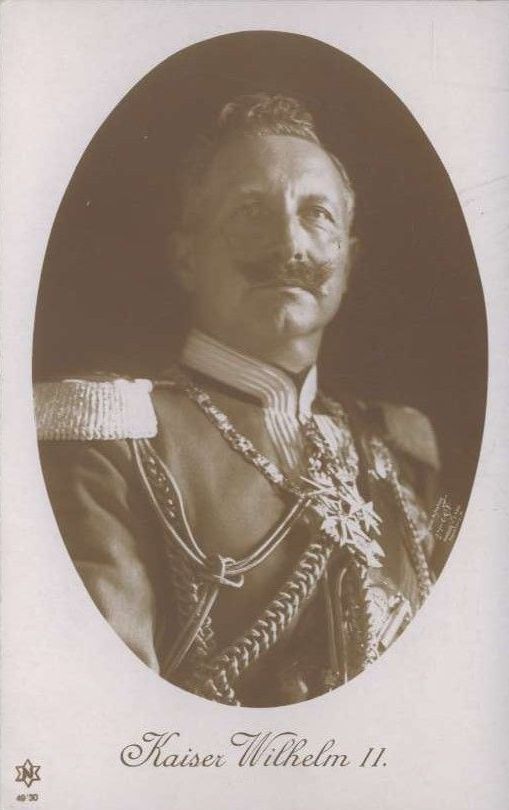
But it was late that same afternoon that Count Giesl, Austria-Hungary's ambassador in Belgrade, visited the Serbian Foreign Ministry and read out to him the ultimatum to Serbia, which had been carefully composed so that Serbia would under no circumstances feel able to comply with its demands. The situation was one that we might recognise; a Great Power, feeling threatened by a terrorist outrage and determined to do something decisive, wanted to wage war, though there was scant evidence that the country concerned had anything to do with the act of terrorism. 9/11 and Iraq, anyone? The Dual Monarchy thought they could knock out Serbia, and if the conflict did spread, there was a fatalistic feeling both in Vienna and Berlin that war would have to come some time and it might as well be now. There was an Emperor in Berlin who was eager to prove himself in conflict (like George W.Bush).
 |
Photo: Studio
Thomas Heinrich Voigt, court photographer |
The ultimatum 'accused the Serbian government of tolerating criminal activities on its soil and demanded that it take immediate steps to end them, including dismissing any civilian or military officials Austria-Hungary chose to name, closing down nationalist newspapers and reforming the education curriculum to get rid of anything that could be construed as propaganda directed against Austria-Hungary.' In addition, Serbia 'was ordered to accept the participation of the Dual Monarchy in suppressing subversion within Serbia's borders and in the inevestigation and trial of any Serbian conspirators responsible for the assassinations.' (The War that Ended Peace, by Margaret MacMillan, Profile Books 2013)
Serbia was given 48 hours to respond.
On 25th July, the Daily Herald reported
WAR IMMINENT AGAIN IN SERBIA.
The German government, it reported, was 'using its influence to localise the conflict.' © Trinity Mirror.
But the match had been applied to the cord and the flame was licking along to the powder-keg. On the 28th July, Austria declared war on Serbia.
*Dorothy Evans was arrested for possession of explosives, following arson attacks.
Newspaper quotes all obtained from the British Newspaper Archive.