Showing posts with label Janie Hampton. Show all posts

Thursday, 8 July 2021

Whipsnade Zoo in World War Two by Janie Hampton

Whipsnade Zoo Keeper ploughing paddocks with Dixie the elephant,  1940.  Source: Zoo and Animal Magazine, 1939/40. 

Lucy Pendar’s father, Albert, was the Resident Engineer of Whipsnade Zoo, a 500-acre park in the Chilterns, Bedfordshire. They lived in a little pointed red-brick house set against pine trees. ‘Like a picture in a pop-up nursery rhyme book,’ she remembered. But growing up surrounded by exotic animals, zoo-keepers and thousands of visitors, was a lonely life for a child.
However, the outbreak of the war in September 1939 changed everything for 11-year-old Lucy. London Zoo in Regent’s Park evacuated many of their animals to Whipsnade, including two Giant Pandas who joined ‘Ming’, the first Giant Panda ever seen in Europe; and five elephants who joined Dixie, the retired circus elephant. 
The London Zoo chimpanzees were evacuated onto an island surrounded by a moat and a barrier. One day Lucy was surprised. ‘Tiny Tim, the youngest chimp, was executing a beautiful crawl stroke, swam smartly across the moat, and with equal aplomb, climbed over the barrier and made off in the direction of the Giraffe House.’ Nobody realised that chimps could swim; and no-one had noticed that Tiny Tim had grown up, until a female chimp produced an unexpected baby.
When the Black bear from London Zoo escaped for the third time, Lucy’s father laid a trail of treacle into the ladies’ lavatories and waited in bushes nearby. ‘At long last the bear appeared and started licking the step,’ said Lucy. Her father followed the bear into the lavatories. ‘Father triumphantly slammed the door on it.'
 Best of all for Lucy, was the arrival of the families of London Zoo staff who moved into the wooden huts normally occupied by summer waitresses. The evacuee girls asked Mrs Beale, the wife of the Zoo Superintendent, to start the 1st Whipsnade Girl Guide company, and while Captain Beale tended to his stamp collection, they met in the Beale’s front room. Among the Guides were Mary Billet, daughter of the Keeper of the Bird Sanctuary; Beryl Rogers, the daughter of Bert the Giraffe Keeper; and Austrians Elizabeth, Esther, Lilly and Gertrtude, who had recently arrived in England with Kindertransport.
The 1st Whipsnade Guide Company , run by Mrs Beal. Credit Lucy Pendar.
‘Captain Beale had been chief veterinary officer of East Africa, so he taught us how to stalk and track both animals and humans.’ When Mrs Beale invited a handsome, young, Cambridge undergraduate to teach Morse Code, meetings were always well attended. The 1st Whipsnade Guides taught the local Home Guard Morse code, tracking and stalking. ‘We showed them how to wriggle through a wheat field on your tummy, so slowly that the wheat made no noise,’ recalled Lucy.  
After Guide meetings, Lucy walked home through the zoo in the dark, with her black-out torch shining a pin-hole onto the ground. ‘I could hear the elephants putting themselves to bed. There was also the roar of lions, the tigers slinking through their jungle, polar bears splashing in their pond and the barking of sea-lions. I wasn’t frightened, I knew them all well.’ She hand-fed the rare Chinese Pere David deer fawns with bottles; and even tried to resuscitate a frozen baby alligator with warm water.
Keeper Billett, father of Girl Guide Mary, of Whipsnade Zoo , November 1939. 
Lucy’s father started a rifle club in the café for the Air-Raid Wardens and Guides. ‘The walls were protected with sand bags, filled by us Guides. In the summer the rifle club moved to a chalk pit near the bison’s paddock. Father used to arrange competitions against the Home Guard, and us Guides always won. When the RAF camped nearby, he suggested a shooting competition. We beat them too.’
The first Christmas of the war was miserable, especially after the death of the Black rhinoceros, an evacuee from London. ‘Disposing of a dead rhinoceros is not an easy task, weighing nearly four tonnes.’ Lucy and the Guides helped collect firewood to make a huge funeral pyre. Then an African elephant died, and its body was added. ‘The new year was greeted with the acrid smell of burning flesh and the belching forth of black smoke, which lasted for almost a week, until a smouldering pile of ash was all that remained of the great beasts.’ That was the last time so much meat was cremated and not fed to other animals. When the German-Italian-Japanese alliance was named the ‘Axis’ in 1940, the dainty Axis deer from India were renamed ‘Spotted’ deer.

The ‘Whipsnade Lion’, carved on a chalky Chiltern hill, made a perfect landmark for enemy planes to navigate to the armament factories in nearby Luton, so the Guides helped to camouflaged it with brushwood and manure.

The war was tough on the animals. When snow engulfed the park, one of the Giant Pandas and a litter of tiger cubs had convulsions. Once petrol rationing began there were fewer visitors, so less money to pay for the food. ‘One February day in 1940 the takings amounted to six pence [2p], which meant the solitary visitor was a soldier as they got in half price. At first, visitors were encouraged to bring lettuce, cabbage and carrots, but soon no one had even those to spare.’ The zoo bred their own mealworms to feed to birds, and fish-eaters were given meat coated in cod-liver oil. ‘The zoologist Julian Huxley appealed to the public to bring buns for the bears, which of course was not what bears needed at all.’
A colony of bright green, noisy Quaker parakeets, originally from South America, lived in a huge communal nest overhanging the zoo’s main gate. ‘When they ventured down the hill and stripped Mrs Hain’s orchard, she was furious. The following year they were kept in a cage until the apples had been harvested. ‘By the next spring they had flown, their fate a mystery.’
Whipsnade Park had originally been a farm, and now even the parkland and cricket pitch were ploughed up. With no combine harvesters, and most of the keepers called- up, the Guides helped gather in the harvest. ‘With British Double Summer Time we could work even longer hours than normal,’ said Lucy. ‘June saw hay-making. The sheep were sheared, then dipped in July. Grass was scythed again in August. And then the wheat harvest. My back was aching, and my arms sore from scratches, as we gathered up the sheaves and stacked them in stooks.’ Filling sacks of grain for hours was rewarded with a ride on the truck to the barn. ‘The joy,’ she remembered, ‘standing like Boadicea, leaning on the cab as we sped down Bison Hill with the wind in my face. We brought back rough loaves of oaten bread, which had normally been fed to animals.’
The Girl Guides’ war work included mucking out and riding the Shetland and rare Iceland ponies. Lucy Pendar was one of the first people to experience their unusual tölt, a running walk, and the flugskeid - a flying pace.
The five o’clock Closing Time hooter, high on the side of the water tower, served as the air-raid siren. ‘The wind carried its sound for some distance and the howling of the wolves, which always accompanied it, added both to its effectiveness and its eeriness.’ During 1940, over forty bombs were dropped around the zoo. Most fell in the paddocks, making large holes which were later turned into ponds. The only reported casualties were a spur-winged goose - – the oldest inhabitant –- and a baby giraffe which panicked. 
One night Lucy was on duty with the Home Guard. ‘We stood in a field all night in thick fog. As the dawn began, we saw these figures approaching, very quietly, through the fog.’ They stood quaking, convinced they were German parachutists. ‘Suddenly the cloud thinned and they were revealed – as Farmer Bates’ cows!
The Giant Pandas returned to London in 1942. 
The Whipsnade Guides practiced first aid on themselves and were also practiced on by the WRVS, Air-Raid Wardens, and Home Guard. ‘I often had to pretend I had a broken arm, or an epileptic fit,’ said Lucy. In the blacksmith’s forge at the zoo, the Guides put out incendiary bombs with a stirrup pump.

WP Beale, the first superintendent at Whipsnade 1930-47, Captain of the Home Guard. Credit Lucy Pendar.

After Lucy’s 16th birthday, she didn’t want to confess the reason for not becoming a Ranger Guide: the uniform required a long-sleeved jersey and she was hopeless at knitting. So she helped to run the Whipsnade Cub Scouts instead. Later she became a Girl Guide District Commissioner in West Yorkshire, and then a Fellow of the Royal Zoological Society.
Lucy Pendar, Whipsnade - my Africa, Book Castle Dunstable, 1991.
Janie Hampton, How the Girl Guides won the war, Harper Press, 2010.
Interview with Lucy Pendar, 12 November, 2008

www.janiehampton.co.uk

Friday, 8 January 2021

Basketry by Janie Hampton

Bronislava and Jan Madejscy with their kablacok willow baskets, are part of the Slow Art in Poland movement, in Lucimia Village which is on UNESCO’s ‘intangible cultural heritage’ list. © Paulina Adamska, Serfenta Association, 2009.
Baskets have been part of our lives ever since humans first gathered fruit to eat. Since then, basketry skills have been used to make hats, water carriers, coffins, boats, furniture, lampshades and designer handbags.
Despite much speculation, the origin of the word ‘basket’ is obscure but is assumed to be from the early 13th C Anglo-French bascat. The Oxford English Dictionary’s earliest source is Shakespeare’s Merry Wives of Windsor published in 1602: ‘Look, here is a basket…. he may creep in here.’
Because baskets are used until they fall apart, and are then either burned or decay, they rarely feature in archeology. The earliest known baskets survived through chance – in fish-traps left behind in waterlogged ditches; in permafrost; or in desert caves.
Baskets have been found in Turkey from the neo-lithic period of 7500-5500 BC. They left only impressions in the mud after they were wrapped around the dead. In Fayum, near the Nile Valley in Egypt, there are no traces of dwellings left, but over 100 grain storage pits made between 5000 and 4200 BC reveal patterns from baskets made from wheat straw. One whole boat-shaped basket with colours and fine patterns was found in a grain pit in 1924. Its discovery raised the question: ‘Does its quality indicate that the value of grain was very high? Or was it first used for something of higher status, and then when it was half worn out, recycled as a grain scoop?’
Early 20thC basketmaker in Kent.  © Mary Butcher
Humans have always been good at adapting whatever they can find, to live more comfortably and safely. In the Peruvian Andes, the Spanish Conquistadors were astonished that the only way across deep gorges was by bridges made from rope. Designed over 500 years ago during the Inca Empire, the bridges were made entirely of grass. One keshwa chaca still survives, spanning the Apurimac River (‘The Great Speaker’). Only humans and llamas can cross it, but the tradition and skills are so important to the people that it is rebuilt every year using the same local qqoya grass and methods passed down to each generation. The grass has to be soaked and softened, then pounded by children, and spun into cords by women. Each household produces 40 arms-length of rope. Once about 7 kms of grass cord has been made, the men twist bunches of 24 cords into ropes. Old men then braid the cables, while the young ones stretch them across the channel. The bridge is completed with a deck of brushwood matting. The combination of grass - a material with little strength on its own, community effort, and the design of the keshwa chaca is a wonderful example of engineering friction, social cohesion and human ingenuity. As Ian Ewart writes, the process is ‘a nexus of social regeneration and reinforcement.’ 
Nassa fish traps from Gozo in the Mediterranean Sea,
made by the late Salvo ta Bertu from split Mediterranean cane
and a grass similar to esparto. © Geraldine Jones. 

Materials for baskets come from plants - trees, grasses, cacti, heathers – whatever grows near the maker. In the islands of northern Scotland, there are stones to build houses, but few trees to use as rafters to hold up the rooves. But there is plenty of heather, which can be twisted into ropes to hold the thatch, made of more heather. 
The first Girl Guide uniforms in 1910 included a wide brimmed hat woven from rush.
This was made by Jean Francis for Salt Cellar Workshops in Cornwall in 2019. 
During World War One, baskets were so important for transporting carrier-pigeons and medical supplies, and for observation-balloon baskets and even aeroplanes, that basket-making was a ‘reserved occupation’ and the War Office appointed a National Willow Officer. Mary Crabb relates that the artillery-shell basket had ‘a curious, slightly sinister cyclic quality about it. Woven to offer protection to objects of death and destruction – those injured by the shells were then taught to weave baskets as a means of therapy and rehabilitation.’ Basket making was found to be a therapeutic activity for shell-shock, requiring meditative repetition, hand-eye coordination and creating a sense of purpose with the finished product. The materials were cheap, and when imported cane ran out, wild roses and brambles were available in hedgerows. Also, it could be done in bed or a wheelchair. 
Basket weaving therapy at Seale Hayne Military Hospital, 1919.
Seale-Hayne Archives. © Margaret Rose Preston Estate. 

Angus MacPhee was a Gaelic speaker brought up on South Uist – a remote island on the Outer Hebrides. During the 1940s he developed schizophrenia and was sent to Craig Dunain Psychiatric Hospital in Inverness. An elective mute, he worked on the hospital farm where he invented his own therapy. He twisted and twined grass into yarn and then using only two pieces of broken fence wire, he looped, netted and stitched. He made coats, trousers, hats, boots and pouches, often interwoven with wild flowers and sheep’s wool from fences. Twice a year the hospital groundsmen tidied up his artefacts and burned them. He would watch apparently undisturbed, and make some more. A few pieces survived him, and basket-makers recognized the same looping techniques as used in 12th C socks found in a cave in Arizona, in Norse cultures, and by indigenous people of Australia today. 
A typical English fruit basket from the 1950s, designed for
occupational therapy and made of easily-manipulated cane. 
Basket making gained a bad name after the derogatory term ‘basket-case’ was coined in 1919, meaning someone who had lost both their legs in war and was now ‘useless’; and by the mid-20th century basketry’s association with the disabled and mentally ill meant its reputation declined. Recent research has shown the beneficial effects on brain injury and trauma that basketry can contribute to improving brain plasticity with sensory and motor signals, sequencing, recognition of mistakes and decision making.
Baskets have a protective role of containment and holding. ‘We are, after all, ’writes Hilary Burns, ‘nurtured in baskets from cradle to grave, literally from crib to coffin.’ 
Boks baskets from Vanuatu in South Pacific embody a rhythmic 
sequence of pandanus (pine palm) ribbons, passed down the generations. 
Whereas ’found materials’ or rubbish were originally used to make baskets for economic reasons, now basket makers use them to create political messages about sustainability. Lois Walpole used to buy rattan, until she realized the huge carbon footprint of transporting it across the world, and then dyeing it. Now she consciously uses only found materials such as disused packaging and ‘ghost gear’ – flotsam and jetsam from beaches- to make colourful, beautiful baskets and furniture. In the Shetland Isles she taught children to appreciate ‘ghost gear’ and not see it as ‘undesirable and untouchable but as something they could profit from as their forebears would have done [with grown materials]’. 
‘Ghost gear’ on Breckon beach, Isle of Yell. © Lois Walpole 
As more people buy plastic or factory-made baskets, the skills of different methods, knots, weaves and styles are dying out. In many places, only the oldest people still know how to make traditional baskets. A few basket historians, such as Geraldine Jones of Basketry & Beyond, have sought out these basket-makers in places like Malta, Cornwall, The Azores and Northern Spain.
We take basketry for granted but now historians, artists, anthropologists and mathematicians are revealing stories, structures and skills in basketwork. The Material Culture of Basketry: practice, skill and embodied knowledge is a beautifully produced book which will inspire anyone interested in the interdisciplinary history of crafts, knots, plants. The book’s 36 authors remind us that baskets are not just craftily-made containers, but also holders of knowledge, history and design; and the textures, patterns and geometric forms in basketwork express maths, art, culture and engineering. 
Geraldine Jones of Basketry & Beyond made this stainless-steel wire ball
following the mathematical pattern of a sepak raga football from Malaysia,
 usually made from split bamboo. © Geraldine Jones

The Material Culture of Basketry: Practice, Skill and Embodied Knowledge, Stephanie Bunn and Victoria Mitchell (Eds), Bloomsbury, 2020.

Unless otherwise stated, all photographs © Janie Hampton 

Friday, 11 September 2020

Procrastination Jelly by Janie Hampton

Procrastination helped me create a way to look at my goldfish above water.
In theory the lock-down of 2020 has been good for thinking and writing. But many of us have found concentrating on anything very difficult. My mind often wanders and I look out of my study window.What do I see? A reason to leave my desk - my garden calls out to be tended. The vegetables want to be harvested; and the fruit picked. This presents an ideal opportunity for procrastination. Without my immediate intervention the pears will disappear. I can see six rooks perched on branches pecking away at the tops of the pears. One by one they crash to the ground. Squirrels do the same annoying trick, only eating a small part. When they bounce on to the lawn, they split, and the wasps attack them. If the potatoes are not dug up this very minute, worms will eat them.
So out into the garden I go with my basket. Jumping up for the pears, I realised that the cabbages need hoeing. After I picked up the hoe, I noticed it needed sharpening. I looked for the sharpening stone, and wondered what the proper name for a sharpening stone is. As I spotted it on the shed shelf, I remembered it is a whetstone, spelled with an ‘h’. Is that to do with water or something quite different? Made mental note to look it up. Sharpened hoe. On the way down the garden path I spotted that the courgettes needed watering. So the hose had to be untangled. And on it went- one procrastination opportunity surpassing the last. Soon I had found the whetstone, sharpened the hoe, sliced through several rows of weeds, watered the courgettes, picked some runner beans, and for good measure even put the garden tools in a neat row. I’d also learned that whet is from the Anglo-Saxon whaet, meaning keen or bold which led to sharpen or stimulate (as in ‘appetite’.) But I was still no further on with my blog.
My vegetable patch gives me plenty of procrastination opportunities.
During this pandemic lockdown, we have all had plenty more time for the art of procrastination. It is defined as ‘to put off, to delay, to defer, to postpone, especially something that requires immediate attention.’ Crastimus is the Latin for ‘pertaining to tomorrow’ – and we all know that tomorrow never comes. It’s the Roman equivalent of ‘manana’. Synonyms include ‘dithering, stalling, delaying tactics and vacillations’, to which I would add ’seeking out distractions, around any corner.’ I suspect that most History Girls and our readers indulge in various levels of procrastination, and can spot a handy distraction a mile off. 
A skip outside a party shop provided me with some
dummy fireworks to hold up my tomatoes.
That consumed a happy afternoon.
The most rewarding kinds of procrastination for writers are those that somehow connect to the writing one is supposed to be doing. While researching my book ‘How the Girl Guides Won the War’, I found a Second World War recipe that took procrastination to new levels. In one fell swoop, I could procrastinate and be ‘researching’ my book at the same time: the recipe demonstrated the historical economics of food rationing, the philosophy of Make Do and Mend and offered an opportunity to practice Real History. And unlike most procrastinations and distractions, there is something delicious to eat at the end. 
Hedgerow Jelly - free from a hedge near you
Find some hedges in late August or September, preferably containing many varieties of fruit-bearing bush. Harvest the fruit on your own and the time spent is both ‘exercise’ (walking along a hedgerow) and ‘work’ (you are silent, so obviously thinking about your next book). If this stretches your conscience too far, then go with some friends as ‘recreation’ - an essential time of ‘re-making your creativity’. Wander down lanes in the countryside, or seek out rogue wild bushes in parks and along footpaths in cities. In your own garden you may find autumn raspberries, elderberries, apples, pears or random gooseberries. Carry a woven basket for authenticity, or a cotton bag for Green credentials, or a plastic ‘Bag for Life’ for practicality. Pick as many berries as you can find, or can be bothered to pick, or can carry. Mix together hawthorn, rose hips, elderberries, both black and red blackberries (red contain more pectin which helps jelly to set), crab apples, wild gooseberries and raspberries. Do not include holly, ivy, privet, yew nor deadly nightshade – they are all poisonous.
Hedgerow jelly comes in many colours.

After washing them in a colander, boil up the berries together in a little water until soft, and then mash them up a bit. Then put into some clean, old tights, and hang from the back of a chair over a large bowl to drip overnight. To remain historically accurate, use cotton muslin or an old, clean tea towel. In the morning, or after a few hours, squeeze the tights (or muslin) to get out all the juice. Put the seedy pulp into the compost, or feed to wild birds or your chickens. 

For every pint of thick red juice, add one pound of white sugar. In a big jam-pan, boil up until the jelly reaches a lovely rolling setting point - drop a blob on a bottle from the fridge. If it sets like jelly, stop cooking. Don’t let it burn. With practice, you can tell when it’s ready: the boiling jelly rolls at a certain speed and plays a certain note. 

Pour into very clean glass jars, or tea cups if you don’t have enough jars. Put circles of grease-proof paper on the surface of the jelly, and screw on a metal lid while still hot. For presents, add circles of dress fabric or old shirts, tied with brown string. 

Good pans make good jam. 

 Make labels that say ‘Best War-time Hedgerow Jelly, 2020’. Or 'Procrastination Jelly, 2020'  Then get back to work. During breaks, eat this delicious, clear, red jelly with bread, or meat, or cheese. Or put some in hot water on cold winter days to remind you of sunnier times.  If you don’t manage to make this fruit jelly this year, then don’t worry, next year will do instead. It’s a deadline that you are allowed to miss. 

This year, when friends are not around, 
chatting to a bantam is a useful waste of time.

www.janiehampton.co.uk

Friday, 10 January 2020

Felicia Skene: writer & philanthropist by Janie Hampton

Felicia Skene, left, with her niece Zoe Thomson, wife of the Archbishop of York,
and her brother William Forbes Skene, Historiographer Royal of Scotland, in 1892.

When I first moved to Oxford I rather disapproved of the hostel next door, with its Victorian attitude to young, single mothers. I was not surprised when our local vicar told me that it was run by the ‘Skene Moral Welfare Association’. I then learned that the Skene in question was Felicia Mary Frances Skene, one of the most radical women in nineteenth century Oxford. I was even more amazed to discover that she was my grandfather’s great aunt, known in the family as ‘Fifi’. I wanted to know more.
Felicia Mary Frances Skene as a young woman

Her father James, was a wealthy Scottish lawyer and amateur artist whose engravings illustrated Walter Scott’s novels. Born in 1821, Fifi comforted Scott with fairy stories the night in 1825 when he lost everything. Roused by her cheerful spirit, he decided to fight bankruptcy and work through his debts. Scott wrote that Fifi’s parents ‘bring so much old-fashioned kindness and good humour with them that they must be always welcome guests.’ They were also enterprising and resourceful.
James Skene believed that travel was the best form of education, and so led his family on a grand tour around Europe. Fifi was taught the piano in France by Liszt, whom she described as ‘a wild-looking, long-haired excitable man’. Between 1838 and 1845 the family lived in Athens where Fifi sang with the Greek royal family. During an expedition on horseback across the Marathon plain, she spent the night in a shack with Albanian peasants and their pigs. At the age of twenty-four she brought her young nieces aged ten and eleven (one of them my great grandmother Janie) home from Athens by ship and train via Constantinople. Arriving in England she wrote her first book Wayfaring Sketches among the Turks and Christians, first in French and then in English. Her observations of conditions in slave markets, galley- ships and an Ottoman Pasha’s harem made it a bestseller.

Fifi’s father James Skene of Rubsilaw, 1775–1864,
 with two of his grandchildren.
The Skene method of education obviously worked. Her older brother James Henry married Rhalou, a Greek aristocrat and became a British Consul to Aleppo. Fifi’s brother George was Professor of Law at the University of Edinburgh and Sheriff of Glasgow. Another brother William became the Historiographer Royal of Scotland, writing the first academic history from Scotland’s point of view. One of her sisters married the Swedish ambassador to Washington, Berlin and Paris, and the other married a Greek archaeologist– the brother of her sister-in-law.
Fifi settled in Oxford, where her social views were considered overly progressive, especially for a woman. Her 1866 novel Hidden Depths was an exposure of prostitution in Oxford inspired by the injustices she had witnessed in the prison and women’s reformatories. The Athenaeum criticised her writing as ‘unrepresentative of society’, The London Review disapproved of the message and Mudie’s Library considered the subject-matter altogether too provocative. The Lesters: A Family Record warned readers of the dangers of alcohol but was denounced by Saturday Review as being ‘cheap melodramatic horror’ and ‘almost beneath criticism’ while Academy dismissed the novel as 'dull and destined for failure'.
Despite many offers, the auburn-haired and boisterous Fifi was far too busy to bother with marriage. She preferred to carve out her own life as a writer and philanthropist than belong to a man. Fluent in both French and Greek, and possessing a photographic memory, she published more than twenty books under the pseudonyms of Oxonesis, Francis Scougal and Erskine Moir. Her interest in the high-church ‘Oxford Movement’, inspired a theological work The Divine Master, which ran to eleven editions. She wrote for Blackwood’s, Cornhill and Macmillan's Magazines, Quiver, Temple Bar and Good Words, which had a circulation of 100,000 and featured contributions by Thomas Hardy and Anthony Trollope.
Fifi’s 1865 anonymous pamphlet, ‘Penitentiaries and Reformatories’ on the humiliation of ‘fallen women’ whom society ‘sought to hide its blackest curse under a veil of mock prudery. . . because their sin was unfit to be named in the polite society that received with open arms the very men on whom they sinned’. (University of Indiana's Victorian Women Writers Project)
Fifi was a deeply religious and principled woman and used the income from her books and articles to finance her philanthropic work. Her biographer, Edith Rickards, wrote in 1902 that ‘it was her rule throughout her long life never to spend on herself what she gained from her writings, partly from her natural love of giving, partly from an old-fashioned idea that it was an undignified thing for a lady to earn money for her own personal advantage.’

'The Skene Arms', left, in St Michael’s Street, Oxford.

For most of her life, Fifi lived in St Michael’s Street in the centre of Oxford. It’s nickname was ‘The Street of Seven Deadly Sins’. Her home was known as ‘The Skene Arms’, because it was always open to beggars, clergymen, prostitutes, politicians and students. In her Cornhill Magazine article ‘Ethics of the Tramp’ she wrote that like her parrots, men of the road should roam free and never be incarcerated. She braved the wrath of local pimps and drunken husbands by finding refuge for women fleeing prostitution and domestic violence.
Fifi, Tatters and Rev. Algernon Barrington Simeon,
the first Warden of St Edward’s School,
whom she nursed though diphtheria, 1875.
After years of impromptu visits to Oxford Prison accompanied by Tatters, her Skye terrier, Fifi became England’s first official female Prison Visitor. She insisted on complete confidentiality and demanded that male and female prisoners be housed separately, for the protection of the women. On their release, she gave prisoners a hearty breakfast and a reference for employment. She even organised marriages to legitimatize the children of ‘fallen women’. Independently of any political movement, she fought for prisons to be used for rehabilitation; for the abolition of capital punishment; and for the decriminalization of suicide. She also campaigned against female inequality, animal vivisection and religious intolerance. When the Prime Minister, W.E. Gladstone, asked her advice on the new theory of evolution, she told him that Darwin’s discovery was true, and compatible with Christianity. 
Fifi helped found St Edward’s School for the sons of poor clergymen and dug the first sod of earth for its new buildings in North Oxford. With Dr Henry Acland, Fifi trained nurses to deal with cholera and smallpox outbreaks in Oxford. But when she offered her nurses to Florence Nightingale for the war in the Crimea, all but three were turned down for being ‘too working class.’

Fifi, 1821-1899, in old age.


Fifi died of bronchitis in 1899 and was buried in St Thomas Church, near Oxford railway station. A century later the assets of the Skene Moral Welfare Association were redistributed among Oxford’s social housing associations. In old age, Fifi had said of herself, ‘I am like the Martyr’s Memorial – everybody knows me and no-one is interested me.’ Beyond Oxford, she has largely been forgotten, but in 2002 a blue plaque was erected outside her home, now a hostel for single men. The plaque describes Fifi as ‘Prison reformer and friend of the poor’ but there is no mention of her literary achievements.
At times I have felt that my own career, which is split between writing popular history books and international development, confuses people. Great Aunt Fifi demonstrated that a woman can have as many different careers as she likes.
 Some of her titles: Wayfaring sketches among the Greeks and Turks, and on the shores of the Danube by a seven years resident in Greece, 1849. The Isles of Greece, and other poems, 1843. Use and Abuse,  a tale, 1849. The Inheritance of Evil or, The Consequence of marrying a deceased wife’s sister, 1849. The Tutor's Ward, 1851.  The Divine Master, 1852. S. Alban’s, or, the Prisoners of Hope, 1853.  Hidden Depths ,1866. Still and Deep, 1875. Memoir of Alexander, Bishop of Brechin, 1876. Raymond, 1876.  Life of Alexander Lycurgus: archbishop of the Cyclades, 1877. More than Conqueror , 1878. The Shadow of the Holy Week, 1883. A Strange Inheritance, 1886. The Lesters: a Family Record, 1887. Through the Shadows: a Test of the Truth, 1888. Awakened. A tale in nine chapters, 1888. Dewdrops: selections from writings of the saints,1888. Scenes from a Silent World, or, Prisons and their Inmates, 1889.

Saturday, 27 July 2019

Colouring in Oxford by Janie Hampton

The tower of Magdalen College was built in 1492 beside the River Cherwell
Copyright Janie Hampton, 2019.
The River Cherwell (pronounced ‘Charwell’) flows into the River Thames- but where it flows through Oxford, the Thames is called the Isis! It then goes back to being the Thames until London and then the English Channel. On May Morning, Magdalen choir sing from the top of the tower at dawn. Then drunk students leap off Magdalen Bridge into the River Cherwell. It is shallow enough to punt, so a dangerous pastime. On the left are the Oxford Botanical Gardens, home to many exotic and wonderful plants.
It is far too hot here in Southern England to read much. So here are some drawings of the history of Oxford you may print out. Then go and sit under a tree, or any shadey, cool place, and colour them in. Choose your favourite. Or print out several and offer them to friends, or neighbours. But don't sell them or use them for commercial gain. You can use paint, coloured pencils or felt pens, or a combination of all three. There are no rules for colouring. Use any colour you like, stay in the lines, go over the lines, add your own flowers, leaves and people. The only rule is that you should enjoy doing it. This is not work, or school prep, it is for fun!
Queen Elizabeth I (1533-1603) visited Oxford once, in 1566.
The castle mound in the background is still there. Copyright Janie Hampton, 2019.
In 1566 Queen Elizabeth I (1533-1603) visited Oxford during her annual ‘Royal Progress’ around England. The Queen and her courtiers were entertained by university students with debates, plays and music. She attended discussions at the Church of St Mary the Virgin and closed the final debate herself with a speech in Latin. Five years later in 1571, she founded Jesus College, the first Protestant college. Her father, Henry VIII, had ensured she was well-educated and although she had no children of her own, she paid for the education of many of her 100 godchildren.
Alice Lidell (left) and her sisters Lorina and Edith with ukuleles in 1848.
From a photograph by Lewis Carroll, author of ‘Alice in Wonderland’.
Copyright Janie Hampton, 2019.
The drawing above of Alice Lidell (1852-1934) and her sisters is possibly the first ever photo of anyone playing a ukelele. Though some people dispute these were exactly like ukeleles that we play today. Can you spot the characters from ‘Alice in Wonderland’? 
Stained glass window in Christ Church Cathedral, designed by Pre-Raphaelite artist Edward Burne-Jones (1833-1898) . Copyright Janie Hampton, 2019.
Christ Church cathedral was built on the site of St Frideswide's monastery, which dates back to the 12th Century. Christ Church College, where many British Prime Ministers were educated, was built in 1525, funded by Henry VIII as part of his dissolution of Roman Catholic monasteries and establishment of the Church of England.
Oxford, originally called Oxnaforda, (the place where Oxen could cross the river without a bridge) has been here for over a thousand years. I have lived in Oxford thirty four years this week, and little has changed, apart from more traffic, more visitors and more cafés with wi-fi. It is not often I really look at this beautiful, old city. Doing these drawings made me look, and think, and appreciate. One day I may have enough to make a whole book. But for now, I share a few of them with you, gentle readers. If you like them I shall do some more.

Thursday, 27 June 2019

Greyhound Racing by Janie Hampton


I had laid my bet on a shiny, black bitch called Millicent Magic. She had previously been beaten by Jet Stream Smurf and Boherduff Solas, and that night she ran against Boom Boom Love and Smoothappa Razor. Six sleek dogs stood quietly by their handlers in the dim light of a misty evening. A metal cage lay across the track and the dogs calmly stepped into the back. As a florescent rag zoomed past, the trap opened and whoom! The dogs bounded out, as on springs. Their long, powerful legs and flexible spines took them from 0 to 43 mph within six strides. They hurtled around the track, a blur of legs. One dog tripped and somersaulted across the sand. But he rolled upright and was soon only a few lengths behind the pack.
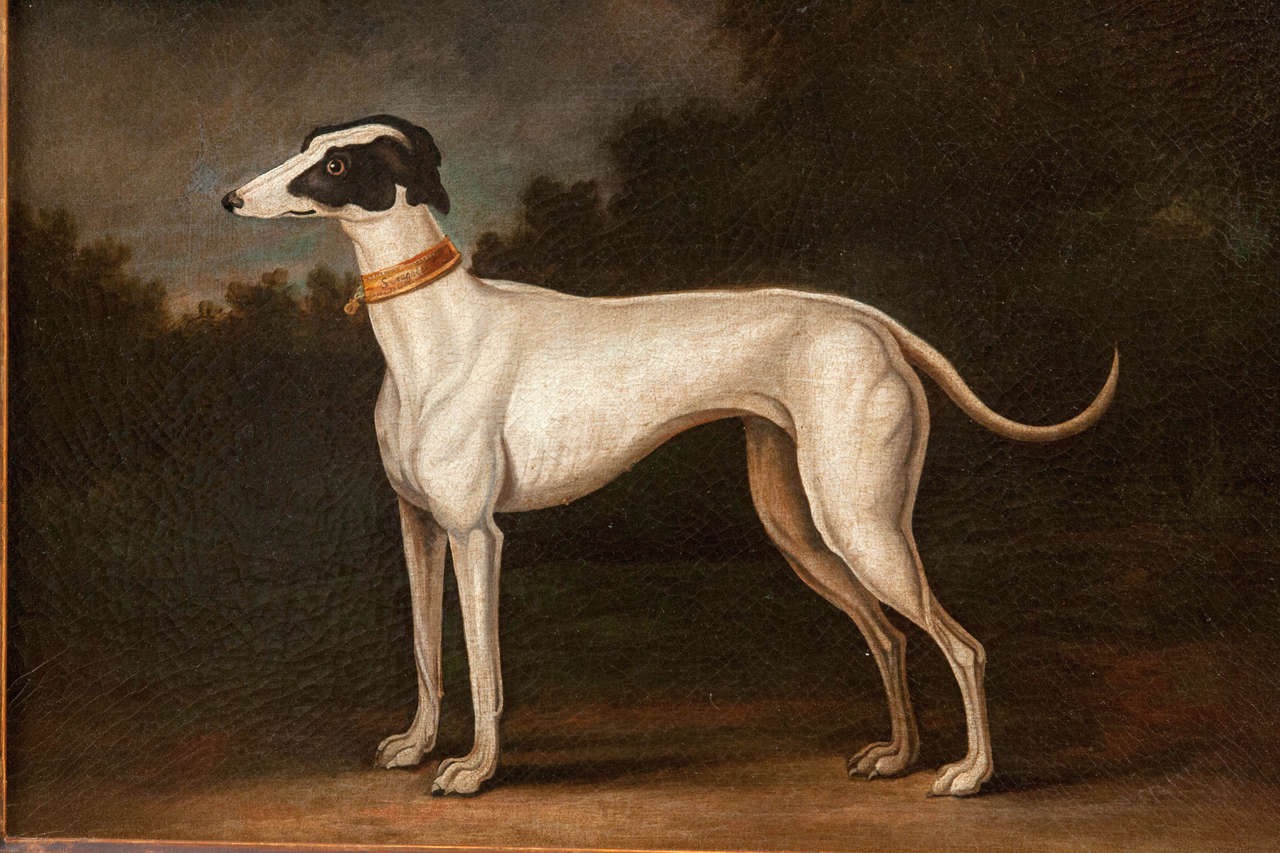
Image result for greyhound racing painting
18th century racing greyhound
Less than 30 seconds and 420 metres after they started, there was light applause as the winner flashed past the finishing line. The handlers walked their dogs back to the kennels; their half a minute’s work for the week was over.
My lovely Millicent Magic came last and I lost one pound. Was the trip to Swindon Greyhound Race Track worth a few seconds of excitement? For thousands of people in Britain, greyhound racing has been their world, their life: as trainers, owners, bookmakers, kennel hands and punters.
In 1926, greyhound racing was introduced from the USA to Manchester, England. Within a few weeks over 11,000 spectators attended each Belle Vue meeting and two years later there were 68 tracks around England. There was not much else for the working man to do, and it was a cheap night out.
Giclee Print: Hares and Graces by Harry Woolley Art Print : 24x18in

After a decline during the second world war, there was a post-war boom and 50,000 people regularly attended White City stadium in London. Working men had raced dogs for centuries, and this offered a night out with a bar and the promise of riches.One of them was East-ender Alan 'Ginger' Newman, born in London in 1940. I met him in a café and he told me how he had spent his life in the greyhound racing business as a tic-tac signer and bookmaker in all the 33 London dog tracks. ‘White City, Hackney Wick, Wimbledon, Wembley. Back then you could only bet legally on the track, and I knew all the bookies: ‘Fatty’ Sparks; Obie ‘The Chalk’ Dyer; Big Bertie Pearson; Harry ‘Erroll Flynn’ Saffron; and Tony ‘The Professional’ Morris. You’d always knew when Judah and his brother had lost. They would start screaming at each other. Then one of them would kick the other quite hard. The punters loved it.’
“Jock the Thief” was a regular at the Wimbledon track in the 1950s. ‘He always came with a big suitcase,’ remembers Newman. ‘It was stuffed with razors, shirts, silk ties, ladies stockings, scarves, perfume –things that were difficult to get. He sold them out of his suitcase at knock-down prices but nobody asked questions. By the time the races started he had sold the lot. He then proceeded to lose it all on the dogs. Next week, he was back, with another suitcase full.’

Once legal betting shops opened in 1961, track attendances declined. New clientele were attracted by modern restaurants up in the stands. Roger Moore was starring in The Saint when he took Bette Davis to White City greyhound stadium. ‘She loved it,’ wrote Moore. ‘The idea of being able to dine, place bets and watch races every fifteen minutes from our table was like manna from heaven to Bette. Everybody was so pre-occupied with looking at their racing forms, eating and placing bets that they never paid much attention to us.’ It was one place where humans were not the stars.‘Dogs don’t need much training,’ trainer Gilly Hepden told me. ‘You breed them, feed them, groom them, love them and then say “Go!”’ The dogs walk daily on a lead, and once a week they run 350 metres. ‘They don’t need stamina, they need explosive energy,’ said Daryl Porter, a trainer for over 50 years. His dogs eat cornflakes for breakfast, beef and tripe for lunch and vegetable soup for supper. ‘They know when it’s race day. As soon as they get a racing breakfast, they start to get excited. They may look calm standing on the track ready to race, but their hearts are pounding away. A dog won’t race unless it wants to, they just do it because they love it.’
'Running in field', painting by Charles Hampton. 
The dogs are placed in categories from A1 to A10 and so unlike horses, there is little possibility of a surprise outsider winning. There are six dogs in each race, matched as equally as possible. Dogs are remarkably consistent in their form and eyebrows are raised if a dog runs one third of a second out of its normal speed. The owner keeps the prize money which ranges from £35 to £100,000 for the English Greyhound Derby. A Derby winner can then earn £1,000 a pop in stud fees. So there’s a gamble in the owning too.Winston Churchill described greyhound racing as ‘animated roulette’, the dogs were simply running machines on which to bet, and the business had a reputation for cruelty. But now all tracks employ qualified vets who inspect every greyhound before racing. Dogs start racing at about 16 months and are usually retired by six years. Greyhounds make ideal pets for retired or lazy people as they only need a 10-minute daily walk and sleep up to 18 hours a day. ‘They are loveable, calm couch potatoes,’ said Steve Simmon, owner of retired greyhounds. ‘Easy-going and good with children.’
‘In the old days,’ said Gilly Hepden, ‘rich people raced horses and poor people had dogs. Now dogs are owned by all types.’ A greyhound costs anything from £500 up to £40,000 and then £50 a week to train. ‘You never make your money back, that isn’t the idea. People do it for the love of dogs, and the other people who love dogs.’

Just 21 tracks are open now – the land is often worth more for housing. Over 8,000 people attended the last night of racing at Walthamstow, near London, in 2008. Oxford stadium closed in 2012; and Wimbledon in 2017. Swindon track probably wouldn’t survive without speedway and its indoor market and car-boot sales. However, people in Britain still bet over £2 billion a year on the dogs and owning a greyhound has become so cool even Jools Holland has one.
The author with Dylan, a rescue greyhound-cross, or lurcher.
The Retired Greyhound Trust rehomes nearly 4,000 dogs a year,
funded by a levy from bookmakers.
Back at Swindon dog track, I turned my attention to the next race. For one night I was Bette Davis and Mr Hampton was my Roger Moore.

Greyhound Board of Great Britain
Retired Greyhound Trust
Swindon Greyhound Track
www.janiehampton.co.uk

A version of this article originally appeared in The Oldie magazine.


Monday, 27 May 2019

Judith Kerr Obituary by Janie Hampton

photo: Rex Shutterstock
Judith Kerr, esteemed writer and illustrator of children’s and young adult books, died last week aged 95. I had two memorable phone conversations with Judith. The first was when I was researching my book on Girl Guides and the Second World War, which included Jewish Girl Guides coming from Nazi-occupied Europe to Britain. Judith told me about her arrival from Germany in London, aged 13 in 1936. She was born in Berlin, where her father was a well-known German-Jewish journalist who openly criticized the Nazis. In 1933 he was warned that his passport might be confiscated, and he fled Germany, just a day before he would have been arrested. Shortly afterwards his wife, Judith, and her brother followed. The family travelled via Switzerland and Paris and settled in London.
Judith had left school when the Second World War began. By now speaking perfect English, she worked first as a secretary and then volunteered for the Red Cross, before being awarded a scholarship at the Central School of Arts in London. Later, she described an air- raid in London as vividly as a picture: ‘The sky was red, reflecting the fires on the ground, and in it hung clusters of orange flares which lit up everything for miles around. They looked like gigantic Christmas decorations floating slowly, slowly down through the night air. In the distance, yellow flashes like lightning were followed by muffled bangs – the anti-aircraft guns in Hyde Park. Suddenly a searchlight swept across the sky. It was joined by another and another, crossing and re-crossing each other, and then a great orange flash blotted out everything else.’ Judith met her future husband, television scriptwriter Nigel Kneale, in the school canteen where she was teaching, and he suggested she join the BBC as a scriptwriter.
The second lively conversation I had with Judith was when I was writing about the Coronation of Queen Elizabeth II in 1953. I was searching for other cultural events that year, and Judith told me about her work at the BBC television studios in Lime Grove. Nigel Kneale, known as Tom, was writing a science-fiction television serial when he, Judith and their colleagues watched the coronation on a black and white television. The Quatermass Experiment was to be about an alien arriving on Earth, but Kneale could not decide where the alien should land. As the coronation reached its climax, he realised that most television viewers had now seen inside Westminster Abbey: this would be the perfect place to first see the alien. ‘There was neither a budget nor the possibility of filming in the Abbey, so we bought a guide book, which included a photo of Poets’ Corner,’ Judith told me. Making television drama in 1953 required ingenuity and imagination. They photographed the guide book’s photo, blew it up and pasted it onto a canvas panel. ‘Then I put on a pair of wash-leather gloves, while Tom stuck bits of curled wire and twigs onto them. We cut a slit in the backdrop, and Tom put his hands through, wearing the gloves. He waggled his fingers very slowly. That was the scariest moment of the drama – when ‘the vegetable’ first appeared, this creep-crawly alien thing with tendrils which had absorbed the bodies and souls of two astronauts. The cameras could not move, and the cameraman saw everything upside down and back to front. It was all filmed live for the television, while another camera showed the actor in terror.’
Mog the Cat. copyright HarperCollins
Judith and Kneale were married in 1954 and had two children. When they complained that children’s books were boring, Judith told them stories about ‘Mog’ the cat. Later she wrote and illustrated the stories, and the series of 18 titles about Mog were published from 1970 to 2015. ‘Cats are very interesting people,’ she later said. After 30 years she wrote Goodbye Mog in which the cat died, a brave step for a children’s writer.
The Tiger who Came to Tea. copyright HarperCollins
Probably her best-known book was The Tiger Who Came to Tea, which also began in order to liven up her children’s day. Asked by BBC presenter Emily Maitlis if the tiger symbolised the the overturning of suburban life during the 1960s sexual and social revolution, she simply replied, ‘No, it was about a tiger coming to tea.’ Kerr’s ability to see the world from a child's perspective enabled her to write and draw exactly what a child wants to see, not what an adult thinks they should. She never wasted their time by repeating in words, what was already in the illustration. The illustrations were clear and simple, with only the essential people and objects in them. Published in 1968, the book has never been out of print. 
Judith Kerr at work
Judith’s son was eight when he saw the film The Sound of Music and commented, 'Now we know what it was like when Mummy was a little girl.' Judith was determined that he, and other children, should know what life was really like and so wrote the semi-autobiographical Out of Hitler Time trilogy. When Hitler Stole Pink Rabbit, Bombs on Aunt Dainty (originally published as The Other Way Round) and A Small Person Far Away, describe childhood among of the rise of the Nazis in Germany, life as a refugee in Britain during World War II, and the post-war years. When Hitler Stole Pink Rabbit won the state-funded Deutscher Jugendliteraturpreis (German Children's Literature Award) in 1974 and became a set text in German schools. In 2004, she said, 'I think of the business of the Holocaust, and the one and a half million children who didn't get out as I got out, in the nick of time -- I think about them almost every day now, because I've had such a happy and fulfilled life and they'd have given anything to have had just a few days of it. And I hope I've not wasted any of it: I try to get the good of every bit of it because I know they would have done if they'd had the chance.'
After the death of Nigel Kneale in 2006, Judith found writing and drawing even more important and continued publishing books into her ninth decade. Over 50 years, she published more than 30 books. Her publisher at HarperCollins, Charlie Redmayne, said she was 'a wonderful and inspiring person who was much loved by everyone. She was a brilliantly talented artist and storyteller. Always understated and very, very funny. She loved life and loved people - and particularly she loved a party.'
photo Daniel Sambraus/AP
Judith Kerr was awarded an OBE in 2012 for services to children's literature and Holocaust education. A year later, the ‘Judith Kerr Primary School’ in London opened as Britain’s first German-English state bilingual school. Just a week before she died, Judith was nominated at the British Book Awards as Illustrator of the Year. She leaves her son Matthew Kneale, a prize-winning novelist and author of ‘The English Passengers’ and daughter, Tacy, who designs special-effects for films.
Anna Judith Gertrude Kerr, 1923 -2019. 


Saturday, 27 April 2019

May Day by Janie Hampton


'Bringing in branches at Maytime', from 
A Book of Hours by Jean Poyer, 1500

The first of May has been important in our family ever since my grandmother Rachel Gurney was born on that day in 1886. Two years later, her sister Richenda was also born on 1 May. Both survived into their 80s and enjoyed many shared birthday parties.
For over 30 years I have lived in Oxford, where May Morning has been celebrated since mediaeval times with garlands of greenery, dancing and music.
The new growth of Spring has been celebrated in Europe since ancient times: the Romans celebrated Floralia, the Celts observed Beltane, and Germanic peoples had Walpurgisnacht. The early Christian church incorporated the lively pagan traditions involved in  bringing in the May, but by 1250, the Chancellor of Oxford University felt the need to  forbid ‘alike in churches, all dancing in masks or with disorderly noises, and all processions of men wearing wreaths and garlands made of leaves of trees or flowers or what not.’ However Spring is Spring and not easily repressed, so by 1550 in Thame, the churchwardens had again bought fifteen yards of green and yellow fabric and bells to make coats for their Morris dancers. In Abingdon in 1566, the churchwardens‘paid for setting up Robin Hood’s bower, eighteen pence.’ ‘Church ales’, or festivals, were often used as  fund-raising events. The church financed the amusements and sold the ale. Profits then paid for the maintenance of the parish church, and  alms to the poor.
Philip Stubbes’ Anatomie of Abuses (1583) describes how hundreds of people of all ages ran into the woods on May Eve and made merry all night. At dawn they returned with branches of trees, pulled by twenty or forty yoke of oxen, each with a sweet nose-gay of flowers placed on the tip of his horns. ‘Their chiefest jewel they bring home from thence is their Maypole (this stinking idol rather) which is covered all over with flowers and herbs, bound round about with strings, from the top to the bottom, and sometimes painted with variable colours, following it with great devotion. And thus being reared up with handkerchiefs and flags streaming on the top they straw the ground about, bind green boughs about it, set up summer houses, bowers and arbours hard by it. And then fall they to banquet and feast, to leap and dance about it, as the Heathen people did at the dedication of their Idols.’


File:St. George's Kermis with the Dance around the Maypole by Pieter Brueghel the Younger.jpg
St. George's Kermis with the Dance around the Maypole', 
Pieter Breughel the Younger, 16th century. 
Note the drinking bower on the right  
In 1598 there was a May Day clash between Town and Gown in Oxford when youths, including the mayor's son William Furness, fought the University authorities. Nineteen years later, a group of  young men were found guilty of insulting the Mayor by dressing up on May Day.  William Stevenson an apprentice, Frost the cobbler, Peter Short the cutler, Tilcock the painter and Pigeon the chimney sweep were held in the stocks for two hours the next market day, with paper notices pinned to their hats describing their offences.
King James I was entertained by ‘Suites for morrice dancers all lyke with garters of bells’ on his first Royal Progress to Oxford in 1605. He described Maypoles and Morris dancing as ‘harmless recreation’ in his 1618 Book of Sports.
17th-century woodblock from the ballad sheet 'The May Day Country Mirth'
During Oliver Cromwell’s Protectorate , May revels were shut down everywhere. In Oxford, Anthony Wood reported on May Day in 1648 . ‘ This day the Visitors, Mayor, and the chief officer of the well-affected of the University and City, spent in zealous persecuting of the young people that followed May-Games, by breaking of Garlands, taking away fiddles from Musicians, dispersing Morrice-Dancers, and by not suffering a green bough to be worn in a hat or stuck up at any door, esteeming it a superstition or rather an heathenish custom.’
With the Restoration of the Monarchy in 1660, May Games returned, to widespread public  rejoicing, and Wood reported, ‘the people of Oxon were so violent for Maypoles in opposition to the Puritans that there was numbered 12 Maypoles besides 3 or 4 morrises.’
However, to  Thomas Hall, Flora was a heathen goddess. He wrote in 1660, Funebria florae, the downfall of May-games, that Flora was ‘the whore of the city of Rome, in the county of Babylon’. She attracted a pack of ‘ignorants, atheists, papists, drunkards, swearers, swash-bucklers, maid-marions, morris dancers, maskers, mummers, may-pole stealers, health-drinkers, gamesters, lewd men and light women’.
By the late 17th Century, singing from church towers was widespread in Europe, and Oxford diarist Anthony Wood, recorded in 1695: ‘the choral ministers of this House do, according to an ancient custom, salute Flora every year on the first of May, at four in the morning, with vocal music of several parts. Which having been sometimes well performed, hath given great content to the neighbourhood and auditors underneath’. They then processed to St Bartholomew’s Hospital on Cowley Road, with ‘lords and ladies, garlands, fifes, flutes and drums to salute the great goddess Flora and to attribute her all praise with dancing and music.’ This was only abandoned after too many  clashes between Magdalen men and ‘the rabble of the town’.
Hornblowers accompany the May garland, from Hone's Table Book of 1827. 
During the 18th century, boys in Oxford blew horns early on May morning. In 1724, Thomas Hearne writes: ‘The custom of blowing them prevails at Oxford, to remind people of the pleasantness of that part of the Year, which ought to create Mirth and Gayety.’ ‘Whit-Horns’ were made from strips of willow bark wound into a funnel and fixed with hawthorn or blackthorn spines. The reed was made of bark and the mouthpiece pinched to create a primitive oboe. From about 1800, Oxford town boys blew their horns at the foot of Magdalen Tower to drown out the choristers.
May Day outside the parish church Great Tew, Oxfordshire, 1911.
The Victorians forgot about the pagan origins of May Day celebrations as they embraced the myth of Merrie Olde England. Three Victorian men helped popularise May Day: Alfred Tennyson with his poem The May Queen; William Holman Hunt with his painting May Morning on Magdalen Tower; and John Ruskin who taught trainer teachers May Day dances at Whitelands College in Chelsea.
By the early 20th Century when my granny Rachel married a vicar, choosing the May Queen was an important part of the parochial calendar. Once seen as a pagan goddess in human form, she was now chosen not for her beauty, but for her regular attendance at Sunday School!
Grand-daughters and great nieces celebrate Rachel and Richenda's
80th and 78th  birthdays, May 1 1968.  The author is on the far left. 
The people of Oxford still celebrate May Morning, starting at 6 a.m. with Magdalen College choir singing the 17th Century Hymnus Eucharisticus from the Great Tower. Church bells then peal out over the city for 20 minutes, and the carousing begins. In Broad Street the Whirly Band  play 'Rough Music'; Sol Samba perform on Magdalen Bridge; and Oxford's community street band Horns of Plenty in Queen’s Lane. Pubs and cafés are open from dawn.
An alternative May Day was started in 1972 by the sculptor Michael Black (1928-2019). His daughter Chess recalls, ‘Michael built a 30 ft high scaffold replica of Magdalen Tower. A full-size plaster ox was decorated with flowers and filled with beer. The Headington Morris men danced outside the Anchor Pub near Aristotle Bridge.Then the dancers came to a slap-up breakfast at Michael's house, cooked by us daughters! Much more drinking and singing followed.’ This year, there will be a wake for Michael in the form of more dancing, drinking and singing at dawn.

www.maymorning.co.uk   www.dailyinfo.co.uk/mayday

 www.janiehampton.co.uk
.