
Showing posts with label Augustus. Show all posts

Friday, 13 May 2022

Don't you Dare Forget About Me By L.J. Trafford

An example of a Roman Emperor


Being a Roman Emperor is hard; what with a daily inbox brimming with problems that desperately require solutions; barbarian incursions, military mutinies, revolting provinces, troublesome new religions, failed harvests, plague, inflation, riots - not to mention your own officials plotting behind your back to replace you.

On top of those energy sapping problems an emperor was also expected to do stuff for their people. Easy, I hear you cry, Bread and Circuses! Oh if only it were that easy. Let’s take the circus part of that duo of people pleasers.

The emperor builds a shiny new amphitheatre. If it’s the colosseum it’s taken 10 whole years to complete, a whopping big hugely complex building project that took hundreds of people and oodles of money. This structure is not for the emperor, it’s not a palace where he can kick off his sandals at the end of hard day of emperoring and sink into a comfy couch with a glass of vino and some honey roasted dormice to snack on, it is purely for his people.

You’d think they’d be at least a bit grateful for the effort or at the least the thought. But no! They require more. They want to be entertained and they want the emperor to pay for and stage this entertainment in their shiny new amphitheatre he’s taken 10 years to build for them. And it was not enough to throw a load of gladiators in the arena and tell them to get on with it. Oh no, the people want to see something new from their emperor, something novel, something that nobody had ever seen before, and they want to see it now or else they might riot out their displeasure at your ever so ordinary games.


Even if they are enjoying watching two blind men fight, elephants walking the tightrope and freaking leopards doing kick boxing (that last one is invented, as far as we know, frankly I’m not ruling it out) they will probably make use of being in the same space as the man who makes all the decisions by yelling out why they think those decisions you made stink. This being ancient Rome, a time when poets put pen to papyri to threaten people they didn’t like with the insertion of a radish and a mullet fish in an orifice of their choice and the noble citizen of a seaside down one day paused on his evening walk to scrawl the immortal line ‘I’ve buggered men’ on a wall*, you can bet that such political commentary is likely not going to be terribly polite.


And just to top it off not only did you have to pay for the entertainment of others, provide a suitable level of spectacle and take abuse from the crowd, you also had to look like you were enjoying the thing! Because if you for one small moment look away to sign some official form or the gods forbid take a quick nap you could find yourself publicly scorned or possibly even assassinated!. Witness here Augustus trying to avoid the bloody fate of his adopted father, Julius Caesar.

He gave his entire attention to the performance, either to avoid the censure to which he realized that his father Caesar had been generally exposed, because he spent his time in reading or answering letters and petitions. Suetonius Life of Augustus.

Oh and did I mention the prizes? Yes, aside from the free novel entertainment and the opportunity to abuse the man at the top, a good emperor tossed prizes into the crowd.

These demands of perfection are applied to every task that an emperor undertakes. Woe betide any that fall a cm short, because they can expect to find themselves in one of the pithier passages in Suetonius’ highly entertaining biographies of the first eleven emperors (and Julius Caesar) or in the case of Claudius here who grievously failed with the Bread part, actual physical danger:

When there was a scarcity of grain because of long-continued droughts, he was once stopped in the middle of the Forum by a mob and so pelted with abuse and at the same time with pieces of bread, that he was barely able to make his escape to the Palace by a back door.
Suetonius Life of Claudius
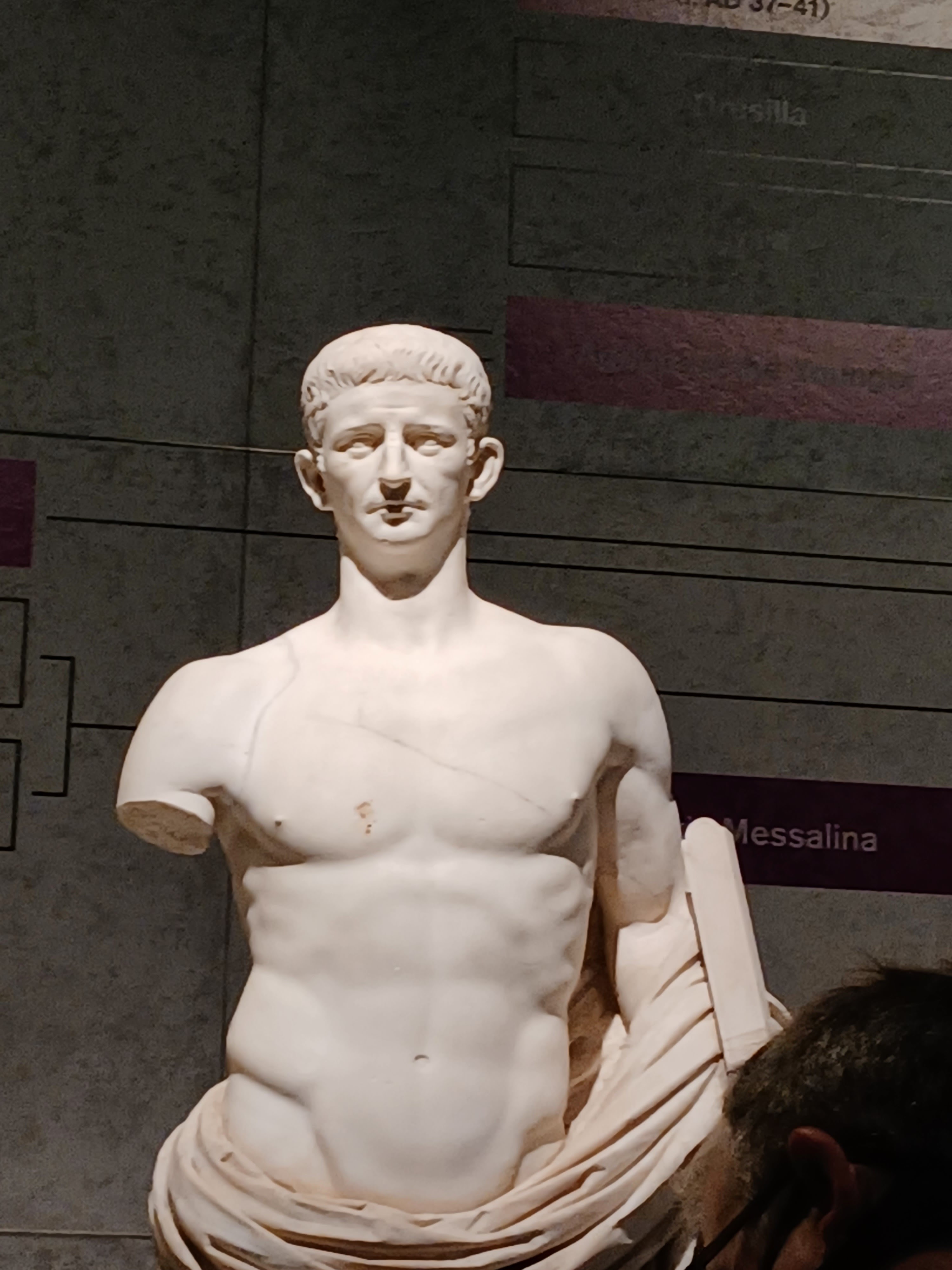
The Emperor Claudius having possibly lost his clothes in that mob attack


Is it any surprise that Emperors dive at the perks of the role, grasping them in both hands and shed a grateful tear as their name is slapped on a building, a month renamed in their honour and an enormous dish of flamingo tongues and eel spunk* is placed in front of them? Frankly they deserve that eel spunk, let them have it. 

However, one Emperor decided he wanted proper appreciation for the job that he’d done and he found a way that ensured that the generally ungrateful Roman public could never forget all the good stuff he had done for them. The route he took to do this was not subtle, but subtlety gets you nowhere in a society where lucky penises are scrawled onto every available surface. His name was Augustus and you’ll have heard of him because he made damn sure he was unforgettable by writing a list of everything he’d done that was marvellous, having it inscribed in massive letters and shipping copies to be put on display throughout the empire.

The man himself, Augustus looking damn Imperial


The Res Gestae Divi Augustus or the deeds of the divine Augustus as it translates, is a list of all the achievements that Rome’s first emperor wanted to be recorded for posterity. It consists of 35 paragraphs, every single one of which translates as ‘I’m brilliant, marvel at it.’


Reading the Res Gestae for the first time is an interesting experience, the boastful tone is at odds with our modern sensibilities where achievements must be downplayed, and we must act humble and grateful when rightfully rewarded. Or at least you do when you’re British. Probably the nearest analogy I can find to the Res Gestae is a job application and that box that asks you to, ‘explain why we should appoint you to the position of xxxx using examples.’ Which you fill in with an account of how you have made a glorious success of every job you've ever held and how much everyone loved you for that, even if you didn’t and they didn’t. But nobody ever got offered a job interview by downplaying their successes or referencing the time they completely cocked up a project.


Amongst Augustus' many talents was directing people to the facilities


The Res Gestae is similar in tone. There is no mention of any cock ups in those 35 paragraphs but rather a hugely long list of things he, Augustus, has personally done during his forty odd years in power. He uses ‘I’ 122 times in a text that is only 3861 words long, so he would have been useless at the teamwork question on a job application. But being proactive and working on one’s own initiative Augustus has examples of in spades, as it evident from the opening line of the Res Gestae

“At the age of nineteen [44 BC] on my own responsibility and at my own expense I raised an army, with which I successfully championed the liberty of the republic when it was oppressed by the tyranny of a faction.”

A singular sentence that is capable of rendering every reader over 20 feeling instantly inadequate and pondering quite why they spent so much time downing £1 pints of cider in the student union bar when they could have been off championing the liberty of the republic instead.

On keeping the ungrateful people of Rome grateful Augustus is at pains to mention how many times he dipped into his pockets for them:

To each member of the Roman plebs I paid under my father's will 300 sesterces and in my own name I gave them 400 each from the booty of war in my fifth consulship, and once again in my tenth consulship I paid out 400 sesterces as a largesse to each man from my own patrimony, and in my eleventh consulship I bought grain with my own money and distributed twelve rations apiece, and in the twelfth year of my tribunician power I gave every man 400 sesterces for the third time. These largesses of mine never reached fewer than 250,000 persons.


Now I could work out for you what 300 sesterces times 250,000 people is and then do the same for the subsequent amounts mentioned and then translate this into how many loaves of bread/soldiers/pints of eel spunk that would purchase in total. But I don’t need to, the fact that Augustus mentions it and the number of 0’s that feature demonstrates on its own that Augustus gave away sh*t loads of money to the Roman public. Although it might be handy for you to know that the annual salary of a soldier in this time was around 1200 sesterces per year and soldiers were considered suitably recompensed. Because if they weren’t there tended to be trouble of the pointy sword variety.
 

Yet another thing Augustus was brilliant at - obedience training wild boars


In a paragraph dedicated to the Games he staged, Augustus is keen to have noted the efforts he went to in providing entertainments.

I gave beast-hunts of African beasts in my own name or in that of my sons and grandsons in the circus or forum or amphitheater on twenty-six occasions, on which about 3,500 beasts were destroyed. I produced a naval battle as a show for the people at the place across the Tiber now occupied by the grove of the Caesars, where a site 1,800 feet long and 1,200 broad was excavated. There thirty beaked triremes or biremes and still more smaller vessels were joined in battle. About 3,000 men, besides the rowers, fought in these fleets


I can almost feel him hovering over my shoulder like the ghost of Obi wan Kenobi in Star Wars saying in Alec Guiness' deep voice ‘Be impressed, my child.’ Impressed am I' (accidental Yoda voice).


Augustus with that far more succinct first draft of the Res Gestae


Other impressive things Augustus is keen to impress upon us include .

I undertook many civil and foreign wars by land and sea throughout the world, and as victor I spared the lives of all citizens who asked for mercy.
Bless you, Imperial Majesty

I restored the Capitol and the theatre of Pompey, both works at great expense without inscribing my own name on either.
 
 Unexpectantly restrained of you, Imperial Majesty

The door-posts of my house were publicly wreathed with bay leaves and a civic crown was fixed over my door and a golden shield was set in the Curia Julia, which, as attested by the inscription thereon, was given me by the senate and people of Rome on account of my courage, clemency, justice and piety.
Humble much, Imperial Majesty?

I made the sea peaceful and freed it of pirates. 
 Ooo ahhh, Imperial Majesty

And my all time favourite:  After this time I excelled all in influence, although I possessed no more official power than others who were my colleagues in the several magistracies. 
Of course you didn’t Imperial Majesty whom I am calling Imperial Majesty because I want to of my own free will.


The Res Gestae as well as being a document to big up one man (and by the gods it does that!) also acts as a blueprint for what a good emperor should be; they should be generous to the people, build a ton of stuff, secure Rome’s frontiers & conquer new lands, be mindful of religion and paying respect to the gods, take care to reward the army and put on fabulous entertainments.

All of which sounds bloody exhausting, someone pass the roasted dormice please!

* The poet here is Catullus who has the reputation for writing an opening line to a poem so filthy it wasn't translated into English until the 20th century, 2000 years after it was written.
* A favourite dish of the Emperor Vitellius, it is referred to in our sources by the far nicer sounding milt of lampreys.


L.J. Trafford is the author of many books about Ancient Rome, she just can't stop writing them. Amongst her titles are How to Survive in Ancient Rome a guide for the would be time traveller to the year 95 CE and Sex and Sexuality in Ancient Rome a guide for people interested in that sort of thing.


Friday, 12 November 2021

Maybe it's because I'm a dreamer, By L.J. Trafford


A lion dreams of whatever it is lions dream of.

     "
I have often felt the urge to start on this current project,” is the opening line of Artemidorus’ great work Oneirocritica. This fabulous book written in the 3rd century CE, which its author feared was an “overwhelming prospect” due to the scale and complexity of its subject, is a volume dedicated to the interpretation of dreams.
    It was probably just one of many such volumes available in the ancient world but Artemidorus’ Oneirocritica is the only complete book of dream interpretations that has survived to the modern day. We are fortunate indeed because it is quite stupendous.

    
The index shows the range of dreams Artemidorus covers

    In his work Artemidorus tackles an array of topics that might assault your mind in those hours of darkness, such as playing hoop & stick, cabbages, sundials, the gods, being struck by thunder and having sex with your mother. The latter of which you will be unsurprised greatly influenced Sigmund Freud. There is very little that he does not cover, except obviously television, space travel and portable communication devices that allow you to read super informative articles like this one and watch funny cat videos.


    The belief that your dreams held important information about your future was a view shared from the lowest in Roman society up to the highest. The biographer Suetonius tells us that the Emperor Augustus held great store by dreams, hardly surprising when one had once saved his life:

    "At the battle of Philippi, though he had made up his mind not to leave his tent because of illness, he did so after all when warned by a friend's dream; fortunately, as it turned out, for his camp was taken and when the enemy rushed in, his litter was stabbed through and through and torn to pieces, in the belief that he was still lying there ill". Suetonius

    Augustus was also the subject of a whole series of plot spoiling dreams foretelling his rise to prominence, starting with his parents:

    "Atia too, before she gave him birth, dreamed that her vitals were borne up to the stars and spread over the whole extent of land and sea, while Octavius dreamed that the sun rose from Atia's womb." Suetonius

Augustus looking dandy
        That ought to have alerted the whole world that he was going to be a big cheese. But clearly nobody had a copy of Artemidorus to hand (probably because it wasn’t written until two centuries later) because nobody cottoned on to his imminent big cheeseness until after cheeseness had been obtained and there was a doh and a collective slapping of foreheads
Enough about cheese! (interesting and necessary aside, if you should dream about feeding bread and cheese to your penis you will die a criminals death according to Artemidorus.)

    In a world where the gods’ plans for you were unknowable and where it was highly likely you would lose relatives to disease and illnesses that are readily curable today, it is hardly surprising that people sought out dream interpreters for help and reassurance about their lives, Not that reassurance was always forthcoming, as we shall shortly see, Artemidorus’ interpretations often predict unhappy fortunes for the dreamer which is indicative of the toughness and often shortness of life in antiquity.

    Artemidorus did not pluck these dream interpretations out of thin air, he treated it almost like a science. Travelling extensively across the empire he interviewed people about their dreams and what happened to them subsequently. From these interviews he compiled his encyclopaedia of dreams and their meaning.
        As he says himself, “The benefits I have derived from this welter of material is that in any given case I can respond with the simple truth and no long rigamarole and give clear evidence for whatever my comments might be.”

    Throughout his work Artemidorus references those numerous interviews, such as this tale: “I know of a professional performer on the lyre who was about to compete in the sacred games of Smyra and dreamt that he was going to take a bath but found no water in the bath house. What happened was that he was caught attempting to rig the contest and was fined and thrown out the games. This was what the dream signified for him, that he would not find what he was looking for with the bathhouse symbolizing the auditorium.”
    This disgraced lyre player however can be considered fortunate compared with the fate of this fellow Artemidorus interviewed. “I know of someone who was castrated after having this dream.” Blimey.
That is certainly one thing to be aware of with Artemidorus, he will interpret your dreams but you might not always like what he has to say.
    Disclaimer issued let us crack on and see if Artemidorus can offer us some illumination in the 21st century by seeing what he has to say about the most common dreams people have today.


Your teeth falling out.
    

Dreaming about your teeth falling out is, according to Dr Google, one of the most common dreams experienced. Let us see what our 3rd century dream interpreter makes of this dream.
Artemidorus actually has a lot to say about teeth. “The mouth must be thought of as a house and the teeth the people in it.”
The teeth on the right side of your mouth signify the men in your house, the left side teeth are the women. Your front teeth, the incisors are representative of the young members of your household, the grinders at the back the older members of your house.
    “The sort of teeth lost will be followed by the loss of the corresponding type of person.” he says. Yikes. 
    It gets worse, should you dream of all your teeth falling out your “household will be completely berefit of all its members at the whole time.” Double yikes. 
    Although maybe they’ve only all gone out to Thorpe Park for the day.

    But hold on Artemidorus has a caveat from these grim outcomes, teeth can also signify property. So dreaming of losing a tooth doesn’t necessarily mean the loss of a relative, it could signify the loss of property. I prefer this interpretation, let’s stick with it.
    “For debtors any teeth falling out signify the repayment of their debt,” says Artemidorus. But how easily this debt is paid off depends on whether you dreamed of a painless loss of teeth (you will repay from your wages) or painful (you’re going to have to sell some of your stuff to repay the debt


Being unable to find a toilet


Joyfully Artemidorus has a whole chapter entitled “dung, defecation” which is most informative. Thus I can tell you that dreaming of having a poo in the toilet is “auspicious for all – it signifies great relief from the burdens of anxieties and anything troubling one, as the body does indeed become lighter after it has relieved itself”


        Artemidorus then lists the meaning behind defecating in various places – which I’m interpreting as being unable to find a toilet, else why would you be having a poo there?

To summarise:
  • Pooing in your bed – inauspicious and signifies a long illness.
  • Pooing on the floor – If it’s on the floor of your house it signifies ‘no further enjoyment of the house’ which I think we can all get behind. A domestic clear up of that nature is bound to linger in the memory and also likely on the rug.
  • Pooing in a temple – this is very inauspicious meaning you will encounter “serious disgrace and significant financial loss” and also “the wrath of the gods” which anyone with a passing knowledge of mythology will know is unlikely to be much fun.
  • Pooing on the seashore, on country roads/fields - profitable says Artemidorus because “these places are not harmed by the man defecating there and they give the man himself the opportunity to drop his load without embarrassment.” Although I guess this depends on what seashore you choose, Scarborough beach on a hot July afternoon is one to presumably avoid,


Flying

Icarus who had no fear of flying,
      
      Ok first up, no flying as in planes or other aircraft. The closest we get is to dream of flying with wings which is auspicious, but flying without wings is ”a danger and a source of fear for the dreamer.”
To dream of flying with the birds “signifies spending time in foreign parts” UNLESS you are a criminal, in which case “it means punishment, often even crucifixion for the guilty.” 
Which may be causing some panicked morning wakings from those of you with outstanding speeding fines.

     Other inauspicious flying dreams include “taking flight when pursued by a wild animal, man or demon” and dreaming of flying whilst sitting on a chair “signifies that the dreamer will contract some serious illness or be paralysed or no longer have the use of their legs”
    On the happier, auspicious side if you dream of flying high you will become a high flyer in life and be like properly prosperous.


Being married to Boris Johnson and wandering about the Conservative Party Conference in your dressing gown


    OK this is one of my dreams that my ever helpful subconscious provided for me knowing that I was writing this article. So let us turn to Artemidorus to unpick my strange, and it has to be said somewhat disturbing, dream.
    “If a woman who has a husband imagines herself marrying another man, [] she will bury her husband or be separated from him in some other way.”

    Oh dear, well I suppose at least it’s not crucifixion. But what about the dressing gown motif? The closest I can find from Artemidorus is a section on the meaning behind dreaming of wearing clothes inappropriately which a dressing gown at the Conservative party conference certainly is. He says to dream of inappropriate clothing is:
    “Malign for all and signifies that in addition to unemployment the dreamer will have to endure ridicule and mockery”
Oh. 

So to recap, my 2022 will involve divorce, unemployment and mockery. Well, I suppose that’s no worse than what the last two years have brought. Heigh ho!


List of Illustrations
1) Sleeping lion, Wikicomms
2) Index of Artemidorus' dream interpretations, author's own photo.
3) The Emperor Augustus from the Ashmolean Museum, Oxford. Author's own photo.
4) Permanent teeth, wikicomms
5) A light box in Miaoli County, Taiwan using the less common term for "toilet", Wikicomms Hippietrial
6) Daedalus and Icarus. Engraving by AGL Desnoyers after CP Landon. Public Domain. Wellcome Collection.
7) Official portrait of Boris Johnson


L.J. Trafford writes about Ancient Rome. Quite a lot. She has written four fiction books covering the year of the four emperors, 69 CE and two non fiction works, How to Survive in Ancient Rome and her latest book, Sex and Sexuality in Ancient Rome. 


Sunday, 19 May 2019

Roman Recommendations by L.J. Trafford


I thought for this month’s post I might do something a bit different. Rather than write a piece on some part of Roman history I thought I would recommend some Roman related things that I have enjoyed and that you might too.


Books

When I became Roman obsessed in the early 90s there really wasn’t much in the way of ancient Rome set fiction. What there was were weighty, long and frankly, dull books in the vein of Ben Hur and Quo Vadis. Which ,yes I did read but by Jupiter’s fiery thunderbolt they were a struggle.
But then I stumbled across a few books that gripped me in their story and not once did I have to skip chapters of long philosophical meanderings to get to the ruddy plot.

I, Claudius – Robert Graves 

The classic book that has forever, probably unfairly, set our views on the Emperor Claudius. Here he is the underdog in the nest of vipers that is the Julian Claudian clan. He’s clever and able but he can’t show it if he wants to survive. But survive he does through the reigns of Augustus, Tiberius and Caligula. Which is no mean feat given the family members who are popping off left, right and centre of him.

This is also notably the book that casts Livia as a mass murderer intent on getting her son, Tiberius to be emperor. You do have to wonder when she found the time for all that murder let alone why she bothered when the Tiberius portrayed here is such a freaky pervert. Really she should have bumped off everyone much sooner. I mean at one point there is only Agrippa and Augustus standing between Tiberius and emperor-hood. Surely that was the time to strike? Why wait until Agripppa has children who clutter up the system? It makes no sense.

Elsewhere Graves tries to make more sense by straightening out that Julio Claudian habit of giving everybody the same name, e.g. Agrippina becomes Pina, Drusus Castor. Which takes all the fun out of trying to work out which generation of Julia is bonking about the place.

It’s a work of classical fiction. But with sex a plenty, skulduggery a muchly and all the best bits of Suetonius wrapped up as literature.


The Falco Series – Lindsey Davis


Whereas I, Claudius concentrates on life in the palace and the fierce battling to be emperor, the Falco books examine life for the ordinary Roman making do. Yes, Imperial types such as Vespasian and Titus do feature and act as sometime employer of Falco but the emphasis is very much on Rome’s ‘others’.

Falco himself is from the rough Aventine district where he works as a detective for hire. Falco’s job gives Davis scope to explore wide ranging aspects of ancient Rome, such as criminal gangs, religion, law, gladiatorial shows and slavery. She also takes Falco out of Rome into the provinces like Britannia and Germania.

They are written as a 40s crime noir but with the twist that although Falco is your typical cynical, hard edged tec he is burdened with a large interfering family. Philip Marlow never had to counter with a Ma like Falco’s!

In fact it is Falco’s extended family, friends and enemies that make the series so enjoyable. Not least his arch nemesis, palace spy Anacrites. Now I know my fellow writer and ex History Girl, Alison Morton will disagree with me most passionately on this, but Anacrites is by far the best character. Possibly because Davis maintains him as a man of mystery, the genuine noir loner, for nearly the entire series.
Falco says of Anacrites that ‘he could be pleasant and was tolerable to look at’. By which I think we can deduce he is well sexy and charming. For which I will forgive his occasional attempts to murder Falco.


Augustus - Allan Massie


This was the book that cemented my passion for ancient Rome. It is a simply brilliant telling of the rise of Augustus from the man himself. Massie gets Rome's first emperor dead on; his sentimentality but ruthless ambition, his never ending drive and controlling nature. If you ever wanted to understand how devious Octavius become benevolent first citizen Augustus, this is the book to read.
Massie followed this up with Tiberius. Another absolute cracker of a read, Massie reject those Capri stories about Tiberius and instead paints a credible picture of a humiliated but proud man. It has never been bettered as a portrait of Tiberius, nobody has come even close. Highly, highly recommended.


Other books worth reading:
Steven Saylor’s hero Gordianus the Finder flexes his detecting muscles in Late Republican Rome. It would be difficult to write a dull book about the late republic, it is positively bursting with characters and incidents. Both of which Saylor uses magnificently.
His portrayal of Marcus Caelius Rufus is stuck in my head as definitive and nothing but nothing can shift it.

Also see Ruth Downie's Medicus series for another Roman detective, this time based in the wilds of Roman occupied Britain.


Podcasts
Podcasts! They’re like radio shows that you can listen to anytime you like! And seemingly the technology is there for any bod with a bedroom and a microphone to inform the nation about their particular passion. Which has done wonders for history broadcasting.


Totalus Rankium


As the introduction informs, this podcast “ranks all the emperors from Augustus to Augustulus” not unlike a game of Top Trumps.
Our presenters Jamie and Robb review the record of each Roman Emperor giving them a rating for
  • Fightius Maximus – Were they an all conquering Caesar? Or a hide in a march until the battle is all done with type of emperor?
  • Opprobrium Crazium – Meglomania alone won’t get you a high ranking, best to juice it up with dollops of scandal, a dash of sadism and a strong belief that your horse would make a decent politician.
  • Sucessus Ultimus – With all the power in the world, how well did they wield it?
  • Imigo Facius – With extra points for sexiness, a commanding chin and a truly great beard.
  • Tempo Completo – How long did they reign for?

And then finally deciding whether they possess a certain Je Na Caesar

As you can probably guess from the above, this is no serious history programme. It is a very funny, sometimes nonsensical, sometimes idiotic and always hilarious podcast.
Where else can you hear about the Flavian conquest of the east on two Vespa mopeds?
Or the students that plagued Antoninus Pius’ life with pranks?
Not to mention Elagbalus and his unique way of hiring staff based on their erm advantage.

Highly recommended. Though a word from the wise, probably best not to listen to at work. Unless you want to spit tea all over your desk from laughing, as I once did.
Series One took us up to the fall of the Western Empire. They are now covering the Byzantines who are properly extreme in a cut off your nose, eunuch-tastic way.


Roman Things to See (if you’re not in Rome)


British Museum
Upstairs in the Roman Gallery you have the treat of hanging out with scary Augustus head. Be sure not to look in his eyes.


Look out for the clever positioning of the bust of Tiberius, a clear three paces behind that of his mother Livia. Ha! Also Hadrian and his lover Antoninus directly facing a bust of Hadrian’s wife Sabrina. Ouch!


Museum of Classical Archaeology, Cambridge
Having lived near Cambridge the vast majority of my life I had somehow, shamefully, never quite managed to visit the Museum of Classical Archaeology.

I put this right a few months ago. Situated in the grounds of one of the colleges this Museum is a joyful collection of plaster casts of famous Greek and Roman statues.
Augustus kindly points the way to the toilets. Gent


L.J. Trafford is the author of the Four Emperors Series of books.


Monday, 19 November 2018

THE SAUCE FACTOR By L.J. Trafford


The Roman biographer Gaius Suetonius Tranquilius was born in 69AD, probably in North Africa. A friend of Pliny the Younger, Suetonius wrote several notable works. His most notable and most notorious is The Twelve Caesars.
This was a collected biography of twelve ruling Caesars from Julius Caesar to Domitian. As an employee of the Emperor Hadrian Suetonius had access to the Imperial archives and he used materials from there to pepper his work. 

Pepper his work with SAUCE, that is. Yes, Tacitus is a brilliant writer and oh so very quotable. Yes, Virgil wrote an epic poem that apparently is so good first year ancient history BA’s are forced to write essays on it two thousand years later. Yes, some people think Livy wrote good histories. But NONE of them have a patch on Suetonius. 

For Suetonius is the master sauce merchant. There is no scurrilous rumour too unlikely for him to commit to papyri. We thank him for being a gleaming light of entertainment sandwiched betwixt the Aeneid and those books that Livy wrote on stuff.

So to give him his due I have elected to celebrate his work with a competition we, (or rather I) like to call THE SAUCE FACTOR!

I have read each of Suetonius’ 12 chapters on emperors and rated each one according to their sauce level. I have also added in a category for omen/portent-ability. The Romans were heavy believers in the Gods transmitting their will via freak weather events, odd occurrences, dreams and the eating habits of chickens of the sacred variety. I shall be picking out the most incredible omen associated with that emperor and giving it a score.

Settle down with a large glass of wine, set your mind to boggling and your eyes to goggling because we are going in....
Welcome to the Sauce Factor!


1) Julius Caesar

He wasn't actually an emperor but we'll overlook that. Lover of many ladies, fighter of pirates, destroyer of the Republic.

Top Omen – There was a long steady string of what Suetonius calls ‘unmistakable signs’ before his assassination. The Gods were very much trying to SAY something. If only he’d LISTENED. Which is Caesar’s tragedy in a much shorter form than Shakespeare managed. Ha!
The best of these unmistakable signs is undoubtedly the horses that couldn’t stop crying.

Omen Rating: 4/5 for sheer quantity. 

Top Sauce - Definitely an affair with the King of Bithynia that earned him the hardly original nickname, “The Queen of Bithynia”. Frankly everyone could have done better on that one.
Sauce Rating: 3/5


2) Augustus
Now Augustus was definitely an Emperor.

 He Instituted laws against adultery whilst putting it away all over the place himself, was debauched by Julius Caesar and possessed a cruel & ruthless streak as streaky as Danish bacon. 

Top Omen – Augustus’ life must have been very tiring what with all those portents/omens flashing all around him constantly. A one man weather magnet he was frequently accompanied by lightening (very, very frightening. No genuinely, Augustus had a fear of thunderstorms) and rainbows.
The most notable of the young Augustus’ 
constant brush with portents was undoubtedly: The Silencing of the Frogs. The toddler Augustus annoyed by the constant croaking around him order the frogs to cease. They did. And never ever croaked in that area ever, ever again. 
Omen Rating: 5/5


Top Sauce - Deflowering maidens gathered by his wife. 

Sauce rating: 3/5


3) Tiberius.
Forced to divorce the wife he loved, so fed up with Augustus he ran away to Rhodes in a sulk, terrible judge of character *cough* Sejanus *cough* . Tiberius did not have the happiest of lives. But it really all kicks off when he retired to Capri, where despite being in his mid 70s he partook in debaucheries that would have killed a lesser man. Possibly he gained such stamina in his youth as a successful general in the provinces. Or possibly it was all made up. Suetonius refuses to take sides on the debate and instead lovingly records every gruesome detail so that we may make up our own minds (once our eyes have popped back in our skulls).


Top Omen – Tiberius had no deep regard for the Gods and clearly they had not a lot for him because portents/omens are thin on the ground. The best Suetonius can find is an earthquake on Capri shortly before he died which destroyed a light house.
Omen Rating: 1/5

Top Sauce - Retiring to Capri & partaking of activities 'too vile to discuss'. Which Suetonius then lists. 

Sauce Rating: A deserved OMG 5/5

4) Caligula.
Suetonius does a nice quotable bit on Caligula which is worth memorising and repeating every time someone annoys you. “So much for the man. Now for the Monster.” Suetonius

Photo by Clio20
then has great fun listing all of Caligula’s monstrous acts including incest with all 3 sisters, wearing *the horror* silk robes, snuggling up with the actor Mnester, inviting people to dinner then nicking their wives and a thing with Valerius Catullus, who announced to all “that he had buggered the Emperor, and quite worn himself out in the process”

Top Omen – Much like Julius Caesar Caligula was plagued with signs of DEATH before his brutal murder. The best of these is the statue of Jupiter that burst into laughter. 

Omen Rating: 4/5

Top Sauce - Summoning three terrified Senators in the dead of night solely to perform a dance for them.
Sauce Rating:  5/5 for effort & speed of sauce given he only ruled for 3 years.


5) Claudius.
Not as kindly as Robert Graves would have you think. Married four times, Suetonius intriguingly tells us Claudius divorced his first wife for scandalous behaviour and suspicion of MURDER. Then infuriatingly does not elaborate any further.

Photo by  Marie-Lan Nguyen
Top Omen – Claudius unlike Caesar and Caligula actually paid attention to the Gods and was all over omens like a slobbering rash. 
One night Claudius’ attendant Narcissus had a terrible dream that the emperor had been murdered by a certain Appius Silanus. When Claudius told this to his wife she revealed she had had the EXACT same dream. Now this was clearly a sign that needed LISTENING to. So Claudius had Silanus executed. Only it was actually a FAKE omen dreamed up by the Empress and Narcissus to get rid of Silanus. 
Omen Rating: A pathetic and fake 0/5

Top Sauce - Making it legal to marry your niece. So he could marry his niece. She later had him poisoned
Sauce Rating: 3/5

6) Nero.
Fabulous at getting rid of family members including his wife, his step brother & most shamefully his mother, Nero lived life LARGE. So large he had to take himself over to

Greece to accommodate his growing ego. Suetonius informs us sagely that Nero practised every kind of obscenity. But this time, unlike with Tiberius, he leaves it to our imagination. After that Tiberius chapter my imagination has descended hitherto unknown depths, so I’m confident they were horrifically obscene.

Top Omen – Suetonius has several bad omens at the birth of Nero including the words of his own father that any child of his and Agrippina’s was bound to have a detestable nature. Which when you think about it is more of an informed comment
than an omen. 

After this the best Suetonius can do is to record the people who post Nero’s death remembered that the Emperor had during his artistic career played various characters who met unfortunate ends. But given Nero acted in Greek Tragedy this is not terribly surprising.
Though Nero’s death was short on omens the end of the Julio Claudian dynasty begun by Augustus was predicted by a bolt of lightening that hit the Capitol and decapitated all the statues. So we’ll give him points for that. 
Omen Rating: 2/5

Top Sauce - Toss up between marrying his eunuch Sporus as a groom & marrying his ex-slave Doryphorus as a bride. 
Sauce Rating: 4/5 for being ever the bride and the groom


7) Galba.
The first of the four emperors that ruled in a single year, Galba reigned but a short time. During that whole time there were omens everywhere predicting bad things. Or perhaps that was all the work of a certain Otho who organised the coup that deposed Galba.


Top Omen – So many, so lovingly recorded but my personal favourite is when Galba went to read the auspices. His garland fell off and scared the sacred chickens, who flew away. I like it because it’s the sort of thing that would happen to me.
Omen Rating: 2/5

Top Sauce - A preference for mature & very sturdy men.
Sauce rating: 2/5


8) Otho.
He reigned even shorter than Galba who he overthrew in a very bloody coup. Otho wore a toupee so good that nobody knew about it, says Suetonius 70 years later. He also used to 

prevent beard growth using moist bread & shaved his entire body of hair.

Top Omen – Otho owed his entire position to his astrologer Seleucus who convinced him that not only would he outlive Nero but also that he would become Emperor. Having dispatched Galba, Otho arrived at the palace to find that Vitellius had declared himself Emperor in Germania and was on route with a massive unbeatable army. Which rather served Otho right. Suetonius does not record what happened to Seleucus. 
Omen Rating: Because history would have been very different if Otho hadn't listened to his astrologer 4/5

Top Sauce - A threesome with Nero & his wife Poppaea 
Sauce Rating: 3.5/5


9) Vitellius 
Suetonius says Vitellius' main vices were extravagance & cruelty. So the sauce is literal sauce.
 Photo by Luis García
Top Omen – When he was at Vienna a rooster perched first on his shoulder and then on his hand. As Vitellius was later overthrown by the advance of General Antonius Primus, whose childhood nickname had been Roosters’ Beak, this was seen as a very good premonition. Though the big question is surely what part of Primus was shaped like a rooster’s beak to gain him that nickname? 
Omen Rating: 3/5

Top literal sauce - So greedy he nicked meat off the altar during sacrifices.
Sauce Rating: Probably garum but we'll give him 1/5


10) Vespasian.
Picked up Rome after the civil wars of 69ad. Very lacking in sauce. But positively awash with omens! So it’s not all bad. The Gods were super keen to alert all that Vespasian would be emperor. They repeatedly threw odd events his direction to signal this. But much like

Attributed to Shakko
nobody can quite see that Clark Kent and Superman are clearly the same guy, everyone seems to have just accepted that weird things kept happening to Vespasian and thought no more of it. After Nero died the omens trebled in number and poor Vespasian couldn’t walk down a street without the statues turning round or random passersbys declaring he would be ruler. In the end it would have been rude not to declare himself emperor, so he did.

Top Omen – So, so many to choose from but my favourite is the dog that deposited a human hand on Vespasian’s foot. This was apparently a sure sign he would be emperor. Though the bigger question is where did the hand come from? And shouldn’t someone have gone and found out? 
Omen Rating: 5/5


Top Sauce - Treating his long term mistress Caenis as his wife. 
Sauce Rating: Sorry Vespasian that's nowhere near saucy enough, it's a 0.5/5


11) Titus.
He had a love affair with Queen Berenice of Judaea & declared that he had only one regret in life. Possibly his inability to finish sentences, because he never finished that one.

Attributed TcfkaPanairjdde

Top Omen
– Titus’ reign ought to be one of terrible omens given he presided over the eruption of Vesuvius, another devastating fire in Rome and an outbreak of plague. Annoyingly Suetonius does not attribute the Gods’ displeasure to any of these events and Titus gets off scot free. Apparently he was “an object of universal love and adoration.” I hate him.
Omen Rating: Pah! Only 1/5 because nobody recognised the Gods hated Titus and were desperately trying to tell everyone so.

Top Sauce - Owning a troop of dancing boys who he released into the wild on becoming emperor. 
Sauce Rating: 3/5

12) Domitian.
Domitian is an excellent study in paranoia and also how to induce it in others. 
He was so paranoid he had his floor polished to glass like standards so he could see anyone sneaking up on him. Which still didn't prevent his assassination.

Top Omen- Domitian's paranoia is probably explained by the fact that astrologers had long predicted the day and hour of his death. Something his father, Vespasian, used to joke about over breakfast. Then lunch. Then Dinner. Then just before he read young Domitian his bedtime story. Domitian did not find this remotely amusing.
Amongst a barrage of freak weather, including a hurricane, the top omen is surely the raven that perched on the Capitol and declared “All is well.” Suetonius points out helpfully that the raven was speaking in the future tense and all would be well once Domitian was dead 

Omen Rating: 4/5 for knowing his WHOLE life exactly when he would die. One has to appreciate the specifics of it.

Top Sauce - An affair with his niece Julia. Which isn't that saucy given Claudius had made relationships between uncles and nieces legal.

Sauce Rating: 3/5


The Results
Well, it's been a pleasure and I can now exclusively reveal (after a ten minute pause inserted to create tension) that our top Emperor for Suetonian Sauciness is a joint affair between..........drum roll.............

Tiberius and Caligula!!!!

And our emperor who produced the most impressive omens is....well would you believe it....it's another tie! This time between Vespasian and Augustus.

Well done to all our losers also. Try not to take it too badly.


L.J. Trafford is the author of The Four Emperors Series. With the fourth book in the series being released on 1st December 2018.


Sunday, 19 August 2018

Empress-less :( By L.J. Trafford

The five Julian-Claudian emperors that ruled Rome from 27BC to 68AD clocked up eight empresses between them. 

The chart shows the distribution. It reveals an anomaly.
Rome’s second Emperor Tiberius ruled with no Empress at all. This is quite noteworthy given he ruled for 23 years. Caligula managed two whole empresses in a reign of only 5 years.  So why did Tiberius not marry whilst Emperor? 

He was relatively late in years when he succeeded his stepfather Augustus at the age of 56 years old. Still that was no impediment Claudius married his fourth wife (and second empress) Agrippina aged 59. There was nothing to stop him marrying a much younger woman and producing heirs. But then Tiberius already had heirs aplenty; a son and grandson from his first marriage. Also he'd adopted his nephew Germanicus as his son. Germanicus had three sons of his own. 
This seemed ample enough successors. Any more might well cause the sort of infighting, back-stabbings and poisonings the Julio-Claudian family became famous for.  
Perhaps it was a strong attempt to not muddy the dynastic waters any further. 
However, I rather think not. I rather think Tiberius’ lack of an Empress was a decision born of his traumatic romantic history. 


Wife Number One 

Tiberius' first wife was Vipsania. She was the daughter of Emperor Augustus’ right hand man Agrippa.  They were married when she was likely a teenager and Tiberius was in his early 20s.
Tiberius
Evidently it was a happy marriage.  They had one son, Drusus and Vipsania was pregnant again when in 12 BC her father Agrippa died. 
This was to have devastating consequences beyond a daughter's natural grief. For Tiberius' stepfather, the Emperor Augustus,
ordered the couple to divorce.  This seems like an unnecessary cruelty of the emperor towards Vipsania and Tiberius.  She’d just lost her father and then her husband is forced to divorce her even though she is pregnant with his child. I could here make a valid point about how marriage for centuries was a contract between families, how love had very little if anything to do with it. Naturally with Agrippa dead the marriage between the families is void.  Tiberius was needed elsewhere.  
That’s the standard in the elite rungs of Roman society where marriages were made and dissolved based on changing circumstances. 

But actually this everyday tale has a very bitter sting to it. Tiberius obeyed his stepfather and divorced Vipsania, but it was with much reluctance. 
Hankies at the ready folks, this is what Suetonius has to say:   


But even after the divorce he regretted his separation from Vipsania, and the only time that he chanced to see her, he followed her with such an intent and tearful gaze that care was taken that she should never again come before his eyes.  


And he continued to regret it. As Emperor he maintained a vendetta against Gaius Asinius Gallus who Vipsania had been hastily remarried to. “He had hated him for years” As Tacitus neatly puts it. 
So who was the woman Tiberius was forced to divorce the wife he deeply loved for? 
She was Augustus’ daughter, Julia. 


Wife Number Two

Julia was 28 years old and already a mother of 5 children. This was to be her third marriage.  At age
Tiberius' Stepfather the Emperor Augustus
14 she’d been married to her cousin Marcellus. He had died of a fever after only two years.
Her second marriage had been to Agrippa. Which meant that not only was Tiberius marrying his step sister, he was also marrying his former mother in law. It had to feel weird. 
The two had been raised together in the same household as Tiberius’ mother Livia was married to Julia’s father Augustus. Julia’s upbringing had been strict.


(Augustus) In bringing up his daughter and his granddaughters he even had them taught spinning and weaving, and he forbade them to say or do anything except openly and such as might be recorded in the household diary. He was most strict in keeping them from meeting strangers. 
Suetonius


It was hardly surprising given these restrictions that Julia might develop a rebellious streak.

One day she came into his presence in a somewhat risque costume, and though he said nothing, he was offended. The next day she changed her style and embraced her father, who was delighted by the respectability which she was affecting. Augustus, who the day before had concealed his distress, was now unable to conceal his pleasure. "How much more suitable", he remarked, "for a daughter of Augustus is this costume!" Julia did not fail to stand up for herself. "Today", she said, "I dressed to be looked at by my father, yesterday to be looked at by my husband."  

Macrobius


This rebellion went beyond a slightly low cut dress

When people who knew about her shocking behaviour said they were surprised that she who distributed her favours so wildly gave birth to sons who were so like Agrippa, she said, "I never take on a passenger unless the ship is full."  
Macrobius
Tiberius was well aware of Julia’s wild streak for he had been on the receiving end of one of her passes.

He disapproved of Julia's character, having perceived that she had a passion for him even during the lifetime of her former husband, as was in fact the general opinion.   
Suetonius

Presumably Tiberius did not take her up on her offer.

There is a strong hint of misogyny in descriptions of Julia’s life but the Julia that appears in Macrobius’ account is fun and witty and well read. He tells us:  Her kindness and gentleness and utter freedom from vindictiveness had won her immense popularity, 
However for all these good qualities she was an ill matched wife for Tiberius. Where she was sociable and friendly and fun, he was sullen, taciturn and introspective.  Suetonius says of Tiberius: 

 He strode along with his neck stiff and bent forward,usually with a stern countenance and for the most part in silence, never or very rarely conversing with his companion  

As a teenager he suffered badly from acne and in later years developed a skin complaint that caused weeping ulcers on his face.
Hardly a good fit for the fun loving sparkly, attractive Julia.
They did try to make it work though. They had a child together but when that child died their relationship completely broke down and Tiberius moved out.
 Julia might have made some sort of pass at him in their youth but she was as unhappy as he was with this marriage.  She was most probably relieved when Tiberius went off to Germany on campaign, leaving her in Rome. 
She had her freedom and she enjoyed it a lot.  Too much, for the stories regarding her behaviour get more and more extreme:

She had been accessible to scores of paramours, that in nocturnal revels she had roamed about the city, that the very forum and the rostrum, from which her father had proposed a law against adultery had been chosen by the daughter for her debaucheries.  
Sold her favours and sought the right to every indulgence with even an unknown paramour. 

Seneca

The emperor’s daughter selling her body to passing men in the Forum was a huge scandal not least because, as Seneca mentions above, her father had introduced a series of morality laws.

One of these, the Lex Iulia de Adulteriis Coercendis,  proscribed banishment for those caught in adultery. It also stated that husband’s (under certain circumstances) could kill their unfaithful wife. On the milder side the husband was compelled to divorce an adulterous wife.  
Julia was treading a very dangerous path as her antics became known to everyone in the city, bar her doting father Augustus. Tiberius was undoubtedly in full knowledge of what his wife was indulging in and it placed him in a terrible predicament.

The law of his own father-in-law stated he should divorce his unfaithful wife but that wife was the emperor’s daughter. It also cut into all that Roman society felt about marriage, husband’s should be able to control their wives. What did it say about Tiberius as a Roman man that he could not? The innuendos and gossip he faced must have been unbearable. 

So unbearable that Tiberius bailed:

At the flood-tide of success, though in the prime of life and health, he suddenly decided to go into retirement and to withdraw as far as possible from the centre of the stage. 
Suetonius

He told Augustus his retirement to the island of Rhodes was because Julia’s sons were now of age and he was no longer needed. That was the official version.  
Unofficially everybody (bar her doting father) knew the real reason. 
“From disgust at his wife, whom he dared neither accuse nor put away, though he could no longer endure her.”  Suetonius

Four years after Tiberius ‘ flight from public life Augustus was finally made aware of what had been public knowledge for some years.  The Emperor was devastated and Julia, as the law he’d introduced  dictated, was banished.   

After Julia was banished, he denied her the use of wine and every form of luxury, and would not allow any man, bond or free, to come near her without his permission,   
Suetonius

In Tiberius’ absence Augustus divorced his daughter from his stepson. Tiberius eventually returned to Rome eight years after his exile. In 14 AD he succeeded his stepfather as Emperor.  


Single Once More

Tiberius was a man who held grudges, note his dislike of Vipsania's second husband. He certainly held a grudge against Julia and all that she had put him through. In later years Augustus had lessened the conditions of Julia’s banishment. Once emperor Tiberius increased them.
He had not forgotten.  He had not forgiven. 
It is hardly surprising after the abject failure, personal humiliation and misery of his second marriage that Tiberius did not seek a third even when he was Emperor and the choice would have been his alone.  

But there is also something else at work here. We have a long list of Julia’s lovers but from the moment the couple separated there are no named mistresses or favourite slaves or any paramour at all named for Tiberius.
In a society high on Imperial gossip this is so unusual as to be positively noteworthy.  That the emperor was apparently celibate from his early 30s is quite staggering particularly when you remember he lived in a palace that catered to the emperor’s every sexual whim.  

Unsurprisingly there is quite a lot of speculation by historians over this. Speculation it will remain because they are all theories born of an absence of information. But I can quite believe that Tiberius, as several historians have supposed, was sexually timid, perhaps impotent (maybe caused by the oppressive stress of public life) perhaps even indifferent to sex after his humiliation by Julia. 
However  our tale takes another twist when Tiberius took a second retirement to an island, this time to the island of Capri. 
During these years some quite unbelievably shocking sex stories become attached to his name.  


The Capri Years  

Capri. Photo by Radomil

In 26 AD having ruled for 12 years and at the age of 67, Tiberius left Rome for the island of Capri. He was never to return to the city. 
The reasons why he departed Rome are much to numerous and complex to cover in this short piece. The gist of it was that he was thoroughly fed up with politics and ruling. 
He remained on Capri for 11 years up to his death in 37AD. The citizens of Rome therefore did not set eyes on their emperor for over a decade. Hidden away on a small island is it any wonder stories were told as to what Tiberius was up to. It had to be something sinister for him to abandon his grand position didn’t it? 
Tacitus mentions secret vices. Suetonius helpfully records exactly what the gossips were saying. It is about as extreme as emperor gossip gets.  You have been warned: 

On retiring to Capri he devised a pleasance for his secret orgies: teams of wantons of both sexes, selected as experts in deviant intercourse and dubbed analists, copulated 
before him in triple unions to excite his flagging passions.  

Its bedrooms were furnished with the most salacious paintings and  sculptures, 
as well as with an erotic library, in case a performer should need an illustration of what was required. Then in Capri's woods and groves he arranged a number of nooks of venery where boys and girls got up as Pans and nymphs solicited outside bowers and grottoes: people openly called this "the old goat's garden," punning on the island's name.  

He acquired a reputation for still grosser depravities that one can hardly bear to
 tell or be told, let alone believe. For example, he trained little boys (whom he termed minnows) to crawl between his thighs when he went swimming and tease him with their licks and nibbles; and unweaned babies he would put to his organ as though to the breast, being by both nature and age rather fond of this form of satisfaction
Suetonius


What are we to make of this? Had Tiberius gone senile in his old age? Had his old humiliation by Julia and his loss of Vipsania been repressed and then spilled over into this strange explosion of depravity?  There is a suggestion in other sources that Tiberius had always possessed secret vices but that he had repressed these until he was away from the public eye. 

This seems all a little too convenient. Surely Tiberius would have shown some indication of perversion prior to retiring to Capri ? Yet as previously discussed we have absolutely nothing on Tiberius. Not even any normal sexual relations recorded. 
I am rather reminded of the emperor Domitian whose love of solitude was inexplicable to the public facing Romans. A story circulated that during these quiet periods he was in fact stabbing flies to death with his pen . Because he had to be up to something sinister, didn’t he? 
I would suggest similar forces are at play here. To abandon Rome, the city he ruled and to hide himself away was so odd to the Roman mind that stories were invented to explain the inexplicable. Given that Tiberius spent 11 years on Capri that gave ample time for these tales to be embellished and then further embellished until, as Suetonius notes, they could barely be believed. 


The End 

Tiberius died on Capri in 37AD entirely unloved and unmourned.
The people of Rome, deserted by their emperor declared “To the Tiber (river) with Tiberius”
He was succeeded as Emperor by a man who became the embodiment of vice and depravity, Caligula. He’d spent some time with Tiberius on Capri and the gossips claimed it was the old emperor who first led the impressionable Caligula into his demented perversions.
Which is a sad epithet for an emperor who had dedicated his entire life to both public and military service. Who left the treasury bursting with coinage. Who took over this newly created role of ‘emperor’ from Augustus and kept it going when it might so easily collapsed into the civil wars that Augustus had ended. A legacy that endured for 400 years.