Showing posts with label Christmas Cards. Show all posts

Saturday, 22 December 2018

Seasons Greetings & A Couple of Creepy Cards by Catherine Hokin

                                               
 1950s card, not a photo of my house
Christmas cards: to send or not to send, that is the
question. I wish I could claim my inability to buy/write/post them stems from a concern for the planet but the more honest reason is forgetfulness when it comes to writing down addresses I don't regularly visit and a love of all things electronic when it comes to communication. Also I never know how to display the last few we get - I can't bear them on strings or cluttering up shelves - it's the only aspect
of Christmas that turns me into the Grinch. I'm down to sending a handful now and, in that at least, it seems I'm on trend. Large companies like Hallmark have seen the amount of Christmas cards purchased each year decrease by a third since 2007 and the drop isn't just in the UK: research from the American Greeting Card Association suggest that Europeans and Canadians now send an average of 11 cards per household per year compared to the staggering 300 posted out by pre-baby boomer families, while Americans (despite the best stationary shops on the planet) only send 8.


 Prang Christmas card with Santa's hotline
The tradition of sending cards goes back to the mid nineteenth century. Producing the first commercial Christmas card is an honour claimed by Sir Henry Cole in 1843 but it was a German immigrant to the USA who started the greetings card industry as we now know it. In 1856 Louis Prang opened a small lithographic business near Boston, by 1866, he had perfected the colour lithographic process and by the 1870s he was publishing a range of deluxe Christmas cards. These were mainly sold in England where the introduction of the halfpenny stamp had made sending cards affordable across a wide range of society but the habit also gained ground in America with Prang's cards taking such a big share of the market (he was printing 5 million cards a year by 1881) that he became known as the father of the American Christmas card. This seasonal success story then takes on more of an It's A Wonderful Life feel: Prang's cards were lavish and expensive to produce, often with 30 colours on one print plus glitter (and occasionally tassels) and he was eventually forced out of business in 1890 as cheap copies flooded the market. His cards are now highly collectible - although not quite as valuable as the first Cole card which sold at auction in 2001 for $35,800. That's one I would have made a bit of space for.

 As with many of our current Christmas traditions, sending cards was something the Victorians leaped on with all the fervour of Tiny Tim spying a roasted goose. According to BBC research, the new greetings card industry produced over 11 million cards in 1880 alone and competitions were regularly held to help feed the demand for new designs. In 1879, card publishers to the royal family Raphael Tuck (who produced as many as 3000 designs a season) held an exhibition at the Egyptian Hall in London, with 500 guineas in prizes. It attracted nearly 900 entrants and was so popular that a second competition, judged among others by Sir John Millais, followed in 1882 with this time £5000 being awarded in prizes. It was Raphael Tuck who introduced novelty cards alongside the more traditional Christmas scenes, including cards that could be turned into ships and horses and soldiers. And then things got really strange...

 Santa's reindeer having an off day
Children riding bats anyone? Beetles dancing with frogs, mice riding lobsters? Children being menaced by snowmen even Stephen King couldn't dream up? The iconography of Christmas - trees, puddings, the jolly old Santa - is there in nineteenth century cards but there are also a host of other influences, from the Germanic Krampus and 'monsters of nightmareland' as Gleeson White (editor of The Studio) called some of the images in 1894, to natural history (a Victorian obsession) and what some historians have catalogued as social messages: dead robins in the snow as reminders of the starving poor. Whatever the reasoning was behind the macabre designs has been lost in the passage of time and it may be that these cards were the oddities not the commonplace - the fact of their collection giving them perhaps more importance now than they had at the time. Today the most popular card sold features three cutesy cherubic angels, including one with eyes that would sit better on a spaniel. Since Hallmark first produced it in 1977, this image has sold 34 million copies.

Do not send me it. These, on the other hand, would take pride of place. Enjoy and Merry Christmas one and all.

 Mummy's on the sherry again

 Doing the Christmas recycling
  The Spirit of Christmas


Monday, 24 December 2012

A MERRY CHRISTMAS, ONE AND ALL!

BY ESSIE FOX 


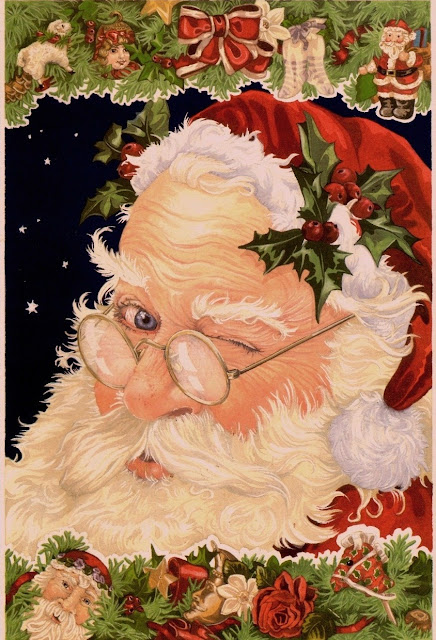
Santa Claus by Essie Fox


Before taking up writing novels I worked as a commercial illustrator, often selling to greetings cards companies, and the Santa Claus shown above was one of my favourite Christmas designs.


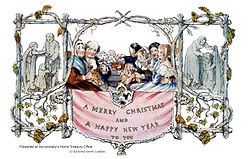
Even in those days I took inspiration from the Victorians - such as in the use of a border of 'scraps'. However, before Queen Victoria's reign there were no commercial Christmas cards – that tradition only really beginning after the introduction of the Penny Post, when Sir Henry Cole had the bright idea of printing up thousands of images which were sold in his London art shop and priced at one shilling each. What an industry that enterprise began!


Sir Henry Cole's first commercial Christmas card


As far as my own jolly gentleman would have been concerned, well, hardly anyone in England then would even have known his name. And yet by 1870 almost every child would recognise the sleigh that was drawn by reindeer, and the stockings full of precious gifts - if only an orange or apple to eat - as a present from Father Christmas.

Illustration by John Leech from Dickens' A Christmas Carol


The two names - Santa Claus and Father Christmas - have now become interchangeable, but their origins are quite different. Father Christmas, on whom Dickens based his Christmas Present was derived from an old English midwinter festival when Sir Christmas, Old Father Christmas, or Old Winter was depicted as wearing green; a sign of fertility and the coming spring. Hence homes were often decorated with mistletoe, holly and ivy. But this visitor did not bring his hosts gifts or climb down their narrow chimneys. He wandered about from home to home, feasting with the families and bringing everyone good cheer; as celebrated in this medieval carol:-


'Goday, goday, my lord Sire Christemas, goday!
Goday, Sire Christemas, our king,
For ev’ry man, both old and ying,
Is glad and blithe of your coming;
Goday!' 


The image of Christmas Present with which we are more familiar now is that of Santa Claus or Saint Nicholas, who 'arrived' in America in the seventeenth century when Dutch settlers imported their own Sinter Klass. And it was in America, in 1822, that Clement Clare Moore wrote a poem for his children which went on to have such a remarkable and enduring influence:-


'He was dressed all in fur from his head to his foot,
And his clothes were all tarnished with ashes and soot;
A bundle of toys he had flung on his back,
And he looked like a peddler just opening his sack.
His eyes how they twinkled! His dimpled how merry!
His cheeks were like roses, his nose like a cherry;
His droll little mouth was drawn up in a bow,
And the beard on his chin was as white as the snow.
The stump of a pipe he held tight in his teeth,
And the smoke it encircled his head like a wreath.
He had a broad face, and a little round belly
That shook when he laughed like a bowl fully of jelly.
He was chubby and plump, - a right jolly old elf –
And I laughed when I saw him, in spite of myself.'


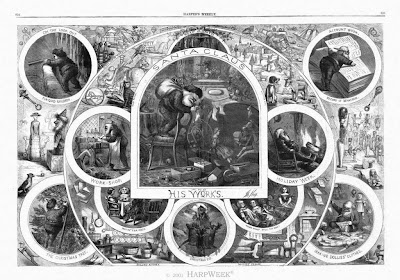
A Visit from Saint Nicholas (now more popularly known as The Night Before Christmas) described the old man’s appearance in detail - and this is what children today will know. His image and 'traditions' are beautifully illustrated in the woodblock print below. Published in 1866 in Harper’s Weekly magazine, it was created by Thomas Nast, and based on personal memories from his own happy childhood in Germany.

Santa and His Works by Thomas Nast


MERRY CHRISTMAS!

Sunday, 18 December 2011

Christmas Cards - Celia Rees


I’m writing this blog in between writing my Christmas cards. This set me thinking about Christmas cards and their use and significance to a novelist.

This was the first commercial Christmas card, commissioned in 1843. It featured a jolly family celebration, snow scenes and Nativities came along much later. The first cards were expensive, 1/- a throw (which was a lot of money in those days), but the introduction of the Penny Post three years earlier meant at least sending them was cheap and Christmas cards were here to stay. It took the introduction of the postcard to make Christmas card sending really popular. Soldiers sent embroidered, patriotic cards from the Front in the First World War. Many families, including mine, kept these carefully preserved in albums, the thick paste board covers ensuring the colours stayed sharp and bright.


In the UK, Christmas cards account for almost half of the volume of greeting card sales, with over 668.9 million Christmas cards sold in the 2008 festive period (or so it says on Wikipedia). Cards are a ubiquitous part of our Christmas preparations, they are also among the most ephemeral, sent and received in a matter of a week or two, displayed for perhaps a fortnight more before being taken down and put into the re-cycling once the Christmas period is over.


Although their presence is fleeting, they carry a record of passing time, the cycles of our lives. As we get older, addresses change, people become lost to us, or names are crossed out of the address book as elderly relatives die. Friendships that were once important, a vital part of our younger lives, are reduced to a few lines in a card, ‘Must write!’, ‘Must keep up!’ although we know that we won’t put pen to paper until another year rolls round. E cards are even more ephemeral, nothing to put up, display, or keep and I always feel rather foolish sitting in front of a computer, watching a tree illuminate itself, or some other Christmas scene unfold. Round Robins are far more interesting, a glimpse into other people’s lives, a record of their year gone by, as well as providing valuable insights into character: what kind of person sends one in the first place? And why would they say that?


Few Christmas cards are kept, but those that are can be hugely evocative and very useful to a novelist. They act as a passport back into our own past lives: the design, the signature, the message inside, take us to a particular time, to friendships forgotten, reminding us of who we were then. They can also provide a way in to the recent past. A single card found in amongst a pile of family papers. There is no personal message inside, just names that you don’t recognize, but the card throws up a whole list of questions, heavy with possibilities. Who kept this card? Why? Who is it from? When was it sent? What does it signify? For a writer, these questions are highly redolent, rich with potential. When there is nobody to ask any more as to the provenance, we are free to make up the answers ourselves. There could be a novel in there, no doubt, but I haven’t got time to think about that now. I’ve got cards to write.